Is The UK Really Planning To Approve “Mini Nuclear Reactor” Rollout?https://cleantechnica.com/2017/09/22/uk-really-planning-approve-mini-nuclear-reactor-rollout/ by James AyreIt was reported last week in The Telegraph that ministers in the UK were “ready” to approve the rapid development and testing of a fleet of “mini nuclear reactors” — to be used as baseload capacity and meant to make up for older soon-to-be-decommissioned nuclear facilities.
Is there any truth to this assertion? What about the assertion that such mini nuclear facilities will provide electricity that’s one-third cheaper than that provide by the nuclear facilities currently in use in the UK?
That sounds a bit “too good to be true” (which means that it probably is), but that is the sales pitch that’s being used.
I haven’t been able to find out too much about what’s going on, as many news outlets haven’t been covering the matter apparently, but it seems that “Rolls-Royce, NuScale, Hitachi, and Westinghouse have held meetings in past weeks with civil servants about Britain’s nuclear strategy and development of ‘small modular reactors’ (SMRs)” in recent days — if The Telegraph is to be believed.
Here’s more from that coverage: “Whitehall sources confirmed that officials from the Department for Business were whittling down proposals from consortia keen to work with government to develop SMRs, with an announcement on the final contenders for funding expected soon.
“The report to be published by Rolls-Royce, entitled ‘UK SMR: A National Endeavour’, which has been seen by The Telegraph, claims SMRs will be able to generate electricity significantly cheaper than conventional nuclear plants.
“The mini reactors are each expected to be able to generate between 200 megawatts and 450 megawatts of power, compared with the 3.2 gigawatts due from Hinkley, meaning more of them will be required to meet the UK’s energy needs.”
The Rolls Royce report claims that its projects would be able to generate electricity at a strike price of £60 per megawatt-hour — a fair bit higher than a number of other electricity generation modalities can offer. Though, I guess that the sales pitch is based on the idea of its use as baseload capacity?
U.S. knows ‘for sure’ it has A-Bomb, foreign minister says
Korea, Japan, China, Russia may suffer if things get violent
North Korea’s possession of nuclear weapons is preventing the U.S. from launching a first strike against the rogue nation, Russian Foreign Minister Sergei Lavrov said in an interview.
“The Americans won’t strike because they know for sure — rather than suspect — that it has atomic bombs,” Lavrov said Sunday on Russia’s NTV television. “I’m not defending North Korea right now, I’m just saying that almost everyone agrees with this analysis.”
Lavrov said the U.S. attacked Iraq “solely because they had 100 percent information that there were no weapons of mass destruction left there,” refuting arguments the American government made at the time.
Tensions between the nations ratcheted up this weekend as President Donald Trump and North Korea Foreign Minister Ri Yong Ho traded threats. On Saturday, U.S. Air Force B-1B bombers flew over international waters east of North Korea.
Lavrov said thousands of innocent people will suffer, in North Korea and in bordering South Korea, Japan and even maybe China and Russia, in the absence of a diplomatic solution.
Turning to another source of tension, Lavrov also added that he can’t rule out that the U.S. plans for Syria go beyond fighting terrorism. The Americans “swear that they have no goal in Syria other than eliminating terrorists,” he said. “When it happens, we’ll see if this was true or the U.S. nonetheless pursues some political goals, which we yet don’t know of.”
Response to ‘Burden of proof: A comprehensive review of the feasibility of 100% renewable-electricity systems’ AUTHORS W. Browna,(a) , T. Bischof-Niemz (b) , K. Blok(c) , C. Breyerc(d) , H. Lund (e) , B.V. Mathiesen (f )(Their university positions are listed at the end of this post) September 2017
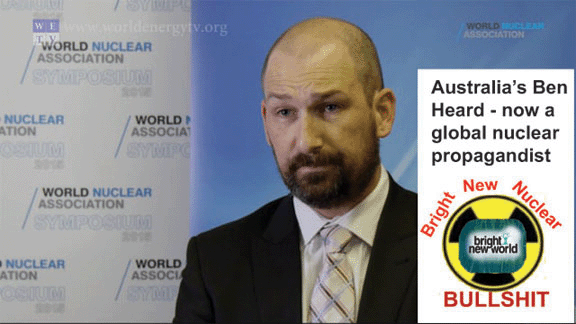
Abstract A recent article ‘Burden of proof: A comprehensive review of the feasibility of 100% renewable-electricity systems’ [by Ben Heard, Barry Brook, Tom Wigley and Corey Bradshaw] claims that many studies of 100% renewable electricity systems do not demonstrate sufficient technical feasibility, according to the authors’ criteria.
Here we analyse the authors’ methodology and find it problematic. The feasibility criteria chosen by the authors are important, but are also easily addressed at low cost, while not affecting the main conclusions of the reviewed studies and certainly not affecting their technical feasibility.
A more thorough review reveals that all of the issues have already been addressed in the engineering and modelling literature. Nuclear power, as advocated by some of the authors, faces other, genuine feasibility problems, such as the finiteness of uranium resources and a reliance on unproven technologies in the medium- to long-term. Energy systems based on renewables, on the other hand, are not only feasible, but already economically viable and getting cheaper every day.
Recent earthquakes near North Korea’s nuclear test site have raised questions as to how far radioactive material would travel if an underground atomic explosion triggers a leak.
A magnitude 3.2 earthquake was detected near the test site on Saturday, according to the Associated Press. The U.S. Geological Service (USGS) registered the quake at a magnitude 3.5.
“The quake is small enough to suspect that it could have been caused by a tunnel collapse, and satellite data shows there have been many landslides in the area since the nuclear test,” Hong Tae-kyung, a professor at the department of Earth System Sciences at Yonsei University, told the AP.
However, Korea’s Meteorological Administration believed the earthquake to be natural.
This string of earthquakes raises questions on how far the wind would carry dangerous radiation if a leak occurs.
Non-tropical systems would be the driving force for where radiation would travel. These systems generally travel in a west to east manner with some fluctuations to the north and south.
“As a weak front passes through North Korea early this week, winds around 4,000 feet (1,219 meters) will begin to pick up from the west to northwest at 20-30 mph,” AccuWeather Senior Meteorologist Alan Reppert said.
Any radiation that would be released into the atmosphere during the second half of the week would push towards northern Japan, possibly towards Hokkaido and far northern Honshu, to the north of Tokyo.
Reppert added “The only major city this would affect is Sapporo, as this would be north of Sendai.”
Any radiation would likely stay fairly close to the ground for the first day or two following a possible leak, before gradually rising higher into the atmosphere.
Beyond the passage through Japan, any possible radiation could travel close to southeastern Russia, the Aleutian Islands or head into the North Pacific Ocean away from any land masses.
This general steering flow will likely persist through the week with slight day-to-day variation.
If a leak occurs, health hazards would not only be limited to those who are outside without the proper protection.
“The big concern is the underground water will be contaminated, polluting the plants and animals, and finally the people who consume animal meat will be seriously impacted,” Wei Shijie, a former worker on nuclear weapons in China, told The Telegraph.
The area where the earthquake struck is not known to experience natural earthquakes. As earth-shaking booms are a natural feature of underground nuclear weapons testing, the quake led to suspicions North Korea had detonated yet another model of nuke — as it did earlier this month, sparking fears it had successfully developed a hydrogen bomb.
“This event occurred in the area of the previous North Korean Nuclear tests,” the United States Geological Survey wrote on its website. “We cannot conclusively confirm at this time the nature (natural or human-made) of the event. The depth is poorly constrained and has been held to 5km by the seismologist.”
According to the Washington Post, China’s state earthquake-monitoring agency initially believed the test to have been an explosion, although South Korean officials told the Associated Press “the analysis of seismic waves and the lack of sound waves clearly showed that the quake wasn’t caused by an artificial explosion.”
Per the AP, the 3.4-magnitude quake would be much smaller than previous nuclear tests, the weakest of which generated a magnitude 4.3 quake and the strongest of which, the test this month, resulted in a magnitude 6.3 quake. One possible explanation is the region is undergoing aftershocks in the wake of the previous nuclear tests.
“It could be a natural earthquake that really was man-made as the nuclear test would have transferred a lot of stress,” Yonsei University in Seoul earth system sciences professor Hong Tae-kyung told CBC. “The quake is small enough to suspect that it could have been caused by a tunnel collapse, and satellite data shows there have been many landslides in the area since the nuclear test.”
Other than the disquieting pace of North Korean nuclear weapons development, one immediate concern from the ongoing tests is seismological data suggesting the test site might be about to cave in.
Researchers at the University of Science and Technology of China in Hefei, Anhui province concluded earlier this month another test at Punggye-ri could cause the overhead mountain to cave in, potentially releasing large amounts of radioactive material which could drift far beyond the region into neighbouring countries including China.
According to South Korean paper Chosun Ilbo, sources said after the September 3rd test, residents in the area were prohibited from travelling to the capital, Pyongyang, due to possible radioactive contamination.
Iraq seeks help with reactor World news briefs, Sept. 23: United Nations, Puerto Rico September 23, 2017
Iraq’s foreign minister is asking nuclear countries for help building an atomic reactor for peaceful purposes, saying the country has a right to use atomic power peacefully. Ibrahim al-Jaafari made the request in his speech Saturday to the U.N. General Assembly’s annual meeting of presidents, prime ministers and monarchs. He called for assistance “to build a nuclear reactor for peaceful purposes in Iraq, to acquire this nuclear technology.” Former Iraqi strongman Saddam Hussein’s previous efforts to build a nuclear reactor were met with an Israeli airstrike in 1981 and years of suspicion about his nuclear intentions. The U.S. cited concerns that Saddam had weapons of mass destruction as the basis for invading Iraq in 2003, but none were ever found. Al-Jaafari cited the Nuclear Nonproliferation Treaty’s provisions allowing countries to pursue peaceful nuclear energy projects. https://www.ohio.com/akron/news/nation/world-news-briefs-sept-23-united-nations-puerto-rico
Oversight panel: Nuclear lab workers violated safety rules
Putting plutonium or other materials too close together could cause a nuclear reaction. Daily Herald, , September 23, 2017 SANTA FE, N.M. — A national laboratory’s workers producing a shell for a triggering device for nuclear weapons violated safety rules in August by storing too much material at one location in a facility for plutonium, a highly radioactive material, a federal oversight panel reported.
The Defense Nuclear Facilities Safety Board memorandum called the Aug. 18 incident at the Los Alamos National Laboratory a “criticality safety event” and said workers there discovered the placement error made by a casting crew three days later when they moved the grapefruit-sized shell again.
The workers at that point failed to follow proper procedures for reporting the Aug. 21 action, the safety board said in a one-page memorandum dated Sept. 1. The report doesn’t specify whether the shell itself contained plutonium.
The Albuquerque Journal and Santa Fe New Mexican reported Saturday on the safety board’s memorandum.
Michael Golay, a professor of nuclear science and engineering at the Massachusetts Institute of Technology who has served on the U.S. Nuclear Regulatory Commission’s research review committee, told the New Mexican there are strict controls on the use of nuclear materials because putting plutonium or other materials too close together could cause a nuclear reaction.
Golay said he could not comment on the specific conditions at Los Alamos……..
Los Alamos — the birthplace of the atomic bomb and still a premier nuclear research facility — is resuming production of the plutonium triggering devices, which are called cores and which haven’t been made since 2011. The Energy Department wants to ramp up production.
KYIV. Sept 11 (Interfax-Ukraine) – Holtec International (the United States) in 2023 will start the active phase of building small module reactors SMR-160, President of Ukrainian National Nuclear Generating Company Yuriy Nedashkovsky said at a ribbon-cutting ceremony for a new plant of the company in New Jersey (the United States).
According to a posting on the website of Energoatom, Nedashkovsky said that earlier President of Holtec International Chris Singh made a proposal to Ukrainian President Petro Poroshenko to create a hub in Ukraine to sell small module reactors to Europe, Asia and Africa with localization of production facilities and the large amount of equipment at Ukrainian enterprises.
Nedashkovsky said that Kharkiv-based Turboatom has turbines suiting SMR-160. There is a chance of attracting other Ukrainian enterprises to the project.
He said that the start of licensing of SMR-160 could start in 2018.
He said that SMR-160 reactors are rather cheap compared to more powerful reactors. They can be installed in small areas and do not require powerful lines. Nedashkovsky said that the need in SMR-160 after 2025 is estimated at $1 trillion.
“These reactors have an increased level of safety due to the fact that they use passive safety systems: that is it has no pumping equipment, reinforcement and other things which require external power supply,” the president of Energoatom said.
The plant, built by Holtec in New Jersey, is mainly focused on two spheres: production of container fleet for spent nuclear fuel, as well as vessels for small modular reactors of the SMR-160 project.
Bridgwater Mercury 21st Sept 2017, CONSTRUCTION workers at Hinkley Point C have overwhelmingly rejected a
renewed pay offer in the long-standing dispute over pay and bonuses on the
project. Industrial action is now likely after 95 per cent of staff
rejected the new deal from EDF which was understood to be about a five per
cent increase on their gross pay. A worker at the power plant site, who did
not want to be named, expects the same proportion of the workforce will
support industrial action. He said: “Considering it is the biggest
project in Europe strike is an absolute catastrophe”. http://www.bridgwatermercury.co.uk/news/15550499.Strike_action_at_Hinkley_Point_C_would_be__absolutely_catastrophic___power_plant_worker_says/
Citizen group prays for fix to Westlake Landfill nuclear waste problem, Sean Franklin , KSDK September 24, 2017, ST. LOUIS – A citizen group that wants to clean up the West Lake Landfill prayed for a solution to what they claim could be a nuclear waste disaster.
For years, ‘Just Moms STL’ has advocated moving the illegally dumped nuclear waste out of the community’s backyard.They say a fire is growing under the buried waste, moving toward where the Environmental Protection Agency knows nuclear waste is sitting.
The landfill is already considered a Superfund Site, so it’s targeted to be cleaned up.
Dawn Chapman is one of the founders of Just Moms STL.
She says prayer and encouragement is what they’re looking for, as she claims the EPA continues to drag its feet on a decision about the landfill.
Chapman says the Landfill near her home worries her.
“At our site, what appears to be a sleeping giant with the radioactive waste sitting there for 44 years,” said Chapman.
No corporate welfare: States shouldn’t bail out nuclear plants, Savannah Now, September 23, 2017
By DAVID WILLIAMS “…..There is no denying that more than half of America’s nuclear power plants face a financial crisis. Collectively, these plants lose nearly $3 billion a year. They simply haven’t been able to compete with power plants that run on cheap natural gas.
In desperation, nuclear operators are begging state legislatures for subsidies to keep their plants running. They’re hoping to lure lawmakers into bailing them out by promising zero-emissions energy production.
State legislators should reject their requests. Nuclear subsidies cost taxpayers and consumers billions of dollars and offer little to no economic or environmental benefits.
Nuclear plants in several states already receive taxpayer-funded subsidies. In July, an Illinois federal judge upheld state legislation that funnels $230 million per year to Chicago-based Exelon to keep its nuclear facilities operating. The same month in New York, a federal judge dismissed a consumer lawsuit against a $480 million annual handout to three nuclear plants.
Subsidy proponents say additional bailouts are needed to prevent plant closures. They claim that if plants go offline, utilities will have to raise electricity rates. They’re wrong.
Nuclear bailouts don’t protect consumers from energy price increases; they facilitate them. Nuclear subsidies are expected to raise New Yorkers’ electric bills by $3.4 billion within the first five years. The Illinois program constitutes the biggest energy rate hike in U.S. history — projected to cost residents and businesses $16.4 billion.
The same goes for other states. Under a proposed subsidy in Ohio, consumers would see their electric bills climb 5 percent per year. Consumers in the mid-Atlantic and the Northeast would have to pay $3.9 billion more per year if nuclear plants in the area received similar backing.
Bailout proponents also raise the specter of job losses. While nuclear facilities do provide local jobs — Exelon employs 5,900 people at its plants in Illinois —subsidy programs just rob Peter to pay Paul. The downsides of propping up an inefficient sector outweigh any economic benefits. An analysis of the Illinois subsidies found they would cost the state 43,000 jobs by 2030 and $14.7 billion in economic output.
Natural gas firms create jobs and grow the economy without picking taxpayers’ pockets. According to the American Petroleum Institute, in Illinois the natural gas industry supported nearly 150,000 jobs and contributed $18 billion to the state economy in 2015. The numbers are higher still for New York, where natural gas is responsible for 152,000 jobs and more than $20 billion in economic output.
Unlike nuclear subsidies that jack up monthly energy bills, natural gas saves consumers billions. And, also according to the aforementioned API report, electricity prices in Ohio have dropped 50 percent since 2008 thanks to affordable natural gas. Last year, thanks to the continued natural gas boom, Americans spent just 4 percent of their household budgets on energy costs — the lowest share ever……http://savannahnow.com/opinion/column/2017-09-23/no-corporate-welfare-states-shouldn-t-bail-out-nuclear-plants
Quiet energy revolution underway in Japan as dozens of towns go off the grid, Japan Times BY AARON SHELDRICK AND OSAMU TSUKIMORI REUTERS, 24 Sept 17, HIGASHIMATSUSHIMA, MIYAGI PREF. – A Miyagi city’s efforts to rebuild its electrical power system after 3/11 mark a quiet shift away from Japan’s old utility model and toward self-reliant, local generation and transmission.
After losing three-quarters of its homes and 1,100 people in the March 2011 Great East Japan Earthquake and tsunami, the city of Higashimatsushima in Miyagi Prefecture turned to the government’s “national resilience program,” with ¥3.72 trillion in funding for this fiscal year, to rebuild.
The city of 40,000 chose to construct microgrids and decentralized renewable power generation to create a self-sustaining system in Tohoku capable of producing an average of 25 percent of its electricity without the need of the region’s power utility.
Oranienburg was reportedly the location of Adolf Hitler’s secret uranium enrichment facility Fiona Keating An amateur treasure hunter in Germany has stumbled upon what could be radioactive material from a secret research facility dating back to World War II.
64-year-old Bernd Thälmann was exploring the ground in Oranienburg, north-east Germany, with his metal detector when it gave an unusual ‘bleep’.
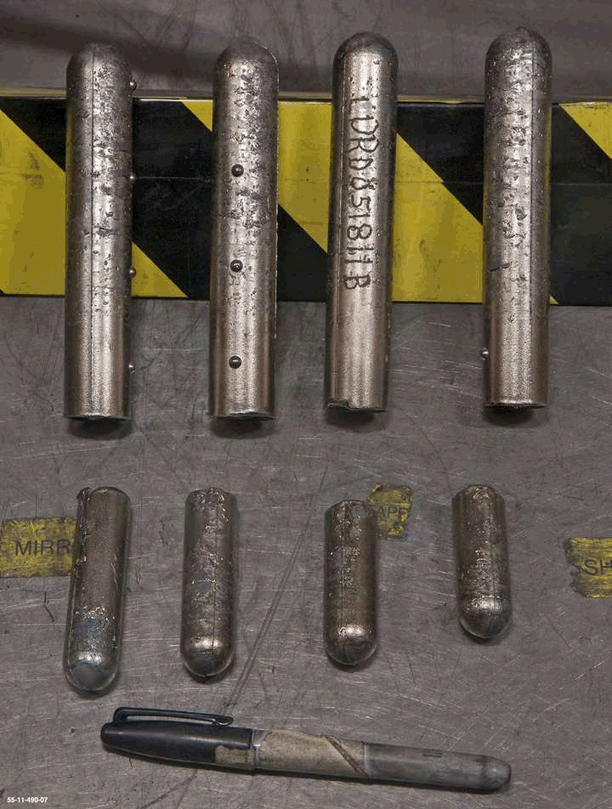
After bringing the mysterious object home, the pensioner alerted the authorities about his discovery of a shiny lump of metal.
Police discovered the find was radioactive, leading to the evacuation of 15 residents from several houses by emergency services. Specialists in hazmat suits searched Mr Thälmann’s home and removed the suspicious object in a lead-lined container which was then placed inside a protective suitcase.
Mr Thälmann is now being investigated for being in possession of “unauthorised radioactive substances”, according to the Berlin Courier.
German authorities have revealed that the area of Oranienburg was the location of Adolf Hitler’s secret uranium enrichment facility.
The research centre was tasked with enriching uranium oxide imported from South America, to make weapons-grade plutonium. The ultimate aim was to create a Nazi atomic bomb.
According to police, Mr Thälmann was intent on retracing his steps to find more hard evidence of the mysterious Nazi-era site. The amateur archaeologist was proving uncooperative, according to authorities.
A police statement revealed that “the finder refuses to provide information on the exact location.” An investigation was launched, with the radioactive find part of a criminal investigation, according to AFP.
Britain and the United States have long possessed information regarding the Nazi’s plans to make atomic bombs.
Nuclear phase-out puts burden on S. Korea’s export drive By Kim Eun-jung SEOUL, Sept. 23 (Yonhap) –– South Korea’s nuclear phase-out policy may create a boom for the renewable energy initiative and allay public safety concerns, but it may also send an unwanted signal to the outside world that could hurt the country’s push to expand into the global atomic power generation market.
Since taking office in May, President Moon Jae-in has scrapped plans for new nuclear power plants and vowed not to extend the life cycles of 24 existing reactors, in a bid to end decades of reliance on the controversial energy source.
The latest move was aimed at addressing safety concerns after the 2011 Fukushima disaster and is in line with actions taken by other advanced economies that are turning to renewable energy sources, including the U.S., France and Germany.
This drastic turn from past administrations’ pro-nuclear policies, however, raises questions over South Korea’s status in the global nuclear market, which has seen spike in competition with the rise of state-backed Russian and Chinese companies in recent years.
Seoul policymakers have pledged continued support for overseas projects separate from its domestic energy policy, but industry insiders worry that less enthusiasm for nuclear power could shrink investment in advanced nuclear technologies and give South Korea less bargaining power on the global stage…….http://english.yonhapnews.co.kr/business/2017/09/22/0503000000AEN20170922008800320.html
BBC 22nd Sept 2017, Labour would consider scrapping the Hinkley Point C nuclear plant, if it
won power. Critics of the deal have warned of escalating costs, including
in the so-called “strike price” – the guaranteed amount that consumers will
pay for the electricity generated. The UK government has guaranteed EDF a
fixed price for the electricity it produces for 35 years.
Asked whether Britain’s new nuclear power station should go ahead, Mr Corbyn said: “You
have to look at the strike price, you have to look at the long term
implications of it. “The government has not yet concluded on that.”
However, asked whether he would pull the plug if Labour came to power after
the station had been built, he said: “If it’s already built and in
operation then of course not.”But I do want to see, I must say, a much
greater diversity of energy generation.” http://www.bbc.co.uk/news/uk-politics-41359590









 nuclear-news