Speedy take up of solar energy headed to outpace nuclear power
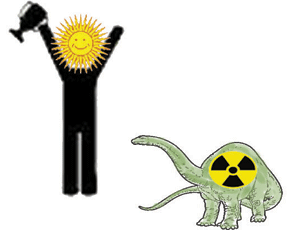 Solar Energy Capacity Could Outpace Nuclear by the End of Year https://www.globalcitizen.org/en/content/solar-power-more-energy-than-nuclear-power/ Solar is still marginal in terms of how much it actually powers. By Joe McCarthy , 10 Sept 17, From giant floating farms to solo rooftop installations, solar power is growing in both scale and potential each year.
China on alert for radiation seeping from North Korea’s latest nuclear test.
 |
Click here to Reply or Forward
|
Mini nuclear weapons to be suggested in Trump administration’s weapons review
A high-level panel created by President Donald Trump to evaluate the nuclear arsenal is reviewing various options for adding a more modern “low-yield” bomb, according to sources involved in the review, to further deter Russia, North Korea or other potential nuclear adversaries.
Approval of such weapons — whether designed to be delivered by missile, aircraft or special forces — would mark a major reversal from the Obama administration, which sought to limit reliance on nuclear arms and prohibited any new weapons or military capabilities. And critics say it would only make the actual use of atomic arms more likely.
The details of what is being considered are classified, and a National Security Council spokeswoman said “it is too early to discuss” the panel’s deliberations, which are expected to wrap up by the end of the year.
But the review — which is led by the Pentagon and supported by the Department of Energy, which maintains the nation’s nuclear warheads — is undertaking a broad reassessment of the nation’s nuclear requirements — including its triad of land-based, sea-based and air-launched weapons…….http://www.politico.com/story/2017/09/09/trump-reviews-mini-nuke-242513
Former defence minister urges discussion Japan hosting nuclear weapons
Times 7th Sept 2017, Japan should discuss hosting nuclear weapons on its territory, a former
defence minister said in a sign that the North Korean threat is changing
the military balance in the region. In what would once have been a shocking
breach of taboo in the only country to have suffered the ravages of atomic
bombs, Shigeru Ishiba said that Japan should debate the abolition of what
are known as the “three non-nuclear principles” — not producing or
possessing nuclear weapons or allowing them on Japanese soil.
https://www.thetimes.co.uk/article/we-should-break-taboo-around-nuclear-weapons-former-japan-minister-says-jpr6sppl2
A picnic in a uranium town that used to be
“Every house. Every tree. Everything was dug up, shredded and buried in a big hole on top of the hill,” Thompson said. Decades and decades of mining left Uravan contaminated with radioactive chemicals and heavy metals. The EPA declared it a superfund site in the 1980s and ordered the mining company, Umetco, to start clearing away the entire town.
You’d never know the empty picnic area was once a community of about 1000 people. Today, you just see the bottom of a crumbling sandstone river valley
she wants to keep having these annual reunion picnics, where the real star of the show is the desert: an actual yellow cake, with yellow frosting and black radioactive signs on top.
Uravan residents may have lost their town, but not their sense of humor.

Uravan: The Uranium Town That Was http://wyomingpublicmedia.org/post/uravan-uranium-town-was, By DAN BOYCE • SEP 8, 2017 Superfund cleanups are a priority for Scott Pruitt, the administrator of the Environmental Protection Agency. He wants to cut through red tape that has left more than a thousand sites still contaminated with everything from radioactive waste to lead.
He also wants to remove sites that have already been cleaned up from the so-called National Priority List, which has more than 1300 sites. One of those sites is the town of Uravan.
After hours in the dark main room of the Rimrocker Historical Society, Jane Thompson showed off what put this part of Western Colorado on the map. She turned on a geiger counter, which began wildly clicking due to the radioactive yellow rock in a nearby antique jar.
Thompson also helps spearhead an annual picnic some 15 minutes up the road, as she did last weekend. She calls it a reunion picnic at the site of her hometown of Uravan.
“The things that happened here were very important,” Thompson said.
A few dozen people gathered under trees and canopies in the otherwise hot empty field on that late August day. Uravan, a tiny mining company town, provided uranium for nuclear weapons developed during the Manhattan Project.
“Even though the town is gone, we feel like that the history of those people need(s) to be kept,” she said.
Uravan — it is gone. Not just the mill where those yellow rocks were processed into so-called yellowcake uranium ore; everything is gone.
“Every house. Every tree. Everything was dug up, shredded and buried in a big hole on top of the hill,” Thompson said. Decades and decades of mining left Uravan contaminated with radioactive chemicals and heavy metals. The EPA declared it a superfund site in the 1980s and ordered the mining company, Umetco, to start clearing away the entire town.
You’d never know the empty picnic area was once a community of about 1000 people. Today, you just see the bottom of a crumbling sandstone river valley. Larry Cooper, 91, sat in a camping chair, wearing suspenders and breathing with the help of an oxygen tank.
“I didn’t know it was dangerous,” he said. “I didn’t know it would hurt ya.”
He worked in the mills and mines around Uravan, starting in the 1950s. His health suffered.
“I got cancer. I lost half of my lung on the right side,” he said.
Registered Nurse Joanna Godwin said it’s very common for former Uravan workers. She attended the picnic with a non-profit called Nuclear Care Partners. They provide free health care through the Department of Labor for medical issues that can be traced back to the mining of radioactive materials.
“We’ve had people with skin cancers. Pulmonary things are very prevalent. It’s a whole array of things,” she said, referring to conditions in former Uravan employees.
After two decades of cleanup, the EPA declared the remediation of Uravan wrapped up in 2008. But, this empty-field-that-used-to-be-a-town was never taken off the list. The agency says it needs further investigation and study before giving it a clean bill of health.
The Colorado Department of Public Health and Environment recently submitted comments to the EPA, saying the agency’s continued work in Uravan is duplicative, costly and causing delay. That seems to be the kind of thing Administrator Pruitt is looking to streamline.
Still, Jane Thompson doesn’t hold out any hope the Uravan site will ever totally be out of the hands of the federal government.
“Well, I think it will remain forever,” she said.
But, she wants to keep having these annual reunion picnics, where the real star of the show is the desert: an actual yellow cake, with yellow frosting and black radioactive signs on top.
Uravan residents may have lost their town, but not their sense of humor.
A-bomb survivors stage sit-in
https://www3.nhk.or.jp/nhkworld/en/news/20170910_02/ People in the Japanese city of Nagasaki have staged a sit-in to voice their opposition to the use of nuclear weapons. This comes amid growing concerns over North Korea’s military provocations.
The protest was held on Saturday as North Korea marked the 69th anniversary of the country’s founding.
Nagasaki suffered an atomic bombing toward the end of World War Two. The attack occurred on August 9th, 1945. A group of survivors and others hold an event to remember the bombing on the 9th of every month at the city’s Nagasaki Peace Park.
About 80 people, including survivors of the atomic bombing and high school students, took part in Saturday’s protest.
Koichi Kawano, who heads a group of survivors, says he wants to urge the Japanese government to do more to discourage Pyongyang from conducting nuclear tests.
Another participant, Sachiho Mizoguchi, is one of the high school students who ask people to sign a petition calling for the abolition of nuclear weapons. She said she took part in the sit-in to protest against the North’s nuclear tests.
Eiji Okumura, a survivor of the atomic bombing, says North Korea conducted a nuclear test after the United Nations took a step toward the creation of a nuclear-free world by adopting a treaty that banned nuclear weapons. Okamura said he cannot tolerate the North’s latest nuclear test, and he wants to express his anger through the sit-in.
Plutonium scattered over New Mexico – the shameful history of the July 16, 1945, atomic bomb test
 The God-awful mess made in New Mexico, nm politics, 10 Sept 17, “What the diary does not reveal… is the appalling fact that from late 1945 until 1952 Japanese medical researchers were prohibited by U. S. Occupation Authorities from publishing scientific articles on the effects of the atomic bombs.” – John W. Dower
COMMENTARY: It wasn’t the effects of the atomic bombs on Japan that prohibited Japanese medical researchers from publishing on the effects of the atomic bombs. Rather, it was how that information would be seen in New Mexico, which never suspected a lurking killer.
Three weeks before the atomic bombs were dropped on Japan, a concept test was made at New Mexico’s Trinity Site. This was an atomic device equal to what was used on Japan.
There’s no doubt that in Japan people were sickened by the resultant radiation. But there wasn’t that realization in New Mexico, even to this day. In fact, there’s resistance to that notion.
Robert Oppenheimer was the head of the Los Alamos Laboratory that developed the first nuclear weapons. The “Manhattan Project” initially produced three nuclear devices.
The first, a plutonium implosion device, was detonated July 16, 1945 at New Mexico’s Trinity Site. Oppenheimer remarked the explosion brought to mind the words of the Bhagavad Gita: “Now I am become Death, the destroyer of worlds.” I certainly understand that thought.
That plutonium scattered over New Mexico……..One positive for Japan: The scientists saw how the New Mexico ground blast spread so much contamination, and they exploded the next two nuclear bombs at 2,000 feet to get the blunt force trauma on the site but not contaminate it as had happened in New Mexico.
The military sent lots of scientists to Hiroshima and Nagasaki to monitor the radiation but seem to have not done so in New Mexico. Or, perhaps they did and the government authorities realized what a mess they made in New Mexico. Worse, they didn’t want the role of cleaning up this God-awful mess. Curious, eh?
As the decades have passed and the New Mexicans who were sickened by the plutonium passed, the interest in this story has gone from very little to none at all, except among those people effected.
I don’t believe there’s a risk now, but government is supposed to protect the citizens. Our government hasn’t even said they are sorry for the God-awful mess they made and all of the people they sickened. http://nmpolitics.net/index/2017/09/the-god-awful-mess-made-in-new-mexico/
Wilder and more frequent wildfires – the new normal
Welcome to the New World of Wildfires, http://www.truth-out.org/news/item/41887-welcome-to-the-new-world-of-wildfires, September 09, 2017, By Dahr Jamail, Truthout | Report When one envisions the US Pacific Northwest, one thinks of green ferns, moss-covered trees in Olympic National Park, or the Hoh Rainforest, where annual rainfall is measured in the hundreds of inches. Moisture, greenery, evergreens, abundant rivers. It’s a large part of the reason why I live here.
But thanks to abrupt anthropogenic climate disruption (ACD), this region is shifting at a rapid pace. On the Olympic Peninsula where I live, this has been the summer of wildfire smoke.
As I write this, Puget Sound, Seattle and the Olympic Peninsula, are all engulfed by thick wildfire smoke and ash from fires burning in Eastern Washington and Montana. A local Seattle weatherman remarked that he had “never seen a situation like this.”
Washington Gov. Jay Inslee declared a state of emergency for his entire state on Saturday September 2.
Smoke from various wildfires has been a near-constant in this part of the country for the past month. Roughly a week ago, we were enshrouded by smoke from multiple wildfires across Oregon, and before that, we spent nearly two weeks breathing in thick smoke from the over 1,000 wildfires that scorched British Columbia up the coast from us.
Stepping outside, the world appears a surreal yellow. The sun varies from not being visible, to emerging as a yellowish orange bulb even during the middle of the day. When it sets, it has often appeared blood red through the thick smoke.
NASA satellite photos show the smoke plume even reaching the East Coast.
Given past and recent scientific reports, this is apparently the world we, and much of the rest of the United States, had better prepare to live in from now on.
Extreme Heat, Extreme Drought
The smoke plume from all of these fires, at the time of this writing, extends from up into British Columbia all the way down into central Oregon.
A wildfire outside Portland has forced hundreds of residents to evacuate while it burned out of control in the Columbia River Gorge. That is just one of 81 wildfires burning across the US at the time of this writing, with 20 of those fires in Oregon alone.
Climate researchers have been warning us for a long time that increasing temperatures and more intense droughts will logically cause dramatic escalations in the number, heat and ferocity of wildfires.
A study published earlier this year showed that human-caused greenhouse gas emissions have increased the likelihood of extreme heat events across more than 80 percent of the planet.
Last fall, researchers published the results of a study that showed ACD accounted for approximately half of the increase in wildfire fuel aridity (forest dryness) in the Western US since just 1979, causing the area of the US West affected by forest fires to double in size since 1984.
According to Inside Climate News: “Nine of the 10 worst fire seasons in the past 50 years have all happened since 2000, and 2015 was the worst fire season in U.S. history, surpassing 10 million acres for the first time on record. So far this year, wildfires in the US have burned 7.8 million acres, but the fire season is far from over. The average fire season is 78 days longer than it was in the 1970s and now lasts nearly seven months — beginning and extending beyond the typical heat of summer. By April of this year, wildfires had scorched more than 2 million acres in the US — nearly the average consumed in an entire fire season during the 1980s.
Extreme Heat
When it comes to hot weather — and relatedly, fire — this has been a summer for the record books in the West. During the first week of September, San Francisco saw a stunning record high temperature of 106°F, amid a heatwave that saw 36.5 million Californians (98 percent of the state population) living under a heat advisory issued by the National Weather Service.
Earlier this month, Los Angeles saw its largest wildfire on record scorch 7,000 acres before rains from a remnant tropical storm helped firefighters get the upper hand.
Yale Environment 360 warned of this likelihood last December. The magazine, published by the Yale School of Forestry & Environmental Studies, reported that as the Arctic continues to warm twice as fast as the rest of the globe, winds in the upper atmosphere would be pulled into the polar zone and cause the jet stream to become wavier during extreme weather patterns. This is a more technical explanation for the fact that, as another study warned in March, these new weather patterns will generate record heatwaves and wildfires — precisely what we are seeing now across the West.
And given that there are no serious, large-scale ACD mitigation efforts happening, least of all within the United States, we can count on these trends to amplify and worsen with time.
Tackling deforestation should be higher on the climate change agenda.
Deforestation Has Double the Effect on Global Warming Than Previously Thought http://readersupportednews.org/news-section2/318-66/45666-deforestation-has-double-the-effect-on-global-warming-than-previously-thought, By Aristos Georgiou, International Business Times 08 September 17 Tackling deforestation should be higher on the climate change agenda.
 n the fight against climate change, much of the focus rests on reducing our dependence on fossil fuels and developing alternative energy sources. However, the results of a new study suggest that far more attention should be paid to deforestation and how the land is used subsequently – the effects of which make a bigger contribution to climate change than previously thought.
The research, conducted by Cornell University and published in the journal Environmental Research Letters,shows just how much this impact has been underestimated. Even if all fossil fuel emissions are eradicated, if current rates of deforestation in the tropics continue through to 2100 then there will still be a 1.5 degree Celsius increase in global temperature.
Most scientists believe that a temperature increase of 1.5 degrees above pre-industrial levels will bring dangerous disruption to the world’s climate. Indeed, many already think this target may be unattainable.
“A lot of the emphasis of climate policy is on converting to sustainable energy from fossil fuels”, said Natalie M. Mahowald, the paper’s lead author. “It’s an incredibly important step to take, but, ironically, particulates released from the burning of fossil fuels – which are severely detrimental to human health – have a cooling effect on the climate. Removing those particulates actually makes it harder to reach the lower temperatures laid out in the Paris agreement.”
Mahowald argues that in addition to reducing reliance on fossil fuels, scientists and policymakers must pay more attention to deforestation and the subsequent changes in land use for agricultural and other human industry. The negative consequences of this process are manifold.
When deforestation occurs, the burning of trees and plants releases carbon dioxide – a greenhouse gas – into the atmosphere. The problem is compounded when the land is then converted to farming or other human usage, releasing large amounts of other greenhouse gases like methane and nitrous oxide. Furthermore, the deforested area can no longer function as a carbon sink – trees and plants absorb carbon dioxide from the atmosphere.
The research showed this process has double the overall warming contribution than previously thought making it “twice as important” in Mahowald’s eyes.
“Normally people only think about what’s happening right now when they think about the carbon budget,” Mahowald said. “But if you think about what’s going to happen over the lifetime of that land, long into the future, you should multiply that land conversion by two to understand the net effect of it.”
As agriculture expands in the tropics and pressure to turn rainforest into cropland increases, Mahowald advocates looking further forward in time to truly assess the impact that these practices have on the climate.
As hurricanes rage, USA’s Republicans in Congress Work to Gut Environmental Protections
With a comfortable majority in the House and Trump appointees at the helm of agencies like the Environmental Protection Agency (EPA), House Republicans have been eagerly working to gut environmental regulations and spending on interior programs. As Hurricane Harvey and Irma devastate coastal communities and wildfires rage across the West, these lawmakers are looking increasingly out of touch.
“We have climate change-fueled disasters happening across the country: two major hurricanes … and then, in the West, people are choking on soot from wildfires,” said Anna Aurilio, DC office director of Environment America, in an interview. “And instead of taking action to cut climate pollution — shift us toward clean energy and make our coasts and cities more resilient — the House of Representatives is working on legislation to take us in exactly the opposite direction.”
On Wednesday, a Republican-led House subcommittee held a hearing on the EPA’s Integrated Risk Information System, which conducts health assessments of chemicals and determines what levels of exposure are considered “safe” in air, water, food and soil.
The program’s findings are often used to justify regulatory restrictions that the chemical industry does not like, according to the Natural Resources Defense Council.
Dr. Thomas Burke, a former Houston resident and director of the Risk Science and Public Policy Institute at the John Hopkins Bloomberg School of Public Health, told the committee that the “capacity to evaluate the hazards of toxic chemicals is essential to protecting our public health.”
“This hearing is particularly timely, as Texas and Louisiana work to protect public health, restore safe drinking water and evaluate risks from contaminated floodwaters and chemical releases,” Burke said in his written testimony.
However, two experts with ties to the chemical industry criticized the program, and the committee’s chairman, Rep. Andy Briggs (R-Arizona), offered an amendment to a major appropriations bill for funding the EPA and Interior Department that would eliminate all funding for the Integrated Risk Information System.
The House’s $31 billion interior spending bill would slash the EPA’s budget by $528 million, a considerable cut but not as deep the more than $2 billion in cuts proposed by the White House and ultra-conservative lawmakers, according to reports.
The bill contains a number of riders that infuriate environmentalists, including measures that would block Obama-era standards designed to reduce smog, make oil and gas drilling in the Arctic safer, restrict the amount of climate-warming methane that oil and gas drillers can spew in the atmosphere, and require government agencies to consider the economic and social costs of carbon pollution when writing regulations.
Democrats offered their own amendments to the spending bill, including riders that would prevent the Trump administration from closing regional EPA offices and selling off public lands to private companies.
“There is a threat,” said Rep. Jared Polis (D-Colorado) during floor debate on Friday. “There are members of this body, and there are members of the president’s administration that are seeking to sell off our public lands.”
However, Republicans hold a powerful majority in the House, so amendments that environmentalists support may not survive ongoing budget negotiations. On Thursday, lawmakers voted down a bipartisan rider introduced by lawmakers in New Jersey and Virginia that would have prohibited federal funding for controversial seismic tests needed to initiate offshore oil drilling in the Atlantic Ocean, despite widespread opposition to offshore drilling on the East Coast.
Nuclear power not a viable option for our energy future
Why Nuclear Energy May Not Be Our Best Alternative Option To Fossil Fuel, Forbes, 9 Sept 17 , Michael Barnard, low-carbon innovation analyst, on Quora: “…..Nuclear ….environmentalists aren’t nuclear power’s problem.
Its first problem is that it keeps getting more expensive while alternatives keep getting cheaper. It was in global decline in terms of absolute and relative generation since 2005, with a small uptick last year due to China’s deployment. That’s because it’s expensive compared to alternatives. Until recently it was fiscally challenged by natural gas generation. A handful of years ago it stopped being competitive with onshore wind. Now it’s not cost competitive with utility scale solar. Depending on the forecast, it’s either not competitive with offshore wind today or in the next two years.
Efforts to make nuclear cheaper, like CCS, have failed. The Toshiba Westinghouse AP1000 was supposed to be a standard, easy to build, cheaper option. It’s turned out to be incredibly expensive in reality and Toshiba Westinghouse has entered bankruptcy. A recent US report on next generation fission technologies found that roughly $2 billion had been spent with no progress. Fusion’s best hope is the ITER Tokamak which is expected to go live in prototype with no generation in 2040, meaning that if it works, some commercializable technology might be contributing by 2070.
The second problem is that nuclear is an inflexible form of generation. Some of that is the technology, but regardless of that, the business case requires about 90% capacity factor for nuclear in order to make money due to the extraordinary capital cost of the technology. That’s just the reality. And inflexible generation doesn’t work with intermittent renewables. If you can’t scale the various technologies up and down cost effectively, then there’s a problem. Ontario has been a bellwether in this regard with its surplus baseload generation problems of the past few years. While people tried to blame this on wind energy, what’s really happening is that the nuclear fleet is too big and can’t be turned off, so Ontario has been paying neighbouring jurisdictions to take the excess electricity. California built a lot of pumped storage to give nuclear something to do at night. France built expensive follow-the-load nuclear which basically wastes all of the generated heat without generating electricity. As France’s new President Macron has said, he used to run that ministry and even he doesn’t know how much they spent on nuclear or how much it costs.
The third problem is that nuclear is a geographically limited solution to a global problem. There are only 30 countries with nuclear today and we mostly don’t want to expand that number for reasonable geopolitical concerns related to radioactive material supply chain security, nuclear waste security and expansion of uranium enrichment technologies which happen in many cases to be useful directly for creating nuclear weapon’s grade uranium or masking the purchase of that enrichment technology. Dirty bombs anyone? A new nuclear bomb owning dictator anyone?……
Nuclear power is a 1970’s solution and hasn’t aged well. It hasn’t become cheaper, more flexible or more ubiquitous and it won’t. It’s failing in the marketplace, not due to environmentalists. …… Should we pay much attention to expanding nuclear? No. Why bother wasting breath on something that doesn’t have a business case…….
Renewables are the answer because they are massively scalable, cheap and solving the problems of renewables is easier than solving the problems of nuclear that is down the road.
The big kerfuffle recently about whether we can get to 100% renewables by 2050 or not was very interesting for one reason. Everyone involved agreed we could easily get to 80%. The question was how hard the last 20% would be.
But getting to 80% globally is a huge advance and is much cheaper to achieve than trying to ride the dead horses of nuclear and carbon capture on fossil fuels. We have to find ways to take carbon out of the atmosphere, likely soil carbon capture with global transformation of agricultural approaches, but it can’t be considered a successful part of the solution to get our emissions to zero. https://www.forbes.com/sites/quora/2017/09/09/why-nuclear-energy-may-not-be-our-best-alternative-option-to-fossil-fuel/#25ec6e8375d0
Carbon capture doesn’t make sense economically or practically
 Why Nuclear Energy May Not Be Our Best Alternative Option To Fossil Fuel, Forbes, 9 Sept 17 , Michael Barnard, low-carbon innovation analyst, on Quora: “… From a carbon capture and sequestration perspective, there’s exactly one sequestration project associated with a coal generation plant which is actually sequestering any reasonable amount of carbon. It’s in Saskatchewan, Canada. It was operating at 40% of targets for months and nobody noticed. It’s very expensive.
I did an assessment of all sequestration efforts in Australia over the past 19 years recently and found that they had spent $4,300 AUD per ton to sequester a vanishingly tiny fraction of Australia’s emissions.
The US CCS projects have gone vastly over forecasts and are abandoned and no new ones are projected. The UK government has stopped funding them………
Are environmentalists saying that CCS doesn’t make sense? Yes, because 20 years of work has shown that CCS related to fossil fuel generation has failed to progress, deliver to milestones or show that it is capable of providing any useful contribution. It’s just not economically or practically possible. …….https://www.forbes.com/sites/quora/2017/09/09/why-nuclear-energy-may-not-be-our-best-alternative-option-to-fossil-fuel/#25ec6e8375d0
Climate change denial – just like denying the cigarette- lung cancer link
Hurricanes Blow Away Climate Change Denial, Consortium News The startling landfall of two giant hurricanes – feasting on especially warm water off Texas and Florida – crashes into the climate change denialism that has been politically popular on the Right, notes ex-CIA analyst Paul R. Pillar.
The loss of respect for truth is one of the most consequential features of public affairs in American today. The roots and causes of this tragic development are multiple. The spread of social media and the related ability to spread untruths cheaply at the speed of electrons are parts of the story. Another part is the phenomenon of fake news (real fake news, that is, not alleged fake news that is really real news that the alleger doesn’t welcome).
The advent of Donald Trump’s presidency has taken this sad story to new depths. The President lies copiously, flagrantly, unashamedly, and far beyond what had been the norm for political fibbing. He has shown how a political career, rising even to the highest office of the land, can be built on lying.
Correctives to this awful trend are difficult to identify. The tribal belief system that prevails in most of the American population, in which people chiefly listen to and believe sources they identify with politically or socially and had already been telling them what they want to hear, is so well entrenched it seems almost impossible to overcome. Many people reject factual corrections as a form of bias and unfair treatment by sources (such as the “left-wing media”) with which they do not identify politically or socially…….
the United States getting hit with two major hurricanes in rapid succession provides a teaching opportunity regarding the critical issue of climate change…
Like Smoking and Cancer
Christine Todd Whitman, a Republican who ran the Environmental Protection Agency under George W. Bush, notes not only that the basic physical links involving global warming, greenhouse gases, and burning of fossil fuels are “as certain as the link between smoking and cancer.” She further observes that ”a broad consensus of scientists also warn of the influence of the warming climate on extreme weather events.”
The overall connections, in other words, in terms of cause, effect, and degree of risk are unquestionable, even if no one case of lung cancer can be blamed on any one pack of cigarettes……..
Without diminishing any immediate sympathy and support for those whose lives the hurricanes have upended, this is the time to shout from rooftops that dishonest climate-change-denying politicians are causing more such suffering in the future for Americans as well as others. And when Trump’s EPA destroyer (a.k.a. administrator) Scott Pruitt says that now is not the time to talk about climate change, the proper response is that now is an excellent time to talk about it.
Paul R. Pillar, in his 28 years at the Central Intelligence Agency, rose to be one of the agency’s top analysts. He is author most recently of Why America Misunderstands the World. (This article first appeared as a blog post at The National Interest’s Web site. https://consortiumnews.com/2017/09/10/hurricanes-blow-away-climate-change-denial/
Future global energy demand – report from Energy Transition Outlook
Energy Post 5th Sept 2017, Global energy demand will plateau from 2030, oil demand will flatten from
2020 to 2028 and go to a significant decline thereafter, the shift to
renewable energy will be quicker and more massive than most people realize,
yet the energy transition will not be difficult to finance.
These are some of the momentous conclusions of a set of major new reports from independent
energy consultancy DNV GL, under the name Energy Transition Outlook (ETO).
They are based on an independent model and output from hundreds of the
company’s experts who work in all sectors of the energy industry.
Energy Post spoke with project leader Sverre Alvik and lead author of the
renewable energy section of the report, Paul Gardner. They agree:
“changes are coming so fast they will surprise many people.” Alvik says
“we have a more optimistic view on the continued cost reduction potential
of solar and wind power and on improvements in energy intensity than many
of the reference scenarios used in the industry.” Alvik notes that “the
growing electrification in combination with the growth of renewables will
make the energy system more energy efficient, leading to important energy
savings.”
“It is possible to build a secure system with a very high
level of renewable energy”, says Gardner. “But in our projections we
don’t quite get to 100%. We see quite a bit of ‘peaking’ gas
generation to go with renewables by 2050. We have a lot of wind, a lot of
solar and a lot of gas plant that spends a lot of time doing nothing. Even
when we include the backup costs for the gas-fired power, this still looks
attractive.”
Gardner does add there is one thing that the model does not
yet take into account, namely the effect that temporary surpluses of wind
and solar power will have on the economics of renewables. “We have not
yet shown what the impact is of that.” However, he says, “we will also
need to decarbonize heat, so it makes sense to store the surplus renewable
energy, for example to heat water with it or to convert it into gas, to be
used for heating. It is not yet clear what the most economic route will
be.”
Shamisen project gives 28 recommendations for nuclear safety
 The European Commission-funded Shamisen project has published 28
recommendations to improve preparedness for and response to a nuclear
accident. The recommendations follow an 18-month review of the response to
previous accidents, particularly Chernobyl and Fukushima-Daiichi.
New recommendations include how to improve professional training, establish
disease registries and evacuation protocols. The recommendations say
reliable information about an accident and associated risks should be given
and radiation dose data collected. Following an accident, dialogue needs to
be established between experts and affected communities.
There needs to be support for populations that want to take their own dose measurements so
they can decide what food to eat and when to return to their homes.
Recommendations also include providing voluntary health screening and
adequate counselling. The Shamisen project, coordinated by the Barcelona
Institute for Global Health, or ISGlobal, brought together 19 European and
Japanese organisations, as well as US, Belarusian, Russian and Ukrainian
experts. It is funded by the EC’s Euratom programme.
The project began in December 2015 with the objective of producing a set of recommendations that
would contribute to health surveillance and related communication with
affected populations after nuclear accidents. Existing recommendations,
ISGlobal said, had a technical focus, with less attention paid to social,
ethical and psychological issues.
http://www.nucnet.org/all-the-news/2017/09/08/ec-shamisen-project-publishes-28-recommendations-on-nuclear-accident-preparedness
1 This Month

of the week – Shut Down Drone Warfare!



Tell the Ukrainian Government to Drop Prosecution of Peace Activist Yurii Sheliazhenko

Petition to revoke the licensing of the Near Surface Nuclear Disposal Facility (NSDF) at Chalk River. https://www.ourcommons.ca/petitions/en/Petition/Details?Petition=e-7247

of the week – STOP SMALL MODULAR REACTORS IN CANADA
To see nuclear-related stories in greater depth and intensity – go to https://nuclearinformation.wordpress.com
-
Archives
- March 2026 (222)
- February 2026 (268)
- January 2026 (308)
- December 2025 (358)
- November 2025 (359)
- October 2025 (376)
- September 2025 (258)
- August 2025 (319)
- July 2025 (230)
- June 2025 (348)
- May 2025 (261)
- April 2025 (305)
-
Categories
- 1
- 1 NUCLEAR ISSUES
- business and costs
- climate change
- culture and arts
- ENERGY
- environment
- health
- history
- indigenous issues
- Legal
- marketing of nuclear
- media
- opposition to nuclear
- PERSONAL STORIES
- politics
- politics international
- Religion and ethics
- safety
- secrets,lies and civil liberties
- spinbuster
- technology
- Uranium
- wastes
- weapons and war
- Women
- 2 WORLD
- ACTION
- AFRICA
- Atrocities
- AUSTRALIA
- Christina's notes
- Christina's themes
- culture and arts
- Events
- Fuk 2022
- Fuk 2023
- Fukushima 2017
- Fukushima 2018
- fukushima 2019
- Fukushima 2020
- Fukushima 2021
- general
- global warming
- Humour (God we need it)
- Nuclear
- RARE EARTHS
- Reference
- resources – print
- Resources -audiovicual
- Weekly Newsletter
- World
- World Nuclear
- YouTube
-
RSS
Entries RSS
Comments RSS
 nuclear-news