 Netflix is now streaming a film about nuclear weapons that puts you inside humanity’s worst nightmare, Business Insider,DAVE MOSHER, AUG 2, 2017,
- Netflix is now streaming an experimental documentary film about nuclear weapons.
- “The Bomb” debuted in April 2016 at the Tribeca Film Festival as an immersive experience with 30-foot-tall screens and live music.
- The filmmakers hope their movie inspires viewers to speak up about the existential threat of nuclear weapons.
The year before I was born, the world almost ended. Twice.
In September 1983, sunlight reflected off a patch of clouds, fooling a Soviet missile-warning system into detecting five US intercontinental ballistic missiles that were never launched. A colonel in a bunker ignored the alarm on a 50/50 hunch, narrowly averting a nuclear holocaust.
Two months later, US forces staged “Able Archer 83” — a massive nuclear-strike drill on the doorstep of the USSR. Soviet commanders panicked at the show of force and nearly bathed America in thermonuclear energy. Once again, an act of human doubt saved the planet.
Today these and other chilling tales seem like dusty history to the population born after the Cold War and those too young to remember the conflict’s many close calls.
But the grave nuclear threat persists. Ageing weapons systems, evolving terrorist threats, and a worryingly hackable digital infrastructure make the danger perhaps even greater today. That’s the message that the makers of “The Bomb” — an ambitious, experimental documentary that Netflix began streaming on August 1 — have tried to make breathtakingly real.
“Nine countries have 15,000 nuclear weapons. That’s an existential threat to mankind,” said filmmaker Eric Schlosser. Schlosser is the author of “Command and Control,” an investigation into nuclear weapons accidents that was a finalist for the Pulitzer Prize. To write the book, he spent more than six years steeped in declassified government materials and interviewed military experts, scientists, and “broken arrow” eyewitnesses.
“The Bomb” is an unnarrated, non-linear film that riffs on the major themes in Schlosser’s book. It leans heavily on archival nuclear weapons footage, roughly a third of which the public had never seen before the movie came out. Cold War-era documents and blueprints are also brought to life with eye-catching animations, and everything is synced to a trippy electro-rock musical score by The Acid.
Co-directors Smriti Keshari, Kevin Ford, and Schlosser told Business Insider in April 2016 that their ultimate goal is to get people to feel something they will never forget — and then do something about it.
Not your father’s nuclear weapons documentary
When “The Bomb” premiered at the Tribeca Film Festival, it was formatted as an immersive, 360-degree experience. The film now playing on Netflix is a “flat” version edited for a high-definition screen.
The original version continues to travel the world, however — it was recently shown in Berlin and Glasgow — and projects the footage onto eight huge screens while “The Acid” jams out a live score.
Keshari, Ford, and Schlosser said this experience is what makes “The Bomb” unique. “Being surrounded by 30-foot-high screens upon which nuclear explosions are being projected, while really loud music plays,” Schlosser said, “I think that’s going to be a memorable life experience for anyone who sees it.”
Keshari likened it to a form of “shock treatment,” meant to help people feel something about nuclear weapons instead of dismissing their existence.
“These weapons are literally buried underground. They’re out of sight, out of consciousness,” Keshari said. “It’s shocking how many we have, the countries that have them, how powerful these are, how much money is spent on them. And yet we’re in complete denial of it.”
They have a point.
The so-called Millennial generation has never experienced the dread of imminent thermonuclear war. For me, the existential threat of nuclear weapons didn’t really click until a few years ago, when I wrote a story about a byproduct of the nuclear arms race.
My fears, not to mention those of preeminent experts, have grown since reading about the January 2016 rhetoric of President Donald Trump, along with North Korea’s maturing intercontinental ballistic missile and nuclear weapons testing programs../…….
Today’s nuclear arsenals are packed with a variety of exceptionally deadly weapons.
Enhanced warheads, for example, are dozens of times more powerful than the relatively crude bombs that destroyed Hiroshima and Nagasaki. Fusion bombs are also on alert and ready to launch, and they are thousands of times more powerful than any nuclear weapons detonated during World War II.
The US and Russia together harbour roughly 90% of the world’s supply of more than 14,900 nuclear weapons, and they’re maintained under tight systems of control. The US is also spending $US1 trillion to upgrade its devices. Nuclear terrorism continues to be a major point of concern, too.
But the central thesis of “The Bomb” — one Schlosser made strongly in “Command and Control” as well — is that mortifying accidents have happened and will happen again, because people are human, and nuclear weapons aren’t foolproof…….
e filmmakers don’t want the film to simply bum people out.
“There’s no point in that. For me, this sort of knowledge should be empowering. Because to live in denial is a much greater danger than to have your eyes open and have the ability to do something about it,” Schlosser said. “It helps you enjoy the day. It puts a lot of bulls**t worries into perspective and helps you not take anything or anyone for granted.”
Text at end of the film drives home this sentiment with a call to action.
“A nuclear war anywhere in the world would affect everyone in the world. These weapons pose an existential threat. The widespread lack of knowledge about them, the lack of public debate about them, makes the danger even worse,” it reads. “Our silence is a form of consent.”https://www.businessinsider.com.au/netflix-the-bomb-nuclear-weapons-film-2017-8?r=US&IR=T
August 2, 2017
Posted by Christina Macpherson |
Resources -audiovicual |
Leave a comment
This paper highlights that climate change will increase human mortality through changes in air pollution. These health impacts add to others that climate change will also cause, including from heat stress, severe storms and the spread of infectious diseases. By impacting air quality, climate change will likely offset the benefits of other measures to improve air quality.
 Climate change set to increase air pollution deaths by hundreds of thousands by 2100The Conversation, Guang Zeng,Atmospheric Scientist, National Institute of Water and Atmospheric Research, Jason West Associate Professor, Department of Environmental Sciences and Engineering , University of North Carolina – Chapel Hill August 1, 2017 Climate change is set to increase the amount of ground-level ozone and fine particle pollution we breathe, which leads to lung disease, heart conditions, and stroke. Less rain and more heat means this pollution will stay in the air for longer, creating more health problems.
Our research, published in Nature Climate Change, found that if climate change continues unabated, it will cause about 60,000 extra deaths globally each year by 2030, and 260,000 deaths annually by 2100, as a result of the impact of these changes on pollution.
This is the most comprehensive study to date on the effects of climate change on global air quality and health. Researchers from the United States, the United Kingdom, France, Japan and New Zealand between them used nine different global chemistry-climate models.
Most models showed an increase in likely deaths – the clearest signal yet of the harm climate change will do to air quality and human health, adding to the millions of people who die from air pollution every year.
Stagnant air
Climate change fundamentally alters the air currents that move pollution across continents and between the lower and higher layers of the atmosphere. This means that where air becomes more stagnant in a future climate, pollution stays near the ground in higher concentrations.
Ground-level ozone is created when chemical pollution (such as emissions from cars or manufacturing plants) reacts in the presence of sunlight. As climate change makes an area warmer and drier, it will produce more ozone.
Fine particles are a mixture of small solids and liquid droplets suspended in air. Examples include black carbon, organic carbon, soot, smoke and dust. These fine particles, which are known to cause lung diseases, are emitted from industry, transport and residential sources. Less rain means that fine particles stay in the air for longer.
While fine particles and ozone both occur naturally, human activity has increased them substantially………
Our models show that premature deaths increase in all regions due to climate change, except in Africa, and are greatest in India and East Asia.
Using multiple models makes the results more robust than using a single model. There is some spread of results amongst the nine models used here, with a few models estimating that climate change may decrease air pollution-related deaths. This highlights that results from any study using a single model should be interpreted with caution.
Australia and New Zealand are both relatively unpolluted compared with countries in the Northern Hemisphere. Therefore, both ozone and fine particle pollution currently cause relatively few deaths in both countries. However, we found that under climate change the risk will likely increase.
This paper highlights that climate change will increase human mortality through changes in air pollution. These health impacts add to others that climate change will also cause, including from heat stress, severe storms and the spread of infectious diseases. By impacting air quality, climate change will likely offset the benefits of other measures to improve air quality. https://theconversation.com/climate-change-set-to-increase-air-pollution-deaths-by-hundreds-of-thousands-by-2100-81830
August 2, 2017
Posted by Christina Macpherson |
2 WORLD, climate change, health |
Leave a comment
Dear Royal Institute of British Architects and Landscape Institute,
 Nuclear Beautifying Competitions –Endorsing the Safety of New Nuclear Reactors?
Amber Rudd the (then) Energy Secretary made statements in 2015 that new nuclear power stations must be designed to look beautiful in order to garner essential public support.
The RIBA and LI agreed to lend kudos and prestige to this unethical PR project by running competitions for the architecture and for the earth mounds (resulting from deep excavation for the foundations).
I would like to ask if you are endorsing the safety of the Moorside plan? If not will you please make a public statement clarifying that the design competition does not in anyway endorse the safety of Moorside. If you do not do this you are aiding and abetting the public being hoodwinked into embracing dangerous new untried untested reactors using “high burn” fuel next to Sellafield. Sellafield is widely acknowledged as the worlds most dangerous nuclear waste site, adding to an already intolerable risk is an abuse of the rights of all Europeans (and further afield) to expect a safe environment.
RED LIGHT SPELLS DANGER
 Below are just a few of the many reasons why the RIBA and LI should make clear that their beautifying competitions do not in any way endorse the safety of the Moorside plan.
• Arnie Gundersen former US nuclear regulator has described the proposed Moorside AP1000 reactors as: Chernobyl on Steroids (1)
• Spent fuel arisings from Moorside would amount to 85% of the radioactivity contained in all existing legacy wastes from the UK’s nuclear power industry. (2)
• By applying the widely used fatal cancer risk factor of 10% per sievert we can calculate around 4 deaths will occur somewhere in the world for every year the station operates. Over 60 years the total would be 240 deaths. (3) (note this does not include accident or incident)
• The new reactors would be vulnerable to a very large release of radioactivity following an accident if there were just a small failure in the steel containment vessel.
In that event gases released from the reactor would be sucked through existing ‘pinhole’ containment flaws in the AP1000 Shield Building due to the ‘chimney effect’, potentially leading to the rapid venting huge amounts of radioactivity to the environment. (4)
• In 2013 Cumbria County Council suggested that a proposed low level radioactive landfill site should be located on or near the Sellafield site instead of at Keekle Head. The reply from the Keekle Head applicants, Endecom was that: it is not possible to site a low level nuclear dump at or near to Sellafield: there is insufficient space on the site ..and.. large areas of contaminated land would have to be excavated to develop a VLLW Facility ie deep excavation near Sellafield would disturb decades of nuclear seepage from the site. The Moorside Landscape Mounds would leach that contamination currently held underground to the nearby village of Beckermet which regularly floods. (5)
• According to the designers, the rainbow installation was inspired by a William Wordsworth poem remarking on the beauty of Cumbria, “My heart leaps up when I behold a rainbow in the sky”. The poem is actually about mans relationship with nature. Every aspect of nuclear power is an assault on the natural world from the ripping out of uranium in Greenland to the plan to dump high level nuclear wastes in Borrowdale Granite. No amount of beautification can hide the obscenity of nuclear.
Lending prestige to the Moorside plan is unethical at best an assault on human rights at worst. Radiation Free Lakeland ask both the RIBA and LI to make clear to the public that they are not in any way endorsing the safety of these three nuclear reactors on the greenfields and river Ehen floodplain next to Sellafield.
Yours sincerely,
Marianne Birkby,
Radiation Free Lakeland
Cumbria UK [many references supplied]
August 2, 2017
Posted by Christina Macpherson |
safety, UK |
Leave a comment
Because of recent news on Japan’s waste disposal plans, I thought this article I did from 2016 would be appropriate to repost.
 Activist news source
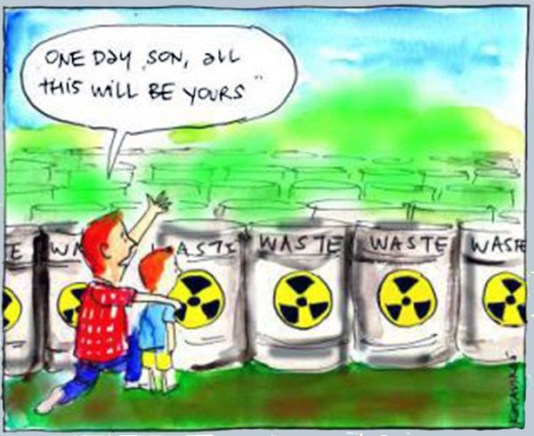
Highly radioactive waste, dangerous for as long as 200,000 years, has to be isolated and guarded in every country that has dabbled in nuclear energy. Cartoon credit: www.sanonofresafety.org/nuclear-waste/
Japan is a place where not two, not three, but four plates meet with no geographical stability. Volcanoes are erupting all the time, new islands pop up in the sea and there are daily earthquakes. Forty thousand years ago, the coast line was totally different and nuclear waste storage is supposed to be safe there?
The issue of Transparency
there seems to be a lack of information on the Japanese plans to bury their nuclear High Level waste. Very little has been discussed on this latest OECD report from May, However, on the JAIF website it has been given a brief mention in a very recent report from JAIF (10 August, 2016)
“When completing its report, the group also took into consideration…
View original post 1,181 more words
August 2, 2017
Posted by arclight2011part2 |
Uncategorized |
Leave a comment
Spain will shut down country’s oldest nuclear plant http://abcnews.go.com/Technology/wireStory/spain-shut-countrys-oldest-nuclear-plant-48966632 1 Aug 17The Spanish government says it’s closing the country’s oldest nuclear power station because of lack of support among political parties and companies involved to keep it open.
Energy Minister Alvaro Nadal said Tuesday the license for the Santa Maria de Garona plant in northern Spain would not be renewed as there was too much uncertainty surrounding the plant’s viability.
Production at the 46-year-old Garona was halted in 2012 when its operator, Nuclenor, objected to a new tax. Its board recently failed to reach agreement on keeping the plant open.
Environmentalists have long claimed that the plant is outdated, although Spain’s Nuclear Security Council this year said it could continue operating.
Spain has seven other nuclear reactors that produce some 20 percent of the country’s electricity.
August 2, 2017
Posted by Christina Macpherson |
politics, Spain |
Leave a comment
http://www.powermag.com/south-korean-president-details-phase-out-of-coal-nuclear-power/08/01/2017 | Darrell Proctor, During his electoral campaign, South Korean President Moon Jae-in vowed to end the country’s reliance on coal and also said the nation would move away from nuclear energy. He took a major step in that direction in June, saying his country would not try to extend the life of its nuclear plants, would close 10 existing coal-fired plants, and would not build any new coal plants.
The president, who took office in May 2017, has made energy policy a cornerstone of his administration and has moved quickly to implement his policies (see “A Mixed Bag of Nuclear Developments in UAE, S. Korea, Switzerland and S. Africa” in the July 2017 issue). South Korea has been among the world’s largest producers of nuclear energy and one of the few nations to export its nuclear technology. Former President Lee Myung-bak, who served from 2008 to 2013, supported nuclear energy as part of his clean energy policy that called for reductions in greenhouse gas emissions. In 2016, a third of the country’s electricity came from nuclear plants, and the World Nuclear Association said South Korea’s nuclear production from its 25 operating plants ranked No. 5 in the world.
Moon announced his initiatives at a June 19 ceremony in Busan to mark the closure of the Kori 1 reactor (Figure 1), the country’s oldest power plant. Kori came online in 1978. Busan, at the southeastern tip of South Korea, is home to many of the country’s nuclear facilities, in part due to its distance from North Korea.
“So far South Korea’s energy policy pursued cheap prices and efficiency. Cheap production [costs] were considered the priority while the public’s life and safety took a back seat. But it’s time for a change,” Moon said. “We will abolish our nuclear-centered energy policy and move toward a nuclear-free era.”
The country’s energy ministry said it will take 15 years or more to decommission the Kori 1 reactor, at a cost of 643.7 billion won ($569 million). South Korea took a hard look at nuclear power after the 2011 Fukushima disaster in neighboring Japan. A 2012 scandal in which plants were shut down after it was discovered parts were being supplied with fake certificates (see “Documentation Scandal Strains South Korea’s Power Supplies” in the August 2013 issue), along with a recent spate of earthquakes in southeastern South Korea, also have brought concern. Seismologists said four of the nine most-powerful quakes in the country’s history have occurred in the past three years, including a 5.8-magnitude quake—the largest since seismic activity began being recorded in 1978—in September 2016.
PIRA Energy Group, part of S&P Global Platts, earlier this year said South Korea had planned to add 20.17 GW of new coal-fired electricity generation from 2017 to 2022, including 5 GW this year. The group reported that private-sector companies already had invested $1 billion toward construction of new coal plants. South Korea at present has 59 operating coal-fired power plants, supplying about 40% of the country’s electricity. The 10 plants that would be closed under Moon’s plan represent about 3.3 GW of the country’s generation, or about 10.6% of the nation’s total coal-fired capacity, according to the energy ministry.
The 10 plants cited for permanent closure all were temporarily closed in June 2017, and will be closed again from March to June next year to limit emissions. Moon has pledged to permanently close all coal plants aged 30 years or more during his presidential term (2017–2022). He has said the country would spend $12.2 billion this year to develop alternative energy sources, and pursue a goal of cutting greenhouse gas emissions by 37% by 2030.
August 2, 2017
Posted by Christina Macpherson |
politics, South Korea |
Leave a comment
Ashland Daily Tidings By John Marciano, 1 Aug 17
This coming Aug. 6-9, the 32nd Annual Hiroshima-Nagasaki Vigil will be held. The theme is “Stepping Back from Nuclear War: The World’s Call to Peace.” It highlights the international effort to abolish nuclear weapons, building upon the work of 122 UN nations that produced the Nuclear Ban Treaty. For more information on the events, please check the Peace House Calendar: peacehouse.net — or contact Herbert Rothschild at herbrothschild@hotmail.com or 541-531-2848.
“This treaty is an incredible new piece of international law, achieved despite the opposition of the most militarized and powerful countries in the world,” states Ray Acheson, director of the Women’s International League for Peace and Freedom’s (WILPF) disarmament effort, Reaching Critical Will. “It marks a turning point in the struggle against these genocidal weapons, in which the vast majority of governments and civil society have united to create law that can change policies and practices of nuclear deterrence and help facilitate nuclear disarmament.”…..http://www.dailytidings.com/news/20170801/guest-opinion-take-back-power-from-nuclear-nations
August 2, 2017
Posted by Christina Macpherson |
general |
Leave a comment
NuClearNewsNo98, August 2017 The Government and Ofgem have published their strategy for a modernised, smart and flexible power system. The 32-page document by the Department for Business, Energy and Industrial Strategy (BEIS) looks at how a smarter energy system will create opportunities to reduce energy costs, increase productivity and put UK businesses in a leading position to export smart energy technology and services to the rest of the world. The plan aims to facilitate a smarter grid through a series of technical and regulatory changes. (1)
A study by Imperial College and the Carbon Trust, which was commissioned by BEIS, estimates that between £17bn and £40bn could be saved by 2050 if technologies such as battery storage and demand side response become more widespread. New rules will make it easier for people to generate their own power with solar panels, store it in batteries and sell it to the National Grid. The rules are due to come into effect over the next year. They will reduce costs for someone who allows their washing machine to be turned on by the internet to maximise use of cheap solar power on a sunny afternoon. And they will even support people who agree to have their freezers switched off for a few minutes to smooth demand at peak times. They’ll also benefit a business that allows its airconditioning to be turned down briefly to help balance a spell of peak energy demand on the National Grid. Thanks to improvements in digital technology, battery storage and renewables, these innovations in flexibility are already under way with millions of people across the UK generating and storing electricity. So instead of predicting peak demand then building power stations to meet it, energy managers will be able to trade in Negawatts – negative electricity. (2)
The Government will invest £246m in battery technology that it says will be a key pillar in helping to power its industrial strategy. In its first major move to support the nascent battery revolution, the Government will set up a “battery institute” to award hundreds of millions of pounds to companies on the brink of major research and development breakthroughs. Greg Clarke underlined the importance of “cutting -edge energy plans”, which include battery power and electric, driverless vehicles.
The rapidly falling cost of battery power is expected to radically change the way Britain is able to make use of its renewable energy generation, by storing excess wind and solar for when wind speeds slip and sunshine wanes. Battery technology is already ushering in major upheaval for automotive industries and fuel retailers by accelerating the boom in electric vehicles. (3)
“You almost need to draw a line under what has come before [with energy markets] and start again” says Nick Boyle, the founder of Europe’s largest solar operator Lightsource. “There is no doubt that batteries completely and utterly metamorphose the market in that they make the uncontrollable controllable. It makes the arguments against renewable energy fall away,”
The new energy reality is not simply about consumers taking power from generators, but means the roles of producer and consumer will flip and, in some cases, merge. Lightsource is already pairing solar panels with battery packs to allow customers to effectively become their own energy market. Solar panels create energy which can be used at cheaper rates than electricity from the main grid, or stored in the battery to use later. If the battery and electric vehicle are both charged a Lightsource customer could sell their power back to the grid. By creating a network of households and businesses which can generate power and reduce demand, Lightsource could create a string of virtual low-carbon power plants.
“We’ve always said that we would like to equip a million homes with solar panels and batteries. If you use a 4kW panel that would be 4GW of capacity,” says Boyle. This is the equivalent scale of Hinkley Point C plus a gas-fired power plant, but only when the sun shines. “But if you add a 6kW battery you’ve created an extra 6GW of storable electricity which could be used to balance the grid.”
“It’s not about hardware anymore. It’s about software. And this can move at such an incredible pace and will only get quicker,” says Boyle. “It seems like we’re offering something impossible. But this is only because many are still using a yardstick of how they bought energy in the past. You almost need to draw a line under what has come before and start again.” (4)
“This government’s record on energy has been incompetent to the point of derision or despair, depending on how much you care about it” says Stuart Elmes, CEO of Viridian Solar. But finally the Government is showing signs that it gets it.
Greg Clarke. Secretary of State for Business, Energy and Industrial Strategy (BEIS) is talking about nothing less than the coming revolution in energy, one that has become evident to many working in the renewables sector, but has until now been just a little too far over the horizon for the politicians to ‘get’. A combination of key technologies – solar, wind, and energy storage coupled with a real-time energy market driven by information technology are maturing and the impact will be extraordinary.
Solar panels and wind turbines have a complementary output profile and a combination of both will even out seasonal energy production in northern climates such as the UK. Energy will be stored in and released from large batteries – including those in electric vehicles – to meet shorter term peaks in demand and troughs in supply. Real-time electricity pricing will allow internet enabled appliances to turn on or regulate down following pricing signals to smooth out demand to better match supply.
What we’re looking at is a fundamental shift from an energy system based on resources to one founded on technology. The inflexion point is coming and it’s now no longer a question of whether the oil age will end, but how soon it will come. So, two cheers for Greg Clarke, it looks like he’s got the vision, competent implementation to support a smart grid will now be the key to the UK taking advantage of the coming energy revolution. (5) http://www.no2nuclearpower.org.uk/nuclearnews/NuClearNewsNo98.pdf
August 2, 2017
Posted by Christina Macpherson |
ENERGY, UK |
Leave a comment
,Japan Times, 1 Aug 17 KYODO KYODO AUG 1, 2017 HIROSHIMA/NAGASAKI – The mayors of Hiroshima and Nagasaki will call on the government to help realize a treaty banning nuclear weapons at upcoming anniversaries marking the 1945 U.S. atomic bombings in their cities.
This year’s declarations follow the adoption in New York last month by 122 U.N. members of the Treaty on the Prohibition of Nuclear Weapons. As a country under the U.S. nuclear umbrella, Japan did not participate, nor did any of the nuclear weapon states.
Hiroshima Mayor Kazumi Matsui announced an outline of his declaration at a news conference on Tuesday, to be read out at a commemoration ceremony on the anniversary of the bombing on Aug. 6.
According to the outline, he will stress that the “hell” Hiroshima saw 72 years ago is not a thing of the past, saying, “As long as nuclear weapons exist and policymakers threaten their use, their horror could leap into our present at any moment.”…..
Nagasaki Mayor Tomihisa Taue is to read his declaration at the city’s ceremony three days later on Aug. 9. In Nagasaki, an estimated 74,000 people died from the bombing by the end of 1945.
“Action by civil society will be crucial in making the nuclear prohibition treaty an international norm,” Taue said at a news conference on Monday announcing the outline of his declaration. “I would like to call for coordination.”
Taue said he will call on the government to change its mind and join the treaty, while Matsui will urge the government to “manifest the pacifism in our Constitution” by “doing everything in its power to bridge the gap between the nuclear weapon and non-nuclear weapon states.”…..
Both the Hiroshima and Nagasaki declarations were drafted after meetings in recent months with hibakusha and experts. http://www.japantimes.co.jp/news/2017/08/01/national/hiroshima-nagasaki-mayors-urge-government-act-nuke-ban-treaty/#.WYD_7xWGPGg
August 2, 2017
Posted by Christina Macpherson |
Japan, politics, politics international, weapons and war |
Leave a comment
August 01, 2017 Jiji Press FUKUI — Kansai Electric Power Co. said Monday it has concluded a contract to procure mixed oxide, or MOX, nuclear fuel for the Nos. 3 and 4 reactors at its Takahama nuclear power station in the central prefecture of Fukui.
The company signed the contract with Nuclear Fuel Industries Ltd. MOX fuel is a blend of uranium and plutonium extracted from spent nuclear fuel.
Kansai Electric became the first power supplier in Japan to conclude a deal to receive supply of MOX fuel since the March 2011 triple meltdown at Tokyo Electric Power Company Holdings Inc.’s Fukushima No. 1 nuclear plant.
Nuclear Fuel Industries will take charge of the design of MOX fuel and other processes. The production will be commissioned to a group plant of French nuclear giant Areva SA. Under the deal, 32 sets of MOX fuel will be produced —16 sets each for the two reactors.
Kansai Electric concluded similar procurement deals in March and November 2008. In both cases, it was a few years before MOX fuel produced abroad arrived at the Takahama nuclear plant after the deals were concluded.
The Takahama Nos. 3 and 4 reactors, which went back online earlier this year, produce electricity using MOX fuel, a method called “plu-thermal” power generation.
“We will continue with plu-thermal while giving top priority to safety,” Kansai Electric said
August 2, 2017
Posted by Christina Macpherson |
Japan, technology |
Leave a comment
Guardian, Warren Pearce, 1 Aug 17, Media and political attention is being wasted on boosting the public’s notion of scientific consensus, crowding out more important discussion and action
In a democracy, we hope that science helps to inform the public about its problems. In the case of climate change, believe it or not, the evidence suggests this is going relatively well.
Climate science is a vast, sprawling field of knowledge that has achieved great success in occupying the public consciousness. According to Yale University’s Climate Change in the American Mind project, six in ten Americans are worried about global warming, seven in ten think global warming is happening and eight in ten think humans have the ability to reduce global warming. These figures have fluctuated very little since 2012, suggesting that the US public is relatively well informed about the risk, reality and policy potential of climate change, even in the face of well-documented attacks by climate sceptics.
Despite this evidence that the public knows enough about climate change to regard it as a problem, some climate communication researchers continue to claim that the public remain misinformed. Some have focused their attention on the proportion of the public that know the level of consensus within climate science. In 2013, a group of researchers launched the Consensus Project, publishing a claim that 97.1% of journal articles expressing a position on anthropogenic global warming either explicitly state or imply that humans cause warming. The claim made a huge media splash, became a key part of the Obama administration’s climate change messaging, and even gave birth to a new Guardian blog. The Yale report has found that only one in ten Americans could correctly identify the approximate level of scientific consensus. It is argued that perceptions of the degree of consensus play a “pivotal role” in “acceptance of science” and that awareness of scientific consensus is a “gateway belief” towards increasing public concern about climate change.
The debate around these perceptions and their significance is going on within a relatively small pool of researchers, and the argument over effects is intense. Put this in the context of broader debates in psychology about replication and the usefulness of laboratory studies and we get a picture of a young field of study that is yet to reach a “consensus on consensus”……
Climate activists are clearly pained by the glacial progress being made on climate policy, as am I. However, there is as yet no convincing evidence that consensus quantification plays a significant role in building the public’s understanding of climate change. Attempts by climate communicators to shut down this argument is quite the opposite of “constructive” and smacks of the same cavalier attitude to evidence displayed by many climate sceptics over the years. More importantly, consensus messaging is an attempt to win political arguments with scientific numbers and risks a further politicisation of science that the US can ill-afford. It is less about informing democracy and more about reducing engagement to the level of a trivia quiz.
Warren Pearce is a Research Fellow (iHuman) at the University of Sheffield. https://www.theguardian.com/science/political-science/2017/aug/01/well-never-tackle-climate-change-if-academics-keep-the-focus-on-consensus
August 2, 2017
Posted by Christina Macpherson |
general |
Leave a comment
 India’s Nuclear Graveyard: Haunting images show the devastating effects of uranium mining in Jadugoda http://www.mirror.co.uk/news/gallery/indias-nuclear-graveyard-haunting-images-10871818, BY NATALIE EVANSJAMIE FERGUSON, 1 Aug 17,
For years, the local population has suffered from the extensive environmental degradation caused by mining operations, responsible for the high frequency of radiation related sicknesses and developmental disorders found in the area. Increases in miscarriages, impotency, infant mortality, Down’s syndrome, skeletal deformities, thalassemia have been reported. With raw radioactive ‘yellow-cake’ production to increase and more than 100,000 tons of radio-active waste stored at Jadugoda the threat to the local tribal communities is set to continue.
August 2, 2017
Posted by Christina Macpherson |
health, India, Resources -audiovicual |
Leave a comment


 Nuclear Beautifying Competitions –Endorsing the Safety of New Nuclear Reactors?
 Below are just a few of the many reasons why the RIBA and LI should make clear that their beautifying competitions do not in any way endorse the safety of the Moorside plan.






 nuclear-news