 MOX injunction delayed until at least July 31 http://www.aikenstandard.com/news/mox-injunction-delayed-until-at-least-july/article_01a4ce3c-25f5-11e7-9f5c-8fd2c77c42e0.html By Michael Smith msmith@aikenstandard.com Apr 20, 2017
An injunctive order that would move plutonium disposition forward in Aiken County will have to wait until at least July.
U.S. District Judge Michelle Childs signed an order giving all parties until July 31 to develop a jointly written statement that will be used to frame the order. The previous deadline was April 21.
Childs previously ruled the U.S. Department of Energy failed to comply with an agreement to dispose of 1 metric ton of weapons grade plutonium by Jan. 1, 2016. South Carolina sued the DOE, the National Nuclear Security Administration, NNSA director Lt. Gen. Frank Klotz and former Secretary of Energy Ernest Moniz in February 2016, saying the defendants reneged on their obligations to dispose of plutonium or make $1 million a day “economic assistance payments.”
Childs ruled the federal government failed to dispose of plutonium as agreed, but refused to issue any financial sanctions. Her order asks all parties to develop a joint statement to determine exactly what the injunction will say.
The April 20 order to delay comes at the request of the DOE and its codefendants.
According to court documents, the DOE’s budget is only funded through April 28.
In addition, the DOE cited difficulty in coordinating with a number of program offices and officials, “a process which is complicated by the fact that a number of leadership positions at DOE are not presently filled.”
The motion goes on to say that settlement negotiations will continue. If an agreement can’t be reached by the deadline, then both parties will submit individual statements, court records state.
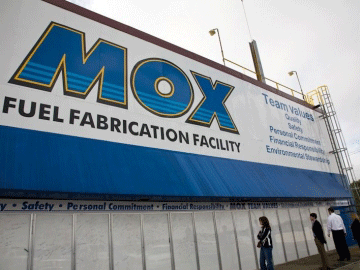
The DOE missed the Jan. 1, 2016 deadline because the mixed oxide, or MOX, fuel fabrication facility at the Savannah River Site in Aiken County isn’t built yet.
Once operational, MOX will convert plutonium stockpiles into fuel for commercial reactors. It’s presently about 73 percent complete, sources familiar with the project say.
The plutonium disposition is part of a nuclear deal with Russia, both nations agreed to dispose of 34 metric tons of defense plutonium. An NNSA news release from 2011 heralding the MOX deal said that’s enough plutonium to make 17,000 nuclear weapons.
Russia suspended, but didn’t withdraw from, the agreement in 2016. While not citing MOX directly, Russian President Vladimir Putin cited “unfriendly” practices by the U.S.
Both nations were supposed to begin disposition in 2018, the NNSA news release said.
April 22, 2017
Posted by Christina Macpherson |
- plutonium, Legal, USA |
Leave a comment
The SIPRI said that there were 455 fewer nuclear warheads at the start of 2016 among nine nuclear states than a year earlier. The United States, Russia, Britain, France, China, India, Pakistan, Israel, and North Korea together had a total of 15,395 nuclear warheads at the start of 2016, including 4,120 that were deployed operationally. The total number of nuclear warheads in those countries at the start of 2015 was 15,850, the press release stated Monday.
Global nuclear-weapon inventories “have been declining since they peaked at nearly 70,000 nuclear warheads in the mid-1980s,” Researchers Shannon Kile and Hans Kristensen stated in the report.
The decline has been due primarily to cuts made by Russia and the United States, the report said. But they said “the pace of their reductions appears to be slowing compared with a decade ago, and neither Russia nor the United States…has made significant reductions in deployed strategic nuclear forces since the bilateral New START treaty” came into force in 2011.
SIPRI estimated that Russia had 7,290 nuclear warheads, including tactical, at the beginning of 2016, and the United States had 7,000.
It said that accounts for 93 percent of the nuclear weapons in the world.
It estimated France has 300 nuclear weapons, followed by China with 260, Britain with 215, Pakistan with 110 to 130, India with 100 to 120, Israel with 80, and North Korea with 10.
SIPRI also said that “None of the nuclear weapon-possessing states are prepared to give up their nuclear arsenals for the foreseeable future,” and that Washington and Moscow both have “extensive and expensive nuclear modernization programs.”
SIPRI said India is strengthening its nuclear-capable ballistic-missile program and speeding up its production of plutonium while its regional rival, Pakistan, is developing battlefield nuclear weapons in response to India’s stronger conventional forces.
The SIPRI report said Pakistan’s nuclear arsenal “may increase significantly” during the next decade.
The report concluded that the prospects worldwide for “genuine progress towards nuclear disarmament remain gloomy.”
SIPRI’s report was based on open sources, including data from governments and the International Atomic Energy Agency.
But SIPRI said many nuclear-capable states were “non-transparent.”
The report said SIPRI was unable to verify whether the secretive country of North Korea, which conducted its first nuclear test in 2006, has been able to produce or deploy operational nuclear weapons.
April 22, 2017
Posted by Christina Macpherson |
2 WORLD, weapons and war |
Leave a comment
The Unfolding Tragedy of Climate Change in Bangladesh A three-foot rise in sea level would submerge almost 20 percent of the country and displace more than 30 million people—and the actual rise by 2100 could be significantly more, Scientific American, By Robert Glennon on April 21, 2017
In some places, the impact of climate change is obvious. In others, scientists predict that climate change will occur based on elaborate computer models. In Bangladesh, it is already happening at a scale that involves unprecedented human tragedy………..
Sea surface temperatures in the shallow Bay of Bengal have significantly increased, which, scientists believe, has caused Bangladesh to suffer some of the fastest recorded sea level rises in the world. Storm surges from more frequent and stronger cyclones push walls of water 50 to 60 miles up the Delta’s rivers.
At the same time, melting of glaciers and snowpack in the Himalayas, which hold the third largest body of snow on Earth, has swollen the rivers that flow into Bangladesh from Tibet, Nepal, Bhutan, and India. So too have India’s water policies. India diverts large quantities of water for irrigation during the dry season and releases most water during the monsoon season.
According to the Bangladesh government’s 2009 Climate Change Strategy and Action Plan, “in an ‘average’ year, approximately one quarter of the country is inundated.” Every four to five years, “there is a severe flood that may cover over 60% of the country.” Rapid erosion of coastal areas has inundated dozens of islands in the Bay. For example, Sandwip Island, near Chittagong, has lost 90 percent of its original 23-square-miles—mostly in the last two decades.
Climate change in Bangladesh has started what may become the largest mass migration in human history. In recent years, riverbank erosion has annually displaced between 50,000 and 200,000 people. The population of what the Bangladesh government calls “immediately threatened” islands, called “chars,” exceeds four million.
The Bangladesh riverine environment is so dynamic that, as chars wash away, the process of accretion creates new chars downstream. Land is so scarce and the population so dense that the displaced people try to eke out an existence on these new, highly unstable sand bars.
A three-foot rise in sea level would submerge almost 20 percent of the entire country and displace more than 30 million people. Some scientists project a five-to-six foot rise by 2100, which would displace perhaps 50 million people. As perspective, the ongoing tragedy in Syria has caused the exodus of approximately three million people.
Already, the intruding sea has contaminated groundwater, which supplies drinking water for coastal regions, and degraded farmland, rendering it less fertile and eventually barren.
It is not just people who are affected. The Sundarbans, the largest mangrove forest in the world and a World Heritage Site, lies in the delta of the Ganges River in Bangladesh and India. Home to the iconic Bengal tiger, the Sundarbans also play a critical role in protecting Bangladesh’s coastal areas from storm surges caused by cyclones.
Nevertheless, across coastal Bangladesh, sea-level rise, exacerbated by the conversion of mangrove forest for agricultural production and shrimp farming, has resulted in the loss of hundreds of thousands of acres of mangroves. In the Sundarbans, the number of tigers has plummeted. The World Wildlife Fund predicts that the tiger may become extinct. Further loss of mangrove habitat, especially in the Sundarbans, also means that Bangladesh will lose one of its last natural defenses against climate change-induced super-cyclones.
Engineering adaptations to climate change that have been successful in other nations—such as the dikes constructed in the Netherlands—won’t work in Bangladesh because the soils are sandy and constantly shifting. The government has undertaken measures to adapt to climate change. It has developed an effective early warning system to alert coastal rural areas of impending cyclones; built a network of 2,100 cyclone shelters, which can accommodate more than a million people; and financed 4,000 miles of coastal embankment projects. It is even planting trees on chars in an effort to create islands that are more durable. However, despite its economic progress, Bangladesh remains a poor country with limited resources. Some measures, such as levees made of sand bags along the Bay of Bengal and the Sangu River, may temporarily stem the ocean’s advance, but they offer at best a short-term fix.
These changes are happening to the people of Bangladesh, not caused by them. As a country, Bangladesh emits only 0.3 percent of the emissions producing climate change.
February 16, 2017. “Where will they go?” Climate refugees, mostly rural farmers and fishermen, are moving into the slums of the country’s two largest cities, Dhaka and Chittagong. As conditions deteriorate, the capacity of these areas to absorb more people is nearing the end. The sad reality offers limited options to those displaced. Climate refugees from Bangladesh, a predominantly Muslim country, are not welcome in the neighboring countries of India and Myanmar. India is building its version of a border wall, a barbed-wire fence; violence in Myanmar in December 2016 drove an estimated 65,000 Rohingya, an ethnic Muslim minority, into Bangladesh.
It is exceedingly unlikely that the Trump Administration either will welcome Bangladeshi refugees or provide financial support to underwrite costs of relocation to other countries. Opportunities for resettlement in the rest of the world are dwindling.
The unfolding calamity demands a response from the international community. Wealthy countries have generated most of the greenhouse gases that are harming Bangladesh. If these countries are unwilling to absorb tens of millions of refugees, there is a moral imperative for them to help. They should underwrite the adaptation efforts of the Bangladesh government and the construction of roads, power plants, water supply systems, housing and other infrastructure to allow these climate refugees to remain and thrive in their own country. https://blogs.scientificamerican.com/guest-blog/the-unfolding-tragedy-of-climate-change-in-bangladesh/
April 22, 2017
Posted by Christina Macpherson |
ASIA, climate change |
Leave a comment
 Children at a nursery school this month in the hamlet of Naraha in Fukushima. The government lifted the evacuation order on the town in 2015.
NARAHA, Japan — The children returned to Naraha this spring.
For more than four years, residents were barred from this hamlet in Fukushima after an earthquake and tsunami caused a meltdown at a nuclear power plant north of town. When the government lifted the evacuation order in 2015, those who returned were mostly the elderly, who figured coming home was worth the residual radiation risk.
But this month, six years after the disaster, 105 students turned up at Naraha Elementary and Junior High School for the beginning of the Japanese school year.
Every morning, cafeteria workers measure the radiation in fresh ingredients used in lunches. In some grades, as few as six students take their lessons in classrooms built to accommodate as many as 30. There are not enough junior high students to field a baseball team on the new field next to the school.
Yet the return of the schoolchildren, the youngest of whom were born the year of the disaster, has been a powerful sign of renewal in this town, which is in the original 12-mile exclusion zone around the Fukushima plant.
Reopening the school “is very, very meaningful,” said Sachiko Araki, the principal of the junior high school. “A town without a school is not really a town.”
The new, $18 million two-story building has shiny blond wood floors, spacious classrooms, two science labs, a library filled with new books and a large basketball gymnasium. A balcony at the back of the building overlooks the sea.
Many emotions fueled the decisions of the families who returned to Naraha. It was always a small town, with just over 8,000 people before the disaster. So far, only one in five former residents has come home.
 The library at Naraha Elementary and Junior High School. The school was being built when the disaster hit, so workers started over, removing mounds of dirt in an effort to decontaminate the site.
A bank, post office and medical clinic are now open, but a supermarket is still under construction. Because neighborhoods have stood empty for so long, wild boars sometimes roam the streets.
With thousands of bags of contaminated soil piled high in fields around town and radiation meters posted in parking lots, the memory of the nuclear disaster is never distant.
At the Naraha school, which was being constructed when the disaster hit, workers destroyed a foundation that had just been laid and started over, removing mounds of dirt in an effort to decontaminate the site.
Today, radiation is regularly monitored on the school grounds as well as along routes to the building. The central government, based on recommendations from the International Commission on Radiological Protection, set a maximum exposure of 0.23 microsieverts an hour, a level at which there is no concrete scientific evidence of increased cancer risk. (Microsieverts measure the health effects of low levels of radiation.)
Still, some teachers say they are extra careful. Aya Kitahara, a fifth-grade teacher, said she and her colleagues had decided it was not safe to allow children to collect acorns or pine cones in the neighborhood for art projects, for fear that they would pick up small doses of radiation.
Nearby, a nursery school and day care center was built mostly with money from the nuclear plant operator, Tokyo Electric Power Company, in 2007 and reopened this month. Keiko Hayakawa, the principal, said she was surprised that the city had pushed to bring back children before all bags of contaminated soil had been cleared from town.
“We had to start and keep moving to open this facility as soon as possible,” Ms. Hayakawa said on a morning when 3- and 4- year-olds romped in a large playground, climbing a jungle gym, riding scooters and digging in a sandbox. “Otherwise, there was a fear that people might never come back.”
 A class of elementary students. In some grades, as few as six students take their lessons in classrooms built to accommodate as many as 30.
Calculations of radiation exposure are imprecise at best. They may not detect contaminated soil from rain runoff that can collect in gutters or other low-lying crevices. Risk of illness depends on many variables, including age, activities and underlying health conditions.
“I don’t want to accuse anyone of being consciously disingenuous,” said Kyle Cleveland, associate professor of sociology at Temple University in Tokyo, who has written about the psychological effects of the Fukushima disaster. But government officials “have every incentive to downplay the level of risk and to put a positive spin on it.”
Reviving the towns of Fukushima is also a priority for the central government. With the 2020 Olympics to be held in Tokyo, Prime Minister Shinzo Abe wants to deliver on his promise that the Fukushima cleanup effort is “under control.”
“It is really up to the individuals whether they would accept the current environment or not,” said Kentaro Yanai, the superintendent of the Naraha school district. “But for us, we did the best that we could have done so far in order to reduce radiation levels.”
For young families, factors other than radiation risks weighed on the calculus of whether to return. Some longed to go back to the town that had been their home for generations, while others assumed they could afford more space in Naraha.
And as national compensation payments for evacuees are set to expire next year, some residents secured jobs working for the town government or for contractors involved in the reconstruction work. Still others are employed by Tokyo Electric, which is coordinating the huge cleanup at the Fukushima Daiichi plant.
Ayuka Ohwada, 29, had originally thought she and her family would stay in Iwaki, a city of about 340,000 more than 20 miles south, where many Naraha residents lived during the evacuation period. But once her parents moved back to their old home, Ms. Ohwada and her children, now 8 and 6, began visiting on weekends.
 Day care workers and children in Naraha. The town now has a bank, a post office and a medical clinic, but a supermarket is still under construction.
“I started thinking that maybe the countryside is a much better environment for my children,” said Ms. Ohwada, whose parents offered her a piece of land to build a new house. Ms. Ohwada, who was employed as a convenience store clerk before landing a job at town hall, said she and her husband, who works in a nearby town at a company involved in decontamination, could never afford a stand-alone house in Iwaki.
In Naraha, the school is doing as much as it can to cushion the return for young families.
The building, which was originally designed for the junior high school, now houses two elementary schools as well. Extra counselors talk students through lingering anxieties, and the fifth- and sixth-grade classes have two teachers each. All students will receive tablet computers, and lunch and school uniforms are provided free.
Yuka Kusano, 37, said her children had grown accustomed to large classes while they were evacuated in Iwaki. But after enrolling in the Naraha school this month, she said, they benefit from individualized attention rare in Japanese schools.
Her 12-year-old daughter, Miyu, is in seventh grade with just five other classmates, and her son, Ryuya, 9, is in a fourth-grade class of 13 students.
“It is really luxurious,” Ms. Kusano said. Still, with so few children in Naraha, she drives Ryuya to Iwaki on weekends so he can continue to play on a softball team.
Hints emerge of the turmoil the students have endured in the six years since the disaster. During a recent presentation for parents, one girl with thick bangs and large black glasses said she had struggled with frequent moves.
“I am doing O.K.,” she said. “I just want to keep stability in my life.”
Such stability is one reason many families with young children have chosen not to return.
 Uninhabited houses in Naraha. The town numbered just over 8,000 before the disaster. So far, only a fifth of the former residents have returned.
Tsutomu Sato, a nursing home manager with three daughters, 9, 5 and 2, said the family had moved seven or eight times after being evacuated from Naraha.
“I just want to build a base for my family as soon as possible,” said Mr. Sato, who bought a house in the Yumoto neighborhood of Iwaki. He said his oldest daughter cried whenever he raised the possibility of moving back to Naraha, where his parents and grandmother were restoring their house and planned to move back next year.
In exile, he maintains a fierce attachment to his hometown and has formed a volunteer group, Naranoha, to stage cultural events to bring together the diaspora of former residents around the region. He said that if his parents grew too frail to take care of themselves, he would consider moving back.
“With or without the disaster, we have to make life decisions based on our circumstances,” he said.
In Naraha, the mayor, Yukiei Matsumoto, said surveys showed that just under three-quarters of former residents wanted to return eventually.
“In order to clear the stigma that people have,” he said, “we are back now to show the rest of the country and the rest of the world that we are doing well.” But he acknowledged that if more young people did not return, the town had a dim future.
Kazushige Watanabe, 73, said he had come back even though his the tsunami had destroyed his home and his sons lived outside Fukushima Prefecture.
He has moved into a compact bungalow built by the city in a new subdivision in the center of the town, where he has lived alone since his wife’s death in January.
He pointed out a house around the corner where a family with three children had moved in recently. “I can hear the children’s voices,” he said. “That is very nice.”
https://www.nytimes.com/2017/04/21/world/asia/japan-fukushima-nuclear-disaster-children.html
April 21, 2017
Posted by dunrenard |
Fukushima 2017 | Fukushima Children, Return |
Leave a comment
Russia ‘moves troops and equipment’ to North Korea border, as Kim Jong-un warns of ‘super-mighty pre-emptive strike’, Telegraph UK Roland Oliphant Reuters 20 APRIL 2017 Russia has moved heavy military equipment towards its border with North Korea amid mounting fears of a military clash between Pyongyang and the United States over the North’s nuclear program.
A flurry of military activity in Russia’s far east came as the UN Security Council strongly condemned North Korea’s latest missile test and threatened to impose new sanctions against Pyongyang for its “highly destabilizing behavior.”
In a unanimous statement, the council demanded that North Korea “conduct no further nuclear tests” and said Pyongyang’s “illegal missile activities” were “greatly increasing tension in the region and beyond.”……
It was revealed earlier this week that a US aircraft carrier group led by the USS Carl Vinson would spend another 30 days at sea
before heading towards North Korean waters. Last week Donald Trump, the US president, said he had ordered an “armada” into the northwest Pacific in a show of force designed to deter North Korea from further missile and nuclear weapons test.
The US defence ministry acknowledged on Tuesday that the ships had actually travelled into the Indian Ocean to carry out manoeuvres with Australian forces, and only began its journey north recently.
Mr Trump has called on China, Pyongyang’s only ally, to rein in North Korean leader Kim Jong-un, but has threatened to act alone to “solve” the problem if necessary.
Residents and local media in Russia’s Far East reported large military convoys travelling in the direction of the North Korean border since the weekend, in what appear to be contingency plans to contain fallout from a possible military clash between the United States and North Korea.
A video published by local news site DVHab.ru showed a train carrying twelve tracked vehicles, including Tor surface to air missile systems, travelling through Khabarovsk in the direction of Vladivostok.
“Some say the situation around North Korea is a fiction, but this is the third train of equipment we’ve seen since this morning,” a man can be heard saying in the film. “Looks like something is being sent to the Korean border.”………
South Korean presidential candidates clashed on Wednesday night in a debate over the planned deployment in South Korea of a US-supplied Terminal High Altitude Area Defense (THAAD) anti-missile system, which has angered China.
Frontrunner Moon Jae-in was criticised for leaving his options open before the May 9 election.
On Monday, Hwang and Pence reaffirmed their plans to go ahead with the THAAD, but the decision will be up to the next South Korean president. For its part, China says the system’s powerful radar is a threat to its security.
The North has said it has developed a missile that can strike the mainland United States, but officials and experts believe it is some time away from mastering the necessary technology, including miniaturising a nuclear warhead.http://www.telegraph.co.uk/news/2017/04/20/north-korea-warns-super-mighty-preemptive-strike-will-reduce/
There has been some confusion over the whereabouts of a US aircraft carrier group after Trump said last week he had sent an “armada” as a warning to North Korea, even as the ships were still far from Korean waters.The US military’s Pacific Command explained that the USS Carl Vinson strike group first had to complete a shorter-than-planned period of training with Australia. It was now heading for the Western Pacific as ordered, it said.
China’s influential Global Times newspaper, which is published by the People’s Daily, the Communist Party’s official paper, wondered whether the misdirection was deliberate.
“The truth seems to be that the US military and president jointly created fake news and it is without doubt a rare scandal in US history, which will be bound to cripple Trump’s and US dignity,” it said. http://www.telegraph.co.uk/news/2017/04/20/north-korea-warns-super-mighty-preemptive-strike-will-reduce/
April 21, 2017
Posted by Christina Macpherson |
politics international, Russia, weapons and war |
Leave a comment
Risk of ‘Accidental’ Nuclear War Growing, UN Research Group Says, The warning comes as the Pentagon begins an extensive review of its nuclear arsenal. Defense One, BY PATRICK TUCKER, 19 APR 17,
On Sept., 26, 1983, shortly after midnight, the Soviet Oko nuclear early warning system detected five missiles launched from the United States and headed toward Moscow. Stanislav Petrov, a young lieutenant colonel in the Soviet Air Defense Force, was the duty in the Serpukhov-15 bunker that housed the Oko command center. Petrov was the man in charge of alerting the soviets about a nuclear attack, which would trigger a retaliatory strike. He determined that the Oko had likely malfunctioned and the alarm was false. The Americans would not start World War III with a quintet of missiles (risking total annihilation.) It was a daring judgment call. He was, of course, right. As the U.S. prepares to undertake a new nuclear posture review to determine the future direction of the nation’s nuclear weapons, a report from a United Nations research institute warns that the risks of a catastrophic error — like the one that took place that early morning in 1983 — are growing, not shrinking. Next time, there may be no Lt. Col. Petrov in place to avoid a catastrophe.
On Monday, the U.S. Defense Department commenced a new, massive study into its nuclear weapons arsenal, looking at how weapons are kept, how the U.S. would use them in war and whether they present an intimidating enough threat to other countries not to attack us. The review was mandated by President Trump in a Jan 27, memo.
The Pentagon is scheduled to complete the review by the end of the year, an essential step as the military seeks to modernize different aspects of its nuclear deterrent. But a new report from the United Nations Institute for Disarmament Research, or UNIDR, argues that as the modern battlefield becomes more technologically complex, crowded with more sensors, satellites, drones, and interconnected networks, the risks of another nuclear accident are on the rise.
“A greater reliance on automated systems can lead to misplaced confidence while introducing new points of vulnerability,” says the report. Those new points of vulnerability include so-called “hidden interactions.” That means a sensor or computer program misinterpreting some bit of data and possibly presenting false information in a way that could cause an accident. The 1987 incident provides a good case in point. Oko satellites mistook a very unusual sunspot on top of a high altitude cloud as a missile strike, hence the false alarm.
Take those satellites, combine them with sensors on drones and data from other sources as well, including new, perhaps unproven technologies to detect missile launches and the picture becomes much more crowded and murky.
“The complex interactions and tightly coupled systems linked to nuclear arsenals (like those for early warning, and launch command and control) have made ‘accidental war more likely’” the report’s authors say.
Add to that the fact that the number of states that have access to nuclear weapons is increasing, and the number of platforms that they might be able to use to deliver those weapons is also going up. Consider the controversial U.S. plans for a long-range standoff weapon, or LRSO, basically a big nuclear cruise missile that can be fired off a fighter jet. Reports have surfaced that the U.S. is even considering nuclear-armed drones (that would be remotely operated by human pilots and the degree of seriousness in the considerations is up to debate).
Those might sound like awesome capabilities but they increase the chances of a nuclear accident or retaliatory strike, according to the authors of the report, because such weapons essentially turn every jet and drone into a potential nuclear threat in the eyes of an adversary……http://www.defenseone.com/technology/2017/04/risk-nuclear-accidents-growing-un-research-group-says/137171/?oref=defenseone_today_nl
April 21, 2017
Posted by Christina Macpherson |
USA, weapons and war |
Leave a comment
 Tillerson Slams Nuclear Deal after State Department Certifies Iranian Compliance, A proliferation expert suggests the certification was made to comply with law and avoid a crisis while reviewing its Iran policy. The Weekly Standard, APR 20, 2017 | By JENNA LIFHITS Secretary of State Rex Tillerson slammed the Iran nuclear deal for its limited scope and eventual sunset date Wednesday, and said the Trump administration is conducting an exhaustive review of its Iran policy.
The secretary’s rebuke came one day after his State Department certified that Iran is complying with the deal. The decision to certify likely follows from the administration being knee-deep in an intensive review of the agreement and uncertain about next steps, top proliferation experts told THE WEEKLY STANDARD………
While Tillerson did not specify whether the administration would scrap or rigorously enforce the deal, he and other administration officials have suggested a preference for the latter.
Late Tuesday, Tillerson certified to Congress that Iran is complying with the nuclear deal.
The president must by law report to Congress about Iranian compliance with the deal every three months. If the administration does not submit a compliance certification or determines that Iran is in “material breach” of the deal, Congress has the ability to quickly re-impose sanctions lifted under the deal. The certification drew the ire of some in the White House who would have preferred to see no certification filed and the deal subsequently done away with.
The administration likely issued the certification to meet the conditions of the law and avoid a crisis while reviewing its Iran policy, a top proliferation expert told TWS………
If the administration had not issued the certification, the diplomatic fallout could have been significant, David Albright (founder of the Institute for Science and International Security) added.
Tillerson said this week that the administration is conducting a broad review of its Iran policy, including the nuclear agreement and whether to maintain related sanctions relief…….
Administration officials have also reportedly been considering broadening sanctions against Iran and its Islamic Revolutionary Guard Corps (IRGC). http://www.weeklystandard.com/tillerson-slams-nuclear-deal-after-state-department-certifies-iranian-compliance/article/2007709
April 21, 2017
Posted by Christina Macpherson |
Iran, politics international, USA |
Leave a comment

 North Korea risk too high for military option: Robert Litwak https://www.usatoday.com/story/opinion/2017/04/19/north-korea-nuclear-risk-too-high-military-option-robert-litwak-column/100615092/ Robert S. Litwak April 19, 2017
With Pyongyang hurtling toward a nuclear breakout, the real choice is acquiescence or diplomacy. North Korea’s impressive parade of nuclear-capable ballistic missiles last weekend occurred as the Trump administration asserted it was not ruling out any option to address this rising threat. With echoes of Cuba in October 1962, this slow-motion missile crisis will play out not in Robert F. Kennedy’s legendary Thirteen Days, but over the next two or three years.
North Korea crossed the nuclear threshold a decade ago when it conducted its first atomic test. The precipitant of the current crisis is that the Pyongyang regime is now on the brink of vastly expanding its small nuclear arsenal. Left on its trajectory, by 2020, North Korea could have a nuclear stockpile of 100 warheads that can be mounted on long-range ballistic missiles capable of reaching the United States.
The contrast between North Korea’s atomic arsenal (which could, incredibly, approach half the size of Britain’s) and its paltry economy (a gross domestic product of about $17 billion, comparable with Asheville, N.C.) is jarring. North Korea is essentially a failed state on the verge of a nuclear breakout. And this totalitarian state is run by a dynastic cult — the Kim family.
A North Korean ability to strike the U.S. homeland would be a game changer. Vice President Pence declared in South Korea on Monday that the Obama administration’s policy of “strategic patience” was over — but he did not indicate what would follow.
Strategic patience had essentially resulted in acquiescence as North Korea built up its nuclear arsenal and made substantial progress in miniaturizing warheads and acquiring an intercontinental ballistic missile capability. In response, the United Nations and the United States have imposed still stricter sanctions on the Kim regime. But sanctions are not a strategy.
With North Korea perilously close to becoming a major nuclear power, America should pivot to serious diplomacy. Since the end of the Cold War, when the North Korean atomic challenge arose, U.S. hard-liners have eschewed diplomacy toward this “rogue state” because they view it as tantamount to appeasement.
The alternative to diplomacy — the much discussed military option “on the table” — has essentially been off the table because it runs the catastrophic risk of spiraling into a second (this time, nuclear) Korean war. No U.S. president could authorize even a “limited” strike on a missile site and discount this escalatory risk. When the United States can’t bomb and won’t negotiate, it is in fact acquiescing to a continued North Korean buildup. That unsatisfactory prospect reinforces the case for transactional diplomacy through coercive engagement to block North Korea’s current disastrous course.
Though a full rollback of North Korea’s atomic program is not a realistic goal, transactional diplomacy to freeze its capabilities at their current level might be attainable. This would make the best of a bad situation: When zero warheads is not an option on the table, an agreement capping North Korea at 20 nuclear weapons is better than an unconstrained program that hits 100 warheads by 2020. And a freeze would preclude the additional testing that North Korea still needs to master miniaturization and reliable long-range missiles.
Why should diplomacy succeed this time when it has failed in the past? New conditions that change China’s strategic calculus. Until now, Beijing has been lackadaisical in its enforcement of sanctions and has declared that Pyongyang was Washington’s problem. But a North Korea with a large atomic arsenal and ballistic missiles capable of striking the U.S. homeland would be a game changer. That’s true not only for America but also for China, where risky consequences could include the possibility of South Korea and Japan reassessing their own non-nuclear intentions.
Transactional diplomacy would decouple the nuclear issue from regime change. It would create the conditions for success by identifying a point of near-term optimization among the parties.
A freeze would permit Pyongyang to retain a minimum deterrent and the Kim family regime. For Beijing, it would preserve a strategic buffer state and avert the adverse strategic consequences of a nuclear-armed North Korea. And for Washington, a near-term interim agreement freezing North Korean capabilities would prevent a breakout and be characterized as the first step toward long-term denuclearization of the Korean Peninsula.
This analytical option should be put to the diplomatic test. Otherwise, we are left with the bad options of bombing or acquiescing.
Robert S. Litwak is vice president for scholars and academic relations at the Wilson Center and director of International Security Studies. He is the author of Preventing North Korea’s Nuclear Breakout.
April 21, 2017
Posted by Christina Macpherson |
North Korea, USA, weapons and war |
Leave a comment








 nuclear-news