Another month in UK’s failing new nuclear programme nuClear News No.94 April 2017 French nuclear scandal
EDF, Areva and the French nuclear regulator ASN have known since at least 2005 that Areva’s Creusot Forge factory was not capable of producing nuclear safety compliant components. Yet the factory has been allowed to continue manufacturing components which have now been found to contain anomalies, including the bottom and lid for the reactor pressure vessel (RPV) for the EPR at Flamanville. (12)
The French Radio Station which broke the news commented that:
“Never before has the French nuclear industry suffered such a scandal. And this case challenges the entire chain of control of a sector already shaken by the Fukushima disaster.” (13)
The Creusot Forge is under investigation by ASN after it was discovered to have produced potentially defective parts and substandard safety reports for reactors around the world. But the letters from 2005 and 2006 – obtained by France Inter – show that EDF and Areva were told by the ASN about “numerous incidents” at the facility, including “discrepancies during inspections”. This will raise serious concerns about EDF and Areva’s new nuclear project at Hinkley Point. (14)
In December 2005 ASN sent a letter to EDF alerting it to the deplorable condition of the Le Creusot plant, which was experiencing major malfunctions. Yet the lid and bottom for the RPV for the Flamanville EPR were manufactured by the Creusot Forge, in Burgundy, between September 2006 and December 2007. In August 2006 ASN asked Areva to demonstrate that the steel for these two parts was homogeneous. For seven years letters were exchanged between ASN and Areva, but no analysis was carried out. On 24th January 2014 the RPV arrived at Flamanville, and was placed in the reactor building. Nine months later Areva finally did some tests and discovered that the bottom and the lid had abnormalities. “The steel should normally contain 0.2% carbon,” explains Yves Marignac, of WISE Paris, but the concentration was 0.3%, enough to modify the mechanical properties of the steel and, in particular, to influence the temperature at which it becomes less supple and more brittle. (15)
The regulator – ASN – has been seriously at fault, according to the Observatoir du Nucleaire, since it has said nothing for many years about the criminal practices at Le Creusot. It says ASN is no less guilty than Areva and EDF because, although it was fully aware of the serious problems, it authorized EDF to install the pressure vessel in the EPR at Flamanville in December 2013. It is clear, says the website, that ASN is not able to withstand pressure from EDF and politicians who accuse them of seriously harming the industry if they enforce safety regulations. (16)
Following the discovery of manufacturing irregularities and the falsification of documents at Areva’s Creusot Forge foundry last year, French nuclear regulator ASN and several other international regulators inspected the site in early December. ASN said Le Creusot is not up to the job and did not have the right equipment to produce the parts for the nuclear reactors. “Creusot Forge is at the limit of its technical capacity. The tools at its disposal are not adequate to manufacture such huge components. In such a situation, errors are made.” (17) No2NuclearPower nuClear news No.94, April 2017 5
EDF’s oversight of AREVA, which will supply the Hinkley Point C reactors was questioned in an internal document by the UK Office for Nuclear Regulation (ONR). In an ONR report about the visit dated 16th December disclosed under a Freedom of Information request ONR said the nuclear safety culture at Creusot fell short of expectations and warned about the implications for Hinkley Point C. ONR said it has since decided to implement a series of additional inspections of EDF and its supply chain to ensure all components are manufactured to the required standard. The ONR report said after an inspection in late 2016, that an international team from France, Canada, the United States, China, Finland and Britain had concluded that the nuclear safety culture at Le Creusot Forge foundry fell short of what regulators expect from a major supplier of nuclear equipment. It added that improvement measures ordered by ASN were not yet effective and said despite the prohibition of the use of correction fluid on documents at the foundry, the inspectors found evidence of its continued use. (18)……… http://www.no2nuclearpower.org.uk/nuclearnews/NuClearNewsNo94.pdf
April 8, 2017
Posted by Christina Macpherson |
business and costs, France, secrets,lies and civil liberties |
Leave a comment
Another month in UK’s failing new nuclear programme nuClear News No.94 April 2017 The Trump administration is working to find a new owner for Westinghouse, but doesn’t want the Company to fall under Chinese control. The administration is “keenly aware” of the national security implications attached to the sale of the company, and is trying to pre-empt any possible blocking of a deal by making clear at an early stage that the US government would take a tough stance on any significant Chinese role. A US-led deal for even the profitable operations of Westinghouse could be tricky to arrange though. The only US company with substantial nuclear engineering operations is General Electric, through its joint venture with Hitachi, but its technology is different from Westinghouse’s. Westinghouse has close links to China, where it has four of its AP1000 reactors under construction. As part of the deal for those projects, Westinghouse agreed to transfer intellectual property relating to the plants. More than 75,000 No2NuclearPower nuClear news No.94, April 2017 4 documents were handed over to its Chinese customers in 2010 in the first stage of implementing that agreement. (11) http://www.no2nuclearpower.org.uk/nuclearnews/NuClearNewsNo94.pdf
April 8, 2017
Posted by Christina Macpherson |
business and costs, politics international, USA |
Leave a comment
Russian sub causing nuclear headache in Denmark http://cphpost.dk/general/russian-sub-causing-nuclear-headache-in-denmark.html An elderly Russian nuclear submarine is to pass Denmark on its way to St Petersburg later in the year. April 6th, 2017 3:50 pm| by Stephen Gadd
This summer, a giant Russian typhoon-class nuclear submarine, 172 metres in length, is expected to pass Denmark.
The submarine will depart from Russia, pass Norway and then sail into the North Sea and the Skagerrak, onwards into the Baltic, where it will finally dock in St Petersberg, the Barents Observer writes. The sub will pass underneath the Øresund Bridge as the water is not deep enough by the Great Belt Bridge or at Flintreden.
All the preparations are underway, and now all that is needed is the signature of Russian President Vladimir Putin.
No nukes, please!
The submarine was built in 1981 and has the capacity to carry up to 20 missiles and 200 nuclear warheads at a time. However, nowadays it is used as a test platform for ballistic missiles and is based in the town of Severodvinsk in western Russia.
The age of the vessel might be cause for concern, though, according to Norwegian atomic physicist Nils Bøhmer.
“I’m worried when a 40-year-old atomic submarine with a relatively large reactor aboard sails along the Norwegian coast and into the Baltic,” he told Barents Observer.
“The authorities have to know the exact time of its voyage in order to be prepared. It is also vital to ensure there are not atomic weapons on board.”
April 8, 2017
Posted by Christina Macpherson |
Denmark, Russia, safety |
Leave a comment
With Westinghouse Bankruptcy, the Nuclear Energy Story Nearly Over The much touted nuclear renaissance is now over. News Click Prabir Purkayastha 07 Apr 2017 With Westinghouse announcing its bankruptcy, India’s pledge to buy at least 10,000 MW as a part of the India US Nuclear Deal and reiterated by Modi last year, should be given a decent burial. Any agreement with Westinghouse now means that India would be bailing out Westinghouse and the US nuclear industry with Indian peoples’ money.
This also draws to a close all talk about a nuclear renaissance. The three major reactor manufacturers – Toshiba-Westinghouse, GE-Hitachi and Areva, France – are all in major financial difficulties. Only a fool will still believe their promise that the 3rd generation reactors they are developing – none of which have been successfully commissioned as yet – are either safe or cheap.
The Left’s position during the India US 123 Deal was that it neither served India’s strategic interest, nor made sense in energy terms. It also meant abandoning India’s self-reliant nuclear reactor industry for importing costly and unproven US reactors. Though it failed to stop the 123 Agreement in Parliament, the Left successfully led the struggle to modify India’s Nuclear Liability Act, ensuring that nuclear suppliers, like in any other hazardous industry, should be liable for their faulty equipment.
The Fukushima disaster has shown that a nuclear accident can cost up to $200 billion . Even this could be a conservative estimate. The Indian liability law caps operator and suppliers’ liability to just $ 407 million (300 million SDR’s). Though cost of a reactor is in billions of dollars, even this small liability, only a fraction of its cost, was perceived to be too “dangerous” and unacceptable to the US suppliers.
Last year, Modi, announced during one of his US visits that not only would India buy US reactors, a continuation of the assurance given by Shivshankar Menon, the Foreign Secretary under Manmohan Singh (Letter September 10th, 2008 ), but would also assume the liabilities of the US suppliers in case of of a nuclear accident. India offered Mithi Virdi in Gujarat to Westinghouse and Kovvada in Andhra to GE as the two sites. Subsequently on GE’s failure to show any successful contract combined with local resistance in Mithi Virdi, GE’s project was considered cancelled, and its Andhra site offered to Westinghouse.
Fortunately for India, Modi’s assurances have come too late for the US nuclear industry. The much touted nuclear renaissance is now over. In OECD countries, only 7 new reactors are being built with varying degrees of state support. With huge cost and time overruns, the curse of the nuclear industry, all of them are in deep trouble. GE, unsuccessful in selling even one of its so-called advanced design, has virtually pulled out of the nuclear business. After huge and continuing losses, Areva, the French reactor supplier, is being taken over by EdF, the French state-owned energy utility. EdF has already scrapped the new Areva EPR design, with which the Finnish Olkiluoto and French Flamanville plants were being built. This is also the design Areva is trying to sell for the Jaitapur project in Maharashtra.
The major objections of the Left regarding imported reactors have been proven correct. The untried and untested designs have meant numerous changes and difficulties in construction, leading to significant delays and sharp increase in costs. The cost of the two Areva plants of Euro 3 billion each originally, have increased by almost three times .
The Westinghouse story is no different………
In the exchanges between the UPA and the Left during Manmohan Singh’s government, the cost of new nuclear plants from French or US suppliers had come up. The UPA had presented figures for capital cost per KW of $1,500 and the price of power to be Rs. 1.49 paise per unit from imported nuclear plants. The Left had given figures from Olkiluoto and the US, showing that the capital cost would be at least $4,000 per KW and the price of electricity from such plants around Rs. 5 per unit.
The figures from the US and French projects now show that the capital cost per KW for such plants is in the range of $6,000-7,000, and therefore the price per unit of electricity from such plants will not be less than Rs. 8-10 per unit.
Why did the UPA claim such absurdly low figures for nuclear energy? They were either figments of their imagination or took these figures straight from the promotional material of the nuclear suppliers. To claim nuclear energy to be competitive, the nuclear suppliers took a 60-year life of the plant, left out the interest on capital during construction as a component of the cost, and claimed their new designs had much lower capital costs. They then did what are called levellised cost calculations – the cost of electricity over the lifetime of the plant. By this sleight of hand, they reached figures for the cost of nuclear power to be competitive with coal and gas.
Of course, the actual capital costs are much higher than what the nuclear industry was claiming. The regulators and utilities that price the electricity, have also to look at all the cost components including cost of capital, interest on loans, etc., and fix the price that of electricity. What matters to consumers and utilities (distribution companies or state electricity boards) is not the levellised cost of electricity, but the entry cost of nuclear power to the grid. This is what needs to be competitive to other sources. Any such calculations shows that nuclear energy is simply not competitive.
The collapse of Westinghouse, which has either built or licensed its designs to almost half the world’s reactors, shows that the nuclear story is nearly over. The reality is that with the cost of renewables – solar photovoltaics and wind – dropping sharply, the economics are increasingly against nuclear energy. This is apart from danger of catastrophic accidents or danger from long-term storage of radioactive nuclear wastes. It may still sustain itself for some time in countries, where there is a strong indigenous nuclear industry, such as India, China, Korea and Russia. But its days are now clearly numbered. http://www.newsclick.in/westinghouse-bankruptcy-nuclear-energy-story-nearly-over
April 8, 2017
Posted by Christina Macpherson |
business and costs, India, politics, politics international, USA |
Leave a comment
Lisa Steyn 07 Apr 2017 Once a pioneering nuclear energy giant, the Westinghouse Electric Company now finds itself filing for bankruptcy. This follows uncomfortably close on the heels of another nuclear industry leader, Areva, which was bailed out by the French government in January.
The financial troubles these nuclear powerhouses face is leaving the industry more than a little shaken and raises the question: Is the nuclear industry in meltdown?
“Nuclear industry is not in fine shape at the moment, certainly not in the Western world,” said Chris Yelland, an energy expert and the managing director of EE Publishers…. (subscribers only) https://mg.co.za/article/2017-04-07-00-nuclear-turn-off-tumbles-giants
April 8, 2017
Posted by Christina Macpherson |
general |
Leave a comment
 Radiation Free Lakeland
Latest news and information
NUclear Free Local Authorities media release – for immediate release, 4th April 2017
As Engie becomes the seventh international energy utility to give up on UK
new nuclear build, NFLA say now is the time to move towards a
decentralised, renewable energy alternative policy
The Nuclear Free Local Authorities (NFLA) notes with little surprise
today’s decision by the French energy utility Engie to pull out of the
proposed Sellafield Moorside new nuclear development. This follows
Toshiba’s nuclear subsidiary Westinghouse going into bankruptcy protection
in the United States and its decision that it will not fund new nuclear
reactors at the Moorside site. (1)
Engie follows on from the previous decisions over the past decade of E-on
(Wylfa), RWE Npower (Wylfa), Iberdrola (Moorside), SSE (Moorside),
Centrica (Hinkley Point) and seemingly Toshiba as well (Moorside) who have
pulled out of developing new nuclear reactors in the UK.
The…
View original post 502 more words
April 7, 2017
Posted by Christina Macpherson |
Uncategorized |
Leave a comment
 Mining Awareness +
When rats are cornered they jump?

US President Trump and Israeli PM Netanyahu appear to have the same talking points on Syria. They are both facing corruption investigations; they are both backed by Sheldon and Miriam Adelson, who gave at least $20 million to benefit Trump’s campaign. And, Netanyahu and Trump’s son-in-law/in-laws are long-time aquaintances or friends. A corruption investigation into Israeli PM Netanyahu may take two months, it was learned on Monday. According to the Times of Israel (Jan. 2017), Sheldon Adelson may be called to testify. Is Trump really going against Putin’s interests in Syria? Not necessarily. These missile strikes are in the interest of some Russian oligarchs.
On Tuesday, on Twitter, Benjamin Netanyahu stated: “When I saw pictures of babies suffocating from a chemical attack in Syria, I was shocked and outraged” https://twitter.com/netanyahu/status/849253480036433921?ref_src=twsrc%5Egoogle%7Ctwcamp%5Eserp%7Ctwgr%5Etweet
The next day, on Wednesday, Trump stated: “When you kill innocent…
View original post 1,739 more words
April 7, 2017
Posted by Christina Macpherson |
Uncategorized |
Leave a comment
 geoharvey
Opinion:
¶ “Stunning drops in solar and wind costs turn global power market upside down” • For years, opponents of renewable power, like President Donald Trump, have argued it isn’t affordable. But unsubsidized renewables have become the cheapest source of new power by far, a report from the UN and Bloomberg New Energy Finance says. [Think Progress]
 Solar farm in Chile (Credit: ACERA)
World:
¶ Netherlands-based power provider Eneco and Japanese multinational company Mitsubishi Corporation are planning to install a 48-MW lithium-ion storage system in the German state of Schleswig-Holstein. The 50-MWh battery would be the largest of its kind in Europe, the two companies said. It would store power from wind farms. [pv magazine]
¶ The world added record levels of renewable energy capacity in 2016, according to the UN, but the bill was almost a quarter lower than the previous year, because of the…
View original post 754 more words
April 7, 2017
Posted by Christina Macpherson |
Uncategorized |
Leave a comment
 robertscribbler
“Facts are stubborn things; and whatever may be our wishes, our inclinations, or the dictates of our passions, they cannot alter the state of facts and evidence.” — John Adams
*****

(March sea ice volume hit a new record low in the PIOMAS measure during 2017. Image source: Oren and the Arctic Sea Ice Blog.)
This week, measurements from PIOMAS indicate that Arctic sea ice volume for the month of March hit new, all-time record lows during 2017. March 2017 volume, according to the Polar Science Center, dropped about 1,800 cubic kilometers from the previous record low set during the same month in 2011. In total, more than a third of March sea ice volume has been lost since 1979.
The Polar Science Center notes:
Arctic sea ice volume through March 2017 continued substantially below prior years. March 2017 sea ice volume was 19,600 km3 , …
View original post 520 more words
April 7, 2017
Posted by Christina Macpherson |
Uncategorized |
Leave a comment

 Learning to live with a nuclear North Korea?, https://theconversation.com/learning-to-live-with-a-nuclear-north-korea-75620 The Conversation, Nick Bisley Executive Director of La Trobe Asia and Professor of International Relations, La Trobe University April 3, 2017
 North Korea has been on a long march to acquire a usable nuclear weapon. Since 2011, when Kim Jong-un replaced his father at the head of the Democratic People’s Republic of Korea, the pace of that march has quickened markedly.
Contrary to claims made by Nikki Halley, the new US ambassador to the UN, North Korea’s leader is not crazy – he has decidedly rational motives. Kim wants nuclear weapons to provide security from a world that he believes threatens North Korea’s existence.
So far, North Korea has conducted five nuclear tests – in 2006, 2009, 2013 and two in 2016. The decision to acquire nuclear weapons was initially prompted by the perception that without such a deterrent, North Korea risked Iraq’s fate: invasion and regime change.
Although North Korea has one of the largest militaries in the world – its army alone has more than 1 million soldiers – it is an antiquated fighting force whose principal advantage is its proximity to South Korea. Its ability to win a fight against a technologically sophisticated opponent is widely questioned. Nuclear weapons offset that weakness markedly.
An independent nuclear capacity would also reduce the country’s dependence on China. Beijing has long believed that North Korea is a useful buffer between it and an American-allied South Korea. Pyongyang realises, however, that were Beijing to change its attitude then it would find itself dangerously exposed.
North Korea perceives it is isolated in a world that is hostile to its existence. However loathsome the regime may be and however badly it misallocates resources to bolster the ruling elite, the reason for acquiring nuclear weapons is entirely rational: they are a vital means for North Korea to protect itself.
Kim has made the acquisition of nuclear weapons a core priority. It is central to government propaganda, figures prominently in nationalist iconography, and indeed the country’s nuclear standing is now enshrined in the constitution.
Most analysts believe North Korea has not yet mastered all three parts of the “nuclear trinity” required to make a usable weapon. This entails first developing a controlled nuclear explosion. The second is miniaturising and hardening that technology so it can work reliably while attached to a means of delivery. The final step is an accurate and reliable delivery system, such as a ballistic missile.
North Korea definitely has the first step and is getting close to both the second and third steps. Barring either a change in heart from the regime about its nuclear ambition or some kind of effective international intervention, North Korea is very likely to have a functioning nuclear weapon within a few years – if not sooner.
The acceleration of the nuclear program – three tests since 2013 compared with two tests between 2006 and 2012 – reflects most obviously the higher priority Kim has placed on it.
Development of missile technology – the third step in the nuclear trinity – has also increased in tempo, with more than 20 tests since January 2016. The recent acceleration is an attempt not just to “sprint” to the finish but also to take advantage of the sense of uncertainty in the region.
North Korea’s more adventurous tendencies are most effectively kept in check when the US and China are able to align their interests and policies. That has most assuredly not been the case over the past year or so.
During his “reassurance tour”, US Secretary of State Rex Tillerson declared that the old policies toward North Korea had failed – and “everything was on the table”. Many interpreted this as a new appetite for strategic risk from the incoming administration.
As with other aspects of America’s Asia policy, Tillerson was light on detail about what new approach Washington might pursue. One assumes it was a major point of debate in Seoul and Beijing. But speculation abounds that pre-emptive attacks may be being considered more seriously than in the past.
The problem with managing North Korea’s nuclear ambition is that there are so few options, and none of them are appealing. As an isolated economy that cares little for international public opinion there are precious few carrots and sticks.
Sanctions have had some effect, but they largely punish the population and not the regime. And they are regularly flouted by China on an opportunistic basis.
Due to the compressed geography of the peninsula, military action would come at a heavy price – North Korea would retaliate by unleashing massive force on South Korea. Seoul is within 60 kilometres of the border with North Korea; pre-emption would be extraordinarily risky.
North Korea will be the most pressing issue at this week’s Donald Trump-Xi Jinping summit. What can be done? There are three main options.
The first is to somehow convince North Korea to step back from its nuclear ambitions, possibly using the stalled Six-Party Talks framework. Given how important it has become to the leadership, both as a security goal and as a sense of national purpose and identity, this seems highly unlikely.
Many once assumed North Korea had started down the nuclear path as an elaborate means to receive international aid. That is, it didn’t actually want them as such, but sought them as a means to extort international financial support. This no longer appears to be the case, if it ever was.
The second option is to coerce North Korea into giving them up. This is equally fraught. Not only is the risk of major war significant, but even short of war, more targeted and better-enforced sanctions seem unlikely to halt the run to the finish line.
The third and least-worst of the options is a tried and tested policy but one that is politically unsavoury. That is, to engage with the regime, bilaterally or in the Six-Party mode. The aim here would be to retard but probably not prevent its nuclear weapon development while devising ways of learning to live with a nuclear North Korea.
Well-managed deterrence can produce a more stable strategic environment in northeast Asia than has existed in recent years. Engagement could also lead to reduced tension, greater stability and possibly even economic reform in North Korea.
Of one thing we can be sure: North Korea acts rationally, and the one outcome above all it wants to avoid is its own demise.
April 7, 2017
Posted by Christina Macpherson |
North Korea, politics international |
Leave a comment
U.S. strikes Syrian military airfield in first direct assault on Bashar al-Assad’s government [following US-backed ‘rebel’ chemical false flag] WP, 06 April 2017 | The U.S. military launched approximately 50 cruise missiles at a Syrian military airfield late on Thursday, in the first direct American assault on the government of President Bashar al-Assad since that country’s civil war began six years ago. The operation, which the Trump administration authorized in retaliation for a chemical attack killing scores of civilians this week, dramatically expands U.S. military involvement in Syria and exposes the United States to heightened risk of direct confrontation with Russia and Iran, both backing Assad in his attempt to crush his opposition.
April 7, 2017
Posted by Christina Macpherson |
Syria, USA, weapons and war |
Leave a comment
What specifically makes this new plan different from the operations of administrations past is the new autonomy it gives the military from civilian control, not only in terms of congressional oversight but also in terms of presidential direction.
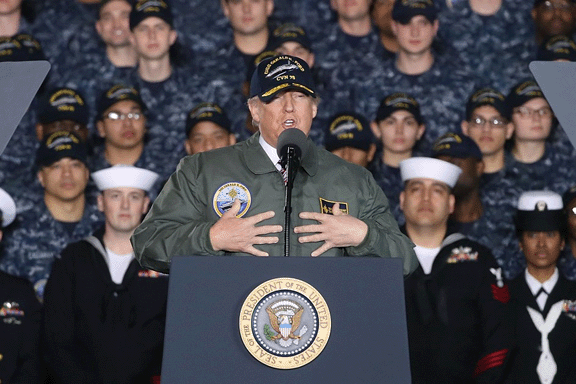
Trump’s dangerous expansion of executive war powers For decades, Congress has relinquished its constitutional role in declaring war. But Trump is taking it to new extremes. Politico, By BONNIE KRISTIAN 04/03/17 With Washington distracted by the health care debate, President Donald Trump has quietly overseen an expansion in the administration’s war-making powers, giving the Department of Defense greater autonomy to conduct military operations independent of the White House.
Already, the Pentagon has used this expanded authority in Yemen, where the U.S. has recently conducted significant air operations against AQAP, an Al Qaeda offshoot. And on Friday, Trump extended the authority to parts of Somalia where the U.S. is targeting Shabab, a terrorist group. In military terms, Yemen and Somalia are now “areas of active hostility,” a bureaucratic way of saying that the U.S. is conducting military operations there, with little input or oversight from either the White House or Congress.
This expanded bombing campaign, though, could be just the tip of the iceberg. In early March, The Guardian reported that the White House is considering a secret Pentagon proposal to designate temporary areas of active hostility in which the military could launch what amounts to six-month wars without congressional approval. Under the proposal, once the president signs off on a temporary battlefield, commanders would be given “the same latitude to launch strikes, raids and campaigns” as they now have in active U.S. warzones like Iraq. Protections for civilians would also be scaled back.
These temporary battlefields, as The Guardian dubbed them, are not exactly new; the Obama administration already applied the label to conflicts in Afghanistan, Iraq, and Syria. But the proposal Trump is considering would expand and formalize that decision, stretching the temporary battlefield designation to cover entire countries in which the United States is technically not at war. Despite the bureaucratic language, Trump’s plan, if implemented, is a flagrant perversion of the Constitution, redoubling the worst excesses of the Obama administration and further undercutting the rule of law.
To understand the recklessness of this proposal, a little history is in order. Though it names the president as “Commander in Chief” of the U.S. military, the Constitution explicitly delegates the power to “declare war” to Congress. The choice of the word “declare” was a careful one, as James Madison’s notes from the Constitutional Convention reveal. Originally written as the power to “make war,” it was amended to communicate that while the executive is permitted “the power to repel sudden attacks” on American soil, it is not allowed to “commence war” independent of the legislature.
George Mason, the “father of the Bill of Rights,” was against “giving the power of war to the Executive, because [it was not] safely to be trusted with it,” Madison records, and Mason supported using “declare” as a means of “clogging rather than facilitating war [and instead] facilitating peace.”…….
With this “temporary battlefields” idea, the White House once again strips Congress of what was left of its responsibility for our military, taking unilateral control of foreign policy for the foreseeable future.
What specifically makes this new plan different from the operations of administrations past is the new autonomy it gives the military from civilian control, not only in terms of congressional oversight but also in terms of presidential direction. In Obama’s scheme, which was already far afield from the constitutional war powers framework, the president and his top national security advisers remained intimately involved in the approval process for U.S. strikes outside of active war zones in Afghanistan, Iraq, and Syria. With the new plan, military commanders would be able to make these decisions independently during 180-day periods. This puts major foreign policy decisions one step further away from congressional influence and civilian control………
this proposal is regression, not reform. It demolishes the last remnants of one our Founders’ most necessary constitutional protections, and it opens the gate to a host of dangerous, imprudent military interventions with no demonstrable connection to U.S. national security interests.
After the last 15-plus years of imprudent executive war-making, what we need is not less oversight of our foreign policy, but more—more open debate about our goals and strategy, more realistic risk analysis, and more careful determination of what political outcomes we can achieve through military force.
Bonnie Kristian is a fellow at Defense Priorities. She is a weekend editor at The Week and a columnist at Rare, and her writing has also appeared at Time Magazine, CNN, Politico, Relevant Magazine, The Hill, and The American Conservative, among other outlets. http://www.politico.com/agenda/story/2017/04/trumps-dangerous-expansion-of-executive-war-powers-000387
April 7, 2017
Posted by Christina Macpherson |
politics, USA, weapons and war |
Leave a comment
Is North Korea putting a nuclear-tipped bargaining chip on the table? Reuters, By James Pearson and Ju-min Park | SEOUL, 6 Apr 17,
As the leaders of China and the United States sit down for a summit on Thursday, North Korea has made sure it also has something on the negotiating table: A nuclear-tipped bargaining chip.
North Korea launched a projectile on Wednesday, which U.S. officials said appeared to be a liquid-fueled, extended-range Scud missile that only traveled a fraction of its range before spinning out of control and crashing into the sea.
The launch was North Korea’s latest in a long series of missile and nuclear tests that have accelerated in their variation and intensity over the last two years.
And now, experts agree, North Korea is closing in on the ability to hit the United States with a missile, a goal that for decades has been the subject of Pyongyang’s vivid propaganda posters.
“They’ve been able to put a nuke on a missile for a while now,” said Jeffrey Lewis of the California-based Middlebury Institute of International Studies.
“The stated purpose of the last test was to validate the nuclear weapon design that would arm all of North Korea’s missiles,” Lewis said of North Korea’s September 2016 nuclear test – its fifth and largest to date.
Since then, North Korea has further ramped up its tests and rhetoric, emphasizing a consistent message: To create a nuclear device small enough to mount on an intercontinental ballistic missile (ICBM), and fire it at the United States.
“If we push the button, the bombs will be fired and reduce the U.S. to ashes,” an editorial in the ruling Workers’ Party newspaper the Rodong Sinmun said on Wednesday.
North Korea now has the strength to “wipe out” the United States “in a moment” with an H-bomb, the editorial said.
“This is again our warning”.
BARGAINING CHIP From last year, North Korea took the rare step of publicizing images of its missile equipment tests, convincing analysts that Pyongyang’s banned program was further along toward successfully testing an intercontinental ballistic missile (ICBM) than first thought.
“The first few tests might fail, but that’s not good news because they’ll learn,” said Lewis. “How long it takes to make it work is anyone’s guess. Maybe a couple of years, maybe the first time”………
It was not clear if Wednesday’s launch was deliberately timed to coincide with Thursday’s summit between China’s President Xi Jinping and U.S. President Donald Trump in Florida, where North Korea is expected to be a prime topic of discussions.
Some experts think North Korea has tried to make sure the two world leaders are aware Pyongyang has a bargaining chip in any forthcoming moves to clam down on its weapons programs…….http://www.reuters.com/article/us-northkorea-missiles-bargaining-idUSKBN17811R
April 7, 2017
Posted by Christina Macpherson |
North Korea, politics international |
Leave a comment
 Amazing that they can pretend that this thing is “non profit”. Backed by nuclear lobbyists like Rod Adams, and with board members like Lenka Kollar (Director of Business Strategy at NuScale Power where she is working to bring NuScale’s small modular reactor to market through business plan development)
Generation Atomic asks the public for donations, and if you donate, they’ll supply a shirt for you to publicise the nuclear industry, on the March For Science on 22 April.
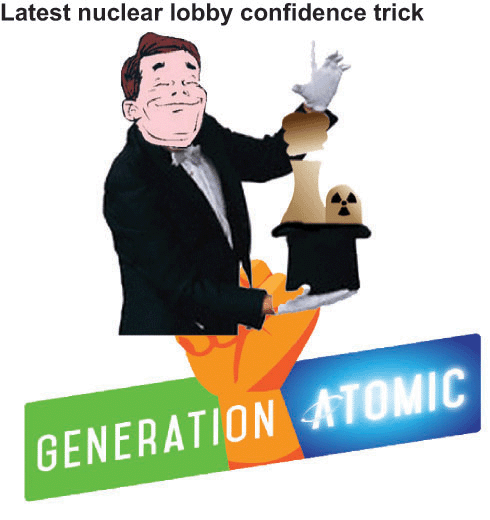
Advocating For Nuclear Energy — There’s An App For That, Forbes, James Conca, 6 Apr 17 There’s a new App that helps you advocate for nuclear energy. Named Atomic Action, it’s from a non-profit grassroots start-up, called Generation Atomic, that specializes in door-to-door canvassing operations and gamifying nuclear advocacy……
The developer, uCampaign, is a pioneer in gamifying advocacy, successfully creating and deploying similar tools for issues and political campaigns in the 2016 elections. Gen A’s team is taking Atomic Action public tomorrow, April 5th. Those interested will be able to download the app beginning tomorrow in Apple’s App Store or the Google Play Store, free of charge…….
When a Gen A volunteer knocks on a door, they present potential supporters with an entirely digital experience on a handheld or mobile device. On the screen are facts about three main benefits of nuclear energy:
– Jobs & Economy
– Affordable Energy
– Environment
Volunteers allow potential supporters to self-select issues through Gen A’s tailored digital platform. Following the conversation, canvassers send the new supporters a text message invitation to download the Atomic Action app.
Supporters even earn points by sharing content, contacting legislators, attending meetings, and recruiting new supporters. The engine for this campaign was rooted at the campuses of the University of Pittsburgh and Pennsylvania State University. Gen A has established two officially-recognized student chapters at each university. Thus far, of the thousands of people Gen A has had a conversation with, 53% sign up to support nuclear…….
The nuclear industry is vilified in the press, scorned by green activists, and ignored by politicians…..But it cannot seem to pierce the unfair image that has been painted by irrational – and baseless – fear……..Above all, the industry must wrest control of the green message.
April 7, 2017
Posted by Christina Macpherson |
spinbuster, USA |
2 Comments
 Former Chernobyl Neighbors Diagnosed with Rare Cancer Years Later, in NYC http://www.livescience.com/58503-rare-cancer-in-new-yorkers-linked-to-chernobyl-exposure.html By Sara G. Miller, Staff Writer | April 2, 2017 WASHINGTON — When 10 people in New York City developed a very rare form of eye cancer over just a four-year period, doctors were puzzled. The cancer, called vitreoretinal lymphoma, had been diagnosed in the U.S. only a handful of times over the previous 20 years.
The doctors tried to figure out what might have caused this rare cancer in these 10 patients, all of whom were diagnosed between 2010 and 2013, and they discovered that six of the patients had an interesting connection: They all had lived near the Chernobyl Nuclear Power Plant.
The Chernobyl disaster is considered the worst nuclear power plant accident in history: On April 26, 1986, an explosion occurred at the plant in Ukraine, leaking massive amounts of cancer-causing radiation into the atmosphere. [Cancer-Fighting Diet: 6 Tips to Reduce Your Risk]
Vitreoretinal lymphoma is a type of eye cancer that affects white blood cells in the retina, the optic nerve or the vitreous humor (the gel-like substance found inside the eye), said Roxana Moslehi, a genetic epidemiologist at the University at Albany, State University of New York, and the senior author of the study on the New York cases. The doctors who diagnosed the cancers had reached out to Moslehi when they realized they were seeing something strange happening with the rates of this cancer, she said.
Moslehi set out to determine if the cases of vitreoretinal cancer represented a “cluster” — in other words, a group of cases that are close together in time and location and occur at higher rates than expected. She presented her findings here today (April 2) at the American Association for Cancer Research’s annual meeting. The findings have not been published in a peer-reviewed journal.
Based on data from the New York State Cancer Registry, Moslehi found that statistically, there should be only one case of vitreoretinal lymphoma in New York state in a four-year period. So to find 10 cases in New York City alone in that same time period was certainly “unanticipated,” and represented a cluster, she said. Moslehi also looked at national rates of the disease, and also found incredibly low rates.
To figure out what could be causing this cluster, the researchers looked for commonalities among the patients, Moslehi said. They noted that eight of the 10 were of Ashkenazi Jewish descent, she said.
But even more interesting to the researchers was that six of the 10 patients had lived near Chernobyl at the time of the disaster, Moslehi said. Four of the patients had lived in Ukraine, one patient had lived in Poland and one patient had lived in Moldova, according to the case report.
“It was very surprising to discover this,” Moslehi told Live Science. The cause of vitreoretinal lymphoma is unknown, “so any clues that you get as to possible causes make you very excited,” she said. [10 Do’s and Don’ts to Reduce Your Risk of Cancer]
Indeed, in looking through the literature, the researchers found several studies linking other types of lymphoma to exposure to radiation, Moslehi said. For example, clean-up workers at Chernobyl have been shown to have higher rates of a type of cancer called chronic lymphocytic leukemia, she said. In addition, rates of leukemia in children and adults are increased in people who were exposed to either Chernobyl or the atomic bombs that the U.S. dropped on Japan during World War II, she said. (Both leukemia and lymphoma affect white blood cells.)
The New York City patients who had lived near Chernobyl ranged in age from 62 to 85 at the time of their diagnosis, according to the case report. The diagnoses took place between 24 and 27 years after the nuclear disaster, meaning that a number of the patients were in their late 30s when the disaster took place. Moslehi is still looking at the cases in the other four patients, who did not live near Chernobyl, for clues in those cases, she said.
There was also another cluster of cases that involved related conditions, called myeloproliferative disorders, that was found in Israel, Moslehi said. Myeloproliferative disorders cause blood cells proliferative abnormally. Similar to the group in New York City, the patients in Israel were of Ashkenazi Jewish ethnicity and lived near Chernobyl at the time of the disaster.
Moslehi noted that they “still cannot link this disease or lymphoma to radiation per se” — more studies are needed to fully understand the cause. For example, it may be that Ashkenazi Jews are more susceptible to the effects of radiation, she said.
April 7, 2017
Posted by Christina Macpherson |
health |
Leave a comment








 nuclear-news