Foreign Ministers at G7 declare support for Iran nuclear agreement

 G7 FMs declare support for Iran’s nuclear deal IRNA http://theiranproject.com/blog/2017/04/11/g7-fms-declare-support-irans-nuclear-deal/ – The G7 Ministers of Foreign Affairs in the final declaration of their meeting in Lucca, Italy have expressed support for the 2015 nuclear deal between Iran and six world powers, known also as the Joint Comprehensive Plan of Action (JCPOA).
“We support the Joint Comprehensive Plan of Action (JCPOA) as an important contribution to the non-proliferation regime,” the Group of 7 (G7) Industrialized nations, including Canada, France, Germany, Italy, Japan, the United Kingdom, and the United States, said in Italy.
“Continued and full implementation of the JCPOA is essential to build confidence that Iran’s nuclear program is exclusively peaceful in nature,” the declaration further read.
The G7 foreign ministers also called for full commitment by all parties involved in the nuclear deal.
“We value the JCPOA’s comprehensive structure and the commitment by all parties to its solid verification mechanism,” they said. We commend and continue supporting the IAEA in its crucial work in Iran, including monitoring and verification to help ensure compliance with Iran’s JCPOA commitments and safeguard obligations, thus playing a key role in fostering mutual trust,” they said.
They further added that, “We stress the need for all parties to entirely and consistently fulfill all their commitments under the JCPOA in good faith.”
The G7 foreign ministers also asked the Islamic Republic of Iran to remain to comply with its JCPOA-commitments.
“We reaffirm the need for Iran to strictly abide by all its nuclear related commitments,” they said in their declaration.
The declaration further referred to the need for the Resolution 2231 of the United Nations Security Council to be fully implemented.
“UN Security Council Resolution 2231 needs to be fully implemented, including its provisions prohibiting the transfer of arms,” the declaration noted.
It also touched upon Iran’s role in Syria and noted, “We call upon Iran to play a constructive regional role by contributing to efforts to achieve political solutions, reconciliation and peace in Syria, Iraq, and Yemen and other parts of the region and to cooperate in countering the spread of terrorism and violent extremism.’
According to the G7 official website, the G7 Ministers of Foreign Affairs met on 10-11 April in Lucca. A traditional meeting held once a year between the seven most industrialized countries of the world.
US reaffirms Iran nuclear agreement

 http://www.argusmedia.com/news/article/?id=1440687 11 Apr 2017, Washington, 11 April (Argus) — The US administration’s new focus on crises in Syria and North Korea is highlighting a full retreat from President Donald Trump’s pledge to rescind the nuclear agreement his predecessor signed with Iran.
US secretary of state Rex Tillerson today reaffirmed support for the multilateral agreement — the Joint Comprehensive Plan of Action — that lifted restrictions on crude exports from Iran in January 2016. The EU, Russia and China also are parties to the agreement.
The G7 foreign ministers, meeting in Lucca, Italy, in a statement hailed the agreement’s “important contribution to the non-proliferation regime.” Implementation of the agreement will “build confidence that Iran’s nuclear program is exclusively peaceful in nature,” the ministers said.
The US’ approach to Iran so far has not departed greatly from the path former president Barack Obama’s administration paved following the lifting of the nuclear-related sanctions, even though Trump still denounces the deal. Trump imposed new sanctions on Iran following tests of ballistic missiles, just like his predecessor did. And the Pentagon continues to view Iran as a threat to US interests in the Middle East, including the freedom of navigation in the straits of Hormuz and Bab al-Mandeb.
Iran since the lifting of the nuclear-related sanctions increased production by more than 900,000 b/d to 3.8mn b/d in February.
Senior White House officials contend that Iran’s missile tests are evidence of a covert nuclear weapons program. Iran says its program is defensive in nature.
The US administration promised to push for a stronger international response to the missile tests than Obama did. But today’s G7 statement only expresses “deep regret” over the tests.
The need to coordinate sanctions programs with the EU is likely a key driver in the new administration’s approach. EU officials also persuaded US senators to delay advancing a widely supported bill to expand the scope of sanctions on Iran over the missile tests. The Senate Foreign Relations Committee will wait until after the Iranian presidential election on 19 May to schedule a vote on the bill, committee chairman Bob Corker (R-Tennessee) said.
The G7 statement calls on Russia and Iran, as allies of Syrian president Bashar al-Assad’s regime, to ensure Syria’s compliance with the UN convention banning the use of chemical weapons. But the US is directing the bulk of its criticism over Assad’s alleged use of chemical weapons against civilians at Russia.
Overall analysis of the Iran Nuclear Agreement
The Impact of the Iran Nuclear Agreement http://www.cfr.org/iran/impact-iran-nuclear-agreement/p39032
Zachary Laub, Senior Copy Editor/Writer April 11, 2017
Introduction
Iran has dismantled much of its nuclear program and given international inspectors extensive access to sensitive sites under an agreement known as the Joint Comprehensive Plan of Action (JCPOA). Under its terms, the United States, European Union, and United Nations have lifted sanctions that had crippled the Iranian economy, but more than year after the accord took effect, Iranians have yet to see the recovery that President Hassan Rouhani had promised. Meanwhile, as the Trump administration has vowed a more aggressive approach to Iran and the U.S. Congress considers levying new sanctions, international businesses, sensing uncertainty, have largely held back from investing in the country.
The JCPOA, which was signed in July 2015 and went into effect the following January, imposes restrictions on Iran’s stockpiles of uranium and its ability to enrich it. The so-called P5+1—that is, the five permanent members of the UN Security Council (China, France, Russia, the United Kingdom, and United States) and Germany—negotiated the agreement with Iran over nearly two years. During this period, the Obama administration said its intent was to set back Iran’s nuclear program so that any decision to sprint toward producing fissile material for a weapon—an indicator known as “breakout times”—would take at least a year, up from just a few weeks.
Nuclear restrictions on Iran. To extend that breakout time, the agreement requires that uranium enrichment at Fordow and Natanz be restricted and a heavy-water reactor, at Arak, have its core rendered inoperable; its plutonium byproduct, the P5+1 countries feared, could have been reprocessed into weapons-grade material. These facilities are now being repurposed for research, industrial, or medical purposes, and subjected to inspections by monitors from the UN nuclear watchdog, the International Atomic Energy Agency (IAEA). The accord imposes limits on the numbers and types of centrifuges Iran can operate, as well as the size of its caches of enriched uranium. (Mined uranium has less than 1 percent of the uranium-235 isotope, and centrifuges increase that isotope’s concentration. Uranium enriched to 5 percent is used in nuclear power plants, and at 20 percent it can be used in research reactors or for medical purposes. High-enriched uranium, at some 90 percent, is used in nuclear weapons.) The JCPOA also aims to guard against the possibility that Iran could develop nuclear arms in secret at undeclared sites.
Many of the JCPOA’s nuclear provisions have expiration dates. After ten years, for example, centrifuge restrictions will be lifted, and after fifteen years, so too will limits on the low-enriched uranium it can possess, as well as the IAEA’s access to undeclared sites.
Monitoring and verification. Among the open-ended provisions, Iran is bound to implement and later ratify an “additional protocol” to its safeguards agreement with the IAEA, which gives IAEA inspectors unprecedented access to Iran’s nuclear facilities. (As a signatory to the Nonproliferation Treaty, or NPT, Iran has committed to never pursue nuclear weapons, but it is entitled to pursue nuclear technology for peaceful purposes.) The agency’s director-general issues quarterly reports to the IAEA Board of Governors and UN Security Council verifying Iran’s implementation of its nuclear commitments.
The JCPOA established the Joint Commission, with the negotiating parties all represented, to monitor implementation of the agreement. That body, chaired by Federica Mogherini, the EU foreign policy chief, is charged with dispute resolution, and a majority vote of its members can gain IAEA inspectors access to undeclared sites they consider suspect. It also oversees the transfer of nuclear-related or dual-use materials.
Sanctions relief. In exchange for these limitations on its nuclear program and opening up access to international inspectors, the EU, UN, and United States all committed to lifting sanctions that they had imposed on Iran for its nuclear program. While the United States has only suspended extant nuclear sanctions, it pledged in the JCPOA to remove specified entities from sanctions lists and seek legislation to repeal the suspended sanctions within eight years, as long as the IAEA concludes that Iran’s nuclear activities remain peaceful in nature.
Still, other U.S. sanctions [PDF], some dating back to the hostage crisis in 1979, remain in effect. They cover matters such as ballistic missile production, support for U.S.-designated terrorist groups, and domestic human rights abuses. The United States has stopped enforcing its sanctions on oil exports, freeing Iran to trade on international markets again, but restrictions on financial transactions remain in place. Many banks and other companies, including foreign subsidiaries of U.S. businesses, are wary of doing business in Iran for fear of incurring fines or being barred from dealing on Wall Street. A major exception to U.S. primary sanctions allows Boeing to sell aircraft to Iranian airlines.
New Security Council resolutions are periodically needed to keep UN sanctions suspended, so, by alleging a major violation, any one of the P5 members can veto a new resolution. This “snapback” mechanism is set to remain in effect for ten years, after which point the UN sanctions are set to be repealed.
Has Iran upheld its obligations?
Implementation Day, on which sanctions were lifted, came once the IAEA certified that Iran had met preliminary requirements, including taking thousands of centrifuges offline, rendering the core of the Arak heavy-water reactor inoperable, and selling excess low-enriched uranium to Russia. Since then, the IAEA has mostly found Iran in compliance with the JCPOA’s requirements. Iran twice exceeded the amount of heavy water that it is allowed under the agreement, the IAEA reported, but quickly resolved it.
“Monitoring is a physical act, but verification is a political act.” —Christopher Bidwell, Federation of American Scientists
The challenge inspectors face is that they are “looking to prove the negative,” says Christopher Bidwell, a senior fellow at the Federation of American Scientists. “IAEA reports talk about where Iran is compliant, but then are silent on known rough issues,” he says, highlighting military sites, for which inspectors must seek access from Iranian authorities or adjudication by the Joint Commission. Also omitted from the public record, the International Crisis Group notes, are reports on Iran’s caches of low-enriched uranium and research on centrifuges. “Monitoring is a physical act, but verification is a political act,” Bidwell says. “How sure are you that what you’ve monitored has told you what you want to know?”
Have the P5+1 countries upheld their obligations?
The United Nations, European Union, and United States all repealed or suspended the sanctions that the JCPOA specified be lifted on Implementation Day, and since then the United States has also unfrozen or delivered to Iran certain seized funds. (Liquid assets freed up in European and Asian banks might have totaled some $50 billion, according to a U.S. Treasury official; in addition, the United States refunded $1.7 billion delivered for an arms deal that was signed before the 1979 revolution but never fulfilled.) Most significantly, the United States is no longer enforcing secondary sanctions on Iran’s oil sector, which has allowed Iran to ramp up its oil exports to nearly the level it had been prior to sanctions. The International Monetary Fund (IMF) estimated in October [PDF] that Iran’s GDP was growing at 4.5 percent in 2016 as it boosted its oil production to 3.6 million barrels per day.
How is Iran’s economy performing?
Iranians have not seen as robust an economic recovery as many had expected to follow the JCPOA’s implementation. A morass of U.S. sanctions unrelated to the nuclear program has discouraged major international banks from investing in the country and made many companies wary of expanding into Iran. They fear being held liable for transacting with the numerous sanctioned entities associated with, for example, the Iranian Revolutionary Guard Corps (IRGC), which is ubiquitous in some industries. Uncertainty over whether the nuclear sanctions might be restored persists.
But factors unrelated to sanctions are also hampering the recovery. Corruption, mismanagement, and aging infrastructure are widely acknowledged barriers to industry, and, at about $50 a barrel as of April 2017, oil is trading at less than half the price it was five years earlier, so the revenues to be made from export don’t go as far. The IMF projected that Iran’s growth would “taper sharply” [PDF] in 2017 as it would have trouble surpassing its pre-sanctions level of oil production, and in March 2017 Iran said it would limit its oil production to 3.8 million barrels per day if OPEC members’ agreement to cap their production—a bid to raise oil prices—holds.
With the economy underperforming compared to what Rouhani had promised, some Iranian politicians have accused the United States of dealing in bad faith. Supreme Leader Ali Khamenei, who has expressed ambivalence about the JCPOA, criticized the faltering recovery. But so too has Foreign Minister Javad Zarif, who negotiated the agreement. He said at CFR in September 2016, “it takes a lot to change the global climate that is afraid of the United States taking action against any bank that does any business with Iran.” Referring to U.S. Treasury regulations, he added, “there is one sentence that it’s OK to do business with Iran and about five pages of ifs and buts,” discouraging banks from entering the market.
Do U.S. politics jeopardize the JCPOA?
On the campaign trail, Trump pledged to dismantle or renegotiate the nuclear agreement, echoing the criticisms made by some members of Congress as the agreement was being finalized. Many objected to sanctions relief on the grounds that it would enrich Iran and allow it to expand its influence in regional conflicts like the Syrian civil war. Critics also said that monitoring provisions in the JCPOA offered no guarantee that Iran could not covertly develop a nuclear weapon.
Trump could reimpose waived sanctions or add new ones by presidential prerogative, enact statutory sanctions passed by Congress, or allow the presidential waivers of nuclear sanctions to lapse when they come due for renewal. Any of those measures could be perceived by either Iran or other members of the P5+1 as the United States reneging on its commitments.
After Iran tested ballistic missiles in late January 2017, the administration extended sanctions to twenty-five individuals and entities associated with either the missile program or the IRGC’s expeditionary Quds Force. (Though ballistic missiles could be used to deliver nuclear weapons, they are beyond the scope of the JCPOA; the UN Security Council resolution that codified the JCPOA contains only nonbinding language on the matter.) “It wasn’t a drastic departure from previous policy, including from the Obama administration,” says Ariane M. Tabatabai, a visiting assistant professor at Georgetown’s Edmund A. Walsh School of Foreign Service.
A bill cosponsored by the top Republican and Democrat on the Senate Foreign Relations Committee could prevent the president from fulfilling the U.S. obligation to delist certain entities within eight years of implementation; it could also be construed as impeding the benefits Iran can accrue from sanctions relief. That would “threaten the ongoing implementation of the nuclear deal,” says the Arms Control Association, an independent Washington-based nonproliferation group.
Do Iranian politics jeopardize the JCPOA?
The JCPOA is contentious in Iran as well. Rouhani is running for reelection on May 19, and “the main thing he’s being judged on by the electorate is the economic recovery,” Tabatabai says.
“The Rouhani government oversold its ability to generate economic recovery following the sanctions relief,” she says, “and so now it is dialing back expectations of what is realistic.” The government is now arguing that the recovery will take more time, and that its lag cannot be attributed to sanctions alone.
Hard-liners in Iran argue that the United States is angling to keep the Iranian economy depressed and that Rouhani was hoodwinked into unfavorable terms, a view they say is bolstered by extreme rhetoric from some members of the Trump administration and Congress. They argue that Iran has “redesigned its nuclear facilities while the sanctions have only been suspended,” and so the United States can reinstate sanctions with relative ease even as the Iranian nuclear program has been permanently set back, says Mohammad Ayatollahi Tabaar, an assistant professor at Texas A&M University’s Bush School of Government and Public Service
While some U.S. lawmakers continue to criticize the JCPOA, the other members of the P5+1 are firmly behind it. Many close watchers of the accord say that if the United States were to reinstate sanctions without presenting clear evidence of Iranian cheating, its negotiating partners would be unlikely to follow suit and resurrect the global regime that drove Iran to the negotiating table. “Iran’s goal is to create a gap between the U.S. and EU,” says Tabaar, so Iran likely won’t renege on its nuclear commitments. Instead, he says, hard-liners might push back against the United States in areas beyond the scope of the JCPOA, such as testing ballistic missiles or boosting its support for its clients in Iraq, Syria, or Yemen.
More on this topic from CFR
Problems in Europe with Westinghouse nuclear fuel assemblies
 A Bankruptcy That Wrecked Global Prospects Of American Nuclear Energy, Forbes, Kenneth Rapoza “……….Unlike with fossil fuels, in nuclear, fuel assemblies are a high-tech and R&D-intensive product. These assemblies can make even reactors run more efficiently, sometimes exceeding their original lifespan. But under investment impacted the quality and comparative performance of WEC versus their main rival, Russian owned TVEL, a unit of Rosatom. In some markets fuel rods supplied by Westinghouse have failure rates almost 1.5 times greater than those manufactured by its competitors, according to at least one utility in Finland that has a Russian reactor.
Westinghouse supplies fuel assemblies mainly to Europe where it has always used its mighty lobbying clout in Brussels to prop their market share. Back in 2003, the European Commission adopted directive 2003/54/EC which made it compulsory for EDF, the French energy giant, to buy nuclear fuel from an “alternative vendor”. This completely opened the door to WEC, with wheels already in motion a year earlier. EDF buys about 15-20% of its fuel from Westinghouse today.
WEC had Washington’s help within companies operating Rosatom reactors, fiercely lobbying for nuclear fuel supply diversification in Eastern Europe. They tried to supply fuel assemblies to Finland and Czech Republic, but both countries eventually chose TVEL. The Czech even had to cancel their contract with Westinghouse amid safety concerns at their Temelin site, despite a large-scale lobbying push which involved letters from the European Commission to utilities encouraging them to switch to WEC. As of now, even after Washington’s cheerleading Toshiba, Westinghouse’s biggest star as far as nuclear fuel assembly diversification goes is Ukraine.
It’s quite understandable that Ukraine, effectively at war with Russia, may be tempted to turn a blind eye to the issues facing Westinghouse. But concerns over incident risks are growing amid reports that plants using WEC’s fuel have had frequent emergency outages. Many claim that corruption and lack of safety culture in Ukraine make it a really dangerous game potentially leading to another Chernobyl, according to a Washington Times columnist with a flare for the dramatic.
Westinghouse told me that their recent contracts with Ukraine to supply Russian built reactors with fuel assemblies was still intact……….
For Westinghouse’s global ambitions, China was the really big picture and Europe was its hub to challenge Russia’s market in the lucrative fuel assembly business. WEC says that the bankruptcy here will not affect their businesses there, but judge Michael Wiles rejected a request by the company to allow for Apollo’s loan to go towards WEC’s European units. Without those loans, the European companies could face their own funding woes now. AxilPartners said that a cash pool the European affiliates normally draws from was halted by the Swedish bank that serves as its monitor. It is unclear who this monitor is, or what that means precisely, Debtwire’s Tracy says. But without that bank, pensions in Europe could become a problem for Westinghouse, as well as tax and payroll issues cropping up in the U.K.
Westinghouse, meanwhile, is hoping for the best. Or as industry cynics would say: Westinghouse is hoping for pixie dust……https://www.forbes.com/sites/kenrapoza/2017/04/13/a-bankruptcy-that-wrecked-global-prospects-of-american-nuclear-energy/#608e8b7e17a1
New radiation detection system begins operations at Port of Los Angeles
 https://homelandprepnews.com/stories/21961-new-radiation-detection-system-begins-operations-port-los-angeles/ The U.S. Department of Homeland Security (DHS) recently announced that a new radiation detection system recently began operations at the Trans Pacific Container Service Corporation (TraPac) terminal at the Port of Los Angeles.
While all incoming cargo into the port is scanned by radiation detecting equipment, the new system automates the process to expedite trade and provide a needed layer of nuclear protection. Approximately two million containers pass through the TraPac terminal every single year.
The new process begins as rail-bound cargo is placed on conveyers by automated carriers. The system then transports the cargo through a radiation portal monitor for detection. If all cargo passes the security check, the cargo is then transported to rail carriers for transportation to its final destination.
TraPac originally envisioned the system as part of a move to automate scanning processes. At the same time, U.S. Customs and Border Protection needed a new means to scan ship-to-rail containers for radioactive materials. DHS then worked with the Pacific Northwest National Laboratory to test, evaluate, and approve the new system for live rail operations.
DHS said the new system offers a more efficient approach to preventing illicit radioactive materials from entering the country.
The Sahara’s little known nuclear wasteland
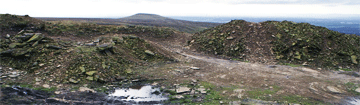 In the Sahara, a Little-Known Nuclear Wasteland, “There’s nothing nuclear in what I do. It’s just rocks we dilute into powder.”, Catapult, Hannah Rae Armstrong Apr 12, 2017 Activist Azara Jalawi lives with her mother, a nomad; her daughter Amina, who watches Mexican soap operas and dates a local human trafficker; her son Doudou, nicknamed “Slim Shady,” and a lean girl, probably a slave, in the town of Arlit, Niger, a mining hub of about forty thousand set deep within the Tuareg Sahara, a slow-baking proto-Chernobyl, a little-known nuclear wasteland.
Around Arlit, prehistoric volcanoes and petrified forests rise from the sand. Beneath it lie the skulls of giant crocodiles who preyed on dinosaurs a hundred million years ago. Within the rocky plateaus are havens like the oasis at Timia, where orange, grapefruit, and pomegranate groves ripen and flower in the desert. For forty years, the French nuclear-energy giant Areva has mined uranium here, and milled it into yellowcake, the solid concentrate that is the first step towards enriching uranium for nuclear fuel or weapons. Three miles outside the town, fifty million tons of radioactive tailings—a waste byproduct containing heavy metals and radon—sit in heaps that resemble unremarkable hills. In strong winds and sandstorms, radioactive particles scatter across the desert. “Radon daughters,” odorless radioactive dust, blanket the town. Public health and the environment exhibit strange symptoms of decay—mysterious illnesses are multiplying; grasses and animals are stunted. The people of Arlit are told that desertification and AIDS are to blame. ………..
Living atop an open-pit uranium mine has made the people ill, in ways they do not understand. Breathing radioactive dust, drinking contaminated well water, and sleeping between walls stitched from radioactive scrap metal and mud, the people tell stories to fill the gaps in their knowledge. ………
At her brother Doudou’s high school, funded by the mining company, students are told not to do drugs or set things on fire. Teachers tell Doudou nothing about the contaminated well water he consumes daily. At lunch on my first day in Arlit, I ask nervously about the source of the water in a chilled glass bottle on the table. “Don’t worry, it’s the well water,” they assure me. “We drink it all the time.” I learn later that well water readings reveal contamination one hundred times beyond the World Health Organization’s threshold for potable water.
………. a dim awareness of the contamination risks was just beginning. Almoustapha Alhacen, a yellowcake miller and environmental activist, recognizes himself on the cover of a 2012 book I’ve brought with me: “Being Nuclear: Africans and the Global Uranium Trade.” He is the man wearing a gas mask and gloves. “The problem with Areva is it never informed people that radioactivity exists and that it is dangerous,” he says. An NGO called the Commission for Independent Research and Information on Radioactivity (CRIIRAD), created by a French EU deputy after the 1986 Chernobyl catastrophe, equipped him with a device and trained him to take readings. Once, he recalls, he saw a pregnant woman eating mud next to the road that leads from the mine to the town. This road is often tamped down with clay from the mines, and the tires that cross it regularly give it a fresh, invisible wash of radon. Almoustapha took a reading there and found radioactivity twenty-four times higher than the safe level. At markets selling scrap metal used for building houses, and at the community taps where people draw water, he took readings that were off the charts.
“Arlit was built around uranium. And humanity needs uranium,” Almoustapha says, speaking quickly and with rage. “But what happens next for us, when the uranium runs out, Areva leaves, and we are left with 50 million tons of radioactive waste?” As an activist, he ponders the future and the environment with seriousness. But these become abstract concerns before the fact of his job, which he needs right now. In a white turban and sunglasses, with sequined leather jewelry adorning his chest, he protests: “There’s nothing nuclear in what I do. It’s just rocks we dilute into powder, powder we dilute into liquid. It’s just mechanics, like for any car.” …….
If any state benefits from the distraction counter-terrorism provides from these underlying issues, it is France. Insecurity shields the mines from environmental scrutiny. Threats justify deepening militarization, an ongoing erosion of Nigerien sovereignty and independence. And the French mines still face no real obstacle to radiating the radiant desert. In fact, they’re expanding. A new mine—Africa’s largest—is being built near Arlit, at a site called Imouraren. There, a “security belt” encircles 100,000 acres, marking the land off limits to nomads.
https://catapult.co/stories/in-the-sahara-a-little-known-nuclear-wasteland#
US: Nuclear waste mislabeled at Washington state site
Skagit Valley Herald, Apr 13, 2017 RICHLAND, Wash. (AP) — A shipment of nuclear waste from a commercial power plant located on the Hanford Nuclear Reservation in Washington state was improperly labeled when it was trucked to a commercial disposal site, the Nuclear Regulatory Commission said.
As a result, Energy Northwest, the consortium that operates the Columbia Generating Station nuclear plant, has been temporarily barred by state regulators from sending waste to the US Ecology disposal site located on leased Hanford land, the Tri-City Herald (http://bit.ly/2pyWwWi ) reported Thursday.
The Energy Northwest plant makes electricity and is located on the sprawling Hanford site, which is half the size of Rhode Island. Energy Northwest is separate from Hanford’s past mission of creating plutonium for the nation’s nuclear weapons, which ended in the 1980s. Plutonium production left Hanford with the nation’s largest collection of radioactive waste.
The incident occurred when a Nov. 9 shipment from the power plant to the disposal site turned out to be more radioactive than claimed on the shipping manifest, the newspaper said…….http://www.goskagit.com/news/state/us-nuclear-waste-mislabeled-at-washington-state-site/article_77794de4-a84d-5bcf-9acb-cadc1146f9b3.html
April 13 Energy News

Opinion:
¶ “How a small tribe in Nevada shut down coal and built a solar farm” • President Donald Trump brags about bringing back coal jobs, but tends to gloss over the fuel’s negative health effects for workers and those who live nearby. The Moapa Band of Paiutes in Nevada know all about those harmful health effects. And they did something about it. [Inhabitat]
 Solar project of the Moapa Band Of Paiutes
¶ “President Trump, it’s time we left coal behind” • In the wake of President Trump’s latest executive orders to undo Obama’s efforts on climate and energy, it has become clear that climate science denial isn’t the only blind spot of this administration. It also suffers from what Australian commentator Waleed Aly calls “commercial denialism.” [The Guardian]
¶ “Understanding Trump’s Energy Plan: Three things to know” • By way of an executive order, US…
View original post 831 more words
Cruel Intentions — Opposition to Climate Change Response is Swiftly Becoming Illegal

“From 1957 onward, there is no doubt that Humble Oil, which is now Exxon, was clearly on notice” about rising CO2 in the atmosphere and the prospect that it was likely to cause global warming… — Environmental Law Center’s Director Carroll Muffett in The New York Times
*****
We’ve known for some time that failing to respond to climate change is a callous cruelty of the worst kind imaginable. That continuing to burn fossil fuels and to delay a necessary transition to renewable energy will not only melt ice caps, provoke extreme weather the likes of which none of us have seen, flood coastlines and island nations, and threaten global food production, but it will also ultimately set off a hothouse mass extinction that is likely to be as bad or worse than the Permian.
We’ve known for decades now that the best, most moral, choice for human…
View original post 1,361 more words
Florida Emergency Declared as More Than 100 Wildfires Burn Across the State
The effects of global warming on temperature, precipitation levels, and soil moisture are turning many of our forests into kindling during wildfire season. — The Union of Concerned Scientists
*****
Florida Governor Rick Scott declared a state of emergency yesterday as a deepening drought and above average temperatures sparked a large wildfire outbreak.
(Florida is now under a state of emergency due to widespread wildfires.)
Over 100 wildfires across the state have now burned 20,000 acres, destroyed 19 homes, and blanketed dense population centers like Orlando with smoke. Moderate to severe drought conditions cover 42 percent of the state. And the result is the worst fire season since 2011 — a record outbreak for Florida which burned over 200,000 acres during the year.
So far for 2017, about 2.5 times the area of land that burns during a usual wildfire season by mid April has already been consumed. Fires…
View original post 402 more words
Disastrous 2016 shows British butterflies are ‘failing to cope’ with climate change

GR:Butterflies and other pollinators seem to be in steep decline around my home in Dewey-Humboldt, Yavapai County, Arizona. Monarch, Morning Cloak, and Swallowtail numbers shrank over the past few drought years. Part of the explanation for butterfly decline here, as in Britain is pesticide use and habitat loss. However, global warming with its rising temperature, droughts, and storms, is probably becoming as important. We just had wet winter, and I hope that this summer and next spring butterfly numbers will rebound.
Butterflies are like the canary in the coal mine. If they die, are we in danger too?
 Two-tailed Tiger Swallowtail (Papilio multicaudata) Arizona’s butterfly.
In Britain: “Butterflies are “failing to cope” with climate change and the pollution of the British countryside, experts have warned after a disastrous year saw population declines in 40 out of 57 species.
“The UK Butterfly Monitoring Survey found it had been the…
View original post 85 more words
South Koreans Give Moorside the Cold Shoulder…and who can blame them!

South Korea’s KEPCO urged not to invest in new nuclear power at UK’s NuGen Moorside
Last edited 12 April 2017 at 11:27am
11 April, 2017
28 members of the National Assembly of the Republic of Korea ‘Caucus on Post-Nuclear Energy’ in South Korea are calling on KEPCO not to invest in new nuclear power or the UK’s NuGen Moorside nuclear project. This comes after Greg Clark travelled to South Korea last week to meet KEPCO and seek support for the Moorside project, following the bankruptcy of Toshiba Westinghouse and Engie pulling out of the NuGen venture.
At a press briefing at the National Assembly at 09.00 KST on Tuesday 11th April, the National Assembly ‘Caucus on Post-Nuclear Energy’ and Greenpeace South Asia gave a joint statement to media.
Hannah Martin, Head of Energy at Greenpeace UK, said:
“Every nuclear power station currently being built in Europe and the USA has…
View original post 314 more words
Earth’s melting permafrost threatens to unleash a dangerous climate feedback loop
GR: Here are some additional comments on the expanded permafrost-melt findings I reported this morning. That study did not project the effect on global temperature. The article below is by respected climate scientist Joe Romm. Perceptions of the permafrost threat has waxed and waned over the past few years, but I think it has permanently waxed this time. There is one correction. I thought permafrost carbon would be released largely as methane. Romm says there will be a substantial amount of methane, but that most of the gas will be CO2.
 In this so-called “drunken forest,” in Alaska, the trees tilt because the once-frozen ground (permafrost) is thawing. CREDIT: NSIDC.
“New permafrost study underscores the critical importance of ambitious climate targets, like the Paris agreement.
“Global warming will defrost much more permafrost than we thought, a new study finds. Every 1°C (1.8°F) of additional warming would thaw one-quarter of the…
View original post 213 more words
April 12 Energy News
Opinion:
¶ “States And Cities Are Fighting Climate Change, With Or Without Nations” • The Under2 Coalition counts more than 150 local and regional governments as members, including huge cities like Beijing and small, rural, developing counties like Laikipia, Kenya. It is just one of several such organizations fighting climate change. [Capital Public Radio News]
 Emissions (United Nations Photo | Flickr)
¶ “Power prices are at record highs – but there’s a pleasant solution to fix that” • Tony Abbott promised that Australia would become a low cost energy superpower, so the carbon price was abolished and the renewable energy target was cut. Now, wholesale electricity prices have doubled, and prices for solar and wind power keep dropping. [The Guardian]
Science and Technology:
¶ February 2017 was the second warmest February in 137 years of modern record-keeping, according to a monthly analysis of global temperatures by…
View original post 768 more words
IAEA chief urges global support for decommissioning Fukushima plant
“Efforts to scrap the nuclear plant “extremely difficult” an understatement for yet impossible.
This is an admission . After 6 years wasted in lies and obfuscation, they finally admit that the Fukushima Daiichi nuclear disaster is not resolved, far from being resolved, that they can’t handle it on their own, and need all the help they can get from the international community to find solutions to contain this major nuclear disaster.

International Atomic Energy Agency chief Yukiya Amano has called for international cooperation in the decommissioning of the crippled Fukushima No. 1 nuclear complex.
“It is important to gather as much knowledge as possible from around the world and engage in the (decommissioning) with the cooperation of the global community,” Amano said at a news conference in Tokyo on Tuesday, calling efforts to scrap the nuclear plant “extremely difficult.”
While reiterating his agency’s support for dealing with the Fukushima plant, he said getting the international community to work together will serve as a good “reference” in the event other countries carry out their own decommissioning work.
The Fukushima crisis, the world’s worst nuclear disaster since the 1986 Chernobyl disaster, resulted in meltdowns at three reactors after a powerful earthquake and tsunami on March 11, 2011.
Decommissioning the crippled reactors is expected to take 30 to 40 years and the total cost has been estimated by the Japan Center for Economic Research, a private think tank, at ¥11 trillion ($98.9 billion), while a government panel estimated the total cost at ¥8 trillion.
Amano also expressed concern over the threat to regional security posed by North Korea’s repeated nuclear tests and missile launches, saying the IAEA was ready to immediately send inspectors to North Korea, even for a brief period.
In 2009, North Korea kicked out the IAEA’s monitoring staff from its Yongbyon nuclear facility. Last year alone, North Korea conducted two nuclear tests and test-fired more than 20 ballistic missiles.
1 This Month


Tell the Ukrainian Government to Drop Prosecution of Peace Activist Yurii Sheliazhenko

Petition to revoke the licensing of the Near Surface Nuclear Disposal Facility (NSDF) at Chalk River. https://www.ourcommons.ca/petitions/en/Petition/Details?Petition=e-7247


of the week – STOP SMALL MODULAR REACTORS IN CANADA
To see nuclear-related stories in greater depth and intensity – go to https://nuclearinformation.wordpress.com
-
Archives
- March 2026 (204)
- February 2026 (268)
- January 2026 (308)
- December 2025 (358)
- November 2025 (359)
- October 2025 (376)
- September 2025 (258)
- August 2025 (319)
- July 2025 (230)
- June 2025 (348)
- May 2025 (261)
- April 2025 (305)
-
Categories
- 1
- 1 NUCLEAR ISSUES
- business and costs
- climate change
- culture and arts
- ENERGY
- environment
- health
- history
- indigenous issues
- Legal
- marketing of nuclear
- media
- opposition to nuclear
- PERSONAL STORIES
- politics
- politics international
- Religion and ethics
- safety
- secrets,lies and civil liberties
- spinbuster
- technology
- Uranium
- wastes
- weapons and war
- Women
- 2 WORLD
- ACTION
- AFRICA
- Atrocities
- AUSTRALIA
- Christina's notes
- Christina's themes
- culture and arts
- Events
- Fuk 2022
- Fuk 2023
- Fukushima 2017
- Fukushima 2018
- fukushima 2019
- Fukushima 2020
- Fukushima 2021
- general
- global warming
- Humour (God we need it)
- Nuclear
- RARE EARTHS
- Reference
- resources – print
- Resources -audiovicual
- Weekly Newsletter
- World
- World Nuclear
- YouTube
-
RSS
Entries RSS
Comments RSS
 nuclear-news