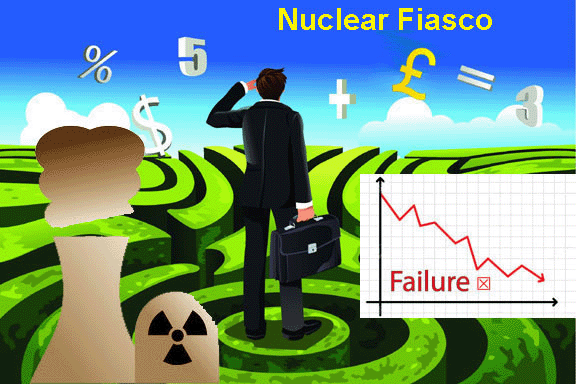
It’s now looking increasingly probable that the [British] Moorside project, given the state of the Nugen consortium and the massive failure of the AP1000 design, may never progress to construction.
The French government is selling assets so it can prop up its heavily indebted
nuclear utilities Areva and EDF. The French nuclear industry is in its “worst situation ever” according to former EDF director Gérard Magnin.
The crisis-ridden US, French and Japanese nuclear industries account for half of worldwide nuclear power generation. Other countries with crisis-ridden nuclear programs or nuclear phase-out policies account for more than half of worldwide nuclear power generation.
Meranwhile renewable energy generation doubled over the past decade and strong growth, driven by sharp cost decreases, will continue for the foreseeable future.
Toshiba’s nuclear flagship goes bust after $10 billion losses http://www.theecologist.org/News/news_round_up/2988820/toshibas_nuclear_flagship_goes_bust_after_10_billion_losses.html, Jim Green, 30th March 2017 News that one of the world’s biggest nuclear power constructors, Westinghouse, has filed for bankruptcy in with debts of over $10 billion has put the entire sector on notice and issued a dire warning to nuclear investors everywhere, writes Jim Green. Among the likely casualties: the UK’s Moorside nuclear complex in Cumbria.
The rapidly-evolving nuclear power crisis escalated dramatically yesterday when US nuclear giant Westinghouse, a subsidiary of Japanese conglomerate Toshiba, filed for bankruptcy.
The Chapter 11 filing took place in the US Bankruptcy Court for the Southern District of New York in New York City.
Westinghouse and its parent Toshiba are in crisis because of massive cost overruns building four ‘AP1000’ nuclear power reactors in the southern US states of Georgia and South Carolina.
The combined cost overruns for the four reactors now amount to about $1.2 billion and counting. And it has now emerged that they may never be finished at all. Whether the four reactors will be completed is now subject to an “assessment period”, according to Westinghouse.
The corporate mishap may also signal the end of new nuclear power in the US. No other reactors are under construction in the country and there is no likelihood of any new reactors in the foreseeable future. The US reactor fleet is one of the oldest in the world, with 44 out of its 99 reactors having been operated for four decades or more.
A $10 billion financial hole – and it’s getting deeper!
Toshiba says Westinghouse had debts totalling US$9.8 billion. Plans for new Westinghouse reactors in India, the UK and China are in jeopardy and will likely be cancelled. Bloomberg noted yesterday: “Westinghouse Electric Co., once synonymous with America’s industrial might, wagered its future on nuclear power – and lost.”
The same could be said about Toshiba, which is selling profitable businesses to stave off bankruptcy. Toshiba said yesterday it expects to book a net loss of $9.1 billion for the current fiscal year, which ends on Friday – a record loss for a Japanese manufacturer.
That projected loss is also well over double the estimate provided just last month, raising investor fears that the final figure may be greater still. “Every time they put out an estimate, the loss gets bigger and bigger”, said Zuhair Khan, an analyst at Jefferies in Tokyo. “I don’t think this is the last cockroach we have seen coming out of Toshiba.”
The BBC noted that Toshiba’s share-price has been in freefall, losing more than 60% since the company first unveiled the problems in December 2016. Toshiba president Satoshi Tsunakawa said at a news conference yesterday: “We have all but completely pulled out of the nuclear business overseas.”
Westinghouse is the major member of the Nugen consortium that’s set to build a massive three-reactor AP1000 nuclear complex at Moorside in the UK, next to the Sellafield site. The company has already stated that while it intends to progress the project through planning stages, it is unable to take on financing or construction and intends to sell its share.
Nugen’s other member, the French energy company Engie (formerly GDF Suez) has also gone on record as wanting to extricate itself from the Moorside project in favour of the ‘new energy’ economy based on renewable, storage and smart grid technologies.
It’s now looking increasingly probable that the Moorside project, given the state of the Nugen consortium and the massive failure of the AP1000 design, may never progress to construction.
The good news for the nuclear industry? The UK’s Office of Nuclear Regulation (ONR) today – with impeccable timing – accepted the AP1000 design as “suitable for construction in the UK“ and issued Westinghouse a Design Acceptance Certificate.
Is the nuclear game up at last?
A similar crisis is unfolding in France, which has 58 power reactors but just one under construction. French ‘EPR’ reactors under construction in France (Flamanville) and Finland are three times over budget – the combined cost overruns for the two reactors amount to about €12.7 billion and counting.
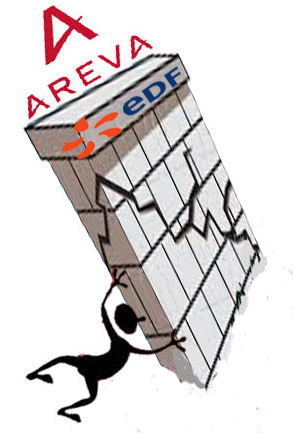
The French government is selling assets so it can prop up its heavily indebted nuclear utilities Areva and EDF. The French nuclear industry is in its “worst situation ever” according to former EDF director Gérard Magnin.
Meanwhile a simple comparison of decommissioning provision between France and Germany indicates that EDF has massively under-budgetted for its liabilities. Germany has set aside €38 billion to decommission its 17 nuclear reactors (€2.2 billion each), but France has set aside only €23 billion to decommission its 58 reactors (€0.4 billion each).
When the real costs, for which EDF will be liable, come in, they could easily bankrupt the company. This in turn puts the UK’s Hinkley Point double EPR nuclear project, in which EDF is the main partner, in doubt.
The crisis-ridden US, French and Japanese nuclear industries account for half of worldwide nuclear power generation. Other countries with crisis-ridden nuclear programs or nuclear phase-out policies account for more than half of worldwide nuclear power generation.
Meranwhile renewable energy generation doubled over the past decade and strong growth, driven by sharp cost decreases, will continue for the foreseeable future.
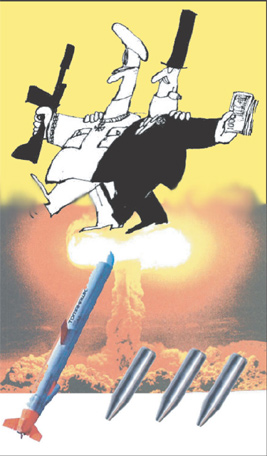
What the million-dollar—trillion-dollar modernization means is that when it came down to making deals with Republicans in the Congress, the Obama administration was willing to do a deal on the future of humanity and said, “Look, if you—if we need you to pass legislation through the Senate, and you want more nuclear weapons and more spending on nuclear weapons, we’ll give you that to get what we want.” And the Obama administration made a tragic deal with the Republicans in the Senate.
But the fact of the matter is, they could have refused to make that deal. But they decided that it was more important to pursue that legislative priority than to think about what the next 30, 40, 50, 60 years will look like. And that is something that we’re now going to have to wrestle with year by year,
And so, this letter from scientists is part of a long-standing effort by scientists from all over the world to make democracy work when it comes to nuclear weapons. And this is what the ban treaty process is also all about, that in the international community, it should not be the most powerful military state in the world that decides what happens in the world, but it should be the majority of the world’s community deciding what is acceptable and what is not acceptable.
U.S. Boycotts U.N. Talks on Nuclear Ban While Spending Trillions to Modernize Nuclear Arsenal, Democracy Now, 30 Mar 17Full interview with Princeton’s Zia Mian about the proposed U.N. nuclear ban treaty, the U.S. boycott and the U.S. trillion-dollar plan to “modernize” its nuclear arsenal. Zia Mian is a physicist, nuclear expert and disarmament activist. He is co-director of the Program on Science and Global Security at the Woodrow Wilson School of Public and International Affairs, Princeton University………
AMYGOODMAN: President Trump has proposed slashing the budgets of the NIH, the National Institutes of Health, at the same time proposed boosting federal spending on the production of nuclear weapons by more than a billion dollars. Your final response?
I think that sooner or later the white working-class constituency will recognize, and in fact, much of the rural population will come to recognize, that the promises are built on sand. There is nothing there.
Maybe scapegoating, saying, “Well, I’m sorry, I can’t bring your jobs back because these bad people are preventing it.” And the typical scapegoating goes to vulnerable people: immigrants, terrorists, Muslims and elitists, whoever it may be. And that can turn out to be very ugly.
I think that we shouldn’t put aside the possibility that there would be some kind of staged or alleged terrorist act, which can change the country instantly
Chomsky: If Trump Falters With Supporters, a ‘Staged or Alleged’ Terrorist Attack Could Follow, truth dig, Mar 29, 2017 By Jan Frel / AlterNet It’s March 2017 , and the political process and the media in the U.S. are a depressing mess, on top of an ever-growing pile of issues that are not remotely being addressed, much less resolved by society: inequality, climate change, a global refugee crisis, you name it.
Donald Trump presents a new problem on top of the old familiar ones; a toxic multifront political disaster whose presence in the White House is doing damage to the national psyche on a daily basis. But in the first few months of his presidency it appears he is unwilling or unable to carry out almost any of the campaign promises he made to his base. Repealing Obamacare was supposed to be a cinch—well, that was a total disaster for Trump and the Republican party; the first big legislative rollout of his presidency, and it didn’t even make it to a vote. What about canceling TPP? Trump did do that, right?
In a recent interview with the renowned intellectual and public commentator Noam Chomsky, he told me TPP was dead on arrival regardless of who was elected. What about scrapping NAFTA? Chomsky said he was doubtful Trump would be able to do much there either. What Trump appears to be doing, Chomsky observed, is ramming through the standard GOP wish list: tax cuts, corporate welfare, climate change denial. How would Trump’s voters react to that? What we need to worry about, Chomsky says, is the potential for the Trump administration to capitalize on a “staged or alleged” terrorist attack. The text of our interview follows.
Jan Frel: Do you observe any meaningful signs of the key power factions in Washington aligning against Trump? Noam Chomsky: Well, the so-called Freedom Caucus, which is a Tea Party outgrowth, has been refusing, so far, to go along with the health plan that he has advocated. There are other indications of the Tea Party-style far-right, separating themselves from Trump’s proposals.
On the other hand, if you take a look at what is actually happening in Washington, apart from the rhetoric and what appears in Sean Spicer’s press conferences and so on, the old Republican establishment is pretty much pushing through the kinds of programs that they have always wanted. And now they have a kind of open door that is Trump’s cabinet, which draws from the most reactionary parts of the establishment. It doesn’t have much to do with Trump’s rhetoric. His rhetoric is about helping the working man and so on, but the proposals are savage and damaging to the constituency that thinks that Trump is their spokesperson.
JF: Do you think there will ever be a moment of awakening, or a disconnect for Trump’s supporters of his rhetoric and what he’s been doing in Washington, or can this just keep going?
NC: I think that sooner or later the white working-class constituency will recognize, and in fact, much of the rural population will come to recognize, that the promises are built on sand. There is nothing there.
And then what happens becomes significant. In order to maintain his popularity, the Trump administration will have to try to find some means of rallying the support and changing the discourse from the policies that they are carrying out, which are basically a wrecking ball to something else. Maybe scapegoating, saying, “Well, I’m sorry, I can’t bring your jobs back because these bad people are preventing it.” And the typical scapegoating goes to vulnerable people: immigrants, terrorists, Muslims and elitists, whoever it may be. And that can turn out to be very ugly.
Westinghouse Files for Bankruptcy, in Blow to Nuclear Power, NYT By DIANE CARDWELL and JONATHAN SOBLEMARCH 29, 2017,Westinghouse Electric Company, which helped drive the development of nuclear energy and the electric grid itself, filed for bankruptcy protection on Wednesday, casting a shadow over the global nuclear industry.
Toshiba Projects Record Loss as Nuclear Unit Files for Bankruptcy, Bloomberg, by Dawn McCarty and Pavel Alpeyev March 29, 2017,
Toshiba warns full year loss may widen to 1.01 trillion yen
Japanese company trying to sell memory chips division
Toshiba Corp. projected its annual loss could more than double to a record 1.01 trillion yen ($9.1 billion) as its U.S. nuclear unit Westinghouse Electricfiled for Chapter 11 bankruptcy.
The collapse of Westinghouse, once the linchpin of Toshiba’s plans to diversify away from consumer electronics, caps a disastrous run for the Japanese conglomerate as project delays crippled earnings from the nuclear plant business. The company has now put its prized memory chip unit up for sale just as it was recovering from a profit-padding scandal that claimed the scalps of senior executives……
Toshiba listed as much as $10 billion debt for Westinghouse and another entity. The nuclear unit filed in U.S. Bankruptcy Court for the Southern District of New York and proposed to appoint Weil, Gotshal & Manges LLP as legal adviser, AlixPartners LLP as financial adviser, and PJT Partners Inc. as investment banker, subject to court approval.
Toshiba said last month it expected to write down 712.5 billion yen in its nuclear-power business, citing cost overruns and diminishing prospects for atomic-energy operations. The company has twice delayed its earnings report, with results for the December quarter now due on April 11.
“There were warning signs when Toshiba delayed releasing financials earlier this year,” said Emmanuel Chua, senior associate at Herbert Smith Freehills in Singapore. “The big question mark is whether the restructuring plan and process presents real opportunities for a turnaround, or whether it is simply an exercise of ‘kicking the can down the road.”’
Shares of Toshiba have slumped 23 percent this year after advancing 13 percent in 2016. The loss forecast was announced after the close of trading on Wednesday.
Expectations that the company may be too big to fail for the Japanese government, and the likelihood that it will get state support is bolstering its bonds. Toshiba’s 20 billion yen of December 2020 bonds were little changed at 88 percent of face value, according to data compiled by Bloomberg……
Scana and Southern could end up facing billions of dollars in additional costs, according to Morgan Stanley. Scana faces as much as $5.2 billion in higher costs that could drag its shares down 5 percent, analysts at the bank including Stephen Byrd said in a March 22 research note, while cost overruns for utility owner Southern could reach $3.3 billion……https://www.bloomberg.com/news/articles/2017-03-29/toshiba-s-u-s-nuclear-unit-westinghouse-files-for-bankruptcy
Westinghouse files for bankruptcy in blow to nuclear power, NYT, 30 Mar 17 “……..Bankruptcy will make it harder for Westinghouse’s business partners to collect money they are owed by the nuclear-plant maker. That mostly affects the American power companies for whom it is building reactors, analysts say. Now, it is unclear whether the company will be able to complete any of its projects, which in the United States are about three years late and billions over budget.
The power companies — Scana Energy in South Carolina and a consortium in Georgia led by Georgia Power, a unit of Southern Company — would face the possibility of new contract terms, long lawsuits and absorbing losses that Toshiba and Westinghouse could not cover, analysts say. The cost estimates are already running $1 billion to $1.3 billion higher than originally expected, according to a recent report from Morgan Stanley, and could eventually exceed $8 billion over all.
Dennis Pidherny, a managing director at Fitch Ratings who is sector head of the United States public power group, said that it was possible that the company’s bankruptcy filing could terminate the contracts and that it could be difficult for the utilities to find another builder to take them over.
“There’s still quite a bit of work that needs to be completed,” he said. “The biggest challenge there is quite simply finding another suitable contractor who can complete the contract and have it completed at a quote-unquote reasonable cost.”
That is, if they are constructed at all. Stan Wise, chairman of the Georgia Public Service Commission, said the utilities developing the Alvin W. Vogtle generating station in the state would have to evaluate whether it made sense to continue.
“It’s a very serious issue for us and for the companies involved,” Mr. Wise said. “If, in fact, the company comes back to the commission asking for recertification, and at what cost, clearly the commission evaluates that versus natural gas or renewables.”
In a statement on Wednesday, Toshiba said Westinghouse and affiliated companies were “working cooperatively” with the owners to arrange for construction to continue. In recent days, the affected companies issued statements saying they were monitoring the situation and exploring their options, as did the Energy Department, which has authorized $8.3 billion in federal loan guarantees for the Georgia project.
“We are keenly interested in the bankruptcy proceedings and what they mean for taxpayers and the nation,” said Lindsey Geisler, a Department of Energy spokeswoman. “Our position with all parties has been consistent and clear: We expect the parties to honor their commitments and reach an agreement that protects taxpayers, promotes economic growth, and strengthens our energy and national security.”https://www.nytimes.com/2017/03/29/business/westinghouse-toshiba-nuclear-bankruptcy.html?_r=0
In 2016, the No. 1 tourist destination of Ukraine was the lifeless town of Pripyat, evacuated after the deadly reactor meltdown at Chernobyl in 1986. Today, Ukraine relies on nuclear power for 53 percent of its power generation, but is risking another nuclear accident on a scale greater than Europe — and the world — could imagine.
The problems facing Ukraine’s nuclear power industry are multi-faceted, but the main issue is the same one plaguing the whole of the former Soviet republic — corruption, which is breeding a lack of accountability and mismanagement of the sector’s critical infrastructure.
Ukraine’s nuclear power plants are supposed to be regulated by the State Nuclear Regulatory Inspectorate of Ukraine (SNRIU), which by law is an independent regulatory body. In recent years, however, it has become standard practice for the leaders of SNRIU to be appointed by the state nuclear power plant operator, Energoatom, instead of through a rigorous, independent selection process.
This, perversely, subjugates the regulator to the whims of the operator. If Energoatom cannot meet certain safety standards or deadlines, its bosses simply inform the regulator of such, and the deadlines are extended or eliminated, public safety be damned.
In addition, many positions at the regulatory body remain empty. For example, the position of the chief state inspector of nuclear and radiation safety has been vacant for three years. Other key posts of the Ukrainian nuclear regulator remain vacant.
U.S. miner Arch Coal Inc. had $4.5 billion in net debt and a market capitalization of just a few million dollars when it filed for Chapter 11 in January 2016. After emerging from a nine-month gestation in the courts, it’s now worth $1.73 billion and is debt free, with net cash of $31 million.
Toshiba Corp. shareholders appear to hope the same rule will hold true for Westinghouse Electric Co., the nuclear unit that’s dragged one of Japan’s oldest industrial conglomerates to the brink of insolvency. The stock has rallied 20 percent in a week, after Toshiba said Westinghouse’s board was considering bankruptcy. The unit has filed for Chapter 11 protection in New York, court documents showed Wednesday.
If the courts are about to give Westinghouse a get-out-of-jail-free card, someone ought to tell the credit markets.
Compare Toshiba’s own credit-default swaps to those on Southern Co. and Scana Corp., the two U.S. electric utilities for whom Westinghouse is under contract to build four reactors, and it’s clear that investors expect one of the three players to suffer most of the costs. Insuring $10 million of Toshiba’s debt against default for five years would set you back about $423,000, compared to $78,000 for Scana and $64,000 for Southern.
Toshiba faces a bewildering array of potential hits to its balance sheet from its nuclear foray, but most of them are either relatively small (such as its 34.6 billion yen ($311 million) in decommissioning and environmental liabilities), or already factored in (like the 713 billion yen goodwill writedown that will leave it with negative shareholders’ equity once it reports annual results).
The deal with Southern and Scana is different. Payment guarantees to subsidiaries of the two utilities constitute 90 percent of the 794 billion yen in parent-company guarantees for which Toshiba has promised to indemnify Westinghouse. Put into English: If Westinghouse fails to build the reactors on time and on budget, Toshiba is on the hook for a sum not much less than the 768 billion yen value of all its factories, machinery and land.
Aside from a bailout by the Japanese government, the sliver of hope for Toshiba shareholders is that the messy bankruptcy process will allow some of those liabilities to be taken on by other players. The U.S. government, for instance, has made an $8.3 billion loan guarantee to the owners of Southern’s reactors. That may complicate the process, the Nikkei reported earlier this month. Moody’s Investors Service and S&P Global Ratings in recent weeks have put shareholders in the plants, including Southern and Scana and associated units, on negative ratings outlooks on the possibility they will have to bear some costs.
Creditors of the two utilities seem unconcerned. It’s been more than a year since Scana’s 4.125 percent bonds due February 2022 last dipped below par, while the Southern unit that will be the main shareholder in its nuclear plant project, Georgia Power Co., managed to raise fresh debt just last month. Its $400 million of 3.25 percent notes due 2027, sold at a modest 0.113 cent discount to par, are trading at 98.56 cents on the dollar.
That should be worrying for Toshiba, because there’s no magic spell behind Chapter 11. Bankruptcy doesn’t make liabilities vanish outright. For the most part, it just reorganizes them, imposes haircuts on junior creditors, and converts a portion from the most stringent form — debt — to a milder alternative, equity. If bondholders at Westinghouse’s customers are feeling confident, Toshiba shareholders should prepare for a troublesome chain reaction.
Pope backs nuclear weapons ban treaty, rrrstar.com, Mar 29, 2017 By Josephine McKenna Religion News Service VATICAN CITY — Pope Francis says nuclear weapons offer a “false sense of security” and are an ineffective deterrent to 21st-century threats like terrorism, conflict and cybersecurity.
The pontiff spoke as talks on a proposed global nuclear arms ban at the United Nations seem doomed to fail with the U.S., France, Britain and South Korea among nearly 40 countries boycotting the talks.
In a message addressed to the conference in New York, the pope called for “total elimination” of nuclear weapons. He said there were many doubts about the effectiveness of deterrence and warned of “catastrophic humanitarian and environmental consequences” if nuclear weapons were ever used again.
“How sustainable is a stability based on fear, when it actually increases fear and undermines relationships of trust?” Francis asked. “International peace and stability cannot be based on a false sense of security, on the threat of mutual destruction or total annihilation, or on simply maintaining a balance of power.”
The pope said the elimination of nuclear weapons was a “moral and humanitarian imperative” and stressed it was possible to achieve.
“Although this is a significantly complex and long-term goal, it is not beyond our reach,” he said.
Francis said money currently spent on nuclear weapons could be used for “the promotion of peace and integral human development, as well as the fight against poverty.”
“An ethics and a law based on the threat of mutual destruction — and possibly the destruction of all mankind — are contradictory to the very spirit of the United Nations,” he said.
SGI joins diverse faith groups in calling for action at historic UN nuclear weapons negotiations J oint statement stresses moral and ethical imperative for nuclear weapons abolition https://religionnews.com/2017/03/29/sgi-joins-diverse-faith-groups-in-calling-for-action-at-historic-un-nuclear-weapons-negotiations/March 29, 2017 NEW YORK — On March 28, religious groups urged governments to make decisive progress toward establishing a framework for complete elimination of nuclear weapons in a statement read on the second day of a historic UN conference to begin negotiations on a legally binding instrument to prohibit nuclear weapons.
Jasmin Nario-Galace of Pax Christi Pilipinas read the joint statement on behalf of Faith Communities Concerned about Nuclear Weapons before representatives of some 120 governments taking part in the negotiations at UN Headquarters that will continue until March 31. Afterwards, she stated, “As various faith communities working for a world without nuclear weapons, we aim to show that we share the same aspirations for peace and for a world where people live without fear.”
Signatories include more than twenty individuals representing diverse faith groups from Pax Christi and the World Council of Churches to Islamic organizations, the Soka Gakkai International (SGI) Buddhist association, the Quakers in Britain and Religions for Peace.
The groups stress that nuclear weapons manifest a total disregard for the shared ethical values of religious faiths. They condemn the theory of deterrence and the catastrophic humanitarian impact of any nuclear weapon use, stating: “We reject the immorality of holding whole populations hostage, threatened with a cruel and miserable death. We applaud the world’s political leaders that have demonstrated the courage to begin these negotiations.”
The statement also urges those states not participating in this round of the negotiations to reexamine their positions and commit to joining the June-July session in good faith. The statement and list of endorsers can be read here.
Kazuo Ishiwatari, SGI Executive Director of Peace and Global Issues, comments, “To be successful, a treaty prohibiting nuclear weapons must heed, reflect and embody the voices of the entire human family… SGI will call for an even greater enlistment of the power of individual and collective conscience in order to support, strengthen and enrich the negotiation process.”
Signatory Mustafa Cerić, Grand Mufti Emeritus of Bosnia and President of the World Bosniak Congress, adds, “Man’s ability to trust in God is his ability to trust in Man. Hence, we don’t need Nuclear Weapons if we trust in God. Indeed, if we trust in Man.”
The interfaith statement builds on previous statements issued by some of the same individuals and groups on the occasion of key negotiations related to the humanitarian impact of nuclear weapons held in Washington DC (April 2014), Vienna (December 2014), New York (May 2015) and Geneva (May 2016).
The working paper argues that the goal of achieving a world without nuclear weapons should be understood as integral to the larger effort to demilitarize international relations and develop nonviolent conceptions of the state. It quotes SGI President Daisaku Ikeda who stresses: “The inhumanity of nuclear weapons is found not only in their overwhelming destructive power. It lies in their potential to instantaneously obliterate and render meaningless the painstaking efforts of generations of human beings… They are a denial and rejection of our very humanity.”
The Soka Gakkai International (SGI) Buddhist association links over 12 million members around the world. It has been engaged in efforts to support the abolition of nuclear weapons for sixty years.
Native American uranium miners and the Trump budget, Bulletin of the Atomic Scientists Robert Alvarez, 30 Mar 17,For minimum wage or less, they blasted open seams, built wooden beam supports in the mine shafts, and dug out ore pieces with picks and wheelbarrows. The shafts penetrated as deep as 1,500 feet, with little or no ventilation. The bitter-tasting dust was all pervasive, coating their teeth. They ate in the mines and drank water that dripped from the walls and, sometimes, developed chronic coughs. And much worse.
Native American uranium miners were essential to the United States’ efforts to create a nuclear arsenal. From the late 1940s to the early 1970s, Indian people dug up approximately four million tons of uranium ore—nearly a quarter of the total national underground production in the United States used in nuclear weapons. As they did so, they were sent into harm’s way without sufficient warning, becoming the workers most severely exposed to ionizing radiation in the US nuclear weapons complex. After more than a century, the legacy of US uranium mining lingers. More than three billion metric tons of mining and milling wastes were generated in the United States. Today, Navajos still live near about one third (approximately 1,200 out of 4,000) of all abandoned uranium mines in the United States.
Only after concerted efforts by Navajo activists to spur congressional investigations in 1993 and 2006 did the US government promise to remediate abandoned mines and ascertain their health impacts. But more than a century after the government issued the first uranium mining leases on Navajo land, the Trump administration has proposed deep cuts in the Environmental Protection Agency’s budget—upward of 30 percent overall—putting that cleanup effort in peril.
America’s Indian miners were never warned of the hazards of radioactivity in the mines, where they inhaled, ingested, and drank uranium dust. The water in the mines was especially dangerous; it contained high quantities of radon—a radioactive gas emanating from the ore. Radon decays into heavy, more radiotoxic isotopes, called “radon daughters,” which include isotopes of polonium, bismuth, and lead. The alpha particle emissions of radon daughters are considered to be about 20 times more carcinogenic than x-rays. If they lodge in the respiratory system, especially the deep lung, radon daughters emit energetic ionizing radiation that can damage cells of sensitive internal tissues.
And of course, the miners brought the uranium dust home, along with their contaminated clothing.
A known danger, hidden. …..
How the Trump budget threatens uranium mine cleanup. Even though there is a significant body of evidence, spanning decades, of deliberate negligence by the US government, federal courts have denied claims by the uranium miners and those exposed to radioactive fallout from Nevada nuclear weapons testing on the grounds of sovereign immunity. “[A]ll the actions of various governmental agencies complained of by plaintiffs were the result of conscious policy decisions made at high government levels based on considerations of political and national security feasibility factors,” is how one federal judge put it.
After several decades of considerable effort by miners and their families, Congress passed the Radiation Exposure Compensation Act in October 1990. The Act offered a formal apology for sending people into harm’s way and provided a one-time compensation to each victim in the amount of $150,000. But the financial compensation came too late for many who had died. And it would never be enough to compensate for illness and death that could have been prevented.
Westinghouse troubles loom over South Carolina, Georgia nuclear projects, Denver Post, By THE ASSOCIATED PRESS March 29, 2017 Westinghouse Electric Co., the U.S. nuclear unit of Japan’s Toshiba Corp., filed for bankruptcy protection Wednesday, calling into question the future of a number of billion-dollar nuclear projects under construction, including two in the U.S.
Westinghouse said in a statement that it filed the Chapter 11 petition in U.S. Bankruptcy Court in New York. The move had been largely expected.
The troubles at a company long associated with nuclear power add to the industry’s problems. ….. the four nuclear reactors Westinghouse is helping to build in South Carolina and Georgia are behind schedule and billions of dollars over budget…….
Toshiba acquired Westinghouse in 2006 with much fanfare, making nuclear power an important part of its business strategy. Instead, Westinghouse has saddled the Japanese company with mounting losses. Toshiba said Westinghouse had racked up debt of $9.8 billion. Wednesday, Toshiba said it could post a loss as big as 1 trillion yen ($9 billion) for the fiscal year ending March 31. It previously said Westinghouse lost 712.5 billion yen ($6.2 billion) from April to December of last year.
In South Carolina, Westinghouse is a partner with state-owned utility Santee Cooper and publicly-traded SCANA Corp. on the construction of two reactors at the V.C. Summer Nuclear Station near Jenkinsville. SCANA said in September that the cost of building the reactors had increased nearly $3 billion from the original $11 billion estimate in 2009. The first reactor was supposed to open in 2017, but has been delayed at least two years.
SCANA officials told investors on a conference call Wednesday that all options remain on the table, from finishing both reactors, to finishing one reactor and delaying completion of the other or abandoning the project altogether. The company said it will spend at least the next 30 days reviewing its options.
The Plant Vogtle project in eastern Georgia was more than three years behind schedule and more than $3 billion over its original budget as of the end of 2016. Oglethorpe Power, one of the partners in the project, said in a regulatory filing this week that “the revised in-service dates of December 2019 and September 2020” for the two reactors it’s building “do not appear to be achievable.”
Georgia Power, a subsidiary of Southern Co. and holder of a 46-percent stake in the Vogtle project, said in a statement that it “will continue to take every action available to us to hold Westinghouse and Toshiba accountable for their financial responsibilities.” Southern Co. and the other partners have a $920 million letter of credit from Westinghouse obtained in 2015……http://www.denverpost.com/2017/03/29/westinghouse-troubles-loom-over-nuclear-projects/
The Whole World Is Watching as Trump Trashes U.S. Climate Policy http://www.ecowatch.com/trump-trashes-climate-policy-2334750567.htmlAmid questions over whether the executive order would end U.S. involvement in the Paris agreement—and with no firm indication from the White House about staying in the agreement—top European Union climate official Miguel Arias Cañete expressed “regret” over Trump’s policies Tuesday, promising that the European Union “will stand by Paris, we will defend Paris and we will implement Paris.”
China showed it would continue to cement its global leadership on climate, as officials reaffirmed to press the country was still committed to the Paris agreement and adding “China’s resolve, aims and policy moves in dealing with climate change will not change.”
Former United Nations Framework Convention on Climate Change leader Christiana Figueres expressed confidence in the agreement’s durability, telling Fusion in an interview that the economic benefits of a global clean energy transition make the agreement “unstoppable.”
“It’s important to understand that no single country, no matter how large or small, can cancel the Paris Climate Agreement,” explained Figueres. “The Paris Agreement is a multilateral agreement that has gone into force, and any country has the right to exit the agreement, or in fact to exit the Convention, but that doesn’t mean that the multilateral structure is actually canceled.”
Britain has a chance to rethink its nuclear energy policy, Ft.com 30 Mar 17 The Westinghouse bankruptcy offers an opportunity to consolidate the industry Michael ShellenbergerThe bankruptcy of Toshiba-owned nuclear energy group Westinghouse on Wednesday throws up in the air ambitious British plans to use nuclear power to replace coal and, eventually, natural gas.
Britain’s plan was to build 12 reactors to replace its current nuclear estate — and to raise the share of electricity it receives from atomic fission from roughly 20 per cent to 30 per cent by 2030. But now, all bets are off. Westinghouse’s filing for Chapter 11 bankruptcy protection means that its efforts to build new reactors in the UK look increasingly precarious. That might be a good thing. …..
nuclear power is not like other market products. The manufacture of food or clothes, for example, does not require guaranteeing anywhere between £5bn and £10bn for the cost of building a farm or factory……
It should scrap future nuclear deals and empower an independent commission to choose a single, experienced contractor and power utility to build the 10 or more reactors required — to a single, standard design…….
Westinghouse wins UK reactor approval from nuclear regulator, Reuters, 30 Mar 17 , By Susanna Twidale and Nina Chestney | LONDON Toshiba’s (6502.T) Westinghouse, which filed for bankruptcy on Wednesday, has won approval for its AP1000 reactor design, Britain’s nuclear regulator said on Thursday.The Office for Nuclear Regulation (ONR) approval is needed before the design can be used at NuGeneration Ltd’s (NuGen) Moorside new nuclear project in north west England, which consists of three AP1000 units.
“The closure of our assessment of the generic design of the AP1000 reactor is a significant step in the process, ensuring the design meets the very high standards of safety we expect,” Richard Savage, ONR’s chief nuclear inspector, said.
“We will now focus our regulatory attention on site specific assessments, and NuGen’s application for a nuclear site license,” he added in a statement.
Westinghouse’s bankruptcy filing has raised questions over whether it will be able to complete capital intensive projects……
Britain ……has struggled to get large projects built, especially nuclear, due to the costs involved.EDF’s (EDF.PA) 18 billion pound ($22.5 billion) Hinkley Point C nuclear project in southwest England got the final go-ahead in 2016 after several years of delay, but only after securing backing from the French government.
NuGen, a joint venture between Toshiba and French utility Engie (ENGIE.PA) has also come under doubt since Japan’s Toshiba said last month it planned to pull out of the construction work at the British plant after posting a $6.3 billion writedown on Westinghouse, which has been hit by billions of dollars in cost overruns at new nuclear plants……http://www.reuters.com/article/us-toshiba-westinghouse-britain-idUSKBN1711E6










 nuclear-news
