The rapidly deepening financial disaster that is the nuclear industry
 Nuclear power’s rapidly accelerating crisis, REneweconomy, By Jim Green on 22 February 2017 A fire-sale is underway as the punch-drunk nuclear power industry tries to stop the rot.
The French government is selling assets so it can prop up its heavily indebted nuclear utilities. Électricité de France (EDF) announced in 2015 that it would sell A$13.8 billion of assets by 2020 to rein in its debt, which now stands at A$51.8 billion.
EDF is purchasing parts of its bankrupt sibling Areva, which has accumulated losses of over A$14 billion over the past five years. French EPR reactors under construction in France and Finland are three times over budget ‒ the combined cost overruns amount to about A$17.5 billion. Bloomberg noted in April 2015 that Areva’s EPR export ambitions are “in tatters“, and now Areva itself is in tatters.
Meanwhile, Japanese industrial giant Toshiba would like to sell indebted, US-based nuclear subsidiary Westinghouse, but there are no buyers so Toshiba must instead sell profitable assets to cover its nuclear debts and avoid bankruptcy.
Engie reportedly wants to sell its stake in the consortium, and the French government has already sold part of its stake in Engie … to help prop up EDF and Areva! Deck-chairs are being shuffled.
The latest dramas occur against a backdrop of deep industry malaise, with the receding hope of even the slightest growth resting squarely on the shoulders of China. A February 15 piece in the Financial Times said: “Hopes of a nuclear renaissance have largely disappeared. For many suppliers, not least Toshiba, simply avoiding a nuclear dark ages would be achievement enough.”
Toshiba and Westinghouse are in deep trouble because of massive cost overruns building four AP1000 reactors in the US ‒ the combined overruns are about A$14 billion and counting. The saga is detailed in Bloomberg pieces titled ‘Toshiba’s Nuclear Reactor Mess Winds Back to a Louisiana Swamp‘ and ‘Toshiba’s Record Fall Highlights U.S. Nuclear Cost Nightmare‘.
Toshiba said on February 14 that it expects to book a A$8.2 billion writedown on Westinghouse,(on top of a A$3 billion writedown in April 2016. These losses exceed the A$7.1 billion Toshiba paid when it bought a majority stake in Westinghouse in 2006.
Bankruptcy looms for Toshiba, with the banks circling and the risk heightened by the likelihood of further delays and cost overruns with the AP1000 reactors in the US, and unresolved litigation over those projects.
Toshiba says it would likely sell Westinghouse if that was an option ‒ but there is no prospect of a buyer. The nuclear unit is, as Bloomberg noted, “too much of a mess” to sell. And since that isn’t an option, Toshiba must sell profitable businesses instead to stave off bankruptcy.
Toshiba planned to make nuclear operations and microchips its two growth areas. But now the company plans to sell most ‒ perhaps all ‒ of its profitable microchip business to prop up the nuclear carcass and avoid bankruptcy. The company might get A$17‒22 billion by selling its entire stake in its microchip business, said Joel Hruska from ExtremeTech. “That would pay off the company’s immediate debts,” Hruska said, “but would leave it holding the bag on an incredibly expensive, underwhelming nuclear business with no prospects for near-term improvement.”
Plans for three AP1000 reactors at Moorside in the UK are in doubt. Toshiba hopes to sell its 60% stake in the project consortium NuGen. Cumbrians will be glad to see the back of corruption-plagued Toshiba ‒ but corruption-plagued South Korean utility KEPCO might take its place. Cumbrians Opposed to a Radioactive Environment (CORE) commented: “KEPCO is itself still emerging from a major scandal that surfaced in 2012 involving bribery, corruption and faked safety tests for critical nuclear plant equipment which resulted in a prolonged shut-down of a number of nuclear power stations and the jailing of power engineers and parts suppliers.”
Plans for six AP1000 reactors in India may not survive the Toshiba / Westinghouse meltdown. The project is now almost impossible according to Reuters’ sources. India is said to be one of the countries leading the ‘nuclear renaissance’ but hasn’t seen a single reactor construction start since 2011.
Toshiba’s demise would not greatly concern the nuclear industry if it was an isolated case, but it is symptomatic of industry-wide problems. Nick Butler from Kings College London wrote in a Financial Times online post: “Toshiba is just one company in the global nuclear industry, but its current problems are symptomatic of the difficulties facing all the private enterprises in the sector.
Civil nuclear power involves huge up-front capital costs, very long pay-back periods and high risks that are compounded by a lack of experience, especially in managing nuclear construction projects after a long period with few new plants. For all those reasons, private investors avoid the sector and prefer to put their money where they see faster and safer returns.”http://reneweconomy.com.au/nuclear-powers-rapidly-accelerating-crisis-26711/
There is agreement that the nuclear industries in the US, Japan and the EU ‒ in particular their nuclear export industries ‒ are in deep trouble. A February 2017 EnergyPostWeekly article says “the EU, the US and Japan are busy committing nuclear suicide.” Michael Shellenberger from the pro-nuclear Breakthrough Institute notes that: “Nations are unlikely to buy nuclear from nations like the US, France and Japan that are closing (or not opening) their nuclear power plants.”
Shellenberger said: “From now on, there are only three major players in the global nuclear power plant market: Korea, China and Russia. The US, the EU and Japan are just out of the game. France could get back in, but they are not competitive today.”
That’s good news for the nuclear industries in South Korea, China and Russia. But they might end up squabbling over scraps ‒ there were just three reactor construction starts last year around the world. South Korean companies have failed to win a single contract since the contract to build four reactors in the UAE. Likewise, China has made no inroads into export markets other than projects in Pakistan and Argentina.
Russia’s Rosatom has countless non-binding agreements to supply reactors, mostly in developing countries. But Russia can’t afford the loan funding promised in these agreements, and most of the potential customer countries can’t afford to pay the capital costs for reactors. Former World Nuclear Association executive Steve Kidd says it is “highly unlikely that Russia will succeed in carrying out even half of the projects in which it claims to be closely involved”.
The pro-nuclear Breakthrough Institute’s Michael Shellenberger presents cataclysmic assessments of nuclear power’s “rapidly accelerating crisis” and a “crisis that threatens the death of nuclear energy in the West“.
Likewise, pro-nuclear commentator Dan Yurman says that a “sense of panic is emerging globally” as Toshiba exits the reactor construction industry. He adds: “After nine years of writing about the global nuclear industry, these developments make for an unusually grim outlook. It’s a very big rock hitting the pond. Toshiba’s self-inflicted wounds will result in long lasting challenges to the future of the global nuclear energy industry. Worse, it comes on top of the French government having to restructure and recapitalize Areva …”
Yurman notes that Westinghouse may struggle to keep its nuclear workforce intact: “Layoffs and cost cutting could reduce the core competencies of the firm and its ability to meet the service needs of existing customers much less be a vendor of nuclear technologies for new projects.” Likewise, Will Davis, a consultant and writer for the American Nuclear Society, explains the failure of the Japanese/US AP1000 projects and the French EPR projects with reference to the “loss of institutional knowledge, industrial capability and construction capability” over the past generation.
As recent history has repeatedly shown, this loss of capability leads to reactor project delays and cost overruns, and that in turn leads one after another country to abandon plans for new reactors. Vast numbers of staff, skilled across a range of disciplines, need to be trained and employed if the nuclear power industry is to move ahead (or even survive). But utilities and companies are firing, not hiring, vast numbers of staff and making a perilous situation much worse … possibly irretrievable. EDF, for example, plans to cut 5,200 to 7,000 staff by 2019 (including 2,000 sacked last year) ‒ about 10% of its total workforce.
Ironically, Westinghouse, the villain in Toshiba’s demise, may have made the best strategic decision of all the nuclear utilities. In 2014, Westinghouse announced plans to expand and hopefully triple its nuclear decommissioning business. The global reactor fleet is ageing and the International Energy Agency anticipates an “unprecedented rate of decommissioning” ‒ almost 200 reactor shut-downs between 2014 and 2040. http://reneweconomy.com.au/nuclear-powers-rapidly-accelerating-crisis-26711/
President Donald Trump’s control of U.S. nuclear forces is no longer a laughing matter.
 The Trump Nuclear Threat, It’s time to worry about Donald Trump’s control of U.S. nuclear forces. US News, By Louis René Beres | Feb. 21, 2017,
Global nuclear catastrophe waits in the wings, as Japan plans for Olympics
Fukushima: a Lurking Global Catastrophe? http://nation.com.pk/international/21-Feb-2017/fukushima-a-lurking-global-catastrophe Robert Hunziker – Year over year, ever since 2011, the Fukushima Daiichi nuclear meltdown grows worse and worse, an ugly testimonial to the inherent danger of generating electricity via nuclear fission, which produces isotopes, some of the most deadly poisonous elements on the face of the planet.
As it happens, “”inventing technology” is experimental stage stuff. Still, there are several knowledgeable sources that believe the corium, or melted core, will never be recovered. Then what?
According to a recent article, “Potential Global Catastrophe of the Reactor No. 2 at Fukushima Daiichi,” d/d Feb. 11, 2017 by Dr. Shuzo Takemoto, professor, Department of Geophysics, Graduate School of Science, Kyoto University: The Fukushima nuclear facility is a global threat on level of a major catastrophe.
Meanwhile, the Abe administration dresses up Fukushima Prefecture for the Tokyo 2020 Olympics, necessitating a big fat question: Who in their right mind would hold Olympics in the neighborhood of three out-of-control nuclear meltdowns that could get worse, worse, and still worse? After all, that’s the pattern over the past 5 years; it gets worse and worse. Dismally, nobody can possibly know how much worse by 2020. Not knowing is the main concern about holding Olympics in the backyard of a nuclear disaster zone, especially as nobody knows what’s happening. Nevertheless and resolutely, according to PM Abe and the IOC, the games go on.

“A short-term, whole-body dose of over 10 sieverts would cause immediate illness and subsequent death within a few weeks, according to the World Nuclear Association” (Emi Urabe, Fukushima Fuel-Removal Quest Leaves Trail of Dead Robots, The Japan Times, Feb. 17, 2017).
Although Fukushima’s similar to Chernobyl Exclusion Zone in some respects, where 1,000 square miles has been permanently sealed off, Fukushima’s different, as the Abe administration is already repopulating portions of Fukushima. If they don’t repopulate, how can the Olympics be held with food served from Fukushima and including events like baseball held in Fukushima Prefecture?
Making matters worse yet, Fukushima Diiachi sets smack dab in the middle of earthquake country, which defines the boundaries of Japan. In that regard, according to Dr. Shuzo Takemoto, professor, Department of Geophysics, Graduate School of Science, Kyoto University: “The problem of Unit 2… If it should encounter a big earth tremor, it will be destroyed and scatter the remaining nuclear fuel and its debris, making the Tokyo metropolitan area uninhabitable. The Tokyo Olympics in 2020 will then be utterly out of the question,” (Shuzo Takemoto, Potential Global Catastrophe of the Reactor No. 2 at Fukushima Daiichi, February 11, 2017).
Accordingly, the greater Tokyo metropolitan area remains threatened for as long as Fukushima Diiachi is out of control, which could be for generations, not years. Not only that, Gee-Whiz, what if the big one hits during the Olympics? After all, earthquakes come unannounced. Regrettably, Japan has had 564 earthquakes the past 365 days. It’s an earthquake-ridden country. Japan sits at the boundary of 4 tectonic plates shot through with faults in zigzag patterns, very lively and of even more concern, the Nankai Trough, the candidate for the big one, sits nearly directly below Tokyo. On a geological time scale, it may be due for action anytime within the next couple of decades. Fukushima Prefecture’s not that far away.
Complicating matters further, the nuclear site is located at the base of a mountain range. Almost daily, water flows from the mountain range beneath the nuclear plant, liquefying the ground, a sure-fire setup for cascading buildings when the next big one hits. For over five years now, radioactive water flowing out of the power plant into the Pacific carries isotopes like cesium 134 and cesium 137, strontium 90, tritium, plutonium americium and up to 100 more isotopes, none of which are healthy for marine or human life, quite the opposite in fact as those isotopes slowly cumulate, and similar to the Daleks of Doctor Who fame (BBC science fiction series, 1963-present) “Exterminate! Exterminate! Exterminate!”
Isotopes bio-concentrate up the food chain from algae to crustaceans to small fish to big fish to bigger humans. Resultant cancer cells incubate anytime from two years to old age, leading to death. That’s what cancer does; it kills.
Still, the fact remains nobody really knows for sure how directly Fukushima Diiachi radiation affects marine life, but how could it be anything other than bad? After all, it’s a recognized fact that radiation cumulates over time; it’s tasteless, colorless, and odorless as it cumulates in the body, whether in fish or further up the food chain in humans. It travels!
An example is Cesium 137 one of the most poisonous elements on the planet. One gram of Cesium 137 the size of a dime will poison one square mile of land for hundreds of years. That’s what’s at stake at the world’s most rickety nuclear plant, and nobody can do anything about it. In fact, nobody knows what to do. They really don’t.
The Fukushima nuclear meltdown presents a special problem for the world community. Who knows what to believe after PM Abe lied to the IOC to get the Olympics; see the following headline from Reuters News: “Abe’s Fukushima ‘Under Control’ Pledge to Secure Olympics Was a Lie: Former PM,” Reuters, Sept. 7, 2016.– COUNTERPUNCH
“Abe gave the assurances about safety at the Fukushima plant in his September 2013 speech to the International Olympic Committee to allay concerns about awarding the Games to Tokyo. The comment met with considerable criticism at the time… Mr. Abe’s ‘under control remark, that was a lie,’ Koizumi (former PM) now 74 and his unruly mane of hair turned white, told a news conference where he repeated his opposition to nuclear power,” Ibid.
As such, a very big conundrum precedes the 2020 games: How can the world community, as well as Olympians, believe anything the Abe administration says about the safety and integrity of Fukushima?
Still, the world embraces nuclear power more so than ever before as it continues to expand and grow. Sixty reactors are currently under construction in fifteen countries. In all, 160 power reactors are in the planning stage and 300 more have been proposed. Pro-Nuke-Heads claim Fukushima proves how safe nuclear power is because there are so few, if any, deaths, as to be inconsequential. That’s a boldfaced lie.
Opposition to nuclear power grows, in China
As the plans circulated online, opposition to the plan appeared to be mounting in the wake of Chinese public reaction to rising radiation levels at the crippled Fukushima nuclear plant in Japan.
“Last year, 100,000 people took to the streets of Lianyungang in protest against a nuclear power plant there, and they successfully blocked [its] construction”
The growing concerns over China’s nuclear power program came as the Hong Kong-listed arm of a state-owned nuclear power company announced further delays to controversial reactors at Taishan in the southern province of Guangdong.
 Plans to Build Four New Nuclear Power Plants in China’s Henan Spark Outcry, Radio Free Asia, 21 Feb 17 Reported by Ding Wenqi for RFA’s Mandarin Service, and by Goh Fung for the Cantonese Service. Translated and edited by Luisetta Mudie. Plans by authorities in the central province of Henan to move ahead with four new nuclear power stations in the wake of the Fukushima disaster have sparked growing public fears in China.
In a directive dated Jan. 25, the provincial government was ordered to move ahead with the implementation of power generation plans that include new nuclear reactors at Nanyang, Xinyang, Luoyang and Pingdingshan, according to a statement on its official website.
“[We must make] steady progress with preliminary work for nuclear power projects,” the statements said. “We must complete onsite protection work for nuclear power projects at Nanyang, Xinyang and the other nuclear power projects,” it said. “We should proceed with the planning and construction of inland nuclear power projects on behalf of our country, and strive to continue to be included in the national nuclear long-term development plan,” the directive said.
It called on government departments to “strengthen public awareness of nuclear power projects, nuclear power project planning and construction to create a good atmosphere.”
As the plans circulated online, opposition to the plan appeared to be mounting in the wake of Chinese public reaction to rising radiation levels at the crippled Fukushima nuclear plant in Japan.
“An old issue in Japan has sent ripples across the East China Sea to shake China,” the Global Times newspaper, the sister paper of ruling Chinese Communist Party mouthpiece The People’s Daily, reported.
“The news has been traveling fast on the Chinese internet … Many Chinese became worried, some even canceling their trips to Japan,” the paper said.
A resident surnamed Li of Henan’s Anyang city told RFA that the news is causing great concern among local people.
“I am extremely worried about this; they definitely shouldn’t go ahead with building them,” Li said. “I heard the pollution from nuclear plants is very serious.”
“I expect there to be a public outcry in Anyang and in Henan about the plans to build nuclear power stations.”
Chernobyl fears
While one resident of Luoyang said they hadn’t heard of the plans, another Henan resident Yang Chunxia, hit out at the plans online.
“Last year, 100,000 people took to the streets of Lianyungang in protest against a nuclear power plant there, and they successfully blocked [its] construction,” Yang wrote.
“The whole of Eastern Europe was polluted by the Chernobyl nuclear disaster in 1983,” the user added. “Now, they’ve got their eye on Henan. What will Henan people do about it? Please, everyone who lives in Henan, please pass this on!”
Meanwhile, authorities in Anyang detained local resident Wang Shoufeng for five days’ administrative detention for “making things up to disrupt public order” after he posted on social media in a similar vein.
Wang told RFA on Tuesday that he was innocent.
“I don’t believe that I did anything to disrupt public order,” he said. “A lot of people here in Henan want the government to go public with the information on this, and clarify whether they are planning to go ahead with it.”
“We want to understand everything about this and to catch the attention of as many people as possible.”
Wang’s friend Feng Lei said local people have a right to know about the dangers of nuclear power.
“They had that huge nuclear leak in Japan, and people here in Henan want a safe environment for their children and grandchildren to live in,” Feng said.
“They will be pushing for that.”
Repeated calls to the Henan provincial government offices rang unanswered during office hours on Tuesday.
Iitate village in Fukushima prefecture radioactively contaminated
 Greenpeace exposes high radiation risks in Fukushima village as govt prepares to lift evacuation order http://www.newkerala.com/news/fullnews-228867.html Tokyo/ New Delhi, Feb 21 : The Japanese government will soon lift evacuation orders for 6,000 citizens of Iitate village in Fukushima prefecture where radiation levels in nearby forests are comparable to the current levels within the Chernobyl 30km exclusion zone – an area that more than 30 years after the accident remains formally closed to habitation.
The relatively high radiation values, both inside and outside houses, show an unacceptable radiation risk for citizens if they were to return to Iitate. Citizens returning to their irradiated homes are at risk of receiving radiation equivalent to one chest X-ray every week. This is not normal or acceptable, said Ai Kashiwagi, energy campaigner with Greenpeace Japan .
As Japan nears the six year anniversary of the nuclear disaster, the Japanese government last week confirmed that it has not yet conducted any assessments of lifetime exposure risks for citizens if they were to return to Iitate.
Life can never go back to normal for people living near nuclear power plants. But clearly, the world has failed to learn its lessons from nuclear accidents like those in Chernobyl and Fukushima. India, for instance, seems determined to add on to its nuclear power capacity despite putting the lives of millions of people at risk, says Nandikesh Sivalingam, climate and energy campaigner, Greenpeace India.
The fact remains that nuclear power is neither safe nor economical, and that India is grossly ill-prepared to handle a nuclear disaster. This was pointed out by Red Alert, a Greenpeace India report that released last year.
Last years Indo-Japan nuclear deal also negated the lessons learnt from Fukushima.
Greenpeace India stand by the victims of Fukushima who are being forced to return to the accident site for economic reasons. India must learn from the Fukushima disaster and its long lasting impacts on peoples lives and livelihoods and move away permanently from highly risky and economically unviable nuclear energy to safer, greener and cheaper energy sources like solar and wind.
Greenpeace has launched a public petition in solidarity with the Fukushima survivors campaigning for the restitution/protection of their human rights.
Radioactive Iodine-131 observed across much of northern and central Europe
French nuclear agency: Mystery radioactive residue over Europe raises concern 21.02.2017 Concerns have spread in Europe about a potential nuclear “incident” following a recent report by a French nuclear watchdog agency – the Institute for Radiological Protection and Nuclear Safety (IRSN), the French national public expert in nuclear and radiological risks – that radioactive Iodine-131 had been observed across much of northern and central Europe. Since the isotope has a half-life of only eight days, the detection was an indication of a rather recent release. As the Barents Observer added, “where the radioactivity is coming from is still a mystery.” The emission was rumored to have originated close to the Arctic circle, with some speculating that a nuclear test of emergency had taken place in Russia in January and the fallout then spread to Norway and onward to Europe:
“Iodine-131 a radionuclide of anthropogenic origin, has recently been detected in tiny amounts in the ground-level atmosphere in Europe. The preliminary report states it was first found during week 2 of January 2017 in northern Norway. Iodine-131 was also detected in Finland, Poland, Czech Republic, Germany, France and Spain, until the end of January”, the French Institute de Radioprotection et de Süreté Nucléaire wrote in a press release.
Adding an air of mystery to this alleged “incident” was the spotting of the “Constant Phoenix”, which as we first reported, arrived on Friday in the UK’s Mildenhall airbase from Florida. The WC-135 Constant Phoenix has been used in the past to determine whether nuclear tests or detonations have taken place in any given region. The WC-135 is a derivative of the Boeing C-135 transport and support plane. Two of these aircraft are in service today out of the ten examples operated since 1963. The aircraft are flown by flight crews from the 45th Reconnaissance Squadron from Offutt Air Force Base while mission crews are staffed by Detachment 1 from the Air Force Technical Applications Center.
Read more here. http://www.tornosnews.gr/en/world-news/23242-french-nuclear-agency-mystery-radioactive-residue-over-europe-raises-concern.htm
On both sides o f USA-Canada border, opposition grows to transport of nuclear wastes
 Opposition growing to cross-border nuclear shipments, http://news.wbfo.org/post/opposition-growing-cross-border-nuclear-shipments, By MIKE DESMOND, 21 Feb 17 Opposition is brewing on both sides of the U.S.-Canada border about plans to move dozens of shipments of nuclear waste from a plant in Chalk River, Ontario, to a plant in South Carolina.
Buffalo Congressman Brian Higgins has been very vocal in his opposition. He is being joined by opposition in Canada. Dean Allison is the member of Parliament for Niagara West, which includes the QEW, a potential route for some shipments. The Conservative Allison says the shipments pose real problems for first responders because they are not being told anything about the shipments or how to prepare for the highly radioactive material.
“I’ve understood from talking to some of the people with the Canadian Coalition for Nuclear Responsibility that it’s almost 17,000 times more toxic and more radioactive than when it first started and when it was first shipped, originally,” Allison says. “So our first responders need to have some kind of idea what it is because, more than likely, they will be the ones on the road, on the scene should anything happen.”
The material started in the United States and has been made far more radioactive in Canada because of research and developing nuclear materials for medical use. Higgins has long been demanding information about the shipments and their routes.
Beamsville resident Allison says he is trying to set up a meeting in his district to bring together residents, first responders and shipments officials to talk about what is going on.
“We’re going to try to get some of the key players down,” Allison says. “I don’t anticipate they’re going to give us more information but we’re going to certainly press and see if we can get anything that may be helpful to our first responders.”
Long closure of Flamanville nuclear reactor is costing EDF £1m a day
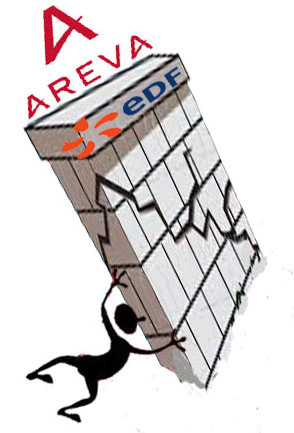 EDF faces £1m a day bill to keep French nuclear reactor offline https://www.theguardian.com/business/2017/feb/21/edf-faces-1m-a-day-bill-to-keep-french-nuclear-reactor-offline Prolonged closure at Flamanville plant after fire damage piles further financial pressure on state-owned energy firm, Guardian, Adam Vaughan, 21 Feb 17, The prolonged closure of a major French atomic reactor after an explosion this month probably costs EDF at least £1m a day, according to experts.
The nuclear plant operator, which will spend £18bn building the UK’s first new nuclear power station in a generation, shut unit 1 at its Flamanville plant after a fire broke out in the turbine hall.
The company initially estimated it would switch on the reactor within a week, but later pushed the date to the end of March. Work begins this week on replacing damaged equipment.
The unexpectedly long closure adds to the financial pressure on EDF, which last week reported a 6.7% decline in core earnings to €16.4bn (£14bn) in 2016. Closures of its French nuclear plants last year, partly for safety checks, have already cost the 85% state-owned company an estimated €1.3bn.
Prof Neil C Hyatt, head of nuclear materials chemistry at the University of Sheffield, said the lost revenue from the reactor closure in Normandy could be £1m per day.
“Bringing a nuclear power plant back online after an unscheduled outage is a complex task and EDF will want to ensure that all parts of the system are working safely and effectively. A short delay to complete the necessary checks is to be expected, given that the outage was unplanned,” he said.
Another expert said the cost of closure could be up to £1.8m per day, depending on energy market prices, and questioned why there was a delay.
“It took operator EDF almost a week to progressively correct the original outage estimate from one day to 50 days. EDF has provided no information as to why the outage time went from a few days to seven weeks,” said Mycle Schneider, a nuclear energy consultant based in Paris.
The 1.3GW reactor at Flamanville is one of a dozen of EDF’s French nuclear fleet currently offline, which the company said was usual for this time of the year.
It did not say why the restart date for the reactor had been revised four times, or why it had jumped from a few days to more than six weeks. John Large, a nuclear consultant who has advised the UK government, said initial reports that the fire was in a ventilator suggested the offline reactor would be back online within a week or two. Replacing such parts should be relatively straightforward, he said.
He added that the plant’s continued closure would also add to headaches at the French grid operator RTE, which warned of power cuts at the start of winter due to nuclear outages. “The continuing impact on the grid is likely to be significant, especially if a cold snap develops,” Large said.
A second reactor at the plant is still supplying electricity to the French grid. EDF said: “Work on recommissioning the affected equipment has started this week and should last several weeks, with reconnection to the grid planned for the end of March.”
China stalls in its push for nuclear power
China Nuclear Push Stalled by Next-Generation Reactors, Bloomberg, by Stephen Stapczynski and Aibing Guo, February 21, 2017,
-
Aims to approve eight new nuclear reactor projects this year
-
CGN’s Taishan units see further delay in commercial operations
China’s decision to approve its first new nuclear reactors in two years may need to wait for its success starting up the world’s first next-generation units.
Plans to green-light eight reactors this year in the world’s fastest-growing nuclear market, announced last week, could depend on whether it’s able to complete some of the world’s most-advanced facilities, including Westinghouse Electric Co.’s AP1000 and Areva SA’s EPR. The first such reactors may come online as early as the first half, followed by new approvals, according to Karl Liu, an analyst at BOC International Holdings Ltd. in Hong Kong.
“There are indications that Chinese policy makers want to wait for the AP1000s and EPRs under construction to come online and see how they do operationally before approving new projects,” said M.V. Ramana, a professor at the University of British Columbia. “I am not entirely sure that this plan will actually translate into reality.”
China is seeking to be the first country to bring online either an AP1000 or EPR, so-called generation III+ reactors, which have suffered costly delays in the U.S. and Europe. The world’s second-biggest economy, and largest energy consumer, is aiming to boost its nuclear power capacity and develop its own next-generation technology for export.
Construction delays for third-generation units are among reasons the Chinese government approved no new reactors last year, according to BOC’s Liu.
“The country wants to wait until the first AP1000 reactor successfully starts commercial operations before approving reactors using the same or similar technologies,” he said. …….
Originally designed to be cheaper and safer than earlier technology, growing complexity and new safety requirements of third-generation reactors are among cost issues that contributed to Westinghouse’s parent company Toshiba Corp. taking a multi-billion dollar writedown this year and Areva seeking a government bailout.
Oversupply
China’s power-generation overcapacity is another possible risk to new approvals, according to Ramana at the University of British Columbia. The country began showing signs of a glut as early as 2013, and hit a high in 2015, according to IHS Markit…….https://www.bloomberg.com/news/articles/2017-02-20/china-nuclear-ambitions-seen-stalled-by-next-generation-reactors
Pakistan and India have agreed to extend their bilateral nuclear safety agreement


 Pakistan, India extend nuclear safety agreement, By Our Correspondent, Express Tribune, February 21, 2017 ISLAMABAD: Pakistan and India have agreed to extend their bilateral agreement on reducing the risk from accidents relating to nuclear weapons in a move suggesting the two rivals are still mindful of nuclear dangers despite currently strained ties.
The key agreement was extended for the next five years (2017-2022), said a statement issued by the Foreign Office on Tuesday.
The agreement came into force in 2007. It was subsequently extended for a period of five years in 2012. The accord is part of the nuclear confidence building measures agreed between Pakistan and India. The aimed of the agreement is to promote a stable environment of peace and security between the two countries, reads the official handout.
“It is premised on the recognition that the nuclear dimension of the security environment of the two countries adds to their responsibility for avoidance of conflict,” the statement added.
The agreement provides for immediate exchange of information between the two countries in the event of any accident relating to nuclear weapons, under their respective jurisdiction and control, which could create the risk of radioactive fallout, with adverse consequences for both sides, or create the risk of an outbreak of a nuclear war…….https://tribune.com.pk/story/1334606/pakistan-india-extend-nuclear-safety-agreement/
Algerian human rights agency to prosecute France for nuclear tests
 Algerians take steps to prosecute France for nuclear tests https://www.middleeastmonitor.com/20170215-algerians-take-steps-to-prosecute-france-for-nuclear-tests/#.WKqZtaGEIJo.facebook
The details were revealed in a statement by the National Secretary of the Algerian League for the Defence of Human Rights, Houari Kaddour, who is tasked with this issue, during an interview with Anadolu news agency. Kaddour stressed that his organisation “is trying to use all legal means to put the French authorities on trial and prosecute them in all international legal bodies, as well as in the EU, for their crimes.”
Algeria marked the 57th anniversary of the French nuclear tests two days ago. They were carried out between 1960 and 1966; Algeria gained independence from France in 1962. The French authorities still refuse to admit to these crimes and instead have announced that they will pay financial compensation to the victims.
According to Kaddour, his organisation contacted the UN Human Rights council and requested it to look into the crimes. “We also urged the Algerians in Europe to help us find lawyers specialising in international law to file a lawsuit against France in the next three months, before the Office of the High Commissioner on Human Rights in the EU. We also plan to prosecute France in the local courts in Switzerland which specialise in international crimes.”
Kaddour said that his organisation is coordinating with a number of human rights and international bodies in this regard, including all international human rights organisations, international organisations against nuclear testing, and French human rights groups. He noted that the Algerians had submitted over 730,000 compensation cases that were rejected by the compensation committee due to the impossible conditions imposed on the victims. Civilian victims, he added, are not recognised.
The Algerian League for the Defence of Human Rights accused the Algerian authorities of “not putting enough pressure on France to admit to these crimes.”
Larry Criscione, Nuclear Regulatory Crusader

 Nuclear Regulatory Crusader http://allthingsnuclear.org/dlochbaum/nuclear-regulatory-crusader DAVE LOCHBAUM, DIRECTOR, NUCLEAR SAFETY PROJECT | JANUARY 23, 2017, To many, the acronym NRC stands for Nuclear Regulatory Commission. At times, NRC has been said to stand for Nobody Really Cares, Nuclear Rubberstamp Committee, and Nielsen Ratings Commission.
In regard to Larry Criscione, it may stand for Nuclear Regulatory Crusader.Larry is an engineer working for the U.S. Nuclear Regulatory Commission (NRC). Last year, Larry received the Joe A. Callaway Award for Civic Courage from The Safeek Nader Trust. Joe Callaway established the award in 1990 to recognize individuals who, with integrity and at some personal risk, take a public stance to advance truth and justice.
In March 2011, the three operating reactors at the Fukushima Daiichi nuclear plant in Japan melted down after a tsunami generated by a large earthquake flooded the site and disabled primary and backup power supplies to emergency equipment. In public, the NRC denied that reactors operating in the U.S. were vulnerable to such hazards.
In private, the NRC knew otherwise.
Flooding Risk at Oconee
In June 2010—nine months before Fukushima—the NRC issued a Confirmatory Action Letter to the owner of the Oconee nuclear plant in South Carolina requiring more than a dozen measures be taken. The measures were intended to lessen the chances that the Jocassee Dam fails and to increase the chances that the three operating reactors at Oconee survive should the dam fail anyway.
An evaluation showed that if the dam—located about 21 miles upriver from Oconee—failed, the site would be inundated with about 12.5 to 16.8 feet of flood water. The site was protected by a flood wall about seven feet tall, so it mattered little whether the actual depth was 12.5, 13, 14, 15, or 16.8 feet.
The NRC estimated that if the dam failed and flooded the site, there was a 100 percent chance that all three reactors would meltdown.
But the NRC issued the Confirmatory Action Letter secretly and did not tell the public about the hazard it required Oconee’s owner to lessen. After Fukushima tragically demonstrated the hazard posed by flooding, the NRC continued to cover-up measures taken and planned to lessen the flooding vulnerability at Oconee.
Larry and the OIG
So, Larry sent a 19-page letter dated September 18, 2002, to the NRC Chairman chronicling this history and asking four things:
- The NRC’s Office of General Counsel (OGC) should review the documents related to flooding at Oconee and the associated federal regulations to determine whether the documents could be made publicly available.
- The NRC’s Office of Nuclear Security and Incident Response (NSIR) should review the information on flooding hazards redacted from documents released to the public in response to Freedom of Information Act (FOIA) requests to determine whether additional information could be made publicly available.
- Based on the OGC and NSIR reviews, ensure that all flooding hazard documents that can be made publicly available are publicly available.
- The NRC’s Office of the Inspector General (OIG) should investigate whether the agency has been inappropriately marking documents as containing “Security-Related Information.”
Exercising his rights under the Lloyd-La Follette Act of 1912, Larry copied U.S. Congressional staff members on the email transmitting his letter to the NRC Chairman.
Larry’s letter was obtained by a reporter and featured in a Huffington Post article dated October 19, 2012.
As Larry had requested, the NRC’s OIG investigated handling of documents about flooding hazards. But rather than investigate whether NRC had improperly withheld information as he contended, OIG investigated whether Larry had improperly released information. As detailed in our 2015 report on the NRC and nuclear power safety, OIG made Larry an offer—he could voluntarily resign from the NRC or they would turn over his case to the Department of Justice (DOJ) for prosecution.
Larry did not resign.
OIG did refer the case to DOJ.
DOJ did not prosecute.
Through FOIA, UCS obtained DOJ’s response to NRC declining to prosecute Criscione. Under the Primary Reasons for Declination section, DOJ checked one box—No Federal Offense Committed.
Fortunately for Larry, not breaking the law is not yet against the law.
Thanks to Larry’s selfless efforts, the flooding hazards at Oconee have been made public. Larry had been right about the NRC inappropriately withholding information from the public. When lawyers and investigators were all through, the information he sought to have publicly released was publicly released. The NRC lacked legal grounds to continue hiding it.
More importantly, NRC’s mangers may think twice—or at least once—before withholding dam safety information in the future.
Unfortunately for Larry, he experienced unnecessary stress and expense defending himself against baseless OIG investigations. The Callaway Award does not fully offset those unfortunate consequences. But it helps show Larry and others who have our backs that not everyone wants to twist a dagger in their backs.
A video of the award presentation and Larry’s acceptance speech has been posted to YouTube.
Bottom Line
Doing the right thing when it’s relatively easy fails to accurately measure courage.
Larry Criscione did the right thing when it was a very hard thing to do. He could have remained silent like so many of his co-workers opted to do. He faced a strenuous courage test and aced it.
Florida Senate bill to promote solar energy, and repeal nuclear fees
 Pro-consumer Florida energy bills would expand solar, repeal nuclear fees http://protectingyourpocket.blog.mypalmbeachpost.com/2017/02/21/pro-consumer-florida-energy-bills-would-expand-solar-repeal-nuclear-fees/
China’s culture, and the fear of speaking out on environmental concerns
Why Environmental Activists Are Afraid to Speak Out, http://www.sixthtone.com/news/why-environmental-activists-are-afraid-speak-out , Feng Yongfeng, Feb 21, 2017 In 2007, soon after I founded an organization called “Nature University,” I ran a program for those with an interest in conservation — both experts and amateurs alike. I took them walking along Beijing’s waterways every Saturday, and each time, we saw foul water pouring directly into the streams and rivers. “We are environmental activists,” some of our shocked volunteers said. “We shouldn’t just look on and do nothing.”
Nature University is a Beijing-based virtual community school for sharing information about environmental protection. We mainly target volunteers and nongovernmental organizations in our campaigns. Back in 2007, our big idea was to launch a photo event encouraging people to send in pictures of Beijing’s sewage outlets, which we would then forward on to the authorities to create a dialogue with them about water pollution.
Hardly anybody responded to our call for submissions. When the time for action arrived, I was left wondering where all the once-vocal critics had gone. In my opinion, they failed to overcome the deep-seated fear of speaking out — a fear passed down from generation to generation. People were afraid that if they reported severe pollution in the area, their families or friends might become targets for retribution by those responsible, such as factory bosses or owners.
Fear of playing a role in public affairs is rooted in many people’s upbringings. From a young age, Chinese parents constantly warn their children that only grave misfortune will come of stepping into the public domain and challenging the powers that be, citing examples from ancient history in which those who made enemies of such people were executed, their accomplices exiled, and their family and friends mistreated. This mindset leads many environmental activists to gag themselves. Activities like crowdfunding, agenda-sharing, photographing contamination sites, lodging official complaints, and speaking out on social media all suffer under this mentality.
Sometimes, activists treat all stakeholders in a pollution event — from coal mine owners to managers, from local officials to the most menial workers — as enemies to be held in the utmost contempt. As their fear turns to anger, they make themselves more foes than friends, and therefore find more problems than solutions. Everyone involved in the disaster becomes a symbol of the fear they feel, and thus everyone becomes an antagonist in the fight for real change. It is hardly surprising that many of the projects organized by environmental activists are stymied by infighting before they truly get off the ground.
Environmental activists are at war with pollution, but fear of the transgressors keeps us too daunted to act. Ingrained self-denial makes us reluctant to pursue meaningful endeavors and keeps us locked in constant equivocation. Therein lies China’s dilemma: Very few people are happy about pollution, but even fewer are willing to act decisively against it. The only way to publicly escalate the issue is to stay mentally strong and argue based on the facts we have. Blots on China’s environmental landscape cast shadows over a large portion of the population. It is in the public interest to fight pollution, but we are too worried about ramifications for individuals when we should be worried about the collective good.
We must exorcise our collective malaise if we are to save our environment. If you suspect that a factory is acting irresponsibly in limiting pollution, do something about it. Find out about what it produces, the technical details of its product, and the national laws requiring it to protect its surroundings. If you find inconsistencies in any of these areas, report them.
Make your voice heard through social media and crowdfunding. Be encouraged by small but meaningful signs of progress. Day by day, week by week, a concerted public effort can and will reshape the environment around us, provided we can muster a groundswell of support. With these tools, we can overcome fear. The only real thing we should fear is our own apathy and lack of ambition when it comes to social and environmental justice.
A workshop I attended at the prestigious Peking University last December convinced me of this. At the end of the event, a student asked, “What is the greatest challenge facing China’s environmentalist groups today?” I expected the answer to be something rather banal, like a shortage of funding, labor, or knowhow. Instead, the speaker — the secretary general of the China Biodiversity Conservation and Green Development Foundation, Zhou Jinfeng — gave a much more refreshing response: “Now is the best time for environmental groups to make their mark in China, because no other country in the world has more environmental disasters going unchecked. Environmental groups, activists, and volunteers will have an impact in China so long as they put their words into actions. So why are so many of you sitting around watching?”
Ingrained self-denial makes us reluctant to pursue meaningful endeavors and keeps us locked in constant equivocation. Therein lies China’s dilemma: Very few people are happy about pollution, but even fewer are willing to act decisively against it. The only way to publicly escalate the issue is to stay mentally strong and argue based on the facts we have. Blots on China’s environmental landscape cast shadows over a large portion of the population. It is in the public interest to fight pollution, but we are too worried about ramifications for individuals when we should be worried about the collective good.
Perpetrators of ecological disasters are far more vulnerable than most people think. From the moment when a pollution event occurs, those responsible for it live in fear of the judgment — both official and unofficial — against them. Yet to capitalize on this weakness in those who ravage the land, sea, and air, environmental crusaders must be brave. Even just a few soldiers fighting valiantly on the front lines can turn the tide of battle and inspire the public to put aside its fear of jumping into the fray.
Famous ex-CIA spy Valerie Plame Wilson anxious about “reckless” President Trump and his “low-quality” administration
Ex-spy Plame’s big worries: ‘reckless’ president, nuclear weapons, By Kevin Fagan, San Francisco Chronicle, 21 Feb 17, When the most famous ex-CIA spy alive is concerned about the world blowing up, there’s probably something worrisome in that.
1 This Month
Chernobyl: The Lost Tapes – A good documentary on Chernobyl on SBS available On Demand for the next 3 weeks– https://www.sbs.com.au/ondemand/tv-program/chernobyl-the-lost-tapes/2352741955560

of the week–London Campaign for Nuclear Disarmament

Tell the Ukrainian Government to Drop Prosecution of Peace Activist Yurii Sheliazhenko
To see nuclear-related stories in greater depth and intensity – go to https://nuclearinformation.wordpress.com
-
Archives
- April 2026 (152)
- March 2026 (251)
- February 2026 (268)
- January 2026 (308)
- December 2025 (358)
- November 2025 (359)
- October 2025 (376)
- September 2025 (257)
- August 2025 (319)
- July 2025 (230)
- June 2025 (348)
- May 2025 (261)
-
Categories
- 1
- 1 NUCLEAR ISSUES
- business and costs
- climate change
- culture and arts
- ENERGY
- environment
- health
- history
- indigenous issues
- Legal
- marketing of nuclear
- media
- opposition to nuclear
- PERSONAL STORIES
- politics
- politics international
- Religion and ethics
- safety
- secrets,lies and civil liberties
- spinbuster
- technology
- Uranium
- wastes
- weapons and war
- Women
- 2 WORLD
- ACTION
- AFRICA
- Atrocities
- AUSTRALIA
- Christina's notes
- Christina's themes
- culture and arts
- Events
- Fuk 2022
- Fuk 2023
- Fukushima 2017
- Fukushima 2018
- fukushima 2019
- Fukushima 2020
- Fukushima 2021
- general
- global warming
- Humour (God we need it)
- Nuclear
- RARE EARTHS
- Reference
- resources – print
- Resources -audiovicual
- Weekly Newsletter
- World
- World Nuclear
- YouTube
-
RSS
Entries RSS
Comments RSS
 nuclear-news