Climate scientists face harassment, threats and fears of ‘McCarthyist attacks’
Researchers will have to deal with attacks from a range of powerful foes in the coming years – and for many, it has already started “…….The Texas Tech University professor Katharine Hayhoe, who has gathered a healthy following for her Facebook posts that mix climate science with evangelism, has opened her inbox to missives including “Nazi Bitch Whore Climatebecile” and a request that she “stop using Jesus to justify your wacko ideas about global warming”.
Threats and badgering of climate scientists peaked after the theft and release of the “Climategate” emails – a 2009 scandal that was painfully thin on scandal. But the organized effort to pry open cracks in the overwhelming edifice of proof that humans are slowly baking the planet never went away. Scientists are now concerned that the election of Donald Trump has revitalized those who believe climate researchers are cosseted fraudsters.
Mann said climate scientists “fear an era of McCarthyist attacks on our work and our integrity”. The odd unfulfilled threat may be perturbing but a more morale-sapping fear is that the White House and Congress will dig up and parade seemingly unflattering emails, sideline or scrap research and attempt to hush the scientific community…..https://www.theguardian.com/environment/2017/feb/22/climate-change-science-attacks-threats-trump
February 25, 2017
Posted by Christina Macpherson |
civil liberties, climate change, USA |
Leave a comment
Air pollution may have masked mid-20th Century sea ice loss https://www.sciencedaily.com/releases/2017/02/170223124327.htm February 23, 2017
- Source:
- American Geophysical Union
- Summary:
 Humans may have been altering Arctic sea ice longer than previously thought, according to researchers studying the effects of air pollution on sea ice growth in the mid-20th Century.
-
Humans may have been altering Arctic sea ice longer than previously thought, according to researchers studying the effects of air pollution on sea ice growth in the mid-20th Century. The new results challenge the perception that Arctic sea ice extent was unperturbed by human-caused climate change until the 1970s.
Scientists have observed Arctic sea ice loss since the mid-1970s and some climate model simulations have shown the region was losing sea ice as far back as 1950. In a new study, recently recovered Russian observations show an increase in sea ice from 1950 to 1975 as large as the subsequent decrease in sea ice observed from 1975 to 2005. The new observations of mid-century sea ice expansion led researchers behind the new study to the search for the cause.
The new study supports the idea that air pollution is to blame for the observed Arctic sea ice expansion. Particles of air pollution that come primarily from the burning of fossil fuels may have temporarily hidden the effects of global warming in the third quarter of the 20th Century in the eastern Arctic, the researchers say.
These particles, called sulfate aerosols, reflect sunlight back into space and cool the surface. This cooling effect may have disguised the influence of global warming on Arctic sea ice and may have resulted in sea ice growth recorded by Russian aerial surveys in the region from 1950 through 1975, according to the new research.
- “The cooling impact from increasing aerosols more than masked the warming impact from increasing greenhouse gases,” said John Fyfe, a senior scientist at Environment and Climate Change Canada in Victoria and a co-author of the new study accepted for publication in Geophysical Research Letters, a journal of the American Geophysical Union.
To test the aerosol idea, researchers used computer modeling to simulate sulfate aerosols in the Arctic from 1950 through 1975. Concentrations of sulfate aerosols were especially high during these years before regulations like the Clean Air Act limited sulfur dioxide emissions that produce sulfate aerosols.
The study’s authors then matched the sulfate aerosol simulations to Russian observational data that suggested a substantial amount of sea ice growth during those years in the eastern Arctic. The resulting simulations show the cooling contribution of aerosols offset the ongoing warming effect of increasing greenhouse gases over the mid-twentieth century in that part of the Arctic. This would explain the expansion of the Arctic sea ice cover in those years, according to the new study.
Aerosols spend only days or weeks in the atmosphere so their effects are short-lived. The weak aerosol cooling effect diminished after 1980, following the enactment of clean air regulations. In the absence of this cooling effect, the warming effect of long-lived greenhouse gases like carbon dioxide has prevailed, leading to Arctic sea ice loss, according to the study’s authors.
The new study helps sort out the swings in Arctic sea ice cover that have been observed over the last 75 years, which is important for a better understanding of sea ice behavior and for predicting its behavior in the future, according to Fyfe.
-
The new study’s use of both observations and modeling is a good way to attribute the Arctic sea ice growth to sulfate aerosols, said Cecilia Bitz, a sea ice researcher at the University of Washington in Seattle who has also looked into the effects of aerosols on Arctic ice. The sea ice record prior to satellite images is “very sparse,” added Bitz, who was not involved in the new study.
Bitz also points out that some aerosols may have encouraged sea ice to retreat. Black carbon, for instance, is a pollutant from forest fires and other wood and fossil fuel burning that can darken ice and cause it to melt faster when the sun is up — the opposite effect of sulfates. Also, black carbon emissions in some parts of the Arctic are still quite common, she said.
February 25, 2017
Posted by Christina Macpherson |
ARCTIC, climate change, oceans, Reference |
Leave a comment

 Antinuclear lobby groups say government’s secrecy is embarrassing
Two groups are asking the high court to declare the alleged nuclear deal with Russia‚ signed by Energy Minister Tina Joemat-Pettersson‚ unlawful, Business Live 22 FEBRUARY 2017 PETRU SAAL The court battle between lobby groups and the government over the alleged R1-trillion proposed nuclear deal with Russia — ostensibly the biggest procurement by the government to date — resumed in Cape Town on Wednesday.
Earthlife Africa Johannesburg and the Southern African Faith Communities’ Environment Institute (Safcei) have taken the Department of Energy to court for procuring this arrangement under a veil of secrecy.
They have asked the court to declare the deal‚ signed by Energy Minister Tina Joemat-Pettersson‚ unlawful and unconstitutional.
Spokesperson for Earthlife Makoma Lekalakala said it was “embarrassing” that they had to turn to the courts because the government refused to divulge details of the deal, which was of great public interest.
“We wondered why the government wanted to build nuclear plants especially after what happened in Hiroshima. Nuclear is also very costly so this deal is on the brink of bankrupting the country‚” Lekalakala said…… Finance Minister Pravin Gordhan made no mention of the deal in his budget speech.https://www.businesslive.co.za/bd/national/2017-02-22-antinuclear-lobby-groups-say-governments-secrecy-is-embarrassing/
February 25, 2017
Posted by Christina Macpherson |
Legal, South Africa |
Leave a comment
 FirstEnergy Corp. to sell or close its nuclear power plants By John Funk, The Plain Dealer February 22, 2017 AKRON, Ohio — FirstEnergy made it clear Wednesday that it is leaving the competitive power plant business, closing or selling all of its plants, including its nuclear plants, by the middle of next year.
The sale of the nuclear plants to another company would have little immediate impact on customer bills.
Closing the plants, which would probably take several years, would also have little impact on customer bills or power supplies….
The company’s acknowledgement Wednesday during a teleconference with financial analysts that it plans to sell or close its three nuclear plants came 24 hours after an Ohio lawmaker revealed that the FirstEnergy is seeking what amounts to additional and unprecedented rate increases.
The money from these first-of-a-kind charges would be earmarked for Davis-Besse, located east of Toledo, Perry, located east of Cleveland, and Beaver Valley, northwest of Pittsburgh.
FirstEnergy is proposing that the state create a program awarding “Zero Emission Credits” to the three plants ……
If lawmakers approve the plan, consumers would see an estimated 5 percent increase in their monthly bills. Commercial and industrial customers would see bills increase by 5-to-9 percent to reflect the value of the millions of megawatts the nuclear plants generate.
The Zec program would give the company’s nuclear fleet an increase of about $300 million a year, maybe enough to offset the losses competitors running gas turbine power plants have inflicted. …….
Even if the state creates a Zec program to subsidize FirstEnergy’s nuclear plants, the company acknowledges that it intends to try to sell them because it no longer wants to operate in competitive markets……
The company’s background materials accompanying Wednesday’s financial report show that FirstEnergy Solutions has a total value of $1.6 billion But the subsidiary carries a long-term debt of $3 billion.
The nuclear power plants are now valued at $900 million — with a debt of about $1.3 billion, the documents show. …..
The new charges would be “non-bypassable,” meaning a customer could not avoid the ZEC charges by purchasing power from another supplier.
The Ohio Zecs would be similar to a program Illinois created last fall to assist nuclear plant owners there. Opponents immediately sued in federal court, claiming an unconstitutional subsidy because the state is deregulated and power prices are set on competitive markets.
A piecemeal state-by-state Zec program to bail out nuclear plants could pose a problem for PJM, said PJM’s top executive in an interview earlier this week. …….http://www.cleveland.com/business/index.ssf/2017/02/firstenergy_corp_to_sell_or_cl.html
February 25, 2017
Posted by Christina Macpherson |
business and costs, USA |
Leave a comment
 Connecticut girds for nuclear power debate as critics line up against Millstone support bill Independent generators say allowing the Dominion plant to bid into renewable energy solicitations would undermine competition. Utility Dive, 23 Feb 17 The bill to provide support for Connecticut’s sole nuclear power plant has yet to be drafted, but the opposition is already lining up.
Connecticut legislators are picking up where they left off last year and drafting a bill that would essentially make nuclear power a Class Irenewable resource, making it eligible to participate in state solicitations for renewable energy resources.
The nuclear plant is not named – indeed, the legislation is not even drafted – but there is only one nuclear plant in Connecticut, Dominion Energy’s 2,110 MW Millstone plant in Waterford.
Dominion has not been as vocal as other nuclear operators such as Exelon, which has for years said that it would have to close at least two of its nuclear plants in Illinois if it did not get some form of financial relief……
Nuclear subsidies and their discontents
As some have analysts have predicted, Illinois and New York’s success with ZECs has emboldened other states to follow suit.
In 2016, the Connecticut Senate passed SB 344, which would have allowed nuclear plants to bid into state RFPs as a renewable resource, but the bill did not make it through the state’s House of Representatives.
Legislators in the state are now drafting a bill, SB 106, that would take up those same issues again.
In its Feb. 7 testimony filed with Connecticut’s General Assembly, the Electric Power Supply Association, a trade group for independent generators, used SB 344 as the basis of its comments on the assumption that the bill will provide the “framework” for the new SB 106.
SB 344 would have expanded the definition of “renewable” so that nuclear power could bid into the state’s clean energy solicitation and be eligible to be awarded a 10-year power purchase agreement……..http://www.utilitydive.com/news/connecticut-girds-for-nuclear-power-debate-as-critics-line-up-against-mills/436685/
February 25, 2017
Posted by Christina Macpherson |
business and costs, politics, USA |
Leave a comment
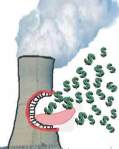 Skyrocketing costs bury Southern Co. Kristi E. Swartz, E&E News reporter Energywire: Thursday, February 23, 2017 The financial fallout of Toshiba Corp.’s nuclear construction business has now hit Southern Co.’s nuclear expansion project in Georgia.
Meanwhile, the Atlanta-based energy giant said its next-generation coal project in Mississippi still needs a couple of weeks before it is fully operational.
Those were just two of the major announcements from Southern as it reported its 2016 earnings yesterday. The company also filed a 900-plus-page annual report with the Securities and Exchange Commission, and its Mississippi Power subsidiary submitted an economic viability analysis on the Kemper County energy facility………
There is much discussion over Vogtle’s [nuclear plant’s] cost and schedule after Toshiba said last week it would book a $6.3 billion write-down from its nuclear construction business, which is tied to Vogtle and a project in South Carolina.
Scana Corp.’s South Carolina Electric & Gas Co. announced its units at V.C. Summer were roughly eight months behind.
Executives also said they were reviewing all options on how to finish the reactors if Westinghouse cannot. Toshiba and Westinghouse have told Scana and Southern that they intend to see the projects through……http://www.eenews.net/stories/1060050444
February 25, 2017
Posted by Christina Macpherson |
business and costs, USA |
Leave a comment
GOP lawmaker calls for Trump’s border wall, warns nuclear weapons may be hidden in marijuana Arizona Republican Rep. Trent Franks told CNN he worries about terrorists using bales of marijuana to smuggle nukes, salon.com SOPHIA TESFAY , FRIDAY, FEB 24, 2017 Arizona Republican Rep. Trent Franks defended President Donald Trump’s proposed border wall by claiming it could prevent a nuclear weapon from being smuggled into the United States concealed in a bale of marijuana……..
Franks also failed to explain why presumed nuke-smugglers would choose to try to hide their weapon in something the U.S. Border Patrol is already looking for, although The Washington Post
reported Wednesday that Franks’s suggestion is one that has been floated by at least one nuclear weapons expert and Democratic congressman in the past…….
David Kay of the International Atomic Energy Agency told “
Frontline” in 1996 that concealing a nuclear weapon in a bale of weed would be his “preferred method” of nuke smuggling.
February 25, 2017
Posted by Christina Macpherson |
politics, USA |
Leave a comment
Don’t Invest in Nuclear Power. It’s a Sucker’s Bet. It was a Scam! Energy and Capital by Jeff Siegel February 21, 2017 Donald Trump is considered to be one of the greatest salesmen of all time.
But not even Trump would be able unload this steaming pile.
Last week, after Toshiba (OTCBB: TOSYY) projected a $6.3 billion write-down for its nuclear unit, management announced it was looking to sell its majority stake in Westinghouse, for which it paid $5.4 billion in 2006.
More than 10 years ago, the suits at Toshiba were overly optimistic about their ability to roll out a new generation of nuclear power plants that would be smaller, cheaper, and safer.
Today, they have four under construction in the United States and all have run into technical hiccups and cost overruns.
All in all, it was a big bet on a nuclear renaissance that, as I’ve warned dozens of times before, will never materialize in the U.S. The economics didn’t make sense 60 years ago, and they don’t make sense today….any hope of a nuclear power renaissance is based on nothing more than false hope and the illusion that’s often paraded around by lawmakers who have skin in the game.
A Very Risky Bet
In all fairness to Toshiba, the company did the Westinghouse deal right after the U.S. government ponied up a bunch of loan guarantees, tax credit packages, and cost-overrun backstops for nuclear power development.
With Washington bullish on nuclear, management likely figured it could rely on the government to help hedge some of the risk that comes along with building massive industrial projects such as nuclear power plants.
But it wasn’t enough…….https://www.energyandcapital.com/articles/dont-invest-in-nuclear-power-its-a-suckers-bet/5760
February 25, 2017
Posted by Christina Macpherson |
general |
1 Comment
Fukushima: A Lurking Global Catastrophe?
by Robert Hunziker / February 19th, 2017

Year over year, ever since 2011, the Fukushima Daiichi nuclear meltdown grows worse and worse, an ugly testimonial to the inherent danger of generating electricity via nuclear fission, which produces isotopes, some of the most deadly poisonous elements on the face of the planet.
Fukushima Diiachi has been, and remains, one of the world’s largest experiments; i.e., what to do when all hell breaks lose aka The China Syndrome.
Scientists still don’t have all the information they need for a cleanup that the government estimates will take four decades and cost ¥8 trillion. It is not yet known if the fuel melted into or through the containment vessel’s concrete floor, and determining the fuel’s radioactivity and location is crucial to inventing the technology to remove the melted fuel.1
As it happens, “inventing technology” is experimental stage stuff. Still, there are several knowledgeable sources that believe the corium, or melted core, will never be recovered. Then what?
According to a recent article, “Potential Global Catastrophe of the Reactor No. 2 at Fukushima Daiichi,” February 11, 2017 by Dr. Shuzo Takemoto, professor, Department of Geophysics, Graduate School of Science, Kyoto University: The Fukushima nuclear facility is a global threat on level of a major catastrophe.
Meanwhile, the Abe administration dresses up Fukushima Prefecture for the Tokyo 2020 Olympics, necessitating a big fat question: Who in their right mind would hold Olympics in the neighborhood of three out-of-control nuclear meltdowns that could get worse, worse, and still worse? After all, that’s the pattern over the past 5 years; it gets worse and worse. Dismally, nobody can possibly know how much worse by 2020. Not knowing is the main concern about holding Olympics in the backyard of a nuclear disaster zone, especially as nobody knows what’s happening. Nevertheless and resolutely, according to PM Abe and the IOC, the games go on.
Along the way, it’s taken Tokyo Electric Power Company (TEPCO) nearly six years to finally get an official reading of radiation levels of the meltdown but in only one unit. Analysis of Unit #2 shows radiation levels off-the-charts at 530 Sieverts, or enough to kill within minutes, illustrative of why it is likely impossible to decommission units 1, 2, and 3. No human can withstand that exposure and given enough time, frizzled robots are as dead as a door nail.
A short-term, whole-body dose of over 10 sieverts would cause immediate illness and subsequent death within a few weeks, according to the World Nuclear Association.2
Although Fukushima’s similar to Chernobyl Exclusion Zone in some respects, where 1,000 square miles has been permanently sealed off, Fukushima’s different, as the Abe administration is already repopulating portions of Fukushima. If they don’t repopulate, how can the Olympics be held with food served from Fukushima and including events like baseball held in Fukushima Prefecture?
Without question, an old saw – what goes around comes around – rings true when it comes to radiation, and it should admonish (but it doesn’t phase ‘em) strident nuclear proponents, claiming Fukushima is an example of how safe nuclear power is “because there are so few, if any, deaths” (not true). As Chernobyl clearly demonstrates: Over time, radiation cumulates in bodily organs. For a real life example of how radiation devastates human bodies, consider this fact: 453,391 children with bodies ravaged, none born at the time of the Chernobyl meltdown in 1986, today receive special healthcare because of Chernobyl radiation-related medical problems like cancer, digestive, respiratory, musculoskeletal, eye disease, blood disease, congenital malformation, and genetic abnormalities. Their parents were children in the Chernobyl zone in 1986.3
Making matters worse yet, Fukushima Diiachi sets smack dab in the middle of earthquake country, which defines the boundaries of Japan. In that regard, according to Dr. Shuzo Takemoto, professor, Department of Geophysics, Graduate School of Science, Kyoto University:
The problem of Unit 2… If it should encounter a big earth tremor, it will be destroyed and scatter the remaining nuclear fuel and its debris, making the Tokyo metropolitan area uninhabitable. The Tokyo Olympics in 2020 will then be utterly out of the question.4
Accordingly, the greater Tokyo metropolitan area remains threatened for as long as Fukushima Diiachi is out of control, which could be for generations, not years. Not only that, Gee-Whiz, what if the big one hits during the Olympics? After all, earthquakes come unannounced. Regrettably, Japan has had 564 earthquakes the past 365 days. It’s an earthquake-ridden country. Japan sits at the boundary of 4 tectonic plates shot through with faults in zigzag patterns, very lively and of even more concern, the Nankai Trough, the candidate for the big one, sits nearly directly below Tokyo. On a geological time scale, it may be due for action anytime within the next couple of decades. Fukushima Prefecture’s not that far away.
Furthermore, the Fukushima Diiachi nuclear complex is tenuous, at best:
All four buildings were structurally damaged by the original earthquake some five years ago and by the subsequent hydrogen explosions so should there be an earthquake greater than seven on the Richter scale, it is very possible that one or more of these structures could collapse, leading to a massive release of radiation as the building falls on the molten core beneath.5
Complicating matters further, the nuclear site is located at the base of a mountain range. Almost daily, water flows from the mountain range beneath the nuclear plant, liquefying the ground, a sure-fire setup for cascading buildings when the next big one hits. For over five years now, radioactive water flowing out of the power plant into the Pacific carries isotopes like cesium 134 and cesium 137, strontium 90, tritium, plutonium americium and up to 100 more isotopes, none of which are healthy for marine or human life, quite the opposite, in fact, as those isotopes slowly cumulate, and similar to the Daleks of Doctor Who fame (BBC science fiction series, 1963-present) “Exterminate! Exterminate! Exterminate!”
Isotopes bio-concentrate up the food chain from algae to crustaceans to small fish to big fish to bigger humans. Resultant cancer cells incubate anytime from two years to old age, leading to death. That’s what cancer does; it kills.
Still, the fact remains nobody really knows for sure how directly Fukushima Diiachi radiation affects marine life, but how could it be anything other than bad? After all, it’s a recognized fact that radiation cumulates over time; it’s tasteless, colorless, and odorless as it cumulates in the body, whether in fish or further up the food chain in humans. It travels!
An example is Cesium 137, one of the most poisonous elements on the planet. One gram of Cesium 137 the size of a dime will poison one square mile of land for hundreds of years. That’s what’s at stake at the world’s most rickety nuclear plant, and nobody can do anything about it. In fact, nobody knows what to do. They really don’t.
When faced with the prospect of not knowing what to do, why not bring on the Olympics? That’s pretty good cover for a messy situation, making it appear to hundreds of thousands of attendees, as well as the world community “all is well.” But, is it? Honestly….
The Fukushima nuclear meltdown presents a special problem for the world community. Who knows what to believe after PM Abe lied to the IOC to get the Olympics; see the following headline from Reuters News:
“Abe’s Fukushima ‘Under Control’ Pledge to Secure Olympics Was a Lie: Former PM,” Reuters, September 7, 2016.
Abe gave the assurances about safety at the Fukushima plant in his September 2013 speech to the International Olympic Committee to allay concerns about awarding the Games to Tokyo. The comment met with considerable criticism at the time… Mr. Abe’s ‘under control remark, that was a lie,’ Koizumi (former PM) now 74 and his unruly mane of hair turned white, told a news conference where he repeated his opposition to nuclear power.
As such, a very big conundrum precedes the 2020 games: How can the world community, as well as Olympians, believe anything the Abe administration says about the safety and integrity of Fukushima?
Still, the world embraces nuclear power more so than ever before as it continues to expand and grow. Sixty reactors are currently under construction in fifteen countries. In all, 160 power reactors are in the planning stage and 300 more have been proposed. Pro-Nuke-Heads claim Fukushima proves how safe nuclear power is because there are so few, if any, deaths, as to be inconsequential. That’s a boldfaced lie.
Here’s one of several independent testimonials on deaths because of Fukushima Diiachi radiation exposure (many, many, many more testimonials are highlighted in prior articles, including USS Ronald Reagan sailors on humanitarian rescue missions at the time):
It’s a real shame that the authorities hide the truth from the whole world, from the UN. We need to admit that actually many people are dying. We are not allowed to say that, but TEPCO employees also are dying. But they keep mum about it.6
- Emi Urabe, “Fukushima Fuel-Removal Quest Leaves Trail of Dead Robots“, The Japan Times, February 17, 2017. []
- Emi Urabe, “Fukushima Fuel-Removal Quest Leaves Trail of Dead Robots”, The Japan Times, February 17, 2017. []
- “Chernobyl’s Legacy: Kids With Bodies Ravaged by Disaster”, USA Today, April 17, 2016). []
- Shuzo Takemoto, “Potential Global Catastrophe of the Reactor No. 2 at Fukushima Daiichi”, February 11, 2017. []
- Helen Caldicott: “The Fukushima Nuclear Meltdown Continues Unabated”, Independent Australia, February 13, 2017. []
- Katsutaka Idogawa, former mayor of Futaba (Fukushima Prefecture), “Fukushima Disaster: Tokyo Hides Truth as Children Die, Become Ill from Radiation – Ex-Mayor”,RT News, April 21, 2014. []
Robert Hunziker (MA, economic history, DePaul University) is a freelance writer and environmental journalist whose articles have been translated into foreign languages and appeared in over 50 journals, magazines, and sites worldwide. He can be contacted at: rlhunziker@gmail.com. Read other articles by Robert.
This article was posted on Sunday, February 19th, 2017 at 11:15pm
February 24, 2017
Posted by arclight2011part2 |
Uncategorized |
1 Comment
 geoharvey
Opinion:
¶ “Will fossil fuels and conventional cars be obsolete by 2030?” In 2016, solar power became the cheapest form of energy in 58 lower-income countries, including China, India, and Brazil, and the cost is still dropping. In Europe, in 2016, 86% of the newly installed energy capacity was from renewable sources. Is it all over for fossil fuels? [Huffington Post]
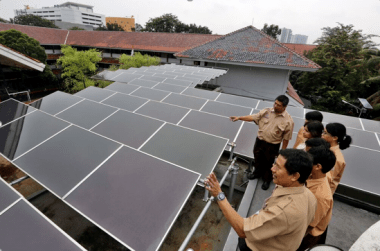 Solar power rising
World:
¶ London has air pollution levels that sometimes exceed those of Beijing. NOx levels have gone well beyond EU legal limits; over a 5 day period in January, their levels exceeded the EU’s legal limit for a full year. The Mayor announced that central London will institute a £10 charge for entering vehicles that don’t meet Euro 4 standards. [CleanTechnica]
¶ The government of France is reportedly now offering a state subsidy of €200 to buyers of certain electrically powered bicycles…
View original post 823 more words
February 24, 2017
Posted by Christina Macpherson |
Uncategorized |
Leave a comment
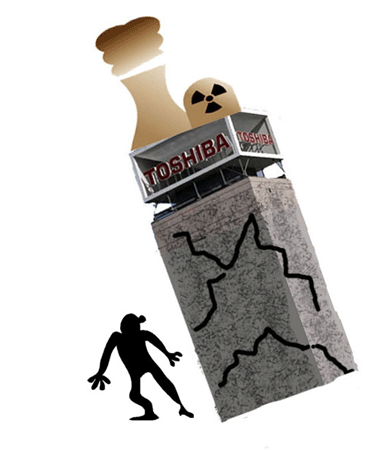 Overseas nuclear business a huge burden on Toshiba ,
  Japan News, February 22, 2017 By Miho Yokoi / Yomiuri Shimbun Staff Writer Toshiba Corp. has been facing a need to review its nuclear business because it has been a drag on the company’s reconstruction efforts, mostly caused by the huge loss booked in reactor building projects in the United States and construction delays in other countries.
Nonetheless, it will not be easy for the major electronics and machinery maker to considerably shrink its nuclear business overseas because there are only a handful of entities that can build such facilities.
Toshiba will likely book a loss of more than ¥700 billion for the April-December 2016 period, and U.S. subsidiary Westinghouse Electric Co. is a major factor behind the result…….
It is likely that Toshiba will face a ballooning loss if construction for the reactors [Plant Vogtle in Georgia, USA) continues to be delayed. “It would be a lie if we say there’s no risk at all,” said Corporate Vice President Mamoru Hatazawa.
Toshiba won contracts for building two reactors in Texas in 2009, but their construction has not yet started. The projects have been affected by the increase in the amount of U.S. shale gas production, which has caused fuel prices for thermal power generation to nosedive, thereby boosting needs for a method with cheaper running costs.
Meanwhile, Toshiba’s nuclear businesses in countries other than the United States have also been facing an uphill battle.
In China, for example, Westinghouse has undertaken construction of four nuclear reactors, originally with an aim to put them into operation between 2013 and 2015. However, none of them has been completed because of delays in the work.
The U.S. subsidiary also hoped to win contracts for developing six reactors in India, but the plan has been stalled because it is so risky for a builder to sign a contract under the current Indian law, which obliges the entity to assume liability for compensation in the event of a nuclear accident……..http://the-japan-news.com/news/article/0003536775
February 24, 2017
Posted by Christina Macpherson |
business and costs, Japan |
Leave a comment
Bill to label nuclear energy as renewable stalls A bill aimed at classifying nuclear power as a renewable energy source in New Mexico stalled Thursday afternoon in committee on a tie vote.
House Bill 406, sponsored by Rep. Cathrynn Brown, R-Carlsbad, would have amended the state’s Renewable Energy Act, which requires energy companies provide a certain amount of electricity from renewable sources…. New Mexico Political Report 24 Feb 17
Nuclear Is Renewable Energy? http://krwg.org/post/nuclear-renewable-energy
By CVNM •Santa Fe, N.M. 24 Feb 17 – Today, the House Energy, Environment and Natural Resources Committee debated Nuclear Energy as Renewable Energy (HB 406, Brown). The bill was tabled on a tied vote. CVNM Legislative Director Ben Shelton and CVNM Education Fund Western New Mexico Program Director Talia Boyd released the following statements:
“Nuclear energy is part of the problem, not the solution. Proposing to classify nuclear as renewable energy – as Governor Martinez did her in energy plan – disrespects the sacrifice Indigenous communities in western New Mexico have already made and continue to make with their health from the impacts of uranium mining,” says Ben Shelton, CVNM Legislative Director. “In addition, adding nuclear energy to the Renewable Energy Portfolio standard neutralizes its job creating potential because of nuclear assets already held by New Mexico’s two largest electric utilities – something our leaders should not consider a possibility.”
“My community in Gallup and Church Rock have witnessed our health, culture, families, and land be desecrated and sacrificed for uranium – an industry that many in our communities do not want, as demonstrated by a ban on uranium mining passed by the Navajo Nation in 2005,” says Talia Boyd, CVNM Education Fund Western New Mexico Organizer and member of the Diné Nation.
“Communities that have been living with the impacts of poor energy policy need to be at the table shaping our energy future by putting hardworking New Mexicans first with clean, renewable energy jobs, like wind and solar.”
February 24, 2017
Posted by Christina Macpherson |
politics, spinbuster, USA |
Leave a comment
 A link between cancer rates and nuclear plants? http://www.pottsmerc.com/article/MP/20170221/NEWS/170229937 Joseph Mangano Executive Director Radiation and Public Health Project 02/21/17,SINCE THE TWO NUCLEAR REACTORS AT LIMERICK Began operating in the 1980s, the question of whether toxic radiation releases affected local cancer rates has persisted.
The latest official statistics raise a red flag: among children and young adults, who are more vulnerable to radiation, cancer rates are rising — especially cancers of the thyroid, which is most sensitive to radiation.
A disastrous meltdown, like those at Three Mile Island, Chernobyl and Fukushima, has always been possible at Limerick. But toxic radioactivity routinely generated is steadily released into local air and water. People living nearby drink, eat and breathe these chemicals on a daily basis.
A study from the early 2000s found high average levels of Strontium-90 in over 100 local baby teeth. This chemical, only created in atomic bomb explosions and nuclear reactor operations, is deposited in bone and teeth. Levels in teeth of children living near Limerick were 50 percent higher than in areas far from nuclear plants; and those results were published in medical journal articles.
The childhood cancer rate in the Pottstown area was 93 percent above the rest of the region in the late 1990s and early 2000s. While multiple factors can cause children to develop cancer, public health officials failed to document any.
Now that the Limerick nuclear reactors are aging, their parts are corroding and more likely to routinely leak radiation. A review of current local cancer rates in young people is in order.
In the most recent four-year period (2011-2014), a total of 430 cancer cases were diagnosed in Montgomery County residents under age 30, a jump from the 338 cases in the four years prior. The rate increase of 27 percent was significantly larger than the 5 percent rise for the rest of Pennsylvania.
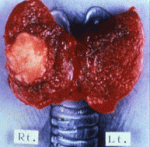 Thyroid cancer is probably the most radiosensitive of all cancers. High rates of this cancer have been found in survivors of the atom bombs in Hiroshima and Nagasaki; Baby Boomers exposed to above-ground bomb test fallout in the 1950s and 1960s; persons living near Chernobyl during the 1986 meltdown; and children living near Fukushima after the 2011 meltdown.
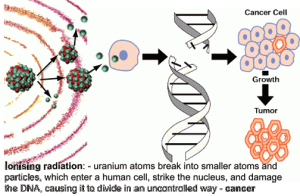
The reason thyroid cancer is sensitive to radiation? Another of the 100-plus chemicals released from reactors is iodine-131 (I-131), tiny radioactive metal particles that seek out the thyroid, a butterfly-shaped gland in the neck. I-131 kills or damages healthy cells, which can lead to cancer. Since 1991, U.S. thyroid cancer cases diagnosed annually soared from 12,000 to 64,000.
New thyroid cancer cases in persons under 30-years-old rose from 40 to 79 in Montgomery County during the most recent two four-year periods, a 97 percent increase. The increase for the rest of Pennsylvania is just 9 percent. The county rate is well above the state.
Thyroid cancer is not caused by working in coal mines. It is not caused by smoking. It is not caused by drinking alcohol. It is not caused by eating processed foods. The Mayo Clinic lists just three risk factors for the disease; being female (not a cause); inherited defective genes (not a cause); and radiation exposure — the only known cause.
The childhood cancer rate in the Pottstown area was 93 percent above the rest of the region in the late 1990s and early 2000s. While multiple factors can cause children to develop cancer, public health officials failed to document any.
Now that the Limerick nuclear reactors are aging, their parts are corroding and more likely to routinely leak radiation. A review of current local cancer rates in young people is in order.
In the most recent four-year period (2011-2014), a total of 430 cancer cases were diagnosed in Montgomery County residents under age 30, a jump from the 338 cases in the four years prior. The rate increase of 27 percent was significantly larger than the 5 percent rise for the rest of Pennsylvania.
Thyroid cancer is probably the most radiosensitive of all cancers. High rates of this cancer have been found in survivors of the atom bombs in Hiroshima and Nagasaki; Baby Boomers exposed to above-ground bomb test fallout in the 1950s and 1960s; persons living near Chernobyl during the 1986 meltdown; and children living near Fukushima after the 2011 meltdown.
The reason thyroid cancer is sensitive to radiation? Another of the 100-plus chemicals released from reactors is iodine-131 (I-131), tiny radioactive metal particles that seek out the thyroid, a butterfly-shaped gland in the neck. I-131 kills or damages healthy cells, which can lead to cancer. Since 1991, U.S. thyroid cancer cases diagnosed annually soared from 12,000 to 64,000.
New thyroid cancer cases in persons under 30-years-old rose from 40 to 79 in Montgomery County during the most recent two four-year periods, a 97 percent increase. The increase for the rest of Pennsylvania is just 9 percent. The county rate is well above the state.
Thyroid cancer is not caused by working in coal mines. It is not caused by smoking. It is not caused by drinking alcohol. It is not caused by eating processed foods. The Mayo Clinic lists just three risk factors for the disease; being female (not a cause); inherited defective genes (not a cause); and radiation exposure — the only known cause.
February 24, 2017
Posted by Christina Macpherson |
health, Reference, USA |
Leave a comment
BERGEN — The cost of bringing the state’s energy portfolio to 50 percent renewable sources by 2030 will be felt all over the state next month.
But communities such as the village of Bergen — which have municipal electric departments — the costs of scaling up renewable sources and keeping four upstate nuclear power plants viable will be felt more deeply.
PUBLISHED: FRIDAY, FEBRUARY 24, 2017
Village officials said Wednesday they have reached out to their approximately 670 customers, but are surprised increasing utility rates aren’t getting more attention. In Bergen alone, Gov. Andrew Cuomo’s Clean Energy Standard is expected to raise the cumulative bill paid by Bergen Electric consumers by $90,668 in 2017 to fund the Zero Emission Credit program.
“No matter who supplies your power, whether it’s Bergen Electric, or National Grid, or RG&E, every electricity user in the state is going to be paying more starting next month,” Bergen Administrator, Clerk and Treasurer Courtney Gale said last week with near incredulity. “(The state) is giving three power plants $482 million per year, basically subsidizing them so they make money … and it’s not just us, everyone in the whole state will have their rates increasing. We sent this letter out, and I’m sure we’ll get a lot of questions.”
In their one-page letter, the village told residents that the ZEC and the Renewable Energy Credit program that will fund renewable energy-generating facilities will show up on their bills, and that they are non-legislative mandates. “Bergen Electric has no choice but to abide with the order” it reads.
“As a village, we’re constantly looking for ways to make it more efficient for everybody, with LED streetlights and other things like that,” Mayor Anna Marie Barclay said. “So we’re on one side, trying to be as efficient as possible … and now we have to add a fee that’s totally out of our control. It’s frustrating.”
With all the focus on windmills off Long Island and the shuttering of the downstate region’s sole nuclear plant, Gale and Barclay said their outreach aims to raise awareness before residents’ bills rise.
It may be spelled out on a private energy firm’s bill, but it will just show up as a higher rate with municipal providers.
According to estimates prepared for the 41 New York communities that provide municipal electricity through a supply that’s partially subsidized from power generated at Niagara Falls, the Zero Emission Credits will vary based on the scale of systems.
Silver Springs is projected to have $20,431 in ZEC charges this year, with Castile at $26,891.
Communities supplying power to agri-business users such as Bonduelle in Bergen, or cold storage operations like Holley will see $97,991 in increases. Those supporting manufacturing facilities, like Arcade, will see $435,404.
They will have higher costs but increases are set across the board at roughly $0.003 per kilowatt hour of electricity.
Even though the village is limited by contracts not to produce its own power in an effort to reduce rates further, Bergen supplies power to residential and commercial users at a market rate of around $0.06 to $0.08 per kilowatt hour, which Barclay said is a small but beneficial support the village can offer.
“It’s a perk that people are glad to hear about,” Barclay said. “It’s not something that causes people to move here to somewhere else, but it does make a difference. Our electric bills are maybe two-thirds of what someone’s bill is outside of the village. And if you have electric heat it’s a huge difference.”
Gale estimated roughly a third of the Bergen’s homes are heated by electric sources, and one subdivision is all electric — there’s no natural gas.
“For a lot of people in Bergen (it makes sense) because it’s so cheap to heat their whole house with electric,” Gale said, at costs of a few hundred dollars per month in the winter. “For them, a little increase is still going to be a lot, and those are people who already have a hard time paying for electric. It will hurt them more.”
Village seeking ideas for grant
Barclay and Gale said Bergen’s energy bonafides are serious and growing. They have already reached the requirements for NYSERDA’s Clean Energy Community program, which will provide grants of $100,000 to four Rochester-area municipalities and five $50,000 grants to five more that show progress on energy efficiency.
By changing all of the village’s streetlights to LEDs over the past years, passing two policy resolutions and staging an energy efficiency training, the village is ready to claim the prizes. Now they need to figure out what to ask for.
Projects would need to be related to additional energy savings, but would have to create a community-wide benefit. Barclay said adding an electric vehicle charging station is one possibility, which could pull more Thruway and I-490 traffic into the village to eat and shop.
“There’s a lot of options,” she said.
February 24, 2017
Posted by arclight2011part2 |
Uncategorized |
Leave a comment







 nuclear-news