Government to cut housing assistance to some Fukushima evacuees

It’s been nearly six years since Japan’s Fukushima nuclear disaster. Now, the local government is preparing to slash housing assistance for those who fled.
It would require them to choose between returning to places affected by radiation or, to bear the financial burden of remaining in their adopted places of refuge.
The huge earthquake and tsunami crippled a nuclear power plant in Fukushima causing tens of thousands of people to evacuate from their homes
According to Fukushima government, at its peak, about 165,000 people were made to evacuate from the contaminated areas.
Some decided to return to their hometown after evacuation orders were lifted. But decontamination and renovation work took time and money
Some decided to leave their homes permanently, finding jobs and life elsewhere.
Over 81000 people are still displaced.
However, the number is said to be much larger, including those that voluntarily evacuated from areas not designated as mandatory evacuation zones, from fears of high levels of radiation in their homes.
The Fukushima local government is preparing to slash unconditional housing assistance for these voluntary evacuees on March 31st.
Many have to choose either to return to areas where they still fear of radiation, or bear the financial burden to remain at their place of refuge
It said that over 32,000 people have to make a choice to self-support themselves or return to Fukushima. where recovery work is slow.
Evacuees said the government is trying to end the Fukushima issues before the Tokyo Olympics, to show the world that “Fukushima is under control.”
It is expected that many will choose to return to Fukushima. But majority say they will not feel safe and under constant fear of lingering radiation. Some even expressed their concerns of possible radiation spills during the decontamination process.
It might be decades until the residents in Fukushima feel truly at ease.
http://america.cgtn.com/2017/02/18/government-to-cut-housing-assistance-to-some-fukushima-evacuees
Robot investigation shows the situation within the Fukushima reactor is much worse than expected
 Radiation levels at Fukushima reactor puzzle nuclear experts, THE ASAHI SHIMBUN, February 19, 2017 A robot was expected to solidify ways to clean up the No. 2 reactor at the Fukushima No. 1 nuclear plant, but its short-lived mission raised puzzling questions that could derail existing decommissioning plans.
The robot, Sasori, was abandoned in the melted-down reactor after it became stuck in deposits and other debris that are believed to have interfered with its drive system.
But it did take radiation measurements that indicate Tokyo Electric Power Co., operator of the plant, was too optimistic about the state and location of the melted fuel within the reactor. The melted fuel, in fact, may be spread out all over the reactor’s containment vessel.
Scientists had believed the melted nuclear fuel fell through the reactor’s pressure vessel and landed on metal grating and the floor of the containment vessel.
The results of Sasori’s investigation, coupled with previous data taken from possible images of the melted fuel, show the situation within the reactor is much worse than expected. And a fresh investigation into the reactor is now nowhere in sight.
A remote-controlled video camera inserted into the reactor on Jan. 30 took what are believed to be the first images of melted fuel at the plant, which suffered a triple meltdown after the March 2011 Great East Japan Earthquake and tsunami.
Based on the images, TEPCO estimated 530 sieverts per hour at a point almost halfway between the metal grating directly beneath the pressure vessel and the wall of the containment vessel. Black lumps on the grating are believed to be melted fuel.
A different robot sent in on Feb. 9 to take pictures and prepare for Sasori’s mission estimated 650 sieverts per hour near the same spot.
Both 530 and 650 sieverts per hour can kill a person within a minute.
Sasori, equipped with a dosimeter and two cameras, on Feb. 16 recorded a reading of 210 sieverts per hour near the same location, the highest figure measured with instruments in the aftermath of the disaster.
Sasori was supposed to travel along a rail connecting the outer wall of the containment vessel with the metal grating to measure radiation doses and shoot pictures inside, essential parts of work toward decommissioning the reactor.
After traveling only 2 meters, the robot became stuck before it could reach the metal grating.
TEPCO at a news conference repeatedly said that Sasori’s investigation was not a “failure” but had produced “meaningful” results.
However, an official close to TEPCO said, “I had great expectations for Sasori, so I was shocked by how it turned out.”……(This article was compiled from reports by Kohei Tomida, Masanobu Higashiyama and Takashi Sugimoto) http://www.asahi.com/ajw/articles/AJ201702190042.html
Growing concern over Trump’s mental condition
Their letter prompted another, from Dr Allen Frances, professor emeritus of psychiatry and behavioural sciences at Duke University Medical College, who happens to be the expert psychiatrist who defined narcissistic personality disorder.
He rebuked the authors, arguing that to claim that Trump is mentally ill is an insult to those who truly are. But he also had this to say – Trump may be a “world-class narcissist”.
But the debate has taken off. Another psychologist weighed in last month, telling US News and World Report that Trump displays a malignant narcissism, characterised by grandiosity, sadism and anti-social behaviour.
 Americans take an anxious journey to the centre of Donald Trump’s mind, The Age,Paul McGeough, 20 Feb 17 Washington: Flip references by reporters – mine included – to Donald Trump not taking his meds have been criticised as offensive to the mentally ill. But Trump’s unhinged behaviour, as in his erratic press conference on Thursday, ensures that the President’s mental state is the stuff of debate.
Rick Wilson, a Republican Party strategist and Trump critic, saw the Thursday press conference as a turning point – instead of a divide between left and right, the split he sees in America is between those who saw the spectacle as a “success” and those who are “terrified” for the future of the country.
“[His press conference] could have been evidence in a mental competency hearing,” he told The Washington Post. “It was really pretty disturbing and terrifying to watch this guy and think: ‘What happens when the stakes are higher?’”
On Saturday, The New York Times‘ conservative columnist David Brooks wrote in similar language about the press conference: “President Trump’s mental state is like a train that long ago left freewheeling and iconoclastic, has raced through indulgent, chaotic and unnerving, and is now careening past unhinged, unmoored and unglued.”
It’s not just the commentariat in the “fake press”, on which Trump has upped the ante, denouncing them as “the enemy of the American people”. Mental health professionals are weighing in.
In a letter to the editor of The New York Times last week, 35 psychiatrists, psychologists and social workers acknowledged they were in breach of professional rules against evaluating public figures, but to remain silent, they wrote, denied journalists and members of Congress the value of their expertise at this critical time.
Here’s their diagnosis: “Mr. Trump’s speech and actions demonstrate an inability to tolerate views different from his own, leading to rage reactions. His words and behaviour suggest a profound inability to empathise. Individuals with these traits distort reality to suit their psychological state, attacking facts and those who convey them (journalists, scientists).
“In a powerful leader, these attacks are likely to increase, as his personal myth of greatness appears to be confirmed. We believe that the grave emotional instability indicated by Mr Trump’s speech and actions makes him incapable of serving safely as president.”
Their letter prompted another, from Dr Allen Frances, professor emeritus of psychiatry and behavioural sciences at Duke University Medical College, who happens to be the expert psychiatrist who defined narcissistic personality disorder.
He rebuked the authors, arguing that to claim that Trump is mentally ill is an insult to those who truly are. But he also had this to say – Trump may be a “world-class narcissist”.
But the debate has taken off. Another psychologist weighed in last month, telling US News and World Report that Trump displays a malignant narcissism, characterised by grandiosity, sadism and anti-social behaviour.
Trump biographer Michael D’Antonio observes: “He lives inside his head, where he runs the same continuous loop of conflict with people he turns into enemies for the purposes of his psychodrama.”
The press conference was Trump unleashed. As though he couldn’t help himself, he seized the lectern at the end of a first chaotic month that had prompted this assessment from General Tony Thomas, head of the military’s Special Operations Command: “Our government continues to be in unbelievable turmoil. I hope they sort it out soon, because we’re a nation at war.”
In casting aside the usual filters and talking heads such as Sean Spicer and Kellyanne Conway, Trump signalled an attempted reset. After weeks of leaks, he is determined to rewrite the agenda – he was doing it again at a Boeing factory in South Carolina on Friday and at a campaign-style rally in Florida on Saturday.
Instead of being confronted by pesky, fake journalists, Trump was hungry for the adoring fans who turned out to both events, described by presidential historian Timothy Naftali as “an attempt to inject some adrenaline into his administration and shake a perception of loserdom“.
At the Florida bash, Trump basked in the glow of a 9000-strong crowd, forgetting his plummeting polls as he re-ran a string of well-worn campaign promises and whacked the media again before reaching his crescendo.
After serial exaggerations and misrepresentations of all that his administration has achieved, or not, he declared: “It’s a new day in America – this will be change for the ages, change like never before.”
But back in the real world, White House deputy press secretary Sarah Huckabee Sanders was probably earning a presidential rebuke by acknowledging Trump’s frustration with media reporting, as she explained the Florida gig was likely to be the first to put Trump out front more often.
“There’s definitely frustration that the media makes up stories and reports things that aren’t true,” she told the Post. The Florida rally, she said, was an attempt “for the President to speak directly to the American people and not have his message filtered through a biased media.”………
As he basked in the limelight at Boeing on Friday, Associated Press dropped an exclusive – an internal administration document outlining a plan for the National Guard to be drafted to round up undocumented migrants. Despite its conformity with all that Trump said in the election campaign, the White House claimed it had been discarded.
Also on Friday, Trump hit a new low in opinion polls – confirming his standing as the least popular new president in American history, Gallup found that just 38 per cent of Americans approve his performance, against 56 per cent who disapprove.
Amidst a constant sense of crisis, two emerging patterns work against Trump – the Republican establishment figures who might save his administration are increasingly reluctant to work for him and he is being hemmed in by the checks and balances of the American democratic process.
Also working against him is the toxic brew he has concocted in the White House – factions divided by ideology and new hires defeated by their youth and inexperience.
After the debacle of appointing a national security adviser who proved incapable of surviving in the job for a month, Trump is desperately seeking for a replacement…….
Trump and those around him are paranoid about loyalty. In the last week, the State Department sacked six senior career staffers who were deemed suspect. And faction wars continue with gusto…….. http://www.theage.com.au/world/americans-take-an-anxious-journey-to-the-centre-of-donald-trumps-mind-20170219-gugc6j.html
Toshiba pulls out: it’s the end for Texas nuclear project

 Toshiba pulling plug on US nuclear reactor plan. Write-downs, delays spell end to Texas project. Nikkei Asina Review, February 20, 2017 TOKYO –– Toshiba appears set to withdraw from a plan to build two nuclear reactors at a U.S. power plant amid sizable write-downs on American nuclear operations and lengthy construction delays.
The Japanese manufacturer had been contracted to build the third and fourth reactors for U.S. utility NRG Energy’s South Texas Project, taking Toshiba’s advanced boiling water reactors abroad for the first time. Toshiba looks to pull out of the project, and will decide later what to do with its stake in the joint venture that serves as the developer.
The real problem of the nuclear industry is simply that it’s unaffordable
 The Real Problem with Nuclear Power, Fortune Justin Worland Feb 17, 2017 “……Today, the biggest downside to building new nuclear power plants in many developed countries is sheer cost. Data from the Energy Information Administration shows that building a new plant costs more than $5,000 per kilowatt of capacity compared to around $2,100 for the primary type of solar power plants and less than $1,000 for the most common type of natural gas plant. (These figures vary by region within the U.S.). A nuclear power plant also requires six years of lead time while a solar plant can operate in as little as two years.
Court battle over pro nuclear law – ‘Future Energy Jobs’
 Nuclear power struggle winds up in court, Herald and Review, TONY REID H&R Staff Writer, 19 Feb 17 CLINTON – Smoldering resentment over the new law that saved Clinton Power Station – and its 700 jobs – has now flared into a federal lawsuit.
A financially viable nuclear power station looks increasingly like a mirage

 Dash for gas — and move on from nuclear power folly https://www.ft.com/content/2a2d94a8-f461-11e6-95ee-f14e55513608 If an industry cannot finance itself after decades, it’s time to try another industry
Inside London FEBRUARY 17, 2017 by: Neil Collins Remember “Nuclear power? No thanks”? That sunny, smiling sticker which was almost standard on the back of every Citroen Deux-Chevaux? How we smiled at such naivety. Nuclear power was the future! The fume-belching little 2CV may have gone the way of the Trabant but, after another grim week for the nuclear industry, it seems those stickers may have been right after all.
Pressure on Hanford doctor to disregard worker safety
 Former Hanford doctor ‘under duress’ to disregard worker safety In 30 years of medical practice, Dr. Loren Lewis of Spokane said he’s never seen tactics like those used at Hanford.
Instead of putting worker safety as priority number one at the former nuclear weapons complex, the occupational medicine expert said he felt “forced and under duress to…manipulate a medical policy” he wasn’t comfortable with.
From 2004 to 2006, Lewis was the top medical professional at the site, the Site Occupational Medical Director (SOMD). As per federal regulation, he was legally and ethically responsible for overseeing medical policy and programs for the 11,000 workers at the site. As SOMD, he was an employee of a federal government contractor, AdvanceMed Hanford.
Lewis said his supervisors at AdvanceMed Hanford and officials they reported to at the U.S. Department of Energy pressured him to abandon his adherence to the federal regulations and loosen medical policy as it related to keeping workers safe from a highly toxic metal at the site called beryllium.
“That was really a violation of their own regulations. They should have been aware that (the regulation) gives strict authority to the SOMD (to direct medical policy),” said Lewis. “To me, it is unthinkable that a medical professional would be forced to do things that are politically or have some other motivation besides the health of the person. That’s what we are trained to do and what the Hippocratic oath is about – the health of the person.”
In the mid-2000s, the subject of keeping workers safe from beryllium was a hot topic. The metal was used at Hanford in non-sparking tools and processes used to produce plutonium. It is one of the most hazardous metals on the planet, and some workers become allergic to it or contract a life-threatening disease called Chronic Beryllium Disease. The condition is an incurable lung disease that can cause a person’s health to decline over several years. It can affect not only a person’s lungs, but can also damage a person’s heart, nervous system, and mental health, as well as liver and kidney function.
After a worker would be diagnosed with an allergic reaction to beryllium, a condition called beryllium sensitivity, experts say best practice is to keep them away from beryllium to the greatest extent possible.
“It takes a seemingly trivial amount of beryllium to cause this disease,” said Dr. Lee Newman of the University of Colorado Denver. “So if you’re not being as strict as possible in controlling the exposures, it’s, unfortunately, easy for someone to be overexposed.”
Newman is considered the world’s leading expert on beryllium.
“There is no known safe level for someone who is sensitized,” said Newman.
But Lewis said his supervisors and a top U.S. Department of Energy official were pressuring him to come up with a safe level of beryllium and to put that measurement in Hanford medical policy for those who had become sensitized.
Hundreds of internal emails obtained by KING 5 show the bitter dispute over this issue between Lewis and his superiors.
“We received specific guidance from (U.S. Department of Energy administrator) Doug Shoop to reword the policy,” wrote Lewis’ boss on Oct. 8, 2006. “He (Shoop) specifically requested that the wording in the medical restriction document contain a reference to the maximum exposure limit…(but) you began questioning this direction…Such behavior is inexcusable.”
Lewis pushed back in dozens of emails.
“I cannot stress enough that it is very inappropriate for…DOE to exert duress and compulsion on the way that we practice medicine, on medical decision making,” wrote Lewis on Oct. 4, 2006.
“I cannot provide a ‘safe level’ of exposure because there is no medical support of such,” wrote Lewis. “(I’m being) forced and under duress to manipulate a medical policy (by people who do not have) a license to practice medicine in the State of Washington. (Going along) would put Hanford workers at increased risk.”
Shoop said he could barely remember Lewis and that he “didn’t believe” he had put pressure on the SOMD.
“My interest was the health of the worker and keeping them safe and not letting them go back into a situation where they could be harmed further,” said Lewis.
Lewis said making deadlines and getting the work done seemed to eclipse worker safety at the site.
“It was in the best interest of the employer and their profitability and getting people to do the work regardless of what the health consequences were,” said Lewis.
Lewis refused to cave under pressure. Nineteen days after he put his foot down once and for all, he was fired. “My supervisor gave me a note and said the Department of Energy had lost confidence in my leadership and fired me on the spot,” said Lewis.
Lewis said on behalf of the sick and forgotten at Hanford, the fight, the stress, the loss of a job was all worth it.
“It was very difficult to stand up against that,” Lewis said. “There was a lot of force…I was proud of myself that I was willing to stand my ground and stick up for my principals and the ethics I felt were important, and if I did it again, I would do the same thing.”
Lewis now works for the U.S. Department of Labor, helping sick nuclear workers.
During that time in the mid-2000s, he tried to get the word out about what was going on. He filed complaints with the Department of Energy in Washington D.C. Teams came out and investigated, but nothing ever came of it.
That’s why he’s speaking out now, to bring attention to what he thinks is most likely still going on at Hanford.
“The workers are not safe and protected by the system,” said Newman.
America’s nuclear weapons made workers very ill
 The perils of Pantex: Hundreds of workers sickened at Texas nuclear weapons plant http://www.star-telegram.com/news/state/texas/article49500030.html
Panhandle nuclear weapons assembly plant a hazardous workplace
Workers used to joke that they made soap at the facility
More than 1,300 workers and families have been awarded compensation since 2000
USA confirms use of depleted uranium i n Syria, despite its previous promises
 Samuel Oakford: US promised it wouldn’t use Depleted Uranium in Syria. But then it did. February 14, 2017. Officials have confirmed that the US military – despite vowing not to use controversial Depleted Uranium (DU) weapons on the battlefield in Iraq and Syria – fired thousands of rounds of such munitions during two high-profile raids on oil trucks in Islamic State-controlled Syria in late 2015. The air assaults mark the first confirmed use of this armament since the 2003 Iraq invasion, when hundreds of thousands of rounds were fired, leading to outrage among local communities which alleged that toxic remnants caused both cancer and birth defects.https://airwars.org/news/depleteduranium1/
ICBUW: United States confirms that it has fired depleted uranium in Syria 21 October 2016. US admits that it fired DU on two occasions in November 2015, contrary to earlier claims; military justification for use unclear after target analysis; ICBUW and PAX call for full disclosure to facilitate harm reduction measures; Russia takes advantage of news to distract from its own conduct in the conflict. http://www.bandepleteduranium.org/en/united-states-confirms-fired-du-syria
Former boss of BP’s Russian arm is the frontrunner to take charge of Europe’s biggest nuclear waste dump
Rowland Dye HANG ON…DID I READ THE CLEANUP COSTS ARE ……..£117BILLION FFS………The former boss of BP’s Russian arm is the frontrunner to take charge of Europe’s biggest nuclear waste dump. David Peattie, 62, is being lined up
to run the Nuclear Decommissioning Authority (NDA), the state-owned body that manages the vast Sellafield site in Cumbria.
Peattie spent more than three decades with BP, leaving in 2013 to become boss of North Sea oil explorer Fairfield Energy. Unfortunately, the move coincided with the oil price collapse, and Peattie left the private equity-backed company two
years later.
The high-flyer’s imminent appointment reflects Whitehall’s determination to get a grip on the NDA. The authority faces a huge damages bill after a court ruling that it botched the award of the £7bn contract to clean up Magnox sites. It is considering an appeal. The NDA’s £3bn annual budget consumes 25% of the business department’s spend¬ing. The clean-up bill for the country’s nuclear plants is estimated at £117bn.
Ex-BP boss lined up for nuclear job Sun Times 19th Feb 2017
“Forest cities” – a plan to save China from air pollution
‘Forest cities’: the radical plan to save China from air pollution, Guardian 18 Feb 17
Stefano Boeri, the architect famous for his plant-covered skyscrapers, has designs to create entire new green settlements in a nation plagued by dirty air When Stefano Boeri imagines the future of urban China he sees green, and lots of it. Office blocks, homes and hotels decked from top to toe in a verdant blaze of shrubbery and plant life; a breath of fresh air for metropolises that are choking on a toxic diet of fumes and dust.

Last week, the Italian architect, famed for his tree-clad Bosco Verticale (Vertical Forest) skyscraper complex in Milan, unveiled plans for a similar project in the eastern Chinese city of Nanjing.
The Chinese equivalent – Boeri’s first in Asia – will be composed of two neighbouring towers coated with 23 species of tree and more than 2,500 cascading shrubs. The structures will reportedly house offices, a 247-room luxury hotel, a museum and even a green architecture school, and are currently under construction, set for completion next year.
But Boeri now has even bolder plans for China: to create entire “forest cities” in a country that has become synonymous with environmental degradation and smog.
“We have been asked to design an entire city where you don’t only have one tall building but you have 100 or 200 buildings of different sizes, all with trees and plants on the facades,” Boeri told the Guardian. “We are working very seriously on designing all the different buildings. I think they will start to build at the end of this year. By 2020 we could imagine having the first forest city in China.”
“It is positive because the presence of such a large number of plants, trees and shrubs is contributing to the cleaning of the air, contributing to absorbing CO2 and producing oxygen,’ the architect said. “And what is so important is that this large presence of plants is an amazing contribution in terms of absorbing the dust produced by urban traffic.”
Boeri said, though, that it would take more than a pair of tree-covered skyscrapers to solve China’s notorious pollution crisis. “Two towers in a huge urban environment [such as Nanjing] is so, so small a contribution – but it is an example. We hope that this model of green architecture can be repeated and copied and replicated.”
If the Nanjing project is a skin graft, Boeri’s blueprints for “forest cities” are more like an organ transplant. The Milan-born architect said his idea was to create a series of sustainable mini-cities that could provide a green roadmap for the future of urban China.
The first such settlement will be located in Luizhou, a mid-sized Chinese city of about 1.5 million residents in the mountainous southern province of Guangxi. More improbably, a second project is being conceived around Shijiazhuang, an industrial hub in northern China that is consistently among the country’s 10 most polluted cities…….. https://www.theguardian.com/cities/2017/feb/17/forest-cities-radical-plan-china-air-pollution-stefano-boeri?CMP=fb_gu
Top science adviser warns on the change in culture in the Trump era
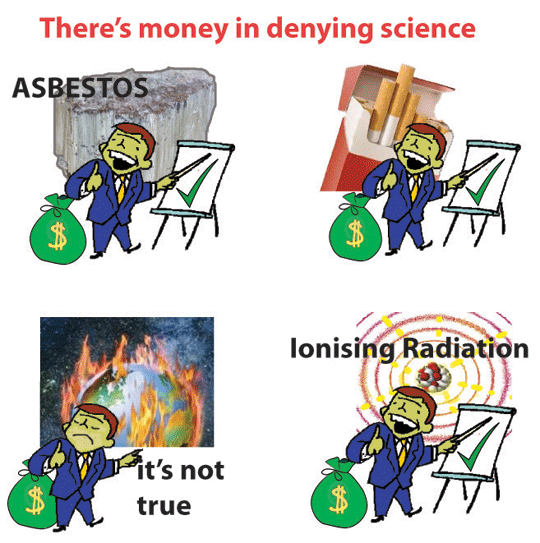 Obama’s top science adviser’s guide to navigating the Trump era John Holdren: “We can be in for a major shift in the culture around science.” Vox News, Feb 18, 2017 BOSTON — If there’s a subtext to this year’s meeting of the American Association for the Advancement of Science, the largest gathering of scientists of the year, it’s anxiety for the future.
John Holdren, the top science adviser to President Barack Obama who spoke Friday at the conference, summed it up like this:
“I’m worried — based on early indications — that we can be in for a major shift in the culture around science and technology and its eminence in government. We appear to have a president now that resists facts that do not comport to his preferences. And that bodes ill on the Obama Administration’s emphases on scientific integrity, transparency, and public access.”
Trump has yet to select people for several top science jobs in the administration — such as NASA administrator, director of the CDC, and director of the NIH.
One of the names floated for Trump’s science adviser is Will Happer, a former Princeton physics professor who recently told ProPublica the science on global warming was “very, very shaky.”……
Scientists are becoming more politically engaged in the Trump era, and it shows here at AAAS. Later in the day, Harvard science historian Naomi Oreskes got a standing ovation after speaking on how scientists can — and should — be “sentinels” for the public, and shouldn’t fear a loss of credibility for getting more politically engaged……http://www.vox.com/science-and-health/2017/2/18/14653234/holdren-aaas-science-trump
Britain has faced 110 nuclear weapon alerts – four times more than the MoD admits
Cheap and Clean Nuclear Power is Becoming a Dream More than the Reality,
Trend In Tech By Natalie Brown February 18, 2017 “………Apart from safety, another major reason why people have backed away from nuclear power projects is down to the cost. Building a nuclear power plant is no cheap task. It’s estimated to cost around $9 billion to build a nuclear power plant in the United States which is more than Apple Inc borrowed in the whole of 2016. That’s also more than 1,000 times the cost of a new fracking well and more than 3,000 times the cost of the world’s largest solar plant.
1 This Month
Chernobyl: The Lost Tapes – A good documentary on Chernobyl on SBS available On Demand for the next 3 weeks– https://www.sbs.com.au/ondemand/tv-program/chernobyl-the-lost-tapes/2352741955560

of the week–London Campaign for Nuclear Disarmament

Tell the Ukrainian Government to Drop Prosecution of Peace Activist Yurii Sheliazhenko
To see nuclear-related stories in greater depth and intensity – go to https://nuclearinformation.wordpress.com
-
Archives
- April 2026 (152)
- March 2026 (251)
- February 2026 (268)
- January 2026 (308)
- December 2025 (358)
- November 2025 (359)
- October 2025 (376)
- September 2025 (257)
- August 2025 (319)
- July 2025 (230)
- June 2025 (348)
- May 2025 (261)
-
Categories
- 1
- 1 NUCLEAR ISSUES
- business and costs
- climate change
- culture and arts
- ENERGY
- environment
- health
- history
- indigenous issues
- Legal
- marketing of nuclear
- media
- opposition to nuclear
- PERSONAL STORIES
- politics
- politics international
- Religion and ethics
- safety
- secrets,lies and civil liberties
- spinbuster
- technology
- Uranium
- wastes
- weapons and war
- Women
- 2 WORLD
- ACTION
- AFRICA
- Atrocities
- AUSTRALIA
- Christina's notes
- Christina's themes
- culture and arts
- Events
- Fuk 2022
- Fuk 2023
- Fukushima 2017
- Fukushima 2018
- fukushima 2019
- Fukushima 2020
- Fukushima 2021
- general
- global warming
- Humour (God we need it)
- Nuclear
- RARE EARTHS
- Reference
- resources – print
- Resources -audiovicual
- Weekly Newsletter
- World
- World Nuclear
- YouTube
-
RSS
Entries RSS
Comments RSS
 nuclear-news