The B-52 “Stratofortress” lost one of its eight turbofan engines when it was around 28 miles from the Minot Air Force base in North Dakota, a spokesman said.
The aircraft, which is designed to hold up to 70,000 pounds (32,000 kg) of nuclear warheads, was not carrying any weapons.
It landed safely using the remaining seven engines.
The eighth engine landed in an unpopulated area and no injuries were caused, the spokesman said.
He added that the crew “declared an in-flight emergency when the pilot discovered that an engine departed the aircraft.”
He said: “There were no weapons on board and it was a local training mission. The aircraft landed safely with no injuries to the five personnel on board.”
The last fatal crash involving the “Stratofortress” occurred in 2008 when the aircraft crashed into the Pacific Ocean during a training flight.
Six crew members were killed and investigators said the probable cause was a system malfunction.
The freak show that is American politics got even freakier last week. Mercury was definitely in retrograde, as Sean Hannity got up close and personal with Julian Assange, Sarah Palin hailed him as a national hero (and urged people to see Oliver Stone’s “Snowden”) and Donald Trump, who once called for the “death penalty or something” for Assange, suddenly embraced the WikiLeaks founder as a trusted source.
On Friday, Trump had a sit-down with top intelligence chiefs at Trump Tower, which he proclaimed as “constructive” — the same way a president describes a meeting with an enemy power. But he made it clear he still wasn’t buying the spooks’ story about foreign interference in an election that he won fair and square, not counting those 3 million or so votes.
The source of all this madness, of course, was the alleged Russian hacking of the U.S. presidential election. On Thursday, James Clapper, the director of national “intelligence” — as President-“elect” Trump air-quotes it — appeared before a Senate committee to confirm his belief in Moscow’s nefarious interference. Yes, this is the same Clapper who once lied bald-faced to Congress about NSA surveillance of the public. But the Senate, in rare bipartisan frenzy, declared the intelligence chief totally credible this time.
The U.S. intelligence report finally released Friday was dismissed by skeptics as underwhelming in its evidence of Russian hacking but was embraced by political partisans like House Democratic leader Nancy Pelosi, who found it “stunning” in its persuasiveness. Computer security experts I contacted have been convinced of Putin’s guilt for some time.
“Healthy skepticism is a good thing, but at this point it’s no longer healthy and bordering on ‘jet fuel can’t melt steel,” Nicholas Weaver, a UC Berkeley computer science lecturer, emailed me. “There is simply a ton of evidence showing that Russia hacked the Democrats and released that information. And those ‘serious’ (people) who state otherwise are simply defending the special snowflake of a president-elect whose ego is so fragile that to admit that Putin helped him out is untenable to him.”
But even if the Russian government was responsible for handing the Democratic National Committee’s emails to WikiLeaks — possibly through other parties — is this really an “act of war,” as ever-belligerent Sen. John McCain has called it? And should we be throwing “rocks,” as Sen. Lindsey Graham demanded, even though the stones on both sides are nuclear-tipped? Pulitzer Prize-winning journalist Glenn Greenwald is not the only one who finds the media’s Putin fever to be “reckless.”
For some much-needed perspective, I consulted with Daniel Ellsberg, the Pentagon Papers whistle-blower and a former nuclear war planner. Ellsberg, who was a Pentagon consultant under Presidents Dwight Eisenhower, John F. Kennedy and Lyndon Johnson, is completing a book based on his experiences titled “The Doomsday Machines: Confessions of a Nuclear War Planner.”
At 85, Ellsberg is still active on the political front and has visited Assange, who has been under house arrest for six years at the Ecuadoran Embassy in London. He refuses to take a position on the Russian hacking question, which he finds “too fraught and complex.” But he was outspoken about the increasingly tense relationship between Washington and Moscow.
Ellsberg, who lives in Kensington, did not vote for Trump, whom he regards as a “disaster” in every way but one. “I’m against conflict with Russia, so on this one issue, I’m on Trump’s side. Even if the Russians are guilty of hacking, I don’t think we should risk war with them. Even if the Russians intervened in our election, as we ourselves have done in many countries on an even bigger scale.”
“Look,” Ellsberg continued, “I think we’re about to see a fascist regime take office in Washington. And I’d rather see these two authoritarian regimes — led by Trump and Putin — not fighting. At this point, I don’t see either regime as expansionist in the Hitler mode. Trump seems less interventionist than the Washington establishment, although his rhetoric about China and Iran is alarming. But on Russia, he looks like a deal maker.”
This is a good thing, Ellsberg observed, particularly given rising tensions in Europe, which could become a nuclear battlefield. NATO, which is committed to defending frontline countries like Poland and the Baltic states against any incursion, maintains a dangerous first-use nuclear policy. Despite Putin’s strong protests, a destabilizing antiballistic-missile system was installed in Romania and another is planned for Poland.
If Trump is serious about reducing tensions with Moscow, Ellsberg said, he should begin by removing those ABM systems and by negotiating reductions in the two countries’ nuclear arsenals to the level where a nuclear exchange would not result in the end of human life on the planet.
“A nuclear exchange involving even a fraction of the weapons that the U.S. and Russia now have on alert status alone would result in nuclear winter, with the smoke from burning cities widely dispersing and blocking sunlight for over a decade. That means years without harvests on Earth. Just one year pretty much does the job of eliminating the human race. So maintaining nuclear arsenals this size is insane and immoral and unjustifiable.”
The old, terrifying Cold War scenarios still loom over the planet as the voices of hysteria clamor for a new Cold War. Ellsberg said that he and his fellow nuclear planners used to regard the mad doomsday satire “Dr. Strangelove” as “a documentary.” In his opinion, Hillary Clinton would have done little to restore sanity in the nuclear relationship with Russia. And Trump is “a cipher. We don’t know what we’ll get from him. And his off-the-cuff remarks are disturbing.”
For this reason, Ellsberg hopes that Trump and the intelligence agencies can establish a healthy working relationship. “He shouldn’t be getting into a war with the intelligence community — it’s bad for him and for the country. There’s no question that he could be putting himself at risk by doing this. Nixon didn’t trust the CIA either. And look what happened to him.”
I didn’t bring up JFK, who threatened to “splinter the CIA into thousand pieces and scatter it to the winds” after the agency’s Bay of Pigs disaster, but of course, the bitter split between that president and his national security team still shadows American history.
In any case, we can only pray that sanity, in extremely short supply these days, can somehow be restored in Washington.
San Francisco Chronicle columnist David Talbot appears Sundays, Tuesdays and Thursdays. Email: dtalbot@sfchronicle.com
At the beginning of December 2016 the Swiss Federal Nuclear Safety Inspectorate (ENSI) requested the inspection of the steam generators at the Gösgen and Beznau nuclear power plants. Georg Schwarz, ENSI Deputy Director and head of the NPPs Division, explains the background and context in the following interview.
The article was removed within 12 minutes but a cached copy remained;
Last summer, the operators of Swiss nuclear power plants were obliged to examine the production documents of forged steel components within their plants in respect of possible falsifications. Now, ENSI has requested that the Beznau and Gösgen nuclear power plants inspect the components in their steam generators for elevated carbon values and possible effects on material toughness. For this purpose, the production documents must first be examined again. Is there a connection between these two issues?
In parallel, but independent of the falsification issue, information became available from France about potential material problems in the steam generators of pressurised water reactors. In a series of reactors, the forged steel components of the steam generators showed elevated carbon content. On 18 October 2016, the French nuclear supervisory authority ASN therefore instructed the operator of the French nuclear power plants, EDF, to subject the steam generators of twelve nuclear power plants to more detailed investigation and to demonstrate that they have the necessary material toughness in spite of the elevated carbon content. This, in turn, prompted ENSI to call for the inspection of the steam generators of the Swiss nuclear power plants Beznau and Gösgen.
And what about the other two nuclear power plants in Switzerland?
Leibstadt and Mühleberg are boiling water reactors. They do not have steam generators and are therefore unaffected of this issue.
What does examination of the documents involve?
The examination of the production documents is a first step and serves as basis for the inspections of the steam generators themselves. In this case, however, it is not a search for potential falsifications, but rather for basic information on the material quality of the steam generators.
Is it still possible to trust these documents?
Yes. The investigations in summer revealed no indication of any falsifications.
In the inspections of the steam generators at Beznau and Gösgen requested by ENSI, the results of the corresponding investigations in France will probably also be considered. What is the current status in France?
In France, the investigations are largely completed and it has been demonstrated that the steam generators with an elevated carbon content are strong enough and do not pose a risk. The reactors which were disconnected from the grid for the investigations have either been reconnected to the grid by now, or will again be delivering power from January 2017. (For details see the chronology below).
In France, the plants had to be disconnected from the grid for the investigations. Why is this not necessary for Beznau and Gösgen?
In France, the nuclear power plants were not shut down immediately, either. In Switzerland we do not see any reason, from a safety point of view, to temporarily disconnect the plants concerned from the grid. The inspections on the steam generators can be performed during a routine maintenance outage.
Can you explain why in more detail?
The first checks in France in the past summer revealed that steam generators in 18 of the 58 French reactors require more detailed investigations. For 6 reactors these investigations could be completed fairly quickly so that by autumn 2016 only 12 reactors remained. ASN set a deadline of three months for the French NPP operator EDF to carry out the required measurements and calculations on the steam generators in the remaining reactors. To be able to perform this work, a reactor must be in shut-down mode. Seven of the reactors concerned were already in routine maintenance outage and they therefore decided to postpone their restart, five reactors initially continued operations. In the course of 2016, three were disconnected from the grid in order to perform the required measurements. The last two will be disconnected in January 2017.
In light of the developments in France, why is there any point in Beznau and Gösgen actually performing the investigations?
The steam generator is an important component of the primary circuit. From a safety point of view, it is appropriate to assess both the situation in the Swiss reactors and to what extent the results in France agree with the corresponding findings in the steam generators in the Swiss plants.
What precisely do the Beznau and Gösgen nuclear power plants have to check?
As stated, a first step will involve examining the production documents. This will result in information on affected components, manufacturer, manufacturing period, material, applied design specification and regulations, deviations during manufacture, details of the forging process, acceptance tests carried out, and test requirements. Based on these documents, a second step involves the derivation of a concept for the further safety assessment.
What result do you expect from the first step, the examination of the documents?
The aim of the in-depth examination of the production documents is to obtain fairly quickly a first overview of the manufacturing of the steam generators. This will result in first insights, based on which further steps can be decided upon.
When will the second step containing the non-destructive testing be performed?
This depends on the concepts. Potential inspections on the steam generators themselves will be performed during the regular maintenance outages of the nuclear power plants.
Is this inspection of the steam generators in any way related to the findings in the reactor pressure vessels, which were uncovered in the Belgian plants Doel 2 and Tihange 3 in 2013 and during 2015 in Beznau 1?
No. The findings in the reactor pressure vessels have nothing to do with the inspections of the steam generators. As already stated above, the trigger for the inspection of the steam generators was information from France stating that the steel of the steam generators potentially contains an elevated carbon content in certain areas.
Reactor pressure vessels and steam generators are different components.
The fuel rods are contained in the reactor pressure vessel. The heat generated by the chain reaction is used to heat up the coolant.
In pressurised water reactors, steam production takes place in the steam generator, where the hot water of the primary circuit transfers heat energy to the secondary circuit.
Does this mean that the investigations concerning the steam generator will have no influence on the decision of whether Beznau 1, upon completion of the investigations into the reactor pressure vessel findings, can start up again?
Precisely, they have no influence at all.
On the basis of findings in the French Flamanville nuclear power plant, various investigations have been triggered in France and Switzerland. These concern falsifications in the production documents from the Le Creusot forge, on one hand, and the material properties of the steam generators on the other hand.
Topic ‘Findings in the Flamanville reactor pressure vessel’
On 7 April 2015, the French nuclear supervisory authority ASN informed the public that zones of elevated carbon content had been identified in the reactor vessel closure head and reactor vessel bottom of the French Flamanville 3 nuclear power plant, which is currently under construction.
Topic ‘Falsifications in the Le Creusot forge’
Topic ‘Carbon content in steam generator components’
2015
On 4 August 2015, ASN President Pierre-Franck Chevet wrote in an open letter that AREVA had decided to arrange an investigation into the production practices at the Le Creusot forge over the past few years by an independent body. These investigations were started in April 2015 at the instigation of the ASN.
2016
On 19 January 2016, the ASN made it known that within the context of a hearing on 8 December 2015 it had informed AREVA of the requirements for the investigation. According to these, the investigation had not only to extend back until 2010, but until at least 2004 because it was in this year that the first parts were forged for the Flamanville EPR.The ASN first informed the public of the results of the investigation on 3 May 2016. It was established that there were irregularities in the production documents for 400 components manufactured at Le Creusot since 1965. These included both inconsistencies between the documents and production or inspection data as well as falsifications (changing of measurement and acceptance reports). Of the relevant 400 components, around 50 are in use in French nuclear power plants.
On 6 June 2016, ENSI required the Swiss nuclear power plants to gather information about whether components originating from the Le Creusot forge with potentially incorrect production documents were or are currently in use.
On 16 June 2016, the ASN could for the first time list those nuclear power plants in France where components of the primary circuit are affected by irregularities in the material properties. To perform additional examinations, the operator EDF took the reactor Fessenheim 2 offline in the middle of June 2016.
On 19 July 2016, the ASN informed the public that the authorisation for a steam generator of the Fessenheim 2 NPP had been suspended. It cited falsifications in the production documents as the reason. The steam generator vessel bottom produced in 2008 does not conform to the dossier that had been submitted to the ASN and was not forged in accordance with the applicable rules.
On 17 August 2016, ENSI informed the public that all plants in Switzerland which had or have components in use originating from the Le Creusot forge, could confirm that these components are not affected by any falsifications in production documents.
On 23 September 2016, the ASN for the first time published a list of the irregularities and falsifications uncovered in the production documents. At the same time, the French supervisory authority made it known that in 21 of the 23 cases uncovered, safety was not affected. Further investigations were announced in two cases, namely Gravelines 5 and Fessenheim 2 which are currently shut down.
On 23 June 2016, the ASN informed the public for the first time that the vessel bottoms of steam generators could have zones with elevated carbon content. Under consideration were 18 reactors, 16 reactors with 900 MWe output and 2 with 1450 MWe output. Amongst the unaffected reactors were 18 reactors of 900 MWe, 2 reactors of 1450 MWe and all 20 reactors with a 1300 MWe output. The supervisory authority required the operator EDF to examine the steam generators from the Le Creusot forge and the Japanese JCFC forge using both non-destructive testing in respect of carbon concentration and using ultrasonic crack testing.On 18 October 2016, the ASN ordered more detailed inspections of the steam generators in respect of the material carbon content in 12 reactors. Seven of the affected reactors were at that time already shut down for routine maintenance outage. Five other nuclear power plants received a deadline of three months.
On 26 October 2016, the ASN announced that within the context of a parliamentary hearing it had provided information that in the steam generators of 12 reactors, which had been manufactured by JCFC, the carbon content elevated.
On 5 December 2016, ASN announced that the documents requested from the operator EDF had been accepted in general. Furthermore, it requested reports for compensatory measures and other medium-term tests. It requested additional calculations for four plants. As soon as these are assessed by ASN, the ten 900 MWe nuclear power plants can start up again. According to ASN, EDF announced that the documents for the two 1450 MWe plants will be submitted soon.
On 9 December 2016, ENSI required that the pressurised water reactors in Switzerland, Beznau and Gösgen, examine their steam generators in a two-stage process.
According to Réseau de Transport d’Electricité RTE (dated 3 January 2017), 4 of 12 reactors subject to more in-depth investigation have been restarted until the end of 2016. 8 further reactors are planning to start up in January 2017.
The Emirates Nuclear Energy Corporation (ENEC) has achieved major milestones as it moves towards a new phase in the construction of Units 3 and 4 at the Barakah Nuclear Energy Plant which is now more than 50 per cent completed.
The recent progress significantly advances Enec’s goal of delivering safe, clean, efficient and reliable nuclear energy to the UAE through its Peaceful Nuclear Energy Program, said a statement from the corporation.
The construction achievements include the successful setting in place of Unit 3’s Reactor Containment Building (RCB) Liner Dome section, effectively installing the roof of the structure which now houses the Reactor Vessel (RV), said the statement.
Further, the completion of Unit 4’s Turbine Generator Operating Deck and the setting of the last Reactor Containment Liner Plate Rings mark important progress for the units, it added.
These milestones are a result of Enec’s extensive collaboration with its prime contractor and joint venture partner, the Korean Electric Power Corporation (Kepco), said its top official.
“All construction milestones for the Barakah Nuclear Energy Plant project have been achieved in accordance with the highest standards of quality and safety,” remarked Enec CEO Mohamed Al Hammadi.
“The latest successful achievement of these milestones for Units 3 and 4, is a result of many months of hard work by all those involved. I am proud of our teams whose commitment and dedication is a key factor in the continued successful construction of the world’s largest nuclear plant, with four identical units being built simultaneously,” said Al Hammadi.
According to him, peaceful nuclear energy will bring many benefits, from the creation of high-value job opportunities to the emergence of a new sophisticated industrial sector to support operations in Barakah.
With the successful setting of Unit 3’s RCB Liner Dome section, it is now more than 62 per cent complete and work to pour the concrete and complete the RCB is progressing steadily.
The RCB is expected to be completed in the first quarter of 2017, roughly a year after similar work was concluded on Unit 2, in line with ENEC’s construction schedule, stated the top official.
Enec’s deputy CEO Ahmed Al Rumaithi said the completion of the Turbine Generator Operating Deck and the setting of the final Reactor Containment Liner Plate Rings on Unit 4 has allowed work to begin on erecting the Turbine Building and the interior and exterior concrete for the Unit’s RCB is now being poured.
“Once completed, we will be ready for the installation of Unit 4’s Reactor Pressure Vessel in mid-2017,” he noted.
Al Rumaithi revealed that 35 per cent of the construction work at Unit 4 had been completed and was ahead of schedule, with the completion of the deck and rings having occurred roughly 10 months after similar work was concluded on Unit 3.
“The Barakah Nuclear Energy Plant is scheduled for completion in 2020, with construction having started in 2012. With four reactors online, the facility will deliver up to a quarter of the UAE’s electricity needs and save up to 12 million tons in carbon emissions every year,” he noted.
Al Rumaithi pointed out that the project at Barakah was progressing steadily and overall, around 75 per cent of the construction work had been completed at Units 1 to 4.
All four units will deliver safe, clean, reliable and efficient nuclear energy to the UAE grid, pending regulatory reviews and licensing, he added.-TradeArabia News Service
Other article describing ways to make mini nuclear weapons for terrorists, dictatorships etc here;
STOCKHOLM (AP) — A spokesman for one of Sweden’s three nuclear power plants says they will have armed guards outside the facilities starting next month in a decision made by the country’s nuclear watchdog.
Anders Osterberg of the Oskarshamn power station says “the elevated level” was based on a general security assessment, not a specific threat.
Osterberg said Thursday in an email to The Associated Press that the Swedish Radiation Safety Authority decided last year that guards should carry firearms as of Feb. 1. There was no immediate word from the authority.
Sweden has a total of 10 reactors in Oskarshamn, Ringhals and Forsmark, providing about half of the country’s electricity production. Sitting some 200 kilometers (124 miles) south of Stockholm on the Baltic Sea coast, Oskarshamn has three reactors.
China cementing global dominance of renewable energy and technology It now owns five of the world’s six largest solar-module manufacturing firms and the largest wind-turbine manufacturer, Guardian, Michael Slezak. 6 Jan 17, China is cementing its global dominance of renewable energy and supporting technologies, aggressively investing in them both at home and around the globe, leaving countries including the US, UK and Australia at risk of missing the growing market.
A report by the Institute for Energy Economics and Financial Analysis (Ieefa) found China’s dominance in renewables is rapidly spreading overseas, with the country accelerating its foreign investment in renewable energy and supporting technologies.
Analysing Chinese foreign investments over US$1bn, Ieefa found 13 in 2016, worth a combined $32bn. That represented a 60% jump over similar investments in 2015.China was already widely recognised as the largest investor in domestic renewable energy, investing $102bn in 2015, according to Bloomberg New Energy Finance – more than twice that invested domestically by the US and about five times that of the UK.
The big foreign investments in 2016 included two in Australia, two in Germany and two in Brazil, as well as deals in Chile, Indonesia, Egypt, Pakistan and Vietnam.
In Australia, China Light & Power struck a $1.1bn deal, buying power from wind and solar farms.
In Chile, Tianqi Lithium spent $2.5bn acquiring a 25% stake of a lithium miner and processor. (Lithium is essential for lithium batteries used in electric vehicles and home battery storage.)
In Germany, Beijing Enterprises Holdings Ltd spend $1.6bn on a Waste to Energy development.
The report noted the global expansion cements China’s total domination of renewable energy growth globally. China now owned:
Five of the world’s six largest solar-module manufacturing firms
Why solar power poses a very tricky problem for Donald Trump, The Week, RyanCooper , 6 Jan 17 The worst imaginable president for climate change might be about to take power, but solar is still a bright spot. The technology and business infrastructure of solar panel manufacturing has been getting better at a blistering pace, and the latest estimates conclude that solar will surpass coal as the cheapest electricity source within a single decade — and in many places, it already has.
This raises the question of what President Trump will do about the solar business. Most Republicans, Trump included, are heavily committed to filth-spewing power sources like coal and natural gas, and deny the science of climate change. But while Republicans will no doubt want to use regulations and subsidies to prop up fossil fuels and keep down renewables, Trump has shown a bizarre fixation with U.S.-based manufacturing jobs that might just redound to solar’s benefit.
The latest estimate of solar panels’ economic viability comes via Bloomberg New Energy Finance. The price of solar power has plummeted by 62 percent merely since 2009. Taking into account current trends and planned technological developments, they estimate solar will be on average the world’s cheapest power source by about 2026, without subsidies of any kind.
That average hides much variability, of course — in some sunny regions, solar is already astoundingly cheap:…….
Republicans will likely respond to the growth of solar by trying to stamp it out by allowing fossil fuels to pollute to their heart’s content (thus granting them a huge implicit subsidy), and passing burdensome new regulations on renewables. On the face of it, this fits well with Donald Trump’s campaign, which was all about valorizing traditionally masculine jobs, particularly in manufacturing and manual labor. In the conservative shorthand, coal is tough and cool, while renewables are for sissy Prius-drivers.
But on the other hand, this stereotype is wildly at odds with the actual reality of the solar business. Solar panels must be manufactured (as of 2015, there were about 30,000 such jobs in the United States) and installed by manual laborers (120,000 jobs as of 2015). That number has no doubt grown substantially in the past year, as solar jobs have been consistently increasing in number by about 20 percent per year……..
Stamping out solar would kill an order of magnitude more jobs than that. If Trump got wind of some policy that would strangle American solar — or worse yet, force the company to pick up and move to Europe or China — there is a genuine chance he’ll go on one of his Twitter rampages and force the Republican Congress to back down.
Conversely, it will be genuinely difficult to revive coal jobs, which have been in long-term decline since the 1970s. Big Coal has been all but killed off by competition with fracked natural gas and, increasingly, renewables. It is smaller than solar and shrinking fast. Stark hypocrisy is basically the Republican motto, but even they might struggle with the large and increasing subsidies necessary to prop up an ever-more-obsolete marketplace loser.
US Rejects North Korea’s Nuclear Claim Amid Growing Concerns http://www.voanews.com/a/us-rejects-north-korea-nuclear-claim-amid-growing-concerns/3665388.html, 5 Jan 17, Amid speculation surrounding North Korea’s nuclear capabilities, the U.S. government said this week that Pyongyang has yet to acquire the ability to outfit an intercontinental ballistic missile with a nuclear warhead.
The latest assessment came after North Korean leader Kim Jong Un’s statement that the preparations for launching an intercontinental ballistic missile had “reached the final stage.” His claim, in a New Year’s Day address, immediately sent ripples across the world’s capitals, prompting President-elect Donald Trump to tweet, “It won’t happen!”
Despite the U.S. rejection of North Korea’s purported capability, experts are raising concern about the threats emanating from the regime. Continue reading →
2016 ‘hottest on record’ in new sign of global warming, Copernicus organisation says http://www.abc.net.au/news/2017-01-06/world-heat-shatters-records-in-2016/8165426Last year was the hottest year on record by a wide margin, with temperatures creeping close to a ceiling set by almost 200 nations for limiting global warming, the European Union’s Copernicus Climate Change Service has said.
Key points
EU body report shows global average temperature in 2016 was 1.3C higher than pre-industrial average
Arctic, Africa and Asia warmer than usual in 2016
Some areas of South America and Antarctica cooler than usual
The data are the first of the New Year to confirm many projections that 2016 will exceed 2015 as the warmest since reliable records began in the 19th century, the Copernicus organisation said in a report.
The Arctic was the region showing the sharpest rise in temperatures, while many other areas of the globe, including parts of Africa and Asia, also suffered unusual heat, it said.
A few parts of South America and Antarctica were cooler than normal.
Global surface temperatures in 2016 averaged 14.8 degrees Celsius or 1.3C higher than estimated before the Industrial Revolution ushered in wide use of fossil fuels, the EU body said.
Temperatures last year broke a 2015 record by almost 0.2C, the Copernicus organisation said, boosted by a build-up of greenhouse gases in the atmosphere and by a natural El Nino weather event in the Pacific Ocean, which releases heat to the atmosphere.
In February 2016 alone, temperatures were 1.5C above pre-industrial times, the study said. Rising heat is blamed for stoking bushfires, heat waves, droughts, floods and more powerful downpours that disrupt water and food supplies.
The UN’s World Meteorological Organisation (WMO), the main authority on global temperatures, compiles data mainly from two US and one British dataset that will be published in coming weeks.
It also uses input from Copernicus.
Dick Dee, deputy head of the Copernicus Climate Change Service, said these data were available quickly because they draw on temperature stations and satellite measurements used to make weather forecasts. “They’re pretty much in perfect agreement” with the WMO data in areas where measurements overlap, he said. The other datasets used by the WMO are collected from sources that can take more time to compile, including ships, buoys and balloons.
US President-elect Donald Trump has sometimes called man-made climate change a hoax and threatened to “cancel” the Paris agreement. But he has also said he has an open mind and sees “some connectivity” between human activity and and global warming.
No deal on closing Indian Point, Gov. Cuomo says after shutdown reports http://pix11.com/2017/01/06/no-deal-on-closing-indian-point-gov-cuomos-office-says/, JANUARY 6, 2017, BY ALIZA CHASAN BUCHANAN, N.Y. — No agreement has been reached to close the Indian Point nuclear plant in Westchester County despite reports the plant would close its two units by 2021, Gov. Andrew Cuomo’s office said Friday.
“There is no agreement,” a spokesman for Cuomo’s office said. “Governor Cuomo has been working on a possible agreement for 15 years and until it’s done, it’s not done. Close only counts for horseshoes, not for nuclear plants.”
The plant has been at the center of potential disasters over recent years and Cuomo has repeatedly called for its shutdown, saying it poses an environmental threat to the Hudson River and a threat to New Yorkers.
“Indian Point is antiquated and does not belong on the Hudson River in close proximity to New York City, where it poses a threat not only to the coastal resources and uses of the river, but to millions of New Yorkers living and working in the surrounding community,” Gov. Cuomo said in November.
Inspectors found hundreds of faulty bolts within the reactor at the Indian Point Unit 2 Plant in March. There was also a 600 gallon oil spill in 2016. Only a small portion of the spill reached the discharge canal.
Entergy, the operator of Indian Point, declined to comment.
The license for Indian Point’s Unit 2 expired in 2013, but can operate as long as the relicensing process continues under the U.S. Nuclear Regulatory Commission. Unit 3’s license expired in 2015, but it remains in operation while the relicensing application is pending. Unit 1 was permanently closed in 1974.
Entergy has applied for a 20-year license renewal for Units 2 and 3.
Indian Point is a key source of energy for the New York area. It has a generating capacity of 2,000 megawatts of clean electricity, according to Entergy. It provides power to about 2 million homes along with businesses and municipal systems.
Indian Point Nuclear Power Plant to Close by 2021 NYT, By VIVIAN YEE and PATRICK McGEEHANJAN. 6, 2017The Indian Point nuclear plant will shut down by April 2021 under an agreement New York State reached this week with Entergy, the utility company that owns the facility in Westchester County, according to a person with direct knowledge of the deal.
The Indian Point nuclear plant will shut down by April 2021 under an agreement New York State reached this week with Entergy, the utility company that owns the facility in Westchester County, according to a person with direct knowledge of the deal.
Under the terms of the agreement, one of the two nuclear reactors at Indian Point will permanently cease operations by April 2020, while the other must be closed by April 2021. The shutdown has long been a priority for Gov. Andrew M. Cuomo, who — though supportive of upstate nuclear plants — has repeatedly called for shutting down Indian Point, which he says poses too great a risk to New York City, less than 30 miles to the south.
“Why you would allow Indian Point to continue to operate defies common sense, planning and basic sanity,” Mr. Cuomo told reporters in June……..
In exchange, the state and Riverkeeper will drop safety and environmental claims against Indian Point they had previously filed with federal regulatory agencies.
Entergy, which is based in New Orleans, has been seeking a 20-year renewal of its license from the federal Nuclear Regulatory Commission since 2007. But New York State officials have challenged that renewal on several fronts and have refused to grant permits that they say the plant needs to continue operating.
Eden Keeper, (USA) 6 Jan 17Faith members considering solar power for churches, temples, mosques, and other houses of worship are discovering that installations are getting both easier and cheaper. Since 2009, according to the Solar Energy Industries Association (SEIA), costs for non-residential solar installations have dropped around 73%, from around $7.50 per kilowatt to today’s cost of about $2 per kilowatt.In Minnesota, for example, approximately 400 congregations are working with Minnesota Interfaith Power and Light (MNIPL), a faith-based nationwide nonprofit concerned with climate change and environmental stewardship. MNIPL Executive Director Julia Nerbonne notes that conversations on solar power for churches are trending all across the state.
Among the 20 Minnesota houses of worship that completed their transition to solar power in 2016 are Unity Church-Unitarian and Woodbury Peaceful Grove United Methodist Church in St. Paul. In Roseville, St. Christopher’s Episcopal Church also completed it’s solar rooftop installation last year……..
Community Solar Farms Offer Additional Solutions……..
Just Community Solar: A Story of Faith in Action
Many States Offer Solar IncentivesCurrent political fearmongering aside, many states are working hard to increase the transition to renewable energy in the US. Minnesota is an inspiring example…
“Tons and Tons of Faith Communities Doing Solar” An additional bill credit especially relating to solar power for churches, faith-based organizations, and other nonprofits may be approved in March 2017, by the Public Utilities Commission………
Learn More about Community Solar Power For ChurchesMNIPL’s project, “Just Community Solar: A Story of Faith in Action” is “connecting the dots between climate, racial, and economic justice.”
Climate change threatens ability of insurers to manage risk
Extreme weather is driving up uninsured losses and insurers must use investments to fund global warming resilience, says study, Guardian, Damian Carrington, 7 Dec 16, The ability of the global insurance industry to manage society’s risks is being threatened by climate change, according to a new report.
The report finds that more frequent extreme weather events are driving up uninsured losses and making some assets uninsurable.
The analysis, by a coalition of the world’s biggest insurers, concluded that the “protection gap” – the difference between the costs of natural disasters and the amount insured – has quadrupled to $100bn (£79bn) a year since the 1980s.
Mark Carney, the governor of the Bank of England, warns in the new report that: “Over time, the adverse effects of climate change could threaten economic resilience and financial stability [and] insurers are currently at the forefront.”
The ClimateWise coalition of 29 insurers, including Allianz, Aon, Aviva, Lloyd’s, Prudential, Swiss Re and Zurich, conclude that the industry must use more of its $30tn of investments to help fund increased resilience of society to floods, storms and heatwaves.
The Bank of England warned in 2015 that insurance companies could suffer a “huge hit” if their investments in fossil fuel companies were rendered worthless by action on climate change and some insurershave already shed investments in coal.
The ClimateWise report, published on Wednesday, also says the industry must also use its risk management expertise to convince policymakers in both the public and private sector of the urgent need for climate action.
The industry’s traditional response to rising insurance risks – raising premiums or withdrawing cover – would not help deal with the rising risks of global warming, it said……..
US delays cleanup rule at uranium mines amid GOP criticism
Federal GOP legislators from Wyoming have said a rule was an unnecessary burden for the uranium industry NBC5 Jan 5, 2017 CHEYENNE, Wyo. —
Federal officials withdrew a requirement for companies to clean up groundwater at uranium mines across the U.S. and will reconsider a rule that congressional Republicans criticized as too harsh on industry.
The plan that the U.S. Environmental Protection Agency put on hold Wednesday involves in-situ mining, in which water containing chemicals is used to dissolve uranium out of underground sandstone deposits. Water laden with uranium, a toxic element used for nuclear power and weapons, is then pumped to the surface. No digging or tunneling takes place.
The metal occurs in the rock naturally but the process contaminates groundwater with uranium in concentrations much higher than natural levels. Mining companies take several measures to prevent tainted water from seeping out of the immediate mining area…….
Along with setting new cleanup standards, the rule would have required companies to monitor their former in-situ mines potentially for decades. The requirement was set for implementation but now will be opened up for a six-month public comment period.
EPA officials didn’t immediately respond to a request for comment Thursday.
Environmentalists and others say uranium-mining companies have yet to show they can fully clean up groundwater at a former in-situ mine. Clean groundwater should not be taken for granted, they say, especially in the arid and increasingly populated U.S. West.
“We are, of course, disappointed that this final rule didn’t make it to a final stage,” said Shannon Anderson with the Powder River Basin Resource Council. “It was designed to address a very real and pressing problem regarding water protection at uranium mines.”
The EPA rule is scheduled for further consideration in President-elect Donald Trump’s administration.
Then, while the first nuclear power plants were being built, extensive delays and modifications resulted in large cost overruns. The utilities incurred these cost overruns, as the contracts were mostly cost-plus, where the construction companies were reimbursed for their costs.
By the end of the last century, 100 nuclear power plants providing 20% of America’s electricity had been built, but the sentiment in the industry was that nuclear power was too costly.
The constant changes and delays while building the first 100 nuclear power plants were attributed to construction being done on site where it was difficult to control events and costs.
It was thought that costs could be controlled by building major components in a factory and then shipping them to the site for installation.
It was believed that a factory environment would allow for the use of manufacturing disciplines and quality control that would keep costs under control.
At the start of this century, there was support for a nuclear renaissance, where new nuclear power plants of a new and safer design could be built at a reasonable cost, with major components being built in a factory.
The Fukushima disaster raised the specter of radiation danger once again, but the new generation of nuclear power plants would shut down safely and automatically if there was a problem.
As construction was started at the four new nuclear power plants, two in Georgia and two in South Carolina, there was great confidence that this time it would be different: Costs would be controlled and the plants would be built on schedule.
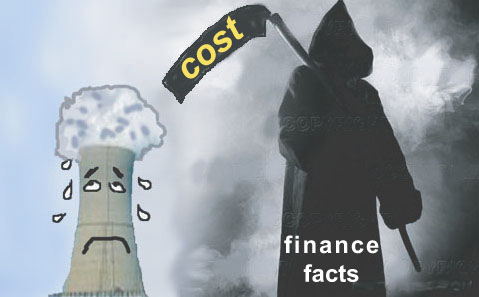
With last week’s announcement that Toshiba would take a multi-billion dollar charge against operations due to cost overruns, quality control problems and delays at the four nuclear power plants being built in the United States, it is now clear that nuclear power may be dead … at least for the foreseeable future.
Westinghouse, the Toshiba subsidiary building these new nuclear power plants, has experienced many of the same problems that occurred in the last century.
Toshiba’s stock fell 30% with the announcement confirming the problems at Westinghouse, and of problems with the construction of other nuclear power plants being built in other countries.
Whereas the utilities incurred the overrun costs in the last century, this time the contracts were written so that the construction companies and supplier of reactors incurred most of these extra costs.
Nuclear power was already dying a slow death in the United States as there was considerable doubt whether existing nuclear power plants would receive a second extension to their operating licenses. See Nothing to Fear for a description of why nuclear power is dying in the United States.
The problems at Westinghouse probably preclude any construction company or supplier of reactors from entering into contracts where they would be liable for cost overruns, and it’s doubtful that any utility regulator would allow any utility to assume such liabilities in the future.
This may have been the final nail in the coffin for nuclear power in the United States.











 nuclear-news