ll Netherlands Railways trains will be 100% wind powered by 2018 http://inhabitat.com/all-netherlands-railways-trains-will-be-100-wind-powered-by-2018/When its citizens demanded clean energy, The Netherlands responded in the best possible way. Following a ruling earlier this year when 886 citizens sued their government to reduce CO2 emissions, a court at the Hague ordered the Dutch government to adopt a goal of cutting carbon emissions by at least 25 percent over the next five years. In response, the Dutch railways unveiled plans to become 50 percent wind-powered by the end of this year and 100 percent by 2018.
The trains are reported to carry 1.2 million passengers each day and emit 550 kilotons of carbon dioxide, yet this number is hoped to reach zero within only a few years. Michel Kerkhof of energy company Eneco stated, “Mobility is responsible for 20 percent of CO2 emissions in the Netherlands, and if we want to keep traveling, it is important that we do this without burdening the environment with CO2 and particulate matter.” This speedy upgrade to renewable, safe energy sources is just what we need to address growing climate change issues.
Wind energy used to power the trains will be sourced not only by the Netherlands, but also from Belgium and Scandinavian countries. This allows the country’s resources to be used in other ventures. It also strengthens partnerships with other providers and encourages expansion of railway use throughout Europe. Perhaps this could be an inspiration to other nations – on all continents – to jump on board with the Netherlands’ enthusiasm to tip the scales toward renewable energy.
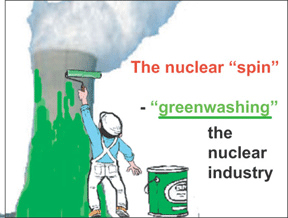
don’t for one second think that nuclear power is green or sustainable in any way. You will hear that, because nukes don’t create CO2 when they’re generating power, they’re a solution to climate change.
What you don’t hear from the proponents of nuclear power/weapons is that the mining and refining of nuclear fuel is extremely energy- and carbon-intensive.
What you don’t hear is that the billions of government subsidy dollars that are going to shore up and bail out unprofitable nuclear power companies could be better spent on developing and bringing to scale truly sustainable forms of energy.
What you don’t hear is that there is no way to safely clean up radioactive waste. “Green” and “nuclear” simply cannot be credibly used together.
My Turn/Darling: No such thing as ‘green’ nuclear power http://www.recorder.com/my-turn-nuclear-facilities-7049505By ANN DARLING , December 26, 2016 Here in the Pioneer Valley we live within a circle of five operating, decommissioning, or decommissioned nuclear power facilities and a nuclear submarine base. Radioactive materials are extremely dangerous and extremely long lived. For our safety and the safety of future generations, we need to be informed about nuclear power and the waste created from its mining and its use.
Of course, there are nuclear facilities all over the world and nuclear contamination has a way of traveling very long distances in the air, through oceans and rivers, and in our bodies. So it’s not something anyone can totally escape from, no matter where we live. We have fouled our nest with nightmarishly toxic and pernicious stuff and we don’t know what to do with it.
It’s extremely painful, frightening and depressing to face this head on. But we have to. We are now the stewards of all this radioactive waste, whether we like it or not. And more waste is being made all the time.
What can you do? First, accept the responsibility of being a nuclear steward. Then, become knowledgeable. Two good resources are the Nuclear Information and Resource Service, www.nirs.org, or Fairewinds Energy Education, www.fairewinds.org.
Second, question everything you hear about nuclear power. Start with these two basic assumptions and see if they help you make sense of it:
Corporations have a “perverse motivation” (i.e. profit) to reduce costs and neglect safety, so they tend to obfuscate and lie when challenged.
The Nuclear Regulatory Commission is about one quarter regulator (at best) and three quarters nuclear industry cheerleader. It is one of many “captive regulators” in an economy driven by short-term gain and not by long-term investment in the future.
Third, do everything you can to pressure government, utilities, and corporations to stop creating more radioactive waste. A good starting place would be calling Gov. Baker and telling him Pilgrim Nuclear in Plymouth should be shut down.
Fourth, don’t for one second think that nuclear power is green or sustainable in any way. You will hear that, because nukes don’t create CO2 when they’re generating power, they’re a solution to climate change. What you don’t hear from the proponents of nuclear power/weapons is that the mining and refining of nuclear fuel is extremely energy- and carbon-intensive. What you don’t hear is that the billions of government subsidy dollars that are going to shore up and bail out unprofitable nuclear power companies could be better spent on developing and bringing to scale truly sustainable forms of energy. What you don’t hear is that there is no way to safely clean up radioactive waste. “Green” and “nuclear” simply cannot be credibly used together.
Fifth, don’t even imagine that Yucca Mountain is an appropriate place to store radioactive waste. Even if we had technology good enough to contain radioactive waste for generations — which we don’t — Yucca is not the right place from a geological standpoint.
Sixth, if you live near a shutdown reactor (which you do) and just want the radioactive waste gone, yesterday, think about where it will go. Think about the places it would be transported through, at great risk of accident or terror attack. Think about the places where it would be stored, and where it could leak or worse. Right now, radioactive materials from the decommissioning of Vermont Yankee are being shipped to a storage facility near the Texas-New Mexico border that sits on top on a huge aquifer supplying at least seven southwestern states. What will happen if the radioactivity gets into the deep water?
Seventh, recognize that the communities and geographies that are being forced or asked to take on radioactive waste are sacrifice zones inhabited by people with dark skin and/or no money or political clout. That storage facility on the Texas-New Mexico border is in an area that is poor, rural, and largely Mexican-American. Uranium is mined on indigenous people’s land throughout the world and the waste simply left there, making them sick. Yucca Mountain itself, and the contaminated Nevada nuclear testing sites nearby, are actually on Shoshone tribal lands. This is racism at a profound level.
Finally, get involved in anything that will slow down or stop the creation of nuclear waste. Promote sustainable energy and energy conservation efforts. Climate Action Now is a good local resource: www.climateactionnowma.org. Advocate to shut down Pilgrim Nuclear in Plymouth: www.capedownwinders.org or www.pilgrimcoalition.org. Get involved in regional and national discussions about what is the least bad resolution to the problem of nuclear waste. The Citizens’ Awareness Network is a local organization with a solid history and national reach: www.nukebusters.org.
You don’t have to be an expert on nuclear power to make a difference. You just have to show up and be ready to learn and work hard for your children and their children and their children.
Ann Darling currently lives in Easthampton and has worked in Greenfield for over 15 years. She is a 35-year resident of the Brattleboro, Vt., area and a member of the Safe and Green Campaign to responsibly shut down and decommission Vermont Yankee Nuclear Power Plant. She recently attended a national summit on radioactive waste in Chicago.
Gov. Cuomo is expected to announce an agreement with the plant operators on Tuesday Indian Point nuclear power plant, less than 30 miles from New York City, will close by April 2021 under an agreement New York State reached this week with the utility company that owns the plant, according to several news reports.
One of the reactors will permanently shut downby April 2020, followed by the rest of the plant, which sits on the east bank of the Hudson River, the following year.
Gov. Andrew Cuomo, who supports nuclear power plants in the upper region of the state, has long requested that the Westchester County plant cease operations.
“Why you would allow Indian Point to continue to operate defies common sense, planning and basic sanity,” Cuomo said in June, The New York Times reported.
New York’s Department of State said the Indian Point plant is in violation of state coastal management regulations and that it poses a risk to the 17 million people who live within 50 miles, The Wall Street Journal reported.
However, Cuomo hasn’t confirmed the win for his administration.
“There is no agreement — Governor Cuomo has been working on a possible agreement for 15 years and until it’s done, it’s not done,” spokesman for the governor, Richard Azzopardi, said. “Close only counts for horseshoes, not for nuclear plants.”
The governor is expected to make the announcement in his home county of Westchester on Tuesday, the New York Daily News reported.
The replacement for the energy the plant provides for New York City and Westchester County isn’t clear; the power plant generates more than 2,000 megawatts — 25 percent of the region’s electricity.
Cuomo previously suggested alternative power options, including power from nearby wind farms and hydropower from Quebec.
In 2015, Cuomo’s administration opposed the 20-year recertification request by the plant’s owner, Entergy, citing ecological concerns. The objection stated that the reactor, located near “two active seismic faults,” kills marine life by using 2.5 billion gallons of water of day for cooling and puts drinking water at risk, according to the advocacy group Riverkeeper.
In his 2004 report “Chernobyl on the Hudson? The Health and Economic Impacts of a Terrorist Attack at the Indian Point Nuclear Plant,” Edwin S. Lyman of the Union of Concerned Scientists “found that a core meltdown and radiological release at one of the two operating Indian Point reactors could cause 50,000 near-term deaths from acute radiation syndrome and 14,000 long-term deaths from cancer.”
When asked if New York City’s safety will be affected by the plant closure, Raul Contreras, a spokesman for Mayor Bill de Blasio, said, “The closing of Indian Point must be coupled with a clear understanding of the risks and impact its replacements will have on air quality, energy affordability and reliability.”
A representative from Entergy told Metro on Saturday that the company has no comment at this time on the closure.
At both poles, “a wave of new record lows were set for both daily and monthly extent,” according to the analysis.
In recent years, Arctic sea ice has been hit particularly hard.
“It has been so crazy up there, not just this autumn and winter, but it’s a repeat of last autumn and winter too,” says Mark Serreze, director of the NSIDC.
In years past, abnormal warmth and record low sea ice extent tended to occur most frequently during the warmer months of the year. But for the past two years, things have gotten really weird in the colder months.
In 2015, Serreze says, “you had this amazing heat wave, and you got to the melting point at the North Pole on New Years Eve. And we’ve had a repeat this autumn and winter — an absurd heat wave, and sea ice at record lows.”
Lately, the Southern Hemisphere has been getting into the act. “Now, Antarctic sea ice is very, very low,” Serreze says.
From the NSIDC analysis:
Record low monthly extents were set in the Arctic in January, February, April, May, June, October, and November; and in the Antarctic in November and December.
Put the Arctic and the Antarctic together, and you get his time series of daily global sea ice extent, meaning the Arctic plus Antarctic:
As the graph [on original] shows, the global extent of sea ice tracked well below the long-term average for all of 2016. The greatest deviation from average occurred in mid-November, when sea ice globally was 1.50 million square miles below average.
For comparison, that’s an area about 40 percent as large as the entire United States.
The low extent of sea ice globally “is a result of largely separate processes in the two hemispheres,” according to the NSIDC analysis.
For the Arctic, how much might humankind’s emissions of greenhouse gases be contributing to the long-term decline of sea ice? The graph above [on original] , based on data from a study published in the journal Science, “links Arctic sea ice loss to cumulative CO2emissions in the atmosphere through a simple linear relationship,” according to an analysis released by the NSIDC last December. Based on observations from the satellite and pre-satellite era since 1953, as well as climate models, the study found a linear relationship of 3 square meters of sea ice lost per metric ton of CO2 added to the atmosphere.
That’s over the long run. But over a shorter period of time, what can be said? Specifically, how much of the extreme warmth and retraction of sea ice that has been observed in autumn and winter of both 2015 and 2016 can be attributed to humankind’s emissions of greenhouse gases?
“We’re working on it,” Serreze says. “Maybe these are just extreme random events. But I have been looking at the Arctic since 1982, and I have never seen anything like this.”
Someday the radioactive material at the Hanford Nuclear Reservation will be cleaned up.
Yet, that “someday” remains elusive as the federal government continues to fall short of its obligation to provide the adequate funding needed to safely remove the radioactive waste stored at Hanford. The Washington state Department of Ecology has concluded cleanup work at Hanford is 25 years behind schedule.
Why? Because federal officials don’t appear to see it as an immediate concern. It’s something that can be put off until, well, “someday.” But that day might be sooner than some think. This week the Tri-City Herald reported that radioactive contamination is spreading within one of Hanford’s processing plants, and the situation could grow worse as the plant — unused since the 1960s — continues to deteriorate.
A report on the Reduction-Oxidation Complex recommends $181 million be spent on interim cleanup and maintenance of the plant, according to the Herald. The plant, referred to as REDOX, is not scheduled to be demolished until about 2032, or possibly later, because the nearby 222-S Laboratory will be needed for another 30 to 40 years to support the Hanford vitrification plant, which is where radioactive material is turned into inert glass logs.
The concern is that contamination could be spread outside the REDOX building by animals, a break in a utility pipe or a fire.
This is serious matter. So, too, is the 56 million gallons of radioactive nuclear waste stored in tanks. Sixty-seven of the tanks have confirmed leaks, and they are buried relatively close to the Columbia River.
If — or, perhaps, when — that material leaches into the Columbia it will be a national disaster. The federal government, which established the Hanford Nuclear Reservation in the 1940s to make plutonium for atomic bombs dropped on Japan, is ultimately responsible for cleaning up the radioactive mess left behind.
The millions needed to stop the spread of contamination of REDOX must be spent immediately. Moving forward, Congress and President-elect Trump must view the cleanup as a real priority, with specific dates established to meet targets. And they must stick to the plan.
If the federal government keeps waiting for “someday” it will be too late.
WATCHDOGS: Zion’s nuclear fallout; still reeling from ’98 closing, Chicago Sun Times, John Carpenter, 1/07/2017, Workers are methodically dismantling the once-mighty Zion nuclear power plant. Just up the road in the far north suburb, a different kind of dismantling is taking place.
The small Lake County city of Zion — founded at the start of the last century as the new “City of God” and once a bustling little blue-collar bedroom community — is staggering. Crushed by the loss of half its property-tax base when the power plant was closed in 1998, it faces the foreseeable future as a nuclear waste dump.
It wasn’t supposed be this way.
“The understanding was that Zion would have a nuclear power plant on the lakefront and that it would be an eyesore but that there could be some economic development down the line,” Zion Mayor Al Hill says. “The understanding also was that, when they closed it, it would be gone. That’s not what happened.”
What happened is that no one can agree on where to put about 1,000 tons of spent nuclear fuel rods. So they will stay, sealed inside stainless steel canisters, encased in concrete and stacked in neat rows of 20-feet-tall cylinders on a concrete pad, all huddled together along some of Illinois’ most beautiful lakefront shoreline.
“We are,” Hill says, “a nuclear waste dump.”
It’s easy to ignore the plight of one small town. But nuclear plants in downstate Clinton and the Quad Cities, threatened with closing earlier this year, narrowly escaped the same fate. There are 11 nuclear reactors in six locations across Illinois and 99 operating across the nation. According to the Nuclear Regulatory Commission, there are 16 nuclear reactor sites nationwide that have been shut down and are being decommissioned — being taken apart, a lengthy process because nearly everything being dismantled is somewhat radioactive and requires special care in handling.
According to the most optimistic estimates, the radioactive waste now being stored in Zion will be there until at least the next decade, perhaps much longer. That’s left the city to try to lure new economic development with a nuclear-waste storage facility occupying its most valuable waterfront land.
If you think this is no big deal, talk to Sharon and Don Bourdeau, who, after running the Zion Antique Mall and Toy Mart for more than 20 years, just closed the store at the end of last month. Until then, it was an easy place to visit, as parking is never a problem these days in the heart of downtown Zion, which has nearly as many empty storefronts as it does working businesses……….
Redmond points out that all U.S. taxpayers, not just electricity rate-payers, are paying for nuclear-waste disposal thanks to the industry’s successful lawsuit against the Energy Department. As of last year, more than $5 billion has been paid out of that judgment fund, he says, with some estimates suggesting that number could climb to almost $30 billion before a storage solution is found.
A spokesman for Commonwealth Edison parent Exelon won’t comment, saying the matter of future waste storage in Zion is in the hands of the federal government. Exelon technically doesn’t own or control the waste, which is now in the hands of Zion Solutions, the company hired to dismantle the plant. Once the dismantling is complete, though, the facility — and the nuclear waste — will return to the control of Exelon until the federal government comes up with a solution…….. http://chicago.suntimes.com/news/zions-nuclear-fallout-town-still-reels-from-1998-plant-closing/
byPETE DOLACKThe ongoing environmental disaster at Fukushima is a grim enough reminder of the dangers of nuclear power, but nuclear does not make sense economically, either. The entire industry would not exist without massive government subsidies.
Quite an insult: Subsidies prop up an industry that points a dagger at the heart of the communities where ever it operates. The building of nuclear power plants drastically slowed after the disasters at Three Mile Island and Chernobyl, so it is at a minimum reckless that the latest attempt to resuscitate nuclear power pushes forward heedless of Fukushima’s discharge of radioactive materials into the air, soil and ocean.
There are no definitive statistics on the amount of subsidies enjoyed by nuclear power providers — in part because there so many different types of subsidies — but it amounts to a figure, whether we calculate in dollars, euros or pounds, in the hundreds of billions. Quite a result for an industry whose boosters, at its dawn a half-century ago, declared that it would provide energy “too cheap to meter.”
Taxpayers are not finished footing the bill for the industry, however. There is the matter of disposing radioactive waste (often borne by governments rather than energy companies) and fresh subsidies being granted for new nuclear power plants. None of this is unprecedented — government handouts have the been the industry’s rule from its inception. A paper written by Mark Cooper, a senior economic analyst for the Vermont Law School Institute for Energy and the Environment, notes the lack of economic viability then:
“In the late 1950s the vendors of nuclear reactors knew that their technology was untested and that nuclear safety issues had not been resolved, so they made it clear to policymakers in Washington that they would not build reactors if the Federal government did not shield them from the full liability of accidents.” [page iv]
“Despite the profoundly poor investment experience with taxpayer subsidies to nuclear plants over the past 50 years, the objectives of these new subsidies are precisely the same as the earlier subsidies: to reduce the private cost of capital for new nuclear reactors and to shift the long-term, often multi-generational risks of the nuclear fuel cycle away from investors. And once again, these subsidies to new reactors—whether publicly or privately owned—could end up exceeding the value of the power produced.” [page 3]
The many ways of counting subsidies
Among the goodies routinely given away, according to the Concerned Scientists, are: Continue reading →
Quake risk for Japanese-French nuclear plant in Turkey lowered to keep costs down, sources say, Japan Times, 8 Jan 17,Government-commissioned research firms have come up with a questionably low estimate for how badly an earthquake could rattle a nuclear power plant being built in Turkey by a Japanese-French venture, sources say.
The estimated “peak ground acceleration” — the term for ground motion caused by a quake — for the plant in the Black Sea province of Sinop is significantly lower than estimates given for quake-prone Japan’s nuclear power plants, and that means it could be an attempt to reduce construction costs, the sources said Saturday.
Turkey is often struck by earthquakes.
The peak ground acceleration for the Sinop plant was estimated at around 400 gal (or 400 cm per second squared), but some experts said it should be “at least 500 gal, based on Japanese standards” and the topography and geography around Sinop.
For instance, the assumed ground acceleration is 620 gal for Kyushu Electric Power Co.’s Sendai nuclear power plant and 856 gal for Kansai Electric Power Co.’s Oi plant.
The assessment was part of a study commissioned by the Agency for Natural Resources and Energy, which is overseen by the Ministry of Economy, Trade and Industry. The aim of the study was to examine potential nuclear power plant construction deals involving Japanese companies in Turkey and Vietnam……..
NTPC’s efforts to get into nuclear power have slowed down even as the public sector power generation behemoth is focussing more on renewable energy.
A senior company official said the uncertainty due to higher tariff cost, along with some earlier ‘legislative hurdles’ are the reasons for lesser excitement for nuclear power projects.
The Parliament cleared the amendment to the Atomic Energy Act 1962 on December 31, 2015. This allowed the joint venture PSUs (public sector undertakeings) to build and operate nuclear power plants.
Impact of delay
NTPC officials BusinessLine spoke to said that ASHVINI — the joint venture between NTPC and Nuclear Power Corporation of India — was to be allocated the 2×700 MW Gorakhpur Haryana Anu Vidyut Pariyojana (GHAVP) project in Haryana. But due to delays in the amendment to the law, NPCIL decided to go ahead and build the plant itself.
In 2010, the then Department of Atomic Energy (DAE) Secretary, Srikumar Banerjee, had said that one of the sites identified by the DAE for the 2×700 MW plant would go to a NTPC and NPCIL joint venture company.
In 2011, NTPC-NPCIL formed the Anushakti Vidhyut Nigam Ltd (ASHVINI) with the objective of building nuclear power plants.
But the JV could not begin building nuclear power plants as the Atomic Energy Act did not allow joint ventures of PSUs for the same.
NTPC officials say that the expected power tariff from GHAVP is likely to be close to ₹10/kWh. Further, the plant will be commissioned in another 10 years.
High cost a concern
Assessing the subdued price of power in the country and the low price of renewable energy, officials said that the high tariff cost will be of concern when the plant is commissioned.
Considering that amendments to the Atomic Energy Act have been approved, it is now the prerogative of the DAE to allocate GHAVP to ASHVINI, according to NTPC officials.
In 2014, the estimated cost of the entire project of 28 GW, to be built in two phases, was envisaged at ₹20,594 crore.
¶ Yellow cedar, a type of tree that thrives in soggy soil from Alaska to Northern California and is valued for its commercial and cultural uses could become a noticeable casualty of climate warming, an independent study in the journal Global Change Biology concluded. It cited snow-cover loss that led to colder soil. [The Japan Times]
Yellow cedars grow along a lake in Washington state. | AP
¶ Alaska’s finances are suffering disproportionately from climate change. Its glaciers lose roughly 42 cubic km (10 cubic miles) of ice per year, its sea ice continues to decline, its shorelines may be eroding at an accelerating rate, its permafrost is melting, and it suffers from forest fires at the greatest rate in 10,000 years. [Ars Technica UK]
World:
¶ Officials in Beijing are creating an environmental police force in a step towards tackling the city’s long-standing…
Shocking images from Moria refugee camp of migrants forced to live in the snow (Lesbos, Greece)
Disgraceful images to anyone calling themselves human has leaked out of Moria refugee camp in Lesbos island, Greece, exposing the dreadful and inhumane conditions that migrants are being forced to endure in order to survive in – 5°C, sleeping in tents, on the frozen ground, under heavy snowfall. The severe weather conditions had been foreseen and expected for many days before and yet hundreds of people that sacrificed everything to escape to “civilized” Europe have been left to their own demise.
The footage itself has been captured on January 7, 2017 by an anonymous refugee, as a desperate message to the world about the appalling conditions provided by the UNHCR, that in turn contradict the ridiculously false statement of Greek Migration Minister, Yiannis Mouzalas, on January 5, 2017 that “there are no refugees or migrants living in the cold anymore. We successfully completed the procedures for overwintering, with the exception of 40 tents left in Vyiohori and another 100 in Athens”.
“This is not normal, we are human beings, I know of dogs who have a better life”, the refugee reiterates in disbelief of the torture that so many people in need are being forced to live in the outskirts of “Fortress Europe”.
Science
Americans who are concerned about climate change have long found themselves in an unenviable position: They have to debate about the existence of a debate.
For about two decades, the vast majority of climate scientists have agreed that human industrial activity is forcing the planet to warm. For about as long, some doubters have argued that this consensus is nonexistent or premature—and that, despite repeated studies identifying it, media attempts to report on the consensus constitute so much liberal bias.
These fights will likely be recapitulated this month. Scott Pruitt, the attorney general of Oklahoma and President-elect Donald Trump’s nominee to lead the EPA, has invested a lot of time in fighting the Obama administration’s climate and environmental regulations. He has not, however, said very much on the record about climate change. One of his only quotes on the matter appeared in a National Review editorial last year. “Scientists…
¶ “China is going all in on clean energy while Trump waffles. How is that making America great again?” • China announced that in the next three years it will invest $361 billion in renewable power, creating 13 million jobs. But the Trump administration talks about renewing an outdated love affair with coal and oil. [Environmental Defense Fund]
¶ For the first time ever, the UK generated more electricity from wind than coal in a calendar year, and this led carbon emissions from the sector to drop 20%. Wind generated 11.5% of the UK’s electricity last year, whereas coal contributed just 9.2%, down 59% from the year before, an analysis by the Carbon Brief found. [City A.M.]
¶ China has made low-carbon transport a priority in dealing with climate change. As part of their effort…
From US Senator Tom Udall:
“Udall Statement on Trump’s Expected Nomination of Rex Tillerson to be Secretary of State December 13, 2016
WASHINGTON — U.S. Senator Tom Udall issued the following statement about President-elect Trump’s plan to nominate Exxon Mobil CEO Rex Tillerson to be Secretary of State:
“The U.S. Secretary of State represents the United States on the world stage. Rex Tillerson is the highly paid CEO for Exxon, a multinational oil company that has made tens of billions of dollars in profit over the years, in part due to its foreign oil interests. And this raises troubling questions about what his agenda might be as America’s top diplomat.
“With this nomination, President-elect Trump is blatantly breaking his promise to drain the swamp of wealthy special interests, and instead is proposing to give a position of vital national importance to the leader of a corporation that defends its…








 nuclear-news
