Toshiba’s rush to save itself from financial doom, caused by its nuclear market failure
Analysis – As nuclear loss grows, Toshiba needs chip investors, soon Reuters 22 JAN 17 TOKYO With mounting writedowns from its nuclear business, Japan’s Toshiba Corp (6502.T) is looking to sell part of its core semiconductors business, a world No.2 in the flash memory chips used in smartphones.
But its rush to plug a hole in its U.S. nuclear business that Japanese media now estimate at as much as $6 billion may complicate any asset sale.
Toshiba, which warned last month of multi-billion dollar charges for U.S. nuclear project cost overruns, wants to boost its capital base by the end of the financial year in March.
Failure to offset the nuclear hit could wipe out already thin shareholder equity and push the company into negative net worth – jeopardising its role in public infrastructure projects and its place on the Tokyo Stock Exchange’s ‘first section’, for larger companies.
Following a 2015 accounting scandal, the conglomerate is barred from raising fresh funding on equity markets. Selling assets, though, could help it win broader financial support from its main banks.
Toshiba could sell 20-30 percent of its chip business, according to media reports.
The business, worth more than $10 billion, is the world’s second largest after Samsung Electronics (005930.KS) in flash memory chips – and it’s Toshiba’s most profitable.
Operating profit is forecast at 130 billion yen (913.35 million pounds) for the year to end-March, accounting for the bulk of overall group profit, forecast at 180 billion yen. Those forecasts were made before its December warning of the U.S. nuclear charges.
People with knowledge of the matter said Toshiba has begun preparations to sell a minority stake in its chip business. One person said non-disclosure agreement forms have been sent to some private equity funds……..
As Toshiba has ruled out ceding control of the chips business, it may also seek state help, as other troubled Japanese technology companies have done in previous restructurings, the sources said.
Another person familiar with the matter said the state-run Development Bank of Japan is among several funds Toshiba may approach for possible investment in its chip business, though the bank could be put off by the size of investment needed.
(Reporting by Makiko Yamazaki and Kentaro Hamada; Writing by Miyoung Kim; Editing by Ian Geoghegan) http://uk.reuters.com/article/uk-toshiba-accounting-semiconductors-ana-idUKKBN156009
Russia trying to sell nuclear power to Kuwait
 Russia, Kuwait Discuss Possible Construction of Nuclear Power Plant MOSCOW (Sputnik) – Russia and Kuwait discussed possible construction of a nuclear power plant (NPP) as well as cooperation in the spheres of petroleum services and gas, Russian Energy Minister Alexander Novak said in an interview with the Rossiya-24 broadcaster on Sunday…….https://sputniknews.com/business/201701221049880931-russia-kuwait-nuclear-power-plant/
US Private Nuclear Waste “Interim” Storage Facility Comment by 27 Jan. 2017 11.59 PM ET(NY-DC), i.e. One Minute Till Midnight

This Private Nuclear Waste “Interim” Storage Facility, i.e. Parking lot for high level nuclear waste, comment deadline is even more important since Doug Kimmelman, owner of private nuclear waste company EnergySolutions, was a Trump fundraiser and a large Trump donor ($285,000 to $335,000). EnergySolutions is trying to take-over its main competitor WCS, in clear violation of US Anti-Trust law and is being sued by the US government.
Private Nuclear Waste “Interim” Storage Facility Comment by Friday, 27 Jan. 2017, 11.59 PM Eastern Time(NY-Boston-DC-Atlanta, Miami, etc.) This is one minute till midnight; one minute till Saturday. Comment here: https://www.regulations.gov/document?D=DOE_FRDOC_0001-3256 Due Jan 27 2017, at 11:59 PM ET. ID: DOE_FRDOC_0001-3256. It is quick, painless, and can still be anonymous. It is important simply to have it in the record that there was opposition. If the current administration deletes the record, God will presumably still have it. You should also share…
View original post 1,416 more words
January 22 Energy News

Opinion:
¶ “3 Ways Donald Trump’s Climate Approach Is A US Economic Disaster” • To be fair, we really don’t know what Donald Trump’s precise climate approach will be, but if he slows and obstructs climate action, allowing increased pollution and CO2 emissions from the out-of-date oil, coal, and gas industries, the economy will be hit, hard. [CleanTechnica]
 Please click on the image to enlarge it.
¶ “Will Offshore Wind Continue To Grow Under Trump?” • Interest in off-shore wind power has been growing in the US. Prospects for an expansion of wind power in the United States may already be hitting a wall, however, as political resistance to new wind farms on the East Coast threatens to derail the growth of renewable energy. [Yahoo Finance]
Science and Technology:
¶ According to Phys.org, a new study published this week in the journal Science suggests that today’s…
View original post 785 more words
3 Ways Trump’s Climate Approach Is A Economic Disaster #auspol

3 Ways Donald Trump’s Climate Approach Is A US Economic Disaster
January 21st, 2017 by Zachary Shahan
To be fair, we don’t yet know what Donald Trump’s precise climate approach will be, but it seems all but guaranteed that he will slow and obstruct climate action and will do a “great deal” to increase pollution and CO2 emissions from the out-of-date oil, coal, and gas industries.
This is idiotic not just because it puts all of human society at great risk, but also because it’s one of the worst economic moves a politician can make. I’ll run down three reasons why in the bulk of this article, but let’s first highlight some positive climate policy news from other economic and energy giants — India isn’t going to pull back its climate efforts no matter what Trump does (CleanTechnica exclusive) and China is already announcing that it’s willing to take the…
View original post 1,653 more words
Another Fukushima evacuee bullied at school: Niigata Pref. education board
NIIGATA — A female junior high school student who evacuated from Fukushima Prefecture to northern Niigata Prefecture in the wake of the 2011 nuclear meltdown has stopped attending classes since mid-December last year due to bullying at school, the Mainichi Shimbun has learned.
According to the Niigata Prefectural Board of Education and other sources, the bullying started at around the end of the first term in the 2016 school year. Several students at the school called her by her name attaching the word “germs” and made her play tag while treating her like a germ.
The student talked to her parents about the matter in mid-December and after being informed from the parents, the school learned about the bullying. The school then imposed guidance on the students who were involved in the case. The bullies and their parents apologized to the parents of the student. The student was also bullied at the elementary school she attended after evacuating from Fukushima Prefecture.
While some of the bullies knew that the student was an evacuee from Fukushima Prefecture, they are reportedly saying that the fact they attached the word “germs” to the student’s name and her being an evacuee are not related.
http://mainichi.jp/english/articles/20170121/p2a/00m/0na/004000c
Crane falls on building with spent nuclear fuel at Takahama plant
Large crane collapses at Takahama nuclear plant
A large crane has toppled onto a building storing nuclear fuel at the Takahama nuclear power plant in Fukui Prefecture, central Japan. Part of the building’s roof was damaged. There were no reported injuries.
Workers at the plant found on Friday night that the crane had half-collapsed onto the building next to the containment vessel of the No.2 reactor.
The crane is about 110 meters long. It buckled where it hit the edge of the roof and is lying across another building.
Officials at Kansai Electric Power Company say no one was injured. They confirmed damage to a facility collecting rainwater on the roof, but say they have detected no change to radiation levels in the surrounding area.
The Secretariat of the Nuclear Regulation Authority says its inspectors have confirmed the falling crane caused wall panels inside the building to move. Workers are checking the building’s functions to prevent radioactive materials from leaking.
Kansai Electric officials say they believe strong winds likely toppled the crane. They are investigating whether there was any problem in its installation.
Weather officials had warned of strong winds in the prefecture at the time.
The Takahama plant’s operational chief, Masakazu Takashima, has apologized for the accident.
The Nuclear Regulation Authority in June last year approved the operation of the plant’s No.1 and No.2 reactors beyond the basic limit of 40 years.
The crane was reportedly being used for construction work on the containment vessel as part of safety measures for the operation extension.
https://www3.nhk.or.jp/nhkworld/en/news/20170121_17/

A crane is seen collapsed over a reactor auxiliary building and another structure at the Takahama Nuclear Power Plant in Takahama, Fukui Prefecture, on Jan. 21, 2017. The No. 2 reactor is seen at top.
Crane falls on Takahama nuke plant buildings amid storm warning
TAKAHAMA, Fukui — A large crane fell on a reactor auxiliary building and a fuel handling building at the No. 2 reactor of the Takahama Nuclear Power Plant in Fukui Prefecture on the night of Jan. 20, damaging part of their roofs, Kansai Electric Power Co. said.
There were no injuries in the incident, nor were there any leakages of radiation to the outside environment, the power company said. A storm warning had been issued in the prefecture, with strong winds at a speed of about 15 meters per second (54 kilometers per hour) observed near the plant at the time of the incident, which occurred at around 9:50 p.m.
The 112.75-meter mobile crane, as well as three other similar cranes, was installed for work to refurbish plant facilities in accordance with the new safety standards introduced in the wake of the Fukushima No. 1 Nuclear Power Plant disaster. The collapsed crane was intended for work to install a new dome above the No. 2 reactor’s containment vessel. After the incident, the framework of the collapsed crane was seen bent along the buildings on which it fell, and the metal rails on the edges of the roofs of the two affected buildings were damaged.
According to Kansai Electric Power Co., a worker at the plant’s central control room heard a loud sound and checked to find one of the four cranes collapsed. When a Kansai Electric employee visually checked the inside of the fuel handling building, where 259 nuclear fuel rods are stored in a pool, there were no objects that had fallen upon them. The utility said there were no effects from the accident on the fuel pool or the fuel rods.
“We are sorry for causing concern,” said Masakazu Takashima, a senior official at the Takahama plant at a press conference, suggesting that work involving large cranes would be suspended at the plant for the time being. With regards to the strong winds in the area at the time, he said, “We thought it would be all right after calculating the effects from the wind. However, we hadn’t taken wind direction into consideration.” Takashima said the cause of the incident had yet to be identified.
The Nuclear Regulation Authority (NRA) in June last year granted permission to extend the operation of the plant’s No. 1 and No. 2 reactors, making them the country’s first reactors to be allowed to operate beyond 40 years.
According to the NRA, the management methods for protecting nuclear plant facilities are provided for by each plant’s safety code. Nuclear safety inspectors stationed at each plant monitor to see if work is in progress as specified by the safety code and conduct safety inspections four times a year. While no work was underway at the time of the crane collapse as it was during the night time, the NRA will investigate if work and equipment were properly managed in accordance with the rules as a storm warning had been issued in the prefecture at the time.
“We will check if the series of work involving the cranes had been properly managed to the effect that it wouldn’t affect nuclear reactor facilities,” said an NRA official.
http://mainichi.jp/english/articles/20170121/p2a/00m/0na/007000c

Workers on Saturday examine a crane that collapsed onto a building that houses spent nuclear fuel at the Takahama nuclear power plant in Fukui Prefecture
Crane falls on building with spent nuclear fuel at Takahama plant
FUKUI – A crane collapsed Friday night at the Takahama nuclear power station in Fukui Prefecture, damaging a building housing spent fuel, the plant operator said Saturday.
No one was injured in the accident at around 9:50 p.m. near the No. 2 reactor building and nothing fell into the spent fuel pool, according to the operator, Kansai Electric Power Co.
The crane also damaged the roof of an adjacent building.
A wind warning was in effect in the area, and strong winds were blowing at the time, according to the utility.
The 112-meter crane had been used to prepare for safety-enhancement work in which a concrete dome will be placed over the No. 2 reactor building. Work was not being undertaken at the time of accident.
An official apologized for the accident at a news conference at the plant, saying the utility would re-examine the risk of crane accidents amid strong winds and investigate the cause of the incident.
There are 59 fuel assemblies in the pool, including spent ones, according to Kansai Electric.
The No. 2 reactor is one of two aging reactors at the plant, in operation for over 40 years. Safety-enhancement work for the facility is expected for completion in 2020.
In June last year, nuclear regulators approved the utility’s plan to extend the operation of the Nos. 1 and 2 reactors beyond the government-mandated 40-year service period. It was the first such approval given under new safety regulation introduced following the 2011 Fukushima nuclear accident.
The plant has two newer reactors. All four reactors are currently offline.
The economic disaster that is the nuclear industry – theme for February 2016

A bunch of American billionaires is trying to save the astronomically expensive nuclear industry – by getting taxpayers to pay for even more astronomically costly “little new nukes”.
Meanwhile in China, France UK, South Korea – and even in America, governments are desperately propping up the super costly “big old nukes’ .
In a world where charlatan Donald Trump can become USA President – the nuclear sales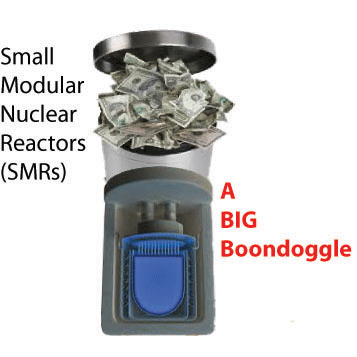 men might well think that any fraud can be perpetrated on the public.
But not for long.
The genuinely clean energy transition is under way world-wide, and becoming ever cheaper.
The “peaceful” nuclear industry is intrinsically linked to the multi $billion nuclear weapons industry. Yet even the nuclear weapons industry is under threat, with the coming UN nuclear disarmament conference.
Even if concern for the public good does not stop the toxic nuclear industry – the unaffordable economic costs eventually will
Climate and nuclear news to 19 January
 19 Jan 17 As I write, there’s a sort of an anxious lull in climate and nuclear news. Indeed, in other news, too. The media world seems to be waiting for the next event, on January 20, concerning a certain narcissistic American. I’ve decided to leave him out of this week’s newsletter.
The exception in all this is Fukushima. Not that you find anything about this in the mainstream media. However, the news is getting out in alternative, and some Japanese media: workers’ cancers: Thyroid Cancer Patient Group : Designation of radioactive waste lifted: Fukushima ‘voluntary’ evacuees: Fukushima foodstuffs.
As climate deniers move into White House – Guardian news focus on climate change.
USA.
- Proposed Energy Secretary Rick Perry – ignorant about nuclear security! Legal action against subsidising of America’s aging nuclear reactors. Despite shutdown of Indian Point nuclear plant, New York will invest billions in upgrading other nuclear stations. Testing a deep borehole as a potential way to bury highly radioactive nuclear trash.
- Obama’s Top Scientist Explains the Climate Challenge Northeast USA predicted to heat up faster than most of the rest of the world. Interfaith effort spreads the word about climate change.
- Solar energy now a bigger employer than Coal, Oil, and Natural Gas combined. World’s largest rooftop solar farm to be built on Tesla’s gigafactory.
JAPAN. Crash in Toshiba shares as nuclear financial crisis deepens. Shimane nuclear power plant found to have dangerous corroded holes in air ducts inside the No. 2 reactor. 7 Times More Leukemia in 2015 than 2014, 80% in Eastern Japan.
CHINA. Nuclear weapons should be completely prohibited – Chinese President Xi Jinping.
BELGIUM. Netherlands, Luxemburg and Germany want Belgium’s dangerous nuclear reactors to be closed.
PAKISTAN. Pakistan vows nuclear retaliation if India attacks.
U K. Political row over proposed west Cumbria nuclear plant. Greens Party running anti nuclear platform in UK by-election. Prince Charles writes a book on climate change (That’s torn it: they won’t let HIM be king)
NORTH KOREA. North Korea may be preparing for a new missile test-launch.
UKRAINE. Russia stops agreement with Ukraine on nuclear power plant construction
SAUDI ARABIA. Saudi Arabia’s $US50bn clean energy plan focusses on solar and wind
Greenpeace Response to Trump Scrubbing Climate Change from White House Website

http://www.greenpeace.org/usa/news/greenpeace-response-trump-scrubbing-climate-change-white-house-website/ 20 Jan 17 In response to news that the Trump administration has removed all mentions of climate change from the official White House website, Greenpeace spokesperson Travis Nichols said:
“We know Donald Trump and his proposed cabinet of millionaires are climate deniers. We’ve known that for years. It is no surprise that on day one they would proceed with their business plan of officially denying science for profit. It doesn’t change the science or the fact that the world wants a clean energy future. If there’s money to be made, Donald Trump will likely continue to officially deny climate change until the boiling seas swallow Mar-A-Lago whole.
That’s why we have to resist. More people believe in climate action than voted for Donald Trump, and we will continue to resist as long as the official White House policy is climate denial.”
As Trump takes over, White House website loses all reference to climate change, promotes coal industry
It also appeared to remove any reference to combating climate change, a topic that had been featured prominently on the White House site under President Barack Obama. The page that once detailed the potential consequences of climate change and the Obama administration’s efforts to address it vanished on Friday just as President Trump was sworn in. It now redirected to a broken link: “The requested page ‘/energy/climate-change’ could not be found.”
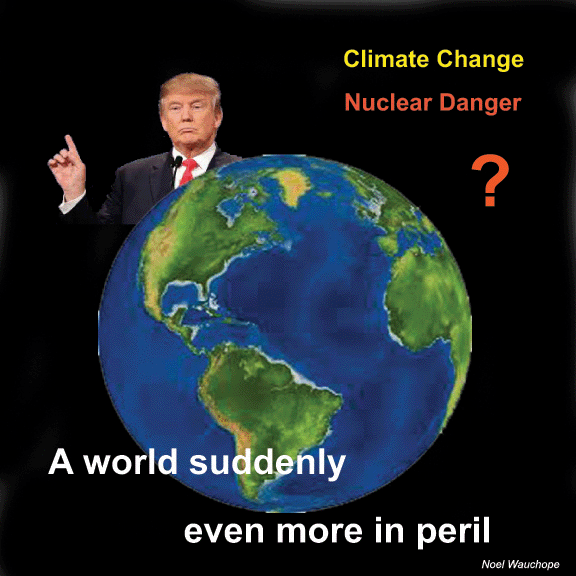
In its place, listed among the top issues of the Trump administration, was a page entitled, “An America First Energy Plan.”
The incoming administration vows to eliminate “harmful and unnecessary policies” such as the Climate Action Plan and the Waters of the United States rule. The first represents a variety of efforts Obama pursued to reduce U.S. greenhouse gas emissions, while the second is a rule issued by the EPA to protect not only the largest waterways but smaller tributaries that others believe should fall under the jurisdiction of states rather than the federal government.
The new White House site says that Trump would “refocus the EPA on its essential mission of protecting our air and water.”
It also says the incoming president will pursue “clean coal technology,” a reference to efforts to remove carbon dioxide emissions from coal-burning plants and bury those emissions in the ground to use them to enhance oil recovery. The Obama Energy Department has already been funding a variety of projects in this area. Though, without nearby enhanced oil recovery projects, the technology is not economic. Trump’s White House site says the new administration would aim at “reviving America’s coal industry.”
Perry poised to lead renewable energy push in Trump’s USA
BY MARK PERRY, 01/20/17 “……..This is where the new administration can make a difference. With Perry guiding the DOE, the agency can stimulate development of a new generation of small modular reactors and advanced nuclear plants.
Just last week, NuScale, an Oregon-based nuclear company, applied to the Nuclear Regulatory Commission for safety certification of a small modular reactor (SMR) that it intends to develop for use in the United States and abroad.
This is the first request for certification of a new reactor design in many years and it could mark the start of the next step for advanced nuclear power…….
Perry is a strong supporter of nuclear power. He can play an invaluable role in pushing for action at the state and regional levels to keep existing nuclear plants online…… it takes new leadership and a renewed appreciation for the importance of nuclear power. Hopefully, Perry will soon provide that leadership as the head of the DOE”.
Wildlife and wind power – they can thrive together
 Wind power and wildlife thrive together http://www.aweablog.org/wind-power-wildlife-thrive-together/, JANUARY 5, 2017 National Bird Day is today and it offers a good chance to share the positive story about wind energy and birds. Cleaner air, healthier habitats
Wind (Energy) Beneath Their Wings
What do some of America’s most respected conservation groups think about wind power?
“Audubon strongly supports properly sited wind power as a renewable energy source that helps reduce the threats posed to birds and people by climate change,” the group says on its webpage.
“Responsibly developed wind energy offers a substantial, economically feasible, and wildlife-friendly energy opportunity for America,” according to the National Wildlife Federation.
Here’s why they offer such strong endorsements.
Scientists overwhelmingly agree that excess carbon pollution threatens birds across the globe. This looms particularly large in North America, where the National Audobon Society finds CO2 pollution could cause 314 different bird species to lose up to 50 percent of their habitats in the coming decades.
Fortunately, wind power remains the biggest, fastest, and cheapest way to reduce carbon pollution, cutting 28 million cars’ worth every year. Wind also contributes to a cleaner environment for America’s birds by eliminating pollutants like nitrogen oxides and sulfur dioxide that create smog.
Working proactively to keep impacts low
The U.S. wind industry works closely with conservation organizations and government officials to understand and minimize the impacts it does have to the greatest degree possible. Here’s one example of groundbreaking research on ways to do this:
How else do wind developers ensure conservation happens? Some examples of the different methods they use include:
- Investing in offsite habitat restoration.
- Thorough site monitoring to notice any unexpected impacts.
- Creating wildlife preserves.
- Partnering to create the American Wind Wildlife Institute to tackle wind and wildlife issues, identifying areas that need research and then making sure it happens.
- Performing extensive pre-construction surveys to minimize impacts, and following best practices to maintain small effects during project operations.
Factors like this contributed to the New York State Energy and Research Development Authority’s finding that wind has the lowest impact on wildlife and their habitats of any way to generate electricity.
It is true that wind does have some impact on bird populations, and the U.S. wind industry takes that very seriously. However, this should also be put into context: wind causes less than 0.01 percent of all human-related bird deaths.
The reality is no human activity is completely impact-free. With decades of siting experience and comprehensive environmental impact assessments done before construction, wind greatly lessens the effects it does have.
And because wind power directly combats the greatest threat to birds, helps create a cleaner environment and preserves habitats through its small footprint, it creates a future where birds of all kinds can continue to flourish.
Future city design will be solar planned
WHY SOLAR WILL BE BUILT INTO OUR FUTURE CITIES http://circulatenews.org/2017/01/solar-will-built-future-cities/ JANUARY 19, 2017

Solar power and other renewable energy sources are increasingly affordable as technologies continues to become more efficient and effective, and the opportunities to scale solutions brings costs down even further. As much as the transition from a fossil-fuel based economy to one powered by renewables is becoming more widely recognised, what is sometimes lost is just how rapid the change has been. Furthermore, it appears the next natural step is a renewable energy source inspired transformation of the way in which we design our future buildings and cities.
During the last six years in the US alone, “solar power has exploded into the energy sector with the kind of industrial vigour not seen since the 1950s”, wrote David Beckham in GreenBiz earlier this month. In 2010, the US had the equivalent of one gigawatt of solar generation capabilities, for perspective on what that means in terms of power demands, Disney Land uses roughly that amount every two weeks – it’s also less than the Doc needed to get the DeLorean running again in Back to the Future! Capacity has ballooned to 30 gigawatts of solar power generation at the beginning of 2016 and is continuing to grow at a rapid pace, mostly thanks to the lowering of costs with the average solar cell now costings $0.35 per watt, compared with around $4 in 2016, all while increasing efficiency by 20%.
Throw in increased volatility in fossil fuel prices – especially oil – and diminishing efficiency gains for non-renewable based technologies, and it should come as no surprise that there is increasing investment and innovation into solar power, not to mention demand, where more panels were installed in the US during 2016 than the previous 38 years combined. Furthermore, digital advances are enabling better understanding and control of complexity and data, a huge advantage for less consistent natural sources of power like solar and wind.
The flexibility of renewables enables designers and architects to adopt a new way of thinking and there are now a growing number of examples where the potential opportunities of integrating energy production into the design of buildings and cities from the outset are being exploited.
Joining up built environment construction and design with renewable energy to create a more diverse, distributed and resilient system of power production integrated directly into cities offers the possibility of producing a holistic solution to individual challenges, the AMIE prototype, produced by Oak Ridge National Laboratory (ORNL), which integrates solar panels, into a connected home and electric vehicle is one great recent example.
Photovoltaic technologies designed for integration into building components produced by corporates like Californian-based Solaria, who have developed especially effective solar tech so that they can produce glass that can be used in typical window openings, is fully see through and generates electricity, are predicted to become increasingly common. Indeed, the level of development and scale of Solaria itself may surprise some.
“Architectural solar” is still in relative infancy, but if anything can be learned by the growth of solar power generation, which few would have expected to be economically viable by 2016 looking at the 2010 landscape, it is that technology with potential can and will be developed exceptionally quickly in a context where there is demand for the solutions it provides. The ORNL experiment and current solutions sold by Solaria may only be a beginning, but anticipating rapid evolution looks like a good bet.
Can Donald Trump manage nuclear diplomacy with North Korea? It’s unlikely
 In Nuclear Poker, Don’t Bet on Trump, Bloomberg JAN 19, 2017 BY James McManus Is North Korea’s belligerent young leader, Kim Jong-un, bluffing when he says the “last stage” is underway for testing a ballistic missile capable of hitting the U.S.? What about President-elect Donald Trump, when he tweets, “It won’t happen“?
As Trump’s administration begins, a showdown with North Korea over ICBMs seems all but inevitable. Just yesterday, South Korean media reported possible signs that the North may be preparing a new missile launch. In managing this conflict, few things will be more crucial than understanding the nature of bluffing. Unfortunately, for all his talk of being a good deal maker, Trump is a terrible bluffer — and his lack of skill is likely to destabilize nuclear politics.
A bluff is an untrue but plausible story. In the mindsport of poker, bluffs work when your opponent believes you have a better hand, so he can’t call your bet or raise, conceding you the pot. The savvier player wants to steadily grind away at the stack of his opponent over a large number of small pots, without risking too many of his own chips in any single hand. The weaker player can counter the “small ball” strategy by raising all-in fairly often, forcing all-or-nothing confrontations.
To understand why these dynamics are so crucial in nuclear negotiation, consider the work of John von Neumann, the prodigiously gifted polymath who immigrated to the U.S. from Hungary in 1933 and later contributed to the Manhattan Project. Von Neumann loved poker because its strategy involves guile, probability, luck and budgetary acumen, but is never transparent; it always depends on the counterstrategies deployed by opponents.
Trump bluffs almost constantly. He has spent his entire adult life overstating the value of his real estate holdings and branding endeavors, while bragging relentlessly about his wealth, sex life, length off the tee, and on and on. His bluffs during the campaign — that he had a replacement for Obamacare, a secret plan to defeat Islamic State and so on — were plainly false to anyone paying attention. To Trump, what was true hardly mattered.
Such tendencies would not serve him well in a poker game. Any player who continually misrepresents the size of his hand would cause sharp opponents to give his bets little credit. They’d simply wait for above-average hands and call him. As Daniel Negreanu, the all-time winningest poker tournament player, put it to me, “Trump’s bluffs are very effective against level-one thinkers. His lies are so outlandish that people think they have to be true or he wouldn’t have said it. The constant barrage makes him tougher to read. But sharper players would pick him apart.”
Kim may not be irrational, but he knows how to seem that he is, which gives him leverage. Kim’s contempt for most North Koreans means that he has less to lose by threatening to nuke an American city. The more we know about his pretensions to deity, his labor camps, the food and electricity shortages his policies have prolonged, the easier it is to believe he might sacrifice millions of Koreans in an absurd attempt to save face. Kim isn’t threatening to defeat the U.S., a bluff no one would credit; he’s trying to prove he could grievously injure it before dying himself, a bluff that must be taken seriously. As Negreanu puts it, Kim is “a scary player. Being unpredictable, capable of any move at any time, makes him hard to prepare for.”
In such circumstances, Trump’s long history of empty boasts is destabilizing. Kim may calculate that he has renewed leverage to push for concessions from the U.S. He might engage in riskier behavior, such as firing more test missiles or launching cyberattacks. Almost certainly, he’ll persist in developing missiles that can reach the U.S., calculating all the while that Trump’s Twitter outbursts are simply talk.
That may be true. But what if, for once in his life, Trump means what he says? What if he can’t bear to have his bluff called, and really is tempted to launch a preemptive attack if it looks like North Korea poses a real threat to the U.S. mainland?……..https://www.bloomberg.com/view/articles/2017-01-19/in-nuclear-poker-don-t-bet-on-trump
1 This Month
Chernobyl: The Lost Tapes – A good documentary on Chernobyl on SBS available On Demand for the next 3 weeks– https://www.sbs.com.au/ondemand/tv-program/chernobyl-the-lost-tapes/2352741955560

of the week–London Campaign for Nuclear Disarmament

Tell the Ukrainian Government to Drop Prosecution of Peace Activist Yurii Sheliazhenko
To see nuclear-related stories in greater depth and intensity – go to https://nuclearinformation.wordpress.com
-
Archives
- April 2026 (139)
- March 2026 (251)
- February 2026 (268)
- January 2026 (308)
- December 2025 (358)
- November 2025 (359)
- October 2025 (376)
- September 2025 (257)
- August 2025 (319)
- July 2025 (230)
- June 2025 (348)
- May 2025 (261)
-
Categories
- 1
- 1 NUCLEAR ISSUES
- business and costs
- climate change
- culture and arts
- ENERGY
- environment
- health
- history
- indigenous issues
- Legal
- marketing of nuclear
- media
- opposition to nuclear
- PERSONAL STORIES
- politics
- politics international
- Religion and ethics
- safety
- secrets,lies and civil liberties
- spinbuster
- technology
- Uranium
- wastes
- weapons and war
- Women
- 2 WORLD
- ACTION
- AFRICA
- Atrocities
- AUSTRALIA
- Christina's notes
- Christina's themes
- culture and arts
- Events
- Fuk 2022
- Fuk 2023
- Fukushima 2017
- Fukushima 2018
- fukushima 2019
- Fukushima 2020
- Fukushima 2021
- general
- global warming
- Humour (God we need it)
- Nuclear
- RARE EARTHS
- Reference
- resources – print
- Resources -audiovicual
- Weekly Newsletter
- World
- World Nuclear
- YouTube
-
RSS
Entries RSS
Comments RSS
 nuclear-news