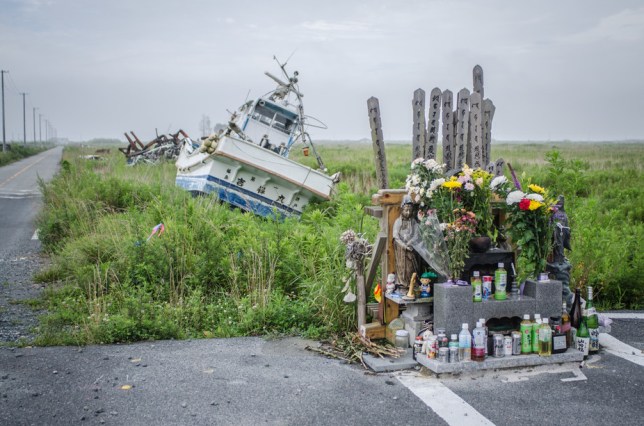
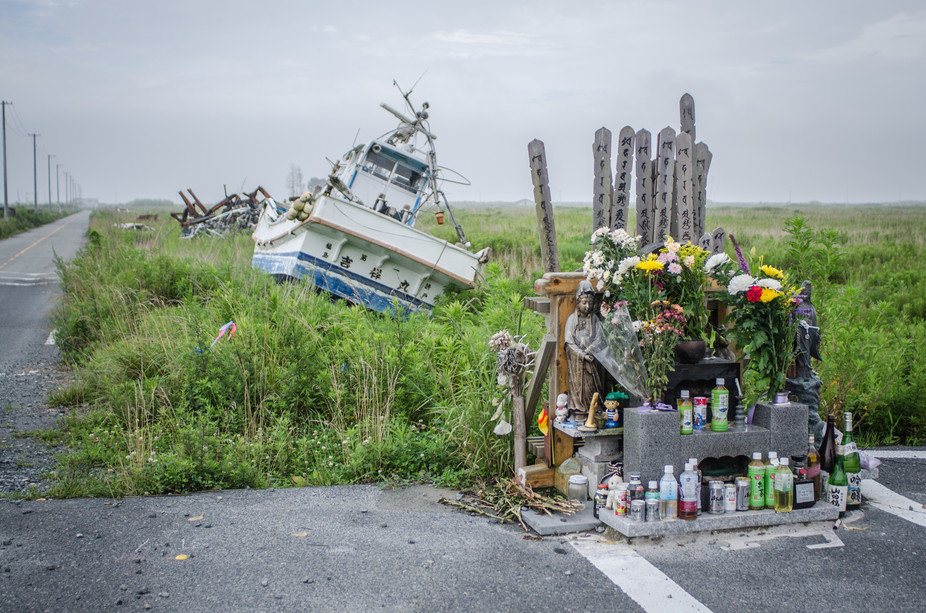
A fishing boat washed inland by the 2011 Tsunami next to a shrine inside the Fukushima nuclear exclusion zone.
At 5.59am local time on November 22, Fukushima was hit by a 7.4 magnitude earthquake, triggering a tsunami warning. For residents in the same region of Japan devastated by the major 2011 Tōhoku earthquake and its tsunami, the threat of a renewed disaster was very real.
The tsunami warning was lifted a few hours later, and the earthquake was later declared a long-term aftershock from the larger quake five years ago. But for people still coming to terms with that disaster and its aftermath, this new earthquake will severely test their resilience once again.
On March 11 2011, the 9.0 magnitude earthquake created a 15-metre tsunami that inundated the Fukushima Daiichi (Fukushima I) nuclear power station. Power was disabled to three reactors, which caused a serious nuclear accident as cooling systems failed. Large quantities of radiation were immediately released into the environment and approximately 100,000 people were evacuated.
The long-term social consequences of the original Fukushima Daiichi accident have been broad and far-reaching. Perception of risk, the likelihood of exposure to danger, has been at the heart of social controversy after the 2011 disaster. Radiation is invisible, and it is challenging to understand or percieve a threat that can only be detected by specialist scientific equipment. Often women and children are hit the hardest by this, regardless of socioeconomic status.
The concept of Fūhyōhigai, or the “harmful rumour”, was initially used by the media and local government to dismiss local women’s concerns about radiation exposure as weak and unscientific. However, this led to a cultural shift by women known as Fukushima’s “radiation brain moms”, who purchased monitoring equipment and took matters into their own hands, forming citizen radiation monitoring organisations (CRMOs).
By forming these groups of resistance, self-help and support, women rejected their culture’s social norms of obedience and subservience, that could have suppressed them from cultivating outrage over injustice and inequality. Participation in CRMOs has decreased over time, as the social memory of Fukushima Daiichi fades, but citizen science initiatives such as Safecast still provide useful information to many.
The recent earthquake temporarily halted the cooling system at the nearby Fukushima Daini (Fukushima II) reactor, and so there is likely to be a resurgence in monitoring, and a reunion of these support networks. Regardless of what happens now, there has already been a positive seismic shift in attitudes by both the government and scientists toward concerned mothers and community monitoring.
Living in ‘temporary’ permanence
Many impacts of the 2011 disaster have been hidden away in the private spaces of everyday life, with the tragedy putting enormous strain on family relations. Not only were thousands of families displaced from their homes, evacuation has meant the separation of family groups.
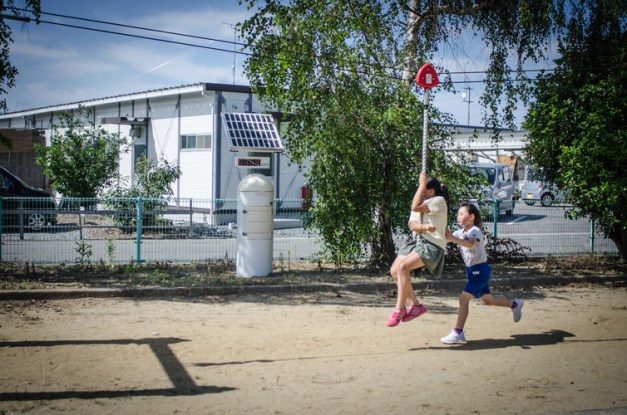
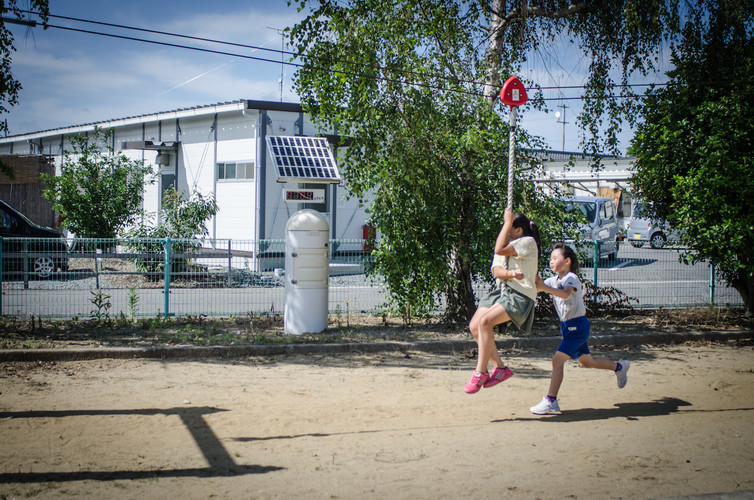
Two girls play on a swing next to a radiation monitor and their temporary housing in Minamisōma, Fukushima prefecture.
Where once three generations could live together in Fukushima’s close-knit rural villages, relocation to cramped prefabricated temporary housing has meant many are forced to live apart. Today, five years after the disaster, 174,000 people are still displaced in a state of “temporary” permanence. Disconnection from the familiarity of place and family, as well as the constant worry about radiation risk, even threatens marital relationships. “Atomic divorce” (Genpatsu rikon) is on the rise, with disagreements on radiation safety, or whether to relocate back to territory now deemed “decontaminated”. News of the recent earthquake will doubtless have jogged memories and resurfaced hidden tensions.
The Japanese government is gradually declaring sections of the 20km nuclear exclusion zone safe and habitable. Despite this, the desire to move back to previously contaminated land has been underwhelming. For example, four months after Naraha Town was declared safe in September last year, only 6% of former inhabitants decided to move home to one of Fukushima’s many atomic “ghost towns”.
In the town of Minamisōma, on the northern edge of the exclusion zone, thousands of mothers and children have refused to return, despite societal pressure not to “betray” their home communities.
Nuclear uncertainty
While Japan’s tsunami warning system worked well, there is still considerable uncertainty surrounding the consequences and likelihood of a further natural hazard causing a nuclear accident in Japan.
The 2011 Fukushima Daiichi accident had already permanently changed the Japanese nuclear landscape. The government has undergone a process of gradual nuclear decommissioning since October 2011, and Fukushima Daaichi and Dai-ni no longer produce energy. Yet, Japan is still heavily reliant on nuclear energy and since 2015 has restarted two of its nuclear reactors, with 24 other reactors in the process of restart approvals.
While social resilience to emergencies has improved since 2011 in Japan, the social aftershocks of Fukushima Daaichi are ongoing. Though many advances have been made that emancipate vulnerable populations and provide increased connectivity, it remains to be seen how much these new technologies and attitudes have improved social resilience and reduced the likelihood of anxiety within the community of Fukushima.
How Cities Plan to Fight Climate Change in the Trump YearsLocal leaders learned how to take action when Washington couldn’t. Now they’re betting those efforts can survive an age of science-denying federal overlords. City Lab, JOHN METCALFE and LAURA BLISS Nov 22, 2016 What impact will Donald Trump’s league of global-warming deniers and fossil-fuel boosters have on U.S. climate action? The short-term prognosis might not be as damaging as some fear, but the broader implications aren’t good. The president-elect has proposed slashing federal funding for clean energy development, resurrecting the coal industry, backing out of the Paris agreement, and essentially ditching the EPA. Trump won’t be able to do it all, but it seems safe to assume that for the next four years, domestic climate policy will be in the deep freezer—while the rest of us heat up.
Yet local leaders across the U.S. don’t need to be persuaded of the devastating impacts of climate change—environmentally, socially, and financially speaking—even if Trump and his top advisers do. Global warming’s effects are perhaps easiest to see on the local scale, with rising tides, melting snowcaps, and drier summers. A significant part what’s causing these changes lies in urban centers, which generate an estimated 70 percent of global greenhouse gas emissions, and house more than 50 percent of the population.
And U.S. cities have the power to shrink that footprint and prepare for the worst, even in the absence of financial or regulatory support from the federal government. Congress has long stalled on advancing climate policies, anyways—while cities have taken control of crucial variables that determine emissions and sustainability: renewable-energy programs, bus-rapid transit and rail, shared mobility, protections against flooding and the ever-rising seas.
Many local leaders say that this work has become more important than ever. Here are five American cities that have made real climate progress in ways that they plan to continue in the years of a Trump administration and Republican-controlled Congress.
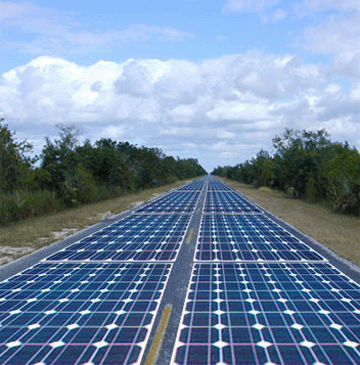
Unit of Colas SA designed solar panels that embed into roads
Work progressing on larger test site in northern France
Electric avenues that can transmit the sun’s energy onto power grids may be coming to a city near you.A subsidiary of Bouygues SA has designed rugged solar panels, capable of withstand the weight of an 18-wheeler truck, that they’re now building into road surfaces. After nearly five years of research and laboratory tests, they’re constructing 100 outdoor test sites and plan to commercialize the technology in early 2018.“We wanted to find a second life for a road,” said Philippe Harelle, the chief technology officer at Colas SA’s Wattway unit, owned by the French engineering group Bouygues. “Solar farms use land that could otherwise be for agriculture, while the roads are free.”
As solar costs plummet, panels are being increasingly integrated into everyday materials. Last month Tesla Motors Inc. surprised investors by unveiling roof shingles that double as solar panels. Other companies are integrating photovoltaics into building facades. Wattway joins groups including Sweden’s Scania and Solar Roadways in the U.S. seeking to integrate panels onto pavement.
To resist the weight of traffic, Wattway layers several types of plastics to create a clear and durable casing. The solar panel underneath is an ordinary model, similar to panels on rooftops. The electrical wiring is embedded in the road and the contraption is topped by an anti-slip surface made from crushed glass.
A kilometer-sized testing site began construction last month in the French village of Tourouvre in Normandy. The 2,800 square meters of solar panels are expected to generate 280 kilowatts at peak, with the installation generating enough to power all the public lighting in a town of 5,000 for a year, according to the company.
For now, the cost of the materials makes only demonstration projects sensible. A square meter of the solar road currently costs 2,000 ($2,126) and 2,500 euros. That includes monitoring, data collection and installation costs. Wattway says it can make the price competitive with traditional solar farms by 2020.
The electricity generated by this stretch of solar road will feed directly into the grid. Another test site is being used to charge electric vehicles. A third will power a small hydrogen production plant. Wattway has also installed its panels to light electronic billboards and is working on links to street lights.The next two sites will be in Calgary in Canada and in the U.S. state of Georgia. Wattway also plans to build them in Africa, Japan and throughout the European Union.“We need to test for all kinds of different traffic and climate conditions,” Harelle said. “I want to find the limits of it. We think that maybe it will not be able to withstand a snow plow.”The potential fragility joins cost as a potential hurdle.“We’re seeing solar get integrated in a number of things, from windows in buildings to rooftops of cars, made possible by the falling cost of panels,” Bloomberg New Energy Finance analyst Pietro Radoia said. “On roads, I don’t think that it will really take off unless there’s a shortage of land sometime in the future.”’
Unlike many other developing countries, around 99% of all Chinese households already have access to the grid.
Solar PV can help China’s poorest, China Dialogue Suzanne Fisher Murray 23.11.2016 中文版本In Anhui villages are hooking up to the grid to generate income and power, writes Suzanne Fisher-Murray The residents of Yuexi county, a mountainous area in eastern China, must have thought it was their lucky day when they heard they had been selected for China’s new solar poverty alleviation project.
The 382,000 residents are some of the poorest in the country, living below the poverty line of 2,300 yuan (about US$1 per day). This was the key criteria for their selection in the project, which is part of China’s 13th Five-Year-Plan, the roadmap for the nation’s development from 2016 to 2020.
The project is being piloted in Yuexi county, Anhui province before being rolled out across the country. Villagers identified as living below the poverty line will have rooftop solar panels rated at 3-5 kilowatts installed on their roofs and become shareholders in village solar power stations with a generating capacity of around 60-100 kilowatts. The aim is for the solar panels to earn each family 3,000 yuan (around US$430) in extra income each year. Local farmers could also earn additional income by leasing out non-arable lands or maintaining the solar farms.
So far, 182 villages (with 30,000 residents) in the county have been identified as eligible for the project. Construction has begun at a staggering pace: 57 solar parks were built in 2015, with the remaining 125 expected to be finished this year.
Unlike many other developing countries, around 99% of all Chinese households already have access to the grid.
Each household will use the solar electricity generated for their own purposes. This will reduce energy bills and any surplus electricity will be sold back to the grid. Families will also have shared ownership of the solar parks, splitting 40% of the profits between them, with the remaining 60% going to pay back loans and park construction fees. This means that once the solar panels are installed, households and villagers could begin to see the benefits quickly.“It will take more time before we know the impact of the project,” warned Yixiong Kang from China Carbon Futures Asset Management Company, which is overseeing the financial and technical aspects of the project.
“But it could have a huge impact. We are talking about the poorest families. They basically have nothing in their houses that use electricity [because they can’t afford to pay the bills].” The extra income they’ll earn could change that. “If you want to change the living standards of people, sometimes it’s not enough to just give them electricity. Electricity – that’s just a power supply. They need greater help,” he added.
Aside from the direct profits, the villagers would also likely benefit from subsidies paid to solar generation projects in China. The rates are set to go down in 2017 due to a solar power generation surplus, but, if paid, will also help increase the villagers’ profits. The village level solar stations will also be part of a Chinese emissions trading programme which is currently being established. The village solar stations that have certified emissions reductions certificates could trade 1000 kWh of their clean energy to replace one tonne of carbon dioxide emissions on the carbon trading scheme.
Zuma’s waning power exposed by stalled nuclear plan. Mail and Guardian 24 Nov 2016 Mike Cohen, Paul VecchiattoGovernment’s decision to stall plans championed by President Jacob Zuma to build nuclear plants has exposed his waning authority.
News of the delay came on Tuesday when the department of energy said additional atomic power won’t come on stream until 2037 under its “base case” scenario, 14 years later than previously projected. Although Zuma says reactors are key to addressing power constraints in Africa’s most industrialised economy, Finance Minister Pravin Gordhan, economists and ratings agencies warn that South Africa can’t afford them now.
“Essentially the project has been indefinitely postponed and the final decision on nuclear power will only be taken by Zuma’s successor,” said Robert Schrire, a politics professor at the University of Cape Town. “This is a great victory for economic rationality and political expediency and reflects the new political balance of a weakened Zuma administration.”…….
Gordhan’s victory
Gordhan won a victory this month after prosecutors withdrew fraud charges against him for allegedly approving a pension payment to a tax service official, two days before he was due to appear in court. The Democratic Alliance, the main opposition party, alleged that Zuma intended to use the court case as a pretext for firing Gordhan and in the process remove the biggest obstacle to his nuclear ambitions.
The party also says that Zuma may already have signed a secret nuclear power supply deal with Russia and that the programme would be used to benefit his own financial interests and those of his allies. The president and the government deny the allegation……
Energy Minister Tina Joemat-Pettersson told reporters the power blueprint was updated to reflect developments in the energy industry, including changes in technology costs and lower-than-anticipated demand. The draft plan will be finalised next year.
Eskom, which supplies about 90% of the nation’s power, isn’t shelving its nuclear plans yet. The state utility will continue to seek requests for proposals to build new reactors pending the completion of the energy plan…..
The dynamics of power in South Africa are shifting, according to Keith Gottschalk, a political scientist from the University of the Western Cape in Cape Town.
Thanks to plummeting unit costs, solar energy will be a crucial source of power for many countries working to meet their climate objectives by 2030.
Projects like Morocco’s Noor-Ouarzazate solar power plant, a $625 million solar rooftop project in India and a recent record solar auction in Zambia underscore how solar is being embraced rapidly as the energy of the future.
Multilateral development banks like the World Bank Group (WBG) can help client countries develop their solar resources, make projects less risky, provide access to low-cost capital for power plants and improve transmission and distribution infrastructure.
Washington, Nov. 10, 2016 – Once a distant possibility, solar power is a game changer for developing countries that are swiftly embracing this clean, renewable source of energy to close their electricity access gaps and meet climate change mitigation goals.
Just the past year is a clear sign of that shift.
For the first time, renewable sources of energy have overtaken coal in terms of cumulative installed power capacity in the world. In 2015, an all-time record 153 gigawatts (GW) of capacity was added through renewables, with photovoltaic solar – which includes mini-grids and rooftop solar systems – accounting for nearly a third (49 GW) of the addition, according to the International Energy Agency. In other words, about half a million solar panels were installed every day around the world last year.
That number is growing. In fact, global electricity capacity from renewable sources of energy is projected to increase by 42 percent, or 825 GW, by 2021, with solar power expected to play a major role in reaching that goal.
Morocco, where climate experts and policymakers from around the world are gathered this week for COP22, is a prime example of this transformation. Earlier this year, the Moroccan king inaugurated the first facility of the largest concentrated solar power (CSP) complex in the world with support from the World Bank, the Climate Investment Funds (CIF) and other partners. Once it is fully operational, the plant will produce enough energy for more than one million Moroccan households.
The North African country is not alone in the shift to solar, which is helping developing countries reduce their reliance on conventional fuels like coal and oil, and boost the share of renewables in their energy mix.
Take the International Solar Alliance, for example. In June, the WBG signed an agreement with the alliance, consisting of 121 countries led by India to collaborate on increasing solar energy use around the world and helping the alliance mobilize $1 trillion in solar investments by 2030.
Seeing the potential of solar in India, the World Bank also pledged $1 billion in planned initiatives to help the South Asian country take sustainable, clean, climate-friendly electricity to millions of its people. This includes a $625 million projectapproved in June to install solar panels on rooftops around the country, supported by a $125 million co-financing loan from the CIF.
In neighboring Bangladesh, 18 million people now have access to electricity thanks to solar home systems that were installed as part of a World Bank project. In the country’s remote islands like Monpura, where extending the electricity grid would be impossible, standalone solar mini-grids are powering up entire communities and businesses, like that of welder Abdulrahim Hawlader.
Previously dependent on a diesel generator, Hawlader says solar power has transformed his business and boosted his income.
“We just turn on the switch and it (machinery) works,” he said. “Because of lower costs, we are making more profits.”
In Bolivia, families that live in remote areas without access to the power grid are turning to solar home systems to meet their electricity needs.
The expansion of off-grid lighting products and services have provided more than 26 million people access to modern energy services through the WBG’s Lighting Global, Lighting Africa, Lighting Asia and Lighting Pacific programs.
And in some countries where private investors hesitate to enter because of perceived risks, the WBG’s Scaling Solar program facilitates competitive auctions and offers standardized documents, financial guarantees and pre-approved financing to alleviate investors’ concerns and make these markets more attractive.
A recent auction in Zambia organized by Scaling Solar set record low prices of 6 cents a kilowatt hour for solar power generation, the lowest to date in Africa and among the lowest recorded globally. It paves the way to take electricity to thousands of Zambians in desperate need.
The applications of solar technology seem boundless. A solar plane recently made history after making a trip around the world entirely on solar power, without using any aviation fuel. An airport in Cochin, India became the world’s first of its kind to be powered fully by solar energy, followed by another in South Africa. Worldwide, companies are producing slick, new designs for solar roofs, windows and even floating solar panels to harness the sun’s power.
A confluence of favorable market forces, including cheaper-than-ever prices and technology, have encouraged the take-up of solar by private investors and countries alike. Solar PV costs have dropped nearly 60 percent since 2010 and are as low as 6 to 8 cents per kilowatt hour today, according to IRENA. They are projected to fall a further 60 percent in the next decade.
Under the WBG’s Climate Change Action Plan, $25 billion in private financing will be mobilized for clean energy in developing countries over the next five years, with another 30 gigawatts of renewable energy added either through direct investment or investments in enabling infrastructure by 2020.
Projects are already under consideration in many countries with WBG support focused on access to the right combination of financing, and technical and advisory expertise to help them succeed with their solar objectives and break down existing barriers.
These barriers include the lack of adequate transmission and distribution infrastructure, absence of affordable and effective storage solutions, weak enabling environments (including a lack of solar-friendly policies and regulation) and high upfront capital costs. A universal uptake of solar power is also nearly impossible without private investment in the sector.
The WBG is working to increase private interest in markets where investors may have otherwise hesitated to enter on their own, with a suite of financial guarantees and instruments and help on technical, policy and regulatory aspects – all designed to strengthen confidence and draw investment in solar technology well into the future.
Peru declares state of emergency over deadly forest fires Blazes have burnt 12,000 hectares, including five protected natural areas Endangered species under threat from fires that ‘took us by surprise’, Guardian, Dan Collyns , 24 Nov 16, Peru has declared a state of emergency in seven districts in the north of the country where forest fires have killed two, injured four and burnt nearly 12,000 hectares (30,000 acres) of land, including five protected natural areas.
Wildfires have spread to 11 regions across the country, according to Peru’s civil defence institute, in what scientists say may be the worst drought in more than a decade.
Peru’s environment minister, Elsa Galarza, said a special brigade of firefighters had been deployed to the worst-affected areas in the north. The 31 firefighters are normally stationed in the Inca citadel Machu Picchu, the country’s top tourist attraction.
Endangered animal species such as the spectacled bear – which inspired the Paddington Bear children’s stories – and the white-winged guan are under threat from the blazes. Other rare species such as jaguars, howler monkeys and the collared anteater, are seeing their habitat destroyed inside the protected areas, which include the Amotape mountain range and Cutervo national park.
Peru’s prime minister, Fernando Zavala, travelled to the affected areas and said the state of emergency would allow the government to “continue mobilising people, resources and diverse equipment in order to confront these fires”.
¶ “Can Trump undo Obama’s policies?” • The environmental achievements under Obama are considerable, and Trump can’t vanquish them with a snap of his fingers. Many power plants have already taken steps to rein in toxic pollutants. Obama’s clean car rules have already stood up in court. But Trump has many options. [The Colorado Independent]
US wind farm (Credit: Mathias Appel, Creative Commons, Flickr)
¶ “Smart Energy Storage Gives Building Owners Control of Electricity Expenses” • In the past, we’ve traditionally overbuilt supply to maintain electric system reliability. We are supporting trillions of dollars of infrastructure that is not normally used. Getting past this with energy storage will bring financial benefits. [cre.tech]
World:
¶ The town of Newstead, Victoria is seeking proposals from potential project partners who could help refine its plan to reach 100% renewable energy in 5 years. The town, with a population…
Torness Nuclear Power Station is around 30 miles from Edinburgh. According to French State owned EDF, owner-operator of the UK’s nuclear reactors, Torness nuclear power station unit one, 33 miles from Edinburgh Scotland, automatically shut down on Tuesday, 22 November, at 8.45 AM “due to an increase in seaweed levels as a result of the weather conditions in the area. We are currently monitoring the weather and the seaweed levels… We know that at certain times of year particular weather conditions in this part of the Forth Estuary can lead to increased seaweed volumes which can enter the station’s cooling water intake system. Our staff are trained to respond in this situation, and to take the plant offline if necessary. In addition, the plant’s safety systems monitor conditions like this will take the unit offline automatically, should levels rise beyond prescribed settings,…” EDF further notes that Torness has operated…
“By removing this tricky “back end problem” of where to store the waste Australian taxpayers can really assist foreign investors to make more money”
It’s not simply a matter however of digging a best-of-breed hole with the taxpayer bearing 100 per cent of the cost – and sanctioned by a cost-benefit analysis focused on benefits but not costs.
The nuclear dump proposal probably couldn’t have got where it is today without the helpful influence of UCL Australia, the “international campus” of the University College London, which is located in Adelaide.
This university campus was started in 2008 with helpful funding from BHP (Olympic Dam – the world’s largest known deposit of uranium in South Australia) and Santos.
Like many countries, Bolivia relies on its glaciers and large lakes to supply water during the lean, dry times. But as Bolivia has heated with the rest of the world, those key stores of frozen and liquid water have dwindled and dried up. Warming has turned the country’s second largest lake into a parched bed of hardening soil. This heat has made the country’s largest lake a shadow of its former expanse and depth. It has forced Bolivia’s glaciers into a full retreat up the tips of its northern mountains — reducing the key Chacaltaya glacier to naught. Multiple reservoirs are now bone-dry. And, for hundreds of thousands of people, the only source of drinking water is from trucked-in shipments.
Drought Emergency Declared for Bolivia
After decades of worsening drought and following a strong 2014-2016…
¶ Many species will not be able to adapt fast enough to survive climate change, say scientists. A study of more than 250 plants and animals suggests their ability to adapt to changes in rainfall and temperature will be vastly outpaced. Amphibians, reptiles and plants are particularly vulnerable. And tropical species are at higher risk. [BBC]
Tropical species may be particularly vulnerable. (Thinkstock image)
World:
¶ Morgan Stanley has released a new report estimating that electric car sales will increase become 10 to 15% of the global new car market by 2025. Though the US may look to abandon its rules, every other civilized country has its own in place, and they require auto manufacturers to lower the emissions dramatically within a few years. [CleanTechnica]
¶ There has been a significant advancement in tidal energy this month with a single massive tidal turbine…
The failure to get to grips with our crises, by all mainstream political parties, is likely to lead to a war between the major powers in my lifetime.
Wave the magic wand and the problem goes away.
Those pesky pollution laws, carbon caps and clean-power plans: swish them away and the golden age of blue-collar employment will return. This is Donald Trump’s promise, in his video message on Monday, in which the US president-elect claimed that unleashing coal and fracking would create “many millions of high-paid jobs”.
He will tear down everything to make it come true.
But it won’t come true. Even if we ripped the world to pieces in the search for full employment, leaving no mountain unturned, we would not find it.
Instead, we would merely jeopardise the prosperity – and the lives – of people everywhere.
However slavishly governments grovel to corporate Luddism…
Taking traditional coal power out of our energy mix and replacing it with cleaner technologies will significantly reduce our greenhouse gas emissions, improve the health of Canadians, and benefit generations for years to come. —Canada’s Environment Minister Kathleen McKenna
Make no mistake – Trump and his legion of doom cronies are a very real threat to the environment. Apart from the fact that they deny climate change actually exists, they are also quite big fans of coal. — IFL Science
Japan Probes Nuclear Cooling System Shutdown After Earthquake
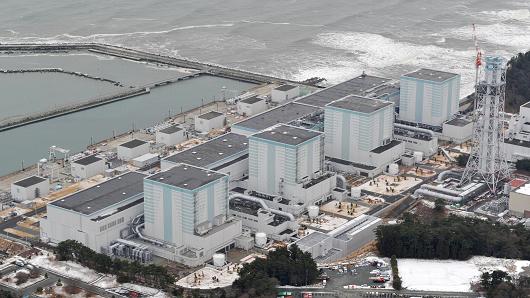
Japan is investigating why a cooling system used to store nuclear fuel rods was temporarily knocked offline at Tokyo Electric Power Co. Holdings Inc.’s shuttered Fukushima Dai-Ni atomic plant after a 7.4 magnitude earthquake struck the same region devastated by a tsunami in March 2011.
The temblor early Tuesday caused water in the pool at the plant northeast of Tokyo to move, according to the utility known as Tepco. Sensors registered the motion as a decline in water levels, triggering an automatic shutdown, the utility said.
One of at least two cooling pumps supplying water to the spent fuel pool at Dai-Ni’s No. 3 reactor was shut around 6:10 a.m. Tokyo time, according to Tepco. The utility started another pump to resume cooling the fuel rods around 7:47 a.m., it said in an e-mailed statement.
More than five years after the Fukushima earthquake and tsunami that wrecked the utility’s Dai-Ichi nuclear plant and resulted in the shutdown of Japan’s atomic fleet for safety checks, just two of the country’s 42 reactors are back in operation. Returning the plants to service is a goal of Prime Minister Shinzo Abe’s government and is critical to Japan’s aim for nuclear to account for as much as 22 percent of its energy mix by 2030.
“The fact that today’s earthquake caused the pumps at the Fukushima nuclear plant to shut down temporarily will certainly not help the government in its goal to restart the reactors,” Daniel Aldrich, a professor and director of the Security and Resilience Studies Program at Northeastern University in Boston, said by e-mail. “Perhaps one interesting change has been Tepco’s transparency about the ongoing problems at the site, including those that occurred during today’s earthquake.”
Government Response
Fifty-seven percent of the Japanese public oppose resuming operations of the country’s nuclear reactors, while 29 percent approve, according to an Asahi newspaper poll conducted in October.
Japan’s government quickly moved to allay any concerns following Tuesday’s earthquake, which was an aftershock of the magnitude 9 quake five years ago.
Safety is the top priority of Japan’s nuclear industry and the country has the world’s strictest rules for atomic plants, Japanese Chief Cabinet Secretary Yoshihide Suga told reporters in Tokyo Tuesday.
The stoppage of the system wouldn’t immediately have led to a release of radiation, Suga said. Earthquakes and tsunamis are among possibilities envisaged under new safety standards for nuclear plants issued by Japan’s Nuclear Regulation Authority since the 2011 disaster, he said.
Power would need to be cut for about a week before temperatures in the spent-fuel cooling system would reach the upper safety limit, according to Yutaka Ikoma, a spokesman at the regulator. Temperatures would rise about 0.2 degrees Celsius per hour without the cooling system, reaching 65 degrees Celsius in about seven days, according to the spokesman.















 nuclear-news