Decentralized renewable energy – this is the future
 “……….Let me develop the real reasons why conventional renewables are likely to emerge as the dominant primary energy sources in the first half of the
21st century. The fundamental advantages of renewables, as revealed by practical experience in China as well as in industrialised countries like Germany where an energy transformation is well under way, are these.As they scale renewable energies do not present greater and greater hazards. Instead they are relatively benign technologies, without serious riskThey are clean (low to zero-carbon); they are non-polluting (important in China and India with their high levels of particulate pollution derived from coal); they tap into inexhaustibleenergy sources; and they have close-to-zero running costs since they do not need fuel. They are also diffuse, which should be viewed as an advantage, since this means that renewable sources are decentralised, and can be harvested by both large and by small operations. So they are eminently practicable.
Some advantages of renewables are not at all obvious and need to be made explicit. Fundamentally, they are scalable. They can be built in modular fashion – one solar panel, 100 solar panels, 1000 solar panels. As they are replicated in this fashion so their power ratings continue to rise, without complexity cutting back on efficiency. This cannot be said of nuclear reactors, which have an optimal operational size – below which or above which the plant under-performs.
Moreover as they scale they do not present greater and greater hazards. Instead they are relatively benign technologies, without serious risks.

When they use hazardous materials, such as the cadmium in Cd-Te solar, the solution would be to recycle materials in order to minimise the use and waste of virgin materials.
Most importantly, the superiority of conventional renewables lies in their cost reduction trends which are linked to the fact that they are always the products of manufacturing – and mass production manufacturing, where economies of scale really play a role. This means that they offer genuine energy security in so far as manufacturing can in principle be conducted anywhere. There are no geopolitical pressures stemming from accidents of chance where one country has deposits of a fossil fuel but another does not. Manufactured devices promise an end to the era in which energy security remains closely tied to geopolitics and the projection of armed force. As Hao Tan and I put it in our article published in Nature, manufacturing renewables provides the key to energy security.
Manufacturing is characterised by improving efficiencies as experience is accumulated – with consequent cost reductions captured in the learning or experience curve. Manufacturing generates increasing returns; it can be a source of rising incomes and wealth without imposing further stresses on the earth. Add to these advantages that renewables promise economic advantages of the first importance: they offer rural employment as well as urban employment in manufacturing industry; they offer an innovative and competitive energy sector; and they offer export platforms for the future.
The real driver of the renewable energy revolution is not government policy, or business risk-taking, or consumer demand. It is, quite simply, the reduction of costs
This is to list the advantages of renewables without even mentioning their low and diminishing carbon emissions. Indeed they offer the only real long-term solution to the problem of cleaning up energy systems.
With all these advantages, it is little wonder that China and now India are throwing so much effort into building renewable energy systems at scale. These are not exercises undertaken for ethical or aesthetic purposes, but as national development strategies of the highest priority.
So the real driver of the renewable energy revolution is not government policy, or business risk-taking, or consumer demand. It is, quite simply, the reduction of costs – to the point where renewables are bringing down costs of generating power to be comparable with the use of traditional fossil fuels, and with the promise of reducing these costs further still. Supergrids are also being promoted for renewables, but these are very different conceptions, based on integrating numerous fluctuating sources in IT-empowered grids, offering the same practicable, scalable and replicable energy future.
Against these advantages, the obstacles regularly cited are small indeed. There is the fluctuating nature of renewables, which can be addressed by various forms of systems integration (smart grids, demand response) and of course through energy storage, which is moving into the same kind of cost reduction learning curve that has characterised solar and wind power, promising rapid diffusion of both commercial and domestic energy storage units. With rapidly falling costs of storage providing the buffer that can even out fluctuating levels of generation, there is no further serious argument against renewables……..
by John Mathews
This article is based on a scientific paper by John A. Mathews, Competing principles driving energy futures: Fossil fuel decarbonization vs. manufacturing learning curves, which was published in Futures in November 2016 (.http://www.sciencedirect.com/science/article/pii/S0016328715300227)
John Mathews is author of the Greening of Capitalism: How Asia is Driving the Next Great Transformation”, published by Stanford University Press: http://www.sup.org/books/title/?id=24288. His latest book, “China’s Renewable Energy Revolution” (co-authored with Hao Tan) was published by Palgrave Pivot in September 2015: http://www.palgrave.com/page/detail/chinas-energy-revolution-john-a-mathews/?isb=9781137546241.
See his author’s archive on Energy Post.
South Africa’s renewable energy is making nuclear power look obsolete

 Solar And Wind Versus Nuclear: Is Baseload Power Obsolete? Planet Save November 20th, 2016 by Stephen Hanley. The future of electrical energy is playing out in South Africa, where 80% of all electricity is generated by burning coal. The government is anxious to shutter all those coal fired plants but is caught in a crossfire between advocates for nuclear power and those who favor renewable solutions like solar and wind energy.
Renewable Strategy Successful
“The program has been very successful, clear of any corruption and very well run,” said Wikus van Niekerk, the director of the Center for Renewable and Sustainable Energy Studies at Stellenbosch University. “It’s been seen by many people in the rest of the world as one of the most successful procurement programs for renewable energy. It’s something that the South African government and public should be proud about.”
Several of those projects are concentrated solar facilities located near Upington in the central part of the country. That area has some of the most abundant daily sunshine of any place on earth. But those facilities use technology that is now almost obsolete. They use mirrors to concentrate sunlight to boil water to make steam.
After the sun goes down, they can continue to make electricity from the steam on hand for a few hours. After that, they have to wait for the sun to reappear the next day. Newer concentrated solar plants use the sun’s rays to heat molten salt, which can be kept in storage for up to 10 hours after the sun sets and used to keep the steam turbines spinning. Researchers in Spain say using molten silicon can store up to ten times as much energy as molten salt……….
Is Baseload Power An Outmoded Concept?
“The concept of baseload is actually an outdated concept,” said Harald Winkler, the director of the Energy Research Center at the University of Cape Town. “Eskom was built around big coal and to a lesser extent big nuclear — big chunks of base load power. It’s really myopic in terms of where the future of the grid is going to go. We’re going to see in South Africa and the rest of the world much more decentralized grids.”
Distributed Vs. Centralized Power
Ahhh, there is in a nutshell. The same fears that drive established utility companies in the United States. Europe, and Australia apply in South Africa. Utility companies think in terms of centralized grids. Renewables coupled with efficient, cost effective energy storage make grids virtually obsolete. Utility companies are petrified they may become irrelevant and the trillions of dollars invested in building grids throughout the world will stop producing income.
Businesses in South African cities are increasingly installing solar panels and going off the grid. Elsewhere in Africa, it is now common to see villagers connecting cellphones to single solar panels outside mud brick homes.
Opposition to South Africa’s nuclear plans is also coming from the government’s main research agency, the Council for Scientific and Industrial Research. It says an expansion of solar and wind energy, in addition to natural gas, could meet South Africa’s future energy needs for less money. “No new coal, no new nuclear,” said Tobias BischofNiemz, who leads the
council’s research on energy. “South Africa is in a very fortunate situation where we can decarbonize our energy system at negative cost.”……..
Nuclear power relies completely on a centralized grid. Building grid infrastructure — transmission lines and substations — costs as much or more as a building generating facilities themselves. That’s why localized renewable power provides the most amount of electricity per dollar invested. http://planetsave.com/2016/11/20/solar-wind-versus-nuclear-baseload-obsolete/
A new nuclear plant at Wylfa on Anglesey? the economics don’t stack up

 Economic case for nuclear ‘falling apart’ anti-Wylfa Newydd protesters claim http://www.dailypost.co.uk/news/north-wales-news/economic-case-nuclear-falling-apart-12201243
Rally urges government not to build new nuclear plant on Anglesey ERYL CRUMP 19 NOV 2016
The economic case for nuclear energy is “falling apart”, a leading anti-nuclear campaigner claimed. Dr Carl Clowes made the claim at an anti-nuclear power rally at Llangefni. An audience of more than 50 listened to arguments against building a new nuclear plant at Wylfa on Anglesey.
Dr Clowes said: “There’s been a proposal to develop Wylfa Newydd for some years now and we believe passionately this is not the right way forward for either energy or employment on the island. “It’s going to cause as many problems as it may potentially solve and it leaves a legacy which is wholly inappropriate for future generations. “There are better more effective, more efficient ways of producing energy now and we need to address those rather than waste our time and money indeed on something that may not happen at the end of the day.
“The economic case for nuclear is falling apart. We’ve seen already this week Vatenfall, a Danish company, is aiming to produce electricity with offshore wind at something like half the price, 45 pence per kiolwatt hour that the Government has agreed for Hinkley C with EDF.
“So it’s a no brainer for an economist or a Government minister they should be seriously looking at the way ahead and it’s not nuclear.” Dylan Morgan of PAWB (People against Wylfa B) claims Hitachi’s Advanced Boiling Water Reactor (ABWR) which they are proposing for Wylfa B is not a proven technology.
“Since the explosions and triple meltdowns at nuclear reactors in Fukushima in March 2011, none of the four ABWRs which were operating in Japan are now operational. “One nuclear power complex shut down in June 2006 after only running from its start up in January 2005.
“Also a plan to build an ABWR in the USA was abandoned in March 2011 because nobody wanted to invest in it,” he said.
The meeting also considered why small nuclear reactors should not be built at the site of the now decommissioned nuclear power station at Trawsfynydd near Blaenau Ffestiniog or anywhere else.
A competition to develop a miniature nuclear power station at Trawsfynydd earlier this year attracted interest from 38 companies from around the world.
Small modular reactors (SMRs) have been compared to the nuclear reactors that have been used to power submarines since the 1950s.
Last year the UK Government announced £250m in funding over the next five years for nuclear research and development, including a competition to identify the best value SMR design for the UK.
New Nuclear Power Is Simply Not Competitive
Let’s Be Honest — New Nuclear Power Is Not Competitive https://cleantechnica.com/2016/11/17/lets-honest-new-nuclear-power-not-competitive/ November 17th, 2016 by Zachary Shahan [graphs] The Before the Flood website recently published a great article about why nuclear power is now a dead end. It was based on solid research and a deep plus broad understanding of the fast-changing energy industry.
As the article noted, nuclear power has been growing only in China. Even in China, though, the growth targets announced a few years ago keep getting undermined by nuclear’s lack of competitiveness, and China is all but certain to dramatically cut its long-term plans.
Nuclear power is nonsensical for new electricity capacity for a handful of reasons. It’s extremely expensive, it’s inflexible, it’s extremely slow to build, and it’s economically and environmentally risky.
Unfortunately, the nuclear lobby is still influential and keeps pushing its agenda despite nuclear power’s lack of competitiveness. I received word that the Before the Flood team got some backlash from nuclear fans after publishing the article, despite the realistic and insightful nature of the summary.
There seem to be remaining science-fiction technology enthusiasts who are simply enamored by the idea of an energy dense, centralized nuclear world, but that idea is disconnected from reality. At least, it is disconnected from any market-competitive reality.
If you look at the facts, new nuclear is about 2–5 times as expensive as solar and wind, is irreparably inflexible (a huge handicap in a 21st century grid), and comes with a financial threat that the private insurance sector won’t touch without massive, massive subsidies and risk protection from the government or ratepayers.
The bottom line: new nuclear makes no sense today.
Frankly, we primarily stopped writing about nuclear since everyone in the industry should know by now it is an industry entering its retirement stage. However, because of the interest (and backlash) the Before the Flood article raised, I decided it was worth communicating this point one more time.
Unless you want to pay 2–5 times as much for electricity, put your country at dramatic economic risk, and increase the number of blackouts in your region, drop the nuclear fantasy and jump into the 21st century.
If you are interested in implementing quick and strong climate solutions, Kelly Rigg’s closing statement in the Before the Flood article is right on point: “in the time it takes to plan and build a single new nuclear plant we could build thousands of new solar and wind plants” … for much cheaper.
Related: Leonardo DiCaprio Gives Us Hope In “Before The Flood”
System problem shuts down old nuclear station at Oyster Creek
Nuclear plant temporarily shuts down due to system problem http://www.dailyprogress.com/nuclear-plant-temporarily-shuts-down-due-to-system-problem/article_2d1f2c37-a7a1-5bc8-bb6f-e1421c989e6b.html LACEY TOWNSHIP, N.J. (AP) — The nation’s oldest operating nuclear plant has been temporarily shut down due to a fault in the turbine control system.
But officials with the Oyster Creek plant say it won’t have any impact on the electrical service it provides.
Oyster Creek is located about 60 miles east of Philadelphia. It generates enough electricity to power 600,000 homes, or roughly all the homes in Monmouth and Ocean counties combined.
Pressure on Governor to name independent nuclear inspector for Pilgrim Nuclear Power Station
Pilgrim: Baker pressed to name independent nuclear inspector Cape Cod Times, Nov 19, 2016 PLYMOUTH — Critics of Pilgrim Nuclear Power Station are frustrated by the silence coming from the governor’s office concerning their request for a state-appointed nuclear engineer to accompany the federal inspection team set to take a sweeping look at the plant’s systems and staff, beginning Nov. 28.
November 20 Energy News

Opinion:
¶ “What Trump really means for global climate-change progress” • Maybe it just won’t get that bad. Yes, United States president-elect Donald Trump is threatening to pull the world’s second-largest emitter out of a major international deal to ratchet down greenhouse gases. But, no, it will not scuttle progress. [Christian Science Monitor]
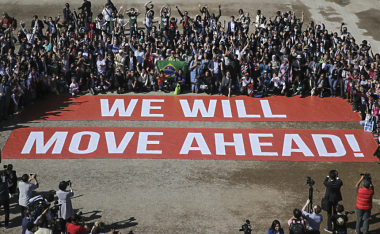 Participants at the COP22 climate conference
(David Keyton / AP)
Science and Technology:
¶ Pioneering techniques that use satellites to monitor ocean acidification are set to revolutionize ocean study. This new approach, published in the journal Environmental Science and Technology, offer a way to monitor of large swathes of inaccessible ocean from satellites that orbit the Earth some 700 km above our heads. [Satellite PR News]
World:
¶ Fruit producer Del Monte Philippines Inc is now able to save 25% of its annual power costs, thanks to a waste-to-energy project developed by…
View original post 751 more words
The case for space – Part 3: Martian delusions

 Figure 1: Mars One, serious vision or fantasy….or scam? [Source: Mars One, 2014]
I previously discussed the idea of colonising space as a possible solution to climate change and a future resource crunch. I think the conclusion would be that its not really a feasible solution. Yes, I have no doubt space exploration (as opposed to colonisation) will continue and I would argue that any money spent on space science is money well spent. But migrating large numbers of people off the planet, or start to mine other worlds for their resources just isn’t an economically feasible or practical proposal. It is therefore worthwhile looking at some of the proposals for colonisation doing the rounds on the internet, most notably Mars One, as well the proposed missions from the Mars Society and Elon Musk.
Mars One
The central theme of Mars One is “Mars to stay”. They propose…
View original post 3,474 more words
Gov Nikki Haley Vision of Color Excludes Black People: Gives Minority Status to Family Friend from India (Holtec); Excessive Black Unemployment in South Carolina and More


South Carolina Governor Nikki Haley whose family is from India would count as a two for one “minority” in Trump’s administration, even though Asians are an est. 37% of world population (India is now considered Asia for those who missed that). Proposed as Secretary of State for which she is unqualified, she would bring close ties to the India-American nuclear industry-lobby and the ability to promote it, like India-American nuclear lobbyist Richard Verma who became Ambassador to India under Obama. Although an advocate of the nuclear industry, she is suing the US government to take radioactive waste away from South Carolina. A US State Governor who is suing the US government promoted to US Secretary of State appears unseemly.
The disparity between black and overall unemployment in Governor Nikki Haley’s South Carolina is greater than Sen. Jeff Session’s state of Alabama; and far greater than Mississippi. So, she has no…
View original post 1,761 more words
Nuclear is No Solution to Climate Change
The Fairewinds Crew created this special 2-minute animation to show you why building new nukes is a lost opportunity for humankind with precious time and money wasted on the wrong choice. At least $8.2 Trillion would be needed to build the 1,000 atomic reactors the nuclear industry wants – that’s 1 reactor every 12-days for 35-years. Watch the animation to see what it means and why!
If you want more information, we have issued a paper, and presented this topic at several major universities and forums , and wanted to make it more accessible to people throughout the world. Truthout published Arnie Gundersen’s summation of this project in a news analysis entitled: Nuclear Power Is Not “Green Energy”: It Is a Fount of Atomic Waste.
http://www.fairewinds.org/nuclear-energy-education//smokescreen
Fuel Removal from Fukushima Reactor 3 Likely to Be Put Off Again
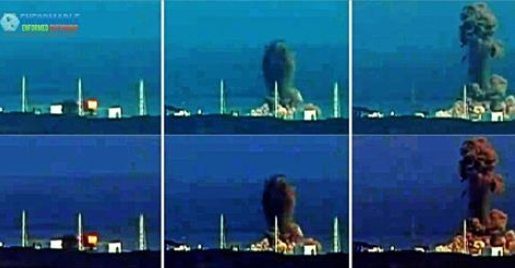
Tokyo, Nov. 18 (Jiji Press)–Tokyo Electric Power Co. Holdings Inc. <9501> is expected to face a further delay in the start of work to remove fuel from the storage pool at the No. 3 reactor of its disaster-stricken Fukushima No. 1 nuclear power station, it was learned Friday.
It now appears difficult to begin the work in January 2018, as currently targeted by the company, the sources said. The expected postponement is due to a delay in preparations necessary for the removal work.
All six reactors at the power station in Fukushima Prefecture, northeastern Japan, are set to be decommissioned, after the plant was knocked out by the March 2011 earthquake and tsunami. Three of the six reactors suffered core meltdowns in the accident.
The fuel removal from the No. 3 reactor pool was initially planned to begin during April-September 2015.
The No. 3 reactor building was heavily damaged by a hydrogen explosion soon after the March 11 disaster. As part of the preparations, TEPCO plans to install a cover and relevant equipment at the reactor.
http://jen.jiji.com/jc/eng?g=eco&k=2016111800715
Taiwan Continued Protest Against Food Imports from Japan
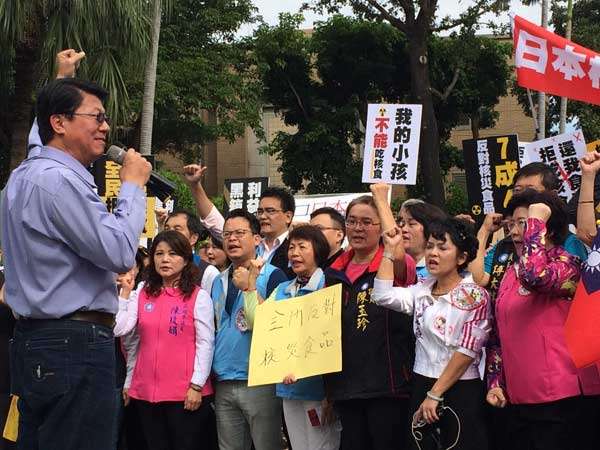
Hundreds protest Fukushima imports
TAIPEI, Taiwan — Hundreds on Thursday called for the president and premier to resign, accusing the ruling party of “selling out Taiwan” and “poisoning our children” in its push to ease a ban on food imports from Japan’s radiation-affected regions.
Protesters organized by the Kuomintang (KMT) demonstrated in front of the Executive Yuan early Thursday, as party councilors from across the country took turns addressing the crowd.
“We are humans, and humans don’t eat radiation-contaminated food,” the crowd chanted with Tainan City Councilor Hsieh Lung-chieh (謝龍介), who accused that Democratic Progressive Party (DPP) of betraying its promise to safeguard Taiwan’s food safety.
“We all remember clearly which party strongly protested against nuclear power in the past, but who’s about to feed poisonous food to our children now!” Hsieh said.
Taipei City Councilor Wang Hsin-yi (王欣儀) said the protest was not about political issues but was instead “a matter of life and death.”
Taipei City Councilor Ying Hsiao-wei (應曉薇) introduced a 3-year-old girl carried by an elderly woman, and urged the crowd to “fight the government to defend public health.”
Clash with Police
Hsieh asked police officers to “give way” to protesters so they could enter the Executive Yuan and submit their petition to the premier.
When the police stood their ground, demonstrators attempted to storm the grounds.
The clash ended after Hsu Fu (許輔), director of the Cabinet’s food safety office, stepped outside the Executive Yuan to receive the protesters’ petition and then invited KMT Legislator Alicia Wang (王育敏) and Chen Yi-ming (陳宜民) into the building for talks.
‘No contaminated food’
“No radiation-contaminated food products will be allowed into the nation,” according to a Cabinet press statement released Friday afternoon.
The Cabinet stated that it would take protesters’ concerns into account and reinstate its “four-noes policy” on Japanese food imports.
It said all products from the Fukushima Prefecture would continue to be prohibited from entering Taiwan’s borders.
Food products from Gunma, Ibaraki, Tochigi, and Chiba — four of the five prefectures affected by the 2011 Fukushima nuclear disaster — that are at high risk of absorbing radiation would also remain banned.
Those with a lower risk of radiation contamination would also stay banned if they did not have a certificate confirming state of origin and radiation levels.
Food products still banned by the U.S. and the Japanese government would also remain banned from Taiwan.
An earthquake and tsunami had triggered meltdowns of nuclear power plants in Fukushima Prefecture in 2011.
Dozens of countries worldwide imposed sanctions or tightened restrictions on food imports produced in the regions around Fukushima Prefecture.
Starting 2015, the European Union and the U.S. gradually lifted the bans as Tokyo continued to urge the move on grounds of fair international trade.
http://www.chinapost.com.tw/taiwan/national/national-news/2016/11/19/484392/Hundreds-protest.htm
Government communication on Japanese food is a failure: Luis Ko
The issue of allowing the import of food products from parts of Japan affected by the 2011 Fukushima nuclear disaster has triggered a spate of conflicts and quarrels in Taiwan. Apart from opposition parties and social groups including physicians, even Democratic Progressive Party city mayors and county magistrates have been sending out mixed signals. The uproar has even made the model student in the matter of food safety, I-Mei Foods Co. CEO Luis Ko, shake his head. On November 19, he wrote on his Facebook page that the government should plan first and move later, and not create needless public dissatisfaction and unease.
Because several countries recently gradually lifted import restrictions on products from the disaster-stricken areas, Taiwan could soon follow suit and allow the import of some products from Fukushima prefecture and from four other prefectures (Gunma, Ibaraki, Tochigi and Chiba). The government organized public hearings on the matter which were criticized as haphazard. Earlier this week, 15 county and city chiefs from ruling and opposition parties voiced their opposition and said they did not agree with the import of the food. However, after the Presidential Office and the Executive Yuan contacted the 13 DPP mayors and magistrates, they altered their stance and said they agreed with the central government, saying that what they opposed was food imported from Fukushima prefecture.
On November 19, I-Mei Foods CEO Luis Ko wrote on his Facebook page that he felt surprise and concern at the government’s current handling of its food safety policy. He wondered why the government departments and officials in charge of agricultural produce and foodstuffs were the ones to stand at the forefront of the discussions with the public, and why the officials at the Ministry of Health and Welfare and at the Food and Drug Administration, who have usually made brave statements about food safety issues, only played a “supporting role.” He said the government had failed in its internal communication and integration. “Major problems have arisen with the functioning of the government team!”
Luis Ko also says the fact that the new government has failed to successfully execute several policies over the past six months as a result of insufficient internal “communication and integration” and of being unable to “plan first and move later.” He concluded by calling on the president and the premier to bear in mind the profound hopes of the people and to show the ability to reflect.
13 Fukushima High School Students Visited Fukushima Daiichi
Propaganda to downplay the chaos & the effects of the disaster goes on at full throttle. Is it happening because Japanese are so recklessly brave and immune to radiation? Are school teachers and TEPCO officials sane enough? How could a university professor take them around at the damaged NPP without be concerned about the effect of radiation on young people?
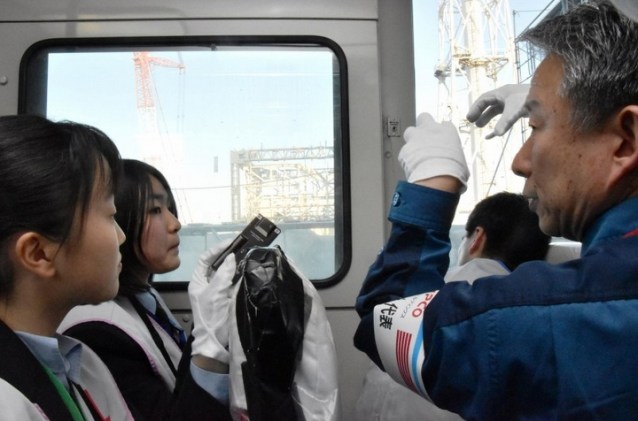
Fukushima students see crippled nuclear plant firsthand
OKUMA, Fukushima Prefecture–It was no ordinary outing for the 13 students from Fukushima High School.
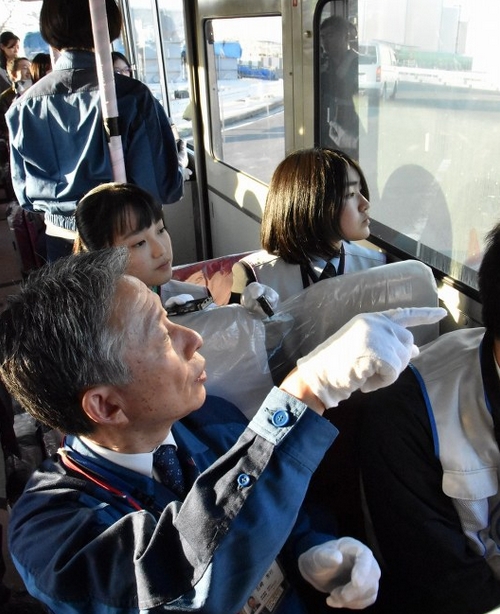
The teenagers toured the site of the crippled Fukushima No. 1 nuclear power plant by bus on Nov. 18 to get a firsthand look at work to decommission the reactors following the triple meltdown in 2011.
It was the first tour by youngsters since the disaster as plant operator Tokyo Electric Power Co. had deemed the radiation risk was too high.
Through bus windows, the students observed the damaged reactor buildings, rows of storage tanks holding contaminated water and other facilities on the sprawling nuclear complex.
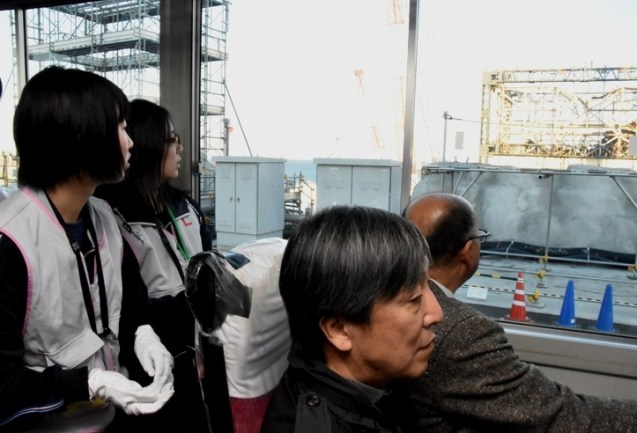
“The tour made me realize that we should arm ourselves with accurate information if we want to change people’s perceptions of Fukushima as a scary place,” said Keika Kobiyama, a first-year student in the group. “For starters, I want to tell my fellow high school students ‘We went to the plant to see for ourselves what was going on there.’”
TEPCO had previously refused to allow tours by those under the age of 18.
But the company gave the green light to this request as an exception on grounds that radiation levels had dropped significantly.
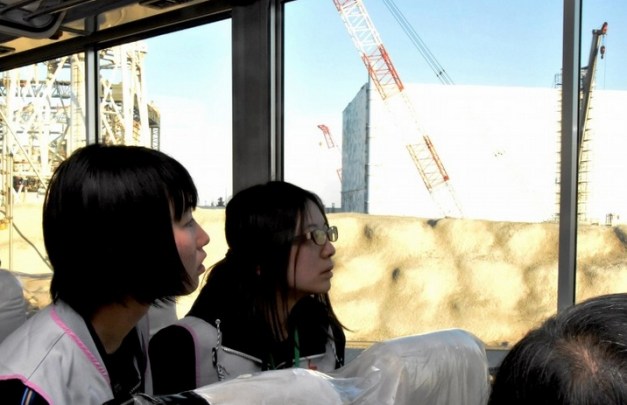
The students were each given a dosimeter as they boarded the bus for the two-hour tour. The trip was held after their parents agreed to the visit.
The students themselves had been releasing updates on the disaster for Japanese and foreign audiences by monitoring radiation levels in the prefecture and studying the decommissioning process.
World Baseball Chief Plays Down Fukushima Olympic Fears
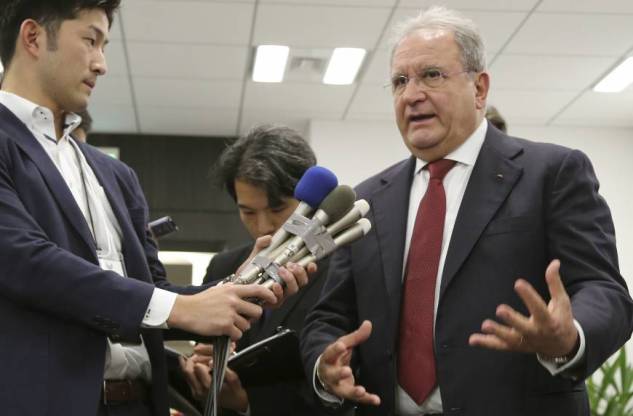
The president of the World Baseball Softball Confederation Ricardo Fraccari at press conference in Tokyo on Friday.
World baseball chief plays down Fukushima Olympic fears
The president of world baseball’s governing body on Friday played down fears that the sport’s top stars will refuse to play in Fukushima if the nuclear disaster-hit prefecture hosts games at the 2020 Olympics.
Olympic chiefs are currently considering a proposal to play part of the Tokyo 2020 baseball and softball competition in Fukushima Prefecture, which in 2011 suffered the world’s worst nuclear accident in 25 years when the Great East Japan Earthquake triggered a meltdown at the Fukushima No. 1 nuclear power plant.
The prefecture successfully hosted games at the Under-15 Baseball World Cup in the city of Iwaki this summer, and World Baseball Softball Confederation President Riccardo Fraccari believes senior teams will not be deterred from playing there in 2020 should its bid to host games be accepted.
“This can be an issue, but from the data I received, the situation at this moment is not dangerous in Fukushima,” said Fraccari, who held talks with Tokyo 2020 organizers in Tokyo on Friday and will visit the prefecture on Saturday to inspect potential venues.
“Even at the last Under-15 World Cup, only one country refused to come. But the rest were there. In three years — just now the situation is good, so I think from this point there won’t be any problem for countries to come to Fukushima.”
Fraccari must give his consent to the prefecture’s bid before it can be put before the International Olympic Committee, which will make a final decision when it holds its executive board meeting from Dec. 6 to 8.
Three venues in the prefecture are under consideration — Iwaki Green Stadium in Iwaki, Azuma Baseball Stadium of the city of Fukushima and Koriyama Kaiseizan Baseball Stadium in Koriyama.
“From the perspective of the WBSC, I know the importance of baseball and softball in Japan, and I know how we can facilitate the recovery from the disaster,” said Italian Fraccari. “If the field in Fukushima has all the requirements, we can take it into consideration and analyze internally the possibility.
“But I repeat, we have to check many things because we have to see how it’s possible to include it in the schedule, the distance, the fields. There are many issues and we won’t take any decision yet.”
Baseball and softball were voted onto the 2020 program as a joint bid after an absence of 12 years at an IOC session in Rio de Janeiro in August ahead of the Summer Games. The format of the competitions has yet to be decided.
Nippon Professional Baseball has agreed to suspend play for the duration of the July 24 to Aug. 9 Tokyo Olympics, but Major League Baseball has yet to say whether it will cooperate.
“There is, even from the major leagues, a desire to be more international,” said Fraccari. “Now we are discussing, but before we discuss we need to have the details of the tournament, the details of the schedule. I think that we can find a solution to have the best games possible.”
Fraccari also played down suggestions that pressure to agree to Fukushima’s proposal, which was floated by IOC President Thomas Bach during a visit to Tokyo last month, will affect his decision.
“I used to be an umpire, so I know what it means to be under pressure,” he said.
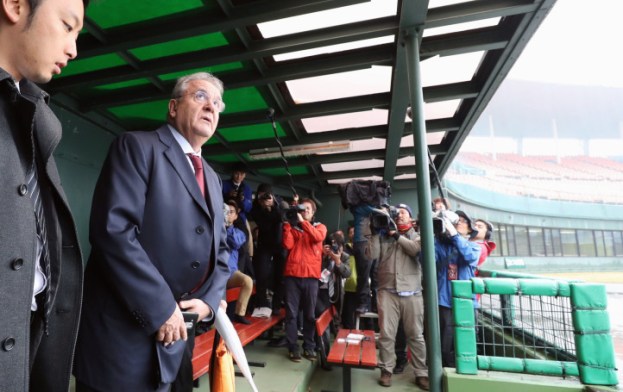
Olympics: No decision yet as world baseball-softball chief inspects Fukushima
World Baseball Softball Confederation President Riccardo Fraccari stopped short of issuing a verdict after inspecting Fukushima Prefecture as a potential host site of the 2020 Olympic baseball and softball competitions Saturday.
Fraccari scouted Azuma Stadium in Fukushima City and Koriyama’s Kaiseizan Stadium but insisted the purpose of his visit this time was to gather intelligence and not to reach a decision of any kind. The third city being considered is Iwaki, whose Green Stadium Fraccari has already visited.
“At the moment, I’m just collecting information of the stadiums,” said Fraccari, who met Fukushima Gov. Masao Uchibori ahead of his stadium tours.
“The problem for Fukushima is not just the stadium. We have to check about the transportation, the facility for the teams and the schedule.”
The 2020 organizing committee is looking to open the baseball and softball tournaments in the prefecture, with Japan set to play in the first game of both competitions.
Fraccari did not mention a deadline on when the competition format and the overall schedule would be made, but did say all the stakeholders would have to work fast, with the organizing committee aiming to finalize details at the Dec. 6-8 executive board meeting of the International Olympic Committee.
“Yesterday, it was a good meeting with Tokyo 2020,” he said. “We work very close with them, we cooperate a lot because both of us have the best interests in the Games in 2020.”
“We have to work very fast because we don’t have too much time. We don’t yet have a fixed deadline, for sure but we have to work very, very soon towards the entire Games (plan).”
Uchibori reiterated Fukushima’s willingness to stage the two sports.
“We want to express our strong desire to organize the events in Fukushima Prefecture,” Uchibori said to Fraccari in his native Italian.
“It will help unite the people of Fukushima, and help unite the prefecture and the world. They’re fantastic sports.”
Uchibori reassured Fraccari that the radiation levels in Fukushima, which was devastated by the March 2011 earthquake and the nuclear power plant crisis that followed, are no different to that of major cities around the world.
“In almost all areas in the prefecture, the figures are the same as any of the world’s major cities,” Uchibori said.
School failed to act on extortion of Fukushima evacuee bullied at school
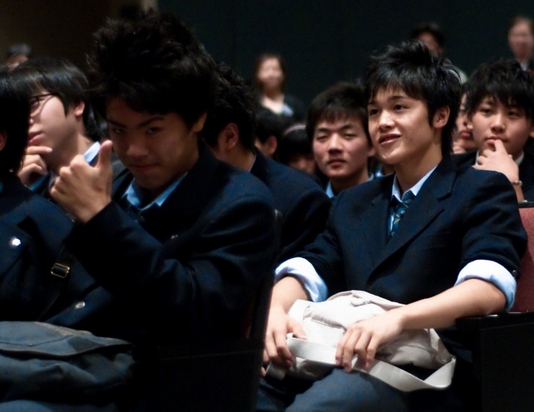
YOKOHAMA — Education authorities failed to react to financial and emotional damage incurred by a boy who was bullied at his school here after evacuating from the Fukushima nuclear disaster, it has been learned.
The boy, who is now 13, was bullied at an elementary school in Yokohama after he transferred there from Fukushima Prefecture. Although the school and the Yokohama Municipal Board of Education were aware that the boy was forced to pay about 1.5 million yen to his classmates, they failed to respond proactively to the case. His parents had conveyed the amount to the school and education board after being informed of it by Kanagawa Prefectural Police.
According to attorneys for the student and other sources, the parents consulted with prefectural police in July 2014 about their son’s classmates demanding money from him. After checking the footage of security cameras at a video arcade, prefectural police found that at least one of the bullies had squandered hundreds of thousands of yen of boy’s money each time.
The money that the victim was forced to pay was spent on travel, dining and entertainment. The student was initially demanded to pay around 50,000 yen at a time, but the sum eventually snowballed.
The bully extorted the victim, saying, “You’ve got compensation money (for the nuclear disaster), don’t you?” The victim could not confide the incidents to his parents and secretly paid the bullies using his family’s money budgeted for living expenses.
The victim stopped attending school for a second time in June 2014, and his parents reported the prefectural police’s investigation results to his school and the city education board. However, the school didn’t deem the case a “serious situation” under the law to promote measure to prevent bullying, and shelved it.
At a Nov. 15 press conference, the city education board admitted that there was money trouble between the students. Superintendent of schools Yuko Okada said, “We should have recognized the case as serious as more than one month had passed since the student stopped attending school and the money and goods issues surfaced.”
A third-party panel to the city education board criticized the school and the education board, saying, “There are no traces of their having given sufficient instructions to the parties who ‘paid’ and ‘were paid for,’ though (the education authorities) were aware of the exchange of monies in the tens of thousands of yen.”
http://mainichi.jp/english/articles/20161118/p2a/00m/0na/018000c
1 This Month

of the week – Shut Down Drone Warfare!


Tell the Ukrainian Government to Drop Prosecution of Peace Activist Yurii Sheliazhenko

Petition to revoke the licensing of the Near Surface Nuclear Disposal Facility (NSDF) at Chalk River. https://www.ourcommons.ca/petitions/en/Petition/Details?Petition=e-7247
To see nuclear-related stories in greater depth and intensity – go to https://nuclearinformation.wordpress.com
-
Archives
- April 2026 (114)
- March 2026 (251)
- February 2026 (268)
- January 2026 (308)
- December 2025 (358)
- November 2025 (359)
- October 2025 (376)
- September 2025 (257)
- August 2025 (319)
- July 2025 (230)
- June 2025 (348)
- May 2025 (261)
-
Categories
- 1
- 1 NUCLEAR ISSUES
- business and costs
- climate change
- culture and arts
- ENERGY
- environment
- health
- history
- indigenous issues
- Legal
- marketing of nuclear
- media
- opposition to nuclear
- PERSONAL STORIES
- politics
- politics international
- Religion and ethics
- safety
- secrets,lies and civil liberties
- spinbuster
- technology
- Uranium
- wastes
- weapons and war
- Women
- 2 WORLD
- ACTION
- AFRICA
- Atrocities
- AUSTRALIA
- Christina's notes
- Christina's themes
- culture and arts
- Events
- Fuk 2022
- Fuk 2023
- Fukushima 2017
- Fukushima 2018
- fukushima 2019
- Fukushima 2020
- Fukushima 2021
- general
- global warming
- Humour (God we need it)
- Nuclear
- RARE EARTHS
- Reference
- resources – print
- Resources -audiovicual
- Weekly Newsletter
- World
- World Nuclear
- YouTube
-
RSS
Entries RSS
Comments RSS
 nuclear-news