Lessons for South Africa, in Vietnam pulling the plug on nuclear power plans
SA – listen to your scientists on new nuclear energy deals Biz News, David Fig, 25 Nov 16 According to David Fig, an honorary research associate at the University of Cape Town, nuclear energy is unnecessary for South Africa’s progress as a developing nation. It swallows up too many resources in return for too little electricity, the waste is a nightmare and the alternatives are cheaper, cleaner and ultimately, more cost-effective.
He draws on the recent journey of Vietnam to illustrate how that thriving nation has stepped away from the nuclear abyss in the current economic climate, improving its long-term prospects. The territory he doesn’t really explore is our domestic political culture and climate, which previous contributors to Biznews have argued is the real reason behind what amounts to a simmering long-term intention to go big on nuclear.
That is; there are potential and (perhaps even current) crooked financial incentives for our politicians to want to pull the Russian nuclear deal off ice. And these have nothing to do with ignoring the scientific advice on the matter – it doesn’t even come into play. How can we not think otherwise in the aftermath of the useless and hugely costly Arms Deal, with all its attendant dirty dealings? – Chris Bateman……..
Vietnam is only the latest in a long list of countries, including more recently Chile and Indonesia, that have postponed indefinitely or abandoned entirely their plans for nuclear new-build.
Vietnam’s decision is for outright cancellation of a contract for two reactors which were to be part of a sequence of purchases. But South Africa is not being as decisive. Yet South Africa is realising that it must at least postpone its nuclear plans. In its latest Integrated Resources Plan 2016, one option is to delay completion of the first reactor until 2037.
A postponement would mean that South Africa wouldn’t need to start building new nuclear plants until the mid-2020s. The country’s energy provider Eskom, however, is still bent on initiating the procurement process very soon………
Lessons for South Africa
Nuclear energy is unnecessary for the country’s progress as a developing nation. It swallows up too many resources for too little electricity in return. The nuclear fuel and the waste have to be safeguarded for many millennia, and the reactors have to be operated safely. Accidents contaminate huge areas and affect millions of people.
There are a number of safer and cleaner renewable alternatives, especially solar and wind. If Vietnam is brave and shrewd enough to step away from the nuclear abyss, so can South Africa. Instead of postponement of nuclear procurement, South Africa should reject this technology outright.
The country’s Integrated Resources Plan decides on the ratio of different power sources in the total energy mix. South Africa needs to listen more clearly to its scientists. And it could learn some useful lessons from Vietnam’s approach. https://www.biznews.com/energy/2016/11/25/sa-scientists-nuclear-energy/
South East Asian countries shifting focus to renewable energy and away from nuclear power
ASEAN’s Nuclear Power Race: Winding Down For Renewable Energy? – Analysis As the world’s fastest-growing economic region, Southeast Asia’s energy demand will increase to drive this growth. While Vietnam’s push towards nuclear energy may have started a regional race to develop nuclear power, this may slow down somewhat now that Hanoi has decided to freeze it. ASEAN should shift its focus to developing renewable energy.
By Cung Vu* On November 22, 2016, the National Assembly of Vietnam ratified their government’s decision to hold off the building of its nuclear reactor. Cost was cited as the main reason. Another possible factor could be the unfolding lessons from the event of Fukushima, and the safety and security of nuclear reactors in cases of intentional attacks such as cyberattacks or terrorism still need to be assessed.
This is good news for the region. A possible regional nuclear energy race would now be avoided, and Vietnam’s neighbours would not have to brace themselves for a potential nuclear fallout. The region should now focus on developing renewable energy to meet its energy demand…….
ASEAN Power Grid
To meet electricity demand to stimulate economic growth, ASEAN needs to have a reliable and cheap source of electricity. ASEAN plans to construct a bilateral cross-border power grid, then expand to a sub-regional and finally to a total integrated regional system. This would serve to meet the electricity demand as well as to provide access to some of the 50% of the population which currently has no electricity……http://www.eurasiareview.com/25112016-aseans-nuclear-power-race-winding-down-for-renewable-energy-analysis/
Fukushima Evacuees Still Unable to Go Home Over 5 Years after Earthquake, Nuclear Accident
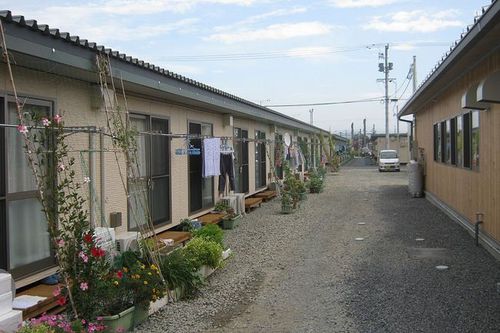
Over five-and-a-half years have passed since the Great East Japan Earthquake in March 2011 and the subsequent nuclear accident at Tokyo Electric Power Co.’s (TEPCO) Fukushima Daiichi nuclear power plant. Since then, big disasters have occurred in several other areas around the world, and in Japan the 2016 Kumamoto earthquakes also caused great damage. So, the term “disaster area” does not always evoke specific images of Tohoku or Fukushima for many of us in Japan today. However, a large number of disaster victims continues to suffer from the disaster in Tohoku, especially by the nuclear accident in Fukushima. The hard times for disaster victims haven’t ended yet. We report here on the latest situation in the Tohoku and Fukushima districts so as not to forget their ongoing suffering.
The losses from the Great East Japan Earthquake as of March 10, 2016, were officially reported as follows: 18,455 people dead or still missing (not including deaths related to injuries after the earthquake); 400,326 houses or buildings either completely destroyed or half destroyed. By prefecture in the most seriously affected areas in the Tohoku region, the death tolls are 4,673, 9,541, and 1,613, in Iwate, Miyagi, and Fukushima, respectively.
The estimated number of evacuees was approximately 470,000 at the peak, but 144,471 people were still living as refugees as of February 12, 2016.
Looking at the data of estimated populations of communities in the disaster-hit areas, comparing the population as of March 1, 2011 (before the disaster) and the most recent population, we see that the severely affected communities in Iwate and Miyagi have lost about one third of their populations. In Fukushima, several communities show “minus 100%” as the change of their population. Those ones are communities in the areas affected by the nuclear accident at TEPCO’s Fukushima Daiichi nuclear plant, where the evacuation order has not yet been lifted even today.
On a chart showing the timeline of evacuation orders issued right after the disaster, we see that areas ordered to evacuate were rapidly increasing one by one, while in the middle of all this, another explosion occurred at the reactor No.3. The timeline shows how the evacuation-ordered areas expanded.
Later, the government designated three evacuation zones based on international basic safety standards on radiation exposure. We can see on a map two significant evacuation zones: the Evacuation Order Zone (Warning Zone) — within a 20-kilometer radius from Fukushima Daiichi — and the Emergency Evacuation Preparation Zone — within a 20-30 kilometer radius. And we also see one more evacuation zone on the map, the Planned Evacuation Zone — a large zone including part of the 20-30-kilometer radius zone and extending to areas outside of a 30-kilometer radius, which is the area into which the wind was blowing when the plant exploded — meaning large amounts of radioactive materials were carried into the area by wind.
At the same time, Emergency Evacuation Preparation Zones were also designated where the cumulative dose during the year after the nuclear accident was predicted to exceed 20 millisieverts (mSv) depending on wind direction and geography. The zones were also called “hot spots,” and an evacuation advisory was issued to their residents.
Later on, the categories of evacuation zones were revised as follows:
- Zones where evacuation orders were ready to be lifted (where it was confirmed that the annual cumulative dose of radiation will definitely be 20 mSv or less). People could go home temporarily (staying overnight prohibited) to prepare to return completely, and resume some operations such as hospitals, welfare facilities, shops, and farming.
- Zones in which the residents were not permitted to live (where the annual cumulative dose of radiation was expected to be 20 mSv or more and where residents were ordered to remain evacuated in order to reduce the risk of radiation exposure). People could temporarily return home and pass through the areas along main roads to repair infrastructure.
- Zones where it was expected that the residents would have difficulties in returning for a long time (where the annual cumulative dose of radiation was expected not to be less than 20 mSv in five years and the current cumulative dose of radiation per year was 50 mSv or more). People were legally required to evacuate from the area.
As seen in the zone map showing evacuation orders, many areas are still designated today as “difficult-to-return” zones.
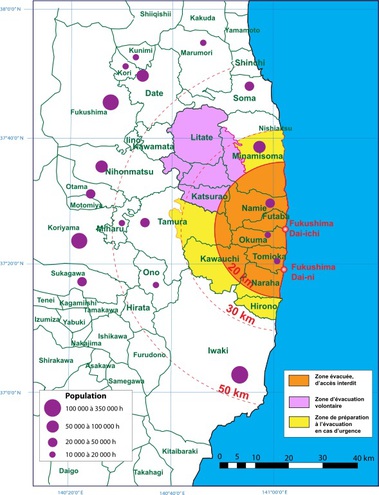
Let’s look specifically at the status of Fukushima Prefecture. Before May 2012, the total number of evacuees was 164,655. As of March 2013, the number from zones with evacuation orders and other areas was about 109,000. Looking at the updates in July 2016, 89,319 people in Fukushima are still living as evacuees . Also, Tomioka, Futaba, and some other Fukushima towns and local governments located in evacuation zones have moved their administrative functions both inside and outside of the prefecture.
Besides the number of deaths related directly to disaster-caused injuries in Fukushima Prefecture, the number of disaster-related deaths is still increasing, due to mental shock and physical conditions at shelters, such as poor hygiene and cold. Japan’s Reconstruction Agency recognized 459 people in Iwate Prefecture, 920 in Miyagi, and 2,038 in Fukushima as qualifying for payment of condolence money for disaster-related deaths. These numbers surpass the deaths directly caused by the earthquakes and tsunami.
The Tokyo Shimbun, a regional newspaper covering eastern Japan, gathered statistics on the deaths tied to the nuclear accident by asking municipalities in Fukushima to read through application forms for condolence money to find out the number of people that died from worsened physical conditions due to the stress of evacuation from the nuclear accident. The company wrote in its newspaper on March 6, 2016, “We interviewed municipal governments in Fukushima Prefecture and found that at least 1,368 people had died in connection with the nuclear accident, just from the numbers that could be confirmed.” The disaster-related death toll confirmed by each municipal government amounted to 2,028 as of March 4, 2016. It states that 67% of the disaster-related deaths are considered to be nuclear-related deaths.
According to statistics gathered by the Cabinet Office on the number of annual suicides related to the Great East Japan Earthquake and Fukushima nuclear plant accident, the number in Miyagi and Iwate prefectures is approaching zero, while it is still increasing in Fukushima.
Victims of nuclear accident face multiple difficulties, as shown below.
- Loss of daily living
- Loss of ways to earn a living
- Loss of community
- Forced to make own decisions whether to evacuate or not, and personally accept all risks that entail (people whose homes are outside of designated mandatory evacuation zones)
- Divorce, family breakdown, and separation of generations due to differences of opinion among family members
- A second mortgage to pay at the place of temporary evacuation
- Discrimination or bullying at place of temporary evacuation
- Not knowing when they can return home
- Uncertain about safety of returning home even after evacuation order is lifted
- Unable to rebuild community because many people have rebuilt their own lives (employment, human relations) at their place of temporary evacuation, and leaving mainly the elderly to return home.
Before the disaster, the nuclear power plants in Fukushima were generating power to send the electricity mainly to the Tokyo metropolitan area, not for local use. The nuclear accident forced people to leave their hometowns, and they are still not allowed to return to some areas. Even if the evacuation directive is lifted, evacuees will be unable to escape their anxieties about whether or not their homes are safe, and this situation continues to bring sorrow and hardship to the evacuees.
Even in this situation, Japan continues to approve the restart of nuclear power plants, some with operating permits for more than 40 years, despite the fact that the ruined plants have not yet been cleaned up, compensation for the accident is still not complete, and many people are still forced to live away from their hometowns. Each of us needs to think about the seriousness of nuclear accidents and the responsibilities that come with using nuclear power.
http://www.japanfs.org/sp/en/news/archives/news_id035681.html
1 This Month

of the week – Shut Down Drone Warfare!


Tell the Ukrainian Government to Drop Prosecution of Peace Activist Yurii Sheliazhenko

Petition to revoke the licensing of the Near Surface Nuclear Disposal Facility (NSDF) at Chalk River. https://www.ourcommons.ca/petitions/en/Petition/Details?Petition=e-7247
To see nuclear-related stories in greater depth and intensity – go to https://nuclearinformation.wordpress.com
-
Archives
- April 2026 (57)
- March 2026 (251)
- February 2026 (268)
- January 2026 (308)
- December 2025 (358)
- November 2025 (359)
- October 2025 (376)
- September 2025 (257)
- August 2025 (319)
- July 2025 (230)
- June 2025 (348)
- May 2025 (261)
-
Categories
- 1
- 1 NUCLEAR ISSUES
- business and costs
- climate change
- culture and arts
- ENERGY
- environment
- health
- history
- indigenous issues
- Legal
- marketing of nuclear
- media
- opposition to nuclear
- PERSONAL STORIES
- politics
- politics international
- Religion and ethics
- safety
- secrets,lies and civil liberties
- spinbuster
- technology
- Uranium
- wastes
- weapons and war
- Women
- 2 WORLD
- ACTION
- AFRICA
- Atrocities
- AUSTRALIA
- Christina's notes
- Christina's themes
- culture and arts
- Events
- Fuk 2022
- Fuk 2023
- Fukushima 2017
- Fukushima 2018
- fukushima 2019
- Fukushima 2020
- Fukushima 2021
- general
- global warming
- Humour (God we need it)
- Nuclear
- RARE EARTHS
- Reference
- resources – print
- Resources -audiovicual
- Weekly Newsletter
- World
- World Nuclear
- YouTube
-
RSS
Entries RSS
Comments RSS
 nuclear-news