Probe of Fukushima Daini’s N°3 Reactor Cooling System Knocked Offline After Earthquake
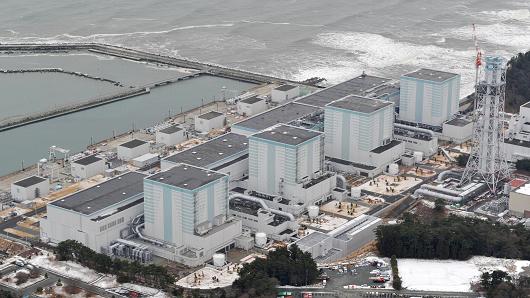
Fukushima Daini
Japan Probes Nuclear Cooling System Shutdown After Earthquake
Japan is investigating why a cooling system used to store nuclear fuel rods was temporarily knocked offline at Tokyo Electric Power Co. Holdings Inc.’s shuttered Fukushima Dai-Ni atomic plant after a 7.4 magnitude earthquake struck the same region devastated by a tsunami in March 2011.
The temblor early Tuesday caused water in the pool at the plant northeast of Tokyo to move, according to the utility known as Tepco. Sensors registered the motion as a decline in water levels, triggering an automatic shutdown, the utility said.
One of at least two cooling pumps supplying water to the spent fuel pool at Dai-Ni’s No. 3 reactor was shut around 6:10 a.m. Tokyo time, according to Tepco. The utility started another pump to resume cooling the fuel rods around 7:47 a.m., it said in an e-mailed statement.
More than five years after the Fukushima earthquake and tsunami that wrecked the utility’s Dai-Ichi nuclear plant and resulted in the shutdown of Japan’s atomic fleet for safety checks, just two of the country’s 42 reactors are back in operation. Returning the plants to service is a goal of Prime Minister Shinzo Abe’s government and is critical to Japan’s aim for nuclear to account for as much as 22 percent of its energy mix by 2030.
“The fact that today’s earthquake caused the pumps at the Fukushima nuclear plant to shut down temporarily will certainly not help the government in its goal to restart the reactors,” Daniel Aldrich, a professor and director of the Security and Resilience Studies Program at Northeastern University in Boston, said by e-mail. “Perhaps one interesting change has been Tepco’s transparency about the ongoing problems at the site, including those that occurred during today’s earthquake.”
Government Response
Fifty-seven percent of the Japanese public oppose resuming operations of the country’s nuclear reactors, while 29 percent approve, according to an Asahi newspaper poll conducted in October.
Japan’s government quickly moved to allay any concerns following Tuesday’s earthquake, which was an aftershock of the magnitude 9 quake five years ago.
Safety is the top priority of Japan’s nuclear industry and the country has the world’s strictest rules for atomic plants, Japanese Chief Cabinet Secretary Yoshihide Suga told reporters in Tokyo Tuesday.
The stoppage of the system wouldn’t immediately have led to a release of radiation, Suga said. Earthquakes and tsunamis are among possibilities envisaged under new safety standards for nuclear plants issued by Japan’s Nuclear Regulation Authority since the 2011 disaster, he said.
Power would need to be cut for about a week before temperatures in the spent-fuel cooling system would reach the upper safety limit, according to Yutaka Ikoma, a spokesman at the regulator. Temperatures would rise about 0.2 degrees Celsius per hour without the cooling system, reaching 65 degrees Celsius in about seven days, according to the spokesman.
No comments yet.
1 This Month

Petition to revoke the licensing of the Near Surface Nuclear Disposal Facility (NSDF) at Chalk River. https://www.ourcommons.ca/petitions/en/Petition/Details?Petition=e-7247

18 March Webinar @ 1 PM EST: An Assessment of SMR Projects: The Case of Canada
register for the zoom:
https://us02web.zoom.us/webinar/register/WN_o8BIIOUvQ2ONJR1nta65DQ#/registration


of the week – STOP SMALL MODULAR REACTORS IN CANADA
To see nuclear-related stories in greater depth and intensity – go to https://nuclearinformation.wordpress.com
-
Archives
- March 2026 (152)
- February 2026 (268)
- January 2026 (308)
- December 2025 (358)
- November 2025 (359)
- October 2025 (376)
- September 2025 (258)
- August 2025 (319)
- July 2025 (230)
- June 2025 (348)
- May 2025 (261)
- April 2025 (305)
-
Categories
- 1
- 1 NUCLEAR ISSUES
- business and costs
- climate change
- culture and arts
- ENERGY
- environment
- health
- history
- indigenous issues
- Legal
- marketing of nuclear
- media
- opposition to nuclear
- PERSONAL STORIES
- politics
- politics international
- Religion and ethics
- safety
- secrets,lies and civil liberties
- spinbuster
- technology
- Uranium
- wastes
- weapons and war
- Women
- 2 WORLD
- ACTION
- AFRICA
- Atrocities
- AUSTRALIA
- Christina's notes
- Christina's themes
- culture and arts
- Events
- Fuk 2022
- Fuk 2023
- Fukushima 2017
- Fukushima 2018
- fukushima 2019
- Fukushima 2020
- Fukushima 2021
- general
- global warming
- Humour (God we need it)
- Nuclear
- RARE EARTHS
- Reference
- resources – print
- Resources -audiovicual
- Weekly Newsletter
- World
- World Nuclear
- YouTube
-
RSS
Entries RSS
Comments RSS
 nuclear-news
Leave a comment