Fukushima Facility to Become Soccer Training Camp for 2020 Olympics
Tepco to end operations at the J-Village complex by March
Facility to be used as training camp for 2020 Tokyo Olympics
The base for the cleanup of the Fukushima nuclear plant will be returned by March to its original use: the training camp for the Japanese national soccer team.
In a symbolic step in the struggle to contain one of the worst nuclear disasters, Tokyo Electric Power Co. Holdings Inc. will return the J-Village facility — about 20 kilometers (12 miles) from the crippled Dai-Ichi plant and just 7 kilometers from the current exclusion zone — to the prefectural government during the current fiscal year, company spokesman Tatsuhiro Yamagishi said Tuesday. It’s also a boon for soccer players who will use the complex as their training base for the 2020 Tokyo Olympics.
The complex, opened in 1997 and shut down after March 2011 meltdown, will be fully reopened for players of “The Beautiful Game” in April 2019. It boasts 11 soccer pitches, a 1,200 square-meter gymnasium and a four-lane pool.
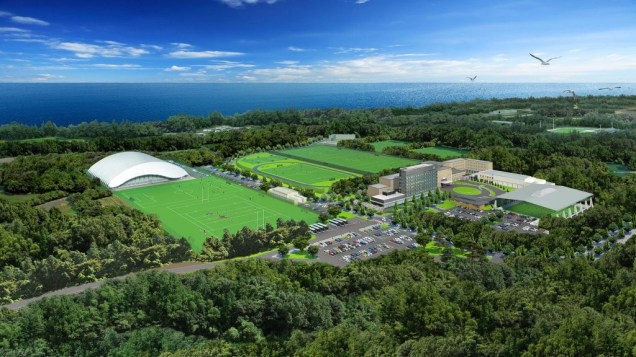
The hand-over is a shot in the arm for Prime Minister Shinzo Abe, who has vowed the nuclear disaster will not impede the nation’s plans to host the 2020 Games. In September, the premier said the situation at Fukushima is “under control” and that there doesn’t need to be a review of measures to prevent contamination.
“This promised handover of J-village would serve as a symbol of progress,” Daniel Aldrich, professor and director of the security and resilience studies program at Northeastern University in Boston, said by e-mail.
“Tepco clearly hopes that this will show the nation that it is on track in the Fukushima accident clean up process,” Aldrich said. “However, a number of obstacles, including expanding costs for decommissioning, a lack of physical control over the contaminated groundwater at the site, and complaints about the decontamination process nearby will no doubt hinder the process.”
As Tepco begins in coming years to remove melted fuel at Fukushima, clean-up costs may rise to several hundred billion yen annually from the current 80 billion yen ($763 million), Japan’s industry ministry said in October. About 300 metric tons of water — partly from the nearby hills — flow into the reactor building daily, mixing with melted fuel and becoming contaminated, according to the company.
The utility used the soccer facility as a make-shift base for tasks from corporate communications to measuring the radiation exposure of employees. It even built temporary dormitories there.
No comments yet.
1 This Month

of the week – Shut Down Drone Warfare!


Tell the Ukrainian Government to Drop Prosecution of Peace Activist Yurii Sheliazhenko

Petition to revoke the licensing of the Near Surface Nuclear Disposal Facility (NSDF) at Chalk River. https://www.ourcommons.ca/petitions/en/Petition/Details?Petition=e-7247
To see nuclear-related stories in greater depth and intensity – go to https://nuclearinformation.wordpress.com
-
Archives
- April 2026 (19)
- March 2026 (251)
- February 2026 (268)
- January 2026 (308)
- December 2025 (358)
- November 2025 (359)
- October 2025 (376)
- September 2025 (257)
- August 2025 (319)
- July 2025 (230)
- June 2025 (348)
- May 2025 (261)
-
Categories
- 1
- 1 NUCLEAR ISSUES
- business and costs
- climate change
- culture and arts
- ENERGY
- environment
- health
- history
- indigenous issues
- Legal
- marketing of nuclear
- media
- opposition to nuclear
- PERSONAL STORIES
- politics
- politics international
- Religion and ethics
- safety
- secrets,lies and civil liberties
- spinbuster
- technology
- Uranium
- wastes
- weapons and war
- Women
- 2 WORLD
- ACTION
- AFRICA
- Atrocities
- AUSTRALIA
- Christina's notes
- Christina's themes
- culture and arts
- Events
- Fuk 2022
- Fuk 2023
- Fukushima 2017
- Fukushima 2018
- fukushima 2019
- Fukushima 2020
- Fukushima 2021
- general
- global warming
- Humour (God we need it)
- Nuclear
- RARE EARTHS
- Reference
- resources – print
- Resources -audiovicual
- Weekly Newsletter
- World
- World Nuclear
- YouTube
-
RSS
Entries RSS
Comments RSS
 nuclear-news
Leave a comment