Japan inaugurates new body for nuclear fuel reprocessing
The organization will manage Japan’s 49 tons of plutonium and 17 million kg from 56,000 used fuel assemblies for the next 241,000 years
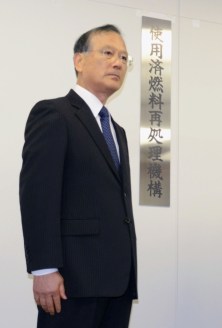
The industry ministry said Monday a new body for supervising nuclear fuel reprocessing has been established as the Japanese government seeks to retain a recycling policy, obliging 10 nuclear plant operators nationwide to fund the body for an uninterrupted reprocessing program.
The Nuclear Reprocessing Organization of Japan opened its head office in Aomori City in northeastern Japan. It mandates nuclear power utilities to shoulder the cost of reprocessing spent fuel in the form of financial contributions to itself.
Until now, power companies voluntarily set aside reserves to be used for reprocessing programs.
The new entity draws reprocessing operational plans and consigns them to Japan Nuclear Fuel Ltd., whose main shareholders are power companies, according to the Ministry of Economy, Trade and Industry.
The body plans to set up a representative office in Rokkasho, Aomori Prefecture, where Japan Nuclear Fuel has facilities for reprocessing.
In May, a law to strengthen state involvement in nuclear fuel reprocessing cleared Japan’s parliament, paving the way for securing funds to continue recycling nuclear fuel.
The ministry granted authorization for the establishment of the new body on Sep. 20 under the Spent Nuclear Fuel Reprocessing Fund Act.
Tainted Water Grows at Fukushima N-Plant despite Ice Wall

Tokyo, Oct. 2 (Jiji Pres)–Six months into operation, the much-hyped underground ice wall has not yet produced the intended effects of curbing the growth of radioactive water at Tokyo Electric Power Company Holdings Inc.’s stricken Fukushima No. 1 nuclear plant.
TEPCO initially claimed that the ice wall would prove effective in about a month and half, but the amount of contaminated water at the plant has continued to increase at a pace faster than projected by the utility.
The plant in northeastern Japan faces a chronic shortage of welded-type water storage tanks, while an increasing volume of tainted water has been transferred to the reactor and turbine buildings as a makeshift measure despite a high risk of leaks.
TEPCO constructed the 1.5-kilometer-long ice wall encircling the plant’s damaged No. 1 to No. 4 reactors in an attempt to block groundwater from flowing into reactor buildings and mixing with radioactive water accumulating inside.
The government has to date spent a total of 34.5 billion yen in the construction of the structure by freezing underground soil, which is believed to be technically very difficult.
China’s graphite mining communities pay heavy health toll, to supply modern technological devices
Inhaling particulate matter can cause an array of health troubles, according to health experts, including heart attacks and respiratory ailments.
But it’s not just the air. The graphite plant discharges pollutants into local waters…

IN YOUR PHONE, IN THEIR AIR A trace of graphite is in consumer tech. In these Chinese villages, it’s everywhere.Washington Post, Story by Peter Whoriskey Photos by Michael Robinson Chavez Videos by Jorge Ribas October 2, 2016 At night, the pollution around the village has an otherworldly, almost fairy-tale quality.
“The air sparkles,” said Zhang Tuling, a farmer in a village in far northeastern China. “When any bit of light hits the particles, they shine.”
By daylight, the particles are visible as a lustrous gray dust that settles on everything. It stunts the crops it blankets, begrimes laundry hung outside to dry and leaves grit on food. The village’s well water has become undrinkable, too.
Beside the family home is a plot that once grew saplings, but the trees died once the factory began operating, said Zhang’s husband, Yu Yuan.
“This is what we live with,” Zhang said, slowly waving an arm at the stumps.
Zhang and Yu live near a factory that produces graphite, a glittery substance that, while best known for filling pencils, has become an indispensable resource in the new millennium. It is an ingredient in lithium-ion batteries.
Smaller and more powerful than their predecessors, lithium batteries power smartphones and laptop computers and appear destined to become even more essential as companies make much larger ones to power electric cars.
The companies making those products promote the bright futuristic possibilities of the “clean” technology. But virtually all such batteries use graphite, and its cheap production in China, often under lax environmental controls, produces old-fashioned industrial pollution.
At five towns in two provinces of China, Washington Post journalists heard the same story from villagers living near graphite companies: sparkling night air, damaged crops, homes and belongings covered in soot, polluted drinking water — and government officials inclined to look the other way to benefit a major employer.
After leaving these Chinese mines and refiners, much of the graphite is sold to Samsung SDI, LG Chem and Panasonic — the three largest manufacturers of lithium-ion batteries. Those companies supply batteries to major consumer companies such as Samsung, LG, General Motors and Toyota.
Apple products use batteries made by those companies, too Continue reading
Climate denialists fiddle on, as scientists sound the alarm on climate change
Scientists Sound Alarm on Climate but US Still Toys With Skepticism Monday, 03 October 2016 By Dahr Jamail, Truthout Every month, after I finish writing this climate dispatch, I think that this is the most dire, intense, mind-bending, heartbreaking dispatch I have written to date. And every month, for the more than two years that I’ve been writing them, I am correct.
During the morning I was finishing this dispatch, I conducted an interview with Mike Loso, a physical scientist with the National Park Service (NPS), about ice loss in several US national parks. “We as park rangers are tasked with managing and protecting what is in our National Parks, to protect it so it will be there for future generations,” he told me. “But the glaciers are going away, and we can’t stop climate change. So if the Park Service can’t stop the change, we at least have to bear witness to it.”
The information he provided, which will be used in future writings, caused my heart to feel 50 pounds heavier.
To see more stories like this, visit “Planet or Profit?”
When we finished the interview, all I could do was go outside, stand still, and gaze at the trees. I called a friend and shared some of it with him, and he listened. “Thank you for bearing witness with your dispatches, and for holding all of this information,” he told me.
The news about how rapidly the planet is changing only continues to accelerate in both frequency and intensity, and it’s all for the negative……….
Things have become dire enough that 375 National Academy of Sciences members, (including 30 Nobel Prize winners), frustrated with the ongoing political inaction towards anthropogenic climate disruption (ACD), signed an open letter warning of the “real, serious, immediate” climate threat.
Richard Betts, the head of climate impacts research at the UK meteorological office’s (Met Office) Hadley Centre recently stated that the planet is already two-thirds of the way to the 1.5C benchmark, [the politically agreed upon goal of the upper limit of global temperature increase that is allowable before extreme climate disruption impacts ensue] and could begin to pass it in about a decade.
And the alarm bells continue to ring………..
Meanwhile, the tangible signs of warming abound, all around the planet.
Although the Southern Hemisphere is still technically in its winter season, in early September, temperatures across the Antarctic Peninsula and areas of Western Antarctica reached levels of 15 to 23 degrees Celsius (27-40 degrees Fahrenheit) above normal, with the Larsen C ice shelf experiencing thawing temperatures during winter.
Yes, you read that correctly. Parts of Antarctica are melting during the winter.
Scientists are also now closely monitoring a key ocean current in the North Atlantic to find out if rising seawater temperatures and increasing freshwater from melting ice are combining to alter the “ocean conveyor belt,” which they describe as “a vast oceanic stream that plays a major role in the global climate system.” In their own words, they are studying “how climate change could jam the world’s ocean circulation.”……
Is this how life in our ACD-driven world will be, going forward? How much unpredictability can our planet and its inhabitants take?
Earth Soils around the planet are soaking up far less carbon than we previously believed……..
Water As usual, much is happening in the water realm, when it comes to ACD……..
……..rising oceans are not simply a thing of the future: Noticeable sea level rise has already begun.
In the US, one only need look towards Virginia, Florida and Louisiana, among other places, to see that warnings about sea level rise are not theoretical; it is already causing flooding on a daily basis.
Looking west, sea level rise is now causing increasing numbers of people to move off of the Marshall Islands.
The same can be said for most of the population of the atoll of Takuu, which is in the Bougainville region of Papua New Guinea. Ten years ago, 600 people lived on the atoll. Now there are only 50, and sea level rise is a large part of the reason why.
Lastly, a disconcerting report from Australian Geographic cites two recent studies showing that life in the oceans is diminishing so rapidly that they are literally going quiet, since diminishing nutrients and increasing ocean acidification (driven largely by ACD) are killing off sea life.
Air In addition to the global temperature records mentioned above, another interesting study was published last month about ACD-related atmospheric changes……….
Fire In addition to wildfires burning more often, hotter, and with greater frequency around the planet as ACD advances, a recent report showed that there is an alarming increase of fires across the Brazilian Amazon………
Denial and Reality As usual, there is plenty of material from the ACD-denial camp for this dispatch………
Thankfully, the number of people and organizations recognizing ACD’s reality far outweighs the deniers.
Joining a growing handful of other states, Washington State recently adopted a new rule to limit greenhouse gas emissions from large carbon polluters. The change covers fuel distributors, power plants, oil refineries, pulp and paper mills, and other industries.
A recent report from the US military has called ACD a “significant and direct” threat. More than a dozen retired military and national security officials signed a statementsaying that “climate change presents a strategically significant risk to US national security, and inaction is not a viable option.”
Similarly, a recently released US government report stated that ACD is going to get worse. “The impacts of climate change on national security are only going to grow,” Dr. John Holdren, director of the White House Office of Science and Technology Policy, said of the report. The report noted that over the next 20 years, ACD will pose an increasing security challenge, due to the heightening of social and political tensions which will threaten the stability of some countries and cause increasing risks to human health. The report also said that extreme weather events already have dire implications for humanity, which “suggest that climate-change related disruptions are well underway.”………
it is more important than ever that we see it clearly, so as to make more informed decisions about how we live our lives during this key time. http://www.truth-out.org/news/item/37833-scientists-sound-alarm-on-climate-but-us-still-toys-with-skepticism
US Dept of Energy spells out good news on wind and solar power’s phenomenal rise
DOE charts show why climate doom and gloom isn’t needed Clean tech costs have fallen 41–94% over the past 7 years. Wind and solar accounted for two-thirds of new energy installations in the US in 2015, [Excellent graphs] Guardian, Dana Nuccitelli, 3 Oct 16 , A new report from the US Department of Energy paints a bright picture for our prospects to cut carbon pollution and prevent the most dangerous levels of climate change. The report looked at recent changes in costs and deployment of five key clean energy technologies: wind, residential solar, utility-scale solar, batteries, and LED bulbs. For each technology, costs fell between 41% and 94% from 2008 to 2015
However, it’s important to acknowledge the progress that’s being made, and retain a sense of hope and optimism that we can still avoid the worst climate consequences. This new DOE report highlights the fact that clean energy technology is quickly moving in the right direction, toward lower costs and higher deployment.
Wind energy is blowing away expectations
The report finds that due to its low cost, US wind energy capacity has nearly tripled since 2008. Wind now supplies nearly 5% of total US electricity generation.
As a result, there are now nearly 90,000 U.S. manufacturing, construction, and wind operations jobs. Research has resulted in bigger turbines that can generate more electricity:
a wind turbine installed today on average has 108% longer blades and is 48%taller than one installed in 1999. The longer blades allow each turbine to capture more energy, and taller towers allow access to the stronger and more consistent wind speeds that occur at higher altitudes in many parts of thecountry. Combined, these innovations allow each turbine to produce more electricity, reducing both the number of turbines needed to produce a given amount of electricity and the land area needed for their installation.
Offshore wind also presents tremendous untapped potential, with the first such project set to begin generating power off the cost of Rhode Island this month. The DOE envisions wind generating 20% of the nation’s electricity by 2030 and 35% by 2050, with costs falling a further 35% by 2050.
Solar energy’s bright future
Utility-scale solar farm costs have fallen 64% since 2008, and distributed (mostly residential) solar costs by 54%. While solar still accounts for a relatively small percentage of overall US electricity generation, its deployment has been increasing rapidly as costs have dropped. Even the military is getting on board:
For example in 2015 the Department of the Navy procured 210 MW of a utility-scale PV project to support fourteen Navy installations in California.
In 2015, the solar sector employed about 220,000 Americans. The DOE envisions that solar power could supply 27% of US electricity generation by 2050. Solar deployment is surging in 2016, with around 10 gigawatts (GW) set to be installed this year – equal to all the solar capacity installed in the US through 2014.
Solar panel leasing from companies like Solar City and Sungevity has revolutionized the distributed solar market, accounting for the majority of domestic residential system installed in leading state markets in 2015. This approach makes solar panels obtainable for households that can’t afford to purchase them. Distributed solar costs are expected to fall a further 16–33% by 2020.
Stunning drop in LED costs
The best available LED bulbs use 85% less energy than incandescent bulbs. ………
Electric cars are the future of transportation
Electric vehicle (EV) sales in the US reached 115,000 in 2015, more than double the number sold in 2012. Overall US EV sales will surpass a half-million by the end of this year. As shown by a new paper and app from MIT, EVs reduce greenhouse gas emissions 58% compared to gasoline-powered cars, and often cost less on a per-mile basis. As low-carbon energy deployment increases, EVs will only become cleaner………. https://www.theguardian.com/environment/climate-consensus-97-per-cent/2016/oct/03/doe-charts-show-why-climate-doom-and-gloom-isnt-needed
In these Chinese villages – graphite IN THE AIR, IN THE WATER
IN YOUR PHONE, IN THEIR AIR A trace of graphite is in consumer tech. In these Chinese villages, it’s everywhere. Washington Post, Story by Peter Whoriskey Photos by Michael Robinson Chavez Videos by Jorge Ribas October 2, 2016 “………IN THE AIR, IN THE WATER
Despite the name, only a small portion of a lithium-ion battery consists of lithium. Graphite is used to make the negative electrode and represents about 10 to 15 percent of the cost of a typical lithium-ion battery, according to analysts.
The demand for graphite has risen in parallel with the demand for more-powerful laptops, tablets and phones.
Ten years ago, for example, the battery of the best-selling Motorola Razr had a capacity of 680 milliamp-hours. Today, the batteries in the best-selling smartphones have three or four times that.
Lyu Guoliang, senior engineer at the graphite business association in Jixi, said the demand for graphite rose very rapidly in 2010, driven by the demand for lithium-ion batteries.
Graphite for batteries must be refined to high levels of purity, and the flakes must be reformed into tiny spherical or potato-like particles. This extra refining means that the refined graphite is worth 10 times as much as the raw material, said Lyu, and that made the business particularly attractive.
But without proper controls, mining and refining can cause pollution in two ways — by air and by water.
Graphite powder can quickly become airborne dust, drifting for miles. Without systems of tarps and fans to keep it under control, the resulting fine-particle pollution can cause an array of breathing difficulties, such as aggravating lung disease or reducing lung function, and has been linked to heart attacks in people with heart disease, according to the U.S. Environmental Protection Agency.
Graphite operations can also lead to pollution because their chemicals leak into local waters. According to industry sources, the purifying process, especially in China, is commonly done with acids, often hydrofluoric acid, a highly toxic substance.
This method is cheaper than the one used in other countries, where the graphite is purified by “baking,” — that is, heating it up. Riddle, of Asbury Carbons, said refining graphite that way is better for the environment but adds about 15 percent to the price. He said that for the past 20 years his company has insisted on purchasing only graphite refined this way.
“We had hoped more companies and users would follow our lead, but this has not been the case,” Riddle said.
Tracing your battery’s graphite
The lithium-ion battery industry has a massively complicated supply chain. Each consumer company has dealt with multiple suppliers — and their suppliers have dealt with multiple suppliers. This shows some of the connections within the industry. See companies’ responses to Washington Post’s investigation.
WAR AGAINST POLLUTION’
The Chinese government has shown increasing concern about the nation’s environmental woes.
After decades of extraordinary economic growth, the country’s air has become an acute health danger. A million or more Chinese die prematurely every year because of outdoor air pollution, according to multiple estimates, including the report known as the Global Burden of Disease, part of a project run out of the University of Washington. One of the critical groups of pollutants in the Chinese air is “particulate matter” — dust, soot, smoke — a category that includes the air pollutants emitted from graphite plants.
Meanwhile, water quality in China has deteriorated, too. In 2015, the portion of the country’s groundwater supplies classified as “bad” or “very bad” stood at over 60 percent, according to China Water Risk, a nonprofit group that tallies figures from China’s Ministry of Environmental Protection. More than a quarter of China’s key rivers were deemed by the government as “unfit for human contact,” according to the group.
According to a report on graphite mining shown on state-run CCTV, the rivers in Jixi show levels of lead and mercury that are many times the national limit. Given the array of industry in the area, however, it is impossible to say how much of the lead and mercury come from the graphite industry.
“We will resolutely declare war against pollution as we declared war against poverty,” Premier Li Keqiang announced in 2014.
About three years ago, the country’s environmental efforts focused on the graphite industry, and records indicate that more than a dozen companies were issued citations by provincial and city officials, mostly in Heilongjiang and Shandong provinces, where most of China’s graphite business is done.
For example, Aoyu, which operates the plants near Lyu Shengwen and Liu Fulan in Mashan, was cited for not controlling the dust and the water pollution. It was fined roughly $7,500 for those infractions and asked to make improvements, according to a database of government records kept by the Institute of Public and Environmental Affairs (IPE), a Beijing-based nonprofit.
Likewise, BTR faced similar enforcement efforts for air and water pollution.
So, too, has Hensen, a graphite producer in Shandong province that sells to BTR, according to its manager, who did not respond to emailed questions regarding the water pollution.
Guo, the BTR spokeswoman, said that the plant in question has been improved and won the approval of the local government. She attributed the complaints to the fact that BTR is an environmental leader within the industry. As a result, she said, “we think it is normal . . . that someone attacks BTR by improper means. . . . BTR will talk with local people. . . . We would like to prove to them that BTR doesn’t make pollution on the water and crops.”
An Aoyu official hung up on a reporter seeking comment about the pollution.
But not all of the graphite factories appear to have been targeted by the crackdown. For two of the five factories visited by Post journalists, no records of any government citations could be found in the IPE database.
And even at those places where polluters were cited by the government, neighbors said that if any improvements were made, they were short-lived or not substantial enough to clean up the problem. Villagers said some factories employ pollution prevention measures — such as tarps to keep graphite from flying away, or actions to prevent toxic sewage from flowing into local waters — only when the environmental officials are present.
“It was worse last year, but it’s still bad,” Li Jie said in Liumao. “Everything is mai tai.” The trouble, residents and some industry representatives said, is that while the government wants to protect the environment, they also want to protect the jobs at the graphite factories.
Hou Lin, 30, works at the Aoyu plant in Mashan as a safety manager. He walked by as some farmers were complaining to reporters about the pollution.
“The company pollutes a lot,” he agreed. “But people need to have jobs.”……………..Story by Peter Whoriskey. Photos by Michael Robinson Chavez. Videos by Jorge Ribas. Graphics by Lazaro Gamio andTim Meko. Design by Matt Callahan, Emily Chow and Chris Rukan. https://www.washingtonpost.com/graphics/business/batteries/graphite-mining-pollution-in-china/
So far, in 2016, solar energy is outstripping coal power in UK
A spokeswoman for the Solar Trade Association (STA) said: “This is a valuable milestone on the road to renewables overtaking fossil fuels. It is a testament to just how effective the British solar industry has been at installing clean and reliable power and at bringing down costs.”
Solar outstrips coal in past six months of UK electricity generation
More power came from solar panels than from Britain’s ageing coal stations from April to September this year, report shows, Guardian, Adam Vaughan, 4 Oct 16, Electricity generated by solar panels on fields and homes outstripped Britain’s ageing coal power stations over the past six months in a historic first.
Climate change analysts Carbon Brief found more electricity came from the sun than coal from April to the end of September, in a report that highlighted the two technologies’ changing fortunes.
Solar had already eclipsed coal for a day in April and then for the whole month of May, with coal providing zero power for the first time in more than 100 years forseveral days in May. The latest milestone saw an estimated 6,964 gigawatt hours (GWh) generated by solar over the half-year, or 5.4% of the UK’s electricity demand. Coal produced 6,342GWh, or 4.7%.
The trend will not continue into winter because of solar’s seasonal nature, but the symbolic records reveal the dramatic impacts solar subsidies and environmental penalties for coal have wrought.
Increases in the carbon floor price last year have driven three major coal power plants – Longannet, Ferrybridge C and Rugeley – to close earlier this year. That came on top of a similar amount of coal power being closed between 2012 and 2014 because upgrading the stations to meet higher air pollution standards was deemed uneconomic……….
Solar has grown rapidly in the last six years, though figures published last week by the Office for National Statistics showed installations had crashed after the government came to power and cut the industry’s subsidies.
A spokeswoman for the Solar Trade Association (STA) said: “This is a valuable milestone on the road to renewables overtaking fossil fuels. It is a testament to just how effective the British solar industry has been at installing clean and reliable power and at bringing down costs.”
The government said last week that solar power could produce electricity more cheaply than the price agreed for a new nuclear power station at Hinkley Point, but officials suggested solar would have additional costs for the National Grid.
But a new report for the STA, published on Tuesday, concluded that integrating many more solar panels into the grid would not add excessive costs to accommodate the fact the sun doesn’t always shine and backup power is required to cover solar.
“With intermittency costs today of around £1.3/MWh for solar [with around 10-12GW of solar installed], increasing to £6.8/MWh with a substantial 40GW of solar on the system by 2030, we would suggest these costs do not provide a strong argument against the further build out of renewable generation,” said the report, by the consultancy Aurora. https://www.theguardian.com/environment/2016/oct/04/solar-outstrips-coal-in-past-six-months-of-uk-electricity-generation
Nuclear power? Not right for Kenya.
Kenya not ready to generate nuclear energy http://www.standardmedia.co.ke/ureport/story/2000218411/kenya-not-ready-to-generate-nuclear-energy Erick Kizito 04th Oct 2016 Six years ago, Kenya announced it was going to build a nuclear power plant, which would generate 1,000MW (1GW) of electricity.
By 2030, the country hopes to produce 4GW from nuclear sources. This implies that nuclear will at that time account for 19 per cent of Kenya’s total energy output, second to hydroelectric power.
I am highly pessimistic about Africa’s largest geothermal energy producer’s capacity to harness and safely utilize nuclear energy.
It is only KenGen that is showing seriousness in geothermal energy production and putting in place safety measures to curb accidents and damages. The overriding concern about any nuclear project is safety. There is the potential damage in terms of costs and casualties in the event of a nuclear accident.
Although advancements in nuclear science have led to improved reactor designs with the ability to shut down automatically during an emergency, scientists say the probability of a nuclear accident will never be zero.
In the event of a reactor meltdown or terrorist attack on the plant, which would release dangerous radioactive particles into the atmosphere, Kenya’s disaster preparedness and response will ultimately make the difference between minimal and widespread damage.
The second concern is disposal of radioactive waste from the plant, which is hazardous to human health and the environment. The third worry is that much of the knowledge and materials employed in a civilian nuclear programme can be used to develop nuclear weapons.
Kenya is a signatory to the Treaty on the Non-Proliferation of Nuclear Weapons, which aims to promote safe use of nuclear energy by preventing the spread of nuclear weapons or their technology.
Kenya’s installed electricity generation capacity is much smaller than the expected nuclear output.
The USA’s nuclear lobby’s main aim? -to weaken NRC safety regulations
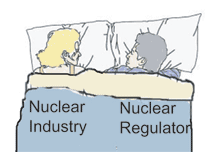 Nuclear power lobby names new CEO, The Hill, By Timothy Cama – 10/04/16 The Nuclear Energy Institute (NEI) has tapped Maria Korsnick, a veteran of the nuclear industry, to be its new CEO.
Korsnick, currently the chief operating officer at NEI, will start her new role Jan. 1, when Marv Fertel, the current CEO, retires.
The changes come at a crucial moment for the nuclear sector. Numerous plants are expected to close in the coming years amid competition from cheap natural gas and renewables, and increasing safety and security requirements.
A small handful of new plants or reactors are under construction domestically as well.
NEI is working on various major policy priorities, like getting a tax credit renewed for newly built plants, trying to get the Yucca Mountain nuclear waste site built and reforming the Nuclear Regulatory Commission. http://thehill.com/policy/energy-environment/299158-nuclear-lobby-names-new-ceo
Chinese villagers intimidated by graphite plant owners in collusion with local authorities
IN YOUR PHONE, IN THEIR AIR A TRACE OF GRAPHITE IS IN CONSUMER TECH. IN THESE CHINESE VILLAGES, IT’S EVERYWHERE. WASHINGTON POST, STORY BY PETER WHORISKEY PHOTOS BY MICHAEL ROBINSON CHAVEZ VIDEOS BY JORGE RIBAS OCTOBER 2, 2016 “…….BEING WATCHED
One of the main obstacles in clearing the pollution, villagers said, is the powerful alliance between local government officials and the owners of the graphite plants. The officials, the villagers said, protect the factories from environmental complaints.
At three of the five villages visited by Post journalists in May and June, a village official either tried to attend interviews or soon after inquired of the interviewees what had transpired in the interviews. Moreover, plant managers and party officials sometimes discouraged journalists from speaking with villagers.
After Post journalists visited the Haida Graphite plant in Pingdu, for example, a plant employee jumped in a car to follow their taxi off the property and through the village streets.
The taxi stopped twice in the village so The Post could interview more people. At each stop, the driver of the Haida car approached to within a few feet and blared the car horn continuously, making talking to villagers impossible. The driver relented only when The Post’s taxi left the area. Asked to comment later about the pollution complaints, a Haida official accused a Post reporter of “espionage” and refused to answer questions.
Similarly, after The Post visited a BTR graphite factory in Jixi, two cars with several men inside began following the reporters’ taxi. Three times, over several miles, the taxi pulled over to let them pass. Each time, the following cars pulled over and stopped behind the Post taxi. Confronted, the men in the cars told reporters that it was just a coincidence that they had stopped at the same time that the taxi did. The men said they were mapping out a bicycle race.
The intimidation has an effect on villagers.
Not far from the Hensen graphite plant in Laixi is a small factory that makes women’s underwear. Han Wenbing, 48, is the owner. A large man, proud of his workshop, he was eager to talk about the graphite pollution.
He readily invited reporters into his home, showing the dust quickly gathering on his kitchen table and showing how his well water, which had been fine for drinking, now is topped with a gray film.
But as he made his case against the graphite plant, his wife grew nervous — and then angry. To speak out would only cause trouble with the plant manager and village officials, she warned her husband.
“Yes, there is absolutely an impact [from the graphite], but we don’t want to be on TV,” she said. “This could offend the boss of the company, which could affect our lives. You [reporters] wash your hands and walk away, but we live here.”
Han nevertheless wanted to make his complaints known. Once his wife acquiesced, he offered to point out a field that showed some of the worst effects of the pollution. The field had been used by small farmers, he said, but industrial runoff had affected the soil so much that “not even the weeds can grow.”………Story by Peter Whoriskey. Photos by Michael Robinson Chavez. Videos by Jorge Ribas. Graphics by Lazaro Gamio andTim Meko. Design by Matt Callahan, Emily Chow and Chris Rukan. https://www.washingtonpost.com/graphics/business/batteries/graphite-mining-pollution-in-china/
Rising demand for lithium, and the pollution resulting from this
IN YOUR PHONE, IN THEIR AIR A TRACE OF GRAPHITE IS IN CONSUMER TECH. IN THESE CHINESE VILLAGES, IT’S EVERYWHERE. WASHINGTON POST, STORY BY PETER WHORISKEY PHOTOS BY MICHAEL ROBINSON CHAVEZ VIDEOS BY JORGE RIBAS OCTOBER 2, 2016 “……DEMAND RAMPS UP
While U.S. consumers may seem uninvolved in — and untouched by — the Chinese pollution, the truth is more complicated.
The U.S. demand for cheap goods helps keep the Chinese factories going. More than a quarter of the emissions of two key pollutants in China — sulfur dioxide and nitrogen oxides — arose from the production of goods for export, according to research published in 2014 in the Proceedings of the National Academy of Sciences. The largest share of exports goes to the United States.
Moreover, the same researchers found that some of the pollution in China reaches the United States — the air pollution drifts across the ocean and raises ozone levels in the western part of the country, according to the study.
“Outsourcing production to China does not always relieve consumers in the United States . . . from the environmental impacts of air pollution,” according to the authors of the study, which was conducted by a consortium of scientists from China and the United States.
Now the rise of the electric-car industry promises a huge surge in the lithium-ion battery business.
Making batteries big enough to power cars will cause a daunting leap in demand. A laptop requires just a handful of the familiar, thin, cylindrical lithium-ion batteries known as “18650s.” A smartphone requires even less. But a typical electric car requires thousands of times the battery power.
Today, the best known “gigafactory” for electric-car batteries is the one being built by Tesla in the Nevada desert — a plant the company says will produce 500,000 electric-car batteries annually. But it’s just one of many. About a dozen other battery gigafactories are being planned around the world.
This is “not just a Tesla story,” said Simon Moores, managing director of Benchmark Mineral Intelligence, a firm that tracks demand and assesses prices for raw materials in the industry. “The demand is rising everywhere, especially in China.” Todd C. Frankel and Yanan Wang in Washington and Xu Jing contributed to this report.
The connection between optimism, and having a global point of view

These differences can lead to heated debates, such as the Brexit situation which pitted English citizens against one another as the country decided whether or not to leave the E.U. What if our global or local mindsets influenced the types of goals we set and the way we think about our own lives?
This was the question that researchers set out to answer, and their findings are available online in the Journal of Consumer Psychology. The investigators suspected that people with a global mindset would adopt goals that encourage growth and advancement (promotion goals).
“Previous research has shown that people with a promotion mindset think more broadly and about the future,” says researcher Rajeev Batra, a professor in the Ross School of Business at the University of Michigan. “They are more optimistic and want to maximize the positive things in their lives.”
People with a local mindset, however, would most likely focus on goals that center around roles and responsibilities (prevention goals). “These people think about the here and now and want to minimize the negative, prevent losses and think about reasons not to do things,” Batra says……
The researchers also conducted two other experiments that showed similar variations between people who associated with global versus local identities.
“These mindset differences might help us understand why we see some of the population adopting a more broad, optimistic view while others are more protective of the status quo,” Ng says. “Policy makers who want to influence people to think more globally may want to design campaigns about global issues, such as climate change, that help people connect with the worldwide community.” https://www.eurekalert.org/pub_releases/2016-10/sfcp-tgl100316.php
“Population Mixing” Theory Debunked


Kinlen Theory Debunked By Dr Ian Fairlie
October 3, 2016
The Kinlen hypothesis debunked
A recent COMARE report on child cancers near NPPs was published on the day after the Government committed the UK to a new nuclear power station. This was not a coincidence: it is a prime example among many of nuclear policy-led science. We should have science-led policies but these rarely, if ever, occur on nuclear matters.
The report downplays radioactive releases from NPPs as an explanation for the nearby raised levels of cancers. Instead it champions the Kinlen hypothesis.
Since 1988, Professor Kinlen has been suggesting that increases in childhood cancers near nuclear facilities are due to an infective, perhaps viral, agent arising from the influx of new workers to rural areas. But most scientists throughout the world discredit this theory because of its myriad problems and inconsistencies.
First, the idea leads to the expectation of…
View original post 298 more words
USNRC Issues Criticality Hazard Warning to Nuclear Fuel Facilities Due to Toshiba Criticality Hazard in South Carolina; Does Toshiba Have Uranium Accounting Problems Too?

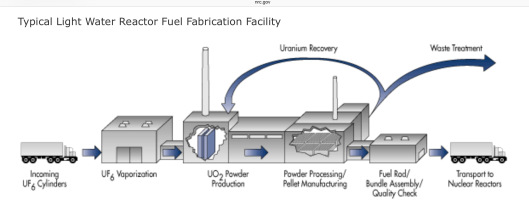
According to the USNRC: “The long-term accumulation of uranium in equipment with an unfavorable geometry, particularly in process ventilation and scrubber systems, has been a recurring issue throughout the nuclear fuel industry.”
The accumulation in an unfavorable geometry can lead to a criticality accident. At Toshiba’s Westinghouse Facility the amount of uranium exceeded the criticality safety evaluation (CSE) mass limit by over three times.
“A criticality accident is an uncontrolled nuclear chain reaction. It is sometimes referred to as a critical excursion or a critical power excursion and represents the unintentional assembly of a critical mass of a given fissile material,… In the history of atomic power development, 60 criticality accidents have occurred, including 22 in collections of fissile materials located in process environments outside of a nuclear reactor or critical experiments assembly“. https://en.wikipedia.org/wiki/Criticality_accident
“Criticality control should be part of an integrated program that…
View original post 1,181 more words
October 4 Energy News

Opinion:
¶ “Quid Pro Quo In Environmental Politics” • Prime Minister Justin Trudeau wants British Columbia’s backing for a national carbon strategy. In return for her support, Trudeau is willing to endorse Premier Christy Clark’s plans for an LNG project that appears to be condemned by every scientist “not funded by the proponent.” [CleanTechnica]
 Parliament (Photo by Alex Indigo, via Flickr, CC BY SA 2.0)
¶ “Off-grid renewables: the sustainable route to 100% global electricity access” • World households without electricity pay 60 to 80 times as much as people in New York or London for the same amount of light. Exposure to smoke from wood-fired cook stoves cause more than 4 million premature deaths each year. There is an off-grid solution. [The Ecologist]
World:
¶ At the beginning of the decade, Cape Verde authorities set a goal of getting 50% of its power from renewables by…
View original post 672 more words
1 This Month
Chernobyl: The Lost Tapes – A good documentary on Chernobyl on SBS available On Demand for the next 3 weeks– https://www.sbs.com.au/ondemand/tv-program/chernobyl-the-lost-tapes/2352741955560

of the week–London Campaign for Nuclear Disarmament

Tell the Ukrainian Government to Drop Prosecution of Peace Activist Yurii Sheliazhenko
To see nuclear-related stories in greater depth and intensity – go to https://nuclearinformation.wordpress.com
-
Archives
- April 2026 (126)
- March 2026 (251)
- February 2026 (268)
- January 2026 (308)
- December 2025 (358)
- November 2025 (359)
- October 2025 (376)
- September 2025 (257)
- August 2025 (319)
- July 2025 (230)
- June 2025 (348)
- May 2025 (261)
-
Categories
- 1
- 1 NUCLEAR ISSUES
- business and costs
- climate change
- culture and arts
- ENERGY
- environment
- health
- history
- indigenous issues
- Legal
- marketing of nuclear
- media
- opposition to nuclear
- PERSONAL STORIES
- politics
- politics international
- Religion and ethics
- safety
- secrets,lies and civil liberties
- spinbuster
- technology
- Uranium
- wastes
- weapons and war
- Women
- 2 WORLD
- ACTION
- AFRICA
- Atrocities
- AUSTRALIA
- Christina's notes
- Christina's themes
- culture and arts
- Events
- Fuk 2022
- Fuk 2023
- Fukushima 2017
- Fukushima 2018
- fukushima 2019
- Fukushima 2020
- Fukushima 2021
- general
- global warming
- Humour (God we need it)
- Nuclear
- RARE EARTHS
- Reference
- resources – print
- Resources -audiovicual
- Weekly Newsletter
- World
- World Nuclear
- YouTube
-
RSS
Entries RSS
Comments RSS
 nuclear-news