October 21 Energy News

Opinion:
¶ “A renewable fiction: Myths mainstream media refuses to let go” • For years now, many in mainstream media have been propagating myths about renewable energy in general, and wind and solar in particular. It’s unclear why this is so. Perhaps it is fear of new technologies and new ideas. But it remains an issue. [RenewEconomy]
 Wind farm
¶ “What would it mean for Los Angeles to go 100% renewable?” The Los Angeles City Council recently passed a unanimous resolution requiring Los Angeles Department of Water and Power, the largest municipally-owned utility in the country, to study how the city can achieve a 100% clean energy future. [Environmental Defense Fund]
¶ “‘Last Gasp of Dying Industry’: Nuclear Experts Decry First New US Reactor in 20 Years” • Watts Bar’s launch is “a symbolic gesture. It’s very sad that this is the last gasp of the…
View original post 745 more words
6.6 Magnitude Earthquake in Western Japan
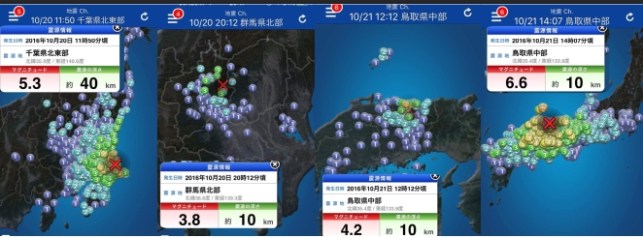
Since the strong earthquake today at 2:07 p.m. in Tottori, of 6.6 magnitude and 6 intensity that shook half of Japan, the earth continues to shake with an impressive number of aftershocks. Officials at the Meteorological Agency say seismic activity continues in Tottori and are asking people to be prepared and take precautions against another possible earthquake.
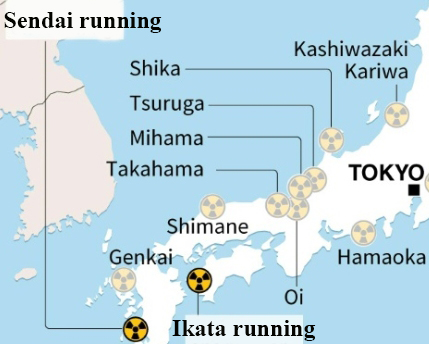
On this coast of West Japan lies the largest concentration of nuclear power plants in the world. Though stopped, they are full of potentially very dangerous spent nuclear fuel. The epicenter of this earthquake was at 76km from the Shimane nuclear power plant. Of course, no damages say the Authorities, as usual…
Strong quake in western Japan
An earthquake with a preliminary magnitude of 6.6 struck Tottori Prefecture in western Japan on Friday afternoon. The Japan Meteorological Agency says there is no tsunami theat.
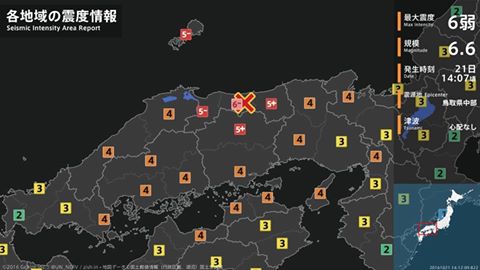
The jolt registered 6 minus on the Japanese seismic scale of 0 to 7 in central Tottori. The focus was 10 kilometers deep in the prefecture.
There are some reports of injuries and houses collapsing.
About 30,000 households in the prefecture are without power.
The tremors have disrupted transportation.
Local airports have cancelled flights.
Some bullet train services in central Japan are suspended. Parts of highways have been closed to check for damage.
Officials at the nearby Shimane nuclear power plant say there are no irregularities. The plant was off-line at the time of the quake.
http://www3.nhk.or.jp/nhkworld/en/news/20161021_27/
M6.6 quake strikes western Japan, no tsunami warning issued
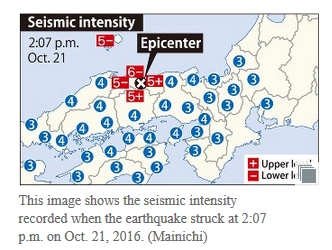
A powerful earthquake struck Tottori Prefecture and surrounding areas shortly after 2 p.m. on Oct. 21, the Japan Meteorological Agency said. No tsunami warning was issued.
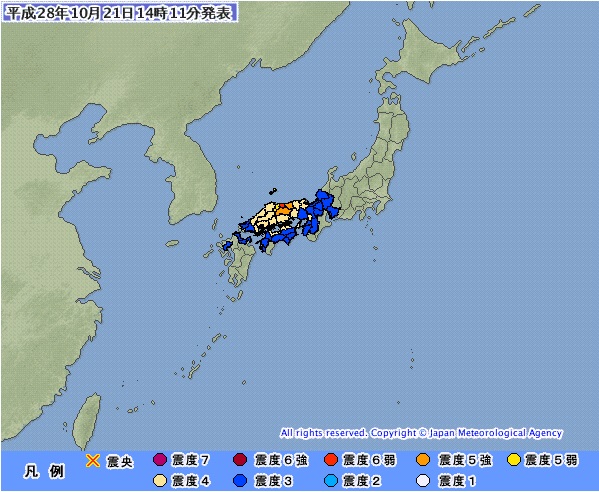
The 2:07 p.m. quake, which had an estimated magnitude of 6.6, measured a lower 6 on the 7-point Japanese seismic intensity scale in some parts of the Tottori Prefecture city of Kurayoshi, the town of Yurihama and the town of Hokuei, the agency said. It measured an upper 5 in parts of the city of Tottori, as well as in parts of neighboring Okayama Prefecture.
Reports said that several homes in Yurihama had collapsed. The Tottori Prefectural Government is in the process of confirming the information. The quake caused a blackout affecting nearly 32,000 households in Tottori Prefecture, Chugoku Electric Power Co. reported.
Firefighters in Tottori said that a female employee at a supermarket restaurant was taken to hospital with burns to her legs after an accident with hot oil when the quake struck. Elevators also stopped in the quake and there were reports that at least one person had been trapped.
Broken windows were reported over a wide area of Kurayoshi. A 53-year-old architect in the city, Katsunori Choda, said he was about to get in a vehicle when the ground started shaking, and pedestrians crouched on the ground to balance themselves. Soon afterward there was a blackout. Ambulance sirens could be heard and tiles fell from the roofs of old homes.
“I’d never felt an earthquake this big before,” the architect said. “There is a lot of old town scenery in the area and I’m worried about damage.”
Earthquake sounds could still be heard 30 minutes after the quake and aftershocks were reportedly continuing. The earthquake struck at an estimated depth of 10 kilometers, the meteorological agency said.
Services on the Sanyo Shinkansen bullet train were suspended between Shin-Osaka and Hakata stations following the quake, but resumed at 2:27 p.m., West Japan Railway Co. announced.
http://mainichi.jp/english/articles/20161021/p2g/00m/0dm/062000c
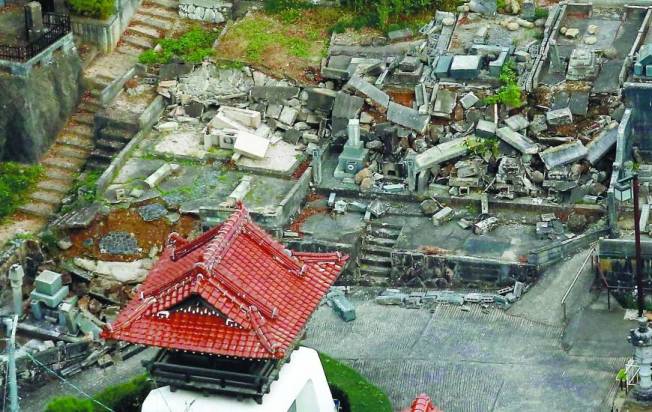
This aerial photo shows broken grave markers and collapsed walls at a cemetery in Kurayoshi, Tottori Prefecture, following a strong earthquake that shook the area Friday.
Homes damaged, power cut after strong quake rattles parts of western Honshu
A powerful earthquake with a preliminary magnitude of 6.6 shook parts of western Honshu early Friday afternoon, damaging homes and roads and cutting power to almost 40,000 households.
The Meteorological Agency said the earthquake occurred at 2:07 p.m. in central Tottori Prefecture, about 700 km west of Tokyo, at a depth of 10 km. It was followed by a weaker aftershock about 30 minutes later.
The agency said there was no danger of a tsunami from the inland temblor.
Two houses collapsed in the town of Hokuei, Tottori Prefecture, according to the local fire department. Roads were cracked and roof tiles laid strewn in the town.
In Kurayoshi in the prefecture, ATMs at some local banks temporarily went offline due to a power outage.
All up, the blackout affected nearly 40,000 households in Tottori Prefecture, according to Chugoku Electric Power Co.
Okayama City Fire Department said a woman in her 70s was taken to hospital after she fell and broke her right leg. Five people are reported to have been injured in Tottori Prefecture.
West Japan Railway Co. temporarily suspended all services on the Sanyo Shinkansen Line between Shin-Osaka and Hakata stations.
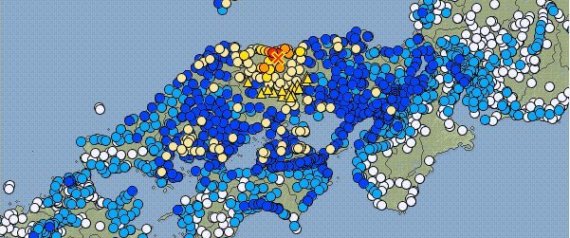
The quake registered lower 6 on the Japanese seismic scale of 7 in parts of Tottori Prefecture, and upper 5 in a wide area in Tottori and Okayama prefectures, according to the agency.
No abnormalities were detected at the Shimane nuclear plant, which is currently off-line, in nearby Shimane Prefecture, according to the utility.
Okayama airport closed its runway to check its safety, airport officials said.
According to local officials a house in the town of Yurihama, in central Tottori Prefecture, was destroyed, and a number of dwellings in other parts of the prefecture suffered damage
UPDATE: Quake rattles buildings in Tottori; 6 injured
Tottori Prefecture in western Japan was struck by a series of major earthquakes on Oct. 21, causing structural damage to some buildings and homes and at least six injuries.
A quake measuring lower 6 on the Japanese intensity scale of 7 was recorded at 2:07 p.m.
The focus was about 10 kilometers underground, and the temblor had an estimated magnitude of 6.6.
Shaking was felt in a wide area of western Japan and as far as the Kanto and Kyushu regions.
Japan Meteorological Agency officials urged caution because there was a possibility of another quake measuring lower 6 in intensity striking over the next week in areas where the shaking was particularly strong.
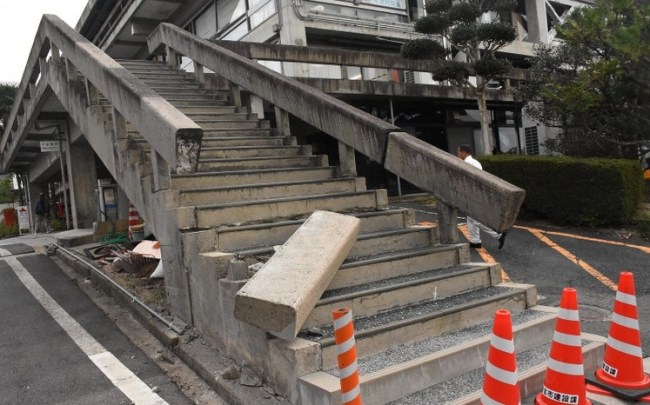
Among the buildings damaged was the Kurayoshi city government building. Government workers evacuated as the building has been declared off-limits.
Homes in Yurihama were also heavily damaged, according to Tottori prefectural officials.
One individual suffered burns at a shopping center in Tottori city while a woman in her 70s in Okayama city, south of Tottori, fell and broke her leg.
Meanwhile, officials of Chugoku Electric Power Co. said about 31,900 households in the prefecture suffered a blackout after the quake struck, centered mainly on Kurayoshi.
However, the quake did not affect the two reactors at the Shimane nuclear power plant in the neighboring prefecture. Both reactors were not operating when the temblor struck.
Various stretches of expressways were closed to traffic.
Bullet train services between Shin-Osaka and Hakata stations operated by West Japan Railway Co. were stopped for about 20 minutes immediately after the quake. Service on the Tokaido Shinkansen line was also temporarily suspended between Shin-Osaka and Toyohashi in Aichi Prefecture.
http://www.asahi.com/ajw/articles/AJ201610210040.html
Final presidential debate reveals sobering facts on how fast nuclear war could happen
 Clues to the end of the world shared during final 2016 presidential debate, Mondoweiss, Wilson Dizard on October 20, 2016 “……Four minutes is what it takes between the president’s decision to fire nuclear missiles, Clinton claimed during the debate, and their launch………..Here is the most illuminating exchange on nuclear weapons, according to a transcript published by the Washington Post. Clinton gave a clinical description of how fast nuclear weapons can be fired away at a president’s command. That information was perhaps a subtle way of warning Russian president Vladimir Putin that we remain the fastest guns in the West.
CLINTON: “I — I find it ironic that he’s raising nuclear weapons. This is a person who has been very cavalier, even casual about the use of nuclear weapons. He’s advocated more countries getting them, Japan, Korea, even Saudi Arabia. He said, well, if we have them, why don’t we use them, which I think is terrifying.
But here’s the deal. The bottom line on nuclear weapons is that when the president gives the order, it must be followed. There’s about four minutes between the order being given and the people responsible for launching nuclear weapons to do so. And that’s why 10 people who have had that awesome responsibility have come out and, in an unprecedented way, said they would not trust Donald Trump with the nuclear codes or to have his finger on the nuclear button……..
What Trump doesn’t seem to understand that defending Saudi Arabia, Germany, Japan and South Korea means defending major trading partners and, in the case of Saudi Arabia, a sand seared ocean of oil. But if the American nuclear umbrella suddenly closed, all of those countries could have nuclear weapons ready within weeks or months. The details are unimportant. What’s nauseatingly disturbing is that we are discussing the possibility of nuclear war at all. After all, this is 2016, right? If the arc of history bends towards justice, a nuclear holocaust is the thing that would blow that arc to smithereens. The real end of history
Clinton, for her part, recommitted herself to a no-fly zone in Syria, a provocation to Russian air forces the U.S. blames for bombing civilians and Western-friendly rebels. She also said that the occupation of Iraq would “not be in our interest,” while not mentioning that the Iraqis also have their objections to American military occupation. Classic Clinton.
This is all happening while thousands of nuclear weapons in the United States and Russia stand waiting to incinerate you and your family, if necessary………http://mondoweiss.net/2016/10/clues-presidential-debate/
Fact checking Donald Trump – got his facts wrong on USA-Russia nuclear START Treaty
 AP FACT CHECK: Trump gets facts wrong on START Treaty http://www.usnews.com/news/politics/articles/2016-10-19/ap-fact-check-trump-gets-facts-wrong-on-start-treaty
AP FACT CHECK: Donald Trump is wrong to say that only Russia can still create warheads under the New START treaty limiting nuclear weapons A claim from the final presidential debate and how it stacks up with the facts:
East Africa’s water resources drying up as a result of climate change
 Climate change killing East Africa’s water resources, UN warns, Daily Nation OCTOBER 20 2016 BY KEVIN J. KELLEY
One of East Africa’s (EA) most important sources of water is drying up due to the impact of climate change on Mt Kilimanjaro, the United Nations Environment Programme (Unep) warned on Wednesday.
Five more nuclear reactors need shutdown and safety inspection – says France’s nuclear regulator

 France’s nuclear watchdog wants to shut down 5 reactors over failure risk https://www.rt.com/news/363484-france-nuclear-shut-down/ 20 Oct, 2016 10: The French nuclear watchdog has called for the shutdown and inspection of five more nuclear reactors for safety checks. The reactors have a high level of carbon which could lead to various failures.
The Nuclear Safety Authority (ASN) has asked nuclear power utility EDF to carry out additional inspections at Fessenheim 1,Tricastin 2 and 4, Gravelines 4 and Civaux 1 reactors, according to a press release. All these reactors are located across the whole France, close to towns and communes.
“The performance of these inspections will require shutdown of the reactors concerned,” ASN added. The watchdog wants to check “certain channel heads of the steam generators on five of its reactors, in which the steel is affected by a high carbon concentration.”
According to ASN’s analysis, “certain channel heads of the steam generators … contain a significant carbon concentration zone which could lead to lower than expected mechanical properties.”
The watchdog said that it doesn’t want to wait “for the scheduled refueling outage of these reactors” and thus demands safety checks “within three months.”
According to the Local, this abnormality could lead to failures in mechanical properties and even to leaks or explosions.
The five reactors under scrutiny are among 18 at which ASN found abnormalities in June. Of the 18 reactors ASN says that six could be restarted after inspection. Seven others (Bugey 4, Civaux 2, Dampierre 3, Gravelines 2, Saint-Laurent-des-Eaux B1 and Tricastin 1 and 3) are being inspected and awaiting reboot.
CEO of ASN Olivier Gupta downplayed the concerns in comments to Le Monde newspaper, saying “the safety margins are very large and the carbon content does not undermine integrity or security, even in the case of an accident.”
France has 58 nuclear reactors with total capacity of 63.2 GWe. The country gets two thirds of its electricity from nuclear generation. READ MORE: Risk of nuclear theft, sabotage, cyberattacks by terrorists may be increasing – report
In April, President Francois Hollande promised to formally initiate the shutdown of the France’s oldest nuclear reactors on the grounds of environmental and safety concerns surrounding the Fessenheim power plant near the German and Swiss borders.
READ MORE: Hollande vows to shut down France’s oldest nuclear power plant Fessenheim houses two 920 megawatt reactors and has been running since 1978, making it France’s oldest operating plant. Due to its age, the German government and activists alike have long been calling for it to be permanently closed.
READ MORE: France shuts down Flamanville nuclear reactor over transformer failure
The German government has repeatedly called on France to terminate the Fessenheim plant as soon as possible, after an April 2014 accident when one of the reactors had to be shut down as water was found leaking from several places.
Costing more than $6 billion and 40 years later – America’s Watts Bar nuclear reactor turned on
The reactor has been more than 40 years in the making and cost approximately $6 billion to complete, not adjusting for inflation.
Watts Bar Unit 2 is one of five reactors in the U.S. expected to open in the next five years. However, cost overruns and delays are leading critics to question whether new nuclear plants will be built in the future.
Construction on Watts Bar Units 1 and 2 began in 1973. Work stopped on Unit 2 in 1985 due to deficiencies at the plant. Unit 1 began operation in 1996. In 2007, the TVA began efforts again to complete Unit 2, submitting an updated license application to the Nuclear Regulatory Commission in 2009 and received its operating license in October 2015. Unit 2 is the first new reactor in the U.S. since its sister plant started operations.
The Unit 2 startup comes at a time when nuclear operators have shut down—or announced plans to shut down—10 reactors in five states due to difficulty competing against low natural gas prices, according to the Nuclear Energy Institute, which represents the nuclear industry. The group predicts that an additional 15 to 20 nuclear reactors are at risk of premature closure in the coming years.
Marvin Fertel’s, NEI’s president and CEO, praised TVA’s completion of the plant……..
Mark Cooper, a senior research fellow for economic analysis at the Vermont Law School, said it is no longer financially viable to build new reactors in the U.S. Watts Bar Unit 2 “is not a monument to the future nuclear power, it’s a mausoleum for the future of nuclear power,” he told Bloomberg BNA Oct. 19.
Watchdogs Say Building Nuclear Too Costly
The TVA estimates that it spent $1.3 billion originally on the project. Work resumed after the board of directors approved $4 billion to $4.5 billion to complete the reactor in 2012, and then later approved an additional $200 million in 2016, bringing total estimated costs to $6 billion.
Critics say that the $6 billion price tag to complete Watts Bar Unit 2 is a reminder of the expense of building nuclear reactors today.
Tim Judson, executive director of the Nuclear Information and Research Service, a information center for environmentalists concerned about nuclear power and radioactive waste, said he would estimate Watts Bar Unit 2 cost between $7 billion and $8 billion when adjusted for inflation.
“As an economic enterprise, they are doomed,” Cooper said of nuclear reactors in the U.S………
To contact the reporter on this story: Rebecca Kern in Washington atrKern@bna.com
To contact the editor responsible for this story: Larry Pearl atlpearl@bna.com https://news.google.com/news/story?ncl=dD89j-wHhzuijvMA6PD5gUuZYagbM&q=nuclear&lr=English&hl=en&sa=X&ved=0ahUKEwiI5uq6k-rPAhWrqlQKHfGrApMQqgIIIjAB
Energy utilities sue New York Public Service Commission’s (PSC) over subsidies to nuclear industry

 Energy industry coalition sues NY PSC over nuclear subsidies Reuters 19 Oct 16 An energy industry coalition including competitive non-nuclear electricity producers sued on Wednesday to oppose a plan to subsidize nuclear power plants in New York State.
The lawsuit in federal court said the New York Public Service Commission’s (PSC) plan to raise electric rates across the state by requiring consumers to pay for zero emission credits (ZECs), infringes illegally into federal regulators’ territory.
The coalition said in a statement that the litigation was “solely to save several New York nuclear plants that, allegedly, can no longer compete successfully in the federally-regulated wholesale electric power market.”…..Coalition members opposed to the nuclear subsidies include units of Dynegy Inc and NRG Energy Inc. http://www.reuters.com/article/us-new-york-nuclear-idUSKCN12J2N2
Costs falling fast, as wind energy booms in Europe
Europe’s offshore wind industry booming as costs fall The European Union’s push away from fossil fuels toward renewables, along with falling costs, has seen offshore wind thrive with turbines being installed from the Irish to the Baltic Seas, reports Environment 360, Guardian, Christian Schwägerl, 2q1 Oct 16 “……In Europe, offshore wind farms like the one at Burbo Bank are undergoing a boom. While still significantly outnumbered by windfarms on land, the importance of windfarms at sea has grown dramatically in the past several years. Until 2011, between 5 and 10% of newly installed wind energy capacity in Europe was offshore. Last year, almost every third new wind turbine went up offshore. That growth has helped boost the share of wind energy in the European Union’s electricity supply from 2% in the year 2000 to 12% today, according toWindEurope, a business advocacy group.
New investments for offshore projects totaled $15.5bn in the first half of 2016 alone, according to WindEurope, and newly installed offshore wind energy capacity will double to 3.7 gigawatts this year compared to 2015. More than 3,300 grid-connected turbines now exist in the North Sea, the Baltic Sea, and the Irish Sea, and 114 new wind turbines were linked to the grid in European waters in the first half of this year alone. This is in stark contrast to the US and Asia, where offshore wind use is only just getting started.
The offshore wind boom is part of a wider move from fossil fuels to renewable energy across the European Union. The overall share of renewable electricity sources in the EU – hydropower, wind, solar, biomass, and geothermal – has gone up from about 15% in 2004 to roughly 33% in 2014, according to data from Eurostat and Entso-E, the association of grid operators. Along with solar photovoltaic power, wind energy is driving this expansion. Newly installed wind energy capacity amounted to 13 gigawatts in 2015, twice as much as newly installed fossil fuel and nuclear capacity combined. WindEurope claims that all European wind turbines taken together can now generate enough electricity for87m households.
This is not only a result of government subsidies and incentives, but also of dramatically reduced production costs for wind energy. The price for a megawatt hour is now between €50 and €96 for onshore wind and €73 to €140 for offshore wind, compared to around €65 to €70 for gas and coal. Electricity generated from onshore windfarms is now the cheapest among newly installed power sources in the UK and many other countries. If environmental costs are considered, the picture looks even more favorable for wind power.
Germany now meets one-third of its electricity demand with renewable energy, Denmark 42%, and Scotland as much as 58%. On some sunny or very windy days, renewables can now fully supply the electricity demand in these countries.
The picture isn’t entirely rosy, though. The European wind industry says that grid and storage infrastructure hasn’t expanded fast enough to soak up surplus wind energy, and that the fossil fuel and nuclear industries are trying to sabotage what is called Energiewende, Germany’s transition from coal andnuclear power to renewable energy. The wind energy boom, with its recurrent surges of surplus energy, has led to a dramatic decline in electricity prices in spot market trading at the European Electricity Exchange, with the price per kilowatt hour falling by as much as 50% in the last five years. With preferential treatment from EU governments, wind energy is now outcompeting coal-fired power plants, posing major challenges for utilities heavily invested in fossil fuels.
Out in the Irish Sea, however, Dong Energy’s Sykes shows no mercy for the fossil fuel industry. “Wind power on land is becoming the cheapest form of newly installed electricity capacity,” he says. “And even out here at sea, we can’t say anymore that there are technical hurdles.”………
To long-term players in the field such as Henrik Stiesdal, a Danish wind power pioneer and former chief technology officer of Siemens Wind power, the situation is ironic: “While there were warnings in the past that wind energy would never be able to meet demands, politicians are now confronted with its abundance,” he said. Stiesdal sees storage technologies and better grid integration as opportunities, rather than problems – wind energy’s “golden bullets”.
“Once these problems are solved, wind will be able to cover the greatest part of the world’s electricity needs,” he says. The WindEurope business group says it could easily double the amount of wind electricity for EU consumption to almost 30% by the year 2030. The group argues that the recent ratification of the Paris agreement on climate change means the EU will have to pursue a more ambitious energy transition.
A visit to Dong Energy’s Burbo Bank project demonstrates the rapid progress the industry has made from its modest beginnings in the 1990s. It will take engineers and workers just a few months to assemble a facility that will provide electricity for a quarter-million households.
Like Stiesdal, Dong’s Sykes sees a bright future for offshore wind. He expects no impact from the UK’s Brexit and notes that the Burbo Bank extension is co-owned by an unlikely player in power production: the parent company of Lego, the toymaker. “Offshore is a reliable and increasingly cheap source of energy, with no lasting harm to the environment,” Sykes says. “It will soon be simply unbeatable.” https://www.theguardian.com/environment/2016/oct/20/europes-offshore-wind-industry-booming-as-costs-fall
October 20 Energy News
Science and Technology:
¶ European researchers announced the development of an offshore wind turbine which can be completely assembled and commissioned in controlled harbor conditions before being towed to its offshore location. This process makes the costly and rare heavy-lift vessels currently used in offshore wind projects unnecessary. [CleanTechnica]
 ELISA wind turbine
¶ Scientists have accidentally discovered a way to reverse the combustion process, turning carbon dioxide back into the fuel ethanol. Because the materials used are relatively cheap, they believe the process could be used in industrial processes, for example to store excess electricity generated by wind and solar power. [The Independent]
World:
¶ It’s certainly not a law yet, but a Polish newspaper has reported that the Ministry of Energy wants to introduce “low-emissions zones” in cities where only electric vehicles could enter. This would be an obvious solution to the dirty air that…
View original post 733 more words
Toshiba-Westinghouse AP1000 New Nuclear Power Station Piping Defects Appear Never-Ending; Any Part You Want, As Long as It’s Defective?

On September 29th, the US NRC reported piping deviations for the Vogtle AP 1000 “two flanges identified with deviations on Passive Core Cooling System pipe spools for the Vogtle Unit 3 AP1000r project had incorrect raised-face dimensions. This appears to have been caused by the two flanges being transposed due to an inadvertent fabrication error that occurred at the pipe spool supplier’s facilities (CB&I Laurens). The error was subsequently discovered after delivery to the fabrication facility (Aecon Industrial).” And, what does this mean? Did they replace it? Or? An expert assures me that this means that they did the equivalent of forcing a door shut, which doesn’t want to go. It should have been replaced rather than corrected: “The flange configuration was corrected and the Q223 Mechanical Module was delivered to the Vogtle Unit 3 site…” http://www.nrc.gov/reading-rm/doc-collections/event-status/event/2016/20160929en.html Thus, Aecon is potentially producing defective “modules” in…
View original post 3,100 more words
Climate Change — Seas Are Now So High it Only Takes a King Tide to Flood the US East Coast

“It gets higher every year. I imagine it will be worse next year.” Guido Pena, Miami marina employee commenting on water levels during king tides.
*****
King tide. It’s a new term for an old phenomena. One that few people noticed before human-forced climate change began to push the world’s oceans higher and higher.
During spring and fall, the sun lines up with the moon and other astronomical bodies to produce a stronger gravitational pull on the Earth. This pull, in its turn, affects the tides — generating higher and lower tides over certain regions of the world.
(Rising ocean levels due to human-forced climate change is resulting in worsening instances of tidal flooding at times of high tide. In this video, a simple…
View original post 798 more words
Amy Goodman Speaks After North Dakota Judge Dismisses “Riot” Charges for Covering Pipeline Protest
By Democracynow.org:
“VIDEO: Amy Goodman Speaks After ND Judge Dismisses “Riot” Charges for Covering Pipeline Protest OCTOBER 17, 2016 2016 WEB EXCLUSIVE
A North Dakota judge has dismissed the “riot” charges against Amy Goodman for covering the protests against the Dakota Access pipeline. Just after the decision was announced, Amy addressed supporters outside the Morton County Courthouse. Her attorneys, Tom Dickson and Reed Brody, spoke first.
http://www.democracynow.org/2016/10/17/breaking_riot_charges_against_amy_goodman
TRANSCRIPT
This is a rush transcript. Copy may not be in its final form.
AMY GOODMAN: First of all, I would like to introduce my lawyer, Tom Dickson, and also—who is here from Bismarck, who will make a brief statement. As you may have heard, I was going into court today at 1:30 to face riot charges. Tom will speak, and then my other attorney, Reed Brody, will speak. And then I’d like to introduce you to the Democracy Now!team.
TOM DICKSON:…
View original post 1,273 more words
October 19 Energy News
Science and Technology:
¶ Bristol University, as reported earlier this week, is pioneering a technology which aims to prevent coastal nuclear and coal-fired power plants from being disrupted by swarms of jellyfish. In one case, the 1200-MW Torness Nuclear Power Station was offline for a week because of a swarm of moon jellyfish. [Power Engineering International]
 Jellyfish
World:
¶ The latest report into the South Australia blackout by the Australian Energy Market Operator has blown away two of the biggest myths about wind energy that its critics were using as reasons for the state-wide outage. Neither intermittent wind power nor excessive wind speed causing turbines to shut down was a factor. [RenewEconomy]
¶ The Mayor of London, Sadiq Khan, has launched the second phase of the city’s air quality consultation, which includes proposals to introduce the planned Ultra Low Emission Zone (ULEZ) a year earlier than…
View original post 640 more words
Testing of Seawater Off Fukushima Daiichi
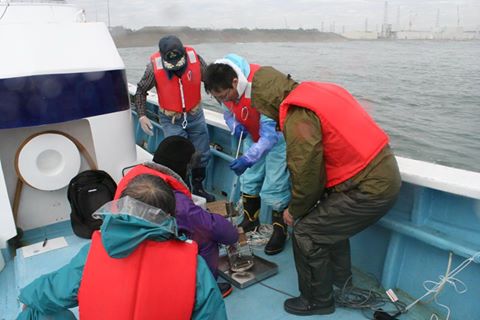
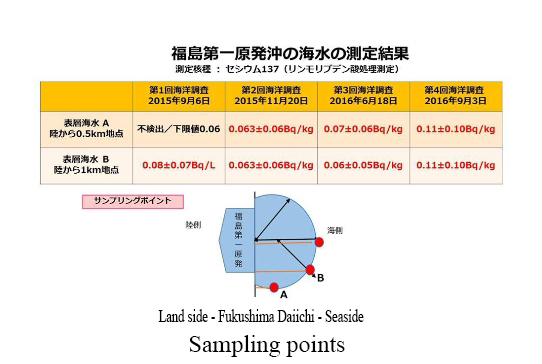
Results of seawater testing off the Fukushima Daiichi Nuclear Plant by Tarachine, the Mother’s Radiation Lab & Clinic of Iwaki, Fukushima
Item measured: Cesium 137 (method by treatment with phosphomolybdic acid)

https://www.actbeyondtrust.org/campaign/pledge/tarachine/jp/
1 This Month

of the week – Shut Down Drone Warfare!


Tell the Ukrainian Government to Drop Prosecution of Peace Activist Yurii Sheliazhenko

Petition to revoke the licensing of the Near Surface Nuclear Disposal Facility (NSDF) at Chalk River. https://www.ourcommons.ca/petitions/en/Petition/Details?Petition=e-7247
To see nuclear-related stories in greater depth and intensity – go to https://nuclearinformation.wordpress.com
-
Archives
- April 2026 (114)
- March 2026 (251)
- February 2026 (268)
- January 2026 (308)
- December 2025 (358)
- November 2025 (359)
- October 2025 (376)
- September 2025 (257)
- August 2025 (319)
- July 2025 (230)
- June 2025 (348)
- May 2025 (261)
-
Categories
- 1
- 1 NUCLEAR ISSUES
- business and costs
- climate change
- culture and arts
- ENERGY
- environment
- health
- history
- indigenous issues
- Legal
- marketing of nuclear
- media
- opposition to nuclear
- PERSONAL STORIES
- politics
- politics international
- Religion and ethics
- safety
- secrets,lies and civil liberties
- spinbuster
- technology
- Uranium
- wastes
- weapons and war
- Women
- 2 WORLD
- ACTION
- AFRICA
- Atrocities
- AUSTRALIA
- Christina's notes
- Christina's themes
- culture and arts
- Events
- Fuk 2022
- Fuk 2023
- Fukushima 2017
- Fukushima 2018
- fukushima 2019
- Fukushima 2020
- Fukushima 2021
- general
- global warming
- Humour (God we need it)
- Nuclear
- RARE EARTHS
- Reference
- resources – print
- Resources -audiovicual
- Weekly Newsletter
- World
- World Nuclear
- YouTube
-
RSS
Entries RSS
Comments RSS
 nuclear-news