The American point of view on USA-Russia crisis over Syria
Throughout her campaign, Clinton has repeatedly called for a no-fly or “safe zone” for Syrian civilians, without providing a detailed explanation as to what that would entail. But her advisors have suggested that it could involve the United States shooting down Syrian aircraft, forcing Russia to choose between defending Assad or working with Washington. In discussing the no-fly-zone idea, Clinton has not acknowledged the presence of an advanced Russian S-400 air defense system in Syria, which potentially could be used against U.S. aircraft enforcing a no-fly zone

Putin Throws Out the Old Nuclear Rules, Rattling Washington, FP, Washington and Moscow used to keep arms control separate from other crises around the world. But that era is over and the next president will have to decide how to deal with it. BY , OCTOBER 16, 2016
Russian President Vladimir Putin’s nuclear saber-rattling and military brinksmanship have upended the rules that long governed relations between Moscow and Washington, presenting the United States with a dangerous dilemma.
The next U.S president will inherit an increasingly fraught relationship with Russia in which Washington’s attempts to deter Putin have mostly failed. Moscow’s decision this month to pull out of a landmark agreement on disposing tons of weapons-grade plutonium, coupled with reports last week that Russia deployed new nuclear-capable missiles to Kaliningrad on the Baltic Sea, underscore how Putin is flexing Russia’s power in new and often unpredictable ways.
“It very much feels like we are entering a very troubled and dangerous phase in this bilateral relationship,“ said Julianne Smith, a former senior Pentagon official who oversaw NATO policy and a former senior advisor to Vice President Joe Biden. “The next president will face some big strategic choices,” said Smith, who now advises Democratic presidential candidate Hillary Clinton on Europe and Russia.
In the Kremlin’s decree this month declaring Russia would no longer cooperate with the United States on a 2009 agreement to dispose of weapons-grade plutonium, Moscow said it would consider reviving the agreement only if the United States scaled back its military presence near Russia’s border, lifted all sanctions against Russia, and paid Moscow compensation for the economic losses caused by the sanctions.
When lawmakers last month asked the chairman of the Joint Chiefs of Staff, Gen. Joseph Dunford, about the possibility of the United States setting up a no-fly zone in Syria, he said it “would require us to go to war with Syria and Russia.”
Russia indicates readiness for World War 111- bomb shelters and gas masks
| Putin preps Russians for nuclear war; civilians advised to check bomb shelters and prepare gas masks. INQUSITR, John Thomas Didymus, 15 Oct 16 | |
|
President Vladimir Putin of Russia is sending a clear signal to the U.S. and its Western allies that he is ready for a military showdown with the West over the ongoing clash of geostrategic interests in Syria. Following the spiraling of tensions between Moscow and Washington to their highest since the Cold War, the Russian government has been issuing instructions to civilians through the state-controlled media about what to do in the event that war breaks out with the West and the “Motherland” comes under direct attack.
The Russian authorities have directed civilians to check and familiarize themselves with the nearest bomb shelters and to prepare their gas masks, according to ABC News. Officials have also issued detailed instructions on how to prepare for a nuclear attack and what to do in the event of an attack. The latest disquieting set of instructions to civilians and related actions in recent weeks by the Russian authorities ostensibly in preparation for war have grabbed the attention of global analysts who are scrutinizing them to decipher the underlying motives of the Kremlin. Most analysts believe that despite Moscow’s elaborate and dramatic posturing to the rest of the world that it is preparing for a major global conflict that could involve deployment and use of nuclear arms, Putin is not actually preparing to launch a war against the U.S. and its allies. He is only engaging in tactical responses to ongoing speculation that Washington is considering seriously a plan to launch airstrikes against Syrian government forces. The chain of events that led directly to the present situation was initiated after the U.S. suspended bilateral consultations with the Russians over Syria, with U.S. officials alleging that the Russians had failed to fulfill a commitment to curtail ongoing aerial and ground assaults on the eastern districts of Aleppo held by rebel forces. The U.S. authorities also formally accused the Russian government of waging cyber warfare against U.S. institutions, including the Democratic National Committee (DNC) and the Hillary Clinton campaign, the Inquisitr reported. U.S. intelligence officials later told NBC News that the CIA was preparing to launch a series of retaliatory cyber-attacks against the Russian government. The CIA sources said the attacks were being designed specifically to disable the capacity of the Russians to use cyber warfare to disrupt presidential voting in November. According to NBC News, the CIA sources said the agency “has already begun opening cyber doors, selecting targets and making other preparations for an operation.” “We are sending a message to Putin and that it will be at the time of our choosing, and under the circumstances that will have the greatest impact,” Vice President Joe Biden reportedly said. Tensions rose further following speculation that Washington was planning to launch aerial strikes against the forces of President Bashar Al-Assad in an attempt to stop ongoing assault against Aleppo and force the Syrian government to consider resuming negotiations. Russia reacted to the speculation, warning sternly that the U.S. should consider “the possible consequences” of launching airstrikes against government forces in Syria. The Russian defense ministry threatened that it would shoot down U.S. and coalition jets attempting to launch attacks against forces of Syria’s President Bashar Al-Assad. The Russians warned that they had deployed S-300 VM air defense systems in Syria that have the capability to shoot down U.S. fighter jets. They warned that any airstrikes against Syrian government forces would be construed as an attack against Russian forces on the ground. “Today, the Syrian army has effective S-200, BUK and other air defense systems, which have undergone technical renovation in the past year,” Major General Igor Konashenkov said. “I [also] remind US strategists that air cover for the Russian military bases in Tartus and Hmeymim includes S-400 and S-300 anti-aircraft missile systems, the range of which may come as a surprise to any unidentified flying objects.” The Russian government followed up the stern warnings by stepping up preparations for war and issuing instructions to civilians about how to prepare for a nuclear attack, including what to do in the event of direct attack against the “Fatherland.” “If that [nuclear attack] should one day happen, each of you must know where the nearest bomb shelter is,” the government instructed civilians in a broadcast by the state-controlled NTV. The broadcast also took Russians on a familiarization tour of nuclear bunkers in Moscow and advised civilians to have their gas masks ready. Earlier in the month the authorities had held a large-scale civil defense drill involving 40 million citizens. The authorities issued information about how government would operate in the event of a war and which government bodies would be in charge of different areas of public affairs. image: data:image/svg+xml;base64,PHN2ZyB4bWxucz0naHR0cDovL3d3dy53My5vcmcvMjAwMC9zdmcnIHZpZXdCb3g9JzAgMCA2NzAgNDQzJz48L3N2Zz4= Putin’s government has warned the U.S. that it will shoot down U.S. jets attempting to attack government forces in Syria [Image by Plavevski/Shutterstock] In the midst of the drills, the authorities deployed nuclear-capable Iskander missiles to Kaliningrad on the Baltic Sea, close to the Lithuanian and Polish borders. The move, which rattled the Polish authorities, brought major Western European cities, including Berlin, within reach of Russian nuclear strike. The Defense Minister of Poland Antoni Macierewicz said the Polish authorities were highly concerned about the development and were monitoring the situation. The Russians had earlier conducted a series of ICBM tests in the Sea of Okhotsk and the Barents Sea, RIA Novosti reported. The tensions escalated even further when Putin suddenly canceled a planned visit to France scheduled for October 19, following a row that flared after President Francois Hollande lashed out at Moscow over its role in Syria, the Inquisitr reported. The French government reportedly said it was considering requesting that prosecutors with the International Criminal Court investigate alleged war crimes by Russia and the Syrian government in rebel-held parts of Aleppo. There was widespread bemusement in Russia when news broke soon after the row with France that the Kremlin had issued a directive to state officials to bring home all relatives living abroad. The authorities warned that officials who failed to heed the warning could be overlooked for promotion, the Inquisitr reported. According to analysts, Moscow’s posturing to the rest of the world that it is preparing for war is designed to boost popular support for Putin at home as tensions rise and to signal to the West that Russia will stand its ground in Syria in the event of U.S. intervention. Kremlin strategists apparently believe that sending a strong message that Russia will not back down with regard to its perceived geopolitical interests will dissuade the U.S. and its allies from trying to stop Russian bombing in Syria. Other analysts believe that Russia’s apparent preparation for war, less than four weeks away from the U.S. presidential election, is not a coincidence. It streamlines with the Kremlin’s overall subtle message to Americans to vote for change by electing the Republican presidential candidate Donald Trump rather than the Democratic presidential candidate Hillary Clinton. The Kremlin intends to get the message across to American voters that “a vote for Clinton is a vote for war with Russia,” because Clinton is expected to continue and possibly even intensify the foreign policy drives of the Obama administration that Moscow is bitterly opposed to. http://www.inquisitr.com/3598031/putin-preps-russians-for-nuclear-war-civilians-advised-to-check-bomb-shelters-and-prepare-gas-masks/ |
|
Modi and Putin revive Cold War bond with lucrative agreements between two nations

 India-Russia ties boosted by defence, energy deals, Straits Times, OCT 16, 2016, Modi and Putin revive Cold War bond with lucrative agreements between two nations BENAULIM (India) • Indian Prime Minister Narendra Modi and Russian President Vladimir Putin signed a raft of lucrative defence and energy pacts yesterday following talks aimed at reinvigorating ties between the former Cold War allies.
Mr Modi hailed Mr Putin as an “old friend” after their meeting in the Indian state of Goa, where leaders of Brazil, Russia, India, China and South Africa (Brics) were gathering for a summit.
“Your leadership has provided stability and substance to our strategic partnership,” Mr Modi said alongside Mr Putin at a beachside resort, after officials signed up to 20 agreements between the two nations……..
They also signed an initial agreement on India’s purchase of Russia’s state-of-the-art S400 missile defence system, capable of shooting down multiple incoming missiles, although there were no details on a timeframe for delivery. The system would strengthen India’s defences along its borders with China and Pakistan……..
The leaders also signed a framework agreement to supply more reactors to a nuclear plant in Kudankulam in southern India, which is attempting to reduce its reliance on highly polluting coal for power. Mr Putin said that Russia would be able to build a dozen nuclear reactors in India over the next 20 years to back Mr Modi’s growth strategy for Asia’s third-largest economy, which continues to suffer power shortages………
Mr Modi was expected to hold talks with China’s President Xi Jinping late yesterday, also in the hope of boosting investment and trade. Relations, however, have been frustrated by Beijing’s decision so far to block New Delhi’s entry to a nuclear trade group, among other issues. http://www.straitstimes.com/asia/south-asia/india-russia-ties-boosted-by-defence-energy-deals
The very real threat of Cyber-attacks Against Nuclear Plants
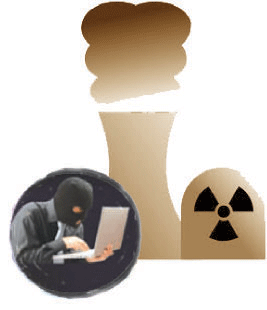 Cyber-attacks Against Nuclear Plants: A Disconcerting Threat INFOSEC Institute, Pierluigi Paganini OCTOBER 14, 2016 A cyber-attack against critical infrastructure could cause the paralysis of critical operations with serious consequences for a country and its population.
In a worst case scenario, a cyber-attack could affect processes that in case of fault could cause serious damages and consequent losses of human lives.
Let’s think for example to a refinery or a nuclear plant, in both cases; a cyber-attack represents a threat to the infrastructure, its processes, and people that work within.
Nuclear plants are critical components of any countries; critical functions depend on their operations, and an incident could have dramatic effects on the population.
Is a cyber-attack against a nuclear plant a possible event?
Unfortunately, the response is affirmative. Nuclear plants are composed of an impressive number of components such as SCADA/ICS, sensors and legacy systems that could be hit by a hacker.
The most popular case of a cyber-attack against a nuclear plant is Stuxnet, which was launched more than five years ago. Stuxnet is the malware developed by experts from the US and Israel with the intent of destroying the Iranian nuclear program. Nation state hackers hit the plant of Natanz in Iran in 2010 interfering with the nuclear program of the Government of Teheran.
The Stuxnet targeted a grid of 984 converters, the same industrial equipment that international inspectors found out of order when visited the Natanz enrichment facility in late 2009.
The cyber-attack against the Cascade Protection System infects Siemens S7-417 controllers with a matching configuration. The S7-417 is a top-of-the-line industrial controller for big automation tasks. In Natanz, it is used to control the valves and pressure sensors of up to six cascades (or 984 centrifuges) that share common feed, product, and tails stations” states “A Technical Analysis of What Stuxnet’s Creators Tried to Achieve” written by the expert Ralph Langner.
Stuxnet was designed with a number of features that allowed to evade detection; its source code was digitally signed, and the malware uses a man-in-the-middle attack to fool the operators into thinking everything is normal.
Stuxnet is the demonstration that it is possible to use a malicious code to destroy operations at a nuclear plant.
In the last years, security experts and authorities confirmed at least three cases of cyber-attacks against Nuclear plants.
Who are the threat actors that could hit a nuclear plant?
There are many actors, such as cyber criminals, hacktivists, nation-state actors, cyber terrorists and script kiddies, that are threatening critical infrastructure worldwide
Let’s see which are the principal incidents that affected nuclear plants in the last years.
The incidents
According to the Director of the International Atomic Energy Agency (IAEA), Yukiya Amano, a nuclear power plant in Germany suffered a “disruptive” cyber-attack two to three years ago……..
This isn’t the first time that we receive the news of cyber-attacks on nuclear plants. There are three publicly known attacks against nuclear plants:
- Monju NPP (Japan 2014)
- Korea Hydro and Nuclear Power plant (S.Korea 2014)
- Gundremmingen NPP (Germany 2016).
It is likely that Amano was referring the cyber-attack against the Gundremmingen nuclear plant that occurred earlier this year. Security experts, in that case, discovered the presence of the Conficker and Ramnit malware in the target systems……
2014 – Malware based attack hit Japanese Monju Nuclear Power Plant
On January, 2nd 2014 one of the eight computers in the control room at Monju Nuclear Power Plant in Tsuruga, Japan, was compromised by a cyber-attack. The local IT staff discovered that the system in the reactor control room had been accessed over 30 times in a few days. The experts observed the intrusion started after an employee updated a free video playback application running on one of the computers in the plant…….
Cyber-attacks against the organizations operating in the Energy industry were already observed in the past, in 2012 the Japan Atomic Energy Agency was targeted by a cyber-attack that compromised a computer at the JAEA headquarters at Tokaimura by infecting it with malware.
2014 – Nuclear plant in South Korea hacked
In December 2014, the South Koran government revealed that a nuclear plant in the country was hacked. …..
2016 – A malware infected systems at the Gundremmingen nuclear plant in Germany
In April 2016, the German BR24 News Agency reported the news of a computer virus that was discovered at the Gundremmingen nuclear power plant in Germany……..The experts involved in the investigation discovered the presence of the Conficker and W32.Ramnit malware in unit B of the Gundremmingen. Conficker is worm with the ability of rapidly spreading through networks, while W32.Ramnit is a data stealer.
The RWE also added that malware had been found on 18 removable data drives, mainly USB sticks, in office computers maintained separately from the plant’s operating systems………
Conclusions
Cyber-attacks against nuclear power plants and industrial control systems are probably at the top of a long list of potential  disasters that can be caused by hackers.
Stuxnet, which targeted nuclear power plants in Iran, is still the most widely publicized threat against such systems.
Security experts are aware of the possibility that hackers could cause serious problems to these critical infrastructures worldwide, for this reason, several governments already launched internal assessments of their infrastructure.
This summer, the European Parliament has passed the new network and information security (NIS) directive that establishes minimum requirements for cyber-security on critical infrastructure operators. http://resources.infosecinstitute.com/cyber-attacks-against-nuclear-plants-a-disconcerting-threat/
Pentagon detects a failed North Korean nuclear test launch
US Pentagon detects a failed North Korean nuclear test launch, news.com.au 16 Oct 16 THE US military has detected a failed North Korean test launch of an intermediate ballistic missile near the northwestern city of Kusong, the Pentagon says.
“We strongly condemn this and North Korea’s other recent missile tests,” said US Navy Commander Gary Ross, a Pentagon spokesman.
“We intend to raise our concerns at the UN to bolster international resolve in holding the DPRK accountable for these actions.” Ross said the US commitment to the defence of its allies in the region, including South Korea and Japan, was “iron-clad” in the face of such North Korean actions.
The missile to be launched by North Korea was a Musadan intermediate-range ballistic missile. In August, North Korea said it would turn the US and South Korea into a ‘heap of ash’ if provoked………
The failed nuclear test launch followed the fifth and biggest launch of its kind in September by one of world’s most secretive societies, governed by communist dictator Kim Jong-un.
There had been speculation that Jong-un could mark the 10 October anniversary of the founding of its Workers’ party with a sixth detonation. http://www.news.com.au/world/asia/us-pentagon-detects-a-failed-north-korean-nuclear-test-launch/news-story/849a066713be509ffd775b0cc0462aff
Nuclear weapons transports through Lancashire a safety risk
 Is Lancashire ‘at risk of nuclear contamination’? Langashire Evening Post , 12 Oct 16 Nuclear convoys carrying warheads routinely drive on the M6. If one crashed, or was attacked by terrorists, more than 260,000 people could be in danger of contamination, according to a new report. Nuclear bomb convoys on the M6 are putting more than a quarter of a million people at risk from radioactive contamination in Lancashire, according to a report by campaigners.
Russia anxious to sell huge amount of nuclear technology to India
 Russia to Continue Assisting India in Developing Nuclear Energy Industry (Sputnik) – Russia will go on providing assistance to India in developing nuclear energy industry, Russian President Vladimir Putin said Saturday after signing a set of documents on cooperation with India as he met with Indian Prime Minister Narendra Modi. https://sputniknews.com/news/201610151046360579-russia-india-nuclear-energy/
For auction – Abandoned nuclear reactor complex in Alabama
TVA sets auction date for Bellefonte nuclear power plant, Abandoned twin-reactor complex in Alabama to go on block Nov. 14, Times Free Press,
TVA said Friday it has set an auction date of Nov. 14 at 9 a.m. central time to sell its unfinished Bellefonte nuclear power plant. Concentric Energy Advisors Inc., a property consulting firm TVA hired this spring to market the 1,400-acre power plant site on the Tennessee River in Hollywood, Ala., will conduct the sale at the plant site.
TVA directors declared the unfinished nuclear plant to be surplus property earlier this year — 43 years after construction began on the twin-reactor complex. TVA said in a statement Friday the “primary goal in selling the site is to provide the best long-term economic return to the surrounding communities.” The minimum bid price is $36.4 million, which is the appraised value of the riverfront property, but the bids will be evaluated on both the price offered and the economic gains any sale would generate for the region.
TVA has invested more than $5 billion in capital and interest costs at Bellefonte since work began on two Babcock and Wilcox reactors in 1973. Work was suspended in the 1980s when TVA’s growth in power demand slowed and TVA determined it didn’t need either of the 1,200-megawatt units…….http://www.timesfreepress.com/news/business/aroundregion/story/2016/oct/14/tva-sets-bellefonte-nuclear-plant-auction-date-next-month/392167/
1 This Month

of the week – Shut Down Drone Warfare!


Tell the Ukrainian Government to Drop Prosecution of Peace Activist Yurii Sheliazhenko

Petition to revoke the licensing of the Near Surface Nuclear Disposal Facility (NSDF) at Chalk River. https://www.ourcommons.ca/petitions/en/Petition/Details?Petition=e-7247
To see nuclear-related stories in greater depth and intensity – go to https://nuclearinformation.wordpress.com
-
Archives
- March 2026 (251)
- February 2026 (268)
- January 2026 (308)
- December 2025 (358)
- November 2025 (359)
- October 2025 (376)
- September 2025 (257)
- August 2025 (319)
- July 2025 (230)
- June 2025 (348)
- May 2025 (261)
- April 2025 (305)
-
Categories
- 1
- 1 NUCLEAR ISSUES
- business and costs
- climate change
- culture and arts
- ENERGY
- environment
- health
- history
- indigenous issues
- Legal
- marketing of nuclear
- media
- opposition to nuclear
- PERSONAL STORIES
- politics
- politics international
- Religion and ethics
- safety
- secrets,lies and civil liberties
- spinbuster
- technology
- Uranium
- wastes
- weapons and war
- Women
- 2 WORLD
- ACTION
- AFRICA
- Atrocities
- AUSTRALIA
- Christina's notes
- Christina's themes
- culture and arts
- Events
- Fuk 2022
- Fuk 2023
- Fukushima 2017
- Fukushima 2018
- fukushima 2019
- Fukushima 2020
- Fukushima 2021
- general
- global warming
- Humour (God we need it)
- Nuclear
- RARE EARTHS
- Reference
- resources – print
- Resources -audiovicual
- Weekly Newsletter
- World
- World Nuclear
- YouTube
-
RSS
Entries RSS
Comments RSS
 nuclear-news