New Power Firms to Pay Some of the Decommissioning Costs

New power firms may have to pay some costs for nuke reactor decommissioning
The Economy, Trade and Industry Ministry has begun discussions on a plan to have new smaller electric power companies shoulder part of the costs of decommissioning nuclear reactors, officials said.
This is due to fears that nine major power companies that operate nuclear plants and the Japan Atomic Power Co. alone cannot fully foot the costs of decommissioning their reactors in the future.
The government intends to draw a conclusion on the plan by the end of the year, but the move could spark criticism that nuclear plant operators would be given preferential treatment.
The industry ministry convened the first meeting of an advisory panel on electric power system reform on Sept. 27 to discuss challenges to the liberalization of the power market. At the meeting, the ministry proposed that the costs of decommissioning nuclear reactors be added to power grid usage fees that new power supplies pay to major utilities.
If new power companies add the costs of reactor decommissioning to electricity charges, consumers will be required to shoulder such additional costs.
The industry ministry has worked out the plan, which could be viewed as a relief measure for major utilities, because the business environment surrounding these companies has worsened following the liberalization of the power market and criticism of nuclear power in the wake of the outbreak of the Fukushima nuclear crisis.
The costs of decommissioning a nuclear reactor are about 10 times that for a thermal power generator. The operators of nuclear plants use part of their income from electricity charges to save enough money to dismantle their reactors in the future.
However, if the liberalization of the electricity market progresses, a growing number of consumers could switch to new power suppliers and the prices of electric power could further decline because of intensifying competition, making it more difficult for major utilities to secure enough funds to decommission their nuclear reactors.
The suspension of operations at most atomic power stations is also adversely affecting major power companies.
Power companies could secure enough funds to decommission nuclear reactors if they saved money on the assumption that the rate of utilizing such plants stood at 76 percent and that the lifespan of each reactor was 40 years.
However, the suspension of operations at many nuclear plants has been prolonged and power companies are being forced to decommission some reactors earlier than planned, as a result of which they have been unable to secure enough funds.
Under these circumstances, major power companies are insisting that new power companies should shoulder part of the decommissioning costs.
“Customers of new electric power firms previously used power generated by nuclear plants operated by major utilities. We would like these customers to shoulder a fair share of the costs for reactor decommissioning,” an official of one major power company said.
Major power suppliers have asked the executive branch of the government and ruling Liberal Democratic Party (LDP) legislators to consider their requests.
The government has shown consideration to major power companies that are being forced to shoulder the expenses of changes in Japan’s energy policy — such as market liberalization and stepped up safety regulations — following the outbreak of the Fukushima nuclear crisis in 2011.
A working group within an advisory committee to the industry ministry called on the government in March 2015 to consider a system that would take advantage of the pricing system for power transmission and distribution to help power companies cover decommissioning costs.
However, new power suppliers are opposed to the move. “It’d be unreasonable for new electric power companies that don’t have nuclear plants to shoulder the costs of those facilities,” said an executive of a Kansai-based new power supplier.
Ennet Corp. President and CEO Tsutomu Takeda told the panel on Sept. 27, “We can’t convince our customers unless you (the government and major power companies) explain how much it will cost to decommission a reactor.”
An executive of a new power company based in the Tokyo metropolitan area said, “It’d be difficult to gain understanding from our customers who have switched from major power companies following the outbreak of the nuclear disaster.”
In response, the industry ministry will consider setting up a market in which power is traded and encouraging major utilities to supply less expensive power generated by nuclear power and coal-fired thermal power plants to the market. The ministry is aiming to allow new power companies to procure less expensive power from the power transaction market in a bid to persuade them to shoulder part of the costs of decommissioning nuclear reactors.
Under the old power supply system in which major utilities enjoyed regional monopolies, power companies were able to secure funds to build and decommission nuclear plants solely by using electricity charges, allowing them to take advantage of low fuel costs for nuclear plants.
With the liberalization of the power market, however, nuclear power plants have lost their edge.
The government has postponed discussions on whether to go ahead with the construction of new nuclear power plants.
The system proposed lately could give preferential treatment to nuclear plants and encourage power companies to build more atomic power stations.
In-depth debate needs to be held on whether nuclear plants will be consistent with the policy of liberalizing the power market.
http://mainichi.jp/english/articles/20160928/p2a/00m/0na/015000c
Related article from September 8, 2016
Gov’t may shift nuke accident, reactor decommissioning costs onto new power suppliers
The government is moving to bill new electricity suppliers for a portion of nuclear reactor decommissioning costs and compensation payments related to the Fukushima nuclear disaster, it was learned on Sept. 7.
After decades under regional utility monopolies, the electricity supply market was opened to competition in April this year. The government apparently fears that the old monopolies such as Tokyo Electric Power Co. (TEPCO) lose too many customers to new suppliers and they may no longer be able to cover the high costs of decommissioning old reactors or compensate the victims of nuclear accidents, hence the move to shift some of the financial burden onto new market entrants.
However, these costs were originally supposed to be covered by the nine big utilities, and the government’s moves would essentially transfer that burden onto the Japanese people, making a clash more than likely.
Under the current system, large utilities must cover nuclear reactor operating expenses — including eventual decommissioning — from electricity bill income. Also, TEPCO receives monies to cover Fukushima nuclear disaster compensation claims from the government-licensed Nuclear Damage Compensation and Decommissioning Facilitation Corp. (NDF), which is in turn funded by all the large utility companies.
The new system being considered by the government would spread the financial burden of nuclear accident compensation and reactor decommissioning to new electricity suppliers, lightening the load on the big utilities. The government estimates the total cost for reactor decommissioning plus Fukushima nuclear disaster compensation paid before the NDF was established at some 8 trillion yen. The new power suppliers would likely pass on their share of these costs to their customers, resulting in monthly power bills up to about 200 yen higher than at present for an average three-person household.
However, forcing customers of the new electricity firms to pay for the old utilities to decommission their reactors and for TEPCO’s nuclear disaster liabilities runs counter to the goals of liberalizing the electricity market, which was intended to push down prices through competition. It would also in essence be corporate welfare for the big utilities operating nuclear plants.
A sub-committee to debate the new system will be established under the Advisory Committee for Natural Resources and Energy reporting to the minister of economy, trade and industry. The committee will decide on what direction to take by the end of this year, with an eye to submitting a bill to revise the Electricity Business Act to the ordinary Diet session next year.
http://mainichi.jp/english/articles/20160908/p2a/00m/0na/006000c
Debris recovery operation in sea carried out for first time since Fukushima nuclear disaster
The Japan Today article cites it as tsunami debris but it would also include debris from the reactor explosions at the plant. Pieces from these explosions have been found as far inland as Naraha. Why this work had not been done sooner was not mentioned.
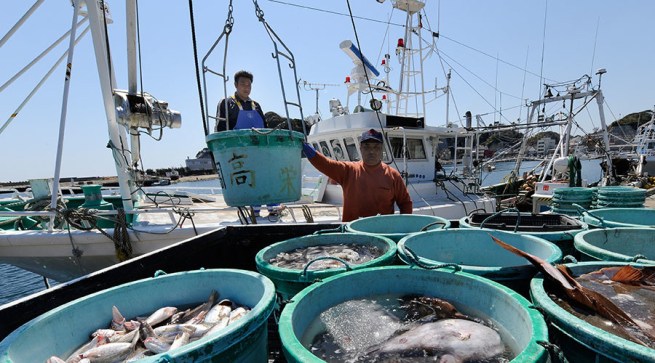
Japan performs tsunami debris cleanup off Fukushima 1st time since nuclear disaster
Local fisheries have begun a debris cleanup near the Fukushima plant for the first time since the tsunami-triggered nuclear disaster. However a plan to start trial fishing next year may face a setback as a nearly-completed ice wall is failing to halt water contamination.
On March 11, 2011, a magnitude-9 earthquake struck northeastern Japan at 2:46pm local time, unleashing a deadly tsunami. Less than an hour after the earthquake, the first of many tsunami waves hit Japan’s coastline. The tsunami waves reached heights of up to 39 meters (128 feet) at Miyako city and reached as far as 10 km (6 miles) ashore in Sendai, destroying everything in its wake. More than 15,000 people died.
At the Fukushima Daiichi Nuclear Power Plant, the tsunami caused a cooling system failure resulting in a nuclear meltdown and the release of radioactive materials. The waves forced the failure of electrical power and backup generators, leading the plant to lose its cooling capabilities. The retreating water sucked a vast amount of rubble into the depths of the Pacific Ocean, contaminating the traditional fishing grounds of the local companies.
Five years after the disaster a cleanup effort to remove the debris has finally been launched by collectives of local fishermen, who aim to start trial fishing expeditions within the area from 5 kilometers (3 miles) to 20 km (12 miles) off the wrecked plant.
On Monday Soma-Futaba Fisheries Cooperative Association send out 32 fishing boats to recover debris from the ocean floor. That fleet is focusing their efforts on the North side of the nuclear power plant.
On Tuesday, the Iwaki City Fisheries Cooperative Association also sent in their fleet to help with the cleanup efforts of the southern side of the contaminated segment.
Once the debris is pulled out and delivered to shore, the unloading of the waste is handled by the industrial waste treatment company. The rubble is then sent to a temporary storage facility where after an inspection for radioactive reading, cleared waste is disposed of in an industrial manner. It is as of yet unclear how the contaminated waste will be treated.
The cleanup work of the seabed endorsed by the Fisheries Agency is scheduled to last at least until February of next year. Fishing on a trial basis can start as early as March.
However such a prospect seem problematic as the recently-completed ice wall around the crippled station has failed to meet expectations, with contaminated groundwater still seeping into the sea.
The $320 million Land-Side Impermeable Wall was built to halt an unrelenting flood of groundwater into the damaged reactor buildings and consequent flow of the contaminated water into the ocean.
But on Tuesday the Japanese government and plant operator Tokyo Electric Power Co. reported that 1.5 km (1 mile) barrier frozen barrier failed to produce the intended results, Nikkei reported.
While gaps still remain in some sections of the ocean-facing side of the wall, TEPCO believes that the inflows that penetrate the contaminated reactor are concentrated at seven unfrozen sections on the inland side.
A similar concern was voiced last month by the operator which claimed that 99 percent of the wall’s is mostly solid and frozen. However, a remaining one percent showed temperatures of the barrier above the freezing point, meaning that the contamination is not fully contained.
TEPCO has been repeatedly facing criticism for the handling of the Fukushima crisis. Despite the ongoing problems encountered following the meltdowns, the company has set 2020 as the goal for ending the plant’s water problem.
The problem of water contamination however is just one of many surrounding the dismantling and decommissioning of the Fukushima plant debris which is estimated to take at least 40 years.
“We will continue to move forward with the decommissioning and contaminated water management in a transparent way, visible to the world, and will also share with the international community the lessons learned from this accident,” Hirotaka Ishihara, state minister of the cabinet office of Japan, told the International Atomic Energy Agency’s 60th General Conference earlier this week.
“We are also making ongoing efforts to ensure the safety of food produced in Japan,” he added. “Recognizing that many countries have already lifted restrictions on food imports from Japan, we encourage the international community to implement import policies based on scientific evidence.”
https://www.rt.com/news/360879-fukushima-fishery-cleanup-debris/#.V-s-7I2uaW0.facebook
Debris recovery operation in sea carried out for first time since Fukushima nuclear disaster
FUKUSHIMA — For the first time since the 2011 nuclear crisis at the Fukushima Daiichi power plant, the removal of debris in seawater located up to 20 km from the plant site has finally started.
The recovery operation, which began Monday, focuses on the removal of rubble in seawater within 5 to 20 km of the wrecked plant, Sankei Shimbun reported.
Five and a half years after the disaster, fishing has yet to be carried out in these waters while tsunami debris on the ocean floor near the Fukushima plant has remained untouched.
With an aim to start trial fishing operations within this targeted cleanup area, the Soma-Futaba Fisheries Cooperative Association employed 32 fishing boats to recover debris such as driftwood and gill nets on Monday.
Following suit, from Tuesday, the Iwaki City Fisheries Cooperative Association started debris removal operations and will continue the cleanup efforts until February of next year.
Donald Trump’s lies about his climate change beliefs
At the Hofstra University debate, Democratic nominee Hillary Clinton challenged Trump’s stance on the environment stating, “Donald thinks that climate change is a hoax perpetrated by the Chinese. I think it’s real.” Trump quickly interrupted her with “I did not, I do not say that.”
Not only was this a lie—one social media users quickly fact-checked—but Trump has also said that, if elected, he would implement a decidedly anti-climate platform that includes weakening the U.S. Environmental Protection Agency (EPA); abolishing President Barack Obama’s Clean Power Plan, without which the U.S. has little chance of meeting its Paris climate pledge; promoting increased fossil fuel exploration; and employing oil and gas executives, including high-profile climate skeptic Myron Ebell, to lead his cabinet.
The outcry from Trump’s many denials prompted his campaign manager, Kellyanne Conway, to tell CNN‘s Alisyn Camerota that the GOP nominee does, in fact, believe in climate change—he just doesn’t believe it’s caused by humans.
“He believes that global warming is naturally occurring,” Conway said. “There are shifts naturally occurring.”
That, too, is scientifically false. In fact, 97 percent of scientists agree that climate change is real and man-made.
In fact, Trump’s climate stance appears to be too unrealistic for even his running mate to get behind. Vice presidential nominee and Indiana Governor Mike Pence, who is well known for his staunchly right-wing policies, said Tuesday there is “no question” that human activity affects the environment.
In a separate appearance on CNN, Pence said, “Let’s follow the science…There’s no question that the activities that take place in this country and in countries around the world have some impact on the environment and some impact on climate.”
US presidential debate: Donald Trump’s $1 trillion error about nuclear weapons
Donald Trump made a $1 trillion error about nuclear weapons during the first presidential debate, Business Insider, PAUL SZOLDRA SEP 28, 2016, Donald Trump made a $1 trillion error when talking about the US military’s nuclear arsenal during Monday’s presidential debate.
After Lester Holt asked whether he would be against using a “nuclear first strike” — the idea of using nukes preemptively — the Republican presidential nominee first answered by criticising the US military’s existing nuclear weapons programs.
“Russia has been expanding their — they have a much newer capability than we do. We have not been updating from the new standpoint. I looked the other night. I was seeing B-52s, they’re old enough that your father, your grandfather could be flying them. We are not — we are not keeping up with other countries.”
But the idea that the US is not keeping up with Russia, or any other country in regards to nuclear weapons, is wrong.
One trillion dollars wrong.
That’s because in November 2015, a fighter jet dropped an unarmed “nuclear gravity bomb” at a Nevada test range called the B61-12, a new weapon costing around $8.1 billion.
The pricey new bomb is actually less than 1% of a $1 trillion push to keep the US nuclear arsenal up-to-date. Officials also say the program will actually help reduce the number of nukes in the world.
In reality, both the US and Russia have been reducing and updating their nuclear stockpiles since 2010. And the mighty B-52 Stratofortress that Trump derided has been continually upgraded since it was first introduced in 1955 — so much so that the Air Force is confident it will keep on running until 2040.…….http://www.businessinsider.com.au/donald-trump-nuclear-weapons-2016-9?r=US&IR=T
Both Russia and America Prepare for Nuclear War? (and this is ‘good for business’)
Dangerous Crossroads: Both Russia and America Prepare for Nuclear War? http://www.globalresearch.ca/dangerous-crossroads-both-russia-and-america-prepare-for-nuclear-war/5548074 By Prof Michel Chossudovsky Global Research, September 27, 2016 Barely acknowledged by the Western media. both Russia and America are “rearming” their nuclear weapons systems. While the US is committed to a multibillion dollar modernization project, Russia is largely involved in a “cost-effective” restructuring process which consists in decommissioning parts of its land-based ICBM arsenal (Topol) and replacing it with the more advanced Yars RS-24 system, developed in 2007.
Rest assured, the B61-12 is a “mini-nuke” with an explosive capacity of up to four Hiroshima bombs. It is categorized as a “defensive” (peace-making) weapon for use in the conventional war theater. According to scientists on contract to the Pentagon, the B61-11 and 12 (bunker buster bombs with nuclear warheads) are “harmless to civilians because the explosion is underground”.
The nuclear triad modernization project is at the expense of US tax payers. It requires the redirection of federal revenues from the financing of “civilian” expenditure categories (including health, education, infrastructure etc) to the “war economy”. It’s all for a good cause: “peace and security”.
 War is “Good for Business”
The multibillion dollar project is a financial bonanza for America’s major defense contractors including Boeing, Lockheed Martin and Northrop Grumman, which are also firm supporters of Hillary Clinton’s stance regarding a possible first strike nuclear attack against Russia, China, Iran and North Korea.
Reported by Defense News, US Secretary of Defense Ash Carter on September 26 called for the “need to modernize all three legs of the nuclear triad.” The project would require a major boost in defense expenditure.
Underscoring today’s “volatile security environment”, the multibillion dollar project is required, according to Carter, in view of threats largely emanating from Russia, China as well as North Korea:
Carter’s comments came during a visit to Minot Air Force Base in North Dakota, … Under the fiscal year 2017 budget request, Carter said, the department pledged $19 billion to the nuclear enterprise, part of $108 billion planned over the next five years. The department has also spent around $10 billion over the last two years, the secretary said in prepared comments. The “nuclear triad” references the three arms of the US strategic posture — land-based ICBMs, airborne weapons carried by bombers, and submarine-launched atomic missiles. All of those programs are entering an age where they need to be modernized.
Pentagon estimates have pegged the cost of modernizing the triad and all its accompanying requirements at the range of $350 to $450 billion over the next 10 years, with a large chunk of costs hitting in the mid-2020s, just as competing major modernization projects for both the Air Force and Navy come due.
Critics of both America’s nuclear strategy and Pentagon spending have attempted to find ways to change the modernization plan, perhaps by cancelling one leg of the triad entirely.But Carter made it clear in his speech that he feels such plans would put America at risk at a time when Russia, China and North Korea, among others, are looking to modernize their arsenals. (Defense News, September 26, 2016)
Carter casually dismissed the dangers of a no-win global war, which could evolve towards a “nuclear holocaust”, Ironically ”… He also hit at critics of the nuclear program — which include former Secretary of Defense William Perry, [who ironically is] widely seen as a mentor for Carter — who argue that investing further into nuclear weapons will increase the risk of atomic catastrophe in the future. (Defense News, September 26, 2016)
Carter expressed his concern regarding Russia’s alleged “nuclear saber-rattling”.
Russia’s ICBM System
Were Carter’s timely statements in response to Russia redeployment and restructuring of its ICBM system on its Western frontier, which were announced on September 20?
Last week, the Russian news agency Tass confirmed that “The westernmost strategic missile force division in the Tver region will soon begin to be rearmed with the missile system Yars.”
It will be a sixth strategic missile division where the newest mobile ground-based missile complexes will replace the intercontinental ballistic missile Topol,” the press-service of the Strategic Missile Force quotes its commander Sergey Karakayev as saying.
According to the official, this year regiments in the Irktusk and Yoshkar-Ola divisions began to be rearmed. The re-armament of the Novosibirsk and Tagil divisions is nearing completion. Earlier, the Teikovo division was fully rearmed.
The final decision to rearm the strategic missile division in the Tver Region will be made after a command staff exercise there. The press-service said the exercises will be devoted to maneuvering along combat patrol routes.
In the near future the ICBM RS-24 Yars, alongside the previously commissioned monoblock warhead ballistic missile RS-12M2 Topol-M, will constitute the backbone of Russia’s strategic missile force.
The Yars ICBM RS-24 was developed in 2007 in response to the US Missile Shield. It is nothing new in Russia’s military arsenal. It is a high performance system equipped with thermonuclear capabilities.
What this report suggests is the restructuring of Russia’s strategic missile force and the replacement of the Topol system (which Moscow considers obsolete) with the Yars ICBM RS-24.
Confusion in South Africa- doubts about request for proposals for the procurement of nuclear power
WILL JOEMAT-PETTERSSON ISSUE REQUEST FOR PROPOSALS FOR PROCUREMENT OF NUCLEAR POWER? The request for proposals would mark the official start of South Africa’s nuclear build programme. Eyewitness News, Gaye Davis , 27 Sept 16 CAPE TOWN – Doubt has been cast on whether the request for proposals for the procurement of nuclear power will be issued on Friday as promised by Energy Minister Tina Joemat-Pettersson.

The request for proposals would mark the official start of South Africa’s nuclear build programme, which President Jacob Zuma has made a top priority but which has been shrouded in secrecy and is the subject of much controversy.
Science and Technology Minister Naledi Pandor says she doesn’t believe Joemat-Pettersson will be able to go ahead because the government’s Integrated Resource Plan (IRP) has yet to be updated.
The IRP forecasts the country’s energy demand, spells out generation plans and determines the required mix of energy sources.
Pandor was answering questions at a briefing by economics cluster ministers this afternoon.
Joemat-Pettersson told Parliament on 7 September the nuclear programme would kick off this Friday with the formal issuing of a request for proposals. But Pandor told journalists this afternoon she wasn’t certain the call for proposals could proceed this week.
Pandor says the next economics cluster meeting of Cabinet is set to discuss the versions of both the IRP, which projects energy demand and ways of meeting it, as well as the integrated energy plan – a kind of roadmap for energy provision………http://ewn.co.za/2016/09/27/Will-Joemat-Pettersson-issue-request-for-proposals-for-procurement-of-nuclear-power
Widespread public mistrust f South African government’s nuclear power plans
 Fears mount over true motivations for SA’s planned nuclear deal, Mail and Guardian, Hartmut Winkler 27 Sep 2016 Nuclear energy in South Africa is a very contentious issue. The decision on whether to proceed with the construction of a fleet of nuclear power plants is destined to become the financially most far-reaching and consequential defining moment of the Jacob Zuma presidency.
There is widespread public mistrust of the nuclear expansion process. Its roots lie in the extraordinary announcement in 2014 that the Russian nuclear agency Rosatom had secured therights to build the new South African nuclear plants. The South African government played down the announcement, claiming that it was inaccurate.
But this precipitated a series of media investigations. These uncovered evidence that individuals close to the president and groups linked to the ruling ANC have significant financial interests in the matter.
Civil society organisations are taking government to court in an attempt to have the deal declared illegal. Their attempts to have details of the Russian agreement released are being resisted. This is likely to strengthen their case, and sway public opinion further.
It appears that those with a stake in the nuclear build are hoping to fast-track the process in the face of growing public opposition. This is evident from revelations that, bizarrely, contracts are being awarded, even though a formal process has not been set in motion by government.
The meaning of this is unclear. It has largely confirmed the fears that the nuclear build is being driven for the benefit of the politically connected rather than the national good.
Burning questions
The debate surrounding the nuclear project centres on three highly contested questions:
- Is the country’s future energy generating potential and demand such that an expensive nuclear power station build is effectively unavoidable?
- Can South Africa afford the associated costs and debt, especially in view of massive funding demands in other sectors such as education?
- If approved, would the nuclear build lead to massive overspends, corruption and beneficiation ofpolitically connected individuals?…….
it is difficult to understand why the renewable fraction is not being increased further, and why the national power utility Eskom, under the leadership of Brian Molefe, a nuclear disciple, now opposes new renewable energy developments.
The promotion of nuclear energy at the expense of renewables bucks global trends………
The ANC’s internal nuclear war
The often obscure processes and overhasty developments require an insight into the present machinations within the governing party.
Tensions within the ruling party have escalated to the point where calls for the president’s resignation are now made openly. And even party leaders acknowledge that factions in their ranks are thriving on corruption.
The organisational fracture is equally evident in attitudes towards the nuclear build. Tensions over the issue have been cited as the major reason for Zuma’s dismissal of the financially prudent former Finance Minister Nhlanhla Nene in December 2015.
The official position…….
the legitimacy of the procurement process has already been undermined.
Looking ahead, actual construction would need to be preceded by the closure of funding agreements, the settling of legal disputes and further public engagement. This takes time.
In the unlikely event that the nuclear build actually does come to fruition, it will not commence any time soon.
Hartmut Winkler, Professor of Physics, University of Johannesburg
This article was originally published on The Conversation. Read the original article. http://mg.co.za/article/2016-09-27-questions-mount-over-south-africas-planned-nuclear-power-deal
No fact checking for moderator in USA’s presidential debates!
 Presidential Debates Commission Makes Outrageous Statement: Fact Checking Is Off The Table, Bipartisan Report By Sarah MacManus –September 25, 2016, In a mind-boggling statement on CNN’s Reliable Sources on Sunday, Janet Brown, executive director of the Commission on Presidential Debates told host Brian Stelter that fact checking isn’t the duty of the moderator. In fact, she said candidates should fact check each other.
With the issue of honesty being such an influential factor in the 2016 election, it’s difficult to believe that the chief is taking this stand. Both candidates have been accused of and found to have issues with twisting the truth, and Donald Trump is a particularly egregious example.
Brown’s reasoning is even more confusing:
‘I think personally if you start getting into fact checking, I’m not sure. What is a big fact? What is a little fact? And if you and I have different sources of information does your source about the unemployment rate agree with my source? I don’t think it’s a good idea to get the moderator into essentially serving as the Encyclopedia Britannica.’
But recently, both candidates have been called to the carpet for serial falsehoods. Donald Trump, the Republican nominee, was analyzed by POLITICO and found to lie every three minutes and 15 seconds over “nearly five hours of remarks.” By tallying up the approximate amount of time that Trump spoke and was interviewed, four hours and 43 minutes, they found he issued 87 separate falsehoods.
POLITICO also fact checked Hillary Clinton, the Democratic nominee, and found that her falsehoods usually only involved herself and her own behavior, including her handling of her pneumonia scare on September 11. POLITICO clocked Clinton in at 96 minutes of speaking, with eight falsehoods.
According to Brown, the commission “asks independent, smart journalists to be the moderators and we let them decide how they’re going to do this.”……..http://bipartisanreport.com/2016/09/25/presidential-debates-commission-makes-outrageous-statement-fact-checking-is-off-the-table/
Modernising America’s nuclear weapons: next President will face $1 trillion price tag
The $1 trillion price tag of modernizing America’s nuclear weapons falls to the next president, Business Insider Yeganeh Torbati, Reuters “………..-budget constraints almost certainly will force the next president to decide whether and how quickly to proceed with the Obama administration’s plans to maintain and modernize the US nuclear arsenal.
Crunch time
The crunch comes in the next decade as American ballistic missile submarines, bombers, and land-based missiles – the three legs of the nuclear triad – reach the end of their useful lives.
The Congressional Budget Office estimates the total cost of nuclear forces through 2024 at $348 billion, but that does not include some of the costliest upgrades, scheduled for the latter half of the next decade. Independent estimates have put the cost of maintaining and modernizing the arsenal at about $1 trillion over 30 years.
“There’s a bipartisan commitment to doing that upgrade, so we have to assume those funds will come through,” Energy Secretary Ernest Moniz told Reuters on Sept. 20. “But it will be a significant budget increase, especially in the next decade.”
The Energy Department shares responsibility with the Pentagon for the nuclear arsenal, and some of its research and production facilities are 73 years old.
The next administration could abandon or delay some aspects of modernization to cut costs. Or it could raise taxes, increase the budget deficit, or cut domestic programs, all unpopular steps with American voters.
The most vulnerable elements of the modernization plans are a long-range standoff weapon, or LRSO – a nuclear-capable cruise missile launched from an aircraft – and new land-based intercontinental ballistic missiles (ICBMs).
Ten US senators, including Elizabeth Warren of Massachusetts and Bernie Sanders of Vermont, called on President Barack Obama in July to cancel the LRSO, saying it “would provide an unnecessary capability that could increase the risk of nuclear war.”
Some Pentagon officials and defense experts have said the cruise missile would be a hedge against improved air defenses that are difficult for even a stealthy bomber to penetrate……..http://www.businessinsider.com/r-cost-of-modernizing-us-nuclear-weapons-to-fall-to-next-president-2016-9?IR=T
The tragic illusion of nuclear deterrence – the Vatican
Vatican Radio , 26 Sept 16 The Vatican told the United Nations on Monday “nuclear arms offer a false sense of security, and that the uneasy peace promised by nuclear deterrence is a tragic illusion.”
“Nuclear weapons cannot create for us a stable and secure world,” said Archbishop Bernardito Auza, the Permanent Observer of the Holy See to the United Nations.
He was speaking at an event marking the International Day for the Total Elimination of Nuclear Weapons.
“Peace and international stability cannot be founded on mutually assured destruction or on the threat of total annihilation,” the Vatican diplomat said. The full statement of Archbishop Auza can be found below……….http://en.radiovaticana.va/news/2016/09/27/holy_see_peace_of_nuclear_deterrence_a_tragic_illusion/1260960
Hillary Clinton’s track record – a promoter of endless war
A vote today for Hillary Clinton is a vote for endless, stupid war https://wikileaks.org/hillary-war/
9 Feb 16 by Julian Assange Hillary didn’t just vote for Iraq. She made her own Iraq. Libya is Hillary’s Iraq and if she becomes president she will make more.
I have had years of experience in dealing with Hillary Clinton and have read thousands of her cables. Hillary lacks judgement and will push the United States into endless, stupid wars which spread terrorism. Her personality combined with her poor policy decisions have directly contributed to the rise of ISIS.
Pentagon generals objected to destroying the Libyan state. They felt Hillary did not have a safe post-war plan. Hillary Clinton went over their heads. Libya has been destroyed. It became a haven for ISIS. The Libyan national armory was looted and hundreds of tons of weapons were transferred to jihadists in Syria. Hillary’s war has increased terrorism, killed tens of thousands of innocent civilians and has set back women’s rights in the Middle East by hundreds of years. Having learned nothing from the Libyan disaster Hillary then set about trying do the same in Syria.
Hillary publicly took credit for the destruction of the Libyan state. On hearing that the country’s president had been killed by her handiwork, she became wild-eyed and gloated “We came, we saw, he died!”. In the momentary thrill of the kill, she had aped, of all people, Julius Ceaser.
Hillary’s problem is not just that she’s war hawk. She’s a war hawk with bad judgement who gets an unseemly emotional rush out of killing people. She shouldn’t be let near a gun shop, let alone an army. And she certainly should not become president of the United States.
New book on Surviving the 21st Century – especially threats of climate and nuclear war
 Can humanity survive the 21st century? Canberra Times, Julian Cribb, 27 Sept 16
Humanity is facing the sternest test in our million-year ascent. But this isn’t a single challenge – it’s a constellation of 10 huge man-made threats now combining to imperil our existence.
Society often treats these risks – ecological collapse, resource depletion, weapons of mass destruction, global warming, global poisoning, food insecurity, population and urban expansion, pandemic disease, dangerous new technologies and self-delusion – as separate issues. In reality, they are intertwined: each affects the others. They cannot be dealt with one by one, but must be solved in conjunction – and at species, not national, level…….
WMD: The latest climate models indicate it would only take 50-100 Hiroshima-sized (ie, small) nuclear bombs to end civilisation in a nuclear winter. World stockpiles currently hold around 15,000 weapons; the risk of them falling into terrorist hands is growing; a new arms race is under way. Nuclear conflict remains the most likely route to end civilisation – and eight nations now have the power to do it. As the International Red Cross points out, the only way to banish the spectre of such a conflict is to eliminate all WMDs and their material stockpiles.
Climate’s hidden risk: The release of 2.9 trillion tonnes of carbon into the atmosphere and oceans will raise the Earth’s temperature by +5-10 degrees centigrade. We have already released 1.9 trillion tonnes and are adding 50 billion tonnes more a year. The unseen risk is that, as the planet warms, some of the 5 trillion tonnes of frozen carbon locked in the tundra and seabed will vent, causing “runaway” heating. Scientists assess this would render the Earth uninhabitable to most large life forms, including humans. The only answer is to cease using fossil fuels completely and revegetate half the world’s land mass. Green energy is advancing in leaps and bounds and will soon be in a position to take over. Paid off by the 90 companies which dominate fossil fuel production, politicians are hampering this transition…….http://www.canberratimes.com.au/comment/can-humanity-survive-the-21st-century-20160926-grohqo.html
UK energy policy- economic and moral bankruptcy with nuclear and fracking
 Nuclear and fracking: the economic and moral bankruptcy of UK energy policy, Ecologist, Peter Strachan & Alex Russell, 27th September 2016 With its choice of Hinkley Point C – a £100 billion nuclear boondoggle – its enthusiastic support for expensive and environmentally harmful fracking, and its relentless attack on renewable energy, the UK government’s energy policy is both morally and economically bankrupt, write Peter Strachan & Alex Russell. It must urgently reconsider this folly and embrace the renewable energy transition
As Prime Minister Theresa May and EDF prepare to sign the Hinkley Point C contract, and Scotland sees the first shipment of fracking gas from the United States, it is perhaps timely to reflect on recent developments in UK energy policy.
Both new nuclear build and UK onshore shale gas and oil extraction fail key environmental, safety and economic tests.
The UK has recently committed to a nuclear renaissance, with Greg Clark, the Secretary of State for Business, Energy and Industrial Strategy (BEIS) at Westminster, describingthe “dawning of a new age of nuclear”.
But by commissioning French and Chinese companies to build the first UK nuclear power station in a generation, the Hinkley Point C deal has come in for almost universal condemnation.
Theresa May clearly buckled under economic pressure from China and has backed nuclear power as the panacea to combat the electricity crunch that we face. Her questionable decision means the UK is committed to a long-term very expensive project that comes with national security and many other concerns.
Empty promises
In 2007 the Chief Executive of EDF’s UK arm effectively cooked his own goose by claiming that Brits would be cooking their Christmas turkeys using nuclear power generated from Hinkley Point C by 2017. Now EDF are claiming that they won’t go over budget, when the new power plant is delivered some time in 2025.
If ongoing experience in France and Finland is anything to go by, and with apparently few financial penalties in place for late delivery, there are serious doubts that the project can be completed in the revised timescale and on budget.
Turning to the financials, the costs of the project are just enormous. Some have claimed that Hinkley Point C will end up being the most expensive physical object ever built. The project is a £100 billion boondoggle. The construction costs alone are in the region of £18-£25 billion. Then there are the subsidies that will amount to a conservative £1 billion plus per year, for at least 35 years.
The deal penned is inflation linked at more than twice the cost of current wholesale electricity prices. The plant will then operate for a further 30 years. It has a potential life span of around 65 years and it will continue to be a drain on public finances even after the initial lucrative contract has expired.
Then try to add into the calculus the unstated decommissioning and radioactive waste management costs, and it soon becomes apparent these super-burdensome costs and risks are incalculable.
If Sellafield in Cumbria, England, is used as a baseline, such costs are just eye watering. Indeed, bucket loads of money amounting to tens of billions of pounds have already been spent, trying to make safe the UK’s nuclear legacy. Based on the available evidence one can only conclude that cheap and clean nuclear power is a myth.
Fuel poverty for future generations
In terms of what Hinkley Point C will mean for household budgets, it is estimated that it will push up individual electricity bills by around £50 per annum. But this is just the start of such price rises as Hinkley Point C is the first of a number of new nuclear projects.
It is only around 3 GW of a 16 GW plus plan. Electricity bills will spiral out of control, as they did a few years ago when there were regular inflation busting price increases. The new nuclear age described by Greg Clark will surely set us on a path to fuel poverty for decades.
Even if households and business can afford such future hideous electricity bills, it might be 2030 before we see the plant operational – more than a decade later than was initially planned. Its promise to generate up to 7% of the UK’s electricity demand will be delivered around a decade too late to meet the 2020 electricity crunch that the UK faces…….
Glittering prizes or fracking folly?……..
Can we have more renewables please?
Most people don’t realise that renewables now supply around 25% of UK electricity and in Scotland it is over 50 per cent. Their market share has grown rapidly in recent years, trebling between 2010 and 2015.
Renewables now supply more electricity to the national grid than nuclear power and coal. They are very popular with the general public, cost-effective, and can be deployed very quickly, compared to the nuclear and shale options just outlined. They are also cleaner energy sources, and given all of these positives should surely be deployed to address the looming electricity crunch that threatens the UK.
But for the past two years the renewables industry has been under attack by the Conservative government. Changes to financial support mechanisms and the planning regime are now bringing onshore wind to a standstill. Solar support is being killed off. And while there is much rhetoric around offshore wind, it is actually progressing at a snail’s pace.
The direct effect of Conservative government policy changes has led to many thousands of green jobs being lost.
Another emerging and detrimental effect has been to undermine local community initiatives. In addition to supplying much needed electricity and investment in local assets such as community halls, churches and youth projects, community owned renewable projects encourage energy conservation, and have wider and important public education benefits.
If ever we needed some sign of reprieve for UK renewables, it is now.
A call to action
Westminster must get back on course and harness the heat of the sun, and the (gale) force of our wind, and the power of our waves and tides. It should fully embrace the energy transition from fossil fuels and nuclear power, to a renewable energy future.
Germany, Europe’s strongest economy, gets it and is making huge strides with their ‘Energiewende‘ strategy. The Scottish Parliament at Holyrood also gets it, and to pinch a phrase from former First Minster Alex Salmond, we have the potential to become the“Saudi Arabia of Renewables“.
The future of humanity depends on an all-encompassing global acceptance of the replacement of fossil fuels and nuclear power by renewables. If there is still a perception that British moral values lead where the world follows then its status is at best precarious.
Theresa May and Greg Clark must step up to the plate and nail the renewables flag to the top of UK energy policy. Nuclear power and fossil fuels have no economic or moral right to a long-term place in UK energy policy.
Peter Strachan is Professor of Energy Policy, Robert Gordon University. He tweets@ProfStrachan.
Professor Alex Russell is Chair of the Oil Industry Finance Association.
Authors’ note: The opinions expressed in this article are those of the authors and not those of the Robert Gordon University or Affiliates.
This article was orginally published on EnergyPost.eu. http://www.theecologist.org/News/news_analysis/2988167/nuclear_and_fracking_the_economic_and_moral_bankruptcy_of_uk_energy_policy.html
New US Bill Would Ban President From Launching ‘First Use’ Nuclear Strike
 US Congress Bill Bans President From Launching ‘First Use’ Nuclear Strike, https://sputniknews.com/us/20160927/1045761657/bill-ban-us-nuclear-strike.html, Newly-introduced legislation would ban the US commander-in-chief from authorizing a nuclear attack without approval from the legislative branch, Congressman Ted Lieu and Senator Ed Markey said in a press release on Tuesday. WASHINGTON — The release claimed that the issue of “nuclear first use” is even more critical in light of the fact that a majority of Americans do not trust Republican presidential nominee Donald Trump with the US nuclear arsenal.
“This legislation would prohibit the [US] President from launching a nuclear first strike without a declaration of war by Congress,” the release stated. On Monday, US Democratic presidential nominee Hillary Clinton during the campaign’s first debate argued that Trump’s position on nuclear weapons runs contrary to longstanding US policy given he has repeatedly said he did not care if other countries possessed them.
Community protest has stopped development of deep borehole waste disposal method in USA
Protests spur rethink on deep borehole test for nuclear waste http://www.sciencemag.org/news/2016/09/protests-spur-rethink-deep-borehole-test-nuclear-waste By Paul VoosenSep. 27, 2016 DENVER—Along the way to testing an old-but-new concept in nuclear waste storage—burying spent fuel in a hole drilled kilometers below the surface—the U.S. Department of Energy (DOE) and its contractors relearned a lesson that seems frequently forgotten: Get the locals on board first.
Failure to gain the trust and approval of residents in rural North and South Dakota doomed the start of a $35 million project that would have drilled a borehole 5 kilometers beneath the prairie into crystalline basement rock. Early this year, the agency tapped Battelle Memorial Institute, a large research nonprofit based in Columbus, to lead the effort. The hole would not have been used for radioactive material, but was rather intended to garner insight to the geology and technical challenges of such drilling.
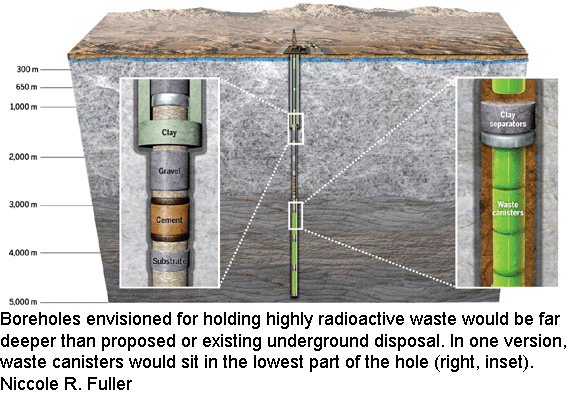
That message would not be heard by residents of Pierce County in North Dakota or Spink County in South Dakota said Mark Kelley, the Battelle project manager who had the “dubious honor” of leading the effort for only half a year, at a presentation yesterday at the annual meeting of the Geological Society of America. “They were not to be convinced,” he said. “They were quite opposed to it.”
This summer, DOE and Battelle agreed to scrap the 5-year effort, which had moved to South Dakota after failing in North Dakota. In August, the agency solicited new bids for the project, due next month, that explicitly require public engagement from the outset, including staff that will remain on site day to day to hear local concerns. Bidders are also expected to find a way of showing how the project could benefit locals through science education or additional research. The agency will likely select multiple contractors for the project’s first phase, keeping its options open on new potential sites.
Battelle had thought its South Dakota site, to be drilled on private land into Precambrian basement rock, might succeed where North Dakota failed. They promised to engage locals earlier, and not repeat the same mistakes, such as when local officials first learned of the project from local newspaper articles. But similar fears that the project would open the county up to a future as a disposal site, or that drilling could go awry and pollute aquifers, led the Spink County’s board of commissioners in June to reject the zoning approval the project needed. It didn’t help, Kelley added, that some of the North Dakota protesters traveled south to keep their opposition going.
Though the concept of borehole disposal, which would see radioactive waste entombed far deeper than traditional repositories, has existed for decades, the idea has been revived in recent years, spurred by troubles in finding a long-term home for the country’s spent fuel. Such boreholes could not house most of the country’s waste, like fuel rods from nuclear power plants, but could have potential for smaller, long-lived radioactive materials. Energy Secretary Ernest Moniz has frequently touted borehole disposal as one alternative to Yucca Mountain, the stalled repository in Nevada.
Many of the scientists working on the borehole project continue to believe in it—if they can only find a community willing to take it on.
“We want to test the things that would be difficult to do,” said Kristopher Kuhlman, a hydrogeophysicist at Sandia National Laboratory in Albuquerque, New Mexico, during the meeting. “If we want to put waste where we’ll never see it again,” he added, it should go at the bottom of a deep borehole.
1 This Month

of the week – Shut Down Drone Warfare!


Tell the Ukrainian Government to Drop Prosecution of Peace Activist Yurii Sheliazhenko

Petition to revoke the licensing of the Near Surface Nuclear Disposal Facility (NSDF) at Chalk River. https://www.ourcommons.ca/petitions/en/Petition/Details?Petition=e-7247
To see nuclear-related stories in greater depth and intensity – go to https://nuclearinformation.wordpress.com
-
Archives
- April 2026 (103)
- March 2026 (251)
- February 2026 (268)
- January 2026 (308)
- December 2025 (358)
- November 2025 (359)
- October 2025 (376)
- September 2025 (257)
- August 2025 (319)
- July 2025 (230)
- June 2025 (348)
- May 2025 (261)
-
Categories
- 1
- 1 NUCLEAR ISSUES
- business and costs
- climate change
- culture and arts
- ENERGY
- environment
- health
- history
- indigenous issues
- Legal
- marketing of nuclear
- media
- opposition to nuclear
- PERSONAL STORIES
- politics
- politics international
- Religion and ethics
- safety
- secrets,lies and civil liberties
- spinbuster
- technology
- Uranium
- wastes
- weapons and war
- Women
- 2 WORLD
- ACTION
- AFRICA
- Atrocities
- AUSTRALIA
- Christina's notes
- Christina's themes
- culture and arts
- Events
- Fuk 2022
- Fuk 2023
- Fukushima 2017
- Fukushima 2018
- fukushima 2019
- Fukushima 2020
- Fukushima 2021
- general
- global warming
- Humour (God we need it)
- Nuclear
- RARE EARTHS
- Reference
- resources – print
- Resources -audiovicual
- Weekly Newsletter
- World
- World Nuclear
- YouTube
-
RSS
Entries RSS
Comments RSS
 nuclear-news