South Africa’s ESKOM has extended the period for nuclear power consultation
ESKOM EXTENDS NUCLEAR POWER CONSULTATION PERIOD http://ewn.co.za/2016/09/02/Eskom-extends-nuclear-power-consultation-period 3 Sept 16
Interested parties in Eastern Cape have 30 days to comment on Eskom’s plan to build nuclear plants. JOHANNESBURG – Power utility Eskom said on Friday it has extended by 30 days the period for interested parties in the Eastern Cape Province to comment on its plan to build nuclear plants.
The utility said in a statement a notice of its “intention to construct and operate multiple nuclear installations (power reactors)” will be published in the Government Gazette this month and comments will be accepted for up to 30 days after that.
Environmental and civic groups have expressed concern about the two proposed sites in the Eastern Cape and Western Cape provinces, while economists have said South Africa cannot afford to build new nuclear power plants.
Pope Francis’ unprecedented stand for the global environment
The Guardian view on Pope Francis: an unlikely voice for the environment, Guardian, 2 Sept 16 Editorial We need more than enlightened self interest to save the planet It is less than a week since the International Geological Conference declared that we should recognise that we entered a new geological epoch, the Anthropocene, in around 1950. The changes that we have made to the planet are now irreversible and their effects will continue for millennia to come. None the less, this may prove to be the shortest of all geological epochs, since there is no guarantee that humans, who made it, will survive the results of their own activity.
Not for the last 2.5bn years or so, since the cyanobacteria filled the earth’s atmosphere with free oxygen, poisonous to almost every other form of life at the time, has any one species had such an effect on the environment as we have done. But we are not bacteria. We are the only species capable of reflecting on our impact. We have moral agency. We can foresee the likely consequences of our actions, consider them, and then make choices. In relation to the environment, these choices have frequently been wrong and show little sign of being right in time to save us from very large and damaging climate change.
The problem is a classic one of game theory and it is one that liberal democracies are ill-fitted to handle. Trust and co-operation would lead to the best result for everyone, but each player or nation state will benefit more in the short term from a policy of selfishness and treachery. The shortness of electoral cycles in the rich world means that almost all governments need economic growth today, whatever the cost to be repaid with cruel interest in the future. That will be someone else’s problem, just as the effects of climate change now appear to be someone else’s problem, until these other people start fleeing war, starvation and disease and turn up at the edges of the richer world.
Climate change is a global problem, and it can only be countered by some kind of global consciousness and a sense of the common good that embraces the whole of humanity. This is where the efforts of the world religions become important.
…….Enter Pope Francis, who has swung the weight of his papacy behind the environmental movement in an unprecedented way. He is not alone. All of the organised world religions now have a strong environmental consciousness. All of them are affected. To be a world religion is by definition to have adherents among both the unimaginably poor and the unimaginably wealthy. However, Pope Francis has devoted considerable effort and political capital to the attempt to construct a coherent theory that can show how damage to our environment also harms us, and not just our hypothetical descendants. This really matters. Self-interest will only work to the common benefit if it is understood that we ourselves are mutually dependent creatures who harm ourselves when we harm one another…….
what his latest initiative imaginatively suggests. Care for the environment is henceforth to be considered by faithful Catholics as a “work of mercy” – what the outside world would call a charitable act. They are called to “a grateful contemplation of God’s world” as a spiritual discipline, but also to the kind of small, slightly inconvenient gestures like recycling, using public transport, or even just turning off unneeded lights, which by themselves are almost meaningless, but when practised by billions of people make a real and very necessary change.
All of these, he says, are to be understood as “simple daily gestures which break with the logic of violence, exploitation and selfishness”; and while the world undoubtedly needs huge and dramatic actions to break the cycle of exploitation and climate change, it also needs ordinary people to play their part with just such simple acts. https://www.theguardian.com/commentisfree/2016/sep/01/the-guardian-view-on-pope-francis-an-unlikely-voice-for-the-environment
Take American promises on the Nuclear Suppliers Group with heaps of salt
The Daily Fix: Take American promises on the Nuclear Suppliers Group with heaps of salt, Scoll In, 2 Sept 16 “……..Speaking to the Times of India, Kerry claimed that the US will work harder to get India into the Nuclear Suppliers Group – an international network that controls the flow of nuclear fuel around the world. The NSG for a brief period seemed like the linchpin of Prime Minister Narendra Modi’s foreign policy efforts. But that bid failed last year after India was unable to push through its application at a plenary meeting in Seoul.
That was the technique used by former US President George W Bush in 2008, when he made a personal call and managed to get India an NSG waiver, but we are dealing with a different president, a vastly different America and an upcoming US election that will not make things easy for any side.
There was hope that there would be a special NSG session later this year, possibly in November, when India’s application would be taken up separately, but that might come up right around the time of the US elections. What are the chances that Kerry’s administration, at that point either transitioning to a Hillary Clinton’s team or enduring the lame-duck period before Donald Trump takes over, will muster the willpower to take on the Chinese on behalf of India?…….http://scroll.in/article/815498/the-daily-fix-take-american-promises-on-the-nuclear-suppliers-group-with-heaps-of-salt
September 2 Energy News

World:
¶ Ireland, Northern Ireland and Scotland have joined forces to advance the development of ocean energy technology by forming a new collaborative network. Separate agencies from each of the three countries formed the Ocean Power Innovation Network in Dublin. [reNews]
 SXC image
¶ Average power supply delivered to the UK grid was the lowest on record in August. The increase in embedded generation capacity and improved energy efficiency measures combined to cut the amount of demand the transmission system was required to meet. [Argus Media]
¶ Construction on one of India’s largest, if not the largest, solar park is expected to being soon. The Minister for Energy in the southern state of Karnataka told media outlets that construction on the proposed 5-GW Pavagada solar park will begin there soon. [CleanTechnica]
 An 11.5-MW solar array in India. Photo by Citizenmj.
CC BY-SA 3.0. Wikimedia…
View original post 385 more words
Typhoons cause ‘ice wall’ to melt at Fukushima nuclear plant
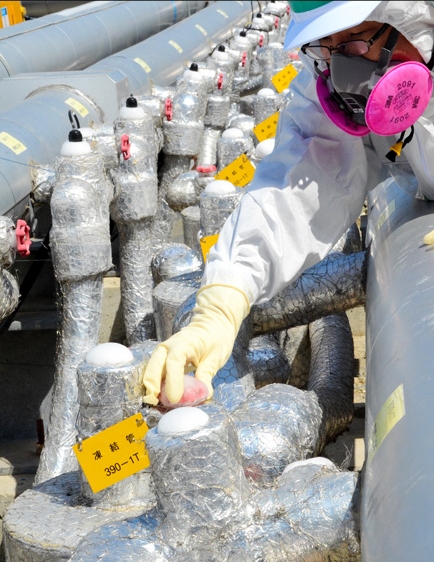
Workers examine pipes for the wall of frozen soil at the embattled Fukushima No. 1 nuclear power plant.
Rainfall from recent typhoons caused partial melting of the “ice wall” at the Fukushima No. 1 nuclear plant, allowing highly radioactive water to leak from around the damaged reactor buildings, the plant’s operator said Sept. 1.
Tokyo Electric Power Co. said melting occurred at two sections of the ice wall, which is designed to divert groundwater away from the reactor buildings.
TEPCO officials believe that during the latest typhoon, contaminated water from around the reactor buildings flowed through openings of the ice wall created by the deluge and reached downstream toward the sea.
The groundwater level near a seaside impermeable wall temporarily rose to 28 centimeters below the ground surface when Typhoon No. 10 passed the area on Aug. 30.
Before the typhoon hit, the water level was 35 cm below the surface.
Around 5.5 cm of rainfall a day fell in the area when the typhoon hit.
The groundwater level, however, actually rose by 7 cm, although 740 tons of groundwater was pumped out of the section.
“If there had been an additional 15 cm of rain, (the contaminated water) could have poured out over the ground surface” and spilled into the sea, a TEPCO official said Sept. 1.
The Meteorological Agency’s initial forecast said Typhoon No. 10 would bring a maximum 20 cm of rain a day at some locations in the Tohoku region.
The 34.5-billion-yen ($335 million) frozen wall was completed in spring to prevent groundwater from entering the reactor buildings and mixing with highly radioactive water.
TEPCO admitted the underground wall of frozen dirt is not working.
The company said the temperatures at the two sections of the frozen wall have climbed above zero since Typhoon No. 7 approached Fukushima Prefecture on Aug. 17.
The company believes that the partial melting was caused by the influx of water brought by the typhoons and heavy rain in between.
TEPCO plans to freeze the wall again by pouring chemicals into pipes that extend underground.
Ban to be lifted on Fukushima’s worst-affected zone in 2022

A barrier set up at the difficult-to-return zone as Typhoon No. 10 approaches Okuma, which co-hosts the Fukushima No. 1 nuclear power plant, in Fukushima Prefecture on Aug. 30
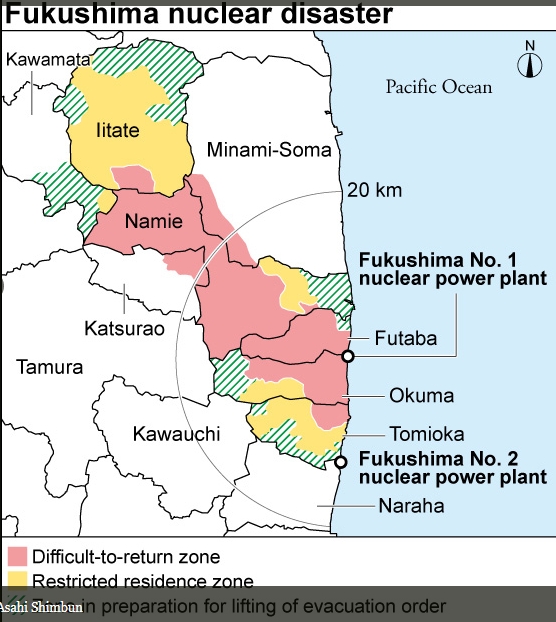
Some of the most contaminated areas of Fukushima Prefecture rendered uninhabitable by the 2011 nuclear disaster will be declared safe to live in again in 2022.
The government’s decision to lift the partial ban on repatriation to the “difficult-to-return zone” was announced Aug. 31 after Prime Minister Shinzo Abe called a joint meeting of the government’s Nuclear Emergency Response Headquarters and Reconstruction Promotion Council.
By 2022, the area’s 24,000 or so residents will have been displaced for more than a decade and there is no way of knowing how many will choose to return to their hometowns.
The difficult-to-return zone encompasses seven municipalities situated in a 20-kilometer radius of the crippled Fukushima No. 1 nuclear power plant as well as a spur of land northwest of the radius.
Partial lifting of the ban, in the eyes of the government, is reasonable as “radiation levels in the zone have dropped” even though no decommissioning work has been done there.
The government said the move is aimed at bolstering efforts to rebuild the prefecture, adding that leaving the zone intact would only perpetuate negative images of the area and sully the reputation of local products.
The ban will initially be lifted for areas where local government buildings, train stations and community halls are located, and eventually the rest of the zone.
There was no word, however, on how many years it will take for that to happen.
The government envisages enacting a law to designate areas earmarked as rebuilding hubs so as to encourage residents to return. The government will try to give priority to decisions by local officials as to which areas fall into that category.
In preparation for the lifting of the partial ban, the government will start extensive decontamination work in the zone from fiscal 2017, which begins next April.
The government estimates it would take 1 trillion yen ($9.7 billion) to clean up the entire zone, and is balking at making such an outlay on grounds of time and cost.
Even if the operation done on a limited basis, it is bound to come with a hefty price tag.
Funds needed for construction of housing and makeshift shops in the hub areas will be set aside in the government’s budget, starting from fiscal 2017.
According to government officials, some municipalities will likely to set up more than one rebuilding hub.
But one of the villages in the zone may end up having no hub at all due to depopulation.
A 2015 survey by the Reconstruction Agency found that the share of displaced people from Okuma, Futaba, Namie and Tomioka who expressed their intention to return to their hometowns varied from 11.4 percent to 17.8 percent. While the ratio was 32.8 percent for Iitate, no figures were available for Katsurao and Minami-Soma.
Underground Ice Wall – Japan’s gamble to contain Fukushima’s irradiated water
Even if the ice wall works, Tepco will face the herculean task of dealing with the huge amounts of contaminated water that have accumulated.
Japan’s $320 Million Gamble at Fukushima: An Underground Ice Wall, NYT By MARTIN FACKLER, AUG. 29, 2016 FUKUSHIMA DAIICHI NUCLEAR POWER STATION — The part above ground doesn’t look like much, a few silver pipes running in a straight line, dwarfed by the far more massive, scarred reactor buildings nearby.
More impressive is what is taking shape unseen beneath: an underground wall of frozen dirt 100 feet deep and nearly a mile in length, intended to solve a runaway water crisis threatening the devastated Fukushima Daiichi Nuclear Power Station in Japan.
Officially named the Land-Side Impermeable Wall, but better known simply as the ice wall, the project sounds like a fanciful idea from science fiction or a James Bond film. But it is about to become a reality in an ambitious, and controversial, bid to halt an unrelenting flood of groundwater into the damaged reactor buildings since the disaster five years ago when an earthquake and a tsunami caused a triple meltdown.
Built by the central government at a cost of 35 billion yen, or some $320 million, the ice wall is intended to seal off the reactor buildings within a vast, rectangular-shaped barrier of man-made permafrost. If it becomes successfully operational as soon as this autumn, the frozen soil will act as a dam to block new groundwater from entering the buildings. It will also help stop leaks of radioactive water into the nearby Pacific Ocean, which have decreased significantly since the calamity but may be continuing However, the ice wall has also been widely criticized as an expensive and overly complex solution that may not even work. Such concerns re-emerged this month after the plant’s operator announced that a section that was switched on more than four months ago had yet to fully freeze. Some also warn that the wall, which is electrically powered, may prove as vulnerable to natural disasters as the plant itself, which lost the ability to cool its reactors after the 45-foot tsunami caused a blackout there.
The reactor buildings are vulnerable to an influx of groundwater because of how the operator, Tokyo Electric Power Co., or Tepco, built the plant in the 1960s, by cutting away a hillside to place it closer to the sea, so the plant could pump in water more easily. That also put the buildings in contact with a deep layer of permeable rock filled with water, mostly rain and melted snow from the nearby Abukuma Mountains, that flows to the Pacific.
Since the accident, five robots sent into the reactor buildings have failed to return because of high radiation levels and obstruction from debris.
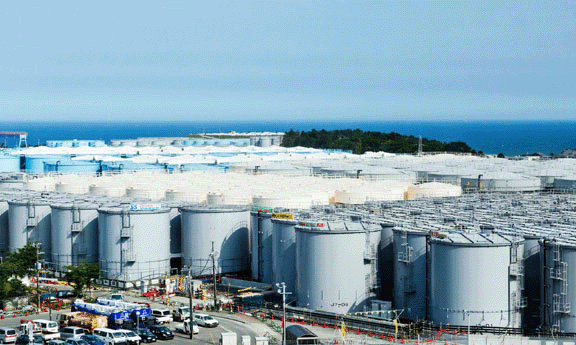
The water has also created a waste-management nightmare because Tepco must pump it out into holding tanks as quickly as it enters the buildings, to prevent it from overflowing into the Pacific. The company says that it has built more than 1,000 tanks that now hold more than 800,000 tons of radioactive water, enough to fill more than 320 Olympic-size swimming pools.
On a recent visit to the plant, workers were busily erecting more durable, welded tanks to replace the temporary ones thrown up in a hurry during the early years after the accident, some of which have leaked. Every available patch of space on the sprawling plant grounds now appears to be filled with 95-foot tanks.
“We have to escape from this cycle of ever more water building up inside the plant,” said Yuichi Okamura, a general manager of Tepco’s nuclear power division who guided a reporter through Fukushima Daiichi. About 7,000 workers are employed in the cleanup.
The ice wall is a high-technology bid to break that cycle by installing what might be the world’s largest freezer. Continue reading
Dangerous transport of radioactive wastes – legal action against this
 The nuclear waste is a byproduct of the process used at the Chalk River laboratories to create medical radioisotopes from highly enriched uranium originally produced in the U.S. It’s being shipped back to the U.S. as part of a 2010 agreement to repatriate the radioactive material, costing the Canadian government about US$60 million.
According to the U.S. lawsuit filed Aug. 12 in Washington, D.C., the thick yellowy-green liquid being shipped contains highly enriched uranyl nitrate, highly enriched uranium, radioactive varieties of cesium, niobium, zirconium, rhodium, rubidium, iodine, xenon, tellurium, barium, lanthanum, cerium, strontium, praseodymium, neodymium, europium, neptunium and plutonium.
 Niagara on nuclear waste route, Welland Tribune, By ALLAN BENNER, August 31, 2016 Trucks loaded with liquid nuclear waste could be rolling down highways within days — likely travelling through Niagara on their way into the U.S.
But seven American environmental groups have teamed up to launch a lawsuit against the United States government and its Department of Energy (DoE) in the hope of stopping the shipments before they begin.
A November 2015 DoE report, which concluded that an environmental impact statement on the plan would not be necessary, says up to 150 shipments of liquid nuclear waste will be hauled by transport truck from Canadian Nuclear Laboratories in Chalk River, Ont., a community near Algonquin Park, to a disposal site in Savannah River, S.C., 1,700 kilometres south.
Each shipment will include four 58.1-litre stainless steel containers, for a total of 232 litres of nuclear waste per trip. Those containers will be placed inside cylindrical steel nuclear transport casks, which will then be loaded into typical shipping containers and loaded onto trucks. The project is expected to continue for several years.
The nuclear waste is a byproduct of the process used at the Chalk River laboratories to create medical radioisotopes from highly enriched uranium originally produced in the U.S. It’s being shipped back to the U.S. as part of a 2010 agreement to repatriate the radioactive material, costing the Canadian government about US$60 million.
Niagara-on-the-Lake resident Gracia Janes, environment convener for the National Council of Women of Canada who has lobbied against the plan, described the material being transported as “absolutely deadly stuff.”
According to the U.S. lawsuit filed Aug. 12 in Washington, D.C., the thick yellowy-green liquid being shipped contains highly enriched uranyl nitrate, highly enriched uranium, radioactive varieties of cesium, niobium, zirconium, rhodium, rubidium, iodine, xenon, tellurium, barium, lanthanum, cerium, strontium, praseodymium, neodymium, europium, neptunium and plutonium.
Although environmental groups believe shipments could begin in September, that information could not be confirmed.
It’s classified……….
Higgins is concerned about the use of the Peace Bridge in the proposed route, one of the busiest border crossings between the two countries. “It’s only three lanes,” he said. “Consequently, trucks are stuck on the bridge idling for inordinate periods of time.”
Niagara’s regional council has taken a stand on the issue, too. On June 11, 2015, councillors ratified a motion opposing any shipment of radioactive liquid waste, and urging the governments of Canada and the U.S. to halt the shipment of high-level radioactive liquid waste pending the outcome of public consultations on the advisability and the potential adverse impacts of the proposed shipments, as well as alternative procedures.
Lincoln regional Coun. Bill Hodgson said he was concerned at the time the motion was passed, but he’s “more alarmed now that it seems that it’s imminent, and really no one with authority has stepped forward and said, ‘Let’s rethink the movement of this stuff.’” “This is a really toxic soup. This is not kid’s play,” he said.
Niagara Falls Mayor Jim Diodati shares the concerns about the plans……..
if one of those containers were to break, Janes said it would be a disaster. “If it did break open, if it did get down to what’s in there, it’s radioactive material that would take an awfully long time — thousands of years — to actually disappear, if it ever does disappear,” said Janes, who first brought the issue to regional council’s attention during a delegation in February 2015.
“It would go into the groundwater and it could be in a community. We’re not sure where it’s going,” she said. “Or there could be a fire, and it could be sending off plumes of we don’t know what.”
She said it’s “not quite Chernobyl, but I don’t know.”
The November 2015 DoE report also looked at worst-case scenarios, including the potential for radioactive liquid to spill on the ground after highway collisions……
Gervais, however, said he doesn’t believe facilities exist at Chalk River to convert the liquid material to solid.
Kamps said the shipments are unprecedented. “Never before has highly radioactive liquid waste been transported in North America,” he said. http://www.wellandtribune.ca/2016/08/31/not-quite-chernobyl
North Korea’s grandiose plans for ‘nuclear backpack’ squad, and giant submarine
 North Korea trains its elite soldiers to use ‘nuclear backpacks’ as individual bombs as it emerges Kim Jong Un wants to build a 3,000 tonne submarine
- North Korea training ‘outstanding’ troops to join ‘nuclear backpack’ squad
- They would be ordered to infiltrate South and set off bombs in event of war
- Pyongyang has tested a submarine-launched missile for the first time
- Kim Jong Un also wants to built a giant 3,000 tonne submarine
By JULIAN ROBINSON FOR MAILONLINE , 1 September 2016 |
North Korea is training its elite soldiers to smuggle ‘nuclear backpacks’ across the border with the South before detonating their individual bombs. Troops from the People’s Army will be trained to enter enemy territory and, in the event of war, unleash their own nuclear bomb. Sources within the secretive country say ‘outstanding’ military personnel have been selected to join the battalion.
It comes as it emerged Kim Jong Un is planning to build a giant 3,000 tonne submarine made from old Russian submarine parts. Defector Kim Heung-kwang claimed the dictator has ordered the huge vessel to be completed by October, 2017. The huge submarine will be capable of carrying four ballistic missiles which can be launched from the vessel.
Meanwhile, there are also plans to create a unit of soldiers capable of carrying their own nuclear weapons. It has yet to be clarified whether Pyongyang intends the unit to be a suicide squad similar to Japanese Kamikaze pilots who attacked warships in the Second World War.
According to Radio Free Asia, formation of the units has been taking place since March and is stationed in the North Hamgyong province. It added that dummy bombs used for training purposes weigh between 22lbs and 62 lbs and rather than generating huge explosions, the back pack bombs would be designed to spray radioactive material over a large area.
News of the unit emerged as it was revealed that North Korea has made considerable progress this year on weapons technology, including testing a submarine-launched missile for the first time.
However, it’s still not clear if the isolated nation has developed a nuclear warhead. It also does not yet have a fleet of submarines that can launch the newly developed missile……….http://www.dailymail.co.uk/news/article-3768447/North-Korea-trains-elite-soldiers-smuggle-nuclear-backpacks-border-South-unleash-individual-bombs.html
UK plans nuclear reactors of 3 different types – a recipe for failure
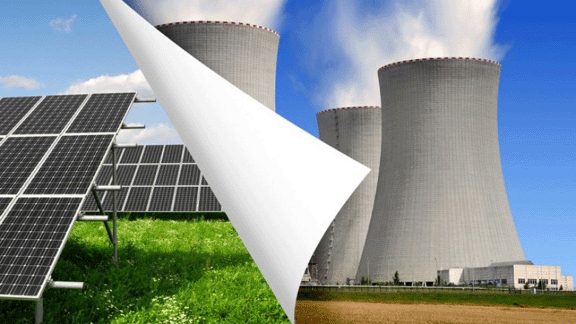 The special treatment the UK is granting to nuclear projects fails to take account of the fact that
 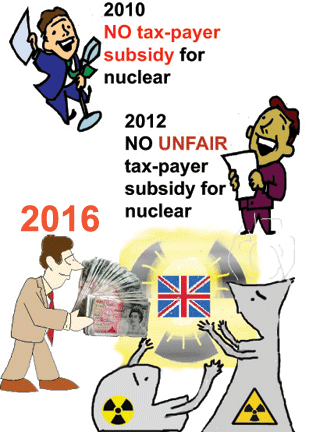 energy markets are undergoing a period of rapid change, “a revolution, not an evolution,” Schneider said. Electricity generation is going in the direction of ever smaller, more decentralized equipment like rooftop solar, integrated horizontally in networks. Nuclear, in Schneider’s view, represents an out-dated, over-priced paradigm of centralized power generation and distribution
 Puzzling path to new UK nuclear power stations, DW, 2 Sep 16 The UK plans to build several new nuclear reactors – of three different types, oddly, including a Franco-German design that has gone radically over-budget elsewhere. That’s a recipe for high costs, critics say. Over the past several years, a number of companies have put forth applications to build new nuclear reactors in the UK. But none have started construction, and now, there’s some doubt whether any of them will go forward. Continue reading
Virginia Citizens Consumer Council (VCCC) – strong petition against $19.2 billion nuclear power plant
the $19 billion Unit 3 is being built above an earthquake fault.

 The Dangerous Nuclear Plant Rising on DC’s Doorstep http://www.counterpunch.org/2016/09/01/the-dangerous-nuclear-plant-on-dcs-doorstep/ by JOHN LAFORGE, Dominion Virginia Power, a section of the giant utility Dominion, is proceeding unlawfully with construction of its $19-billion-plus power reactor 80 miles from Washington, DC — called North Anna 3 — and must get formal approval from the Virginia State Corporation Commission (SCC) before it can continue, according to a petition filed August 30th by the Virginia Citizens Consumer Council (VCCC;), a nonprofit group based in Elliston, Va.
The group’s “Petition for a Declaratory Judgment” says in part: “At an estimated total cost of at least $19.2 billion, North Anna 3 would be the most expensive power [reactor] ever built in the United States and could raise customers’ rates by 26 % or more according to the Virginia Attorney General. While Dominion claims that North Anna 3 is needed for compliance with the federal Clean Power Plan, it would be far costlier than the low-carbon alternative of combined renewables, demand-side management, and efficiency … Dominion has not complied with Virginia law by failing to seek SCC approval before making expenditures on project development and beginning preliminary construction of North Anna 3.” Continue reading
Philippines bishop, climate movement, oppose revival of mothballed nuclear plant
Philippines: Alarm sounded over revival of mothballed nuclear plant, http://en.radiovaticana.va/news/2016/09/01/philippines_alarm_over_revival_of_mothballed_nuclear_plant_/1255178 A diocese in the northern Philippines has voiced opposition to a government plan to revive a nuclear power plant constructed in the 1970s.
The Bataan Nuclear Power Plant in the town of Morong in Bataan province was constructed during the term of former president Ferdinand Marcos. Costing US$.2.3 billion by the time of its completion in 1984, it remains intact though never fueled. Successive governments have not tried to operate the plant after studies revealed it was built near a major geological fault line and lies close to the then dormant Mount Pinatubo volcano.
“We don’t want to put the lives of people in danger … we don’t want our sources of livelihood destroyed,” read a pastoral letter issued by Bishop Ruperto Santos of Balanga. “The diocese has already spoken on this, and we are again making our position known,” said Bishop Santos “For us, life is more precious than profit or money that will come from cheap electricity” he added and “we want to take care of God’s creation in response to His call to take care, not destroy and abuse creation”. Bishop Santos said the government should tap other sources of energy instead of reviving the nuclear plant.
The proposal to revive the plant came during a three-day international conference this week to discuss the prospects of nuclear power in the Asia-Pacific region. Philippine Energy Secretary Alfonso Cusi told journalists on the sidelines of the conference that the country should consider nuclear power to address power shortages and the high cost of electricity. Cusi said the government is already working on a road map and consulting experts on nuclear power.
The Philippine Movement for Climate Justice said that while nuclear energy is not a major contributor to climate change it poses “more danger to humanity than any kind of calamity or disaster known.” The faith-based group warned that the Philippines, with its high poverty incidence, “cannot withstand the disaster that may be brought about by a nuclear accident.”
A safety inquiry in the 1980s, revealed that the Bataan nuclear plant had over 4,000 defects.
Disunity in Philippines Senate over revival of Bataan Nuclear Power Plant
Senators divided on revival of Bataan Nuclear Power Plant August 31, 2016 By KATHRINA CHARMAINE ALVAREZ, GMA News Senators have opposing positions on the possibility of the Bataan Nuclear Power Plant (BNPP) being revived to ensure the long-term supply of energy in the country.
At the hearing of the Senate committee on energy Wednesday, Energy Sec. Alfonso Cusi said he was in favor of reviving the 620-megawatt nuclear plant, declaring that it was “safe for use.”
“I have a bias. If I will make a decision, I will open it but it’s not for me to decide, it’s for the country to decide,” Cusi told the committee.
While Cusi assured that we have sufficient supply, reviving the Bataan plant would beef up power reserves, lowering the risk of parts of the country being placed under yellow and red alerts as what happened in recent months………
But Sen. Sherwin Gatchalian, chairman of the energy committee, opposed the plan, saying the needed $1-billion investment to refurbish the power plant would be better spent on “more feasible generation projects.”
Gatchalian added that the BNPP’s location atop a geological fault makes it a safety hazard for the entire Luzon island group.
He said the plant, built four decades ago, was simply outdated……..http://www.gmanetwork.com/news/story/579582/money/economy/senators-divided-on-revival-of-bataan-nuclear-power-plant
Iran still hindered by USA sanctions, following nuclear deal
Ryabkov Says U.S. Sanctions Continue To Hinder Iran After Nuclear Deal, Radio Free Europe September 01, 2016 The United States has carried out its part of the Iranian nuclear deal, but unilateral U.S. sanctions on Iran have remained in place and are a “big hindrance” for Tehran, a top Russian diplomat told TASS.
Russia’s Deputy Foreign Minister Sergei Ryabkov, who is visiting Tehran, told TASS on August 31 that the U.S. administration has implemented “from start to finish” everything envisaged by last year’s agreement, “but it hasn’t moved any further.”
“All the so-called unilateral sanctions that existed before an agreement was reached with Iran have stayed in place,” he said.
“These unilateral sanctions are a big hindrance,” he said. “Any deal serviced in dollars goes through corresponding controlling agencies of the United States and can be suspended.”
Despite the removal of most international sanctions against Iran, Ryabkov said European and Asian businesses continue to be cautious about dealing with Iran and as a result, “deals are fewer than one would want to see.”
‘secret exemptions’ for Iran in nuclear agreement?

 U.S., partners allowed ‘secret’ exemptions in nuclear agreement for Iran to meet sanctions deadline, http://www.bignewsnetwork.com/news/247272885/us-partners-allowed-secret-exemptions-in-nuclear-agreement-for-iran-to-meet-sanctions-deadline Big News Network, 1 Sep 16, WASHINGTON, U.S. – Reports reveal that the U.S. and its negotiating partners agreed “in secret” to allow Iran to evade some restrictions from last year’s nuclear agreement so it can meet deadlines for relief on economic sanctions.
According to reports, the U.S. and five negotiating partners agreed to allow Iran to keep more low-enriched uranium (LEU) and other nuclear materials than agreed upon, so that the country could be in compliance with the deal by the January deadline.
Another exemption was also made for an undisclosed amount of 20 per cent enriched uranium, described as “lab contaminant.” President of the think tank Institute for Science and International Security, former UN weapons inspector David Albright said that “the exemptions or loopholes are happening in secret, and it appears that they favour Iran.”
The decision was made by an oversight committee which included representatives from the five permanent United Nations Security Council nations, France, Russia, China, U.K., and U.S., along with Germany and Iran, dubbed collectively as the “P5+1.”
Had the exemptions not been allowed, Iran would have failed to comply with the January deadline, forcing the P5+1 powers to keep the sanctions in place.
Further, the report also makes claims that Iran was secretly permitted to maintain 19 radiation containment chambers, or “hot cells”, which violated the terms of the nuclear deal.
Iran was also relieved from having to sell off its excess heavy water, despite a clause in the agreement that the Islamic country should reduce its stores below 130 tons, and allowed it to store excess abroad.
Meanwhile, Iran is expected to build two new nuclear power stations, with aid from Russia, in Iran’s southern city of Bushehr.
Ali Akbar Salehi, head of the Atomic Energy Organization of Iran said, “Operations to build two new nuclear power plants in Bushehr will start on Sept. 10.”
Ali Akbar Salehi, head of the Atomic Energy Organization of Iran said, “Operations to build two new nuclear power plants in Bushehr will start on Sept. 10.”
He added, “We will save 22 million barrels of oil per year by building these two power plants,” and continued, “In the cooperation contract with the Russians, the emphasis has been laid on making use of technical capabilities of Iran for implementation of the project.”
The cost of the project is estimated at $10 billion.
Russian Deputy Foreign Minister Sergei Ryabkov said that global businesses were still wary of the effect of the remaining U.S. sanctions on Iran and that the commission monitoring the implementation of the joint Comprehensive Plan of Action (JCPOA) should address the issue.
He said, “We agree with the conclusions which our Iranian friends make, namely that some countries who participated very prominently while the talks were ongoing, now at the phase of implementation, I would use the word, (they are) stuck in their position of not removing obstacles which have been created by themselves through their national legislations, through their national decisions which do not allow for an even more active result-oriented and advanced economic and trade cooperation between Iran and the rest of the world.”
1 This Month
Chernobyl: The Lost Tapes – A good documentary on Chernobyl on SBS available On Demand for the next 3 weeks– https://www.sbs.com.au/ondemand/tv-program/chernobyl-the-lost-tapes/2352741955560

of the week–London Campaign for Nuclear Disarmament

Tell the Ukrainian Government to Drop Prosecution of Peace Activist Yurii Sheliazhenko
To see nuclear-related stories in greater depth and intensity – go to https://nuclearinformation.wordpress.com
-
Archives
- April 2026 (152)
- March 2026 (251)
- February 2026 (268)
- January 2026 (308)
- December 2025 (358)
- November 2025 (359)
- October 2025 (376)
- September 2025 (257)
- August 2025 (319)
- July 2025 (230)
- June 2025 (348)
- May 2025 (261)
-
Categories
- 1
- 1 NUCLEAR ISSUES
- business and costs
- climate change
- culture and arts
- ENERGY
- environment
- health
- history
- indigenous issues
- Legal
- marketing of nuclear
- media
- opposition to nuclear
- PERSONAL STORIES
- politics
- politics international
- Religion and ethics
- safety
- secrets,lies and civil liberties
- spinbuster
- technology
- Uranium
- wastes
- weapons and war
- Women
- 2 WORLD
- ACTION
- AFRICA
- Atrocities
- AUSTRALIA
- Christina's notes
- Christina's themes
- culture and arts
- Events
- Fuk 2022
- Fuk 2023
- Fukushima 2017
- Fukushima 2018
- fukushima 2019
- Fukushima 2020
- Fukushima 2021
- general
- global warming
- Humour (God we need it)
- Nuclear
- RARE EARTHS
- Reference
- resources – print
- Resources -audiovicual
- Weekly Newsletter
- World
- World Nuclear
- YouTube
-
RSS
Entries RSS
Comments RSS
 nuclear-news
