Complexity of climate effects on Antarctic’s sea ice
Record high to record low: what on earth is happening to Antarctica’s sea ice? https://theconversation.com/record-high-to-record-low-what-on-earth-is-happening-to-antarcticas-sea-ice-66114September 29, 2016 2016 continues to be a momentous year for Australia’s climate, on track to be the new hottest year on record.
To our south, Antarctica has also just broken a new climate record, with record low winter sea ice. After a peak of 18.5 million square kilometres in late August, sea ice began retreating about a month ahead of schedule and has been setting daily low records through most of September.
It may not seem unusual in a warming world to hear that Antarctica’s sea ice – the ice that forms each winter as the surface layer of the ocean freezes – is reducing. But this year’s record low comes hot on the heels ofrecord high sea ice just two years ago. Overall, Antarctica’s sea ice has been growing, not shrinking.
So how should we interpret this apparent backflip? In our paper published today in Nature Climate Change we review the latest science on Antarctica’s climate, and why it seems so confusing.
Antarctic surprises
First up, Antarctic climate records are seriously short.
The International Geophysical Year in 1957/58 marked the start of many sustained scientific efforts in Antarctica, including regular weather readings at research bases. These bases are mostly found on the more accessible parts of Antarctica’s coast, and so the network – while incredibly valuable – leaves vast areas of the continent and surrounding oceans without any data.
In the end, it took the arrival of satellite monitoring in the 1979 to deliver surface climate information covering all of Antarctica and the Southern Ocean. What scientists have observed since has been surprising.
Overall, Antarctica’s sea ice zone has expanded. This is most notable in the Ross Sea, and has brought increasing challenges for ship-based access to Antarctica’s coastal research stations. Even with the record low in Antarctic sea ice this year, the overall trend since 1979 is still towards sea ice expansion.
The surface ocean around Antarctica has also mostly been cooling. This cooling masks a much more ominous change deeper down in the ocean, particularly near the West Antarctic Ice Sheet and the Totten glacier in East Antarctica. In these regions, worrying rates of subsurface ocean warming have been detected up against the base of ice sheets. There are real fears that subsurface melting could destabilise ice sheets, accelerating future global sea level rise.
In the atmosphere we see that some parts of the Antarctic Peninsula and West Antarctica are experiencing rapid warming, despite average Antarctic temperatures not changing that much yet.
In a rapidly warming world these Antarctic climate trends are – at face value – counterintuitive. They also go against many of our climate model simulations, which, for example, predict that Antarctica’s sea ice should be in decline.
Winds of change
The problem we face in Antarctica is that the climate varies hugely from year to year, as typified by the enormous swing in Antarctica sea ice over the past two years.
This means 37 years of Antarctic surface measurements are simply not enough to detect the signal of human-caused climate change. Climate models tell us we may need to monitor Antarctica closely until 2100 before we can confidently identify the expected long-term decline of Antarctica’s sea ice.
In short, Antarctica’s climate remains a puzzle, and we are currently trying to see the picture with most of the pieces still missing.
But one piece of the puzzle is clear. Across all lines of evidence a picture of dramatically changing Southern Ocean westerly winds has emerged. Rising greenhouse gases and ozone depletion are forcing the westerlies closer to Antarctica, and robbing southern parts of Australia of vital winter rain.
The changing westerlies may also help explain the seemingly unusual changes happening elsewhere in Antarctica.
The expansion of sea ice, particularly in the Ross Sea, may be due to the strengthened westerlies pushing colder Antarctic surface water northwards. And stronger westerlies may isolate Antarctica from the warmer subtropics, inhibiting continent-scale warming. These plausible explanations remain difficult to prove with the records currently available to scientists.
Australia’s unique climate position
The combination of Antarctica’s dynamic climate system, its short observational records, and its potential to cause costly heatwaves, drought and sea-level rise in Australia, mean that we can’t afford to stifle fundamental research in our own backyard.
Our efforts to better understand, measure and predict Antarctic climate were threatened this year by funding cuts to Australia’s iconic climate research facilities at the CSIRO. CSIRO has provided the backbone of Australia’s Southern Ocean measurements. As our new paper shows, the job is far from done.
A recent move to close Macquarie Island research station to year-round personnel would also have seriously impacted the continuity of weather observations in a region where our records are still far too short. Thankfully, this decision has since been reversed.
But it isn’t all bad news. In 2016, the federal government announced new long-term funding in Antarctic logistics, arresting the persistent decline in funding of Antarctic and Southern Ocean research.
The nearly A$2 billion in new investment includes a new Australian icebreaking ship to replace the ageing Aurora Australis. This will bring a greater capacity for Southern Ocean research and the capability to push further into Antarctica’s sea ice zone.
Whatever the long-term trends in sea ice hold it is certain that the large year-to-year swings of Antarctica’s climate will continue to make this a challenging but critical environment for research.
New Report Reveals: Sizewell B and 27 other EDF nuclear plants ‘at risk of catastrophic failure’

And the UK is just about to sign up for more of these cancer (and other radiation linked disease) factories!
The Ecologist writes:
Sizewell B and 27 other EDF nuclear plants ‘at risk of catastrophic failure’
Oliver Tickell
29th September 2016
A new report finds that 28 nuclear reactors, 18 of them EDF plants in France and one at Sizewell in the UK, are at risk of failure ‘including core meltdown’ due to flaws in safety-critical components in reactor vessels and steam generators, writes Oliver Tickell. The news comes as EDF credit is downgraded due to a growing cash flow crisis and its decision to press on with Hinkley C.
As a result of AREVA’s failures, a significant share of the French nuclear reactor fleet is at increased risk of severe radiological accident, including fuel core meltdown. However, there is no simple or quick fix to this problem.
A new
View original post 71 more words
September 29 Energy News

Science and Technology:
¶ The findings of a twenty year-long research project shows that golden eagles in proximity to the Beinn an Tuirc windfarm in Scotland are thriving. The wind farm has long-term resident birds successfully raising chicks, throwing a spanner in the works for anyone who claims wind farms and wind turbines are inherently dangerous to birds. [CleanTechnica]
 Golden Eagle (Photo by Martin Mecnarowski, CC BY SA, Wikimedia Commons)
World:
¶ The price of oil surged and slipped back in trading as traders questioned whether the output cut agreed by Opec would be binding. Prices had jumped by 6% on Wednesday’s news that Opec had voted for the first production cut in eight years. Oil ministers said full details of the agreement would be finalized in November. [BBC]
¶ Ontario’s renewable energy industry will continue growing despite the suspension of plans for another round of…
View original post 654 more words
The World Just Hit This Disturbing Climate Change Metric #auspol

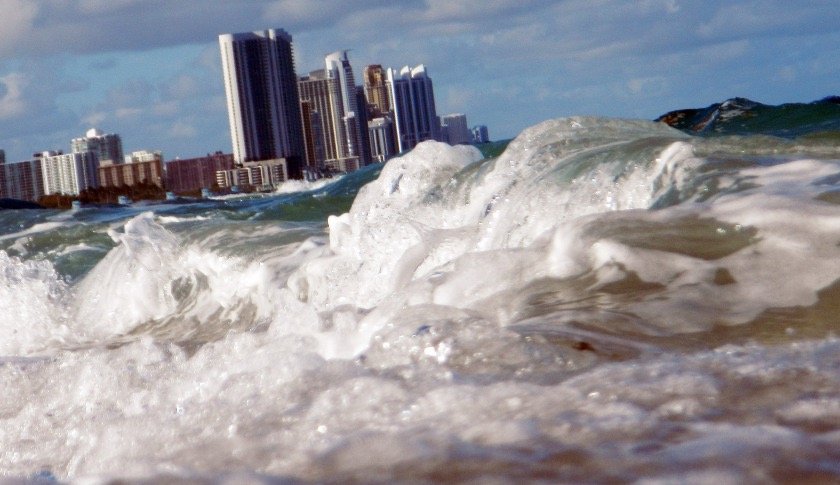 Cities like Miami (pictured) will now have access to real-time climate change data thanks to a new website powered by the White House.Photograph by Joe Raedle—Getty Images
It’s a quiet turning point against the backdrop of U.S. politics.
Earth has seemingly passed a worrisome threshold for the changing climate this week, according to scientists.
The last week in September is often the time of the year when the planet’s carbon emissions are at their lowest as summer turns to fall and plants and leaves start to decay, releasing carbon. However, this year the amount of carbon emissions in the atmosphere this week has remained above 400 parts per million, reports Climate Central.
That means that even with the fluctuating of the seasons, which pushes the levels of carbon emissions up and down, the planet is likely now officially at 400 parts per million for the foreseeable future. While that could…
View original post 328 more words
Uranium, Lead, DU Toxicity

Americans had better be watching the Flint Michigan water situation and those US Congress members who have been trying to further postpone help. It is clear that when a Chernobyl or Fukushima-like nuclear accident or other radiological emergency happens, which is too serious for the US government to hide, Americans are on their own. If there were any doubt, the US EPA just imposed a PAGs which sets aside the Clean Water Act in the event of a nuclear emergency. https://miningawareness.wordpress.com/2016/07/24/usepa-gina-mccarthy-issues-confusing-misleading-simplistic-radiation-in-water-pag-after-accusing-michigan-of-that-for-flint-comment-deadline-monday-11-59-pm The US FDA doesn’t check food for radiation unless it is suspected as having 15 times more radiation than that which is acceptable in Japan.
In the case of Flint, treated Flint River water should be safer than water from Lake Huron. Bruce Nuclear Power Station has 8 CANDU Nuclear Reactors which discharge radioactive materials, in particular high levels of tritium, into Lake Huron. The turnover of Lake Huron…
View original post 567 more words
“We are Suffocating from Smoke” — For Russia, Climate Change is Already Producing Fires that are Too Big to Fight

“For one month we are suffocating from the smoke. The weather is hot, and there is a strong smell of burning…” — Residents of Bratsk, northwest of Lake Baikal, in a petition to Vladimir Putin pleading him to fight the fires now raging there.
*****
Let’s take a snapshot of the current moment from the climate change perspective: This year, global temperatures will probably hit between 1.2 and 1.25 degrees Celsius hotter than 1880s averages. This new heat, in a range likely not seen for 115,000 years, is catapulting us into dangerous new climate states. We’re starting to see the hard changes happen. Weather is growing more extreme, wildfires are worsening, the seas are rising, the glaciers are melting, and ocean health is declining. Threats of destabilization and disruption are ramping up. But compared to what we will see in the future if the world continues to warm, if we…
View original post 1,246 more words
How Can Nuclear Apologists from Academia, Media, Etc., Sleep At Night? PM Trudeau and the Uranium Cartel; Jay Cullen and Justin Trudeau at McGill
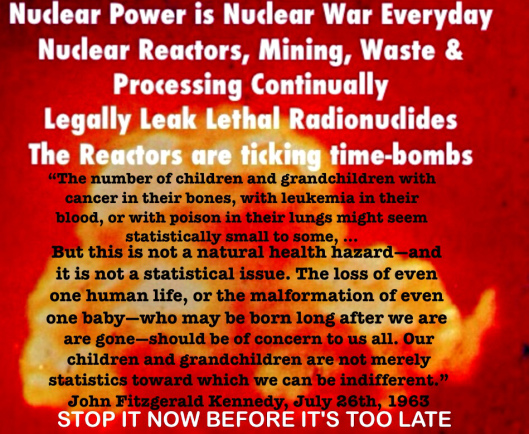

“How Can Nuclear Scientist Academics Media Apologists Sleep At Night?
Oct. 18, 2014, by Dana Durnford
What is the use of nuclear technology if all it does is destroy everything it touches? Why have it on the planet when we can not build anything to contain it! The Nobel gases will detonate it if not released. Everything on nuclear waste sites is vented into your community, all of the time. Or worst, criminally dumped into the ground like Hanford 450 billion gallons in the 50s and 60s. Right now they have right now 41 miles of open pits full of nuclear waste they couldn’t deal with leaching constantly into the water tables and environment is unimaginable when they decry terrorist releasing the same amounts into communities. Nuclear money and destruction of everything is allowed – hell it’s encouraged- while descending narratives decrying the discrepancy are not considered or afforded a…
View original post 2,192 more words
September 28 Energy News
Opinion:
¶ “China: Six little known facts about the country’s solar and wind boom” • China is installing one wind turbine an hour. This year is likely to be the third in a row in which its use of coal declined. About 370,000 people died from air pollution in 2013. Possibly we all knew those things, but here are a few more items worth knowing. [RenewEconomy]
 A 100-kW stand-alone PV plant at 14,500 feet in the Himalaya
powers a clinic, a school, and 347 houses, for five hours daily.
¶ “AWEA: Clean Power Plan stands on firm legal ground, would continue trend of clean energy cutting carbon pollution reliably and cost-effectively” • As the US Court of Appeals for the DC Circuit hears oral arguments today about the merits of the Clean Power Plan, the American Wind Energy Association published its position. [AltEnergyMag]
Science and Technology:
View original post 786 more words
From Maryland to the Caribbean to Asia, Record-Hot Ocean Waters Give Extreme Weather Potentials a Big Boost
The forecasts began coming in this morning: Heavy rainfall expected over the next two days. Possible flash flooding. Turn around, don’t drown.
These advisories buzzed up from local news media for the DC, Maryland, and Northern Virginia metro areas as a crazy, wavy Jet Stream spawned an upper-level low that’s predicted to gorge on an insane amount of moisture spewing up off the record-hot Atlantic Ocean.
Forecast GFS model guidance shows an upper-level low-pressure system situated over the Great Lakes region in association with a big trough dipping down from the Arctic. Over the next 24 to 48 hours, the low is expected to shift south and east. Becoming cut off from the upper-level flow, the low is then predicted to set up a persistent rainfall pattern over DC, Maryland and Northern Virginia.
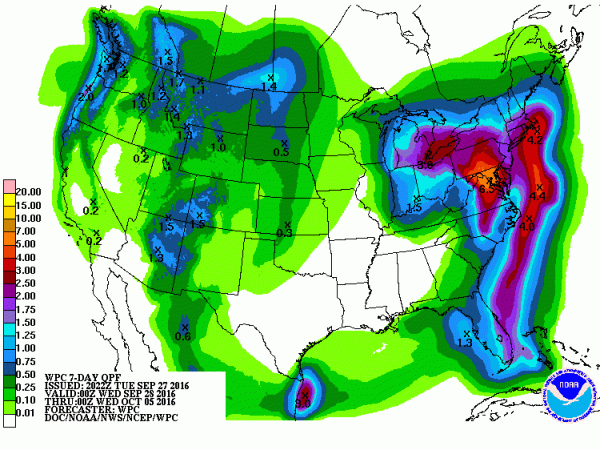
(NOAA’s precipitation forecast model shows extreme rainfall predicted for the DC area over the next seven days. Note…
View original post 1,235 more words

Opposition to South Carolina becoming a nuclear waste dumping ground
Environmentalists say there is no need to move spent nuclear fuel off of atomic power plant sites. They contend it can be stored safely. Transporting it to a disposal area near Barnwell would increase risks to the public, they said
Plan surfaces for new nuclear disposal ground in SC Casks of spent nuclear fuel are stored above ground at many atomic energy plants because there is no national disposal site for the material U.S. Nuclear Regulatory Commission BY SAMMY FRETWELL AND JEFF WILKINSON\ sfretwell@thestate.com,jwilkinson@thestate.com, COLUMBIA, SC
A plan has surfaced to establish another nuclear waste disposal ground in South Carolina, a state with a history of taking atomic refuse from across the country.
An organization called the Spent Fuel Reprocessing Group wants federal approval to open a disposal area near Barnwell and the Savannah River Site nuclear weapons complex. Spent fuel, a type of highly radioactive waste, would be moved from the state’s four nuclear power plant sites and stored indefinitely at the new facility, records show.
The U.S. Nuclear Regulatory Commission in July received notice of the plan. The proposal is a long way from becoming reality, but if eventually approved by the federal government, it would create a place for nuclear waste disposal that is likely to draw opposition.
Several environmental groups said this week they are preparing to fight any effort to create what they called an atomic waste dumping ground. Politicians, including Gov. Nikki Haley, also expressed reservations Monday. The subject of nuclear waste disposal is a touchy one in South Carolina because many people say the state has shouldered more than its share of the nuclear waste burden.
South Carolina already stores highly radioactive material from around the country and world at the Savannah River Site. It also has a low-level waste dump in Barnwell County that was used for decades to bury nuclear garbage from power plants across the country. That site has leaked radioactive tritium into groundwater.
Now, the government is being asked to allow an interim disposal site for high-level nuclear waste from power plants in South Carolina. The site would be near the Barnwell low-level waste dump, environmentalists said Monday. The site would be considered an interim disposal ground that would hold the nuclear waste while the government figures out what to do with it in the long run…….
Environmentalists say there is no need to move spent nuclear fuel off of atomic power plant sites. They contend it can be stored safely. Transporting it to a disposal area near Barnwell would increase risks to the public, they said. If a permanent disposal site were eventually developed nationally, the material would have to be transported again from the interim South Carolina site, according to Savannah River Site Watch, the S.C. League of Women Voters and the state Sierra Club.
“Packaging of the spent fuel for transport, unloading it at the consolidated storage site and eventually repackaging it to transport to a federal facility would unnecessarily pose a high economic cost and a logistical nightmare, both of which can be avoided if the spent fuel is left where it is now stored until such time as a geologic facility is available,’’ according to the groups…….
Climate change will expose top-secret US nuclear project in Greenland
Greenland’s receding icecap to expose top-secret US nuclear project Camp Century – part of Project Iceworm – is underground cold war network that had been thought buried forever, until climate change made that highly unlikely, Guardian, Jon Henley, 28 Sept, A top-secret US military project from the cold war and the toxic waste it conceals, thought to have been buried forever beneath the Greenland icecap, are likely to be uncovered by rising temperatures within decades, scientists have said.

The US army engineering corps excavated Camp Century in 1959 around 200km (124 miles) from the coast of Greenland, which was then a county of Denmark.
Powered, remarkably, by the world’s first mobile nuclear generator and known as “the city under the ice”, the camp’s three-kilometre network of tunnels, eight metres beneath the ice, housed laboratories, a shop, a hospital, a cinema, a chapel and accommodation for as many as 200 soldiers………
Project Iceworm, presented to the US chiefs of staff in 1960, aimed to use Camp Century’s frozen tunnels to test the feasibility of a huge launch site under the ice, close enough to fire nuclear missiles directly at the Soviet Union.
At the height of the cold war, as the US and the USSR were engaged in a terrifying standoff over the deployment of Soviet missiles in Cuba, the US army was considering the construction of a vast subterranean extension of Camp Century.
A system of about 4,000 kilometres of icy underground tunnels and chambers extending over an area around three times the size of Denmark were to have housed 600 ballistic missiles in clusters six kilometres apart, trained on Moscow and its satellites.
Eventually the engineers realised Iceworm would not work. The constantly moving ice was too unstable and would have deformed and perhaps even collapsed the tunnels.
From 1964 Camp Century was used only intermittently, and three years later it was abandoned altogether, the departing soldiers taking the reaction chamber of the nuclear generator with them.
They left the rest of the camp’s infrastructure – and its biological, chemical and radioactive waste – where it was, on the assumption it would be “preserved for eternity” by the perpetually accumulating snow and ice……..
Greenland’s temperatures broke new records this spring and summer, hitting 24C (75F) in the capital, Nuuk, in June – a figure that shocked meteorologists so much they had to recheck their measurements.
Between 2003 and 2010, the ice that covers much of the island melted twice as fast as during the whole of the 20th century. This year it began melting a month earlier than usual.
The researchers studied US army documents and drawings to work out how deep the camp and its waste – estimated to include 200,000 litres of diesel fuel, similar quantities of waste water and unknown amounts of radioactive coolant and toxic organic pollutants such as PCBs – were buried………
The Pentagon has said it “acknowledges the reality of climate change and the risk it poses” for Greenland, adding that the US government has pledged to “work with the Danish government and the Greenland authorities to settle questions of mutual security”. https://www.theguardian.com/world/2016/sep/27/receding-icecap-top-secret-us-nuclear-project-greenland-camp-century-project-iceworm
UK may be forced to leave Euratom treaty on nuclear energy, due to Brexit
 Brexit ‘could trigger’ UK departure from nuclear energy treaty https://www.theguardian.com/environment/2016/sep/27/brexit-could-trigger-uk-departure-from-nuclear-energy-treaty
The UK’s withdrawal from the EU could also force it to exit the Euratom treaty on nuclear energy, ENDS has learned, Guardian, José Rojo for ENDS, part of the Guardian Environment Network. The UK’s withdrawal from the EU could also force it to exit the Euratom Treaty on nuclear energy, ENDS has learned.
The Euratom Treaty, which applies to all EU member states, seeks to promote nuclear safety standards, investment and research within the bloc. Although it is governed by EU institutions, it has retained a separate legal identity since its adoption in 1957.
Brian Curtis, a member of the European Economic and Social Committee (EESC), told ENDS that his Committee had recently consulted the European Commission on whether Brexit would automatically lead to a UK exit of Euratom.
Curtis said the Commission had responded affirmatively, arguing that the Treaty of the European Union (TEU) applies to the Euratom Treaty under article 106 of the latter agreement. This would mean, it said, that the reference to ‘Union’ inTEU’s article 50 – which needs to be invoked by member states wishing to quit the bloc – would apply not only to the EU itself but to Euratom membership as well.
According to EESC, a Euratom withdrawal by the UK – which recently approved the controversial £18bn Hinkley C project – could have major strategic implications for the EU nuclear sector. “But anticipating specific outcomes at this stage is problematic,” the Committee added.
The Commission itself would not comment on the exchange, which took place as the EESC examined the EU’s latest nuclear plan.
The draft Nuclear Indicative Programme (PINC), which was unveiled in April, is the first to be published by the Commission since the Fukushima-Daiichi nuclear disaster in 2011.
The EESC is required by the Euratom Treaty to give its opinion on such plans before they are finalised. It released its opinion on the latest PINC last week, after adopting it at a plenary vote.
The document praises the Commission for its analysis of investment needs during the entire nuclear fuel cycle and its emphasis on funding for nuclear decommissioning.
However, the Committee adds that the 2016 PINC is half the length of thepreceding plan from 2007 and fails to address key issues faced by EU nuclear energy.
These, it says, include the competitiveness of nuclear amid changes to construction and capital costs, its investment needs in the context of the EU’s Energy Union goals and the speed at which new technologies may be rolled out.
EESC’s opinion was published two weeks ahead of a meeting of the European Nuclear Energy Forum, which will be attended by EU member states and European institutions in Bratislava on 3-4 October.
Tokyo Responsibility to Reveal Truth of Fukushima
We already know what is Tokyo definition of “truth”: five years and half of continuous deception, lies and cover-ups, tidbits of truth released only when forced to do so….
More than five years after the meltdown of the Fukushima Daiichi nuclear power plant in Japan, the legacy of the accident continues, characterized by constant radiation exposure and an ever-lasting sense of fear, not only in this island country but also beyond its territory.
Numerous reports about nuclear radiation and its damage to human bodies have been filed since the Fukushima disaster. An Asahi Shimbun article in 2014 revealed that high levels of accumulated radioactive cesium had been detected in the mud of 468 reservoirs outside of the Fukushima evacuation zone.
But more discouraging news awaits. According to a recent report by The Mainichi, an Environment Ministry survey found that high concentrations of radioactive cesium have been accumulating at the bottom of 10 major dams 50 kilometers away from Fukushima No.1 nuclear power plant, yet officials were quoted as saying that “it is best to contain cesium at those dams.”
It is the inaction that is most depressing. As people’s physical health is exposed to possible risks, the psychological fallout from the accident is worrying as well. As nuclear radiation reports are always published, people affected by the nuclear leak are fearful.
The aftermath of the Fukushima disaster that concerns the lives of millions has failed to prompt the Japanese government to assume responsibility actively on a massive scale.
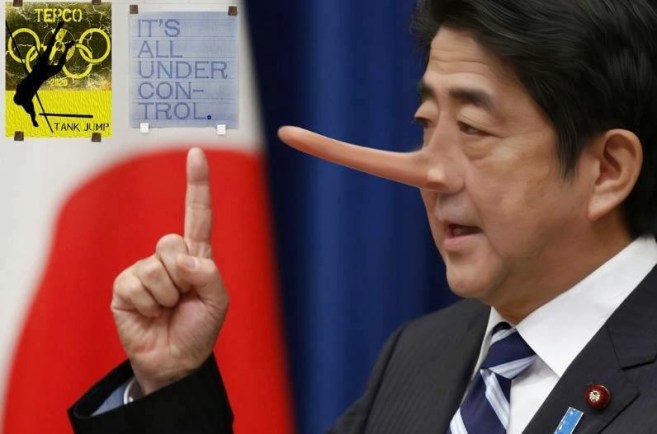
Earlier this month, former Japanese prime minister Junichiro Koizumi accused current leader Shinzo Abe of lying to the international community that the situation at the nuclear power plant is under control.
Those in a position of Japanese authority should release information about Fukushima-related contamination once and for all. The government should also set up a mechanism which can inform the country and the international community of new findings in a timely manner.
As a neighbor of Japan, China has also felt uneasy with the radiation from the disaster. Years after the meltdown of the Fukushima reactors, Chinese travelers are still asking if it is safe to go to Japan. In terms of food safety, despite a ban by Chinese authorities on food imports and agricultural products from Fukushima and 11 other Japanese regions affected by nuclear contamination since the accident, potentially radiation-tainted seafood from Fukushima smuggled to China poses health threats to the Chinese people.
Since a large number of Chinese travelers are going to Japan, related information is indispensable. Therefore, China should also come up with solutions such as assigning experts to monitor the situation in Japan and offer credible advice to the anxious public. This “nuclear war without a war” will attest to the responsibility of a government to its people.
http://www.globaltimes.cn/content/1008771.shtml#.V-sabiwjxlg.facebook
Tokyo Electric Power : Financial Assistance from the Nuclear Damage Compensation and Decommissioning Facilitation Corporation

On September 23, we received a funding grant of 104.1 billion yen from the Nuclear Damage Compensation and Decommissioning Facilitation Corporation (hereinafter referred to as NDF) based on the revision of the Special Business Plan which was approved on March 31, 2016.
This financial assistance was given in response to the 56th request we made in order to cover the compensation payouts due by the end of October 2016. The amount of the payouts to be paid by that time had been estimated to exceed the sum of the compensation we had received in accordance with the ‘Act on Contract for Indemnification of Nuclear Damage Compensation’ (188.9 billion yen) and the financial assistance that the NDF has provided (6,229.9 billion yen).
With financial assistance from the NDF, we are determined to continue to pay the compensation with courtesy and compassion to all of those who have been afflicted by the nuclear damage.
1 This Month

of the week – Shut Down Drone Warfare!


Tell the Ukrainian Government to Drop Prosecution of Peace Activist Yurii Sheliazhenko

Petition to revoke the licensing of the Near Surface Nuclear Disposal Facility (NSDF) at Chalk River. https://www.ourcommons.ca/petitions/en/Petition/Details?Petition=e-7247
To see nuclear-related stories in greater depth and intensity – go to https://nuclearinformation.wordpress.com
-
Archives
- April 2026 (103)
- March 2026 (251)
- February 2026 (268)
- January 2026 (308)
- December 2025 (358)
- November 2025 (359)
- October 2025 (376)
- September 2025 (257)
- August 2025 (319)
- July 2025 (230)
- June 2025 (348)
- May 2025 (261)
-
Categories
- 1
- 1 NUCLEAR ISSUES
- business and costs
- climate change
- culture and arts
- ENERGY
- environment
- health
- history
- indigenous issues
- Legal
- marketing of nuclear
- media
- opposition to nuclear
- PERSONAL STORIES
- politics
- politics international
- Religion and ethics
- safety
- secrets,lies and civil liberties
- spinbuster
- technology
- Uranium
- wastes
- weapons and war
- Women
- 2 WORLD
- ACTION
- AFRICA
- Atrocities
- AUSTRALIA
- Christina's notes
- Christina's themes
- culture and arts
- Events
- Fuk 2022
- Fuk 2023
- Fukushima 2017
- Fukushima 2018
- fukushima 2019
- Fukushima 2020
- Fukushima 2021
- general
- global warming
- Humour (God we need it)
- Nuclear
- RARE EARTHS
- Reference
- resources – print
- Resources -audiovicual
- Weekly Newsletter
- World
- World Nuclear
- YouTube
-
RSS
Entries RSS
Comments RSS
 nuclear-news
.jpg)