Japan’s lurch away from nuclear hasn’t caused fossil fuels to boom
The emergency shutdown of nuclear reactors hasn’t been an emissions disaster.
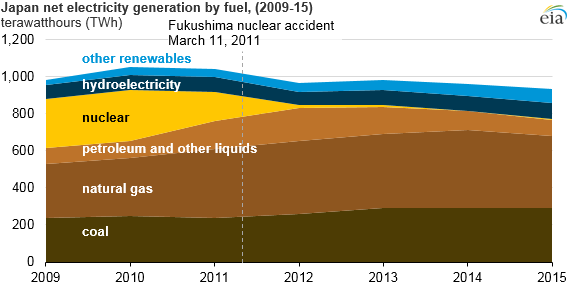
In the wake of the meltdown of the Fukushima Daiichi nuclear reactors, Japan shut down its entire nuclear fleet in order to develop more rigorous safety standards and inspect the remaining plants. As of now, plants are only beginning to come back online.
Given that Japan had recently relied on nuclear for over a quarter of its electricity, the expectation is that emissions would rise dramatically. But that hasn’t turned out to be the case. While coal use has gone up, it hasn’t risen by more than 10 percent. And a heavy dose of conservation has cut Japan’s total electricity use to below where it was at the end of last decade.
Based on the graph, it appears that nuclear was playing a decreasing role in Japan’s energy mix even prior to Fukushima, being displaced in part by natural gas and in part by petroleum. But that may be an artifact of the chart, given that nuclear was shut down entirely immediately after Fukushima, but the chart shows it persisting. In either case, post-Fukushima conservation efforts dropped Japan’s electricity use below a PetaWatt-hour, and further efforts have turned the drop in electricity use into an ongoing trend.
Fossil fuel use has gone up, but not by as much as might be expected. Coal rose by eight percent, and natural gas (transported in its liquefied form) rose by nine percent. These have largely reversed the expansion of petroleum use that began prior to the meltdown at Fukushima. Non-hydro renewables have also more than doubled their electrical production since that time. Combined with hydroelectric plants, they now provide more electricity than petroleum.
The net result of all of this? Carbon emissions have been relatively flat and have not exceeded the nation’s record year back in 2007. Thus, if nuclear plants are brought back online in significant numbers, Japan’s emissions should begin to drop considerably. If the growth of renewables and general conservation continue as well, Japan should see the drop in emissions accelerate.
And that’s going to be needed, given that Japan has pledged to drop its carbon emissions significantly from their recent peak.
No comments yet.
1 This Month

of the week – Shut Down Drone Warfare!


Tell the Ukrainian Government to Drop Prosecution of Peace Activist Yurii Sheliazhenko

Petition to revoke the licensing of the Near Surface Nuclear Disposal Facility (NSDF) at Chalk River. https://www.ourcommons.ca/petitions/en/Petition/Details?Petition=e-7247
To see nuclear-related stories in greater depth and intensity – go to https://nuclearinformation.wordpress.com
-
Archives
- April 2026 (7)
- March 2026 (251)
- February 2026 (268)
- January 2026 (308)
- December 2025 (358)
- November 2025 (359)
- October 2025 (376)
- September 2025 (257)
- August 2025 (319)
- July 2025 (230)
- June 2025 (348)
- May 2025 (261)
-
Categories
- 1
- 1 NUCLEAR ISSUES
- business and costs
- climate change
- culture and arts
- ENERGY
- environment
- health
- history
- indigenous issues
- Legal
- marketing of nuclear
- media
- opposition to nuclear
- PERSONAL STORIES
- politics
- politics international
- Religion and ethics
- safety
- secrets,lies and civil liberties
- spinbuster
- technology
- Uranium
- wastes
- weapons and war
- Women
- 2 WORLD
- ACTION
- AFRICA
- Atrocities
- AUSTRALIA
- Christina's notes
- Christina's themes
- culture and arts
- Events
- Fuk 2022
- Fuk 2023
- Fukushima 2017
- Fukushima 2018
- fukushima 2019
- Fukushima 2020
- Fukushima 2021
- general
- global warming
- Humour (God we need it)
- Nuclear
- RARE EARTHS
- Reference
- resources – print
- Resources -audiovicual
- Weekly Newsletter
- World
- World Nuclear
- YouTube
-
RSS
Entries RSS
Comments RSS
 nuclear-news
Leave a comment