Damage caused only by misconceptions about the nuclear incident not by the nuclear accident itself, according to the Yomiuri Shimbun, a pro-government newspaper
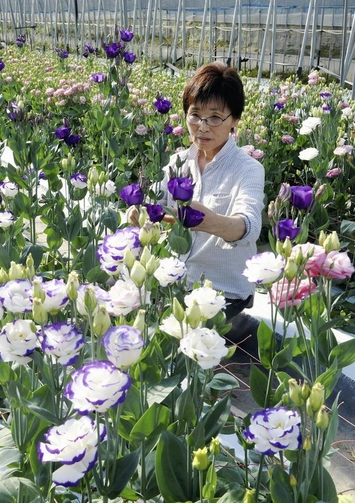
Fukushima farmers plant flowers to revive agriculture
Tomoko Horiuchi checks eustoma she grows in Minami-Soma, Fukushima Prefecture, in early August.
FUKUSHIMA — Farmers from Fukushima Prefecture’s municipalities who have received the government’s evacuation directives in the wake of the 2011 disaster at the Fukushima No. 1 nuclear power plant are cultivating flowers as a new agricultural business to rebuild their lives.
The climate in these areas is suited to growing colorful flowers, as it has abundant sunshine and a relatively large change in temperature between day and night.
After the nuclear crisis, the price of rice harvested in the prefecture has hovered at low levels because of the damaged perception of crops grown in the area.
But because growing flowers is less susceptible to damage caused by misconceptions about the nuclear incident, an increasing number of local farmers actively cultivate eustoma and other popular ornamental flowers.
Junichi Futatsuya, 65, from the Haramachi district in Minami-Soma, began cultivating eustoma in the spring of 2014 using an idle greenhouse where he used to raise rice seedlings. In 2015, a local agricultural cooperative that covers Minami-Soma formed a section to grow eustoma, with Futatsuya participating in the project. Membership has now grown to 25 people.
Stable prices
In July, the evacuation directives were lifted in most areas of Minami-Soma, and many farmers now sell their flowers in Tokyo in the hopes of gaining recognition for them in areas that are major markets.
Futatsuya, who restarted cultivating rice this year, said, “I’m expecting to secure income by growing rice and flowers.”
Kawasaki Flora Auction Market Co. trades in flowers produced by Futatsuya and other farmers from the prefecture.
“We don’t hear any dealers in the market saying they would shy away from the products because the flowers are produced in Fukushima Prefecture,” said Manabu Aishima, 49, a section chief of the Kawasaki-based company. “Farmers can expect all-year shipping with adequate investment in plants and equipment.”
Tomoko Horiuchi, 69, also grows eustoma in the district. She said she did not experience a wide fluctuation in prices before or after the crisis.
“It made me realize that flowers are not susceptible [to damage caused by misconceptions]. I would like fellow producers to increase to more stably supply flowers to the market,” she said.
Supporting ambition
Daytime entry is allowed in areas where evacuation directives have been issued as long as these areas are not designated as “difficult-to-return zones” due to high levels of radiation exposure.
In July last year, six farmers in the town of Namie formed a study group to grow flowers, and one of the farmers was able to grow and ship eustoma to customers.
The Namie town government plans to conduct a survey to find places suitable for flower cultivation and is considering consolidating greenhouses near the town office.
Meanwhile, in the village of Iitate, evacuation directives are scheduled to be lifted in most places at the end of March 2017. Four farmers will build greenhouses in the village to grow baby’s-breath flowers on a trial basis.
The Fukushima prefectural government is also financially supporting farmers if they build greenhouses and purchase equipment to make flower cultivation a new business in the Hamadori area, which is close to the nuclear plant.
“We’d like to support ambitious farmers,” said Masatoshi Kanno, vice chief of the prefectural government’s horticulture section.
No comments yet.
1 This Month

of the week – Shut Down Drone Warfare!


Tell the Ukrainian Government to Drop Prosecution of Peace Activist Yurii Sheliazhenko

Petition to revoke the licensing of the Near Surface Nuclear Disposal Facility (NSDF) at Chalk River. https://www.ourcommons.ca/petitions/en/Petition/Details?Petition=e-7247
To see nuclear-related stories in greater depth and intensity – go to https://nuclearinformation.wordpress.com
-
Archives
- April 2026 (68)
- March 2026 (251)
- February 2026 (268)
- January 2026 (308)
- December 2025 (358)
- November 2025 (359)
- October 2025 (376)
- September 2025 (257)
- August 2025 (319)
- July 2025 (230)
- June 2025 (348)
- May 2025 (261)
-
Categories
- 1
- 1 NUCLEAR ISSUES
- business and costs
- climate change
- culture and arts
- ENERGY
- environment
- health
- history
- indigenous issues
- Legal
- marketing of nuclear
- media
- opposition to nuclear
- PERSONAL STORIES
- politics
- politics international
- Religion and ethics
- safety
- secrets,lies and civil liberties
- spinbuster
- technology
- Uranium
- wastes
- weapons and war
- Women
- 2 WORLD
- ACTION
- AFRICA
- Atrocities
- AUSTRALIA
- Christina's notes
- Christina's themes
- culture and arts
- Events
- Fuk 2022
- Fuk 2023
- Fukushima 2017
- Fukushima 2018
- fukushima 2019
- Fukushima 2020
- Fukushima 2021
- general
- global warming
- Humour (God we need it)
- Nuclear
- RARE EARTHS
- Reference
- resources – print
- Resources -audiovicual
- Weekly Newsletter
- World
- World Nuclear
- YouTube
-
RSS
Entries RSS
Comments RSS
 nuclear-news
Leave a comment