Strained relations between China and UK, after Theresa May delays Hinkley nuclear decision
U.K. Delay on Hinkley Point Nuclear Power Plant Strains Relations With China Decision by new government to review deal comes as British vote to leave the European Union puts trade policy in question, WSJ By JENNY GROSS in London and CHUN HAN WONG in Beijing Aug. 5, 2016
New Prime Minister Theresa May’s surprise move to delay a final decision on building a nuclear plant part-funded by China has prompted questions in Beijing about the U.K.’s commitment to foreign investment and a “golden era” in ties between their capitals.
Britain announced last week it needed until the fall to review the controversial £18-billion ($23.7 billion) project, postponing a deal with China and France agreed to last year by Ms. May’s predecessorDavid Cameron to build the country’s first new nuclear plant in a generation.
Ms. May has said the U.K. will continue to seek investment from around the world, but how she proceeds in China will be closely watched as a bellwether of her government’s diplomatic and economic policy as the country navigates its exit from the European Union following a public vote in June……..
Chinese state media warned that undue delays or cancellation of the project would damage mutual trust. The delay had already spurred concern that Britain might be “thinking of erecting a wall of protectionism,” China’s official Xinhua News Agency said in an editorial this week…….
A Chinese government adviser said China will want Britain to provide a clear explanation for its actions and assurances on the directions of its China policy. He added that while the nuclear deal marked a crucial advance for Beijing, ultimately Britain needs China more than the other way around…….
Nick Timothy, Ms. May’s newly appointed joint chief of staff and a close adviser, last year wrote that the deal was “baffling” and said security experts are worried the Chinese could build weaknesses into computer systems that would allow them to shut down Britain’s energy production.
—Selina Williams in London and Inti Landauro in Paris contributed to this article.http://www.wsj.com/articles/u-k-delay-on-hinkley-point-nuclear-power-plant-strains-relations-with-china-1470402457
Hanford Nuclear Site’s Ongoing Wildfire Problem

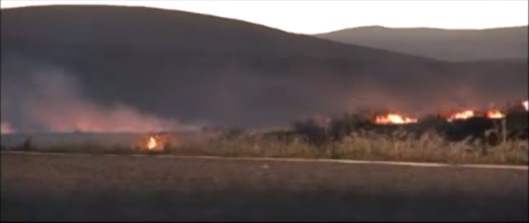
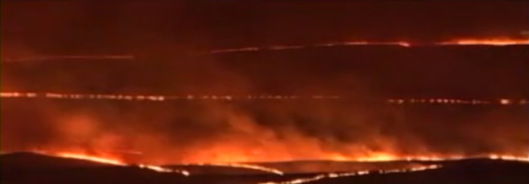
Hanford 2007 fire, US DOE video screenshots
Wildfires on the Hanford Nuclear Site have occurred in 1957, 1973, and 1981, 1984, 1998, 2000, and 2007. How many more have been near the site? The 1998 wildfire burned approximately 4,047 ha (10,000 ac). The 24 Command fire of 2000 and the Wautoma Fire of 2007 burned more than one-half the total acreage of the Hanford Nuclear Site. There is, as well, an ever-present risk of fires occurring spontaneously within the radioactive waste itself.
Official DOE video of Hanford 2000 fire http://youtu.be/lhBDnrDVyIQ
Official DOE video of Hanford 2007 fire http://youtu.be/zDgBUwhUAVE
Private videos of some of the current fires which are near but reportedly not on the site: https://flyingcuttlefish.wordpress.com/2016/08/04/wildfire/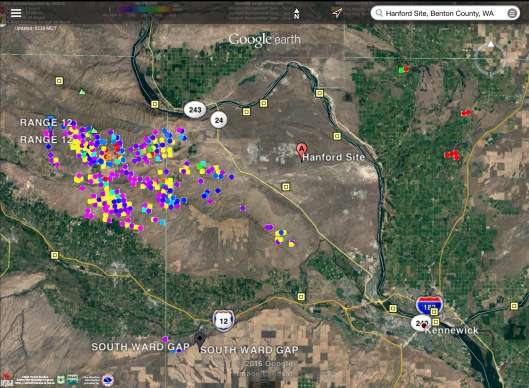
Wildfires in the region of the Hanford Nuclear Site, 230 am MDT update.
Currently there are still ongoing wildfires near the Hanford Nuclear Site, but it is believed that they will be successfully contained…
View original post 2,946 more words
August 5 Energy News

Opinion:
¶ “Nuclear Power Is Losing Money At An Astonishing Rate” • Half of the existing nuclear power plants are no longer profitable. The New York Times and others have tried to blame renewable energy, but the admittedly astounding price drops of renewables aren’t the primary cause of the industry’s woes. [ThinkProgress]
 Cooling towers. Shutterstock image.
Science and Technology:
¶ In a new research study from Argonne National Laboratory and the University of Illinois at Chicago, scientists developed an artificial leaf that uses solar power to transform CO2 into a fuel source. The leaf mimics the process of photosynthesis that occurs naturally in plants, but converts CO2 into syngas, a fuel. [Treehugger]
¶ North Sea hydrocarbon reserves are being depleted, and many hundreds of oil and gas rigs are approaching the end of their productive lives. At the current low oil price, one-third of oil fields…
View original post 665 more words
It’s Not Just Subtropical Cornwall — Climate Zones Everywhere are on the March Poleward

A few weeks ago, the University of Exeter found that parts of Cornwall, England had become subtropical. The study stated that since average temperatures had risen to above 10 degrees Celsius (50 Fahrenheit) for periods of time longer than seven months, this part of England situated on a latitude line north of most of Newfoundland has become part of a climate zone that during the early 20th century extended as far south as the southern tip of Florida.
Parts of Cornwall have become subtropical since 2000 and this could create opportunities to grow new, unusual plants. Sunflowers, maize, grapevines and tea are already grown in the Duchy.
The study also pointed out that the added heat might present a problem or two, instances that…
View original post 1,229 more words
UK Business and Energy Secretary in Japan: Discussed Future Nuclear Power Stations
UK Business and Energy Secretary, Greg Clark, returned from discussing future nuclear power stations in Japan, only to announce that the UK government was postponing their decision regarding the proposed Franco-Sino (EDF) Nuclear Power Station at Hinkley Point in Somerset, England.
Is French State owned EDF’s Hinkley Point Nuclear Power Station Project dead? Will one of the two proposed Japanese (Toshiba in Cumbria, Hitachi in Wales) projects be shifted there? Or is the UK attempting to obtain funding from Japan rather than China? Is the new Prime Minister, Theresa May, trying to make certain that Costain, located in her constituency of Maidenhead, is chosen for any Japanese nuclear projects as they were for the EDF Hinkley Point nuclear project? For the Hinkley Nuclear Power project, Costain was chosen to construct the cooling water tunnels – 9 km of tunnels under the Severn Estuary.
That’s what nuclear power stations are about…
View original post 1,214 more words
Japan’s new environment minister pledges to build trust, contaminated waste storage facility in Fukushima
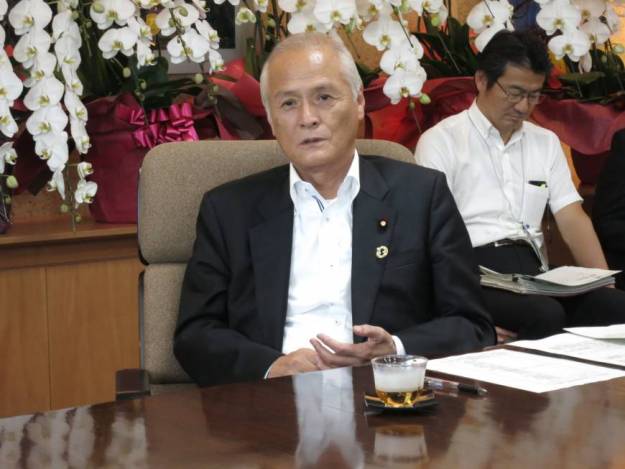
Environment Minister Koichi Yamamoto speaks during a group interview in Tokyo on Friday.
Newly appointed Environment Minister Koichi Yamamoto said Friday he will further efforts to build trust with people in Fukushima Prefecture to facilitate a stalled project to build a temporary nuclear storage facility.
The 2011 triple meltdown at the Fukushima No. 1 nuclear power plant has contaminated a large part of the prefecture while massive amounts of radioactive waste have been generated by decontamination work.
The government is planning to construct a huge temporary storage site near the Fukushima plant, but needs more than 2,300 landowners to agree to use their property for the project. So far it has only secured about 4.9 percent of the 1,600 hectares of land needed, owned by 234 people.
Although the government says it plans to store the waste for 30 years, no other areas have volunteered to host a final disposal site, leading many local residents to fear that the Fukushima site will end up being permanent.
“I’m aware that getting landowners’ consent is a very tough issue,” said Yamamoto, 68, a veteran Liberal Democratic Party lawmaker, during a media interview.
Yamamoto has learned from ministry officials that the situation is improving, and hopes to accelerate the momentum.
Storing contaminated waste at the site is crucial for Fukushima’s reconstruction work, which is currently stalled due to large amounts of waste piling up around the prefecture.
Meanwhile, some landowners are reportedly questioning the government’s commitment on this matter, as environment ministers have already changed four times since Prime Minister Shinzo Abe took office in December 2012.
But Yamamoto said the ministers have handled affairs properly. “This administration has been led by the LDP, so of course we have continuity and even (if) the minister changes (often), we share the same thoughts,” said Yamamoto.
He said 99 percent of the handover information he received from his predecessor, Tamayo Marukawa, was about Fukushima-related issues. “I have to make efforts to go to Fukushima often to make stronger connections than Marukawa did,” he said. Yamamoto plans to visit the temporary storage facility on Tuesday.
The government hopes to begin construction of the temporary storage site in October, the ministry said.
In 2011 Fukushima Ventilation Stack Read Over 10,000mSv/hour
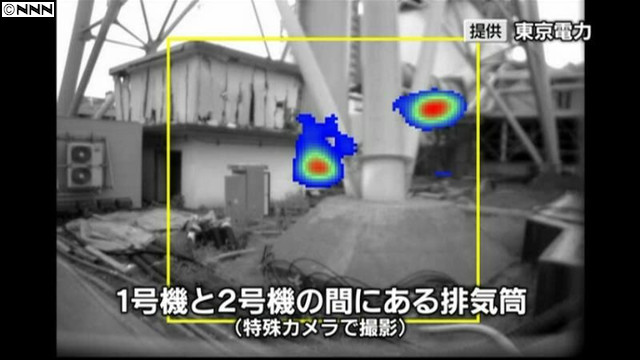
On August 2, 2011, TEPCO released a photo of the ventilation stack between reactors No. 1 and No. 2 where radioactivity over 10,000mSv / hour was measured, the highest amount of radioactivity measured to date.
The photo published is that of the ventilation stack located between reactors No. 1 and No. 2, taken on July 31 by a special camera that reacts to radioactivity.
It shows high radioactivity at two locations: at the center and at the right. The red part at the center is the place with the highest radioactivity.
Later, on August 1, workers measured the radioactivity of the pipes in the ventilation stack. The result revealed a measure exceeding 10,000 mSv / hour, the highest measurable limit.
During the venting of reactor No. 1 on March 12, 2011, the steam passed through these pipes before to be released outside. TEPCO considers that there is a strong possibility that radioactive materials would remain in the pipes.
According to TEPCO, there is no leakage of radioactive materials to the outside of the pipes.
Places around the pipes will be forbidden to enter and shielding work will be done.
Source : http://www.news24.jp/articles/2011/08/02/07187756.html
http://photo.tepco.co.jp/date/2011/201108-j/110802-01j.html
Translation credit to Kurumi Sugita
Hiroshima Day, and why the global nuclear lobby is watching London and New York
6th August – Hiroshima Day. Rather lost in the Brazil Olympics hype, but not forgotten by the hibakusha and other survivors, and families of victims of the nuclear bombing, and of those others, world-wide, who care.

State of the Climate Report documents shattering of environmental records.
 The global nuclear industry, teetering on economic collapse, is intently watching for decisions made in two cities, London and New York.
London. Prime Minister Theresa May suddenly threw a spanner in the works of the world’s largest nuclear power programme – Hinkley Point C – for Somerset, England. Just days before, France’s State-owned company EDF had given approval to build the project. The EDF decision was fraught, too, with unions opposing it, and senior managers urging delay. Everybody, including Tories, knows that the project is, economically, a white elephant. Why do the French and UK governments want to go on with it? Complicated politics, l’honneur, and like Macbeth – in too deep to get out?
 And then there’s the global nuclear lobby, ever there with political campaign funding and propaganda, and desperate for Hinkley to be the flagship of a new world-wide nuclear renaissance.
There’s also, however, the “small nuclear” lobby, like an aggressive little chihuahua, snapping at the heels of Big Nuclear. They wouldn’t mind if Hinkley fizzled out – it would prove that their (still only on paper) Small Modular Nuclear Reactors (SMRs) and PRISMS, will fix British energy, climate change, and the global nuclear waste problem.
New York. The global nuclear industry is taking comfort from the latest decision in New York. The New York State Public Service Commission, backed by the Governor, approved a $7.6 billion bailout of aging nuclear power plants, including them in a “Clean Energy Standard”. It is hoped that this will kick off a nuclear revival.
UK – Lots about Hinkley
USA. Lots about New York . President Obama pushes for UN call to end nuclear weapons testing, by-passes Congress. Wildfires threaten nuclear disaster at Hanford site.
President Obama pushes for UN call to end nuclear weapons testing, by-passes Congress
 Obama will bypass Congress, seek U.N. resolution on nuclear
  testing, WP, By Josh Rogin August 4 President Obama has decided to seek a new United Nations Security Council resolution that would call for an end to nuclear testing, a move that leading lawmakers are calling an end run around Congress.
Top administration officials, including Energy Secretary Ernest Moniz, briefed lawmakers and congressional staffers this week about President Obama’s decision to push for the U.N. action this September, to coincide with the 20th anniversary of the Comprehensive Test Ban Treaty, which was adopted in September 1996 but was never ratified by the Senate.
National Security Council spokesperson Ned Price told me that the administration still would like to see the Senate ratify the test ban treaty but is “looking at possible action in the UN Security Council that would call on states not to test and support the CTBT’s objectives. We will continue to explore ways to achieve this goal, being careful to protect the Senate’s constitutional role.”
The administration did not consult Congress before making the decision, and leading Republicans, including those who opposed Obama’s nuclear deal with Iran, are irate that the White House plans another major national security move without their advice or consent……..
The Obama administration has tried for years without success to build Senate support for ratifying the Comprehensive Test Ban Treaty, which has been ratified by 164 countries. The Clinton administration signed the treaty, but the Senate refused to ratify it in 1999. There’s no chance that the current Republican-led Senate would ratify it before Obama leaves office…….
Several lawmakers and staffers acknowledged that another congressional effort to stop Obama’s new U.N. plan would have little chance of success, especially because of the distractions of the election season and the shortage of days lawmakers are in session this fall………
The president’s push for U.N. action on nuclear testing came after months of debate inside his administration over how to advance his nuclear non-proliferation agenda. The president decided to move forward with this item after meeting with his entire National Security Council at the White House. Other nuclear policy changes could be decided and announced in the coming months. https://www.washingtonpost.com/news/josh-rogin/wp/2016/08/04/obama-will-bypass-congress-seek-u-n-resolution-on-nuclear-testing/
Paradox of USA’s nuclear weapons policy shown by Donald Trump
 Donald Trump, Perhaps Unwittingly, Exposes Paradox of Nuclear Arms, NYT, The Interpreter, By MAX FISHER AUG. 3, 2016 WASHINGTON — Donald J. Trump’s remarks on nuclear weapons have brought him, at times, to a question: Why should he be constrained from ever using them?
The controversy has highlighted a paradox that presidents have grappled with throughout the nuclear age: Nuclear weapons are deployed in great numbers, and at tremendous risk, for the purpose of never being used.
Yet the United States and other nuclear powers have maintained and expanded their arsenals, enhancing their ability to launch nuclear strikes even as they have concluded that the logic of such a conflict makes using the weapons unthinkable.
This leads to an odd dynamic: The more willing leaders are to use nuclear weapons, the less likely they will need to do so. Leaders heighten the risk — making the weapons faster, more powerful and harder to stop — so as to minimize it. They make the weapons more usable precisely because they are not.
There is little in Mr. Trump’s comments to suggest that he intended to highlight this contradiction, but that is what he did in asking why the United States bothers to develop extravagantly expensive weapons it never intends to set off………
In every case since 1945, at least so far, the terrible risks of nuclear conflict have helped avert its initiation. But, paradoxically, this has only deepened nuclear powers’ belief in the necessity of possessing such warheads, and in developing detailed plans for using them.
Tellingly, though Mr. Trump drew outrage when he said in the March interview that he would not rule out using nuclear weapons in Europe, his comments reflected current nuclear doctrine. The United States reserves the right to use nuclear weapons under certain conditions, such as retaliation for a nuclear attack, anywhere it deems necessary……..http://www.nytimes.com/2016/08/04/world/donald-trump-nuclear-weapons.html?smid=li-share&_r=0
Hinkley Nuclear Project : A dramatic turn of events
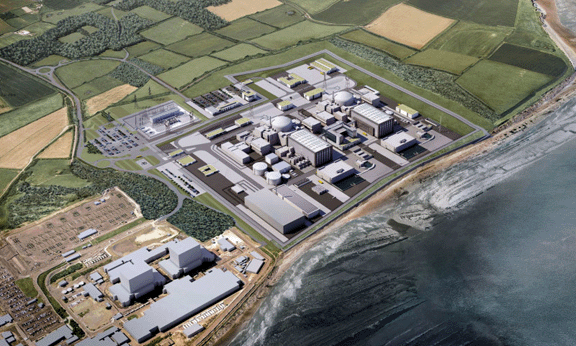
Nu Clear News No 87 5 Aug 16 Hinkley : A dramatic turn of events It has now been a few days since the Government shocked the energy industry by announcing a further review of the Hinkley Point C nuclear power station just a few hours after EDF approved the project.
Although we may never know exactly what has gone on behind the scenes it is clear that EDF had moved its final investment decision forward from September in order to bounce the new UK Government into giving its approval quickly before mounting problems become even more obvious to everyone.
Stop Hinkley spokesperson, Roy Pumfrey said
Much of the media seems to think this is just a temporary pause and that Hinkley Point C will eventually go ahead, but if Theresa May gives this scheme just a cursory glance she will see that we are being asked to buy a pig in a poke.
According to the Financial Times (2) the head of EDF, Jean-Bernard Lévy gave his fellow board members only two days to read 2,500 pages of contracts for a deal which one investment analyst described as “verging on insanity”.
The decision to review the project has been attributed by some to security concerns about Chinese involvement in the sector expressed by Mrs May’s chief of staff, Nick Timothy. The Stop Hinkley Campaign has itself expressed concerns in the past about making nuclear deals with a country with such a poor health and safety record.
Writing on the Conservative Home website last October Timothy said the Hinkley deal could lead to the Chinese designing and constructing a third nuclear reactor at Bradwell in Essex. Security experts – reportedly inside as well as outside government – are worried that the Chinese could use their role to build weaknesses into computer systems which will allow them to shut down Britain’s energy production at will. (5) For those who believe that such an eventuality is unlikely, the Chinese National Nuclear Corporation – one of the state-owned companies involved in the plans for the British nuclear plants – says on its website that it is responsible not just for “increasing the value of state assets and developing the society” but the “building of national defence.” MI5 believes that “the intelligence services of…China…continue to work against UK interests at home and abroad.”
Mandiant, a US company that investigates computer security breaches around the world, looked into the operations of just one Chinese cyber espionage group, believed to be the Second Bureau of the People’s Liberation Army of China, or ‘Unit 61398’. Mandiant found that Unit 61398 has compromised 141 different companies in twenty major industries.
There were 115 victims in the United States and five in the UK. The intellectual property stolen included technology blueprints, manufacturing processes, test results, business plans, pricing documents, partnership agreements, and emails and contact information. Timothy said
evidence like this makes it all the more baffling that the British Government has been so welcoming to Chinese stateowned companies in sensitive sectors. The Government, however, seems intent on ignoring the evidence and presumably the advice of the security and intelligence agencies. But no amount of trade and investment should justify allowing a hostile state easy access to the country’s critical national infrastructure. Of course we should seek to trade with countries right across the world – but not when doing business comes at the expense of Britain’s own national security. http://www.no2nuclearpower.org.uk/nuclearnews/NuClearNewsNo87.pdf
Problems of UK and EU’s uranium supply from Russia, Kazachstan and elsewhere
 Uranium from Russia, with love, Ecologist, 4th August, 2016 Uranium mining is a dirty business that we didn’t clean up but sourced out to less demanding countries, so why isn’t this being discussed in any debate about nuclear energy asks NICK MEYNEN
One issue is security. Reciprocal sanctions between Russia and the EU are now in place for over two years. If some recent polls in the US become reality and Trump becomes the new US president, things will get worse for the EU. Trump already hinted that a grim scenario (or much worse) could play out in Latvia or Estonia, EU countries with a Russian minority of over a quarter of the whole population. How hard can the EU bite in the hand that feeds it with the gas and uranium it so desperately needs? Putin will answer: not that hard.
Another issue is the future supply risk. Any power plant envisaged today will need uranium in 40 years from now. But both Russia and Kazachstan, the two biggest uranium exporters to the EU have plans to build new nuclear power plants for themselves. Kazachstan has gone from zero to hero: in 20 years it went from no production to supplying 40% of the world’s uranium. But aside from their own future needs, and those of nearby befriended Russia, analysts fear that mismanagement is likely to lead to a collapse in exports…………http://www.theecologist.org/News/news_analysis/2987988/uranium_from_russia_with_love.html
Climate change: wildfires threaten nuclear disaster at Hanford site
“Very Serious”: Wildfires burn close to US nuclear site — ‘Red Flag Warning’ issued —
 FEMA: “Fire threatened such destruction as would constitute a major disaster” — Largest wildfire in country (VIDEO) http://enenews.com/very-serious-wildfires-burn-close-nuclear-site-red-flag-warning-issued-fema-fire-threatened-destruction-constitute-major-disaster-largest-wildfire-country-video?utm_source=feedburner&utm_medium=email&utm_campaign=Feed%3A+ENENews+%28Energy+News%29
NPR, Aug 3, 2016 (emphasis added): Washington Fire Crews Fight To Keep Buffer Between Wildfire, Nuclear Reactor — Officials from the Hanford nuclear reservation and Energy Northwest have been meeting with fire managers in southeast Washington state Tuesday. The nearby Range 12 Fire has grown to more than 177,000 acres and high winds are predicted this evening. Fire managers are very serious about keeping the Range 12 Fire off the central portion of the Hanford nuclear site and away from the Northwest’s only nuclear reactor… Energy Northwest spokesman John Dobken called the fire’s distance from the reactor a “non-issue,”… However, fire crews were still active on Rattlesnake Tuesday. Helicopters won’t be able to fly if gusts reach 20-30 miles per hour as predicted.
KEPR, Aug 2, 2016: The fire that began on the Yakima Training Center Saturday night and burned into Benton and Grant Counties over the weekend has ballooned to over 175,000 acres according to fire crews… The Range 12 fire [is] burning close to Hanford… The Northwest Incident Command team managing the firefighting efforts said [the blaze] is getting dangerously close to West Richland… A red flag warning is in place until 8 p.m. Tuesday night… Fire officials said the Red Flag Warning is causing concern for controlling containment lines around the blaze… As of Tuesday the Range 12 blaze stretched… from the Yakima Training Center toward the Hanford Reservation… Randall Rishe with BLM [Bureau of Land Management] said at this time they do not have a clear estimate of when the fire will be fully contained.
NPR, Aug 2, 2016: The Country’s Largest Wildfire Is Burning In Washington State… About 400 firefighters, three helicopters and 34 engines are fighting it. Some firefighters and land managers say they’re on edge because of predicted gusty winds and a red flag warning. The breeze is already kicking up, and firefighters worry that burned areas could pop up and jump the established fire lines. Crews set a backfire Sunday night on Rattlesnake Mountain to keep the Range 12 fire from burning contaminated areas of the Hanford Nuclear Reservation… [This] is the largest wildfire on a list of fires managed by government agencies.
KIRO, Aug 1, 2016: FEMA funds to help fight Benton County wildfire — A wildfire burning toward the Hanford nuclear reservation scorched about 110 square miles of brush and grass Monday as it spread… [FEMA] has authorized the use of federal funds to help with firefighting costs for the South Ward Gap Fire burning in Benton County, Washington. FEMA Region X Regional Administrator Kenneth D. Murphy determined that the fire threatened such destruction as would constitute a major disaster…
Seattle Times, Aug 2, 2016: Winds whip up wildfires; one blaze bearing down on Hanford site… winds pushed the Range 12 fire toward the Hanford Nuclear Reservation… Rishe said the fire Sunday ripped through grass, sagebrush and cheatgrass with ferocity… Crews are racing to put the fire down before winds make the situation more dangerous.
Seattle Times, Aug 2, 2016: Wildfire near Hanford site larger than first thought; high winds a concern — The Range 12 fire, near the Hanford nuclear site, is now 175,000 acres — much bigger than crews first realized… More than 400 firefighters are working the Range 12 fire, which is west of the Hanford nuclear site. Rishe said “there’s very low concern along Highway 240,” the barrier to the nuclear site. But, “it’s all contingent on this wind event.”
Tri-City Herald, Aug 2, 2016: Fire near Hanford much larger than thought… The estimated size of the fire that burned… toward the Hanford nuclear reservation has more than doubled to 273 square miles… A red flag fire warning was issued for the Mid-Columbia on Tuesday… The incident command team was concerned that established fire perimeter lines could be threatened… Crews have come from as far away as Medford, Ore., to help fight the fire.
New York State Public Service Commission’s $7.6 billion bailout of uneconomic nuclear power plants
New York Approves $7.6 Billion Bailout Of Nuclear Power Plants, Huffington Post 08/03/2016 Karl Grossman Investigative reporter
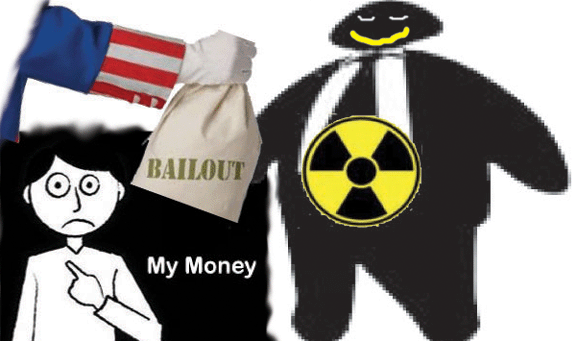
The New York State Public Service Commission—in the face of strong opposition—this week approved a $7.6 billion bailout of aging nuclear power plants in upstate New York which their owners have said are uneconomic to run without government support.
New York Governor Andrew Cuomo—who appoints the members of the PSC—has called for the continued operation of the nuclear plants in order to, he says, save jobs at them. The bailout would be part of a “Clean Energy Standard” advanced by Cuomo. Under it, 50 percent of electricity used in New York by 2030 would come from “clean and renewable energy sources”—with nuclear power considered clean and renewable.
“Nuclear energy is neither clean nor renewable,” testified Pauline Salotti, vice chair of the Green Party of Suffolk County, Long Island at a recent hearing on the plan.
“Without these subsidies, nuclear plants cannot compete with renewable energy and will close. But under the guise of ‘clean energy,’ the nuclear industry is about to get its hands on our money in order to save its own profits, at the expense of public health and safety,” declared a statement by Jessica Azulay, program director of Alliance for a Green Economy, based in upstate Syracuse with a chapter in New York City. Moreover, she emphasized, “Every dollar spent on nuclear subsidies is a dollar out of the pocket of New York’s electricity consumers—residents, businesses and municipalities” that should “instead” go towards backing “energy efficiency, renewable energy and a transition to a clean energy economy.”
The “Clean Energy Standard” earmarks twice as much money for the nuclear power subsidy than it does for renewable energy sources such as solar and wind…….
In opposing the New York nuclear subsidy, Dr. Mark Z. Jacobson, professor of civil and environmental engineering and director of the Atmosphere/Energy Program at Stanford University, wrote in an op-ed in Albany Times Union, the newspaper in the state’s capitol, that he was “shocked” by the PSC’s “proposal that the lion’s share of the Clean Energy Standard funding would be a nuclear bailout.” He said “allowing the upstate nuclear plants to close now and replace them with equal energy output” from offshore wind and solar power “would be cheaper and would create more jobs.” The closure of the upstate plants “would jeopardize fewer than 2,000 jobs” while a “peer-reviewed study” he has done “about converting New York State to 100 percent clean, renewable energy -which is entirely possible now—would create a net of approximately 82,000 good, long-term jobs.”
The upstate nuclear power plants to be bailed out under the plan would be FitzPatrick, Nine Mile Point 1 and 2 and Ginna. The money would come over a 12-year period through a surcharge on electric bills paid by residential and industrial customers in New York State…….
Reuters has reported that the nuclear “industry hopes that if New York succeeds, it could pressure other states to adopt similar subsides” for nuclear plants. The headline of the Reuters story: “New York could show the way to rescue U.S. nuclear plants.”
The two Indian Point nuclear power plants 26 miles north of New York City are not now included in the plan but it “leaves the door open to subsidies” for them, says Azulay of Alliance for a Green Economy. This would mean “the costs [of the bailout] will rise to over $10 billion.” ………http://www.huffingtonpost.com/karl-grossman/76-billion-bailout-of-ny-_b_11302708.html
UK found not in compliance with The United Nations Espoo (EIA) Convention Compliance Committee
 NucClear News August 2016 The Nuclear Free Local Authorities (NFLA) welcomes the recently published decision of the United Nations Espoo Convention Compliance Committee, following its investigation in whether the United Kingdom is compliant with international environmental law in the case of Hinkley Point C.
The Committee found that the United Kingdom was not in compliance with the Espoo Convention. The Espoo (EIA) Convention sets out the obligations of UN member states to assess the environmental impact of certain activities at an early stage of planning. It also lays down the general obligation of States to notify and consult each other on all major projects under consideration that are likely to have a significant adverse environmental impact across boundaries. Hinkley Point C comes into consideration for such a consultation.
Complaints raised by the German MP Sylvia Kötting-Uhl and the NGO ‘Irish Friends of the Environment’ to the Espoo Convention Implementation Committee argued that the UK Government had inadequately consulted other member states of the potential environmental impacts of the Hinkley Point C project.
In its findings, the Implementation Committee concluded that the UK Government should have notified more countries than just the Republic of Ireland of the potential impacts of Hinkley Point C. It concluded on the basis of the ‘Guidance on the Practical Application of the Espoo Convention’, that “notification is necessary unless a significant adverse transboundary impact can be excluded.” http://www.no2nuclearpower.org.uk/news/3-august-2016/
1 This Month
Chernobyl: The Lost Tapes – A good documentary on Chernobyl on SBS available On Demand for the next 3 weeks– https://www.sbs.com.au/ondemand/tv-program/chernobyl-the-lost-tapes/2352741955560

of the week–London Campaign for Nuclear Disarmament

Tell the Ukrainian Government to Drop Prosecution of Peace Activist Yurii Sheliazhenko
To see nuclear-related stories in greater depth and intensity – go to https://nuclearinformation.wordpress.com
-
Archives
- April 2026 (152)
- March 2026 (251)
- February 2026 (268)
- January 2026 (308)
- December 2025 (358)
- November 2025 (359)
- October 2025 (376)
- September 2025 (257)
- August 2025 (319)
- July 2025 (230)
- June 2025 (348)
- May 2025 (261)
-
Categories
- 1
- 1 NUCLEAR ISSUES
- business and costs
- climate change
- culture and arts
- ENERGY
- environment
- health
- history
- indigenous issues
- Legal
- marketing of nuclear
- media
- opposition to nuclear
- PERSONAL STORIES
- politics
- politics international
- Religion and ethics
- safety
- secrets,lies and civil liberties
- spinbuster
- technology
- Uranium
- wastes
- weapons and war
- Women
- 2 WORLD
- ACTION
- AFRICA
- Atrocities
- AUSTRALIA
- Christina's notes
- Christina's themes
- culture and arts
- Events
- Fuk 2022
- Fuk 2023
- Fukushima 2017
- Fukushima 2018
- fukushima 2019
- Fukushima 2020
- Fukushima 2021
- general
- global warming
- Humour (God we need it)
- Nuclear
- RARE EARTHS
- Reference
- resources – print
- Resources -audiovicual
- Weekly Newsletter
- World
- World Nuclear
- YouTube
-
RSS
Entries RSS
Comments RSS
 nuclear-news