August 23 Energy News

Science and Technology:
¶ According to a report by the New York Times, the coral reef on the floor of a remote island lagoon halfway between Hawaii and Fiji started to become a dead zone in the early 2000s. However, a team of biologists in 2015 was “stunned and overjoyed to find Coral Castles, genus Acropora, once again teeming with life.” [The Weather Channel]
 AP Photo / Keith A. Ellenbogen
¶ In a new study, scientists who study the largest ice mass on Earth, East Antarctica, have found that it is showing a surprising feature reminiscent of the fastest melting one: Greenland. The satellite-based study found that meltwater lakes have been forming, nearly 8,000 of them in summer between the year 2000 and 2013. [The Independent]
World:
¶ Navigating through the icy waters of the Arctic, a Greenpeace ship is delivering solar panels to the…
View original post 705 more words
Socialist Nuclear Power (i.e. Unfair Nuclear Subsidies; Corporate Welfare) in America (and Elsewhere)

“There are many forms of government subsidization of the nuclear power industry. These subsidies include the sponsorship of research, enrichment of fuels, and disposal of nuclear wastes… the one government-furnished privilege that the nuclear industry could find it hardest to live without is the Price-Anderson Act’s limitation on a nuclear power plant’s liability in case of an accident“. (Barry Brownstein for the CATO Institute 1984 – see more below)
Home insurance won’t pay in the event of a nuclear accident. Imagine the sort of surprise flooding that Louisiana just suffered, in conjunction with a nuclear disaster. The aftermath of the Fukushima nuclear accident offers a glimpse into disasters which may happen at any moment – most likely in North America or Europe, simply because there are more nuclear reactors operating there.

Waterford Nuclear Power Station sits behind an earthen dam (levee) in the direction that the Mississippi…
View original post 954 more words
10,000 tons of toxic water pools in Fukushima nuclear plant trenches
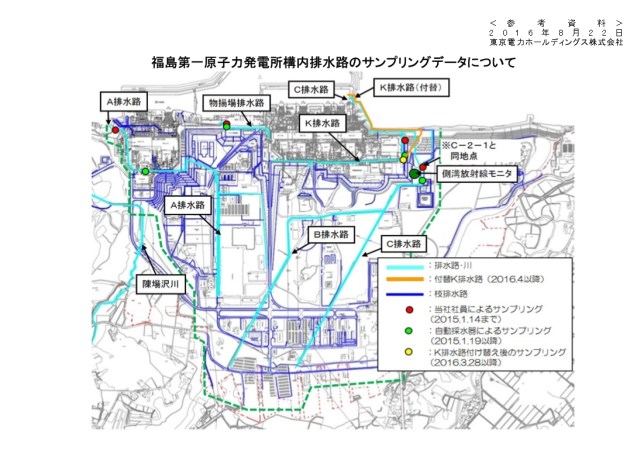
Drainage chart/map
TOKYO (Kyodo) — Around 10,000 tons of contaminated water have pooled in underground trenches around the Nos. 1 to 4 reactor buildings of the crippled Fukushima Daiichi nuclear power plant, according to the plant operator Tokyo Electric Power Company Holdings Inc.
Tokyo Electric has no immediate plan to remove the water in the trenches where cables run for the nuclear power complex devastated by the March 2011 earthquake and tsunami disaster.
Water that flew into the trenches in the wake of the huge tsunami is believed to have been mixed with highly radioactive water leaking from the basements of reactor buildings and contaminated rain water.
“Compared with around 70,000 tons of highly contaminated water that remain in the basements of the reactor buildings, (the water in the trenches) has a low level of concentration and thus poses little threat in terms of radiation exposure and the environment,” said an official of the utility known as TEPCO.

TEPCO said in a report issued in July — based on research conducted in fiscal 2015 — that it has found around 8,000 tons of toxic water in 17 locations in the trenches that connect with reactor buildings where highly radioactive water accumulates, as well as around 3,000 tons of toxic water at 11 locations in trenches that do not connect with reactor buildings.

Of the water in the trenches around the Nos. 1 to 4 reactor buildings, a removal procedure was completed by June for around 500 tons of water in a pipe that measured the highest level of radioactive cesium at 500,000 becquerels per liter.
The level of radioactive cesium in water at other locations in the trenches was mostly measured at several thousands becquerels or below.
The level in toxic water in the basements of reactor buildings has been measured at around dozens of millions becquerels at maximum.
TEPCO has said it will continue to monitor and measure the level of contamination in water in the trenches regularly and consider taking measures to remove the water in the future. But no concrete plan has been created yet.
The electricity firm has so far removed a total of around 10,000 tons of highly radioactive water at three locations in the trenches running in the seaside of the complex and completed the procedure to fill locations concerned with cement to prevent water leaks.
Still, the level of radioactive cesium remains unchecked at 40 locations in the trenches due to high radioactive levels as well as debris and other objects blocking the research operation.
Around 8,000 tons of contaminated water, including those with an extremely low level of contamination, have also been found in the trenches running around the Nos. 5 and 6 reactor buildings. The two units have lower levels of radiation doses than the Nos. 1 to 4 units as there were no nuclear meltdowns or hydrogen explosions there during the nuclear disaster.
http://mainichi.jp/english/articles/20160823/p2g/00m/0dm/074000c
Drainage charts/maps.
https://t.co/EIJkR80Biq
Tepcos Reports (PDF)
https://t.co/lTM563FjQe
August 22 Energy News
Opinion:
¶ “UK energy mix faces seismic shift” • These last weeks have been a time when an inescapable set of signals emerges, all pointing in the same direction. The idea that renewables are not competitive with fossil fuels and nuclear power has lost all basis in fact. It’s time to wake up to the energy revolution. [Climate Home]
 Wind turbine and moon. Pic: Pixabay.
¶ “Trump’s Toxic Threat: Oblivion To Climate Change, Even In His Backyard” • One of the largely unrecognized dangers of Donald Trump’s slash-and-burn presidential campaign is that his many outrageous statements are causing us to lose sight of the very real threat he poses to our shared environment. [WBUR]
Science and Technology:
¶ A team of Australian National University scientists brought economically competitive solar thermal energy generation closer to reality. They hit a record in efficiency for the technology with a…
View original post 495 more words
Government subsidies to help Fukushima farmers restart operations

The central government plans to set up a new subsidy system to help farmers in 12 municipalities near the stricken Fukushima No. 1 nuclear plant restart their operations, according to sources.
The program represents part of the government’s efforts to promote the reconstruction of areas damaged by the March 2011 earthquake and tsunami in the Tohoku region and the subsequent meltdowns at the Tokyo Electric Power Co. nuclear station.
The government will earmark around ¥7 billion for the program under a planned supplementary budget for its special account related to the 2011 disaster, the sources said Monday.
The program will help farmers buy equipment and livestock.
A support system is already available in which the 12 municipalities in Fukushima Prefecture buy facilities and equipment such as greenhouses and tractors and lend them for free to farmers aiming to get back on their feet.
But the system is inconvenient for individuals who want to resume farming operations, because it is mainly designed for group farming and other big operations. Also, approval from local assemblies is necessary to lend out the facilities and gear.
Under the new program, the Fukushima Prefectural Government will cover 75 percent of farmers’ purchase costs for farming equipment and livestock, the sources said. The upper limit on support per farmer will likely be ¥10 million, they said.
The central government will shoulder all costs incurred by prefectural government, the sources said.
The 12 municipalities are Tamura, Minamisoma, Kawamata, Hirono, Naraha, Tomioka, Okuma, Futaba, Namie, Kawauchi, Katsurao and Iitate.

1 This Month

of the week – Shut Down Drone Warfare!


Tell the Ukrainian Government to Drop Prosecution of Peace Activist Yurii Sheliazhenko

Petition to revoke the licensing of the Near Surface Nuclear Disposal Facility (NSDF) at Chalk River. https://www.ourcommons.ca/petitions/en/Petition/Details?Petition=e-7247
To see nuclear-related stories in greater depth and intensity – go to https://nuclearinformation.wordpress.com
-
Archives
- April 2026 (57)
- March 2026 (251)
- February 2026 (268)
- January 2026 (308)
- December 2025 (358)
- November 2025 (359)
- October 2025 (376)
- September 2025 (257)
- August 2025 (319)
- July 2025 (230)
- June 2025 (348)
- May 2025 (261)
-
Categories
- 1
- 1 NUCLEAR ISSUES
- business and costs
- climate change
- culture and arts
- ENERGY
- environment
- health
- history
- indigenous issues
- Legal
- marketing of nuclear
- media
- opposition to nuclear
- PERSONAL STORIES
- politics
- politics international
- Religion and ethics
- safety
- secrets,lies and civil liberties
- spinbuster
- technology
- Uranium
- wastes
- weapons and war
- Women
- 2 WORLD
- ACTION
- AFRICA
- Atrocities
- AUSTRALIA
- Christina's notes
- Christina's themes
- culture and arts
- Events
- Fuk 2022
- Fuk 2023
- Fukushima 2017
- Fukushima 2018
- fukushima 2019
- Fukushima 2020
- Fukushima 2021
- general
- global warming
- Humour (God we need it)
- Nuclear
- RARE EARTHS
- Reference
- resources – print
- Resources -audiovicual
- Weekly Newsletter
- World
- World Nuclear
- YouTube
-
RSS
Entries RSS
Comments RSS
 nuclear-news