Panel: TEPCO’s ‘ice wall’ failing at Fukushima nuclear plant
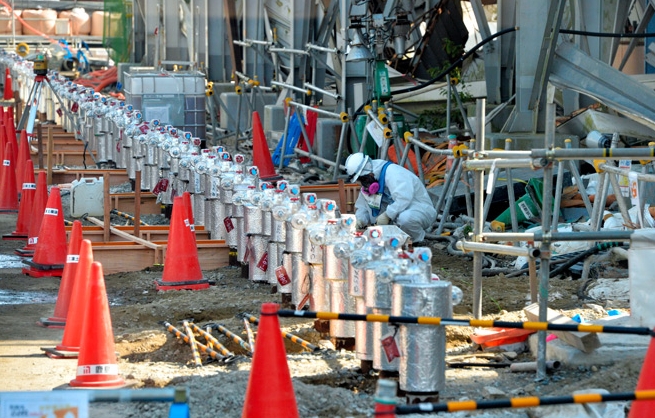
Devices to freeze the earth are set up on the southern side of the No. 4 reactor building at Tokyo Electric Power Co.’s Fukushima No. 1 nuclear power plant in Fukushima Prefecture in 2014.
Tokyo Electric Power Co.’s “frozen wall of earth” has failed to prevent groundwater from entering the crippled Fukushima No. 1 nuclear plant, and the utility needs a new plan to address the problem, experts said.
An expert panel with the Nuclear Regulation Authority received a report from TEPCO on the current state of the project on Aug. 18. The experts said the ice wall project, almost in its fifth month, has shown little or no success.
“The plan to block groundwater with a frozen wall of earth is failing,” said panel member Yoshinori Kitsutaka, a professor of engineering at Tokyo Metropolitan University. “They need to come up with another solution, even if they keep going forward with the plan.”
One big problem hampering work at the nuclear plant, which was hit by the Great East Japan Earthquake and tsunami in 2011, has been the tons of groundwater entering the buildings housing the No. 1 through No. 4 reactors every day.
The water becomes contaminated with radioactive materials within the reactor buildings.
TEPCO’s plan was to create a frozen wall of earth around the reactor buildings to divert the groundwater away from the plant and into the ocean.
The company started freezing the ground on March 31, and the project’s budget was 34.5 billion yen ($344 million) in taxpayer money as of the end of May.
But the amount of groundwater pumped from the ocean side of the frozen wall has shown little change from when there was no icy earth wall.
TEPCO’s report said 99 percent of thermometer readings on the 820-meter-long stretch showed temperatures of freezing or lower, suggesting the underground wall was frozen solid at those points.
However, the remaining 1 percent of the readings above freezing were in areas with high levels of groundwater concentration.
A 99-percent success rate may sound impressive, but much like dams, airlocks and Tupperware, TEPCO’s ice wall is failing if it is not 100-percent watertight.
The utility said the unfrozen sections could be reinforced with an injection of concrete.
The panel asked the utility submit calculations estimating the amount of groundwater that can be blocked if water is pumped before it reaches the frozen wall.
No comments yet.
1 This Month


18 March Webinar @ 1 PM EST: An Assessment of SMR Projects: The Case of Canada
register for the zoom:
https://us02web.zoom.us/webinar/register/WN_o8BIIOUvQ2ONJR1nta65DQ#/registration


of the week – STOP SMALL MODULAR REACTORS IN CANADA
To see nuclear-related stories in greater depth and intensity – go to https://nuclearinformation.wordpress.com
-
Archives
- March 2026 (138)
- February 2026 (268)
- January 2026 (308)
- December 2025 (358)
- November 2025 (359)
- October 2025 (376)
- September 2025 (258)
- August 2025 (319)
- July 2025 (230)
- June 2025 (348)
- May 2025 (261)
- April 2025 (305)
-
Categories
- 1
- 1 NUCLEAR ISSUES
- business and costs
- climate change
- culture and arts
- ENERGY
- environment
- health
- history
- indigenous issues
- Legal
- marketing of nuclear
- media
- opposition to nuclear
- PERSONAL STORIES
- politics
- politics international
- Religion and ethics
- safety
- secrets,lies and civil liberties
- spinbuster
- technology
- Uranium
- wastes
- weapons and war
- Women
- 2 WORLD
- ACTION
- AFRICA
- Atrocities
- AUSTRALIA
- Christina's notes
- Christina's themes
- culture and arts
- Events
- Fuk 2022
- Fuk 2023
- Fukushima 2017
- Fukushima 2018
- fukushima 2019
- Fukushima 2020
- Fukushima 2021
- general
- global warming
- Humour (God we need it)
- Nuclear
- RARE EARTHS
- Reference
- resources – print
- Resources -audiovicual
- Weekly Newsletter
- World
- World Nuclear
- YouTube
-
RSS
Entries RSS
Comments RSS
 nuclear-news
Leave a comment