Tepco’s hazmat suit guideline decreases burden on workers during summer heat
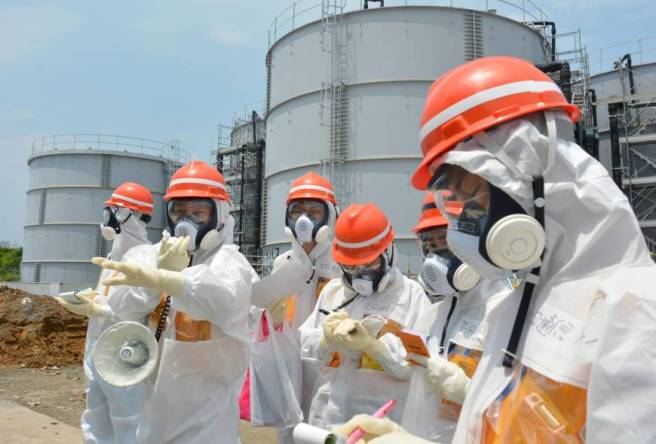
Tokyo Electric Power Company Holdings Inc., operator of the crippled Fukushima No. 1 power plant, has been revising guidelines for when workers need to wear full masks with hazmat suits or less-bulky outfits to improve their working conditions during the scorching summer.
While a full-body outfit limits radiation exposure, hazmat suits and full masks have been a heavy burden for workers because they restrict movement and make it difficult to breathe, prompting Tepco to revise the guidelines on their usage.
In March, Tepco changed the guidelines, dividing the premises into three areas.
In the area where radiation levels remain high, including inside reactor buildings 1, 2 and 3, workers will need to wear a full mask and disposable hazmat suit with a raincoat-like outer layer.
Workers meanwhile will need to wear full or half masks with hazmat suits in areas where radiation levels are lower, such as near tanks filled with radiation-tainted water. In the remaining area, the majority of which has low levels of radiation, workers only need to use disposable masks and their usual work outfits, Tepco said.
According to the utility, out of about 5,000 to 6,000 workers on the premises, about 47 percent were required to wear a full mask in June, down from about 66 percent in January, before the guidelines were changed.
Those who are required to wear a half mask increased to 48 percent from 28 percent in the same period, it said.
Before the guidelines were revised, about 8,000 disposable hazmat suits were used per day, but the number declined to about 4,000.
Even as hazmat suit requirements have halved, radiation exposure cases have remained unchanged at an average of two a day, Tepco said, adding that the risk of radiation exposure has not increased.
Tepco said it will offer summer outfits at the beginning of this month to lessen the chance of workers succumbing to heatstroke.
In July, the health ministry opened a health care office at J-Village near the Fukushima No. 1 power plant so that its workers can seek free health consultations from doctors who are versed in radiation exposure.
“During the summer period, the health of workers tends to worsen due to heatstrokes as well as other illnesses, so we need to step up measures to resolve the situation,” said a heath ministry official.
No comments yet.
1 This Month

of the week – Shut Down Drone Warfare!


Tell the Ukrainian Government to Drop Prosecution of Peace Activist Yurii Sheliazhenko

Petition to revoke the licensing of the Near Surface Nuclear Disposal Facility (NSDF) at Chalk River. https://www.ourcommons.ca/petitions/en/Petition/Details?Petition=e-7247
To see nuclear-related stories in greater depth and intensity – go to https://nuclearinformation.wordpress.com
-
Archives
- April 2026 (114)
- March 2026 (251)
- February 2026 (268)
- January 2026 (308)
- December 2025 (358)
- November 2025 (359)
- October 2025 (376)
- September 2025 (257)
- August 2025 (319)
- July 2025 (230)
- June 2025 (348)
- May 2025 (261)
-
Categories
- 1
- 1 NUCLEAR ISSUES
- business and costs
- climate change
- culture and arts
- ENERGY
- environment
- health
- history
- indigenous issues
- Legal
- marketing of nuclear
- media
- opposition to nuclear
- PERSONAL STORIES
- politics
- politics international
- Religion and ethics
- safety
- secrets,lies and civil liberties
- spinbuster
- technology
- Uranium
- wastes
- weapons and war
- Women
- 2 WORLD
- ACTION
- AFRICA
- Atrocities
- AUSTRALIA
- Christina's notes
- Christina's themes
- culture and arts
- Events
- Fuk 2022
- Fuk 2023
- Fukushima 2017
- Fukushima 2018
- fukushima 2019
- Fukushima 2020
- Fukushima 2021
- general
- global warming
- Humour (God we need it)
- Nuclear
- RARE EARTHS
- Reference
- resources – print
- Resources -audiovicual
- Weekly Newsletter
- World
- World Nuclear
- YouTube
-
RSS
Entries RSS
Comments RSS
 nuclear-news
Leave a comment