South Africa’s nuclear company Eskom urging government to freeze renewable energy program
 Is Eskom building a case for nuclear power?, Business Day Live, BY SALIEM FAKIR JULY 28 2016, IT IS disconcerting that Eskom is advising the government to freeze a globally acclaimed renewable energy programme based on a perceived misunderstanding of the benefits of the renewable energy independent power producer (IPP) programme.
Eskom has justified its recent announcement not to sign further power purchase agreements with independent power producers with reasons that range from questions about the need for additional renewables and baseload IPPs, to improved operating performance, its large-scale new build programme, and protecting consumers from higher prices by not buying additional capacity.
Yet, the renewable energy programme is regarded as highly successful, and it delivers a wide range of benefits at the best prices given that it is a buyer’s market.
Eskom’s own 2016 financial report states that wind and solar are now cheaper than coal-generated electricity. The Treasury has stated that 92 renewable energy programme projects have attracted R193bn in private sector investment, totalling a contribution of 6,327 MW of capacity to the national grid. The total projected value of goods and services to be procured from broad-based black economic empowerment suppliers is put at more than R101bn.
Investment in renewables accounted for 85.8% of total direct foreign investment in SA in 2014. A Council for Scientific and Industrial Research report revealed that wind energy produced net savings of R1.8bn in the first half of 2015 and was also cash positive for Eskom by R300m.
The net savings can be attributed to avoiding diesel and coal fuel costs, as well as the economic costs of load shedding. Renewable energy in total generated a net benefit for the economy of up to R4bn. Renewable energy production has cut 4.4m tonnes of carbon dioxide.
At a policy level, the government has indicated that renewable energy has to be ramped up. The country’s energy vision and the National Development Plan call for a greater mix of energy sources and a greater diversity of IPPs in the energy industry, with the 2010 Integrated Resource Plan’s vision calling for 17,800 MW of renewable energy to be in place by 2030.
Internationally, SA is a signatory to the Intergovernmental Panel on Climate Change (IPCC) global climate change agreement to keep planet emissions beneath 1.5°C by honouring carbon emissions reduction targets.
Legally speaking, Eskom is a buyer of electricity, with the Department of Energy procuring capacity in line with ministerial determinations. The government’s commitment has been laudable. It is worrying that Eskom seems to wish to erode this………..
It seems Eskom is building a case for nuclear and this is the real reason behind the freeze on further renewable procurement. There is no guarantee that the proposed large nuclear new build programme will be cheap, considering that Medupi and Kusile are proving to be more expensive than some renewables. We would urge pragmatism and prudence on their part.
• Fakir is the head of the policy and futures unit with the World Wide Fund for Nature in SA. http://www.bdlive.co.za/opinion/2016/07/28/is-eskom-building-a-case-for-nuclear-power
A doomed attempt to save George Osborne’s face – the Hinkley C Nuclear Shemozzle
Hinkley Point C is no more than a doomed attempt at face-saving, Guardian John Sauven, 28 July 16
With all the costs and risks involved, the spectre of George Osborne’s energy policy could haunt Britain for decades
George Osborne’s reputation as a master political tactician may have gone the way of Leave’s £350m a week for the NHS, but the spectre of his misguided energy policy could haunt Britain for decades, and at Hinkley in north Somerset, for millennia.
Theresa May’s government urgently need to seize the opportunity to minimise the damage, an opportunity which only lasts while her government can portray them as the last regime’s errors, and disown them.
This week we learned that the UK has lost 12,000 jobs in the solar industry. This economic disaster was due to Osborne’s ideologically driven subsidy cuts to what was a vibrant and growing sector of the economy. The ideology in question was not opposition to state subsidies, of course.
Osborne has lavished new subsidies on the fossil fuel industry, just as the other leading industrialised nations have started to cut them, and Hinkley Point C is an Olympic-sized subsidy swallower. Osborne simply didn’t like renewables, despite onhore wind farms providing the cheapest electricity in Britain, and solar looking like the technology most likely to undercut them.
Whether this was due to powerful empathy with the small minority of voters who object to renewable energy, a gross misunderstanding of the economics, or an unhealthy affinity with the larger, more established firms pushing older technologies, is difficult to say. But the initial bad decisions became calcified into commandments as the government was forced to defend them repeatedly against an array of bewildered experts.
To avoid paying a low level of subsidy on technologies whose prices were dropping dramatically, Osborne’s Treasury made them rain on the one technology whose costs just keep on going up.
Hinkley C had been described as “the most expensive object on Earth” many months before the National Audit Office (NAO) revealed that subsidies would be nearly five times as big as had been previously advertised………
The NAO has claimed this month that new offshore wind would actually be cheaper than new nuclear energy, a claim confirmed by Danish firm Dong Energy building two offshore windfarms for €72.70 (£61.10) a megawatt hour, compared to Hinkley’s £92.50.
That eye-watering price is guaranteed to Hinkley for 35 years from the plant becoming operational, so billpayers will still be cursing the ghost of austerity past in the 2060s. But that’s just the short-term cost. Hinkley will produce yet more nuclear waste to add to our huge, hazardous and homeless stockpile, and so the legacy of Osborne could haunt us for many hundreds of thousands of years.
And all this, all these costs, risks and subsidies, are now no more than a doomed attempt to save the face of an ex-chancellor whose reputation was finally taken off life support a month ago.
Unless the new government sees sense and calls out their predecessor’s mistakes for what they are, two generations of UK consumers will be left footing the bill for the most expensive act of political face-saving in the history of British politics. https://www.theguardian.com/environment/2016/jul/27/hinkley-point-c-no-more-than-doomed-attempt-face-saving
Hans Kristensen verified Ploughshares’ facts on America’s nuclear arsenal and its costs
GRANTEE SPOTLIGHT: HANS KRISTENSEN http://www.ploughshares.org/issues-analysis/article/grantee-spotlight-hans-kristensen Nuclear weapons information vital to debate in Washington State, Ploughshares.org. Will Lowry, July 26, 2016
A growing number of leaders like Representative Adam Smith (D-WA), Ranking Member of the House Armed Services Committee, are increasingly concerned about the US government’s $1 trillion plan to rebuild our nuclear arsenal – a plan that could trigger a new arms global arms race with Russia and China. “I think to have a Cold War nuclear [weapons] policy is completely inappropriate to the current times,” the US Congressman from Washington State recently said.
He has reason to worry. Few people in the US are aware of this dangerous taxpayer-funded plan that could profoundly impact Washington State. And few locals know that if Washington State were a country, it would be the third largest nuclear state in the world, that just 20 miles west across the Puget Sound is the largest concentration of deployed nuclear weapons in the United States at the Kitsap-Bangor base, and that the US Navy is planning to expand the Kitsap-Bangor base to accommodate Trident-class nuclear weapons submarines.
That is why the Ground Zero Center for Nonviolent Action recently sponsored a public bus advertising campaign in Seattle to raise public awareness of the nuclear threat so close to home.
“We hope to generate a measure of citizen interest, and to begin a public discussion of nuclear weapons in the Puget Sound region. In this election year the danger of nuclear weapons ought to be a topic of discussion,” Ground Zero member Rodney Brunelle recently said of the bus ad campaign.
However, Ground Zero encountered an unanticipated problem. According to the group, the county was hesitant to run the ad, doubting the accuracy of the claim.
That’s where Ploughshares Fund grantee, renowned nuclear expert Hans Kristensen, came into the picture.
Ground Zero contacted Kristensen, Director of the Nuclear Information Project at the Federation of American Scientists, to verify the facts in order to convince the county that their ad was not making false claims. He regularly provides the general public and policymakers with information and analysis on the status, number, and operation of nuclear weapons, the policies that guide their potential use and nuclear arms control.
We believe the public needs this type of information and analysis if for no other reason than that we live in a democracy where people should have a say in the most important decisions the country makes – and this includes policy decisions related to nuclear weapons.
Funding expert sourcing and verification of information around nuclear weapons can help democratize important decisions and inform expert policy analysis at the same time. We are proud to support Kristensen and the Nuclear Information Project at the Federation of American Scientists. Information is the lifeblood of a democracy. We believe that through reason, information and dialogue, the threat of nuclear weapons can be reduced – and one day – even eliminated.
Poland’s restrictive new law hampers wind energy development
Restrictive new law will harm Poland’s wind industry, advocates say, Midwest Energy News, Kathiann M. Kowalski , 28 July 16, A new law that took effect in Poland earlier this month could kill growing competition from land-based wind farms by expanding setback requirementstenfold and increasing tax burdens, clean energy advocates say.
The law took effect July 15 and comes after Poland’s conservative Law and Justice Party won control of the government in last fall’s elections. That party’s leadership has embraced coal as the future of the country’s energy landscape.
“Investors are going to go bankrupt,” said Wojciech Cetnarski of the Polish Wind Energy Association.
Ohio passed its own law tripling property line setbacks for wind turbines in 2014. Since then, the state has seen little development of new wind farms, except forprojects grandfathered in under previous setback requirements.
Among other things, the Polish law raises the minimum setback for a new turbine to at least ten times its height from buildings and forests. In addition, the law allows extended shutdowns for turbine inspections and could lead to a fourfold increase intaxes for all land-based wind farm operations.
In Cetnarski’s view, curtailing wind energy will give an advantage to coal-fired power, which dominates Poland’s energy landscape.
“The market share of the state-owned companies will increase,” he said. “Electricity prices in Poland will go up.”
Other new provisions in Polish law could make it more difficult for renewable energy facilities to sell electricity to the grid, delaying recovery of investment costs and profits.
Poland’s actions came soon after the International Renewable Energy Association (IRENA) announced earlier this year that the levelized cost of electricity from wind energy is now essentially on par with that of coal. More recently, IRENA reported that global average costs for electricity from wind and solar energy could drop up to59 percent by 2025.
Before the law, Poland’s wind industry had been expanding, with installed capacity growing more than five times from 2010 to 2015. Projections showed that the country could add up to another 10 gigawatts of onshore wind energy by 2030.
The new setback law is especially frustrating to Poland’s wind industry because the prior government had finally agreed to a plan that would have shifted more subsidies for the country’s renewable investments into wind energy.
The new government suspended that law in December…….http://midwestenergynews.com/2016/07/26/restrictive-new-law-will-harm-polands-wind-industry-advocates-say/
Georgia Public Service Commission (PSC) authorizes Georgia Power to spend up to $99 million on new nuclear station

 Georgia Power gets green light on new nuclear plant, Atlanta Business Chronicle, Jul 28, 2016, State energy regulators gave Georgia Power Co. the go-ahead Thursday to start laying the groundwork for a new nuclear power plant south of Columbus, Ga.
But the Atlanta-based utility won’t be able to charge customers as much as it wanted to conduct preliminary site work and seek an operating license for a proposed nuclear facility at a 7,000-acre site in rural Stewart County.
The Georgia Public Service Commission (PSC) voted 4-1 to authorize Georgia Power to spend up to $99 million on the early stages of the project through the second quarter of 2019. The utility was asking the commission for authority to recover from customers up to $175 million in costs associated with the work.
The PSC’s staff had recommended that the commission put off a decision on the new nuclear plant until 2019…..
Commissioner Lauren “Bubba” McDonald, who voted against Wise’s motion, said Georgia Power should be willing to invest its own money in the Stewart County project rather than charge customers.
“If they’re as sure about another nuclear program in 2025 and beyond … let their investors make the first investment,” he said.
McDonald questioned the wisdom of building a nuclear plant along the Chattahoochee River because of the huge volumes of water consumed in nuclear power generation and noted that the federal government still doesn’t have a long-term plan for disposing of the nuclear wastes being generated today at plants across the country…..http://www.bizjournals.com/atlanta/news/2016/07/28/georgia-power-gets-green-light-on-new-nuclear.html
July 28 Energy News

Science and Technology:
¶ The European summer heat wave of 2003 has been a focal point for scientists studying whether and how human-caused climate change influences extreme weather events. It was the first weather event to be the subject of an attribution study. A new study examines the numbers of fatalities attributable to climate change. [CleanTechnica]
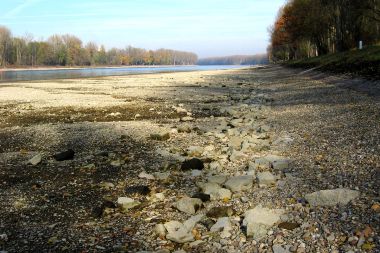 The River Rhine at Dettenheim during the 2003 heat wave.
Photo by BlueBreezeWiki. CC BY-SA 3.0. Wikimedia Commons.
World:
¶ China has installed 22 GW of grid-connected solar PV in the first half of 2016. According to PV-Tech, China’s National Energy Administration announced at an industry event in Beijing that the country had logged 22 GW of grid-connected solar PV in the first half of the year, with 11.3 GW in June alone. [CleanTechnica]
¶ Over the past few days, three separate announcements have been made about Australian wind…
View original post 756 more words
Fuel in the Fukushima Reactor 2 Playing Hide and seek
In June 2016 Tepco released preliminary information announcing that the unit 2 muon scan showed no fuel in the reactor vessel, that the full scan would be completed by mid-July and should confirm any fuel findings, or lack thereof.
The scanner can detect masses of fuel 1 meter or larger.
The scans had identified the fuel in the spent fuel pool, confirming that the system was working properly and that the results were accurate.
The image below is the actual muon scan results with darker blue indicating areas where fuel is. The internal structures of the reactor are drawn in by TEPCO.
TEPCO originally thought there was fuel remaining in the bottom head of the reactor vessel. The scan clearly showed no significant amount of fuel remaining in the core region where the fuel was before the meltdown or in the bottom of the reactor vessel.
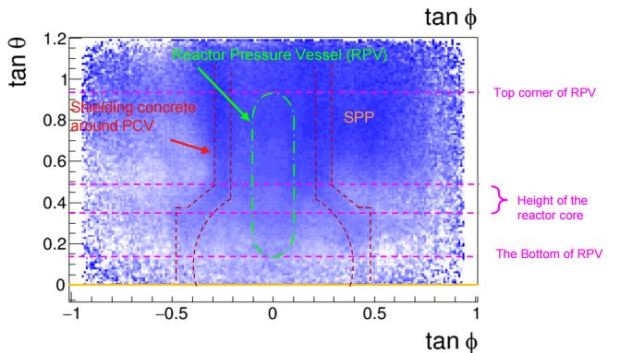
Tepco stating that the final scan report in July might refine the imagery but that it would unlikely change the results.
TEPCO handouts :
https://www.dropbox.com/s/i2bffm237u8osz6/muon%20unit%202%20handouts_160526_01-e.pdf?dl=0
https://www.dropbox.com/s/76w6rryxiwjbhoz/muonscan_2_daiichi_160526_06.pdf?dl=0
Now this Thursday July 28, 2016, one month later, Tepco announces that most of the melted nuclear fuel inside the No. 2 reactor is LIKELY located at the bottom of its pressure vessel.
That a study using muon imaging system was carried out by a team involving Tokyo Electric and the High Energy Accelerator Research Organization in Ibaraki Prefecture, that an ESTIMATED 130 tons of the so-called fuel debris REMAINS at the bottom of the vessel, that it is the first time the location and amount of the melted fuel have been estimated.
As high radiation levels are continuing to hamper direct access to the reactors, researchers have tracked muon elementary particles, which are produced as cosmic rays collide with atmospheric particles and change course when coming into contact with nuclear fuel.
The No. 2 reactor was in operation when the nuclear crisis was triggered by a powerful earthquake and subsequent tsunami that devastated Japan’s northeast.
About 160 tons of fuel assemblies are estimated to have been present inside the reactor vessel prior to the crisis. Most of the fuel is BELIEVED to have fallen to the bottom of the pressure vessel and mixed with nearby structures to form debris.
In the nuclear crisis, massive amounts of radioactive substances were released into the environment, with the Nos. 1, 3 and 4 reactor buildings damaged by hydrogen explosions.
The No. 4 reactor was offline for periodic maintenance work and all of its fuel was stored in the spent fuel pool, avoiding a meltdown.
The finding IF TRUE would be important as the data could help the operator to narrow down methods to remove the fuel debris, the most challenging task in decommissioning the plant’s Nos. 1 to 3 reactors that experienced meltdowns in the nuclear crisis that began in March 2011.
However, in mid-June 2016 using the same muon imaging system Tepco could not detect any fuel at the bottom of the reactor pressure vessel, now one month later Tepco announces that there is an estimated 130 tons of the so-called fuel debris remaining at the bottom of the vessel.
Question : has that fuel been playing hide and seek with Tepco?
Gov’t cited as second-least reliable source of info on nuclear accidents: survey

Respondents to a survey in Shizuoka Prefecture, which houses Chubu Electric Power Co.’s Hamaoka Nuclear Power Plant, have cited the government as the second-least reliable source of information on nuclear accidents.
A total of 29.2 percent of respondents in the survey by Hirotada Hirose, a professor emeritus at Tokyo Women’s Christian University, cited the central government and its ministries and agencies as the least reliable source of information in the event of a nuclear accident. The figure was topped only by “social networking services (SNS), at 36.7 percent, highlighting deep-rooted mistrust in the government as a source of information.
Conducted between May and June, the survey targeted the city of Omaezaki, where the Hamaoka Nuclear Power Plant stands, and 10 municipalities within a 31-kilometer radius of the plant, designated as urgent protective action planning zones (UPZs). A total of 360 people between the ages of 18 and 79 were interviewed directly by researchers.
The respondents were asked to choose from nine sources of information, not including nuclear power companies, which would be responsible for the incidents. Besides SNS and the central government and its ministries and agencies, the next most commonly cited unreliable sources of information were “independent reports by TV stations” at 11.9 percent, and “international organizations such as the United Nations,” at 4.4 percent. “Independent reports by newspapers” came in at 2.2 percent.
When asked for the “most reliable” source, respondents’ top answer was “prefectures and municipalities,” at 41.4 percent, while “the government, its ministries and agencies,” was selected by 11.7 percent of respondents.
“If the credibility level of the government is this low, it could have a negative effect during evacuations. If the government is moving to restart nuclear reactors, then it first should make an effort to clear away the sense of mistrust,” Hirose said.
http://mainichi.jp/english/articles/20160726/p2a/00m/0na/018000c
Doubts about nuclear plant’s quake resistance
Doubts about nuclear plant’s quake resistance shake trust in NRA
Trust in Japan’s nuclear watchdog, the Nuclear Regulation Authority (NRA), has been jolted. At hand is an issue raised by Kunihiko Shimazaki, former acting chairman of the NRA. Shimazaki pointed out that Kansai Electric Power Co. underestimated the maximum shaking that could occur during an earthquake at its Oi Nuclear Power Plant in Fukui Prefecture.
Shimazaki is an authority on seismology, having formerly served as president of the Seismological Society of Japan. While serving in the NRA, he handled screening of power companies’ earthquake predictions for nuclear power plants including the Oi nuclear plant.
After he stepped down two years ago, he re-examined data and found the method of calculating standard ground motion (the maximum shaking that would occur during an earthquake) was inappropriate in some cases, depending on the type of fault. This could lead power companies to underestimate figures, he apparently found in his research.
If Shimazaki’s argument is correct, the Oi Nuclear Power Plant could come under pressure to provide even greater reinforcement against quakes.
The NRA had for the most part accepted Kansai Electric’s data, but following the claim by Shimazaki, a new calculation on ground motion was performed using a method differing from that adopted by the power company. As the figure was below that presented by Kansai Electric, it determined that the utility had not underestimated the shaking, and during a regular meeting on July 13, it decided against revising Kansai Electric’s figure.
Shimazaki, however, objected, saying that the recalculated figure should have greatly surpassed the original figure for standard ground motion. The reason is that during screening, the outcome of calculations is normally multiplied by 1.5 to provide an added element of safety, but this wasn’t done.
The new calculation was performed by the secretariat of the NRA. A member of the secretariat who talked with Shimazaki admitted that the renewed calculation was repeatedly stretched, and had “no accuracy.” The member added, “It’s not known how much leeway should be given.” It couldn’t be helped if the secretariat were accused of adopting its approach to avoid criticism that the estimate for envisaged damage was too low. The fact that the NRA accepted without questions its secretariat’s explanation that Kansai Electric’s estimate was sufficient raises doubts about its competence.
There are no experts on seismology among the NRA’s five commissioners. NRA Chairman Shunichi Tanaka has expressed the opinion that the calculated figure for standard ground motion at the Oi Nuclear Power Plant doesn’t have to be reviewed. We worry whether quake resistance has been calculated properly.
Shimazaki has suggested to the NRA that it listen to a wide range of opinions from experts in seismology and incorporate the good ones into its screening. Even if experts differ in their evaluations of Shimazaki’s research results, his suggestion to the NRA itself is appropriate.
Tanaka, however, commented, “We don’t have the leeway to do that and it’s not our job to do it either.” We can only be skeptical about such a stance.
The NRA is supposed to be the final fortress in ensuring nuclear safety. We hope that it will try to make improvements to methods of calculating quake resistance of its own accord.
http://mainichi.jp/english/articles/20160725/p2a/00m/0na/006000c
NRA sees no need to review maximum quake estimate at Oi nuke plant
The Nuclear Regulation Authority (NRA) on July 27 concluded that there is no need to review the maximum possible earthquake estimate — known as the standard ground motion — for Kansai Electric Power Co.’s Oi Nuclear Power Plant in Fukui Prefecture.
The NRA reached the conclusion at a regular meeting after former acting NRA chairman Kunihiko Shimazaki pointed out that Kansai Electric had “underestimated” the calculated standard ground motion for its Oi plant. The NRA said that the result of Kansai Electric’s calculation was reasonable. The NRA then dismissed Shimazaki’s argument by saying that calculation methods other than the current one used for the Oi plant “have not reached a degree of scientific and technological maturity.”
Shimazaki had earlier suggested that the so-called “Irikura-Miyake method” used by Kansai Electric was the cause of the underestimated standard ground motion. The NRA’s secretariat checked the validity of other methods such as the “Takemura method,” but it concluded that ways of taking into account the “uncertainties” involved in predicting standard ground motions have not been established. Five NRA commissioners approved the secretariat’s verification results.
A string of issues over the calculations of standard ground motions raised questions about the NRA’s expertise.
After recalculating the estimated standard ground motion for the Oi plant using the “Irikura-Miyake method” — the same method used by Kansai Electric — the NRA secretariat found that the recalculated estimate was 356 gals, “gal” being a unit of acceleration. Its recalculation based on the “Takemura” method showed 644 gals. These two figures fell below Kansai Electric’s estimate of 856 gals. Therefore, the NRA secretariat determined that Kansai Electric’s figure was not “underestimated.” The NRA approved the secretariat’s findings on July 13.
On July 19, the NRA secretariat effectively withdrew its findings, saying that “They were unreasonable calculations.” Thus, it came to light that the NRA had confirmed the secretariat’s findings without verifying the validity of the calculations. It also came to light that the NRA had not grasped the detailed process of Kansai Electric’s calculation as the secretariat’s calculation result conflicted with that of Kansai Electric. The NRA approved Kansai Electric’s calculation of the standard ground motion in the autumn of 2014, but questions were subsequently raised about the way in which the screening was conducted.
Among the five NRA commissioners is a geologist, but there is no expert on ground motion. At a news conference on July 27, NRA Chairman Shunichi Tanaka acknowledged that his group was lacking expertise, saying, “That’s what we need to reflect on.” But when he met Shimazaki on July 19, Tanaka bluntly said, “There is no room for listening to outside experts nor am I in a position to do so.” As the biggest lesson learned from the Fukushima nuclear crisis ought to be that the most up-to-date expertise should be reflected in safety measures, the NRA is urged to listen to arguments and suggestions from outside experts.
http://mainichi.jp/english/articles/20160728/p2a/00m/0na/006000c
Climate change a focus for the USA Democrats election policy

 Finally, Climate Change Gets Stage Time At The Democratic Convention“This election is about climate change, the greatest environmental crisis facing our planet,” Sen. Bernie Sanders said. Huffington Post,
 26/07/2016 Just one night into the Democratic National Convention, things are looking a whole lot brighter for the environment under a potential Hillary Clinton presidency than anything we heard in Cleveland last week.
Sen. Bernie Sanders (I-Vt.), long a champion of climate action, dedicated a large portion of his speech in Philadelphia on Monday addressing “the greatest environmental crisis on our planet.”……
Those sentiments were echoed by Sen. Elizabeth Warren (D-Mass.) just moments earlier. In her keynote address, Warren called out the fossil fuel industry while praising Clinton’s inclusion of climate action as a key part of her campaign……..
The inclusion of climate topics at the DNC is a far cry from the almost nonexistent mention of climate change and fossil fuel money at last week’s RNC. Republican nominee Donald Trump, who has called climate change a “hoax” and said he isn’t a “great believer” in man-made global warming, didn’t mention the environment onceduring his acceptance speech.
The only person to speak about the issue on the RNC stage was Harold Hamm, a fracking mogul who said, “climate change isn’t our biggest problem,” and instead called for more oil and gas production, Grist reported.
Scientists have long called for extreme action to halt the worst effect of climate change. Representatives from 195 nations reached a landmark deal in Paris last year pledging to lower greenhouse gas emissions…….http://www.huffingtonpost.com.au/entry/climate-change-dnc_us_5796e480e4b0d3568f84585a
Why is New York Times shilling for the clearly failing technology of nuclear power, while dismissing renewables?
 New York Times Shills For Moribund Nuclear Power, Disses Renewables Revolution, Climate Progress BY JOE ROMM JUL 25, 2016 Why does The New York Times keep pushing nuclear power, whose prices keep rising even as demand has collapsed in every market economy? And why do they keep dissing renewables, whose prices have dropped precipitously while demand has grown beyond expectation here and around the world?
This month alone, the Times managed to publish two pieces whining that the poor, neglected nuclear power industry is having trouble competing with renewables because solar and wind have become … so darn cheap.
Utterly lost on the Times is the irony that nuclear power was originally touted as a key part of a future where electricity was “too cheap to meter.” Now it’s just another inflexible but powerful dinosaur industry being crushed in the marketplace by a superior product — kind of like mainframe computers or the horse and buggy or … print newspapers.
The fact is that on a purely economic basis, nuclear power has to a great extent priced itself out of the market for new power, even for new carbon-free power. Heck, even the French can’t build an affordable, on-schedule next generation nuclear plant in their own nuclear-friendly country!!
But rather than report accurately on the renewable energy miracle, as, say, the International Energy Agency (IEA) and Bloomberg New Energy Finance (BNEF) have, the Times manages to publish articles in its business section headlined, “How Renewable Energy Is Blowing Climate Change Efforts Off Course.” Seriously.
I will be debunking this wildly misleading piece — which is by Eduardo Porter, an economics correspondent (!) — point by point in my next post, but for now, let me just post some actual numbers (and quantified projections). In its latest report on the subject, “The Low Carbon Economy: Our Thesis In 60 CHARTS,” Goldman Sachs has several charts on “Emissions: How low carbon technologies begin to bend the curve.” Here’s just one: [on original]
Goldman Sachs concludes, “On our wind and solar numbers, emissions in IEA scenarios could peak as early as c.2020, rather than 2030.” So, yeah, “Renewable Energy Is Blowing Climate Change Efforts Off Course” — off course from failure to possible success.
The Times piece is the kind of nonsense you would expect to see on an ultra-conservative website with the headline “There Are Serious Problems With Wind And Solar.” Still, it’s probably just a coincidence that the ultra-conservative Daily Caller website repackaged the Times piece with that headline, and this lead: “Wind and solar power have been expensive boondoggles that won’t develop fast enough to affect global warming, according to a New York Times (NYT) article published Wednesday.”
It’s probably just a coincidence that the Times has a history of inflating nukes and deflating renewables….
It’s probably just a coincidence that one of the leading energy reporters for the Times, 30+ year veteran Matt Wald, after leaving the paper joined the Nuclear Energy Institute to become senior director of policy analysis and strategic planning last year.
It’s probably just a coincidence that the Times has been running this sponsored post from a pro-nuke group: http://paidpost.nytimes.com/nuclear-matters/nuclear-energy-in-the-us.html#. Don’t worry, that’s all made clear in small type to readers who can breathe easy that “The news and editorial staffs of The New York Times had no role in this post’s preparation.”
OK, on closer inspection, it does not appear to be a coincidence that, for a long time now, ridiculous stories dissing renewables and favoring nukes have been the norm (see, for instance, my 2009 post “NYT’s Matt Wald blows the ‘Alternative and Renewable Energy’ story, quotes only industry sources, ignores efficiency and huge cost of inaction” and my 2011 post, “The New York Times Abandons the Story of the Century and Joins the Energy and Climate Ignorati”). I will examine a number of more recent pieces below………
Let’s look at some pieces in just the last year that reveal the Times’ apparent ongoing slant……
For decades, the entire conservative political establishment and right-wing media have devoted themselves to blocking all climate action, to spreading disinformation on climate action, and, sometimes, even opposing the use of the word “climate change.” They have also generally devoted themselves to spreading misinformation on clean energy and opposing policies that promote it. For decades, the liberal Democratic “establishment” has supported nuclear power and enacted pro-nuclear policies in national energy bill after national energy bill — including tax incentives andloan guarantees for new plants. And let’s not forget the repeated renewal of the Price-Anderson Nuclear Industry Indemnity Act, which puts the taxpayer on the hook for the cost of a truly major disaster and is probably a $100 billion-dollar subsidy by itself.
In any case, even with all those subsidies, new nuclear power has priced itself out of the marketplace, something this article [from New York Times] never mentions — and so it is perfectly rational for someone who is concerned about climate change to understand that new nuclear power is at best a relatively modest piece of the solution (as the IEA and Nuclear Energy Agency concluded last year), and at worst a very expensive distraction……
And you don’t have to take my word — or the Times’ word. “Ever since the completion of the first wave of nuclear reactors in 1970, and continuing with the ongoing construction of new reactors in Europe, nuclear power seems to be doomed with the curse of cost escalation,” read one 2015 journal article, “Revisiting the Cost Escalation Curse of Nuclear Power.”
Then there’s the Financial Times reporting last October on France’s newest Normandy plant, which originally was projected to cost €3bn ($3.3 billion) and start producing power in 2012. Instead, it “will not start until 2018 at a cost of €10.5bn [$11.3 billion].” Yes, even the French can’t build an affordable, on-schedule next-generation nuclear plant in their own nuclear-friendly country. Does that make them anti-science, too?…..
The key question is why does the Times have a pattern in which it overhypes nuclear power well beyond what the facts warrant — while at the same time generally underselling and minimizing the solar and wind well beyond what the facts warrant? Perhaps, just for the sake of appearance, they should stop running paid pro-nuke ads (that are virtually indistinguishable from their own unbalanced pro-nuke pieces) until they can answer this question. http://thinkprogress.org/climate/2016/07/25/3800630/nuclear-power-renewables-times/
Germany an example to the world of the massive radioactive waste costs of the nuclear industry
Sticker Shock: The Soaring Costs Of Germany’s Nuclear Shutdown, Yale Environment 360 25 JUL 2016: REPORT German Chancellor Angela Merkel’s 2011 decision to rapidly phase out the country’s 17 nuclear power reactors has left the government and utilities with a massive problem: How to clean up and store large amounts of nuclear waste and other radioactive material. by joel stonington 26 july 16 The cavern of the salt mine is 2,159 feet beneath the surface of central Germany. Stepping out of a dust-covered Jeep on an underground road, we enter the grotto and are met by the sound of running water — a steady flow that adds up to 3,302 gallons per day.

“This is the biggest problem,” Ina Stelljes, spokesperson for the Federal Office for Radiation Protection, tells me, gesturing to a massive tank in the middle of the room where water waits to be pumped to the surface.
The leaking water wouldn’t be an issue if it weren’t for the 125,000 barrels of low- and medium-level nuclear waste stored a few hundred feet below. Most of the material originated from 14 nuclear power plants, and the German government secretly moved it to the mine from 1967 until 1978. For now, the water leaking into the mine is believed to be contained, although it remains unclear if water has seeped into areas with waste and rusted the barrels inside.
The mine — Asse II — has become a touchstone in the debate about nuclear waste in the wake of German Chancellor Angela Merkel’s 2011 decision to end the use of nuclear power following Japan’s Fukushima disaster. The ongoing closures have created a new urgency to clean up these nuclear facilities and, most importantly, to find a way to safely store the additional radioactive waste from newly decommissioned nuclear reactors. Nine of the country’s 17 nuclear power reactors have been shut down and all are expected to be phased out by 2022.
In addition to Asse II, two other major lower-level nuclear waste sites exist in Germany, and a third has been approved. But the costs associated with nuclear waste sites are proving to be more expensive, controversial, and complex than originally expected.
And Germany still hasn’t figured out what to do with the high-level waste — mostly spent fuel rods — that is now in a dozen interim storage areas comprised of specialized warehouses near nuclear power plants. Any future waste repository will have to contain the radiation from spent uranium fuel for up to a million years.
Given the time frames involved, it’s not surprising that no country has built a final repository for high-level waste. In Germany, a government commission on highly radioactive nuclear waste spent the last two years working on a 700-page report, released this month, that was supposed to recommend a location. Instead, the report estimated that Germany’s final storage facility would be ready “in the next century.” Costs are expected to be astronomical.
“Nobody can say how much it will cost to store high-level waste. What we know is that it will be very costly – much higher costs can be expected than [what] the German ministry calculates,” said Claudia Kemfert, head of energy, transportation, and environment at the German Institute for Economic Research. The exact number, she said, “cannot be predicted, since experience shows that costs have always been higher than initially expected. ”
At the Asse II mine, roughly $680 million has been spent in the six years since the cleanup began, and the price tag for operations last year totaled $216 million. A 2015 report by Germany’s Environment Ministry noted, “There are currently no technical plans available for the envisaged waste recovery project which would allow a reliable estimate of the costs.”
No one expects to start moving the barrels at the mine until 2033, and estimates of finishing the process extend to 2065. Total costs for moving the waste to a future storage site will almost certainly be in the billions of dollars, with current estimates of just disposing of the recovered waste at $5.5 billion.
The waste issue is one reason nuclear power has been so controversial in Germany and why there is broad support among the public for phasing it out, with three-quarters of the German population saying they are in favor of Merkel’s decision, according to a survey this year by the Renewable Energy Hamburg Cluster.
“Nuclear in Germany is not popular,” Kemfert said. “Everybody knows it is dangerous and causes a lot of environmental difficulties. Nuclear has been replaced by renewables – we have no need for nuclear power any more.”…………..
With both nuclear waste storage and decommissioning, governments and power companies around the world have often opted for halfway solutions, storing waste in temporary depots and partially decommissioning plants. Worldwide, 447 operational nuclear reactors exist and an additional 157 are in various stages of decommissioning. Just 17 have been fully decommissioned.
In Europe, a recent report by the European Union Commission estimated that funds set aside for waste storage and decommissioning of nuclear plants in the EU’s 16 nuclear nations have fallen short by $137 billion. Dealing with nuclear waste in the United Kingdom is also a highly charged issue. At one location — a former weapons-manufacturing, fuel-reprocessing, and decommissioning site called Sellafield — the expected cleanup cost increased from $59 billion in 2005 to $155 billion in 2015. ……
despite recently completing a new plant, the United States is also struggling with decommissioning. The cost estimates of shuttering U.S. nuclear plants increased fourfold between 1988 and 2013, according toBloomberg News. Many governments are slowly starting to realize how much those costs have been underestimated.
As Antony Froggatt, a nuclear expert and researcher at Chatham House — a London-based think tank— put it, “The question is, how do you create a fair cost to cover what will happen far into the future?” http://e360.yale.edu/feature/soaring_cost_german_nuclear_shutdown/3019/
Hottest year on record – 2016 shaping up to be that
2016 set to be world’s hottest year on record, says UN, Guardian, 26 July 16
June marked 14th month of record heat for land and oceans with average global temperature reaching 1.3C above the pre-industrial era The world is on track for its hottest year on record and levels of carbon dioxide in the atmosphere have reached new highs, further fuelling global warming, the World Meteorological Organisation (WMO) has said.
June marked the 14th consecutive month of record heat for land and oceans, the United Nations agency said on Thursday. It called for the speedy implementation of a pact reached last December to limit climate change by shifting from fossil fuels to green energy by 2100.
The average temperature in the first six months of 2016 was 1.3C warmer than the pre-industrial era in the late 19th century, according to Nasa.
“This underlines more starkly than ever the need to approve and implement the Paris climate change agreement, and to speed up the shift to low carbon economies and renewable energy,” said the WMO secretary general, Petteri Taalas…….https://www.theguardian.com/environment/2016/jul/21/2016-worlds-hottest-year-on-record-un-wmo
German situation shows the complex problem of who pays for nuclear wastes disposal
 Sticker Shock: The Soaring Costs Of Germany’s Nuclear Shutdown, Yale Environment 360 25 JUL 2016: REPORT “…….In Germany, negotiations with utilities over who will pay the denuclearization costs have often centered on how much the utilities can afford. The four nuclear utilities in Germany – publicly-traded RWE; E.ON; EnBW, which is majority publicly-owned; and Swedish-owned Vattenfall – are struggling economically as decentralized wind and solar power have undercut wholesale electricity prices and eaten into profits. Last year, E.ON, Germany’s largest utility, lost $7.7 billion.
The four companies have already set aside $45 billion for decommissioning nuclear power plants. But in April, Germany’s Commission to Review the Financing for the Phase-Out of Nuclear Energy recommended that the utilities pay an additional $26.4 billion into a government-controlled fund meant to cover the costs of long-term storage of nuclear waste.
The utilities were unhappy with the commission’s conclusions and released a joint statement saying $26.4 billion would “overburden energy companies’ economic capabilities.” Even so, few experts expect those sums to cover the total eventual costs.
“Some billions now are better than making them bankrupt,” said Michael Mueller, who chairs a government commission on highly radioactive nuclear waste. “So, it’s a compromise that had to be made.”
The utilities are clear about where they see the responsibility: “The temporary and final storage of nuclear waste in Germany is an operative task of the German government, which is politically responsible for this,” the utilities said in a statement. Indeed, if the commission’s recommendation becomes law, then the German government will be on the hook for any storage costs beyond the $26.4 billion paid by the utilities.
“Asse II shows us that radioactive waste storage is a complex problem that is not just about dumping it somewhere,” said Jan Haverkamp, a nuclear energy expert at Greenpeace. “There are many open questions, and those questions are going to lead to a lot more costs………” http://e360.yale.edu/feature/soaring_cost_german_nuclear_shutdown/3019/
Radioactive cesium stays for 3 years in bodies of Fukushima nuclear clean-up workers
 THREE-YEAR RETENTION OF RADIOACTIVE CAESIUM IN THE BODY OF TEPCO WORKERS INVOLVED IN THE FUKUSHIMA DAIICHI NUCLEAR POWER STATION ACCIDENT http://rpd.oxfordjournals.org/content/early/2016/03/14/rpd.ncw036.abstract
+Author Affiliations
Research Program for Radiation Dosimetry, National Institute of Radiological Sciences, 4-9-1 Anagawa Inage-ku, Chiba-shi 263-8555, Japan
- ↵*Corresponding author: nakano@nirs.go.jp
Abstract
Direct measurements of seven highly exposed workers at the Tokyo Electric Power Company Fukushima Daiichi Nuclear Power Station accident have been performed continuously since June 2011. Caesium clearance in the monitored workers is in agreement with the biokinetic models proposed by the International Commission on Radiological Protection. After 500 d from the initial measurement, however, the caesium clearance slowed. It was thought to be unlikely that additional Cs intake had occurred after the initial intake, as activity in foods was kept low. And, the contribution from the detector over the chest was enhanced with time. This indicates that insoluble Cs particles were inhaled and a long metabolic rate showed.
1 This Month

of the week – Shut Down Drone Warfare!


Tell the Ukrainian Government to Drop Prosecution of Peace Activist Yurii Sheliazhenko

Petition to revoke the licensing of the Near Surface Nuclear Disposal Facility (NSDF) at Chalk River. https://www.ourcommons.ca/petitions/en/Petition/Details?Petition=e-7247
To see nuclear-related stories in greater depth and intensity – go to https://nuclearinformation.wordpress.com
-
Archives
- April 2026 (103)
- March 2026 (251)
- February 2026 (268)
- January 2026 (308)
- December 2025 (358)
- November 2025 (359)
- October 2025 (376)
- September 2025 (257)
- August 2025 (319)
- July 2025 (230)
- June 2025 (348)
- May 2025 (261)
-
Categories
- 1
- 1 NUCLEAR ISSUES
- business and costs
- climate change
- culture and arts
- ENERGY
- environment
- health
- history
- indigenous issues
- Legal
- marketing of nuclear
- media
- opposition to nuclear
- PERSONAL STORIES
- politics
- politics international
- Religion and ethics
- safety
- secrets,lies and civil liberties
- spinbuster
- technology
- Uranium
- wastes
- weapons and war
- Women
- 2 WORLD
- ACTION
- AFRICA
- Atrocities
- AUSTRALIA
- Christina's notes
- Christina's themes
- culture and arts
- Events
- Fuk 2022
- Fuk 2023
- Fukushima 2017
- Fukushima 2018
- fukushima 2019
- Fukushima 2020
- Fukushima 2021
- general
- global warming
- Humour (God we need it)
- Nuclear
- RARE EARTHS
- Reference
- resources – print
- Resources -audiovicual
- Weekly Newsletter
- World
- World Nuclear
- YouTube
-
RSS
Entries RSS
Comments RSS
 nuclear-news
