Fukushima’s Ice-Wall – A Fridge Too Far
The Tōhoku earthquake and tsunami on March 11, 2011 caused significant damage to the TEPCO Fukushima Daiichi nuclear power generation site. The damage inflicted to the plant’s cooling system, caused a ‘Loss of Coolant Accident’ resulting in nuclear meltdowns and releases of radioactive materials from several of its reactors. It was the largest nuclear disaster since the Chernobyl disaster of 1986 and only the second disaster (along with Chernobyl) to measure Level 7 on the International Nuclear Event Scale.
The reactor buildings were severely damaged to their foundations, and having been built on ‘made ground’ above a highly active and porous aquifer up to 50 metres deep, ground water began to penetrate the damaged reactor building’s basement at a significant rate. Initially this proved an aid to the immediate situation, with the cooling system out of action an emergency system was set up utilising site waters to cool the damaged reactors, with 400 tons of water being continuously poured into the damaged reactor buildings every day to cool them. On the downside, this cooling water became contaminated by the exposed molten fuel. Added to that, approximately 400 tons per day of groundwater flowing into the basements of the damaged buildings also became contaminated due to cracks in the reactor containment vessels. Approximately 800 tons of contaminated water was required to be pumped up every day from the damaged buildings and treated to minimise its harmful contaminant content. Even after treatment, these stored waters contained significant amounts of caesium-134, caesium-137, strontium-90 and tritium. The water that was not reused for cooling was stored in holding tanks. Needles to say the contaminated water is accumulating as such a rate that some discharges to the sea will become inevitable.
The technical problems posed for the authorities are immense. High level contamination around the damages reactors, massive structural damage, derelict buildings and radioactive debris spread over an extensive area. And an apparently unstoppable flow of ground water flooding buildings wherein the corium stumps of 3 melted-down reactors still lay. And as if to make matters worse, the water levels in the basement behaved tidally, indicating that the contaminated waters had a seriously large conduit or ‘preferential pathway’ to the open sea. With all of these issues, even with the Chernobyl experience, the Fukushima clean-up project is a massive, unique and highly challenging situation, that may take as long as 50 years or more to fully address.
In years following the disaster the Japanese authorities, struggling to meet the daunting challenges, came under increasing internal and external pressure to seek external assistance in the clean-up and remediation of the Fukushima plant. In response, in mid-2013, Japan’s International Research Institute for Nuclear Decommissioning Authority (IRID) made a worldwide call for technologies to address their radio-chemical contaminated water, and other technologies to assist to remediate the site. In a global ‘brainstorm’ they drew in a significant amount of good ideas and prospective valuable new technologies.
There are several key stages to ‘brainstorming‘. Setting the context and defining the problems faced at Fukushima are largely self evident. The plant needs to be made safe and decommissioned, and the wider environment beyond the plant needs to be remediated and restored, at least as far as is possible. In generating ideas, there needs to be a flow of ideas that are uncompromised by ‘mindset’. To this end those involved in the process are generally selected from both within and without the problem owning group and from as wide a range of expertise as possible. So as not to prohibit radical ideas or ideas that would be outside the technical culture of the problem owning group, it is quite normal to reserve any critical review at this stage, until everything is on the table. Thereafter, the filtering of ideas commences. The most promising are shortlisted and then follows a more detail examination of the pros and cons of each, where their merits and de-merits weighed. On selection of the best idea, any specific problems are addressed and if acceptable, the front runner goes forward to be implemented as an operational project.
Consider the operation requirements of decommissioning the Fukushima reactor buildings. There needs to a be robust containment wall put in place, to (a) control the immediate ingress and discharge of water (b) prevent spread of contamination during decommissioning and (c) a coffer must be installed to contain for what will remain a site of significant radiation risk for hundreds of years to come. The ‘brainstorming process seems to have fallen short at Fukushima. The concept of the ice-wall was mooted long before IRID’s call for technology, and advanced as the optimum solution before any wide-ranging brainstorming took place. Moreover, it would appear that the overseeing authorities had become ‘mindset’ on this solution, announcing the decision to construct the Ice-wall in September 2013 despite IRID still seeking and collecting worldwide technology submissions. Installation of facilities to create the ice-wall commenced in June 2014 and was completed on February 9, 2016 at an estimated to cost some ¥34.5 billion ($339 million). Activation was on March 31 this year, with commencement of the freezing of the seaward side wall. Freezing of the land-side wall commenced on June 6 and has as yet to achieve and control over the water ingress to the ice-walled coffer. Yet despite this commitment to the ‘ice-wall’ as a solution to the problem, serious questions arise as to whether this technology is capable of meeting the short term needs, let alone the medium or long-term containment needs.
Ice-wall technology has been used in Japan on hundreds of occasions in civil engineering projects to stem flooding and avoid collapse issues in tunnelling. The purported principal benefit of using a frozen barrier compared with a physical barrier is that it avoids the challenges of building a wall around such underground obstacles as pipes, which it can freeze plug, and if complete, create a seamless barrier. Once in place, frozen walls take a long time to melt and therefore if the site were hit by another earthquake or tsunami the wall might stay intact for a couple of months, allowing time for its refrigeration plant to be repaired and power restored.
As for the cons, relative to what is required at Fukushima, ice-wall technology has only ever been used on a short term basis, and never for a semi-permanent installation. None have run for the decades that Fukushima’s wall would need to be in place. The Fukushima wall at 1,500 metres in length, 30 metres in depth and at circa 70,000 cubic metres in volume would be nearly double the size of the largest prior ice-wall ever constructed. Curiously it was designed only as a partial barrier in that it doesn’t reach to 50 meters to the impermeable rock strata below the aquifer and thus it has no containment floor beneath the site. Such a wall has never been constructed on such a highly active aquifer and it is quite a different matter to freezer moving water. As an added complication, due to the proximity of the sea to the site and the existence of preferential pathways to the sea, the groundwater would have a high mineral content and be highly saline, containing salts of sodium, potassium and critically calcium. Owing to this mixed salinity, freezing to below 0oC would not be nearly enough to freeze the soil-water column solid and stop the water flow. The ground soil-water column would have to be taken to below -21oC and possibly to -41oC. TEPCO are utilising a CaCl2/card-ice eutectic coolant, which has a minimum freezing temperature of -41oC ‘at the pump’ and closer to -25oC in the cooling pipes. It would be hard pressed to get the ground temperature to -21oC due to heat ingress, and even at its coldest it won’t freeze a calcium rich saline system solid. As for the heat ingress into the system, we mustn’t forget that we are trying to enclose 3 very warm meltdown corium stumps, effectively comprising a ‘hot-spring’ at the centre of the ice-wall structure. Over and above that heat, the Fukushima site is located next to the Pacific and has seasonally warm southerly currents bathing the site’s shore front during the summer months bringing yet more heat into the system. Even with a heat exchanger rated at 12.6 Mega Watt, (that’s about enough energy to run a small town), it’s a big ask, and I fear that given the geotechnical circumstances the desired ice-wall project outcomes are beyond the capacity of this technology.
A complication of ice-wall technology is that it causes ground heave. The ice causes the ground to swell, creating a sheer between the unfrozen ground and the ice swollen frozen ground. So, further damage to the foundations of the stricken buildings and localised subsidence is likely. A greater problem might ensue when the wall is thawed. The chewing of the ground by the ground heave process would likely destroy subsoil texture and leave the ground more permeable to water than before.
Given the pros and cons of an ice-wall I ask the question; why didn’t TEPCO opt for a jet grouted cement/mortar double wall that could have totally enclosed the site, as this was the method of choice for controlling groundwater migration at Chernobyl? It would be possible to jet grout below the buildings and flexible ‘soft wall’ mortars could be used rather than Ordinary Portland Cement (OPC) to guard against fracture by future earthquakes.
At present TEPCO contend that the ice wall project is going to plan. However, Japan’s Nuclear regulatory authority (NRA) aren’t yet convinced, pointing out that the ice wall has yet to impact the collection of water in waterfront wells. Test wells within and without the ice wall indicated water levels tracking each other over time, showing the internal and external groundwater systems still interconnected. Moreover, the much vaunted advantage of the ice wall in being able to seal around a plug pipes appears not to be the case a Fukushima, where underground pipes and conduits remain warm and are probably acting as the preferential pathways for water ingress and egress. NRA committee member Toyoshi Fuketa recently stated, “This is not a wall in a true sense. Perhaps it’s more akin to a bamboo screen, with groundwater trickling through the gaps”. It would now seem that in response to criticism and to control the water flow TEPCO are now resorting to a hybrid approach by trying to cement closed the holes in the wall. The problem with cement is, it doesn’t set well below 0oC, but other related sealant options are available.
Thus far, it would appear that after 5 years with the bill racing toward $500 million, all TEPCO’s Ice-wall project has achieved is a very expensive steaming ‘slushy’ and no control over water ingress into the site. Indeed there is little control on water egress from the site other than by continual pumping from the reactor building basement to tanks to maintain the basement water levels below groundwater, and in doing so hope migration of contamination into the sea is prevented. Maybe it’s time to ‘call it a day’, purge the mindset and re-brainstorm the problem.
https://www.linkedin.com/pulse/fukushimas-ice-wall-fridge-too-far-peter-j-hurley
Glory to Areva, benefactor of humanity!
Areva, you’d better venerate it or it’ll retaliate. When it comes to evoke the French nuclear corporation, you’d better choose your vocabulary in the praise glossary, if you do not want to be dragged into court.
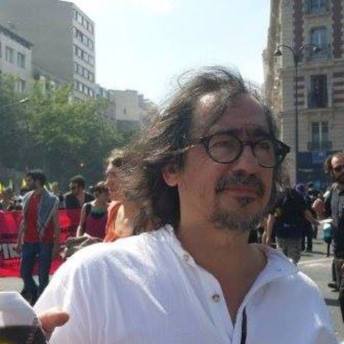
Areva has filed a libel suit against Jean-Jacques Mu, a former blogger on Club Mediapart, just for having relayed a critical article from the Anti-Nuclear Southeast Coordination.
Already in 1974, the anti-nuclear environmentalist newspaper La Gueule Ouverte, which did not mince words, warned its readers: “Corporations, fascism without borders. “
Heil Areva! Today’s freedom of reporting on the nuclear machinations and horrors is exerted only at the risk of citizens who believed to be in democracy.
And since we need to know that no one is too small enough to dare challenge Areva, Areva is taking out a sledgehammer to crush a gadfly: Jean-Jacques Mu, retired, blogger, not belonging to any group or any party. Jean-Jacques Mu is now dragged into court by Areva for defamation. His offense ? To have relayed an article of CAN-84 (Anti-Nuclear Southeast Coordination) on his blog hosted by Mediapart.
On 27 July 2014, Areva spotted the article relayed by Jean-Jacques Mu on Mediapart. Areva’s lawyers found some terms that could be taken for libel into court: they contacted Mediapart which immediately removed the offending article. The matter could have stopped there. But a few days later (July 31, 2014) Areva finds that Jean-Jacques Mu released a new blog post, which though having removed the offending words, gave the link to the same article of the CAN-84 (Anti-Nuclear Southeast Coordination).
In August 2014 (the traditional summer month holiday in France), the lawyers of the Areva Corporation were not idle: they hired a bailiff who traced the IP code of the administrator of the CAN-84 (Anti-Nuclear Southeast Coordination) website as well as the one of the blogger Jean-jacques Mu.
CAN is a collective, there is no single author of the article: who cares, Areva filed a complaint against X and … against Jean-Jacques Mu, based on the Law on the Freedom of the Press of 29 July 1881, which states that if one can not condemn the author of the allegedly defamatory words, then the editor of the words, its media, its distributors, its peddlers, and therefore in the twenty-first century the bloggers-relayers will be the ones to be condemned.
Jean-Jacques Mu faces a condemnation for having posted on his blog an article from the Anti-Nuclear Southeast Coordination, which he considered important to inform the public of.
What was it about? It was about the municipal council of Avignon and the signing of a contract between the city and the Areva Foundation. Like all the corporations, benefactors of humanity, Areva has a foundation that funds, among other things some educational projects.
Better to stuff early into the heads of the “children of a parent–teacher association” the propaganda conditioning them to worship profit ogres who will exploit them their whole lives while destroying the planet: It is cheap and pays off. And as the Ministry of Education’s pockets are increasingly empty, money even radioactive has no odor.
The article of CAN84 roundly blamed some EELV elected officials (Green Ecology Party) to have not voted against the signing of this contract with the Areva Foundation: they did not vote at all, they just got out of the room at the appropriate time.
Areva was only a secondary point of the article relayed by Jean-Jacques MU, which was aiming at the municipal council of Avignon. Yet Areva attacks the CAN84 and the blogger Jean-Jacques Mu, for a handful of forms as it considers defamatory because they are critical.
To be mentioned as the “giant of nuclear death” is bad for the image of Areva, and never mind if from its dirty uranium mines to its power plants operations its nuclear is nothing clean nor favorable to the bright future that its advertisements are promising us.
Good people, never mention “the Areva crimes” nor the permanent ongoing risks that this flagship of French industry poses to entire populations. Forget Chernobyl, forget Fukushima, forget the thyroid cancers that strike massively contaminated populations of children during the nuclear disasters that destroyed their cities, do not use the words “contaminate and kill children”, they could be badly perceived by susceptible Areva which will not hesitate to stick you with a court case.
It is obvious that the relay, in extenso for only 24 hours of a CAN84 article on the blog of Jean-Jacques Mu, has not infringed the notoriously booming business of the nuclear corporation. Areva, which manages to get in economic jeopardy while stirring billions, is very intolerant of criticisms from ordinary citizens and shows a much greater exigency for words in an article relayed by a blog that for the safety of workers in its uranium mines in Niger.
Since it is the freedom of information and expression that Areva is threatening through this libel case to be held in a Paris court on August 30, 2016, it is our responsibility to support Jean-Jacques MU, by raising awareness about this case, by being present in court on the day of the trial, by participating in the kitty that will give him the means that he does not have to prepare his defense.
At a time when corporations want whistleblowers to be condemned and track down the ordinary people who dare to criticize them, we answer: no, we will not be silenced!
https://blogs.mediapart.fr/juliette-keating/blog/300616/gloire-areva-bienfaitrice-de-lhumanite
Asahi exit poll: 49% support constitutional amendment
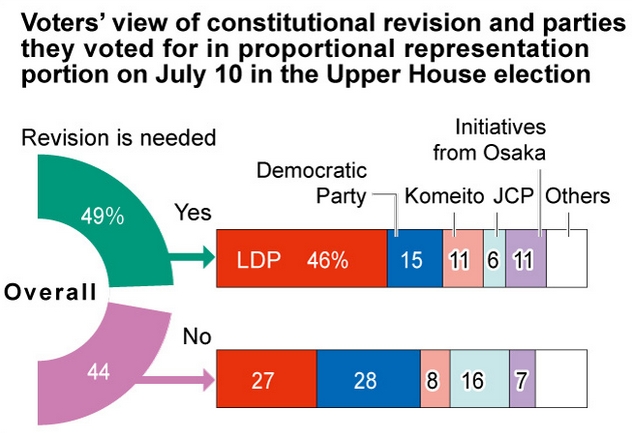
Forty-nine percent of voters in the July 10 Upper House election said the Constitution should be amended, according to an Asahi Shimbun exit poll.
The survey also showed that 44 percent were opposed to constitutional amendment, a goal of Prime Minister Shinzo Abe.
However, the poll found that revising the Constitution was not the central issue for voters when deciding which party to support in the Upper House election.
It showed that 70 percent of voters in favor of constitutional amendment said they cast their ballots for the four pro-revision parties–Abe’s Liberal Democratic Party, junior coalition partner, Komeito, Initiatives from Osaka and the Party for Japanese Kokoro–in the proportional representation portion.
However, 40 percent of those who said they oppose revision also voted for the four parties.
By age group, 55 percent of voters in their 30s supported revision, while 42 percent said it is not necessary.
Voters in their 70s were divided over the issue, with 40 percent backing revision and 43 percent opposed.
Of voters who cast ballots for the LDP, 32 percent did not support revision, while the comparable figure for Komeito, Initiatives from Osaka and the Party for Japanese Kokoro, totaled 36 percent, 35 percent and 31 percent, respectively.
Apparent discrepancies in voters’ stance on constitutional amendment and the parties they actually voted for means revision was not the deciding factor in making up their minds.
According to the poll, only 14 percent named revision as the most important issue in deciding their vote.
The issue cited by most of the voters, at 30 percent, was the economy and employment, followed by social security, at 22 percent.
Of voters who backed the LDP in the proportional representation portion, 5 percent said amending the Constitution was the most important issue. The rate for those who replied similarly was 4 percent for Komeito, 10 percent for Initiatives from Osaka and 15 percent for the Party for Japanese Kokoro.
Twenty-three percent of voters who voted for the main opposition Democratic Party and 34 percent who voted for the opposition Japanese Communist Party said that constitutional amendment was the most important issue.
The exit polls were conducted at 3,660 polling stations around Japan, and 182,646 valid responses were received.
Half of new teen voters choose ruling parties, exit polls reveal
A reminder: only 24% of the Japanese population voted in these elections.
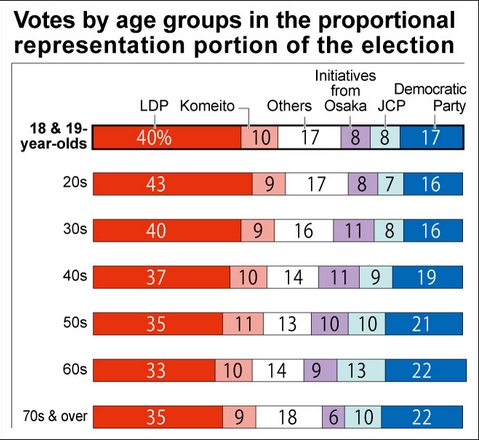
Half of teenage voters cast their ballots for the ruling parties, the Liberal Democratic Party and Komeito, in the proportional representation portion of the July 10 Upper House election, according to exit polls conducted by The Asahi Shimbun.
The nation’s 18- and 19-year-olds, who were enfranchised for the first time in Japan’s history, responded that they placed more importance on issues that are relevant to them now and in the near future: the economy, employment and the consumption tax.
The LDP and Komeito jointly accounted for half the proportional representation votes from the teenage and 20s age groups. In other age groups, the parties fell just short of gaining half the voting share.
By age group, younger people voted proportionately more for the ruling parties, and older people tended to lean more toward the opposing parties. The 20s age group delivered the largest proportion of votes for the ruling parties, at 52 percent all together, followed by the underage group, at 50 percent.
Of the teenagers, 40 percent voted for the LDP, 10 percent for Komeito, 17 percent for the main opposition Democratic Party, 8 percent for Initiatives from Osaka, and 8 percent for the Japanese Communist Party (JCP).
Forty-five percent of males and 35 percent of females aged 18 to 19 voted for the LDP.
In terms of issues, 28 percent of young people chose the economy and employment as their top concern, the most common choice, followed by social security at 15 percent, the Constitution at 14 percent, child support at 13 percent, the consumption tax at 11 percent, and foreign affairs and national security at 8 percent.
In comparison to the other age groups, the teenagers accounted for the highest percentage of respondents choosing the consumption tax as their top concern.
The exit polls were conducted at 3,660 polling stations around Japan, and 182,646 valid responses were received.
Japan Elections: Antinuclear Candidate’s Win Poses Risk to Plant Restarts
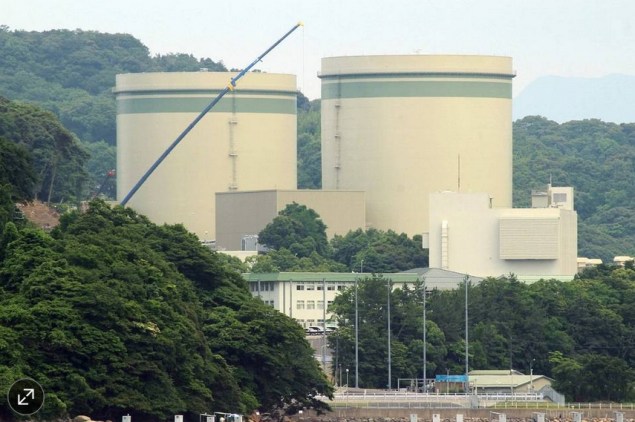
Kansai Electric’s No. 1 and No. 2 reactors at the Takahama nuclear plant on June 20. In March, a district court in Fukui prefecture issued an injunction halting the two reactors just months after they had been restarted.
Ex-journalist Satoshi Mitazono defeats incumbent Yuichiro Ito
TOKYO—The election Sunday of an antinuclear governor in the only Japanese prefecture with an operating nuclear power plant poses another risk to the government’s efforts to restart idled nuclear plants.
Former journalist Satoshi Mitazono defeated incumbent Kagoshima Gov. Yuichiro Ito largely by pledging to suspend operations at Kyushu Electric Power Co. ’s Sendai nuclear plant, which is located in the southern prefecture.
Mr. Mitazono’s victory underscores the strength of antinuclear sentiment in the country, even as Japanese companies such as Toshiba Corp. and Hitachi Ltd. win orders to build plants abroad in countries searching for a reliable, emissions-free source of power.
Kyushu Electric shares tumbled 7.5% to a three-year low Monday.
The Japanese public remains skeptical about the safety of nuclear power after the 2011 triple meltdowns at the Fukushima Daiichi nuclear plant, with many parents still screening food for radiation. Communities hosting the plants are resisting plans to restart reactors.
The Japanese government aims to revive at least 32 of the 54 reactors it shut down following the Fukushima disaster, and plans for nuclear power to account for about a fifth of the nation’s total electricity generation by 2030. It also hopes to double the contribution from renewable energy to meet a goal of cutting the nation’s greenhouse gas emissions by about a quarter from 2013 levels.
Nuclear power is also seen by many analysts and policy makers as key to Japan’s energy security. The country is forced to import nearly all of its fossil fuel.
“Relying on oil and gas is not sustainable, with huge costs to people’s health and the economy, and serious consequences for the environment,” said Hooman Peimani, research fellow at the Tokyo-based Asia Pacific Energy Research Centre.
Yet the government’s goals for nuclear look increasingly ambitious as local communities fight back. In March, a district court in Fukui prefecture issued an injunction halting two reactors at Kansai Electric Power Co. ’s Takahama nuclear plant just months after they had been restarted. The court said Kansai Electric had failed to show the public that the reactors were safe, despite having met stricter safety standards established after the Fukushima accident.
The only other nuclear plant now scheduled to be restarted is Shikoku Electric Power Co. ’s plant in Ikata, in southern Ehime prefecture. The restart is slated for August.
“The people are worried,” Mr. Mitazono said in a TV interview shortly after the election Sunday night. “We will not operate nuclear reactors when their safety cannot be guaranteed.”
The fight against nuclear at home has Japanese plant operators seeking business overseas—particularly in China and India. Hitachi last week said it would work with plant operator Japan Atomic Power to build and run nuclear plants in the U.K.
Toshiba, through U.S. unit Westinghouse Electric, hopes to secure contracts to build 45 nuclear reactors by 2030. Westinghouse is already building four reactors each in the U.S. and China. Toshiba said last week that it is eyeing 12 more deals in India, three in the U.K., and a total of five in the U.S. and Turkey.
Having nuclear plants idled is costly for Japan’s utilities, which are competing in a newly deregulated retail market. Restarting the Sendai plant has enabled Kyushu Electric to cut its imports and consumption of fossil fuels, which helped it log a profit in the year ended in March.
Mizuho Securities Co. analyst Norimasa Shinya said in a note to clients Monday that if the Sendai plant were to remain shut after planned maintenance checks later this year, Kyushu Electric’s recurring profit would fall by nearly a third, or about 18 billion yen ($176 million), in the current business year.
Kyushu Electric declined to comment on the impact of a possible shutdown at Sendai. “We have not been told to halt operations, nor do we know when, if, or how such a request would be made,” a spokesman said. “Voters voted on a wide array of issues, and not just on nuclear.”
Who will pay for decommissioning the Fukushima reactors?
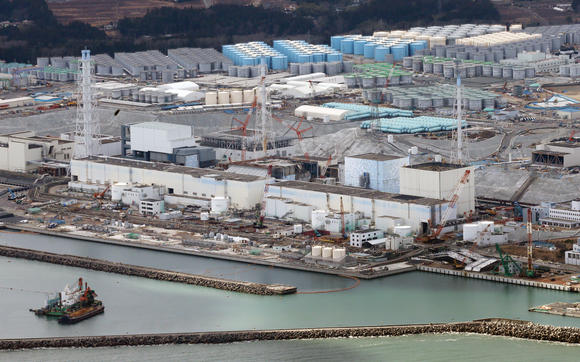
TOKYO — Energy policy was not high on the agenda in Sunday’s upper house election in Japan, in which the ruling Liberal Democratic Party consolidated its power. But Prime Minister Shinzo Abe, the Japanese people and the country’s power companies are facing a difficult question over the fate of the future of nuclear power in Japan: who will foot the costly bill for decommissioning the crippled Fukushima Daiichi nuclear power plant?
Every visit to the site, which was devastated by a magnitude-9.0 earthquake and subsequent tsunami five years ago, shows things are moving forward. A full-face mask is no longer needed in 90% of the compound. An underground ice wall is being constructed to reduce the amount of groundwater entering the basements of the reactor buildings. But what really caught my eye this time was the cream puffs.
Workers engaged in the cleanup effort can now buy the sweets at a convenience store that opened at the site in March. “Every day, we sell at least 50,” a clerk said. This represents a significant improvement in working conditions. In addition, last year, a large lounge and a cafeteria opened, providing the 6,000-plus workers with hot meals for the first time.
“Decommissioning is a project that will last 30 or 40 years, and we will have to pass the work on to future generations,” said Akira Ono, who stepped down as the plant’s manager at the end of June. “We must turn this place from a disaster site to a decommissioning site,” he added.
But the road ahead is fraught with obstacles. “We haven’t even started climbing the mountain, and we don’t even know how high it is,” said Naohiro Masuda, head of the decommissioning project and a managing executive officer of Tokyo Electric Power Co. Holdings, better known as Tepco, the plant’s operator. The most difficult task is going to be the removal of nuclear debris believed to be sitting inside the containment vessels after it melted through the reactor cores. No one precisely knows the current state of the debris.
No matter how long it takes, though, we must climb this mountain. Completing the project will require determination, technology and money. The actual cost will become more clear next year, when the company determines how it is going to remove the debris. Tepco hopes to start removal in 2021.
“The overall decommissioning is estimated to cost over 10 trillion yen ($98 billion),” a government official said. But nobody mentions who will pay the bill and how.
Currently, compensation and decontamination are being covered by the state, on Tepco’s behalf, without charging interest. Tepco and other power companies will eventually have to reimburse the government for compensation payouts through a pool of contributions. The government will recoup decontamination costs by selling the Tepco shares it owns.
Under this program, introduced immediately after the nuclear accident so that Tepco could meet all of its compensation obligations without going bankrupt, 11 power companies that operate nuclear reactors, including Tepco, together made a general contribution of 163 billion yen in the fiscal year to March. Tepco added another 70 billion yen as a special contribution. Although general contributions are meant to create a contingency fund for any future severe accidents at the country’s electric companies, they are in reality being used to cover Fukushima-related compensation claims.
Power companies must make general contributions for decades, and the cost is passed on to consumers through higher electricity bills. But with the liberalization of Japan’s retail electricity market in April, this mechanism will become increasingly difficult to maintain. Previously, dominant power suppliers, such as Tepco, could recoup the cost by assessing a fee on users within their territories. But that may no longer be possible as government-approved rates will be abolished in a few years, making way for new suppliers to step in with cheaper rates.
http://asia.nikkei.com/Business/Trends/Who-will-pay-for-decommissioning-the-Fukushima-reactors
Japan could change pacifist constitution after Shinzo Abe victory
Prime minister wins upper house elections, giving his coalition enough seats to push ahead with controversial changes
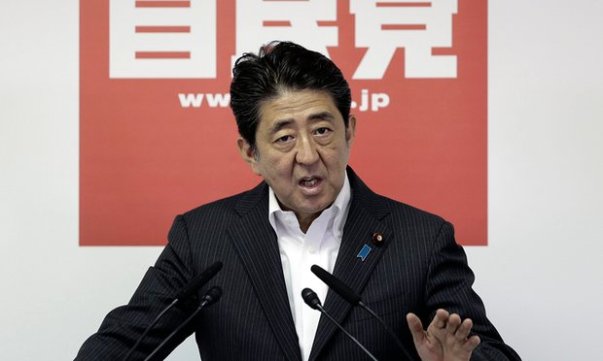
Shinzo Abe has called for a debate on rewriting Japan’s constitution, including an article renouncing war
Japan’s prime minister, Shinzo Abe, has called for a debate on rewriting the country’s pacifist constitution after his Liberal Democratic party [LDP] and its allies secured a supermajority in upper house elections on Sunday.
The LDP, its junior coalition partner Kōmeitō, and several like-minded smaller parties and independent MPs now control two-thirds of the 242 seats in the upper house. The ruling coalition already has a similar majority in the more powerful lower house.
Conservative MPs have enough seats to push ahead with constitutional changes, including scrapping the war-renouncing article 9 – a prospect that has caused alarm in China and among many Japanese who value their country’s postwar pacifism. Any amendments passed in parliament would then require approval by a simple majority in a nationwide referendum.
Abe had studiously ignored the constitution issue during the upper house campaign, insisting that the election was an opportunity to reaffirm public support for his troubled economic policy, as he sought to capitalise on the lack of a credible alternative offered by the opposition.
The LDP won 56 of the 121 seats – half the upper house total – being contested, while Kōmeitō secured 14 seats. Abe had set a goal of winning a combined 61 seats.
But speaking soon after his landslide victory, Abe said his party had always been committed to rewriting the postwar constitution. The Asahi Shimbun newspaper quoted him as saying that he hoped deliberations by expert panels and a deeper public debate would lead to a consensus on which parts of the constitution needed changing.
The most controversial move would be a revision of article 9 to allow Japan’s self-defence forces to act more like a conventional army. The clause forbids Japan from using force to settle international disputes and restricts its land, air and naval forces to a strictly defensive role.
Rewriting the constitution, imposed by the US occupation authorities after the second world war, has been the ideological driving force behind Abe and other conservatives who believe it unfairly restricts Japan’s ability to respond to new threats such as international terrorism, an increasingly assertive China and a nuclear-armed North Korea.
However, Abe risks losing the political capital he has built over the past three and a half years if he is seen to be neglecting the economy in favour of constitutional reform.
“The key question will be whether he can carry out structural reforms,” said Nobuhiko Kuramochi, chief strategist at Mizuho Securities. “If Abe fails to do so, despite the political freedom he has gained, that will be negative for foreign investors’ appetite for Japanese stocks.”
Xinhua, China’s official news agency, described Sunday’s election result as a threat to regional stability, as it had given MPs who support constitutional reform an unprecedented advantage.
“With Japan’s pacifist constitution at serious stake and Abe’s power expanding, it is alarming both for Japan’s Asian neighbours, as well as for Japan itself, as Japan’s militarisation will serve to benefit neither side,” Xinhua said in a commentary.
Some analysts played down the prospects for change, noting that the loose collection of pro-reform parties and independents had yet to reach a consensus on which parts of the constitution should be altered.
“It’s the first time to have two-thirds in both houses of parliament, but you can’t find any issue on which the two-thirds can agree,” said Gerry Curtis, professor emeritus at Columbia University.
But Curtis added: “With these numbers … he [Abe] is going to want to see what he can achieve. That means less attention to the economy and a lot of spinning over the constitution.”
The LDP’s dovish coalition partner, Kōmeitō, is cautious about any change that would expand the role of the military, while the public remains deeply divided. An exit poll conducted by the Asahi on Sunday showed that 49% of voters supported constitutional revision, with 44% opposed.
Many voters unaware what 2/3 majority means for Constitution revision
Nuclear energy and safety were not among the major concerns of the Japanese voters, for whom the main issue remained economic policy. To the exception of Fukushima Prefecture (Fukushima Daiichi Nuclear plant) and of Kagoshima Prefecture (Sendai Nuclear plant) were voters elected anti-nuke candidates.
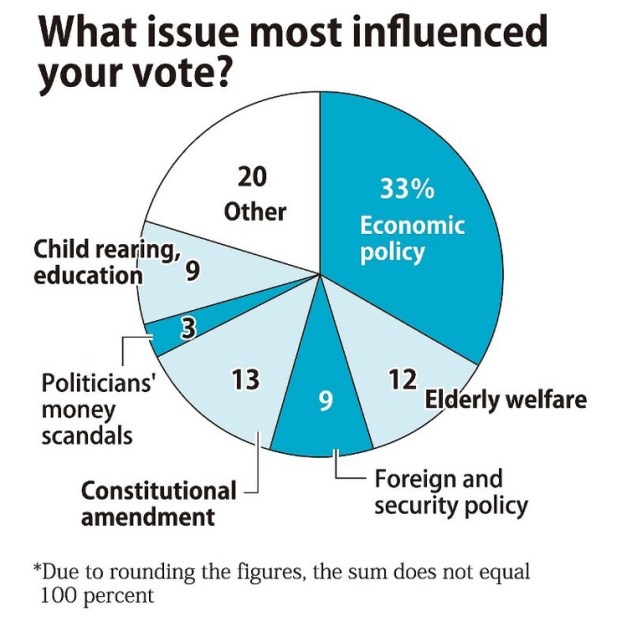
With the ruling Liberal Democratic Party (LDP) having focused its campaign for the July 10 House of Councillors election on economic issues, many voters say they weren’t aware what securing a two-thirds majority in the upper house meant for parties in favor of revising the pacifist Constitution — that is, they can initiate constitutional amendment in the chamber, a Mainichi Shimbun poll shows.
“It ended without us (and the voters) being on the same page,” said Katsuya Okada, head of the main opposition Democratic Party (DP), as he spoke to the media amidst a barrage of camera flashes at his party’s headquarters in Tokyo’s Nagatacho district on the night of July 10. The DP had tried to rally voters around the idea of stopping the ruling coalition and some opposition parties from gaining enough seats to amend the Constitution, while the LDP buried this issue by talking only about the economy. In the end, the LDP came out the clear victor.
Did voters even know about the “two-thirds majority” and its importance for constitutional amendment? On July 10, the Mainichi Shimbun interviewed 150 eligible voters around the country, and 83 of them, or almost 60 percent, said they “didn’t know” what the two-thirds majority meant in terms of constitutional revisions. When asked what issue influenced them the most in their vote, most answered things that were closely related to their lives, like economic or social welfare policies. Only about 10 percent said constitutional amendment was the most influential issue for them.
When asked, “Do you know what the number ‘two-thirds’ means?” a 29-year-old man working in building management who responded to the Mainichi Shimbun poll in front of JR Akabane Station in Kita Ward, Tokyo, responded, “Does that number have something to do with employment?” When the man was told that this was “the number of Diet seats needed for initiating constitutional amendment,” he was surprised and said, “Does that mean Article 9 is going to be messed around with? People don’t know this, do they?”
Based on a prediction that voter turnout would be about 50 percent, the poll was conducted on 75 people who voted and 75 people who didn’t. Among those who voted, 29 people did not know the significance of “two-thirds,” and among those who didn’t vote 54 did not know. Most people who didn’t know and were told the meaning of the number appeared uninterested.
Even among those who knew the significance of securing two-thirds of the vote, many people were more influenced by other issues. A 57-year-old self-employed man in Kagoshima Prefecture said, “As someone operating a tiny business outside of Tokyo, economic policies are most important to me.”
On the night of July 10, Prime Minister Shinzo Abe did not talk about the changes to the Constitution the LDP is looking to bring about. There is no denying that because of the LDP avoiding the topic of the supreme law, debate over constitutional amendment never heated up in the election.
A 21-year-old company employee in Toyama Prefecture explained why she didn’t vote. “I didn’t know what the main issues of the election were. I thought that it would be better not to vote than to just vote without a good reason.”
Due to low voter turnout, those aiming for constitutional amendment have reached their desired two-thirds majority, and a movement to change the country is set to truly begin.
* Interviewees’ opinions on constitutional reform
– It is necessary to consider amendment to make the Constitution match with today’s world, but don’t change the fundamentals of basic human rights and pacifism. (50-year-old female, company employee, Akita Prefecture)
– If necessary it’s OK to change the Constitution, but currently we have not yet had a national debate about this, so it’s too early. (37-year-old male, company employee, Tokyo)
– I don’t want us to do something and then regret it, like the United Kingdom after its referendum result to leave the European Union. I want the issue to be thought over carefully. (47-year-old female, company employee, Tokyo)
– We’ve been peaceful up until now, so we don’t need to change it. (20-year-old male, company employee, Kanagawa Prefecture)
– As long as we have the Self-Defense Forces and they are active, we have to change the Constitution (to clearly allow for those forces). (51-year-old male, company employee, Shiga Prefecture)
– A proposal for constitutional amendment will be a good opportunity for people to think about the Constitution. (65-year-old male, unemployed, Nara Prefecture)
– It’s not that I’m for or against amendment, the problem is that the current administration is too forceful in moving policies forward, when there should be in-depth debate. We shouldn’t rush to amend the Constitution. (34-year-old male, self-employed, Shimane Prefecture)
– We need to create a sovereign Constitution. We shouldn’t depend on another country for our defense. (65-year-old male, taxi driver, Yamaguchi Prefecture)
– I oppose amendment. The current way where we just pay money and are protected by the United States is better. I don’t want us to participate in wars. (56-year-old male, company employee, Fukuoka Prefecture)
* Why eligible voters chose not to vote
– I can’t trust politicians. (18-year-old female, vocational school student, Tokyo)
– I have my hands full with my everyday life. Increasing my income comes before everything else. (40-year-old male, company employee, Kyoto Prefecture)
– There are no candidates or parties I support. I don’t like the ruling parties’ forceful methods, but when it comes to the opposition parties, though they talk about joining forces against the ruling parties, they advocate different policies from each other. (29-year-old male, company employee, Hyogo Prefecture)
– I feel powerless against the hard-line stance of the Abe administration. (66-year-old female, unemployed, Hiroshima Prefecture)
– I didn’t know what the main election issue was. Maybe it’s because my electoral district was merged, but I never once saw the candidates. (43-year-old female, housewife, Kochi Prefecture)
– I don’t feel like a House of Councillors election affects my life. (56-year-old male, civil servant, Ehime Prefecture)
http://mainichi.jp/english/articles/20160711/p2a/00m/0na/026000c
Japan nuclear restart in doubt after skeptic wins governor’s race
TOKYO — The election of a governor who favors shutting down the Sendai nuclear power plant in southwestern Japan raises uncertainty for the nation’s only running reactors.
“A nuclear plant whose safety hasn’t been confirmed shouldn’t be operating,” Satoshi Mitazono, a former TV journalist who ran in Kagoshima Prefecture, told reporters Sunday.
Mitazono said he wanted another study to determine whether the facility lies near active faults and said there are “problems” with the current plans for evacuating residents in an emergency.
His victory in Sunday’s gubernatorial race is not expected to lead to the plant immediately shutting down, since governors lack the legal authority to make this happen.
But the plant’s two reactors are due for regularly scheduled inspections in October and December. Local utility Kyushu Electric Power would have little chance of restarting them after the safety checks if the governor objects. Mitazono’s problems with the evacuation plans may introduce time-consuming revisions.
“If the new governor insists on postponing the restarts, that would rule out operating the Sendai reactors,” said a senior official at the Ministry of Economy, Trade and Industry, which is responsible for Japanese energy policy.
The No. 3 reactor at Shikoku Electric Power‘s Ikata nuclear plant may resume operations as early as this month. Even so, nationwide nuclear energy output would remain far short of the government’s fiscal 2030 target of 20-22% of power generation.
How rights and liberties may be downsized under the LDP
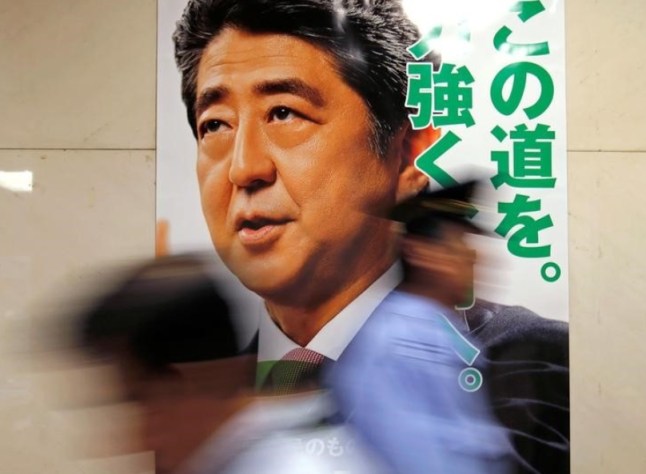
A revisionist path: Men walk past a poster for the July 10 Upper House election with the image of Prime Minister Shinzo Abe, leader of Japan’s ruling Liberal Democratic Party, at the LDP headquarters in Tokyo. The slogan on the poster reads: ‘Forward with strength this path.’
During a recent TV program, the vice president of the Liberal Democratic Party, Masahiko Komura, insisted “there is zero possibility” that Prime Minister Shinzo Abe would revise war-renouncing Article 9 of the Constitution even if the ruling coalition wins a two-thirds majority in the upcoming Upper House elections. But why believe him? Abe has made clear his intentions of promoting constitutional revision. Until he publicly pledges not to do so, voters are right to be wary.
Komura wants to bamboozle voters because he understands that public support for revising the Constitution is weak. An NHK poll in June indicated only 26 percent of Japanese citizens support his plans and only 11 percent think it is a priority. This lack of enthusiasm is also evident in a Kyodo poll in June indicating that 46.6 percent of all Upper House candidates oppose revising the Constitution, while only 34.6 percent support doing so. Broken down by party, 72.1 percent of the LDP favors revision while no candidate from coalition partner Komeito does, and only 28 percent of Osaka Ishin no Kai (One Osaka) candidates support revision. Virtually all the candidates of the Democratic Party and all of those fielded by the Japanese Communist Party and Social Democratic Party oppose revision.
Significantly, despite Abe’s enthusiasm, only 11.7 percent of all candidates think constitutional revision is a priority, according to the Kyodo poll.
DP leader Katsuya Okada has pointed out that Abe doesn’t seem to understand the role of the Constitution, which is to restrain state powers and protect the people’s civil liberties.
Where would Okada ever get that idea? Perhaps he glanced through the LDP’s 2012 draft constitution or the Q&A pamphlet the party distributed to explain its plans.
Indeed, the LDP seeks to fundamentally shift the relationship between the people and the state, imposing duties on citizens while lifting curbs on state powers. The LDP pamphlet asserts that there are “big” and “small” rights after a state of emergency is declared. The prime minister can declare a state of emergency in the event of a natural disaster, an armed attack by external forces or social disorder due to domestic turmoil, and the Cabinet could then suspend these small rights if they are deemed a threat to the undefined “public interest and public order.” So-called big rights are specified as those related to lives, bodies and property. Exactly what the mingy freedoms are is left to our imagination, but the implication is that they are a trivial but necessary sacrifice that must be made in service of the indispensable.
The LDP has cited the recent Kumamoto earthquake as an example of why it would be useful to have such a provision to facilitate relief and recovery efforts, but it is not clear that any problems in such operations had anything to do with the government’s inability to temporarily suspend civil liberties and human rights, or to concentrate power in the Cabinet. A state of emergency provision means that the government would have authority to suspend constitutional rights and bypass the Diet.
Good idea? Well it is troubling that the LDP believes that certain rights not only trump others, but can suspend them. The LDP is arguing that it may be necessary to sometimes put the Constitution on hold and, other times, to enforce it.
How would restrictions on human rights help in an emergency and what civil liberties might get in the way? This raises more questions: What are the criteria for deciding, and who gets to decide, that social turmoil has reached the tipping point for suspension of civil liberties and constitutional freedoms?
In the May 26 edition of the Mainichi Shimbun, the LDP says, “Some are of the opinion that fundamental human rights should not be restricted even in times of emergency. But we believe that it is possible that in order to protect big human rights, such as people’s lives, bodies and properties, we could be forced to place restrictions on smaller human rights.”
The notion that “small” human rights exist in the Constitution and can be violated with impunity is a novel concept. Constitutional scholars do not differentiate between rights by privileging some over others and distinguishing the vital from the inconsequential. Such a regressive view is antithetical to constitutionalism because it means that the government decides on an ad hoc basis what counts and what doesn’t, whereas a constitution is supposed to establish the legal foundations and rules through thick and thin.
Freedom of expression is likely one of the smaller rights that would be jettisoned in a state of emergency. This is the basis of press freedom in the Japanese Constitution. It is hard to imagine how a functioning democracy can exist without freedom of expression or how that small right would be detrimental in an emergency. How would its sacrifice protect property rights and lives? How would freedom of expression threaten such rights?
The LDP’s concern about pesky civil liberties like freedom of thought and conscience or freedom of expression enshrined in the Constitution reflects discomfort with the Western values and notion of “natural rights” that the U.S. wrote into the text in 1947. The LDP is eager to claw back rights for the state that the current Constitution bestows on citizens. The foreign DNA of the current Constitution rankles conservatives, but even former prime minister — and longtime pro-revision politician — Yasuhiro Nakasone now believes that, during the decades since it was written, the spirit and text have been assimilated by society. He sees no pressing need for revision.
Essentially, the only thing that the proposed state-of-emergency proviso allows the state to do that it can’t do now is suspend constitutional rights and effect what amounts to a coup d’etat. It is about boosting powers of the state in the name of protecting big human rights and suppressing dissent or criticism of the state. Rather than Western “natural rights,” the LDP is pushing “natural duties” that are allegedly in line with Japanese traditions and values. It means writing the U.N. Declaration on Human Rights out of the Constitution by renouncing the preamble of Japan’s current Constitution, which states:
“Government is a sacred trust of the people, the authority for which is derived from the people, the powers of which are exercised by the representatives of the people, and the benefits of which are enjoyed by the people. This is a universal principle of mankind upon which this Constitution is founded.” Further on, it reads, “laws of political morality are universal; and that obedience to such laws is incumbent upon all nations who would sustain their own sovereignty and justify their sovereign relationship with other nations.”
Preserving these commitments and derailing the LDP’s revision juggernaut seem reason enough to vote, but my guess is that low turnout persists because citizens find politics in Japan so uninspiring and dispiriting. With a supermajority in both houses, Abe will seek to revise the Constitution without being able to claim a mandate to do so.
Nuclear-free society advocate set to win Kagoshima governor race
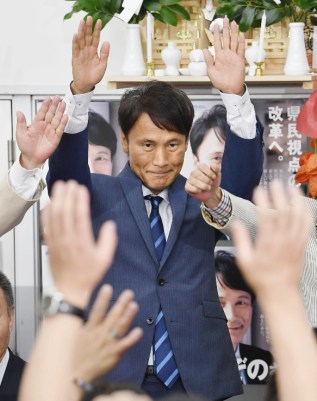
KAGOSHIMA – Anti-nuclear advocate Satoshi Mitazono was heading for victory in the Kagoshima gubernatorial race Sunday, beating incumbent Yuichiro Ito, who agreed to the resumption of reactors at a power plant in the prefecture, a projection showed.
The 58-year-old Mitazono is a former TV Asahi Corp. commentator. He ran as an independent backed by the main opposition Democratic Party and the Social Democratic Party as well as some conservatives who typically support the ruling Liberal Democratic Party but were opposed to the incumbent.
Ito, 68, with the support of the LDP and its junior coalition partner Komeito, was seeking his fourth four-year term.
One of the contentious issues in the race was the fate of Kyushu Electric Power Co.’s Sendai nuclear power plant in the prefecture.
The Sendai plant’s No. 1 and No. 2 units are the only reactors operating in the country after the government imposed tougher safety rules following the 2011 earthquake and tsunami that triggered meltdowns at the Fukushima No. 1 nuclear power plant.
Mitazono demanded that plant operations be temporarily suspended for safety checks in the wake of a series of strong earthquakes that hit central Kyushu in April, while Ito argued that the plant’s safety had been secured.
“We will not activate any reactors the safety of which is not guaranteed,” he told reporters on Sunday.
Nuclear power opponent wins governor’s race in South West Japan

 Japan nuclear restart in doubt after skeptic wins governor’s race http://asia.nikkei.com/Politics-Economy/Policy-Politics/Japan-nuclear-restart-in-doubt-after-skeptic-wins-governor-s-race, 11 July 16 TOKYO — The election of a governor who favors shutting down the Sendai nuclear power plant in southwestern Japan raises uncertainty for the nation’s only running reactors.
“A nuclear plant whose safety hasn’t been confirmed shouldn’t be operating,” Satoshi Mitazono, a former TV journalist who ran in Kagoshima Prefecture, told reporters Sunday.
His victory in Sunday’s gubernatorial race is not expected to lead to the plant immediately shutting down, since governors lack the legal authority to make this happen.
But the plant’s two reactors are due for regularly scheduled inspections in October and December. Local utility Kyushu Electric Power would have little chance of restarting them after the safety checks if the governor objects. Mitazono’s problems with the evacuation plans may introduce time-consuming revisions.
“If the new governor insists on postponing the restarts, that would rule out operating the Sendai reactors,” said a senior official at the Ministry of Economy, Trade and Industry, which is responsible for Japanese energy policy.
The No. 3 reactor at Shikoku Electric Power‘s Ikata nuclear plant may resume operations as early as this month. Even so, nationwide nuclear energy output would remain far short of the government’s fiscal 2030 target of 20-22% of power generation.
British Parliament to vote on renewing Trident nuclear missile system, as Brexit problems loom
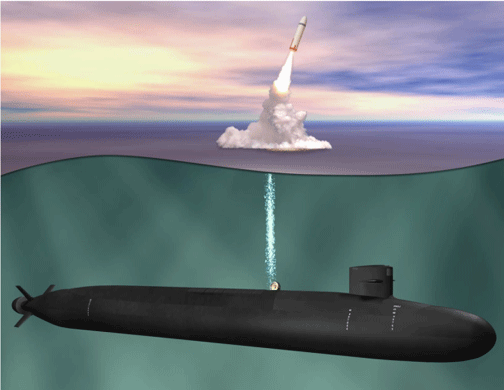 A UK nuclear vote, as Brexit looms http://thebulletin.org/uk-nuclear-vote-brexit-looms9650 By John Mecklin, 10 July 16 In a somewhat unexpected move, United Kingdom Prime Minister David Cameron—who has already declared he will resign in September because of his country’s vote to exit the European Union—announced a quick parliamentary vote on replacing the country’s fleet of nuclear-missile submarines.
The announcement, made at a NATO summit in Warsaw, seems designed to underscore the UK’s commitment to the alliance. This Reuters piece suggests Parliament is likely to vote in favor of renewing the submarine fleet, in large part because of support from Cameron’s Conservative Party.
But amid the political turmoil over possible paths to a “Brexit” from the EU, there will almost certainly be opposition from some in the Labour Party and the Scottish Nationalist Party, which is on record as wanting the Scotland-based submarines decommissioned.
Old nuclear waste from Manhattan Project contaminating Niagara County
 Radioactive hot spots pepper Niagara County, Investigative Post, July 05 By Dan Telvock The first hint of radioactive waste near John Grace’s home in Lewiston came from his son who carried a radiation meter for his government job. The meter would beep every time his son drove over the gravel driveway.
“He said ‘something’s not right here,’ ” said Grace, who lives at 738 Upper Mountain Road.
Turns out, he was right.
Gravel in the driveway was first tested some 40 years ago by the federal Department of Energy and found to have radiation levels some 70 times greater than what’s found in the local natural environment. The driveway was still hot when tested again three years ago by the Environmental Protection Agency.
“I just said ‘you’ve got to be kidding me,’” Grace said. “They said it was all around Niagara County.”
Indeed, this radioactive material is prevalent throughout the region.
Government documents show that state health and environmental officials have known for almost four decades that at least 60 properties throughout Niagara County and Grand Island, including the driveway near Grace’s home, are contaminated with radioactive material that resembles gravel. The radioactivity at these properties ranges from three to more than 70 times what people are naturally exposed to in the local environment, according to state and federal documents……..
Although the exposure to the radioactive waste does not pose an immediate health risk, the EPA and the National Academy of Sciences have concluded there is no safe level of radiation.
Furthermore, the group of attorneys and environmental engineers investigating some of the contaminated properties in Niagara County disagree with the state’s position that the waste does not pose a significant risk………
Radioactive hotspots identified
This story is based on a review of more than 8,000 pages of government documents requested under the Freedom of Information Law, property inspections with a radiation detector, and interviews with more than a dozen experts, attorneys, residents and government officials.
The federal Department of Energy and state Department of Health identified 100 hot-spots in Niagara County and Grand Island almost four decades ago. The federal government cleaned up about a third of the properties after determining the radioactive waste was linked to nuclear weapons development through the Manhattan Project. The remaining contaminated properties were left untouched at the time because the federal government believed the material was linked to commercial metallurgical companies, which have since closed……….http://www.investigativepost.org/2016/07/05/radioactive-hot-spots-pepper-niagara-county/
Renewal of Trident nuclear weapons system opposed by British Labour and Scottish National Party
 Trident: David Cameron confirms date for vote on renewal of nuclear weapons system MPs will vote on the future of the controversial weapons system in the House of Commons, The Independent Siobhan Fenton @siobhanfenton 10 July 2016 Parliament will vote on the renewal of the Trident nuclear weapons system on 18 July, David Cameron has announced.
Replacement for the system is estimated to cost between £15bn and £20bn. The force currently consists of four submarines which are each capable of carrying up to 16 ballistic nuclear missiles which are capable of hitting targets up to 7,500 miles away……
The fleet will need to be replaced in 2028 and a decision is required by Parliament this year whether to renew the system.
The controversial scheme has proved divisive in Parliament…….
The Labour party has previously supported it but current leader Jeremy Corbyn has been a long-time opponent of renewal. It is expected Labour MPs may be given a free vote on the issue.
Mr Corbyn told Sky News: “We are having a look at all the issues surrounding it. I believe security in the world is achieved through peace, through democracy, through justice, through human rights.
“I do not believe that nuclear weapons actually enhance security, I support the nuclear non-proliferation treaty, which we are signed up to, which is trying to bring together collective disarmament. Those are the views that I will be putting forward.”
The Labour party has commissioned a defence review about its policy on nuclear weapons. A draft version has reportedly indicated the party will leave open the option of retaining nuclear weapons on a smaller scale, thereby providing a compromise between total disarmament and renewal.
The SNP has been vocal in its opposition of the scheme. http://www.independent.co.uk/news/uk/politics/trident-david-cameron-confirms-date-for-vote-on-renewal-of-nuclear-weapons-system-a7128466.html
1 This Month
Chernobyl: The Lost Tapes – A good documentary on Chernobyl on SBS available On Demand for the next 3 weeks– https://www.sbs.com.au/ondemand/tv-program/chernobyl-the-lost-tapes/2352741955560

of the week–London Campaign for Nuclear Disarmament

Tell the Ukrainian Government to Drop Prosecution of Peace Activist Yurii Sheliazhenko
To see nuclear-related stories in greater depth and intensity – go to https://nuclearinformation.wordpress.com
-
Archives
- April 2026 (114)
- March 2026 (251)
- February 2026 (268)
- January 2026 (308)
- December 2025 (358)
- November 2025 (359)
- October 2025 (376)
- September 2025 (257)
- August 2025 (319)
- July 2025 (230)
- June 2025 (348)
- May 2025 (261)
-
Categories
- 1
- 1 NUCLEAR ISSUES
- business and costs
- climate change
- culture and arts
- ENERGY
- environment
- health
- history
- indigenous issues
- Legal
- marketing of nuclear
- media
- opposition to nuclear
- PERSONAL STORIES
- politics
- politics international
- Religion and ethics
- safety
- secrets,lies and civil liberties
- spinbuster
- technology
- Uranium
- wastes
- weapons and war
- Women
- 2 WORLD
- ACTION
- AFRICA
- Atrocities
- AUSTRALIA
- Christina's notes
- Christina's themes
- culture and arts
- Events
- Fuk 2022
- Fuk 2023
- Fukushima 2017
- Fukushima 2018
- fukushima 2019
- Fukushima 2020
- Fukushima 2021
- general
- global warming
- Humour (God we need it)
- Nuclear
- RARE EARTHS
- Reference
- resources – print
- Resources -audiovicual
- Weekly Newsletter
- World
- World Nuclear
- YouTube
-
RSS
Entries RSS
Comments RSS
 nuclear-news