Was Tokyo Electric Power Co. (now Tokyo Electric Power Company Holdings, Inc.) putting top priority on ensuring the safety of residents around its Fukushima No. 1 nuclear power plant when the accident occurred? The findings of a recent probe have raised doubts even about this.
A third-party panel of lawyers set up by TEPCO released a report on why it took as long as two months after the crisis for the utility to acknowledge that the reactors had melted down.
On March 14, 2011, three days after the accident occurred following the massive earthquake and tsunami, then TEPCO President Masataka Shimizu instructed a then executive vice president during a press conference “not to use” the word “meltdown,” according to the report. The message was delivered via a public relations staffer, citing instructions from the Prime Minister’s Office, the report said.
Subsequently, TEPCO used the description “core damage” in connection with the accident. “The nuclear power plant and the head office shared a recognition that they should refrain from using ‘meltdown,’” the report pointed out.
Then Prime Minister Naoto Kan and then Chief Cabinet Secretary Yukio Edano have completely denied issuing such instructions on their own.
At the time of the accident, many politicians, bureaucrats and others concerned were working at the Prime Minister’s Office. The third-party probe failed to identify who gave the instructions to Shimizu.
This shows the limitations that the third-party panel faced as it probed the accident based only on interviews it conducted with TEPCO officials. Furthermore, Shimizu’s memories of those days were vague.
However, the probe revealed that TEPCO was paying too much attention to the Prime Minister’s Office’s intentions in responding to the accident.
Operator holds responsibility
When a nuclear power plant is hit by a serious accident, residents living around the facility face severe consequences. It is the primary responsibility of the plant operator to respond appropriately.
In such a situation, the highest priority should be placed on the safety of local residents. The operator must accurately provide local governments and residents with precise and necessary information regarding the situation the power plant is facing.
TEPCO chose to use “core damage,” an expression that made the status of the accident unclear, instead of “meltdown,” even though “meltdown” would have clearly shown the severity of the developments the Fukushima plant was dealing with. The operator cannot avoid criticism for having betrayed local residents with this decision. This kind of stance taken by the utility has caused increasing distrust of nuclear power plants.
At the time of the accident, TEPCO had internal manuals that described what constituted a meltdown. The operator must seriously reflect on why it failed to follow these guidelines.
When it came to public relations announcements at the time of the accident, the investigation committees set up by the government and the Diet both pointed out that the Prime Minister’s Office had some involvement.
An official at the then Nuclear and Industrial Safety Agency of the Economy, Trade and Industry Ministry was replaced after referring to a “meltdown” during a press conference. TEPCO was told by the Prime Minister’s Office to brief it in advance of any announcements made at press conferences, according to the latest report.
The Niigata prefectural government, whose administrative area is home to TEPCO’s Kashiwazaki-Kariwa nuclear power plant, has called for uncovering the whole process of how information was manipulated, saying this is a prerequisite for reactivating reactors at Kashiwazaki-Kariwa. The government cannot help but cooperate with the probe.
http://www.the-japan-news.com/news/article/0003026750
June 20, 2016
Posted by dunrenard |
Fukushima 2016 | Fukushima Daiichi, Lies & Cover-up, Responsibility, Tepco |
Leave a comment
A panel investigating Tokyo Electric Power Co.’s response to the triple meltdown during the 2011 Fukushima nuclear disaster revealed an unpardonable breach of trust by the operator of the stricken Fukushima No. 1 nuclear power plant.
But there is still a lot more work to be done by the panel to uncover the full scope of the utility’s apparent meltdown cover-up.
Immediately after the catastrophic accident at the Fukushima nuclear plant, then TEPCO President Masataka Shimizu instructed employees not to use the term “meltdown,” leading to a delay in the official announcement, according to a report compiled by the investigation panel commissioned by the company.
A reactor meltdown, or the melting of nuclear fuel in the core of a reactor, is about as bad as it gets.
The panel’s report suggests that in the middle of this unprecedented nuclear disaster the top official of the plant operator was trying to conceal the severity of what was unfolding from the public, including people living in areas around the plant.
For four long years, TEPCO kept giving false explanations about the delay in the announcement of the reactor meltdowns to Niigata Prefecture, which was demanding the truth of what happened. The company claimed it did not have the criteria for defining and determining a meltdown. The firm also said no in-house instruction was given to employees telling them not to use the term.
In February this year, however, the company said it had “found” an in-house manual that spelled out such criteria and set up the third-party panel of legal experts to get to the truth about the delayed announcement of the meltdowns.
With the revelations made in its report, can the panel claim it has accomplished its mission?
We have to say the answer is “no,” although the disclosure of the former TEPCO president’s instruction concerning the meltdowns is definitely a step forward.
What is particularly baffling is the opinion about the president’s instruction voiced by Yasuhisa Tanaka, the former president of the Sendai High Court who headed the investigation. “We cannot say for certain that there was a deliberate cover-up by the company,” Tanaka said during a news conference.
At the time of the accident, a reactor meltdown was defined by the nuclear disaster special measures law as an emergency situation that must be reported. The conditions of the reactors at the Fukushima plant fulfilled TEPCO’s criteria, which say a meltdown means that 5 percent or more of the core of a reactor has been damaged.
But the utility initially denied that a meltdown was happening, while the president instructed employees not to use the term. If this was not a cover-up, what was it?
Also questionable is the panel’s suggestion that the TEPCO chief was probably acting on requests from the prime minister’s office in giving the instruction. The panel interviewed about 60 former and current TEPCO officials, but no government officials or bureaucrats who were involved in dealing with the crisis.
In explaining the panel’s failure to interview key government officials, Tanaka said, “Our authority to investigate is limited, and it is difficult (to uncover the entire truth) in such a short time.” But the panel didn’t even request interviews with them.
Both Naoto Kan, who was then prime minister, and Yukio Edano, who was chief Cabinet secretary, rejected the allegations that the government told TEPCO not to declare a meltdown.
As for the related requests made by Niigata Prefecture, TEPCO says it will continue its joint efforts with the prefectural government to uncover the facts.
The company has a responsibility to clarify the broad picture of the accident and publish the findings of its probe. But the Diet has its own role to play.
Whether the prime minister’s office actually asked TEPCO not to declare a reactor meltdown is not the only remaining mystery about the exchanges between the government and the company during the crisis. Only some fragments of information about the communications between the two sides have been revealed.
A Diet investigation committee has drawn up a report on its inquiry into the accident. But there are still many questions that the Diet should try to answer by using its right to investigate state affairs.
We need to learn all vital lessons from the devastating nuclear accident so as to avoid making the same mistakes.
That requires unearthing all the related facts first. It is our responsibility to tackle this challenge for future generations.
http://www.asahi.com/ajw/articles/AJ201606180026.html
June 20, 2016
Posted by dunrenard |
Fukushima 2016 | Fukushima Daiichi, Lies & Cover-up, Meltdowns, Tepco |
Leave a comment
What this article from Nikkei (the Japanese Business & investment Newspaper) does not say is if the nuclear industry discloses, informs the public about the true facts, the public trust in the nuclear industry will NEVER be restored, and no nuclear plant will ever be allowed to restart.

TOKYO — For Tepco, there is no escaping the accusation that the utility’s deliberate avoidance of the term “meltdown” after the Fukushima Daiichi nuclear disaster was an attempt to minimize the severity of the situation to the public.
Tokyo Electric Power Co. recognized immediately that a core meltdown had occurred at the ill-fated power plant, and so did Japan’s government. On March 12, 2011 — the day after the crisis began — the term was used at a news conference held by the Nuclear and Industrial Safety Agency, Japan’s nuclear power regulator at that time. The spokesman who uttered the word was replaced the following day.
The report issued Thursday by a third-party committee investigating Tepco’s handling of the disaster underscores once again the inability of the prime minister’s office and the bureaucracy at the time to face the reality of the situation. It also deepens the suspicion that officials sought to control the flow of information to the public.
A fear of causing widespread panic is a poor excuse for covering up the truth. If anyone was panicking, it was arguably Tepco’s president at the time, Masataka Shimizu, as well as other officials at the utility and at the prime minister’s office. The report said Shimizu gave instructions at Tepco to avoid using the term meltdown.
Crews at Fukushima Daiichi, led by plant manager Masao Yoshida, made every effort to contain the crisis on the assumption that they were dealing with a meltdown. Even if Tepco headquarters had used this term instead of “core damage” in informing the public, the utility’s response on the ground probably would have been the same. But residents of the evacuation zone, as well as the Self-Defense Forces and other first responders, may have acted differently.
The investigative committee did not determine who in the government might have prompted Shimizu’s directive against using the word. There has been reluctance to examine the involvement of elected officials and bureaucrats in the disaster response. More probing is needed.
It took more than five years for Shimizu’s instructions to come to light. The latest investigation itself never would have occurred if not for the persistence of the Niigata Prefecture government, which has its own Tepco — whose formal name is now Tokyo Electric Power Co. Holdings — nuclear power plant to worry about.
What happens at the nation’s nuclear reactors ought to be made public without disguise — and not just when serious safety breaches like meltdowns are involved. Efforts on disclosure must begin with everyday information in order to restore the public’s trust in nuclear power.
http://asia.nikkei.com/Politics-Economy/Policy-Politics/Public-deserves-closer-look-into-Fukushima-response
June 20, 2016
Posted by dunrenard |
Fukushima 2016 | Fukushima Daiichi, Nuclear Industry, Nuclear Plant Restart, Truth |
Leave a comment

Residents on Friday hold a banner that reads: “Kepco’s request has been rejected; Court rejects restart of Takahama reactors.” The protesters are seen in front of the Otsu District Court in Shiga Prefecture.
OTSU, SHIGA PREF. – The Otsu District Court on Friday rejected a bid by Kansai Electric Power Co. to lift an injunction against restarting reactors at a nearby plant, dealing yet another setback to attempts by the utility and the central government to return swiftly to nuclear power.
The move means the No. 3 and No. 4 reactors at the Takahama nuclear plant, in Fukui Prefecture, will remain idled.
In a statement, Kepco condemned the court’s action.
In his decision, Judge Yoshihiko Yamamoto said Kepco failed to provide sufficient evidence to back up its claims that the two reactors were safe.
“The very first article of the law that established the Nuclear Regulation Authority says a fundamental point of Japan’s nuclear power administration is clearly establishing the understanding that the maximum effort must be made at all times to prevent an accident involving the use of nuclear power,” said Yamamoto. “But unless the operator shows that there is nothing lacking in regards to safety, it’s presumed some safety points are lacking.”
The decision was welcomed by citizens’ groups fighting the restart of the two reactors, but it was also expected. Yamamoto was the same judge who had granted their initial request back in March that shut down the reactors, also citing a lack of convincing evidence on the part of Kepco that the plants were safe. The reactors were originally restarted at the beginning of the year.
“It was a just decision, very direct. We hope it will provide a spark to other legal efforts in other parts of Japan to stop nuclear power plants from being restarted,” Yoshinori Tsuji said after the ruling. Tsuji was one of the plaintiffs who filed for an injunction in March.
Legal wrangling over the two reactors continues. Kepco has filed a separate legal challenge to the Otsu court’s decision, and said Friday it hoped that when that ruling came, possibly in July or August, it will lead to restarts.
Shiga residents seeking to keep the reactors offline have said Friday’s decision did not mean their court battles were over.
“If the Otsu court rules against Kepco, it could end up in the Osaka High Court, possibly next year,” said Hidenori Sugihara, another one of the plaintiffs who sought the injunction.
The Otsu court case has demonstrated the difficulty of restarting nuclear power plants in a timely manner. Under laws drawn up by the NRA that went into effect in 2012, localities within a 30 kilometer radius of a nuclear power plant are supposed to establish evacuation plans in the event of an emergency.
But the expanded radius has greatly increased the number of local governments and residents who are concerned about a rush by the utilities to restart as many plants as possible.
In the Kansai region, where parts of Kyoto and Shiga prefectures lie within 30 kilometers of Fukui Prefecture’s plants, lawsuits by residents like the one in Otsu have the potential to slow down, if not halt, Kepco’s plans for restarts.
The original injunction was brought by Shiga residents who fear an accident at the plant would have a damaging impact on Lake Biwa, the nation’s largest freshwater lake and the source of water for about 14 million residents in cities such as Kyoto and Osaka.
http://www.japantimes.co.jp/news/2016/06/17/national/crime-legal/kepco-fails-suspend-injunction-takahama-nuclear-plant/#.V2e1E_ZLJ0t.facebook
June 20, 2016
Posted by dunrenard |
Japan | Court Refusal, Nuclear Plant Restart, Takahama NPP |
Leave a comment
 How much radiation is OK in an emergency? By Rebecca Moss The New Mexican, 19 June 16
New guidelines proposed by the U.S. Environmental Protection Agency would significantly increase the amount of radiation that people can ingest in the days and years following a radiological accident — levels far higher than existing limits set by the Safe Drinking Water Act of 1974.
Watchdog groups, academics and even some EPA officials worry the change could severely compromise public health. The agency’s proposal, released in early June and open for public comment until July 25, suggests a two-tiered system to advise the public when water is too dangerous for consumption after a radiological release — an event ranging from an accident at a nuclear power plant, such as the 1979 reactor meltdown at the Three Mile Island plant in Pennsylvania, to a roadside spill of Cold War-era transuranic waste from Los Alamos to a deliberate act of terrorism. The agency has capped the proposed limits at 500 millirems per year for people over 15, and no more than 100 millirems for younger children, the elderly, and pregnant or nursing women.
The new emergency guidelines are at least 25 times higher than the current guidelines, which cap public consumption of radiation at 4 millirems per year. Opponents of the proposal say it will allow radiation exposure equivalent to 250 chest X-rays each year without medical need or consent……
The EPA proposal has significant ramifications for New Mexico, home to two nuclear weapons research laboratories and the nation’s only permanent underground repository for radioactive waste, all of which were built near underground aquifers.
New Mexico’s highways pose concerns under the new EPA proposal because truck transportation of nuclear waste to the Waste Isolation Pilot Plant near Carlsbad will resume if the now-shuttered underground storage facility reopens, as planned, by the year’s end. When operations restart at the waste site, which has been closed since a radiation leak in February 2014, U.S. 62-180, Interstate 25, Interstate 40 and U.S. 285 would once again be used to transport nuclear waste to WIPP from Los Alamos, as well as from out-of-state defense sites.
In the first decade of the waste plant’s opening, at least 900 trucks carrying transuranic waste traveled those roads to reach the Carlsbad facility. The New Mexico Environment Department documented 29 accidents between 2002 and 2013, though none led to a spill.
Proposals by the U.S. Energy Department show the federal government also plans to store some foreign plutonium at WIPP, after the material has been processed at a facility in South Carolina. Continue reading →
June 20, 2016
Posted by Christina Macpherson |
politics, radiation, Reference, USA |
Leave a comment

 Decades Later, Sickness Among Airmen After a Hydrogen Bomb Accident, NYT, by DAVE PHILIPPSJUNE 19, 2016Alarms sounded on United States Air Force bases in Spain and officers began packing all the low-ranking troops they could grab onto buses for a secret mission. There were cooks, grocery clerks and even musicians from the Air Force band.
It was a late winter night in 1966 and a fully loaded B-52 bomber on a Cold War nuclear patrol had collided with a refueling jet high over the Spanish coast, freeing four hydrogen bombs that went tumbling toward a farming village called Palomares, a patchwork of small fields and tile-roofed white houses in an out-of-the-way corner of Spain’s rugged southern coast that had changed little since Roman times.
 It was one of the biggest nuclear accidents in history, and the United States wanted it cleaned up quickly and quietly. But if the men getting onto buses were told anything about the Air Force’s plan for them to clean up spilled radioactive material, it was usually, “Don’t worry.”
“There was no talk about radiation or plutonium or anything else,” said Frank B. Thompson, a then 22-year-old trombone player who spent days searching contaminated fields without protective equipment or even a change of clothes. “They told us it was safe, and we were dumb enough, I guess, to believe them.”
Mr. Thompson, 72, now has cancer in his liver, a lung and a kidney. He pays $2,200 a month for treatment that would be free at a Veterans Affairs hospital if the Air Force recognized him as a victim of radiation. But for 50 years, the Air Force has maintained that there was no harmful radiation at the crash site. It says the danger of contamination was minimal and strict safety measures ensured that all of the 1,600 troops who cleaned it up were protected.
Interviews with dozens of men like Mr. Thompson and details from never before published declassified documents tell a different story. Radiation near the bombs was so high it sent the military’s monitoring equipment off the scales. Troops spent months shoveling toxic dust, wearing little more protection than cotton fatigues. And when tests taken during the cleanup suggested men had alarmingly high plutonium contamination, the Air Force threw out the results, calling them “clearly unrealistic.”
In the decades since, the Air Force has purposefully kept radiation test results out of the men’s medical files and resisted calls to retest them, even when the calls came from one of the Air Force’s own studies.
Many men say they are suffering with the crippling effects of plutonium poisoning. Of 40 veterans who helped with the cleanup who The New York Times identified, 21 had cancer. Nine had died from it. It is impossible to connect individual cancers to a single exposure to radiation. And no formal mortality study has ever been done to determine whether there is an elevated incidence of disease. The only evidence the men have to rely on are anecdotes of friends they watched wither away.
“John Young, dead of cancer … Dudley Easton, cancer … Furmanksi, cancer,” said Larry L. Slone, 76, in an interview, laboring through tremors caused by a neurological disorder.
At the crash site, Mr. Slone, a military police officer at the time, said he was given a plastic bag and told to pick up radioactive fragments with his bare hands. “A couple times they checked me with a Geiger counter and it went clear off the scale,” he said. “But they never took my name, never followed up with me.”
Monitoring of the village in Spain has also been haphazard, declassified documents show. The United States promised to pay for a public health program to monitor the long-term effects of radiation there, but for decades provided little funding. Until the 1980s, Spanish scientists often relied on broken and outdated equipment, and lacked the resources to follow up on potential ramifications, including leukemia deaths in children. Today, several fenced-off areas are still contaminated, and the long-term health effect on villagers is poorly understood.
Many of the Americans who cleaned up after the bombs are trying to get full health care coverage and disability compensation from the Department of Veterans Affairs. But the department relies on Air Force records, and since the Air Force records say no one was harmed in Palomares, the agency rejects claims again and again.
The Air Force also denies any harm was done to 500 other veterans who cleaned up a nearly identical crash in Thule, Greenland, in 1968. Those veterans tried to sue the Defense Department in 1995, but the case was dismissed because federal law shields the military from negligence claims by troops. All of the named plaintiffs have since died of cancer…….
“First they denied I was even there, then they denied there was any radiation,” said Ronald R. Howell, 71, who recently had a brain tumor removed. “I submit a claim, and they deny. I submit appeal, and they deny. Now I’m all out of appeals.” He sighed, then continued. “Pretty soon, we’ll all be dead and they will have succeeded at covering this whole thing up.”……
The Pentagon focused on finding the bomb lost in the ocean and largely ignored the danger of loose plutonium, the Air Force personnel at the site said. Troops traipsed needlessly through highly contaminated tomato fields with no safety gear. http://www.nytimes.com/2016/06/20/us/decades-later-sickness-among-airmen-after-a-hydrogen-bomb-accident.html
June 20, 2016
Posted by Christina Macpherson |
health, secrets,lies and civil liberties, Spain, USA |
Leave a comment
 The cost of nuclear diplomacy, THE HINDU, SUVRAT RAJU, 20 JUNE 16 The government’s decision to let Westinghouse build six nuclear reactors in India smacks not only of arbitrary use of executive authority but is also financially imprudent
 In their recent joint statement, Prime Minister Narendra Modi and President Barack Obama “welcomed the start of preparatory work… in India for six AP1000 reactors to be built by Westinghouse…” Judging by the cost of similar reactors under construction in the U.S., these six reactors may cost as much as Rs.4 lakh crore. This makes the deal potentially the largest commercial contract in the offing between the two countries.
There are several disturbing aspects to this agreement that deserve close public scrutiny. These include the arbitrary use of executive authority in selecting Westinghouse as a supplier, the international legal commitment made by the government to indemnify Westinghouse in the event of an accident, and the high expected cost of electricity from these reactors.
Economically unviable When the United Progressive Alliance government announced its intention to start work on two reactors each from Westinghouse and General Electric (GE) in the 12th Plan period (2012-2017), it did little to pretend that these contracts made sense on their own merits. Instead, as the former chairperson of the Atomic Energy Commission, Anil Kakodkar, explained, India had “to keep in mind the commercial interests of foreign countries and of the companies there” and was obliged to purchase these reactors in return for U.S. diplomatic support on other issues.
Last year, GE backed out of this arrangement citing concerns about India’s liability law. This was good riddance; GE was offering India an untested design that it has not yet managed to sell anywhere in the world. But the government’s decision to deepen India’s investment in Westinghouse — even as negative news about the company has accumulated — makes little sense.
In April, Toshiba, which acquired Westinghouse in 2006, announced a $2.3 billion write-down in its value, largely because of persistent concerns about the economic viability of Westinghouse’s AP1000 design. Of more than a dozen orders that Westinghouse expected from within the U.S. a decade ago, only four have materialised. Just last month, a utility called Florida Power and Light postponed its plans for two AP1000 reactors by at least four years. And in February, the Tennessee Valley Authority, a U.S. government company, cancelled its plans for two AP1000 reactors explaining that this was “the fiscally responsible action”.
Likewise, the fiscally responsible action for India would be to cancel this deal………
- the government has persisted in making concessions to Westinghouse. In February, it ratified the “Convention on Supplementary Compensation” (CSC) for Nuclear Damage that contradicts India’s domestic liability law and protects nuclear suppliers from liability for an accident. Now, in the event of a disaster, Indian courts may find it difficult to exercise jurisdiction over Westinghouse that is not based in India and could point to India’s international commitments under the CSC to block any potential claims against it.
- For example, Dow Chemicals has rebuffed attempts to make it contribute to a clean-up in Bhopal by arguing that Indian courts have “no jurisdiction over it”. And in a cautionary tale about how flawed international agreements can subvert the domestic legal system, in 2011, an international arbitration tribunal awarded White Industries Australia Ltd. AU$4 million under a bilateral investment treaty even as its dispute with the Indian government was sub judice in India’s Supreme Court……..http://www.thehindu.com/opinion/op-ed/the-cost-of-nuclear-diplomacy/article8748864.ece
June 20, 2016
Posted by Christina Macpherson |
business and costs, India, politics international, USA |
Leave a comment

 UK government needs a nuclear plan B, says Tim Yeo, Guardian, Terry Macalister, 19 June 16, “…….. Tim Yeo, a former chair of the energy and climate change committee, said the government should also consider whether the Russian state operator, Rosatom, or the British state could build new atomic plants.
The Hinkley project in Somerset has been hit by a series of delays, with its developer, EDF, recently postponing a final investment decision until September.
Yeo said continuing opposition from EDF unions to spending huge sums of money in Britain and political uncertainty ahead of the French elections next spring could hold up the project further……..
Yeo said the Russian political situation made it harder for the UK government, but Russian nuclear sources have previously said Rosatom would like to talk.
In 2014, a senior Decc officialconfirmed that there had been serious contact between the two sides……
The pro-nuclear campaigner said the total cost of any new reactor to energy billpayers could be reduced if the British government became directly involved, as some City analysts have claimed…….https://www.theguardian.com/uk-news/2016/jun/19/uk-government-should-have-a-nuclear-plan-b-tim-yeo-hinkley-point-bradwell-scheme
June 20, 2016
Posted by Christina Macpherson |
marketing, Russia, UK |
Leave a comment
The Nuclear Suppliers Group’s Critical India Decision An upcoming meeting will decide whether India will be allowed to join. Member states should think carefully. The Diplomat, By Mark Hibbs June 18, 2016 Beginning on Monday, the Nuclear Suppliers Group, or NSG – 48 countries that export most of the world’s nuclear material, equipment, and technology – will meet in Seoul to decide whether India should now be allowed to join. The United States has strongly urged the NSG to say yes.
The NSG should not say yes next week. It should tell India that there are good reasons to include it, but also that the group needs to complete an internal fact-finding and consensus-forming process in part to prepare the NSG for the consequences of possible Indian membership.
The United States has argued that bringing India into the group would be good for nuclear nonproliferation. So far it isn’t clear what the net overall benefit would be, especially because the White House is prepared to go forward without India having made non-proliferation commitments that many others in the group have made and virtually all say are important.
All NSG members are parties to the Nuclear Nonproliferation Treaty, or NPT. For the group’s 43 states without nuclear arms, NPT membership commits them not to possess these weapons. For the five states in the NSG with nuclear weapons, NPT membership means that they have legally committed themselves to nuclear disarmament and not to assist others in obtaining nuclear weapons. In addition, NSG members have taken other important steps toward a nuclear weapon-free future, by joining the Comprehensive Nuclear Test Ban Treaty (CTBT), by joining treaties that create nuclear weapons-free zones, and/or by permitting the International Atomic Energy Agency to verify that no aspect of their nuclear programs are being used to produce uranium or plutonium for nuclear weapons.
India is a nuclear-armed state. India is not a party to the NPT, it is not a party to a nuclear weapon-free zone treaty, it will not join the CTBT, and it will not make legal commitments identical to NPT articles concerning its nuclear arms. NSG members therefore are compelled to think harder than in previous cases about what will be the consequences of admitting India into the group. Those consequences include the impact on current NSG rules that discourage assistance to nuclear weapons programs in four non-NPT countries, as well as the impact on global efforts to strengthen specific NPT norms……..
The United States advocates Indian NSG membership for commercial and geostrategic reasons largely unrelated to nuclear export controls. Neither ground justifies forcing a decision now. In 2008, the NSG elected to permit civilian nuclear trade with India, meaning that India can import a raft of reactors its wants to buy from vendor Westinghouse. ……http://thediplomat.com/2016/06/the-nuclear-suppliers-groups-critical-india-decision/
June 20, 2016
Posted by Christina Macpherson |
India, weapons and war |
Leave a comment
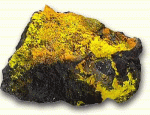 Indian Point Safe Energy Coalition April 11, 2016 Marilyn Elie, “……..Coal, oil, and gas are all remnants from our prehistoric past. They are mined from the earth at great cost and labor…….
The price of civilization has been the destabilization of the natural system of checks and balances that has kept our atmosphere – the air we breathe – operating within the narrow band of gases that is hospitable to life.
Uranium, although it is not rich in carbon, fits into this category of mined fuels. The Navajo have a saying, “You might meet old coal miners, but you will never meet old uranium workers.” The mining and enrichment of the ore into fuel requires an enormous amount of electricity, and most of all, the reactors that are fueled by uranium alter the fuel rods and produce plutonium. One of the most deadly substances on the face of the planet, plutonium leaves a legacy that is deadly for 240,000 years and takes us to a time in the future that we cannot even begin to imagine.
There is no going back. What has happened cannot be undone. What we can do is work to keep all of these ancient fuels, including uranium, in the ground where they belong. We can only hope that we have not yet reached the tipping point that will return us to the Earth’s stormy past and a world inhospitable to life…https://closeindianpoint.wordpress.com/2016/04/11/uranium-as-a-fossil-fuel/
June 20, 2016
Posted by Christina Macpherson |
general |
Leave a comment
June 18, 2016 by Charlie Olson On June 16, 2016, a group of concerned citizens representing grassroots organizations came together to express their concerns and raise questions with the Public Service Commission on the role of gas and nuclear power in the Clean Energy Standards.
Calling nuclear power clean and carbon free, as is done in the CES is simply not true. Mislabeling it in the CES provokes deep distrust of the process and calls into question both the methodology and integrity of the Commission. If we are to move towards a truly green energy policy coal, oil, gas and uranium must be left in the ground. Tier 3 of the plan which supports nuclear power must be eliminated.
We need a policy for New York State that phases out dirty, dangerous generators such as nuclear power and replaces it with clean and green renewables. We stand in solidarity with the Sierra Club and many others, who understand the importance of off shore wind as an abundant source of clean energy and advocate for a special Tier for this important resource. Conservation, efficiency, demand response, and transmission improvements must receive greater weight in the Clean Energy Standards and results must be carefully monitored. There is no bridge to clean energy except clean energy!………… https://www.facebook.com/groups/277245265712386/
June 20, 2016
Posted by Christina Macpherson |
opposition to nuclear, USA |
Leave a comment
Decades Later, Sickness Among Airmen After a Hydrogen Bomb Accident, NYT, by DAVE PHILIPPS JUNE 19, 2016 “……….Spain’s Monitoring
The United States promised to pay for long-term monitoring of health in the village, but for decades it provided only about 15 percent of funding, with Spain paying the rest, according to a declassified Department of Energy summary. Broken air-monitoring stations went unfixed and equipment was often old and unreliable. In the early 1970s, an Atomic Energy Commission scientist noted, the Spanish field monitoring team consisted of a lone graduate student.
Reports of two children dying of leukemia during that time went uninvestigated. The lead Spanish scientist monitoring the population told American counterparts in a 1976 memo that, in light of the leukemia cases, Palomares needed “some kind of medical surveillance of the population to keep watch for diseases or deaths.” None was created.
In the late 1990s, after years of pressure from Spain, the United States agreed to increase funding. New surveys of the village found extensive contamination that had gone undetected, including some areas where radiation was 20 times the permissible level for inhabited areas. In 2004, Spain quietly fenced off the most contaminated land near the bomb craters.
Since then, Spain has urged the United States to finish cleaning the site.
Because of the uneven monitoring, the effect on public health is far from clear. A small mortality study in 2005 found cancer rates had gone up in the village compared with similar villages in the region, but the author, Pedro Antonio Martínez Pinilla, an epidemiologist, cautioned that the results could be because of random error, and urged more study.
At that time, a United States Department of Energy scientist, Terry Hamilton, proposed another study, noting problems in Spain’s monitoring techniques. “It was clear the uptake of plutonium was poorly understood,” he said in an interview. The department did not approve his proposal…..
About a fifth of the plutonium spread in 1966 is still estimated to contaminate the area. After years of pressure, the United States agreed in 2015 to clean up the remaining plutonium, but there is no approved plan or timetable…….http://www.nytimes.com/2016/06/20/us/decades-later-sickness-among-airmen-after-a-hydrogen-bomb-accident.html
June 20, 2016
Posted by Christina Macpherson |
civil liberties, health, politics international, secrets,lies and civil liberties, Spain, USA |
Leave a comment
 With Solar Power, A Gujarat Village Is Irrigating Its Fields For Free NDTV, All India |Written by Rohit Bhan | Updated: May 22, 2016 DHUNDI:
- Farmers formed cooperative to install solar panels in their fields
- Solar panels power irrigation, surplus power sold to electricity board
- Project funded by farmers and non-profit group IWMI
Ramabhai Sagar, a 46-year-old farmer in Gujarat’s Dhundi village, is experiencing first hand a solar revolution of sorts.
Around seven months ago, about a dozen farmers in Ramabhai’s village about 90 km from Ahmedabad came together to form a solar cooperative and set up solar panels in the fields to generate electricity.
“We used to spend 500 rupees on diesel for pumping sets for drawing water for irrigation. But now we do it with solar energy,” Rambhai said.
“We also make money by selling solar power when we not irrigating our fields. We can sell excess electricity to the power board for Rs. 4.63 per unit,” he added…….http://www.ndtv.com/india-news/with-solar-power-a-gujarat-village-is-irrigating-its-fields-for-free-1408800
June 20, 2016
Posted by Christina Macpherson |
decentralised, India |
1 Comment
 Messenger: Activist won’t back down in quest to rid St. Louis of nuclear waste By Tony Messenger St. Louis Post-Dispatch Jun 17, 2016 “…….For decades now, 83-year-old environmentalist Kay Drey has been on a quest: Get the federal government to excavate and move the waste. It’s a story that can get more complicated the deeper you dig. It involves multiple federal agencies, dense reports on various radiological elements and their “daughter products,” half-lives, warring special interest groups, lawsuits and, ultimately, a dispute over who will pay the hundreds of millions of dollars to clean it up or otherwise protect the citizens who live near the landfill.
But Drey has a way of simplifying things.
“It’s in the Missouri River flood plain,” she says of the nuclear waste. “I can’t think of a worse location. The Missouri River floods all the time. We cannot leave it there.”
That was the basic theme of the first of two reports she gave me. It’s 14 pages of testimony she submitted to the U.S. Environmental Protection Agency and the Missouri Department of Natural Resources 10 years ago. In painstaking detail, Drey outlines what is known of the waste, how it might affect groundwater and the potential for disaster if the Missouri River were to reclaim its floodplain now protected by the Earth City levee.
She quotes two old Nuclear Regulatory Commission reports, one from 1982 and the other from 1988, that outline how “hot” the waste is in West Lake and call for some sort of “remedial action.” She quotes one of the foremost flooding experts in the region, Bob Criss from Washington University, who said, “This is the wrong place to store hazardous material. It does not belong in a flood plain.”
Nobody who read Drey’s words from a decade ago would have been surprised by the release this week of a secret EPA report that reached similar conclusions.
The report, internal findings by EPA scientists that had been kept secret since 2013, concluded that it was feasible to remove the nuclear waste from West Lake. The scientists also found that doing so would reduce long-term risks.
So what’s the holdup?
Money.
The EPA has long wanted to simply put a cap over the waste and leave it there, at a cost of $40 million or so. It’s much less expensive than having the Army Corps of Engineers unearth the waste and dispose of it elsewhere, which might cost 10 times as much. Putting a cap in place is the preferred option of Republic Services, the company that currently owns the landfill.
Drey doesn’t care about the cost. She doesn’t care about how long cleaning up the waste would take. And she doesn’t want Republic to pay, either.
“The government put it there,” she said. “The government needs to clean it up. If we can keep making bombs, we can find the money to clean up the waste from the 1940s.”
The U.S. Senate passed a bill this year to carry out Drey’s preferred solution — have the Corps of Engineers take over the project and clean it up. But the measure appears to be dead in the House. Here’s what lawmakers need to know about Drey:
She’s not giving up…… “We need to get both houses of Congress to say they’re going to clean it up,” Drey says. “It just can’t stay there.” http://www.stltoday.com/news/local/columns/tony-messenger/messenger-activist-won-t-back-down-in-quest-to-rid/article_3da42a06-a587-53cc-bd86-e3844af3d6e1.html
June 20, 2016
Posted by Christina Macpherson |
opposition to nuclear, USA, wastes |
Leave a comment
 Decades Later, Sickness Among Airmen After a Hydrogen Bomb Accident, NYT, by DAVE PHILIPPSJUNE 19, 2016 “….. Tests Thrown Out During the cleanup, a medical team gathered more than 1,500 urine samples from the cleanup crew to calculate how much plutonium they were absorbing. The higher the level in the samples, the greater the health hazard.
The records of those tests remain perhaps the most prominent artifact from the cleanup. They show about only 10 of the men absorbed more than the allowed safe dose, and the rest of the 1,500 responders were not harmed. The Air Force today relies on the results to argue that the men were never harmed by radiation. But the men who actually did the testing say the results are deeply flawed and are of little use in determining who was exposed.
“Did we follow protocol? Hell, no. We had neither the time nor the equipment,” said Victor B. Skaar, now 79, who worked on the testing team. The formula for determining the contamination level required collecting urine for 12 hours, but he said he was able to get only a single sample from many men. And others, he said, were never tested at all.
He sent samples to the Air Force’s chief of radiation testing, Dr. Lawrence T. Odland, who started seeing alarmingly high results. Dr. Odland decided the extreme levels did not indicate a true health threat, but were caused by plutonium loose in the camp that contaminated the men’s hands, their clothes and everything else. He threw out about 1,000 samples — 67 percent of the results — including all samples from the first days after the blasts when exposure was probably highest.
Now 94 and living in a rambling Victorian house in Hillsboro, Ohio, where a photo from the Greenland crash hangs in his hall, Dr. Odland questioned his decision.
“We had no way of knowing what was from contamination and what was from inhalation,” he said. “Was the world ending or was everything fine? I just had to make a call.”
He said he never got accurate results for hundreds of men who may have been contaminated. In addition, he soon realized plutonium lodged in the lungs could not always be detected in veterans’ urine, and men with clean samples might still be contaminated.
“It’s sad, sure, it’s sad,” he said. “But what can you do? You can’t take the plutonium out; you can’t cure the cancer. All you can do is bow your head and say you are sorry.”
Monitoring Program Killed
Convinced that the urine samples were inadequate, Dr. Odland persuaded the Air Force in 1966 to set up a permanent “Plutonium Deposition Registry Board” to monitor the men for life.
Experts from the Air Force, Army, Navy, Veterans Administration (now the Department of Veterans Affairs) and Atomic Energy Commission met to establish the program shortly after the cleanup. In welcoming remarks, the Air Force general in charge said the program was “essential” and following the men to their graves would provide “urgently needed data.”
The organizers proposed not notifying troops of their radiation exposure and keeping details of testing out of medical records, according to minutes of the meeting, out of concern notifying them could “set a stage for legal action.”
The plan was to have Dr. Odland’s staff follow the men. Within months, though, he had hit a wall.
“He is not able to get the support from the Department of Defense to go after the remaining people or set up a real registry because of the sleeping-dog policy,” an Atomic Energy Commission memo from 1967 noted.
“The sleeping dog policy? It was to leave it alone. Let it lie. I didn’t agree. Hell no, I didn’t agree,” Dr. Odland said. “Everyone decided we should watch these guys, take care of them. And then from somewhere up high they decided it was better to get rid of it.”
Dr. Odland did not know who gave the order to terminate the program, but said since the board included all the military branches and the veterans agency, it likely came from top-level officials.
The Air Force officially dismantled the program in 1968. The “permanent” board had met just once…….. http://www.nytimes.com/2016/06/20/us/decades-later-sickness-among-airmen-after-a-hydrogen-bomb-accident.html
June 20, 2016
Posted by Christina Macpherson |
health, secrets,lies and civil liberties, USA |
Leave a comment










 nuclear-news