Woman gives up electricity and goes ‘off grid’ for 4 years
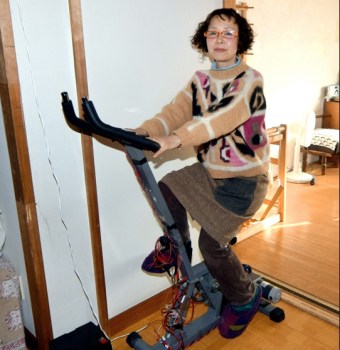
Chikako Fujii says she uses a human-powered dynamo remodeled from a bike-type training machine to generate power in emergencies
Chikako Fujii used to leave the TV on all the time, but since the Fukushima nuclear disaster inspired her to go “off grid” nearly four years ago, she has consumed literally no energy supplied from her regional power company.
Fujii, 55, a textile dyeing artist, uses a tiny amount of electricity generated primarily by solar panels set up on her veranda that measure a total of just 1.6 square meters.
The lifestyle choice means that Fujii cannot power an air conditioner, a refrigerator or a TV with such a small quantity of energy, but those things don’t concern her.
“I enjoy working out how to lead a life without using electricity,” she said.
A resident of Kunitachi, western Tokyo, Fujii terminated her contract with Tokyo Electric Power Co. in September 2012, after rolling blackouts were implemented in the wake of the March 2011 Great East Japan Earthquake and tsunami, which triggered a triple meltdown at the Fukushima No. 1 nuclear power plant.
Fujii said that before the disaster struck, she habitually left the TV on so that she could check the time whenever she wanted.
But when she stopped using her home appliances one by one, she found her electricity bill could be reduced.
While she paid more than 4,000 yen ($36) per month for electricity before the disaster, the figure gradually dropped to around 2,000 yen. When she finally unplugged the refrigerator, which requires much power, the bill reached 800 yen.
“I thought I might be able to live without relying on the power company, and decided to start an off-grid life for the fun of it,” Fujii said.
The solar panels installed on the veranda have a power production capacity of 260 watts and can generate more than 1 kilowatt-hour of power on a typical sunny day–enough to operate a washing machine for three hours to dye fabrics with plant-derived materials.
However, when cloudy weather continues for a week during the June rainy season or due to a typhoon, the electricity stored in the battery dries up. When that happens, Fujii uses a pedal-operated sewing machine and an old charcoal-powered iron for her work instead of electric ones.
One night, Fujii was asked by a business partner to send a document by e-mail on short notice.
She pedaled hard a human-powered dynamo remodeled from a bike-type training machine to generate electricity to use her computer.
As Fujii cannot use an air conditioner, she made small holes in a plastic bag containing water and hung it above the veranda to sprinkle water automatically to cool the surrounding air.
In lieu of an electric kettle, she painted plastic bottles black and exposed them to sunlight to heat the water inside.
In December last year, Fujii also introduced a handmade heater made out of a used tempura oil-based lamp and a flowerpot put over the lamp upside down. According to Fujii, 20 milliliters of oil can keep the flowerpot hot for three to four hours.
She said she daily consumes only 500 to 800 watt-hours of power at home, about one-12th that for an ordinary household.
“I always live while being conscious of the weather,” Fujii said. “For example, when I wake up to find it is sunny, I think I should use the washer today. Thinking this way is fun for me.”

The water heater made of glass tubes can increase the water temperature to 85 degrees in two hours even during winter if it is exposed to sufficient sunlight.

A handmade evaporation heat-based cooler designed to remove heat from flowerpots when water evaporates
http://www.asahi.com/ajw/articles/AJ201606010003.html
No comments yet.
1 This Month

of the week – Shut Down Drone Warfare!


Tell the Ukrainian Government to Drop Prosecution of Peace Activist Yurii Sheliazhenko

Petition to revoke the licensing of the Near Surface Nuclear Disposal Facility (NSDF) at Chalk River. https://www.ourcommons.ca/petitions/en/Petition/Details?Petition=e-7247
To see nuclear-related stories in greater depth and intensity – go to https://nuclearinformation.wordpress.com
-
Archives
- April 2026 (91)
- March 2026 (251)
- February 2026 (268)
- January 2026 (308)
- December 2025 (358)
- November 2025 (359)
- October 2025 (376)
- September 2025 (257)
- August 2025 (319)
- July 2025 (230)
- June 2025 (348)
- May 2025 (261)
-
Categories
- 1
- 1 NUCLEAR ISSUES
- business and costs
- climate change
- culture and arts
- ENERGY
- environment
- health
- history
- indigenous issues
- Legal
- marketing of nuclear
- media
- opposition to nuclear
- PERSONAL STORIES
- politics
- politics international
- Religion and ethics
- safety
- secrets,lies and civil liberties
- spinbuster
- technology
- Uranium
- wastes
- weapons and war
- Women
- 2 WORLD
- ACTION
- AFRICA
- Atrocities
- AUSTRALIA
- Christina's notes
- Christina's themes
- culture and arts
- Events
- Fuk 2022
- Fuk 2023
- Fukushima 2017
- Fukushima 2018
- fukushima 2019
- Fukushima 2020
- Fukushima 2021
- general
- global warming
- Humour (God we need it)
- Nuclear
- RARE EARTHS
- Reference
- resources – print
- Resources -audiovicual
- Weekly Newsletter
- World
- World Nuclear
- YouTube
-
RSS
Entries RSS
Comments RSS
 nuclear-news
Leave a comment