Conditions Promoting Arctic Sea Ice Collapse Are Exceptionally Strong This Spring

It didn’t take long for Arctic sea ice to start to respond to a fossil-fuel based accumulation of hothouse gasses in the Earth’s atmosphere. For since the 1920s, that region of ocean ice along the northern polar zone has been in a steady, and increasingly rapid, retreat. Rachel Carson wrote about the start of the Northern Hemisphere ocean ice decline in her ground-breaking 1955 book — The Edge of the Sea.
But it wasn’t until the late 1970s that consistent satellite observations began to provide an unbroken record telling the tale of Arctic sea ice decline. The National Snow and Ice Data Center, The Polar Science Center (PIOMAS), Japan’s JAXA, The Danish Meteorological Institute, and others have since that time provided a loyal recording of the stark impact human-forced warming has had on this sensitive and critical region.
(Severe sea ice volume losses since 1979…
View original post 1,704 more words
April 16 Energy News

Science and Technology:
¶ Greenland’s massive ice sheet has started its annual summer melt earlier than ever before, according to stunned scientists who said they had to recheck their calculations before releasing the results. The previous earliest dates were all later by weeks, in May. [CNN]
 Franz Josef Fjord, glacier, Greenland. Jerzy Strzelecki.
CC BY-SA 3.0 unported. Wikimedia Commons
World:
¶ The latest figures from the International Renewable Energy Agency show that Poland is on course to increase the proportion of power it generates from renewable energy from 7% in 2010 to nearly 38% by 2030. Poland benefits from a very favorable natural wind resources. [Maritime Journal]
¶ Germany’s economic affairs ministry proposed a 2.5 GW annual gap on new subsidized onshore wind power capacity, which is likely to slow down wind power expansion. Germany has a target to increase onshore wind capacity 2.4 Gw…
View original post 521 more words
Japan: Amidst Earthquakes and Volcanic Eruption, Chimp At Large Points to Another Risk to Nuclear Power Stations

Over the last few days, Japan has had major earthquakes followed by a nearby volcanic eruption, pointing again to the fact that it is a particularly bad location for nuclear power stations. It also resulted in loss of power, a major achilles heel of nuclear power. Elsewhere in Japan, a chimpanzee got loose, and this also resulted in loss of power. Besides zoo chimps, Japan has its own wild monkeys.
Mori Sosen, 1747-1821, Monkeys in Plum Tree

Yellow pins are volcanos; orange spots are recent earthquakes; circles show the magnitude radiating out from VII at the epicenter. Locations of the two closest nuclear power stations are included.

Based on Wolfgang Hugo Rheinhold (1853 – 1900), Affe mit Schädel (Ape with Skull)
While it appears unrelated, unless the chimp sensed the earthquake far away, earthquakes could result in zoo animals getting lose, posing yet another risk to nuclear power stations, especially…
View original post 1,358 more words
Unbelievable Censorship of Japan’s Recent Earthquakes

I find it extraordinary that The Wall Street Journal, The New York Times, and The Washington Post have NOT run a single story in their print and online versions respectively of the earthquakes in Japan.
NHK reports that the second earthquake has been measured as a 7.3, with 41 people reported dead, and over 170,000 people evacuated. How can this story not be newsworthy? The airport and port are closed and so are major roads and the bullet train:
Scale of quake damage growing. NHK April 17, 2016,http://www3.nhk.or.jp/nhkworld/en/news/20160416_24/ The major earthquakes continuing to jolt areas in Japan’s southwestern region have so far left a total of 41 people dead.
Early on Saturday, a magnitude 7.3 earthquake hit areas in Kumamoto Prefecture in the Kyushu Region. It registered an intensity of 6-plus in the prefecture on Japan’s seismic scale of 0-to-7…Utility services have been disrupted. Hundreds of thousands of households are without electricity, gas and tap water.
Yesterday, on the front page of the print edition The Wall Street Journal ran a story “Japan’s Subzero Rates Cast Chill Over Markets” (4/15/2016, A1, A7) but there was no mention of the first earthquake anywhere in the print version of the paper.
Today’s WSJ print version has no mention at all of the earthquake in the front section and if there is any mention anywhere else its so buried I cannot find it.
The electronic version of the The New York Times from yesterday and today carry no mention that I can find of the earthquakes in Japan.
Today, The Washington Post has an article on “Why Mr. Obama Should Visit Hiroshima” (editorial) but like the Wall Street Journal and the New York Times, there is NO story on the earthquake that I can find in the electronic version delivered to my email.
I do NOT understand how two significant earthquakes in a geologically active zone with 41 people reported dead, over a hundred thousand evacuated, and an operational nuclear plant in the vicinity are not newsworthy, particularly given the risks are not over:
Seismic activity poses increasing risk. NHK,http://www3.nhk.or.jp/nhkworld/en/news/20160416_16/
Gen Aoki, the head of the agency’s earthquake and tsunami monitoring section, said the buildup in seismic activity means there’s an increased risk that buildings will collapse and mudslides will occur. He called on residents to stay safe.
It is my conclusion that there is a deliberate and concerted effort to help protect Japan’s economy from bad news, even during the occurrence of large earthquakes that pose the potential for catastrophic results.
I really don’t know what else to say. Its really unbelievable.
My thoughts go out to the people of Kyushu region whose tribulations are being disregarded in order to perpetuate myths about the global economy.
http://majiasblog.blogspot.fr/2016/04/unbelievable-censorship-of-japans.html?m=1

Japanese Government Learned Nothing From Fukushima
410 consecutive earthquakes since 14 April, including 162 of more than 3.5 magnitute, but the Japanese government keeps two reactors at the Sendai plant in operation ….
They have learned nothing from Fukushima.

Landslides sever National Route No. 57 in Minami-Aso, Kumamoto Prefecture, on April 16. Aso-ohashi bridge also collapsed.
410 quakes felt in Kyushu, 162 with magnitudes of at least 3.5
The number of earthquakes that could be felt by people reached 410 by 10 a.m. on April 17 following the start of seismic activity in Kumamoto Prefecture on April 14, the Japan Meteorological Agency said.
Quakes with magnitudes of 3.5 or larger accounted for 162 of the total by 8:30 a.m. on April 17, the largest among inland and coastal earthquakes since 1995. The previous high was set after the Chuetsu Earthquake in Niigata Prefecture in 2004.
“After the magnitude-7.3 earthquake that struck at 1:25 a.m. on April 16, the number of earthquakes increased sharply,” said Gen Aoki, director of the agency’s earthquake and tsunami monitoring division.
He urged people in the affected areas to remain alert amid the ongoing aftershocks.
“Earthquake movements are actively continuing in areas from Kumamoto Prefecture to Oita Prefecture,” Aoki said. “The soil could have become loose due to the rain that started to fall on April 16, so I want people to exercise caution against strong tremors or rain.”
http://www.asahi.com/ajw/articles/AJ201604170042.html

The No. 1 and No. 2 reactors at the Sendai nuclear power plant in Kagoshima Prefecture
Government lets Sendai reactors continue operations
The government on April 16 said there is no need to shut down two nuclear reactors in Kagoshima Prefecture, citing relatively low seismic movements around the nuclear plant.
Cabinet ministers met on April 16 to respond to the Kyushu earthquakes and discuss what to do with the No. 1 and No. 2 reactors of the Sendai nuclear power plant located in Satsuma-Sendai, Kagoshima Prefecture.
Environment Minister Tamayo Marukawa, who serves concurrently as state minister for nuclear emergency preparedness, mentioned the stricter safety standards implemented by the Nuclear Regulation Authority on nuclear power plant operations. Under the NRA’s standards, adopted after the Fukushima nuclear disaster in 2011, 620 gal is the maximum seismic acceleration allowed for reactors to continue running.
Marukawa said the maximum shaking recorded on the Sendai plant grounds was 12.6 gal.
“The NRA has judged there is no need to stop the Sendai plant,” she said.
The two reactors are the only ones currently operating in Japan.
The series of earthquakes that began in Kumamoto Prefecture on April 14 have spread eastward to Oita Prefecture. Kagoshima Prefecture lies at the southern end of Kyushu.
“Under the current circumstances, there is no need to stop the plant because (the shaking) is sufficiently low,” Chief Cabinet Secretary Yoshihide Suga said after the April 16 meeting.
The Japanese Communist Party on April 16 called on the government to shut down the Sendai plant as a preventive measure because the quake activity was spreading through Kyushu.
The party said major problems would arise in evacuations if a nuclear accident arose at the Sendai plant because quake damage has rendered the Shinkansen bullet train line and expressways unusable.
http://www.asahi.com/ajw/articles/AJ201604170031.html

Complex geology behind Kumamoto jolt
The earthquake that struck Kumamoto Prefecture early Saturday had a magnitude of 7.3, the same as the Great Hanshin Earthquake in 1995, in which more than 6,400 people died or remain missing.
The Saturday quake had more than 10 times the energy of the magnitude-6.5 earthquake that occurred Thursday evening, which caused strong shaking in limited areas. On Saturday, violent tremors measuring as high as upper 6 on the Japanese intensity scale of 7 were felt over a wide area.
Experts said the earthquake occurred as multiple faults moved in conjunction with each other, and warned that earthquakes will continue over a wide area.
According to the Japan Meteorological Agency, this is the first magnitude-7 class earthquake with a shallow focus since a magnitude-7 quake in the Hamadori area in Fukushima Prefecture, that is believed to have been an aftershock of the Great East Japan Earthquake in 2011. In the Kyushu region it was the first of that size and type in 11 years, since the magnitude-7 earthquake with its focus in the Genkainada sea in western Fukuoka Prefecture in 2005.
According to the agency’s analysis, Saturday’s quake was a “strike-slip” type, in which the fault involved moved horizontally due to its being pulled to the northwest and southeast. Thursday’s quake and the 1995 Hanshin earthquake involved the same “strike-slip” mechanism.
Yuji Yagi, an associate professor of geodynamics at University of Tsukuba, analyzed the seismic waves from the Saturday quake and said the fault appeared to have moved over an area about 50 kilometers long and 20 kilometers wide.
The underground destruction stretched northeast from the quake’s focus and continued for about 20 seconds.
The focus of Saturday’s quake was located on the northern side of the Futagawa fault zone, which cuts east to west across Kumamoto Prefecture and is at least about 64 kilometers long in its entirety.
The government’s Earthquake Research Committee had deemed there to be “an almost zero to 0.9 percent chance” of a magnitude-7 earthquake occurring in the northeast part of the Futagawa fault zone within 30 years.
The Hinagu fault zone lies to the south of the focus of Saturday’s quake, stretching at least about 81 kilometers. Part of the Hinagu fault zone is believed to have moved in the Thursday earthquake.
Yasuhiro Suzuki, a professor of tectonic geomorphology at Nagoya University, said part of the Futagawa fault zone moved in the Saturday morning earthquake. “It’s appropriate to think of the Hinagu and Futagawa fault zones as connected active faults. The earthquake on Saturday occurred in conjunction with the quakes that have happened from Thursday on, so it appears that part of a very large fault moved,” Suzuki said.
According to Takeshi Matsushima, an associate professor at Kyushu University of solid-state geophysics, the ground in the Kyushu region is subject to forces that pull it north-south. This creates the Beppu-Shimabara rift zone, in which the ground is subsided from Oita to Kumamoto. It contains the Hinagu and Futagawa fault zones, as well as the Beppu-Haneyama fault zone.
Seismic activity has intensified from the southwest to the northeast of the rift zone.
Regarding this fact, the Japan Meteorological Agency said at a Saturday press conference that “large earthquakes have occurred in three locations: Kumamoto, Aso and the central areas of Oita Prefecture.”
The government’s Earthquake Research Committee has decided to hold an emergency meeting on Sunday regarding the quakes. It will examine the causes of the seismic activity and prospects for the future.Speech
http://the-japan-news.com/news/article/0002881595

Seismic activity could move east, trigger quakes in active faults
Seismologists fear that the series of earthquakes rattling Kyushu could trigger temblors in other active faults in the southwestern island, which extend eastward into central Japan.
A number of active faults dot the so-called Beppu-Shimabara Rift, which traverses Kyushu island from east to west, extending to the Median Tectonic Line. This is the nation’s longest tectonic line, and it spans about 1,000 kilometers from the Kanto Plain through Gunma, Nagano, Wakayama, and Tokushima prefectures to Kyushu island in southern Japan.
Ichiro Kawasaki, professor emeritus of seismology at Kyoto University, said: “The epicenter (in the latest series of quakes that began April 14) is gradually moving eastward. When a fault moves, it tends to move other faults that run on an extended line.”
He explained that when an earthquake occurs, other faults around it are exerted to different pressure, which could trigger other quakes.
That view was echoed by Kazuro Hirahara, a Kyoto University professor of seismology and head of the Coordinating Committee for Earthquake Prediction.
“The epicenter of the earthquake in Oita Prefecture, (which occurred early on April 16) is about 100 kilometers from that of the Kumamoto quakes, and therefore it is hard to think that the quake was an aftershock,” he said, adding that there was a possibility the Beppu-Haneyama fault zone in the prefecture may have been stimulated.
“Quite frankly, there is no telling what may happen in the days ahead,” he said. “If some part in the Median Tectonic Line moves, there is a chance it could have an impact on the predicted Nankai Trough Earthquake in the long run.”
Shinji Toda, a Tohoku University professor of earthquake geology, pointed out that the seismic activity could also move southward.
The Slow Bleed: Fukushima Five Years On

Fukushima, Reactors 3 and 4
By Vincent Di Stefano
The meltdown of three nuclear reactors at Fukushima in the wake of the earthquake and tsunami of 11th March 2011 seems to have quietly slipped out of our collective awareness – as quietly as the cauldrons of radioactive elements that were once within the active cores of the reactors invisibly bleed into the groundwaters and seawaters of the region. This event has become yet another minor detail in the distorted mosaic of ruin that mirrors the latter days of a civilisation in free-fall.
Arnie Gundersen is looking a little weathered these days. He has just returned from a five-week long speaking tour of Japan. He spent much of that time in the company of many whose lives have been indelibly seared by the Fukushima catastrophe. What he reports is unlikely to appear in the mainstream media, but such has ever been the case when it comes to the hidden machinations of big government and big business.
What Gundersen has to say is worth closely attending to. As a nuclear engineer, he has been deeply involved in the American nuclear industry for over four decades. He has a special interest in the design and safety of containment structures and holds a patent for a nuclear safety device. He has also managed and coordinated nuclear projects at 70 nuclear power plants in the US and is a former nuclear industry senior vice-president. He knows the industry well, particularly its toxic underbelly.
Arnie Gundersen served as an expert witness in the investigation of the 1979 Three Mile Island accident, and found that releases of radioactivity from that particular event were 15 times higher than the figures published subsequently in a government report. He is no stranger to the prevarication and deceit that have too often accompanied statements made by the nuclear industry and its government supporters.
Gundersen has been an active critic of the nuclear industry for over two decades. More recently, he has co-authored a Greenpeace International report on Fukushima. He was among the first North American commentators to speak publicly and forcefully on the implications of Fukushima in the days and weeks after the meltdowns. And since that time, he has been tireless in his efforts to provide an informed narrative of developments at Fukushima and their consequences for both the inhabitants of Japan and on the global community.
Arnie Gunderson reports that the Japanese Government continues to put the interests of Japanese banks and power companies ahead of the safety of its people. Within a short time of the Fukushima meltdowns in 2011, the Democratic Party of Japan (DPJ) who were in power at that time arbitrarily raised the “acceptable” limits of radiation exposure twenty-fold: from 1 millisievert (mSv)/year – the maximum dose recommended by the International Commission on Radiological Protection – to 20 mSv/year. In 1998, over a decade beforehand, Rosalie Bertell presented the findings of a number of independent studies published in peer-reviewed journals, including the British Medical Journal and the Journal of the American Medical Association that showed unequivocally that radiation doses as low as 2.5 mSv/year were associated with significant increases in the incidence of leukaemias and myelomas, and cancers of the pancreas, lungs and female reproductive organs in nuclear industry workers.
As Japanese medical practitioners begin to encounter the effects of radiation exposure in their patients – particularly children – the government now refuses to pay doctors who record a diagnosis of radiation-induced sickness in their patients. This will come as no surprise to those who followed the actions of the Soviet government and later, the Russian, Ukraine and Belarus governments in their concerted suppression of medical reports dealing with the consequences of radiation exposure on the lives of their citizens after the Chernobyl meltdown.
Rearranging the Deck Chairs

Temporary housing for Fukushima evacuees
Over 100,000 people are still not able to return to their homes in Fukushima prefecture since the meltdowns. In a disturbing disclosure, Gundersen reveals that many of the evacuees have received virtually no information regarding the issue of radiation exposure either from the Japanese government or from TEPCO, the operators of the Fukushima power plant. The subsistence stipend that they have received since being evacuated will cease in March 2017. Considerable pressure is being put on former residents by the government that they now return to Fukushima and tough it out regardless of the ongoing contamination. Many have grave concerns regarding the effects of such a move on the future health of their families.

30 Million Bags of Radioactive Debris
Another remarkable aspect of the present situation concerns the manner in which highly contaminated materials – which include radioactive soil, leaves and other debris – have been dealt with. Thirty million tons of such debris has so far been gathered from throughout the Fukushima prefecture. Much of this is now stored in over 9 million large plastic bags scattered throughout the affected areas. Three years after being filled, the bags have started to disintegrate and nobody seems to know what to do next since their contents need to be kept isolated for at least another 30 years. One favoured option is to incinerate them. This would certainly decrease their number, but would inevitably result in the further dispersion of radioactive elements in aerosol form around Japan.
There are clearly some who still hold to the old but ultimately banal adage that, the solution to pollution is dilution.

Contaminated Water Storage Tanks at Fukushima
Dwarfing the problem of solid wastes is the ongoing leaching of radioactive elements from the melted reactor cores into groundwater and seawater. For the past five years, between 200 and 500 tons of groundwater flow through the reactors every day as a result of multiple cracks in the containment structures. Some of this water has recently been diverted away from the reactors, but an estimated 150 tons of groundwater continue to flow through the reactors daily. This irradiated water inexorably flows on, steadily bleeding into the northern Pacific. Furthermore, 700,000 tons of highly radioactive water salvaged from cooling operations since the meltdown is presently stored in massive tanks that now pepper the reactor site. More are being built as contaminated water continues to accumulate.
The Tragic Absurdity
It is common knowledge that engineers will be busy for the next 30 to 40 years in their efforts to put the lid on the cauldron of radioactivity that seethes in the reactor basements at Fukushima. Meanwhile, the Pacific tectonic plate continues its own inexorable movement beneath the continental Okhotsk plate on which Japan sits creating the conditions for future mega-thrust events like that which shook the region on 11th March 2011. The unspoken terror is that it could all turn again in the blink of an eye.
Despite what has happened at Fukushima, the Abe Government is determined to restart Japan’s nuclear reactors that were all shut down after the 2011 earthquake. Widespread anti-nuclear protests throughout Japan have been ignored and three nuclear power plants in Kagoshima and Fukui prefectures have been restarted since August 2015. Over the next year, a further six to twelve reactors are slated to resume operations. Business reigns as usual.
There are many who proudly insist on riding the nuclear beast regardless of the human and environmental consequences. They insist that this is the way of the future and a “necessary” solution to the problems of rising atmospheric carbon dioxide levels and an ever-accelerating movement towards numerous tipping points which include ocean acidification, loss of polar albedo effects due to melting of polar ice, and the bubbling up of vast new wells of methane gas from the melting of northern permafrost and sea-floor deposits. In the immortal words of Edwin Arlington Robinson, what folly is here that has not yet a name?
Arnie Gundersen’s Report
The video clip below presents an interview between Arnie Gundersen and Margaret Harrington recorded soon after he returned from a recent speaking tour of Japan. The first 25 minutes of the interview offers deep insight into how the worst industrial accident in the history of humanity has affected the people of Japan, and how the Japanese government now increasingly serves the interests of power companies and their financial backers rather than those of its own people. Arnie Gundersen is unambiguously clear regarding the nature of what has gone down in Fukushima in this presentation. And the moral abandonment of both the Japanese government and TEPCO in the downplaying of the present and future consequences of the meltdown are not lost on him.
The second half of this clip offers a detailed review by Gundersen of the developments at Fukushima over the past five years. A separate high-definition version of the second segment can be accessed here.
http://www.countercurrents.org/stefano150416.htm
Not far from Sendai nuclear reactors, Japan gets second earthquake, mag 7.3

 Japan’s Kumamoto rocked by magnitude 7.3 earthquake 24 hours after first shock, SMH April 16, 2016 Tokyo: A magnitude 7.3 earthquake struck southern Japan early on Saturday, killing at least 11 people, injuring many more and bringing down buildings, media reported, just over a day after a quake killed nine people in the same region.
Authorities warned of damage over a wide area, as reports came in of scores of people trapped in collapsed buildings, fires and power outages.
Residents living near a dam were told to leave because of fears it might crumble, broadcaster NHK said…….
People still reeling from a magnitude 6.5 quake on Thursday poured onto the streets after the Saturday quake struck at 1.25 am……….
M7.0 earthquake in Japan – same area as yesterday’s foreshocks. https://t.co/eSYh0m7VMI. Hearts out to them pic.twitter.com/41M2BGRmRR……..
Japan is on the seismically active “ring of fire” around the Pacific Ocean and has building codes aimed at helping structures withstand earthquakes.
http://www.smh.com.au/world/japans-kumamoto-rocked-by-magnitude-74-earthquake-just-24-hours-after-first-shock-20160415-go7ucs.html#ixzz45xKID5Fc
As coal mines go bankrupt, tax-payers will be left with the cleanup costs

 After Bankruptcies, Coal’s Dirty Legacy Lives On, NYT By TOM SANZILLO and DAVID SCHLISSEL APRIL 14, 2016 THE bankruptcy filing on Wednesday by Peabody Energy, the world’s largest private- sector producer of coal, is the latest in a series of major coal company collapses that threaten to leave behind a costly legacy that will haunt taxpayers and consumers for years.
The abandonment of hundreds of mines over the years led Congress in 1977 to pass a law that requires coal companies to clean up after mining. Left untreated, these sites are more than eyesores: They create long-lingering problems including polluted drinking water.
And the problem is likely to become more pronounced in the wake of these bankruptcies. Mining companies are supposed to buy insurance to cover the cost of cleanups. But Congress has allowed some of the more financially secure coal producers to “self-bond,” promising to pay for cleanups themselves.

Perhaps the most glaring instance of self-bonding gone bad is Peabody Energy. Leading up to its bankruptcy, Peabody had been frantically trying to preserve its $1.47 billion in self-bonding agreements in states where they had been called into question by regulators.Two other major coal companies, Alpha Natural Resources and Arch Coal, recently filed for bankruptcy, leaving hundreds of millions in reclamation guarantees in limbo. A deal between Arch Coal and regulators in Wyoming suggests taxpayers will get stuck with the bulk of the cleanup costs. The company agreed toearmark at most $75 million to cover self-bonded reclamation liabilities of more than $450 million………
Rt.com outlines the 8 most dangerous nuclear plants near earthquake fault lines
 Disasters waiting to happen: 8 most dangerous nuclear plants near earthquake fault lines, Rt.com [excellent pictures] 5 Apr, 2016
“ ……….dozens of potential atomic bombs operate along seismic fault lines. Here are eight of the most deadly, including one that may never be built because of Fukushima.
Koeberg nuclear power plant, Capetown Koeberg is the only nuclear power plant on the continent of Africa and just 8km from the Milnerton fault, which crosses Table Bay. While the largest earthquake to hit the city came more than 200 years ago, the Milnerton fault has the potential to hit at least 6.5 on the Richter scale. Energy company Eskom have insisted the plant is built to “ensure that no radiation escapes under any conceivable circumstances, from an earthquake to a jumbo jet collision.”
Diablo Canyon Power Plant, California Situated along by the shores of the Pacific Ocean – and four active fault lines, this plant has come under scrutiny since Fukushima. Diablo Canyon’s two reactors lie in an earthquake red zone with the Hosgri fault, the Los Osos fault, the San Luis Bay fault, and the Shoreline fault all nearby – and the major San Andreas fault 80km away…..
Indian Point, New York The Empire State’s Indian Point is considered by many to be the next Fukushima.Not only has the plant been plagued with operational problems, but it is situated almost on top of the Rampano fault line.A study by Columbia University in 2008 suggested the New York area was at greater risk of high-magnitude earthquakes than first thought, with the discovery of a new potential disaster area, the Stamfrod-Peekskill line. A spill of radioactive water at the plant in January led environmentalists to call for its closure, with the Riverkeeper group declaring that the site, which runs reactors from the 1970s, “isn’t safe anyone.”
Jaitapur Nuclear Power Project, India The French company Areva NP are proposing to build one of the largest nuclear plants in the world in India, capable of producing 9900 MW of power. Greenpeace is among those opposing the six reactor plant, questioning the safety of its pressurized water cooling system and the shaky ground on which it might be built. Like Fukushima Daiichi, Jaitapur would be operate along by the sea. Critics say the 16 fault lines on the west coast pose a serious threat to safety. However, India’s Atomic Energy Regulatory Board are satisfied that there are no faults within5km.
Columbia Generating Station, Washington state The last nuclear power plant remaining in the Pacific Northwest, the Columbia Generating Station (CGS) could be a potential disaster because of its Fukushima-like boiling water reactor.It’s located near the Columbia river along the Cascadia subduction zone, acknowledged by the Washington State Department as capable of producing “some of the largest and most damaging earthquakes in the world.” A 2013 Seattle Times report quoted a geologist working with the Physicians for Social Responsibility as saying the plant had not undergone structural upgrades since its opening in 1984. A March 2015 risk assessment stated that seismic damage to the site “is low for CGS.”
Arkansas Nuclear One, Arkansas A study of the US Geological Survey hazard map suggests the Arkansas state nuclear plant could be at risk from the New Madrid zone, one of North America’s most active areas for earthquakes. A quake in 1811 was thought to be 8.0 on the Richter scale and reportedly rang bells over a thousand miles away in Boston. The US government warns the damage to the area is likely to be 20 times larger than a “big one” in California due to the “less fractured nature” of the rock.
Sendai Nuclear Power Station, Japan…….Sendai and other Japanese power plants need to withstand their precarious position near the tectonic plate zone called the Japan Trench. Because of plate movements in this area, the Pacific country is hit by an estimated 1,500 earthquakes per year.
Akkuyu Nuclear Plant, Turkey The US$20-billion Akkuyu Nuclear Power Plant in Turkey slated to go up along the Mediterranean coast is a joint project with Rosatom. Foundations for the four reactor facility were laid in April last year despite opposition to its location, which is approximately 25km from the Ecemis fault line. The Republic of Cyprus expressed its concern with the plans when Energy Minister Antonis Paschalides questioned the decision to construct it in “a seismically active area.” https://www.rt.com/news/339763-disaster-nuclear-earthquake-japan/
Climate Change threatens the already leaking Marshall Islands radioactive dome
This dome in the Pacific houses tons of radioactive waste – and it’s leaking
The Runit Dome in the Marshall Islands is a hulking legacy of years of US nuclear testing. Now locals and scientists are warning that rising sea levels caused by climate change could cause 111,000 cubic yards of debris to spill into the ocean , Guardian Coleen Jose, Kim Wall and Jan Hendrik Hinzel on Runit Island 3 July 2015
“……..Officially, this vast structure is known as the Runit Dome. Locals call it The Tomb.

Below the 18-inch concrete cap rests the United States’ cold war legacy to this remote corner of the Pacific Ocean: 111,000 cubic yards of radioactive debris left behind after 12 years of nuclear tests.
Brackish water pools around the edge of the dome, where sections of concrete have started to crack away. Underground, radioactive waste has already started to leach out of the crater: according to a 2013 report by the US Department of Energy, soil around the dome is already more contaminated than its contents.
Now locals, scientists and environmental activists fear that a storm surge, typhoon or other cataclysmic event brought on by climate change could tear the concrete mantel wide open, releasing its contents into the Pacific Ocean.
“Runit Dome represents a tragic confluence of nuclear testing and climate change,” said Michael Gerrard, director of the Sabin Center for Climate Change Law at Columbia University, who visited the dome in 2010.
“It resulted from US nuclear testing and the leaving behind of large quantities of plutonium,” he said. “Now it has been gradually submerged as result of sea level rise from greenhouse gas emissions by industrial countries led by the United States.”
Enewetak Atoll, and the much better-known Bikini Atoll, were the main sites of the United States Pacific Proving Grounds, the setting for dozens of atomic explosions during the early years of the cold war……..http://www.theguardian.com/world/2015/jul/03/runit-dome-pacific-radioactive-waste
Parents, Radiation Safety Experts Petition Against 2020 Olympics in Radioactive Fukushima
Young Athletes, Women, More Susceptible to Radiation Dangers Washington, DC — Apr 14, 2016 / (http://www.myprgenie.com) — On March 11, 2016, the fifth anniversary of the Fukushima triple nuclear meltdowns, the Japanese Olympic Minister Toshiaki Endo stated that preliminary softball, baseball and possibly other games would likely be moved from the host city of Tokyo to Fukushima Prefecture. In fact, organizers are already far into the process of developing J Village, located 19 km (12 mi) from the devastated Fukushima Daiichi nuclear reactors, into a training facility for Japan’s soccer team and possibly more uses. J Village was used as a disaster staging and support facility during the early days of the ongoing catastrophic Fukushima Daiichi nuclear disaster.
In a stunning development in 2013, Japan’s Olympic bid was won by Prime Minister Shinzo Abe when he promised the International Olympic Committee (IOC) that it (Fukushima Daiichi) “has never done, and will never do, any damage in Tokyo”. Now, according to the Olympic Minister’s recent statements and credible news reports in Japan, the IOC and IPC will be required to use venues not only in Tokyo as originally agreed upon, but also in Fukushima Prefecture, not far from the Fukushima Daiichi nuclear disaster site. “The Abe administration’s willingness to expose both their own population and the world’s to lethal particles in order to deny the horrendous contamination of their land, is morally reprehensible”, says Mary Beth Brangan, Co-Director of Ecological Options Network.

The person in charge of decommissioning at Fukushima Daiichi has publicly stated that there is no solution in sight to the massive radioactive releases at there and appealed to the international community for assistance. Radiation has been documented well beyond Fukushima to several areas around Japan that have been used for the past 5 years for the open storage and subsequent incineration of toxic and radioactive tsunami rubble, garbage, and more. Cesium 134, 137 and other cancer causing radionuclides from the disaster have been found in tap water and vacuum cleaner bags sampled at different locations around Japan. Hundreds of radioisotopes are released in nuclear accidents, many of which are long-lived and remain hazardous for millions of years. Once inhaled, they pose a significant health risk to everyone in affected environments and to athletes during strenuous competition. Women and children are the most vulnerable as stated in the Biological Effects of Ionizing Radiation (BEIR 7) report issued by the National Academy of Sciences.
“Instead of spending money on the Olympics, Japan should spend it ensuring that citizens of its country are not forced to live in contaminated areas in the same prefecture where Japan now wants to host some of these games”, states Cindy Folkers, Radiation and Health Specialist at Beyond Nuclear. “In 2012, the UN Commissioner on Human Rights traveled to Japan and concluded that the government should “reduce the radiation dose to less than 1mSv/year” in accordance with recommended international standards. Instead, Japan is forcing some evacuees to be exposed to up to 20 times this amount, while telling the world, and the Olympic committee, everything is fine.”
Presidential candidate and US Senator Bernie Sanders has called for the immediate closure of the aging and leaking Indian Point nuclear reactors near New York City. Fukushima Fallout Awareness Network (FFAN) is asking other leaders to also make an informed decision where nuclear hazards are concerned by calling for an immediate halt to the 2020 Summer Olympics and Paralympics games planned in Fukushima Prefecture. Petition recipients include UN Secretary General Ban ki-Moon, Secretary of State John Kerry, Ambassador to Japan Caroline Kennedy, UNICEF, the World Health Organization and others.
Contact: Continue reading
USA Democrats probing oil companies’ campaign against action on climate change
Dem AGs mounting Big Tobacco-style probe of oil companies, industry fights back By Jennifer G. Hickey April 12, 2016 FoxNews.com Democratic officials’ campaign against fossil fuel companies is entering a new phase as state attorneys general launch investigations that mirror the Justice Department’s landmark case against “Big Tobacco,” probing claims that oil companies misled the public about the risks of global warming — a charge industry representatives adamantly reject.
Massachusetts and the U.S. Virgin Islands are the latest to announce probes, specifically into whether ExxonMobil was up-front regarding what it knew about climate change.
“Fossil fuel companies that deceived investors and consumers about the dangers of climate change should be held accountable. That’s why we have joined in investigating ExxonMobil,” Massachusetts Attorney General Maura Healey said in announcing the inquiry.
The announcements follow a similar investigation by New York Attorney GeneralEric T. Schneiderman, who subpoenaed Exxon’s financial records and emails last November. Schneiderman has indicated ExxonMobil is not the only energy company in his office’s crosshairs, vowing to prosecute any that committed fraud to maximize profit at the public’s  expense “to the fullest extent of the law.”
Yet industry representatives and their allies say what’s really going on is a coordinated attempt to silence climate change skeptics while punishing the industry itself for society’s use of fossil fuels, all based on spurious claims of a cover-up. Exxon representatives say the accusations against the oil giant are “laughable” and “not credible,” blasting recent news reports that assert the industry tried to mislead the public about global warming dangers. …….. http://www.foxnews.com/politics/2016/04/12/dem-ags-mounting-big-tobacco-style-probe-oil-companies-industry-fights-back.html
With concerted effort, world could phase out fossil fuels within a decade
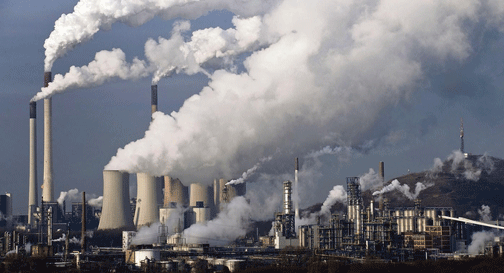
Fossil fuels could be phased out worldwide in a decade, says new study http://www.eurekalert.org/pub_releases/2016-04/uos-ffc041516.php UNIVERSITY OF SUSSEX The worldwide reliance on burning fossil fuels to create energy could be phased out in a decade, according to an article published by a major energy think tank in the UK.
Professor Benjamin Sovacool, Director of the Sussex Energy Group at the University of Sussex, believes that the next great energy revolution could take place in a fraction of the time of major changes in the past.
But it would take a collaborative, interdisciplinary, multi-scalar effort to get there, he warns. And that effort must learn from the trials and tribulations from previous energy systems and technology transitions.
In a paper published in the peer-reviewed journal Energy Research & Social Science, Professor Sovacool analyses energy transitions throughout history and argues that only looking towards the past can often paint an overly bleak and unnecessary picture.
Moving from wood to coal in Europe, for example, took between 96 and 160 years, whereas electricity took 47 to 69 years to enter into mainstream use.
But this time the future could be different, he says – the scarcity of resources, the threat of climate change and vastly improved technological learning and innovation could greatly accelerate a global shift to a cleaner energy future.
The study highlights numerous examples of speedier transitions that are often overlooked by analysts. For example, Ontario completed a shift away from coal between 2003 and 2014; a major household energy programme in Indonesia took just three years to move two-thirds of the population from kerosene stoves to LPG stoves; and France’s nuclear power programme saw supply rocket from four per cent of the electricity supply market in 1970 to 40 per cent in 1982.
Each of these cases has in common strong government intervention coupled with shifts in consumer behaviour, often driven by incentives and pressure from stakeholders. Professor Sovacool says: “The mainstream view of energy transitions as long, protracted affairs, often taking decades or centuries to occur, is not always supported by the evidence.
“Moving to a new, cleaner energy system would require significant shifts in technology, political regulations, tariffs and pricing regimes, and the behaviour of users and adopters.
“Left to evolve by itself – as it has largely been in the past – this can indeed take many decades. A lot of stars have to align all at once.
“But we have learnt a sufficient amount from previous transitions that I believe future transformations can happen much more rapidly.”
In sum, although the study suggests that the historical record can be instructive in shaping our understanding of macro and micro energy transitions, it need not be predictive.
USA could be powered 40% by electricity from rooftop solar panels
Rooftop solar panels could provide nearly half US power http://www.theguardian.com/environment/2016/apr/14/rooftop-solar-panels-could-provide-nearly-half-us-power
Rooftop panels could supply 40% of country’s power with open spaces such as parking lots offering further potential, study shows. Conservation magazinereports Guardian, Prachi Patel To take advantage of the sun’s energy to satisfy our ever-increasing need for electricity, Americans will have to take a fresh look at their roofs. A report by the National Renewable Energy Laboratory (NREL) shows that if all suitable roof areas in the United States were plastered with solar panels, they would generate about 1,118 gigawatts of solar power. That is 40% of the power that Americans consume every year.

And that isn’t the half of it. The study only estimates the solar power potential of existing, suitable rooftops, and does not look at the immense potential of ground-mounted photovoltaics (PV), said NREL senior energy analyst Robert Margolis in apress release. “Actual generation from PV in urban areas could exceed these estimates by installing systems on less suitable roof space, by mounting PV on canopies over open spaces such as parking lots, or by integrating PV into building facades. Further, the results are sensitive to assumptions about module performance, which are expected to continue improving over time.”
The new study doubles the estimate from a 2008 NREL study on US rooftop solar potential, which showed an estimate of 664 GW. Margolis and his colleagues attributed the higher numbers to increases in better-performing modules, improvements in estimation of building suitability, higher estimates of the total number of buildings, and better methods to calculate photovoltaic performance.
For the new report, which is the result of three years of research, the team used light detection and ranging (Lidar) data and geographic information system (GIS) methods to map the topography of 128 cities around the country down to the square meter. This helped them determine the total amount of roof area suitable for hosting rooftop solar panels. Then they simulated the productivity of the panels on this roof area to estimate total rooftop solar potential, and finally extrapolated that data to the whole country.
The report ranked cities with the highest capability to meet energy consumption using potential solar power capacity. Mission Viejo, California topped the charts with a 88% solar potential rating, followed by Concord, New Hampshire at 72%, and Buffalo, New York at 68%.
The six states with the highest potential to offset electricity use all have significantly below-average household energy consumption, the analysts note, indicating that any state that wants to make the most of solar incentives should also prioritize energy efficiency.
Source: Pieter Gagnon, Robert Margolis, Jennifer Melius, Caleb Phillips, and Ryan Elmore, NREL. Rooftop Solar Photovoltaic Technical Potential in the United States: A Detailed Assessment.
Trouble for nuclear deal: Iranian banks unable to process global financial transactions.
Iran’s Central Bank Chief Warns Banking-Access Issues Jeopardize Nuclear Deal Valiollah Seif says Obama administration needs to help facilitate Iran’s banking transactions world-wide WSJ, By JAY SOLOMON in Washington, ASA FITCH in Dubai, and BENOIT FAUCON in London April 15, 2016
Iran’s central bank governor, in a rare visit to Washington, demanded the Obama administration take more steps to facilitate his country’s banking transactions world-wide and warned the landmark nuclear agreement reached last year could be at risk if the U.S. doesn’t act.
Iranian banks have been unable to process international money transfers and finance trade freely in the months since the deal went into effect in January. Iran also has faced obstacles in repatriating tens of billions of dollars of its oil revenues that were frozen in overseas accounts under U.S. sanctions. Some Western banks have acknowledged avoiding dealings with Iran due to fears of crossing the U.S. Treasury.
The troubles have jeopardized the big economic dividend the government hoped to secure from the nuclear deal Iran and six world powers struck last July, and underscored the West’s lingering suspicion toward Tehran.
Iran agreed to scale back its nuclear program in exchange for relief from international sanctions that hurt its economy. “They need to do whatever is needed to honor their commitments,” Iran’s central bank governor Valiollah Seif said during a 90-minute presentation that came on the sidelines of the International Monetary Fund and World Bank spring meetings in Washington on Friday. ”Otherwise, the [Iran nuclear deal] breaks up under its own terms,” he said.
Mr. Seif’s comments came a day after a face-to-face meeting with U.S. Treasury Secretary Jacob Lew that was largely focused on Iranian demands for more sanctions relief in the wake of the landmark nuclear accord, according to Iranian and U.S. officials.
The U.S. and other world powers agreed to lift most sanctions on Iran as part of the deal. But the Treasury still bars Iran from using the U.S. financial system or the American dollar…….http://www.wsj.com/articles/irans-central-bank-chief-warns-banking-access-issues-jeopardize-nuclear-deal-1460745930
1 This Month

of the week – Shut Down Drone Warfare!


Tell the Ukrainian Government to Drop Prosecution of Peace Activist Yurii Sheliazhenko

Petition to revoke the licensing of the Near Surface Nuclear Disposal Facility (NSDF) at Chalk River. https://www.ourcommons.ca/petitions/en/Petition/Details?Petition=e-7247
To see nuclear-related stories in greater depth and intensity – go to https://nuclearinformation.wordpress.com
-
Archives
- April 2026 (114)
- March 2026 (251)
- February 2026 (268)
- January 2026 (308)
- December 2025 (358)
- November 2025 (359)
- October 2025 (376)
- September 2025 (257)
- August 2025 (319)
- July 2025 (230)
- June 2025 (348)
- May 2025 (261)
-
Categories
- 1
- 1 NUCLEAR ISSUES
- business and costs
- climate change
- culture and arts
- ENERGY
- environment
- health
- history
- indigenous issues
- Legal
- marketing of nuclear
- media
- opposition to nuclear
- PERSONAL STORIES
- politics
- politics international
- Religion and ethics
- safety
- secrets,lies and civil liberties
- spinbuster
- technology
- Uranium
- wastes
- weapons and war
- Women
- 2 WORLD
- ACTION
- AFRICA
- Atrocities
- AUSTRALIA
- Christina's notes
- Christina's themes
- culture and arts
- Events
- Fuk 2022
- Fuk 2023
- Fukushima 2017
- Fukushima 2018
- fukushima 2019
- Fukushima 2020
- Fukushima 2021
- general
- global warming
- Humour (God we need it)
- Nuclear
- RARE EARTHS
- Reference
- resources – print
- Resources -audiovicual
- Weekly Newsletter
- World
- World Nuclear
- YouTube
-
RSS
Entries RSS
Comments RSS
 nuclear-news
