European Parliamentary group Calls for End to ‘Uneconomic’ Nuclear Power
Now a new ‘Alliance of Regions for Phasing out Nuclear Power across Europe’ — formed of lawmakers in the European Parliament — is calling for an end to nuclear power in the EU, claiming it is no longer economical.
“The costs of the projects are handed on to EU citizens, via subsidies. This can no longer continue… It is absolutely absurd — especially while the cost of renewable energy is falling — to continue investing in such a high risk technology. The EU should turn away from these dangerous and misguided energy investments, which would have serious consequences for decades to come,” they said.
 Euro Lawmakers Call for End to ‘Uneconomic’ Nuclear Power http://sputniknews.com/europe/20160308/1035964776/europe-nuclear-power-question.html, 8 Mar 16 The future of nuclear power stations in Europe has been called into question by lawmkares in the European Parliament following the sudden resignation of a senior director in French energy giant EDF over a new power plant in the UK.
EDF has been struggling to get building underway at its proposed new nuclear plant at Hinkley Point in Somerset, in the south west of England. The sheer cost of building the plant has been a major sticking point with British taxpayers being forced to back the deal by providing a guaranteed price of generated electricity from the plant.
DF Energy — the UK subsidiary of EDF — agreed a ‘strike price’ with the UK Government, which guarantees EDF a price of US$141 MWh for generating electricity over 35 years and a debt guarantee. Despite this, problems with EDF’s partner Areva — which manufactures the nuclear reactor — have led to delays in putting finance into place.
The sudden departure of the chief finance officer of EDF Monday has been taken as a sign that he believed the sheer cost of building the new plant at Hinkley Point would seriously damage the whole of EDF’s finances.
Delay and Cost-Overruns
The CEO of EDF, Jean-Bernard Lévy, in September announced a further postponement of the commissioning of the gigantic new nuclear power station at Flamanville in northern France and admitted the price has more than tripled.
Levy said the first French third-generation European Pressurized Water reactor (EPR) with a capacity of 1650 MW will cost in the region of US$12 billion — more than three times the original projected cost of US$3.37 billion and fuel loading will not even start until late 2018, six years behind schedule.
Meanwhile, construction by EDF and Siemens of the Olkiluoto nuclear plant in Finland — based on the same design as Flamanville has also suffered many delays and cost over-runs.
Now a new ‘Alliance of Regions for Phasing out Nuclear Power across Europe’ — formed of lawmakers in the European Parliament — is calling for an end to nuclear power in the EU, claiming it is no longer economical.
In a statement they said:
“Many studies have shown that the construction of new nuclear reactors in the EU has now become totally uneconomical and no longer competitive on the energy market. Current projects in Finland, France and the UK are very likely to cost far more than what was initially planned.
“The costs of the projects are handed on to EU citizens, via subsidies. This can no longer continue… It is absolutely absurd — especially while the cost of renewable energy is falling — to continue investing in such a high risk technology. The EU should turn away from these dangerous and misguided energy investments, which would have serious consequences for decades to come,” they said.
Belgium’s nuclear sites in danger: military protection to be set up
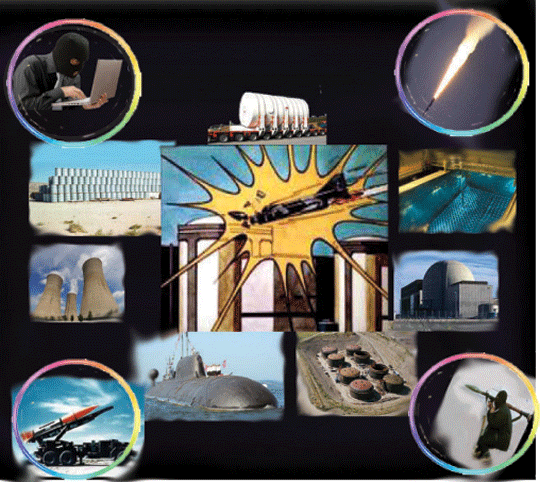 Belgian army to protect nuclear sites: interior ministry http://www.reuters.com/ article/us-belgium-nuclear- security-idUSKCN0W61KR, 4 Mar 16 Belgium has ordered its military to protect nuclear sites such as power plants in the country to safeguard them against possible militant attacks, the country’s interior ministry said on Friday.
Some 140 soldiers will be mobilized to protect locations such as Belgium’s two nuclear power plants at Tihange and Doel as well as nuclear research and storage facilities, a spokesman for the interior ministry said.
“We are setting up a special police unit for this sort of security task but that will take some time for it to be operational,” the spokesman said, adding that the army would take over in the meantime.
In February, Belgian investigators searching houses linked to suspects in the Islamist militant attacks in Paris last November found a video tracking movements of a man linked to the country’s nuclear industry.
The spokesman said there was no direct link between the discovery of the video and the decision to take the additional security measures. (Reporting by Robert-Jan Bartunek; Editing by Gareth Jones)
Petition to UK’s George Osborne – ABANDON HINKLEY NUCLEAR PROJECT !
 George Osborne: Don’t Waste £Billions On Nuclear Power https://secure.greenpeace.org.uk/page/s/osborne-dont-waste-billions-nuclear?source=em&subsource=
 20160307egem01&utm_source=gpeace&utm_medium=em&utm_campaign=20160307egem01
George Osborne is on the cusp of wasting billions on nuclear power. The new nuclear plant he wants to build at Hinkley in Somerset is set to be the most expensive object on Earth – and already it’s at least 8 years overdue.
While Hinkley continues to suffer huge delays, and serious questions are being raised about the safety of the reactor, the cost of renewable energy is falling.
Rumours are now spreading that EDF – the company that wants to build Hinkley – could pull out of the deal, meaning the whole project could be on the rocks.
Let’s seize this moment to pile the pressure on George Osborne.A huge petition could convince him to abandon the project and back renewable energy instead.
Fukushima’s million-ton headache – radioactive water everywhere
Fukushima Nuclear Disaster 5 Years On: Water, Water Everywhere (Part I), Forbes,
John Boyd , 7 Mar 16 “……….Now, on the fifth anniversary of what is known here as the Great East Japan Earthquake, how much progress has TEPCO and the government made in dealing with what was fundamentally a man-made disaster?
The answer is they continue to face the same four huge challenges they grappled with in 2011: dealing with contaminated water that has grown into a million-ton headache; locating and somehow retrieving the molten fuel debris; removing spent fuel rods from the damaged reactor storage pools; and disposing of millions of cubic meters of radioactive waste.
Most evident of these challenges is the contaminated water. Cooling water must be continuously circulated through the damaged reactors Units 1, 2 and 3, where nuclear fuel has melted through at least the inner containment vessels. Consequently, the cooling water injected into the reactor becomes contaminated and finds its way down into the turbine basements adjacent to each reactor; there, it mixes with incoming ground water to greatly compound the problem.
Some of the pooled water is partly decontaminated, cooled and recirculated through the reactors again, the rest is treated and pumped out and stored in tanks to prevent it flowing into the Pacific Ocean.
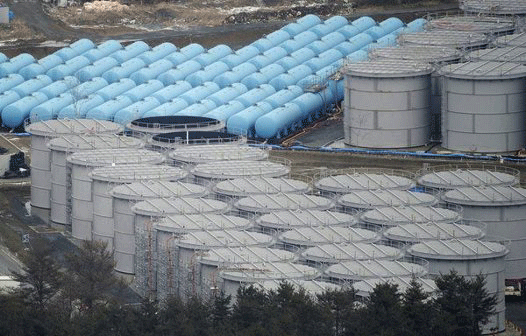
Naohiro Masuda, TEPCO’s Chief Decommissioning Office, told the foreign press in Japan March 2nd that there are over 1,000 such storage tanks located inside and outside the plant, each holding as much as 1,000 metric tons of treated water. And with groundwater streaming in at 150 metric tons a day, a new tank is being added weekly.
The stored water, while filtered and largely decontaminated, still contains tritium—radioactive hydrogen, which can cause cancer if ingested………http://www.forbes.com/sites/jboyd/2016/03/07/fukushima-nuclear-disaster-5-years-on-water-water-everywhere-part-i/#148a72ac1a35
Nuclear Regulatory Commissioners urgently call for correcting reactor cooling systems flaw


 Dangerous Flaw Threatens to Close Nation’s Nuclear Fleet Energy Matters, By Roger Witherspoon, 4 Mar 16
After four years of increasingly tense internal discussion, seven Nuclear Regulatory Commission engineers have formally petitioned the governing Commissioners to either order the nation’s nuclear power plants to immediately correct a design flaw governing their reactor cooling systems or order them all to shut down.
The flaw is in the original design of the electrical system, and has escaped notice for decades. According to the engineers’ petition, as well as a series of staff analyses on file at the NRC, the design flaw occurs in what is called a “single phase” condition in which little or no electricity is entering the plant to operate its backup cooling systems in the event of a blackout or other event cutting off power from the grid. The result is that the motors of backup generators are underpowered and this can cause their motors to burn out. When that happens, there is no way to keep the reactor core cool.
The seven members of the Electrical Engineering Branch in the Office of Nuclear Reactor Regulation, led by Acting Chief Roy K. Mathew, stated in the petition that “the staff determined that all nuclear facilities are susceptible to this design vulnerability except one plant, and recommended that the NRC take prompt regulatory action.”
As a result, the petition states, if the plants are not ordered to immediately redesign their electrical systems then the Commissioners should “issue Orders to immediately shutdown the operating nuclear power plants since the licensees are operating their facilities without addressing the significant design deficiency…and with inoperable electric power systems….”
The situation evolved from an unplanned shutdown in January 30, 2012 in Unit 2 of the Byron Station Nuclear Power Plant in Illinois. At the time, it was thought that the shutdowns resulted from a string of unfortunate coincidences. But further examination by the NRC’s electrical engineering branch found something more alarming…………
Officials from Exelon, which owns and operates Byron and 10 other nuclear power plants, as well as inspectors from the NRC initially thought that the shutdown was the result of a series of unfortunate coincidences. But On Feb. 28, 2012, there was a similar interrupted and undetected phase which caused a shutdown at Byron’s Unit 1. And, as in the earlier event, it disabled the plant’s cooling systems. That caused Mathews and the electric unit he led to investigate further and see if there had been any other shutdowns in which an undetected phase disruption disabled the cooling pumps. Their initial look found identical shutdowns at the Beaver Valley Power Station Unit 1 in Pennsylvania in November, 2007; and in New York, the James Fitzpatrick and the neighboring Nine Mile plants, which share a power substation, shut down in December, 2005.
The staff analysis concluded that the design of the electrical systems was “inadequate because it did not consider the possibility of the loss of a single phase… This situation resulted in neither the onsite nor the offsite electric power system being able to perform its intended safety functions” to provide electric power to the plant’s safety systems. Plants are required to have two separate sets of electrical power lines and monitors for their core cooling systems so that operators can still control the reactor even if one line, or train, is damaged by fire or another event.
The loss of a single phase of alternating current, the NRC staff found, “can potentially damage both trains of the emergency core cooling system.” In that case, there is nothing to prevent a meltdown………..
“In addition,” the staff assessment concluded, “the generic AP1000 plant operating procedures are under development and the licensees’ review of the generic procedures did not identify specific operator actions related to phase voltage verifications of the three phases.”
As a result, the electrical group concluded, all of the nation’s nuclear plants are violating the terms of their operating licenses and must either be brought into compliance or shut down.
According to NRC statutes, this is a major issue.
NRC regulations governing the operating licenses dictate that “the safety systems shall be designed so that, once initiated automatically or manually, the intended sequence of protective actions of the execute features shall continue until completion.”
The group’s petition states “any failures in an offsite power system or onsite power system must not disable the safety functions of emergency core cooling and vital safety systems to protect the health and safety of the public.”
With the current system, they assert, the plants are violating a mandatory condition of their operating licenses ( http://bit.ly/21OiouL ). As the issue was debated within the agency, the Mathews group cast a wider net and began looking at the root causes of shutdowns in the US and abroad, while pushing the agency to more forcefully addresses the design problem. To their surprise, they found 13 “open phase events” over a 14-year period, with the latest taking place at the Oconee Nuclear Power Station in South Carolina in December, 2015………… https://spoonsenergymatters.wordpress.com/2016/03/04/dangerous-flaw-threatens-to-close-nations-nuclear-fleet/
Labour and Nukes: conspiracy of hope killed off?

 nuClear News, March 2016 Lisa Nandy, the Shadow Secretary of State for Energy and Climate Change has called on the government to come up with a “Plan B” in case Hinkley Point C is never built. But instead of taking the opportunity to argue the case for more renewables she has called on the government to find cheaper ways to get more nuclear stations built in future. (1) She now wants the Government to look at new reactor types including Molten Salt Reactors, Heavy Water Reactors, and Fast Reactors (2) A far cry from Jeremy Corbyn’s manifesto last summer which pointed to the 8 countries, 55 cities and 60 regions which are planning to go 100% renewable over the next few decades which Britain should be part of. He said Britain needs the Big 60 million not the Big 6. In his interview with Greenpeace’s Energydesk he said “no” to new nuclear power stations. (3)
Letter from Stop Hinkley Campaign to EDF Energy
nuClear News Mar 16
Dear EDF Energy, We are writing to you before another EDF Board Meeting at which it is rumoured a final investment decision on Hinkley Point C could be made to urge you to scrap this project altogether.
- Debts of €37 billion (£28 billion) and its share price has fallen from €29 in April 2014 to €10.32 last week. Financing a massive project like Hinkley Point C will clearly place a significant strain on finances. (2) The union notes that the debt related to Hinkley Point C will need to be 100% fully consolidated into the EDF accounts – an amount which exceeds the market capitalization of the Group.
- EDF is now facing a €100m bill for upgrading its nuclear power stations in France according to a report by French Government auditor – the Cour des Comptes – rather than €55bn previously estimated. (3)
- EDF has also agreed to buy between 51 and 75% of the struggling French reactor builder Areva NP which is valued at €2.7bn. So will have to find at least €1.4bn for that.
- The French waste agency Andra has estimated that the cost of its deep geological disposal project could be as high as €30bn rather than the €20bn estimated by EDF. (4) French energy minister Ségolène Royal has signed a decree setting the ‘reference cost’ at €25 billion – still a jump of €5bn for EDF. (5)
Florida Nuclear Station is leaking radioactive material into Biscayne Bay
 FPL nuclear plant canals leaking into Biscayne Bay, study confirms
Radioactive ‘tracer’ detected at up to 215 normal levels near canals
County commission set to discuss cooling canal problems Tuesday
Threat from pollution to public, marine life not addressed in report
A radioactive isotope linked to water from power plant cooling canals has been found in high levels in Biscayne Bay, confirming suspicions that Turkey Point’s aging canals are leaking into the nearby national park.
According to a study released Monday by Miami-Dade County Mayor Carlos Gimenez, water sampling in December and January found tritium levels up to 215 times higher than normal in ocean water. The report doesn’t address risks to the public or marine life but tritium is typically monitored as a “tracer” of nuclear power plant leaks or spills.
The study comes two weeks after a Tallahassee judge ordered the utility and the state to clean up the nuclear plant’s cooling canals after concluding that they had caused a massive underground saltwater plume to migrate west, threatening a wellfield that supplies drinking water to the Florida Keys. The judge also found the state failed to address the pollution by crafting a faulty management plan.
This latest test, critics say, raise new questions about what they’ve long suspected: That canals that began running too hot and salty the summer after FPL overhauled two reactors to produce more power could also be polluting the bay………
Over the last two years, problems with the canals have worsened exponentially. After the 2013 plant expansion to increase power output by 15 percent, the canals began running dangerously high. FPL officials blamed problems on an algae bloom that worsened after the canals were temporarily shut down during the project. But when a summer drought hit in 2014, temperatures spiked. At least twice, when temperatures soared to 102 degrees, the utility was nearly forced to power down reactors.
After obtaining permission from nuclear regulators to operate the canals at 104 degrees, the hottest in the nation, FPL officials began plotting a course to fix the canals by pumping in millions of gallons of fresh water from a nearby canal as well as increasing the amount of water drawn from the Floridan aquifer.
But the growing saltwater plume triggered regulatory scrutiny. After the county complained, the state ordered a new management plan, called an administrative order, to address problems……..
Over the last five years, the report said, cooling canal water typically has tritium at levels 60 to more than 800 times higher than in the bay. Tritium at the bottom of the bay close to the canals ranged from more than 130 to 215 times higher — high enough to suggest a consistent flow from the sprawling cooling system.
County staff concluded the findings are “the most compelling evidence” that canal water has spread into the bay.
Even more serious than we thought – climate chnage and sea level rise
Sea level rise threatens larger number of people than earlier estimated, Science Daily, March 8, 2016
 Source:
- Aalto University
- Summary:
- More people live close to sea coast than earlier estimated, researchers have concluded after a new study. These people are the most vulnerable to the rise of the sea level, increased number of floods and intensified storms. By using recent increased resolution datasets, researchers estimate that 1.9 billion inhabitants, 28% of the world’s total population, live closer than 100 km from the coast in areas less than 100 meters above the present sea level.
-
- By 2050 the amount of people in that zone is predicted to increase to 2.4 billion, while population living lower than 5 meters will reach 500 million people. Many of these people need to adapt their livelihoods to changing climate, say Assistant Professor Matti Kummu from Aalto University.The study found that while population and wealth concentrate by the sea, food must be grown further and further away from where people live. Highlands and mountain areas are increasingly important from food production point of view, but also very vulnerable to changes in climate.
- Over the past century there has been a clear tendency that cropland and pasture areas have grown most in areas outside the population hotspots, and decreased in coastal areas. This will most probably only continue in the future, summarises Professor Olli Varis from Aalto University…….http://www.sciencedaily.com/releases/2016/03/160308105053.htm
Build Hinkley Nuclear Station B – quickest way to finish off nuclear power!
Chris Goodall, a pro-nuclear supporter, commented a few months ago that it would be best for nuclear power if Hinkley C did not go ahead. – because the spectacle of disaster would ruin the prospects for future nuclear power. So we, nuclear opponents and sceptics, are entitled to wonder, whether, after all, if we are a little bit cynical, whether it would be best for anti-nuclear politics in the long run, if Hinkley C was now given the go-ahead. A truly ghastly show will then follow! But it would be the end of nuclear power in Europe!
Bravo!

Should anti-nuclear supporters now call for EDF to build Hinkley C? http://realfeed-intariffs.blogspot.com.au/2016/03/should-anti-nuclear-supporters-now-call.html#comment-form
EDF are now in the position whereby they can only build the plant if they finance it on their balance sheet since the 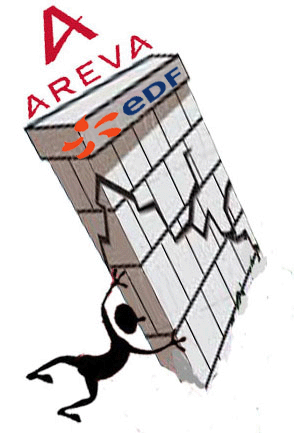 Treasury (in an argument that formed a key basis of their EU state aid application) will not sanction a loan guarantee before a European EPR has been seen to work. This criterion cannot be met until 2019 at least. Even then if similar cost overruns occurred in Hinkley as they have done in France and Finland, that would sink EDF anyway, even with a loan guarantee. EDF face bankruptcy even with their escalating liabilities from their EPR construction disasters as well as increasing costs of refurbishing their existing nuclear fleet. Don’t imagine for a moment that the Chinese will come to the rescue. They have no further political interest other than they have gone so far, and certainly don’t want to pay for any costs overruns on the project. Continue reading
Deep seated concern about Canada’s nuclear safety
 Can the Canadian Nuclear Safety Commission do better? http://www.waterkeeper.ca/blog/2016/3/2/can-the-canadian-nuclear-safety-commission-do-better by Mark Mattson.
If your drinking water comes from Lake Ontario, then you’re one of the millions of people who count on the Canadian Nuclear Safety Committee to do its job perfectly. The same is true for other Canadians who work in the nuclear industry or live near a facility.
In an interconnected, hi-tech world, we rely on regulatory agencies to keep us safe. We assume that buildings are well constructed, that toxic products will be banned, that the water coming out of our faucets will be safe to drink – and if any of these things doesn’t happen, we assume we will be warned.
When we are wrong, the consequences can be grave. Think of the Walkerton tragedy or the crisis in Flint.
Of course, the consequences of poor regulation aren’t always obvious. They may be difficult to detect or very distant from the root cause. Imagine low levels of a carcinogen (say PFOA) in a town’s drinking water, for example. If the regulator fails to prevent this, it is unlikely that the residents will detect its presence. Even if rare cancers begin to appear, making the connection can be difficult.
The CNSC is responsible for protecting Canadians from the risks associated with the nuclear industry. This means ensuring that Canada never has to deal with the pandora’s box of problems that would stem from a complete or partial meltdown, or major release of radioactive material into the environment. It means protecting Canadians from those insidious, day-to-day harms that are harder to detect, like low level radiation or the slow release of radionuclides into the watershed. It also means protecting Canadians from the impact of non-nuclear contaminants, habitat loss, and environmental destruction.
If you’ve followed some of our previous work, you’ll know that Waterkeeper questions whether the CNSC effectively serves the public as an impartial regulator. We believe the CNSC relies on an inadequate licensing process, demonstrates limited appreciation of environmental risks, and has a tendency to downplay or ignore concerns raised by the public.
When regulatory agencies show signs of failing to meet their public duties, it’s important to speak up. In fact, any individual or organization that has such concerns has an obligation to share them. After all, you rely on us to help keep you safe, too.
For this reason, Lake Ontario Waterkeeper is joining Greenpeace Canada, Ecojustice, the Canadian Environmental Law Association and others in calling on Prime Minister Trudeau to initiate a twenty year review of the Nuclear Safety and Control Act. This is the legislation that dictates how the CNSC operates.
Reviewing the Act would provide an opportunity to address deep-seated concerns about the CNSC and improve nuclear regulation in Canada. You can read the open letter that has been sent to Prime Minister Trudeau below. (on original)
Britain: Nuclear threat to renewables
 We have previously reported assertions by Dr Dave Toke that spending on Hinkley Point C would obliterate spending on renewables, because of the way the Levy Control Framework is organised. (19) At the moment it looks as though the UK will miss its European target which requires us to produce around 30% of our electricity supplies from renewable resources –about 108TWh in 2020 rising to 141TWh in 2030. The current Government doesn’t appear to have any ambition to go beyond this low level of renewable supply
nuClear News Mar 16[excellent graphs on original] The Government’s National Policy Statement (NPS) on Energy, published in July 2011, foresaw a need for 113 Gigawatts (GW) of electricity generating capacity in 2025 compared with 85GW now. 59GW of this would be new capacity, of which 33GW would need to be renewable energy, mostly wind, to meet commitments to the European Union. This would leave 26GW for industry to determine. At the time there was 8GW of non-renewable capacity under construction leaving a balance of 18GW still to be determined. The Government said it wanted a substantial portion of this to be nuclear. (1)
Resignation of EDF’s finance director heralds crisis in UK Hinkley nuclear project
Hinkley Point C nuclear project in crisis as EDF finance director resigns
Proposed £18bn Somerset plant has been pushed by George Osborne but some on French company’s board fear risky spending, Guardian, Terry Macalister, 7 Mar 16, The £18bn Hinkley Point C nuclear project was in crisis on Sunday night after reports that the finance director of EDF, the company behind the scheme, had resigned.EDF tells contractors to restart work on Hinkley Point, report says
 Thomas Piquemal has stood down from his post after expressing trenchant opposition to those on the EDF board who want to give the green light to the project within weeks, sources said.
The resignation of such an important figure on the EDF board will make it much harder for the remaining executives to proceed with Hinkley in the short term……..
Piquemal is said to have been arguing that pursuing what would be the world’s most expensive power project at this moment could jeopardise the French group, which already has rising debts.
Union members on the EDF board are also implacably opposed to Hinkley Point, saying it is too expensive and a risk to the energy company’s future…….http://www.theguardian.com/environment/2016/mar/07/hinkley-point-c-nuclear-project-in-crisis-as-edf-finance-director-resigns?CMP=twt_a-environment_b-gdneco
No need for nuclear power in Japan – former Japan PM Naoto Kan
 Five years after Fukushima disaster, there’s no need for nuclear power, says former Japan PM Naoto Kan CNBC by Leslie Shaffer | Interview by Akiko Fujita 6 Mar 2016 As the fifth anniversary of Japan’s massive earthquake and nuclear disaster approaches, the country’s former prime minister said it was time to do without nuclear power.
“If you look at the reality of these last five years, Japan spent two years without a single nuclear plant on line. There are now a few active reactors, but still, that’s only a handful,” Naoto Kan, who was prime minister when the Great East Japan Earthquake struck, told CNBC. His comments were translated from Japanese.
“These five years have demonstrated that we can secure enough power without nuclear plants. That’s why I believe we should stay away from the large risk posed by nuclear plants and focus instead on renewable energy by changing our sources of power,” Kan added.
Kan isn’t alone in his opposition to nuclear power; opinion polls have showed that a majority of Japanese people agree. But he blamed the current ruling party, the Liberal Democratic Party the recent restart of four reactors, which had been shuttered in aftermath of the disaster. Kan is a member of the Democratic Party of Japan……….http://www.cnbc.com/2016/03/06/five-years-after-fukushima-nuclear-disaster-nuclear-power-not-needed-former-japan-pm-naoto-kan-says.html
Trudea called upon to fix Canada’s nuclear law and oversight
Groups urge Trudeau to fix Canada’s nuclear law and oversight, National Observer By Mike De Souza March 8th 2016 Canada needs to fix its nuclear safety law and put a stop to internal political strategizing by its industry watchdog that is putting public safety at risk, Prime Minister Justin Trudeau was told in an open letter released on Tuesday.
The groups released the letter along with a federal strategy document showing that staff at the watchdog were recommending that management consider the “political environment” in 2015 prior to developing any changes needed to improve nuclear oversight.
Greenpeace Canada said this indicates there was political strategizing by the watchdog, theCanadian Safety Nuclear Commission, and demonstrates why the Liberal government has to clean up Canadian nuclear oversight………
All 14 groups, including MiningWatch Canada, EcoJustice and the Canadian Environmental Law Association, said that Japan and the European Union have increased the independence and transparency of their nuclear watchdogs in the wake of the disaster. But the groups argued that the previous federal government, led by former prime minister Stephen Harper, failed to keep pace with the other jurisdictions to prepare the country for any similar disaster in Canada.
“While the (Canadian watchdog) carried out a review of the technical failures that led to radioactive releases at Fukushima, it did not consider how institutional failures and industry-led regulation caused the accident,” said the letter to Trudeau. “This should be addressed as part of a public review process leading to the modernization of the (law).”…..
Greenpeace Canada nuclear analyst Shawn-Patrick Stensil said Trudeau needs to put a stop to the commission’s internal strategizing.
“In public the CNSC says Canada’s nuclear safety laws are fine, but behind closed doors they’re strategizing on how to amend the law without public input,” Stensil told National Observer. “If they’re not being honest with the public about things like this what else are they trying to hide? This is why Trudeau should clean house at the CNSC.”……..http://www.nationalobserver.com/2016/03/08/news/groups-urge-trudeau-fix-canadas-nuclear-law-and-oversight
1 This Month
23 April – WEBINAR – Why new nuclear reactors are the wrong tools for decarbonization Thursday, April 23 • 1 AM – 2 AM AEST
World Nuclear Power. Reactors 1951-2026, 75 Years of Nuclear Power.
Interactive Map– https://dv.worldnuclearreport.org/

Chernobyl: The Lost Tapes – A good documentary on Chernobyl on SBS available On Demand for the next 3 weeks– https://www.sbs.com.au/ondemand/tv-program/chernobyl-the-lost-tapes/2352741955560

of the week–London Campaign for Nuclear Disarmament


Tell the Ukrainian Government to Drop Prosecution of Peace Activist Yurii Sheliazhenko
To see nuclear-related stories in greater depth and intensity – go to https://nuclearinformation.wordpress.com
-
Archives
- April 2026 (231)
- March 2026 (251)
- February 2026 (268)
- January 2026 (308)
- December 2025 (358)
- November 2025 (359)
- October 2025 (376)
- September 2025 (257)
- August 2025 (319)
- July 2025 (230)
- June 2025 (348)
- May 2025 (261)
-
Categories
- 1
- 1 NUCLEAR ISSUES
- business and costs
- climate change
- culture and arts
- ENERGY
- environment
- health
- history
- indigenous issues
- Legal
- marketing of nuclear
- media
- opposition to nuclear
- PERSONAL STORIES
- politics
- politics international
- Religion and ethics
- safety
- secrets,lies and civil liberties
- spinbuster
- technology
- Uranium
- wastes
- weapons and war
- Women
- 2 WORLD
- ACTION
- AFRICA
- Atrocities
- AUSTRALIA
- Christina's notes
- Christina's themes
- culture and arts
- Events
- Fuk 2022
- Fuk 2023
- Fukushima 2017
- Fukushima 2018
- fukushima 2019
- Fukushima 2020
- Fukushima 2021
- general
- global warming
- Humour (God we need it)
- Nuclear
- RARE EARTHS
- Reference
- resources – print
- Resources -audiovicual
- Weekly Newsletter
- World
- World Nuclear
- YouTube
-
RSS
Entries RSS
Comments RSS
 nuclear-news