March 12 Energy News

Science and Technology:
¶ A joint letter from more than 130 scientists refers to “lack of information,” “Misrepresentation,” and “Disregard for science that was not funded by the proponent.” Scientists condemn a flawed review process for a liquified natural gas project at the mouth of British Columbia’s Skeena River. [CleanTechnica]
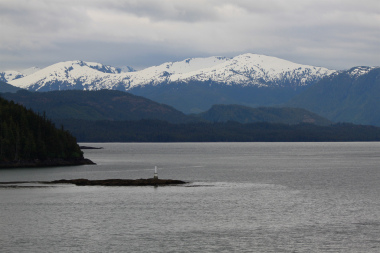 Coast mountains near the mouth of the Skeena River.
Photo by Roy Luck via Flickr (CC BY SA, 2.0 License)
World:
¶ As part of a plan announced last week, Norway will invest $923 million to create 10 broad, two lane, cross-country bicycle highways in and around Norway’s nine largest cities. The plan is a key component of an effort to slash Norway’s transportation emissions by 50%. [CleanTechnica]
¶ India’s massive bet on solar power is paying off far earlier than anticipated. Indian solar prices are now within 15% of coal prices, according to KPMG. If current…
View original post 525 more words
Antarctic ice sheets melting: when will the tipping point be reached?
Tipping point: how we predict when Antarctica’s melting ice sheets will flood the seas https://theconversation.com/tipping-point-how-we-predict-when-antarcticas-melting-ice-sheets-will-flood-the-seas-56125 March 14, 2016 Antarctica is already feeling the heat of climate change, with rapid melting and retreat of glaciers over recent decades.
Ice mass loss from Antarctica and Greenland contributes about 20% to the current rate of global sea level rise. This ice loss is projected to increase over the coming century.
A recent article on The Conversation raised the concept of “climate tipping points”: thresholds in the climate system that, once breached, lead to substantial and irreversible change.
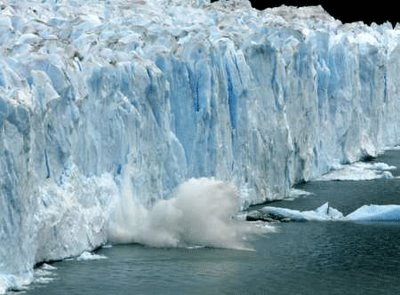
Such a climate tipping point may occur as a result of the increasingly rapid decline of the Antarctic ice sheets, leading to a rapid rise in sea levels. But what is this threshold? And when will we reach it?
What does the tipping point look like? The Antarctic ice sheet is a large mass of ice, up to 4 km thick in some places, and is grounded on bedrock. Ice generally flows from the interior of the continent towards the margins, speeding up as it goes.
Where the ice sheet meets the ocean, large sections of connected ice – ice shelves – begin to float. These eventually melt from the base or calve off as icebergs. The whole sheet is replenished by accumulating snowfall.
Floating ice shelves act like a cork in a wine bottle, slowing down the ice sheet as it flows towards the oceans. If ice shelves are removed from the system, the ice sheet will rapidly accelerate towards the ocean, bringing about further ice mass loss.
A tipping point occurs if too much of the ice shelf is lost. In some glaciers, this may spark irreversible retreat.
Where is the tipping point?
One way to identify a tipping point involves figuring out how much shelf ice Antarctica can lose, and from where, without changing the overall ice flow substantially.
A recent study found that 13.4% of Antarctic shelf ice – distributed regionally across the continent – does not play an active role in ice flow. But if this “safety band” were removed, it would result in significant acceleration of the ice sheet.
Antarctic ice shelves have been thinning at an overall rate of about 300 cubic km per year between 2003 and 2012 and are projected to thin even further over the 21st century. This thinning will move Antarctic ice shelves towards a tipping point, where irreversible collapse of the ice shelf and increase in sea levels may follow.
How do we predict when will it happen?
Some areas of West Antarctica may be already close to the tipping point. For example, ice shelves along the coast of the Amundsen and Bellingshausen Seas are the most rapidly thinning and have the smallest “safety bands” of all Antarctic ice shelves.
To predict when the “safety band” of ice might be lost, we need to project changes into the future. This requires better understanding of processes that remove ice from the ice sheet, such as melting at the base of ice shelves and iceberg calving.
Melting beneath ice shelves is the main source of Antarctic ice loss. It is driven by contact between warmer sea waters and the underside of ice shelves.
To figure out how much ice will be lost in the future requires knowledge of how quickly the oceans are warming, where these warmer waters will flow, and the role of the atmosphere in modulating these interactions. That’s a complex task that requires computer modelling.
Predicting how quickly ice shelves break up and form icebergs is less well understood and is currently one of the biggest uncertainties in future Antarctic mass loss. Much of the ice lost when icebergs calve occurs in the sporadic release of extremely large icebergs, which can be tens or even hundreds of kilometres across.
It is difficult to predict precisely when and how often large icebergs will break off. Models that can reproduce this behaviour are still being developed.
Scientists are actively researching these areas by developing models of ice sheets and oceans, as well as studying the processes that drive mass loss from Antarctica. These investigations need to combine long-term observations with models: model simulations can then be evaluated and improved, making the science stronger.
The link between ice sheets, oceans, sea ice and atmosphere is one of the least understood, but most important factors in Antarctica’s tipping point. Understanding it better will help us project how much sea levels will rise, and ultimately how we can adapt.
FIVE YEARS AFTER
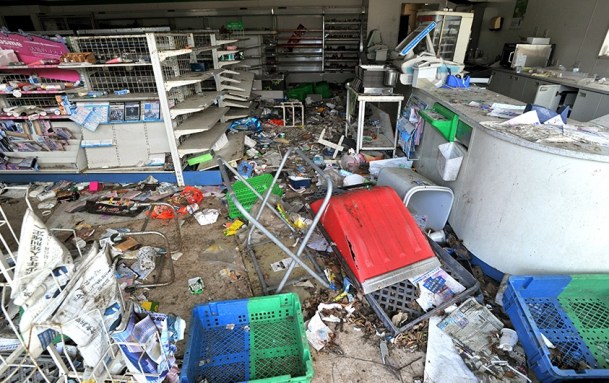
Merchandise remains strewn on the floor of a convenience store in Okuma, Fukushima Prefecture, after the Great East Japan Earthquake shook the town on March 11, 2011
Fukushima towns co-hosting nuclear plant frozen in time
In Okuma, Fukushima Prefecture, a peek inside a convenience store revealed merchandise strewn all over the floor, with the large clock in the back frozen at 2:46 p.m., when a magnitude-9.0 temblor struck five years ago.
Inside the newsstand placed at the entrance of the store, located along the prefectural road, was the March 11, 2011, edition of newspapers, which were discolored.
No signs of people were seen in Okuma and Futaba, the towns co-hosting the crippled Fukushima No. 1 nuclear power plant on March 12, the fifth anniversary of the first hydrogen explosion that occurred at the nuclear complex.
The only movement that could be glimpsed was the occasional passing of vehicles to and from the plant, which is preparing for decommissioning work.
Okuma and Futaba have been evacuated since the onset of the nuclear crisis following the Great East Japan Earthquake and tsunami on March 11, 2011.
Residents have no idea if and when they can ever return to live in their homes since the municipalities are designated in the off-limits zone due to high radiation levels.
Remnants of the disaster still loom over the towns five years later.
In Okuma, pieces of broken walls and window glass were scattered on the street near JR Ono Station, which used to be the busiest area of the town, although the street was cleared to some extent to let vehicles pass through.
The only sound that could be heard was one that a zinc sign made as it swung in the occasional breeze.
Neighboring Futaba was also like a ghost town. Laundry was seen through the window still hanging inside one of the damaged structures in the center of Futaba, five years after it was set out to dry.
http://ajw.asahi.com/article/0311disaster/fukushima/AJ201603130023

In full protective gear, members of a Ground Self-Defense Force unit in Koriyama, Fukushima Prefecture, are seen before they began trying to contain the crisis unfolding at the Fukushima No. 1 nuclear power plant on March 12, 2011.
Government reluctant to specify SDF role in nuclear crisis
When the specter of meltdowns loomed at the Fukushima No. 1 nuclear power plant in March 2011, the legal responsibility fell to Tokyo Electric Power Co., the operator, to contain the crisis.
But as TEPCO employees became overwhelmed, Self-Defense Forces members and Tokyo firefighters were quickly sent to the site at the “request” of the prime minister.
Five years later, there is still no clear delineation of responsibility for the SDF and firefighters to be dispatched or to the extent of their involvement in the event of a nuclear emergency.
The government, the secretariat of the Nuclear Regulation Authority, which crafted new regulations for nuclear plants after the Fukushima disaster, the SDF and the Fire and Disaster Management Agency, which oversees corps of firefighters across the nation, each has differing views.
“Our understanding is that operators of nuclear power plants are presumably prepared (to tackle a nuclear emergency) in line with the world’s most stringent regulations,” said a Defense Ministry official, referring to the nation’s new regulations. “We do not believe that SDF members will be able to do what goes beyond the capability of nuclear power plant operators.”
On March 11, the fifth anniversary of the Great East Japan Earthquake and tsunami, the government declared in a report after a meeting of Cabinet members related to nuclear energy that it will “bear the responsibility for dealing with” a nuclear accident.
The report mentioned the use of “tactical squads” such as the SDF and fire departments to address the situation.
However, what were described as their operation to contain an emergency in the report was “transportation of materials” and other efforts. It has yet to be determined as to what extent the SDF, fire departments and other squads should be prepared to help contain a nuclear contingency in terms of equipment and operations.
When the crisis unfolded at the Fukushima No. 1 nuclear plant following the magnitude-9.0 quake and tsunami, a team of five Ground Self-Defense Force members in Koriyama, Fukushima Prefecture, was tasked with sending cooling water to the overheating No. 1 reactor on March 12, 2011.
The troops had to work amid rising radiation levels at the site, which was a quagmire from the mountain of wreckage left by the quake and tsunami. After the work was forced to be temporarily halted by the hydrogen explosion at the No. 1 reactor that day, the team had to return to work to inject cooling water into the reactor.
When it became obvious that TEPCO could no longer handle such a severe accident on its own, firefighters and police were also deployed to the plant to keep sending water into the reactors.
While the SDF sprayed water from above, firefighters, police and the SDF worked together to direct a spray from the ground.
The law on special measures concerning nuclear emergency preparedness, established in 1999, stipulates the responsibility for containing an emergency lies with the operator of a nuclear facility.
Under the current setup, even if an SDF unit or firefighters are deployed to the site, their activities are to be limited to offering “assistance” to workers grappling with the accident.
In April, the exposure limit to radiation of workers responding to a nuclear emergency will be raised to 250 millisieverts from 100 millisieverts, in light of the Fukushima disaster.
But the cap will only be applied to workers at a nuclear power plant as well as inspectors from the secretariat of the Nuclear Regulation Authority, not SDF members or firefighters.
According to the Defense Ministry, it does not envisage an operation to address a nuclear accident under its directives on responding to a nuclear disaster.
SDF members, in fact, have not conducted drills to deal with such an accident since the SDF’s fleet does not include a nuclear-powered aircraft carrier or similarly powered submarine. Japan does not possess nuclear weapons, either.
The government’s Fire and Disaster Management Agency, too, is reluctant to take on the responsibility.
The new regulations concerning nuclear facilities, which took effect in 2013, require plant operators to have in place a number of fire trucks tasked with sending water to reactors in the event of an accident.
“It is clear that plant operators are now capable of carrying out the kind of work that firefighters were involved in the Fukushima accident,” said an agency official.
In the Fukushima disaster, the deployment of SDF members and firefighters was based on the request from the prime minister, who heads a task force on responding to a nuclear disaster.
Although the Defense Ministry and Fire and Disaster Management Agency keeps a distance from a deployment of their members in the event of a future nuclear accident, the NRA’s secretariat does not.
“If a contingency gets out of the control of the operator, the government might be forced to get involved to contain the accident,” said an official with the NRA secretariat.
http://ajw.asahi.com/article/0311disaster/fukushima/AJ201603130019

17,000 items wait for owners in Fukushima lost and found center
NAMIE, Fukushima Prefecture–In a former gift shop along National Route 6, more than 17,000 items are housed here in a lost and found facility, including disfigured school backpacks, discolored stuffed animals and stained photos.
They are belongings found in the aftermath of the Great East Japan Earthquake and tsunami and waiting to be returned to their rightful owners.
On March 11, the fifth anniversary of the twin disasters, a 26-year-old man and his family stopped by on their way back from a visit to the family grave.
The man picked up a photo holder and carefully sifted through the pictures.
“I am looking for photos from my childhood,” said the man, who has been evacuating in Iwaki, in the prefecture, after his house in Namie was swept away by the tsunami.
The lost and found center, called “The center to display mementoes,” was converted from the former gift facility.
In addition to photos and school backpacks, it houses toys and decorative articles, items that were not broken.
People cleaned them and stored each article with a note mentioning the date and location of the discovery.
While similar lost and found facilities were set up in Miyagi and Iwate, the two other prefectures hardest hit by the 2011 quake and tsunami, shortly after the disaster, the one in Namie just opened in summer 2014.
It was because work to retrieve what was left under debris had been delayed due to the fallout from the disaster at the nearby Fukushima No. 1 nuclear power plant. Evacuees in the town with a population of about 19,000 remain displaced today.
Visitors to the lost and found facility numbered about 3,200 and about 1,600 pieces have been returned to their owner.
Noboru Kawaguchi, 66, who serves as a guide at the facility, is one of those who were reunited with pieces they treasured.
Kawaguchi, who commutes from Soma, a city 30 kilometers north of Namie, had discovered his photos there.
“I have lost everything in the tsunami,” he said, referring to the loss of his parents and his house. “I am always so touched by a visitor discovering something here, as it happened to me.”
Although many similar facilities in Iwate and Miyagi prefectures have closed over time, the center in Namie will remain open at least through spring next year.
http://ajw.asahi.com/article/0311disaster/quake_tsunami/AJ201603130021
The mothers who set up a radiation lab
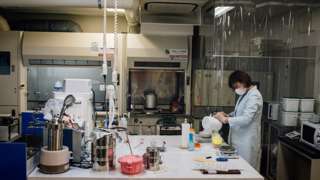
Five years ago an earthquake off the coast of Japan triggered a tsunami and a series of meltdowns at the Fukushima nuclear plant. Kaori Suzuki’s home is nearby – determined to stay, but worried about her children’s health, she and some other mothers set up a laboratory to measure radiation.
A woman in a white lab coat puts some yellow organic material on a slide, while grey liquid bubbles in vials behind her. Other women, one of them heavily pregnant, discuss some data on a computer screen. A courier delivers a small parcel which is opened and its contents catalogued.
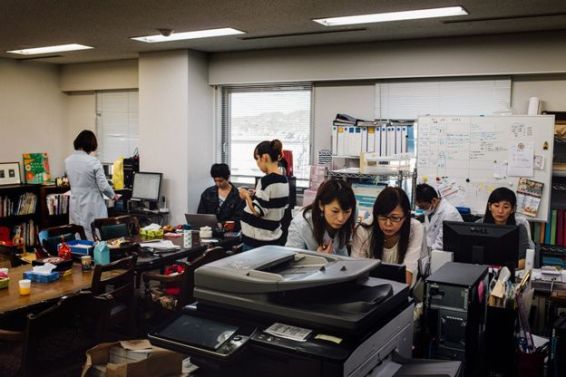
But this is no ordinary laboratory. None of these women trained as scientists. One used to be a beautician, another was a hairdresser, yet another used to work in an office. Together they set up a non-profit organisation – Tarachine – to measure radiation in the city of Iwaki, 50km (30 miles) down the coast from the Fukushima nuclear plant.
Kaori Suzuki, the lab’s director, shows me a list of results. “This is the level of strontium 90 in Niboshi, dried small sardines, from the prefecture of Chiba,” she says.
“What about this food?” I ask, pointing out a high number.
“Mushrooms have higher levels [of radiation]. The government has forbidden people from eating wild mushrooms, but many people don’t care, they take them and eat,” she says.
The lab mainly measures the radioactive isotopes caesium 134 and 137, and collects data on gamma radiation. Strontium 90 and tritium were only added to the list in April last year. “Since they emit beta rays we weren’t able to detect them until recently. Specific tools were necessary and we couldn’t afford them,” says Suzuki. Thanks to a generous donation, they now have the right equipment.
Tarachine publishes its findings online every month, and advises people to avoid foods with high readings as well as the places they were grown.

Five years ago, Suzuki knew nothing about radiation. She spent her time looking after her two children and teaching yoga. The earthquake on 11 March 2011 changed everything.
“I’ve never experienced so much shaking before and I was very scared. Right from the moment it started I had a feeling that something might have happened to the nuclear plant,” she says. “The first thing I did was to fill up my car with petrol. I vividly remember that moment.”
The authorities evacuated the area around the nuclear plant – everyone within a 20km (12-mile) radius was told to leave, and those who lived up to 30km (18 miles) away were instructed to stay indoors. Despite living outside the exclusion zone, Suzuki and her family fled and drove south. The roads were congested with cars and petrol stations ran dry.
“We didn’t come back home until the middle of April and even then we wondered if it was safe to stay,” says Suzuki. “But my husband has his own business with 70 employees, so we felt we couldn’t leave.”
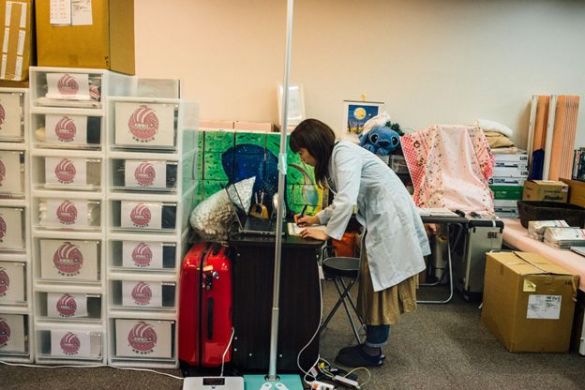
Although radiation levels in Iwaki were officially quite low, the “invisible enemy” was all people could talk about. Conversations with friends changed abruptly from being about children, food and fashion, to one topic only: radiation. “You can’t see, smell or feel it, so it is something people are afraid of,” says Suzuki.
Above all, people didn’t know what was safe to eat.
“It was a matter of life and death,” she says.
Fukushima is farming country and many people grow their own vegetables. “People here love to eat home-grown food and there’s a strong sense of community with people offering food to their friends and neighbours,” says Suzuki. This caused a lot of anxiety. “A difficult situation would arise where grandparents would be growing food, but younger mothers would be worried about giving it to their children.”
Suzuki formed the group “Iwaki Action Mama” together with other mothers in the area. At first they organised demonstrations against nuclear power, but then they decided on a new tactic – they would learn how to measure radiation themselves.

They saved and collected $600 (£420) to buy their first Geiger counter online, but when it arrived the instructions were written in English, which none of them understood. But they persevered and with the help of experts and university professors, organised training workshops. Soon they knew all about becquerels, a unit used to measure radiation, and sieverts, a measure of radiation dose. They would meet at restaurants and cafes to compare readings.
Becquerels and Sieverts
•A becquerel (Bq), named after French physicist Henri Becquerel, is a measure of radioactivity
•A quantity of radioactive material has an activity of 1Bq if one nucleus decays per second – and 1kBq if 1,000 nuclei decay per second
•A sievert (Sv) is a measure of radiation absorbed by a person, named after Swedish medical physicist Rolf Sievert
In November 2011 the women decided to get serious and set up a laboratory. They raised money and managed to buy their first instrument designed specifically to measure food contamination – it cost 3 million yen (£18,500, or $26,400).
They named the laboratory Tarachine, after a strong female character in Japanese theatre who speaks the language of Samurai warriors. “We felt as though we were on the front line of a battlefield,” says Suzuki. “When you’re at war you do what you have to do, and measuring was the thing we felt we had to do.”

Today Tarachine has 12 employees, and more work than it can handle. People bring in food, earth, grass and leaves from their backyards for testing. The results are published for everyone to see. At first the lab was able to provide results after three or four days, but its service has become so popular it can’t keep up. “We have so many requests now that it can take three months,” says Prof Hikaru Amano, the lab’s technical manager.
Amano confesses he was surprised that a group of amateurs could learn to do this job so accurately, but says it is important work.
People began to mistrust the nuclear contamination data provided by the government and by the Tokyo Electric Power Company (Tepco), which manages the nuclear plant, he says.
About 100 so-called “citizen laboratories” have since sprung up, but Tarachine is unusual because it monitors both gamma and beta rays – most can only measure gamma rays – and because it tests whatever people want, whether it’s a home-grown carrot or the dust from their vacuum-cleaner.
The government does take regular readings from fixed points in Fukushima prefecture. It also check harvests and foods destined for the market – for example, all Fukushima-grown rice is required to undergo radiation checks before shipping.
But “if you want to know the level of strontium and tritium in your garden, the government won’t do this measurement,” says Suzuki. “If you decide to measure it yourself, you’ll need 200,000-250,000 yen (£1,535, or $2,200) for the tests, and ordinary people can’t afford to pay these costs. We have to keep doing this job so that people can have the measurements they want.” Tarachine only charges a small fee – less than 2,000 yen (£12, or $17).

Mother of two Kaori Suzuki now spends much of her time at the laboratory
Tarachine also provides training and equipment to anyone who wants to do their own measurements. “Some of the mothers measure soil samples in their schools. It’s fantastic, they really have become quite skilled at doing this,” says Suzuki.
And the group keeps an eye on children’s health. It runs a small clinic where doctors from all over Japan periodically come to provide free thyroid cancer check-ups for local children. Since screening began, six months after the meltdown, 166 children in Fukushima prefecture have been diagnosed with – or are suspected of having – thyroid cancer. This is a far higher rate than in the rest of the country, although some experts say that’s due to over-diagnosis.
And for parents who want to give their children a break from the local environment, Tarachine even organises summer trips to the south of the country.
Suzuki’s own life has changed dramatically since 2011. “I was just a simple mother, enjoying her life. But ever since I started this, I’ve been spending most of my time here, from morning to night,” she says. “I must admit, sometimes I think it would be really nice to have a break, but what we are doing is too important. We’re providing a vital service.
“If you want to have peace of mind after an accident like the Fukushima one, then I believe you need to do what we’re doing.”
Source: http://www.bbc.com/news/magazine-35784923?SThisFB
An addition to this article, thanks to Beverly Findlay-Kaneko:
The article missed an important point that has news value. Tarachine is trying to expand their health clinic to include more services, including cataract screening for children. This video is in Japanese, but you can see what the inside of their operation looks like.
1 This Month

of the week – Shut Down Drone Warfare!


Tell the Ukrainian Government to Drop Prosecution of Peace Activist Yurii Sheliazhenko

Petition to revoke the licensing of the Near Surface Nuclear Disposal Facility (NSDF) at Chalk River. https://www.ourcommons.ca/petitions/en/Petition/Details?Petition=e-7247
To see nuclear-related stories in greater depth and intensity – go to https://nuclearinformation.wordpress.com
-
Archives
- April 2026 (44)
- March 2026 (251)
- February 2026 (268)
- January 2026 (308)
- December 2025 (358)
- November 2025 (359)
- October 2025 (376)
- September 2025 (257)
- August 2025 (319)
- July 2025 (230)
- June 2025 (348)
- May 2025 (261)
-
Categories
- 1
- 1 NUCLEAR ISSUES
- business and costs
- climate change
- culture and arts
- ENERGY
- environment
- health
- history
- indigenous issues
- Legal
- marketing of nuclear
- media
- opposition to nuclear
- PERSONAL STORIES
- politics
- politics international
- Religion and ethics
- safety
- secrets,lies and civil liberties
- spinbuster
- technology
- Uranium
- wastes
- weapons and war
- Women
- 2 WORLD
- ACTION
- AFRICA
- Atrocities
- AUSTRALIA
- Christina's notes
- Christina's themes
- culture and arts
- Events
- Fuk 2022
- Fuk 2023
- Fukushima 2017
- Fukushima 2018
- fukushima 2019
- Fukushima 2020
- Fukushima 2021
- general
- global warming
- Humour (God we need it)
- Nuclear
- RARE EARTHS
- Reference
- resources – print
- Resources -audiovicual
- Weekly Newsletter
- World
- World Nuclear
- YouTube
-
RSS
Entries RSS
Comments RSS
 nuclear-news