FIVE YEARS AFTER
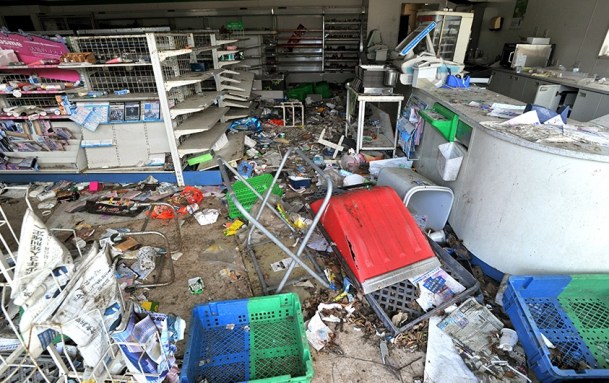
Merchandise remains strewn on the floor of a convenience store in Okuma, Fukushima Prefecture, after the Great East Japan Earthquake shook the town on March 11, 2011
Fukushima towns co-hosting nuclear plant frozen in time
In Okuma, Fukushima Prefecture, a peek inside a convenience store revealed merchandise strewn all over the floor, with the large clock in the back frozen at 2:46 p.m., when a magnitude-9.0 temblor struck five years ago.
Inside the newsstand placed at the entrance of the store, located along the prefectural road, was the March 11, 2011, edition of newspapers, which were discolored.
No signs of people were seen in Okuma and Futaba, the towns co-hosting the crippled Fukushima No. 1 nuclear power plant on March 12, the fifth anniversary of the first hydrogen explosion that occurred at the nuclear complex.
The only movement that could be glimpsed was the occasional passing of vehicles to and from the plant, which is preparing for decommissioning work.
Okuma and Futaba have been evacuated since the onset of the nuclear crisis following the Great East Japan Earthquake and tsunami on March 11, 2011.
Residents have no idea if and when they can ever return to live in their homes since the municipalities are designated in the off-limits zone due to high radiation levels.
Remnants of the disaster still loom over the towns five years later.
In Okuma, pieces of broken walls and window glass were scattered on the street near JR Ono Station, which used to be the busiest area of the town, although the street was cleared to some extent to let vehicles pass through.
The only sound that could be heard was one that a zinc sign made as it swung in the occasional breeze.
Neighboring Futaba was also like a ghost town. Laundry was seen through the window still hanging inside one of the damaged structures in the center of Futaba, five years after it was set out to dry.
http://ajw.asahi.com/article/0311disaster/fukushima/AJ201603130023

In full protective gear, members of a Ground Self-Defense Force unit in Koriyama, Fukushima Prefecture, are seen before they began trying to contain the crisis unfolding at the Fukushima No. 1 nuclear power plant on March 12, 2011.
Government reluctant to specify SDF role in nuclear crisis
When the specter of meltdowns loomed at the Fukushima No. 1 nuclear power plant in March 2011, the legal responsibility fell to Tokyo Electric Power Co., the operator, to contain the crisis.
But as TEPCO employees became overwhelmed, Self-Defense Forces members and Tokyo firefighters were quickly sent to the site at the “request” of the prime minister.
Five years later, there is still no clear delineation of responsibility for the SDF and firefighters to be dispatched or to the extent of their involvement in the event of a nuclear emergency.
The government, the secretariat of the Nuclear Regulation Authority, which crafted new regulations for nuclear plants after the Fukushima disaster, the SDF and the Fire and Disaster Management Agency, which oversees corps of firefighters across the nation, each has differing views.
“Our understanding is that operators of nuclear power plants are presumably prepared (to tackle a nuclear emergency) in line with the world’s most stringent regulations,” said a Defense Ministry official, referring to the nation’s new regulations. “We do not believe that SDF members will be able to do what goes beyond the capability of nuclear power plant operators.”
On March 11, the fifth anniversary of the Great East Japan Earthquake and tsunami, the government declared in a report after a meeting of Cabinet members related to nuclear energy that it will “bear the responsibility for dealing with” a nuclear accident.
The report mentioned the use of “tactical squads” such as the SDF and fire departments to address the situation.
However, what were described as their operation to contain an emergency in the report was “transportation of materials” and other efforts. It has yet to be determined as to what extent the SDF, fire departments and other squads should be prepared to help contain a nuclear contingency in terms of equipment and operations.
When the crisis unfolded at the Fukushima No. 1 nuclear plant following the magnitude-9.0 quake and tsunami, a team of five Ground Self-Defense Force members in Koriyama, Fukushima Prefecture, was tasked with sending cooling water to the overheating No. 1 reactor on March 12, 2011.
The troops had to work amid rising radiation levels at the site, which was a quagmire from the mountain of wreckage left by the quake and tsunami. After the work was forced to be temporarily halted by the hydrogen explosion at the No. 1 reactor that day, the team had to return to work to inject cooling water into the reactor.
When it became obvious that TEPCO could no longer handle such a severe accident on its own, firefighters and police were also deployed to the plant to keep sending water into the reactors.
While the SDF sprayed water from above, firefighters, police and the SDF worked together to direct a spray from the ground.
The law on special measures concerning nuclear emergency preparedness, established in 1999, stipulates the responsibility for containing an emergency lies with the operator of a nuclear facility.
Under the current setup, even if an SDF unit or firefighters are deployed to the site, their activities are to be limited to offering “assistance” to workers grappling with the accident.
In April, the exposure limit to radiation of workers responding to a nuclear emergency will be raised to 250 millisieverts from 100 millisieverts, in light of the Fukushima disaster.
But the cap will only be applied to workers at a nuclear power plant as well as inspectors from the secretariat of the Nuclear Regulation Authority, not SDF members or firefighters.
According to the Defense Ministry, it does not envisage an operation to address a nuclear accident under its directives on responding to a nuclear disaster.
SDF members, in fact, have not conducted drills to deal with such an accident since the SDF’s fleet does not include a nuclear-powered aircraft carrier or similarly powered submarine. Japan does not possess nuclear weapons, either.
The government’s Fire and Disaster Management Agency, too, is reluctant to take on the responsibility.
The new regulations concerning nuclear facilities, which took effect in 2013, require plant operators to have in place a number of fire trucks tasked with sending water to reactors in the event of an accident.
“It is clear that plant operators are now capable of carrying out the kind of work that firefighters were involved in the Fukushima accident,” said an agency official.
In the Fukushima disaster, the deployment of SDF members and firefighters was based on the request from the prime minister, who heads a task force on responding to a nuclear disaster.
Although the Defense Ministry and Fire and Disaster Management Agency keeps a distance from a deployment of their members in the event of a future nuclear accident, the NRA’s secretariat does not.
“If a contingency gets out of the control of the operator, the government might be forced to get involved to contain the accident,” said an official with the NRA secretariat.
http://ajw.asahi.com/article/0311disaster/fukushima/AJ201603130019

17,000 items wait for owners in Fukushima lost and found center
NAMIE, Fukushima Prefecture–In a former gift shop along National Route 6, more than 17,000 items are housed here in a lost and found facility, including disfigured school backpacks, discolored stuffed animals and stained photos.
They are belongings found in the aftermath of the Great East Japan Earthquake and tsunami and waiting to be returned to their rightful owners.
On March 11, the fifth anniversary of the twin disasters, a 26-year-old man and his family stopped by on their way back from a visit to the family grave.
The man picked up a photo holder and carefully sifted through the pictures.
“I am looking for photos from my childhood,” said the man, who has been evacuating in Iwaki, in the prefecture, after his house in Namie was swept away by the tsunami.
The lost and found center, called “The center to display mementoes,” was converted from the former gift facility.
In addition to photos and school backpacks, it houses toys and decorative articles, items that were not broken.
People cleaned them and stored each article with a note mentioning the date and location of the discovery.
While similar lost and found facilities were set up in Miyagi and Iwate, the two other prefectures hardest hit by the 2011 quake and tsunami, shortly after the disaster, the one in Namie just opened in summer 2014.
It was because work to retrieve what was left under debris had been delayed due to the fallout from the disaster at the nearby Fukushima No. 1 nuclear power plant. Evacuees in the town with a population of about 19,000 remain displaced today.
Visitors to the lost and found facility numbered about 3,200 and about 1,600 pieces have been returned to their owner.
Noboru Kawaguchi, 66, who serves as a guide at the facility, is one of those who were reunited with pieces they treasured.
Kawaguchi, who commutes from Soma, a city 30 kilometers north of Namie, had discovered his photos there.
“I have lost everything in the tsunami,” he said, referring to the loss of his parents and his house. “I am always so touched by a visitor discovering something here, as it happened to me.”
Although many similar facilities in Iwate and Miyagi prefectures have closed over time, the center in Namie will remain open at least through spring next year.
http://ajw.asahi.com/article/0311disaster/quake_tsunami/AJ201603130021
No comments yet.
1 This Month


18 March Webinar @ 1 PM EST: An Assessment of SMR Projects: The Case of Canada
register for the zoom:
https://us02web.zoom.us/webinar/register/WN_o8BIIOUvQ2ONJR1nta65DQ#/registration


of the week – STOP SMALL MODULAR REACTORS IN CANADA
To see nuclear-related stories in greater depth and intensity – go to https://nuclearinformation.wordpress.com
-
Archives
- March 2026 (139)
- February 2026 (268)
- January 2026 (308)
- December 2025 (358)
- November 2025 (359)
- October 2025 (376)
- September 2025 (258)
- August 2025 (319)
- July 2025 (230)
- June 2025 (348)
- May 2025 (261)
- April 2025 (305)
-
Categories
- 1
- 1 NUCLEAR ISSUES
- business and costs
- climate change
- culture and arts
- ENERGY
- environment
- health
- history
- indigenous issues
- Legal
- marketing of nuclear
- media
- opposition to nuclear
- PERSONAL STORIES
- politics
- politics international
- Religion and ethics
- safety
- secrets,lies and civil liberties
- spinbuster
- technology
- Uranium
- wastes
- weapons and war
- Women
- 2 WORLD
- ACTION
- AFRICA
- Atrocities
- AUSTRALIA
- Christina's notes
- Christina's themes
- culture and arts
- Events
- Fuk 2022
- Fuk 2023
- Fukushima 2017
- Fukushima 2018
- fukushima 2019
- Fukushima 2020
- Fukushima 2021
- general
- global warming
- Humour (God we need it)
- Nuclear
- RARE EARTHS
- Reference
- resources – print
- Resources -audiovicual
- Weekly Newsletter
- World
- World Nuclear
- YouTube
-
RSS
Entries RSS
Comments RSS
 nuclear-news
Leave a comment