Another Three Mile Island Disaster or Worse in the Making: Brunswick and Perry Nuclear Power Stations Valve and Electrical Failures This Week


Oddly, Nuclear Power Stations depend on electricity from the grid for cooling of the reactor and its spent fuel pool. Above ground power lines at Brunswick nuclear power station, on the Atlantic Ocean, put it at high risk from hurricanes, as well as tornadoes. Building in background is Brunswick Nuclear Power Station. One can only hope that backup generators work, and that they can access enough diesel.
There are endless problems at aging nuclear power stations, which are reported by the US NRC using the euphemism of “event” like it’s a big nuclear party: http://www.nrc.gov/reading-rm/doc-collections/event-status/event/ Some “events” are indeed drunk or drugged up employees, euphemistically called “fitness for duty”, or rather lack thereof. It puts in mind those who hold parties during major hurricanes, rather than evacuating. While hurricane parties often end badly for the stupid participants, nuclear “events” could impact many innocents for generations.
A look at today’s auto…
View original post 3,735 more words
February 12 Energy News

Opinion:
¶ To Minimize Wind Power’s Impact on Birds & Bats, The Dept. of Energy Can Use AWWI As A Model • The Audubon Society says climate change threatens over half of American bird species. The American Wind Wildlife Institute has studied ways to protect wildlife and can be a model. [Natural Resources Defense Council]
 Golden Eagle. (photo credit: Dave Taylor via Flickr)
Science and Technology:
¶ According to the Geothermal Energy Association, the industry reached about 3,442 MW at the end of 2013. Almost 700 geothermal projects are under development in 76 countries. Here is a closer look at some of the pros and cons when it comes to producing geothermal energy for home, business, or city. [PlanetSave.com]
World:
¶ The Indonesian island of Sumba is blessed with an abundance of natural resources, wind, solar and flowing water. In 2009 the Dutch NGO Hivos realized…
View original post 700 more words
Australia Institute demolishes Senator Edwards’ argument for PRISM nuclear technology

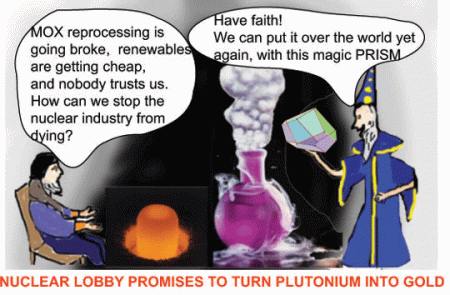
The impossible dream Free electricity sounds too good to be true. It is. A plan to produce free electricity for South Australia by embracing nuclear waste sounds like a wonderful idea. But it won’t work. THE AUSTRALIA INSTITUTE Dan Gilchrist February 2016
“…...NEW TECHNOLOGY
View original post 1,703 more words
The Week to February 12 in Nuclear News
 Armed transport ships spotted in Panama Canal, headed for secret mission to later transport plutonium.
The very secretive Transatlantic Trade and Investment Partnership (TTIP).
Arbitrary detention of Julian Assange – United Nations finding.
JAPAN. Fukushima nuclear station area has drastic mass death of species. What is to be done with all Fukushima’s radioactive trash? Japan Nuclear Regulation Authority Says No to Fukushima Daiichi’s Ice Wall. 5,300 tons of Fukushima radioactive trash dumped in 5 prefectures.
UK may be getting Beautiful Nuclear Cathedrals! (Amber Rudd will be pleased). The UK ghost ships with the deadly nuclear cargo. Huge production of radioactive trash would come from Hinkley point C nuclear reactor. Hinkley Nuclear Project: trials and Tribulations Continue, and EDF is in dire financial straits. £100 billion. Confusion about financing of UK’s Hinkley nuclear power project. UK govt spurns the success of renewable energy, follows the dodgy chimera of “Small Nuclear Reactors” Trident nuclear weapons system could all too soon become obsolete.
EUROPE. Court action against nuclear reactors in Belgium. Nuclear utility Vattenfall in crisis – third consecutive annual loss. Ukraine buying Western technology, plans to double its nuclear power.
FRANCE Electricite De France (EDF) faces €100bn bill for upgrading ageing nuclear power stations.
USA.
- Indian Point power plant radioactive leak gets worse. Call for closure of Indian Point Nuclear Station while radioactive leak is investigated.
- Fire/Explosion Reported at North Carolina Nuclear Plant. At Pilgrim nuclear power plant, security officer skipped more than 200 fire watches.
- South Carolina takes legal action against DOE over unfinished Nuclear Fuel Project.
- New Texas nuclear reactors not going to happen anytime soon, despite Fed approval.
- The decline of the South Carolina Mixed Oxide Fuel Fabrication (MOX) Nuclear Reprocessing Facility.
- Should Georgia’s electricity customers get hit with the ballooning costs of Vogtle nuclear power plant?
- Signing of Trans Pacific Partnership: Bernie Sanders opposes it.
- Most Curious Page of President’s Three Mile Island Nuclear Disaster Report: What is Hidden? Will It Be Declassified?
SOUTH AFRICA. Nuclear “renaissance” to Nuclear Fascism.
CHINA. China’s nuclear fusion experiment – it’s still decades away from practical application. Problems for China’s nuclear power plans.
INDIA. Ambiguities in marketing nuclear reactors to India. Convention on Supplementary Compensation (CSC) does not override India’s nuclear liability law.
CLIMATE CHANGE & RENEWABLE ENERGY Sea-level rise ‘could last twice as long as human history’. New study: Meeting carbon reduction goals economically means no nuclear power. World’s largest solar plant to be switched on in Morocco.
Fukushima nuclear station area has drastic mass death of species
 “Mass death” of species found around Fukushima nuclear plant — Gov’t: They “seem to have disappeared… Little or no reproductive success… It is evident biota around the power plant has been affected since the nuclear accident”http://enenews.com/mass-death-species-found-around-fukushima-nuclear-plant-govt-disappeared-little-reproductive-success-evident-biota-around-power-plant-affected-nuclear-accident?utm_source=feedburner&utm_medium=email&utm_campaign=Feed%3A+ENENews+%28Energy+News%29
Yomiuri Shimbun, Feb 7, 2016 (emphasis added): The National Institute for Environmental Studies (NIES) revealed that the total number of sessile species, such as barnacles and snails, has been decreasing significantly along the coast within 10 kilometers south of the Fukushima No. 1 nuclear power plant… [T]here is the possibility that the mass death of sessile specieswas influenced by radioactive materials released into the sea…
National Institute for Environmental Studies, Feb 2016 (underlining by NIES): NIES has conducted field surveys in the intertidal zones of eastern Japan to investigate the ecological effects of the serious accident at the Fukushima Daiichi Nuclear Power Plant… The number of intertidal species decreased significantly with decreasing distance from the power plant… no rock shell (Thais clavigera) specimens were collected near the plant, from Hirono to Futaba Beach (a distance of approximately 30 km) in 2012. The collection of rock shell specimens at many other sites hit by the tsunami suggests that the absence of rock shells around the plant in 2012 might have been caused by the nuclear accident in 2011. Quantitative surveys in 2013 showed that the number of species and population densities in the intertidal zones were much lower at sites near, or within several kilometers south of, the plant than at other sites… especially in the case of Arthropoda (e.g., barnacles). There is no clear explanation for these findings, butit is evident that the intertidal biota around the power plant has been affected since the nuclear accident…
Study funded by the Government of Japan, Feb 2016: Surveys in 2012… The number of intertidal species decreased significantly with decreasing distance from the power plant… The three animal species… 1 km south of FDNPP, were a barnacle… and two herbivorous snails… The sizes… were very small [and] densities were very low… No rock shell (Thais clavigera) specimens were found at 8 of the 10 sites in Fukushima Prefecture within a radius of 20 km of FDNPP… the area without rock shells extended… approximately 30 km… Surveys in 2013… Population densities of sessile organisms at Tomioka fishing port and Okuma were less than one-tenth to about one-fourth those at other sites… The total wet-weights in each intertidal zone at Okuma were much lower than those at other sites… it is unlikely that the absence of rock shells around FDNPP was caused only by the tsunami. The absence of rock shells at sites close to FDNPP… suggests that reproduction and recruitment did not occur there, or were less successful… [I]t is still unknown why adult rock shells living there disappeared or why rock shells had little or no reproductive success there… [I]t is also notable that barnacles seem to have disappeared from Kuboyaji, north of FDNPP…
Electricite De France (EDF) faces €100bn bill for upgrading ageing nuclear power stations
 EDF faces €100bn bill for upgrading ageing nuclear power stations, Ft.com Michael Stothard in Paris , 11 Feb 16 French utility EDF is facing a €100bn bill for upgrading its ageing nuclear power stations at the same time as a new law could force it to close a third of its reactors, according to the country’s state audit office.
The report by the Cour des Comptes comes at a bad time for the world’s largest nuclear power generator as it scrambles to secure financing for a contentious £18bn nuclear project in the UK.
Unions and analysts have already raised concerns that EDF might be biting off more than it can chew with the proposed nuclear plant at Hinkley Point in Somerset. The utility is grappling with a large debt load as well as increased competition in its domestic market.
Shares in EDF, which is 85 per cent owned by the French government, have fallen 55 per cent in the past year, reducing its market capitalisation to €21bn. The group has net debt of €37bn.
The audit office said on Wednesday that the cost of increasing the life expectancy of the 58 nuclear plants in France from their current 40 years would be €100bn during the 2014-2030 period.
This is well above EDF’s €55bn estimate for the 2014-2025 period. The difference is in part because the €100bn also includes EDF’s operating expenses over that period.
The audit office also said that a law passed last year to reduce the share of nuclear in French energy production from 75 per cent at the moment to 50 per cent by 2025 could lead to the closure of 17 to 20 EDF reactors.
The law was set to “jeopardise planned investments” by EDF and “force it to close a third of its plants,” with possible consequences for jobs, said the report. It suggested that EDF might have to turn to the state for compensation………
EDF has said it wants to keep all of its 58 reactors running. It said that it wants the reduction of the share of nuclear in the French energy mix from 75 per cent to 50 per cent in the law to come from growing demand.
But the Cour des Comptes said this kind of growth in demand was unlikely. “Only a very significant increase of electricity use or power exports could limit the number of closures, but experts do not expect this will happen,” it said. http://www.ft.com/intl/cms/s/0/581cb61a-d00d-11e5-92a1-c5e23ef99c77.html#axzz3ztplMhin
What is to be done with all Fukushima’s radioactive trash?
 Five years after nuclear meltdown, no one knows what to do with Fukushima, SMH, Anna Fifield February 11, 2016 Futaba: Seen from the road below, the Fukushima Dai-ichi nuclear power station looks much as it may have right after the catastrophic earthquake and tsunami that caused a triple meltdown here almost five years ago.
The No. 3 reactor building, which exploded in a hydrogen fireball during the disaster, remains a tangle of broken concrete and twisted metal. A smashed crane sits exactly where it was on March 11, 2011. To the side of the reactor units, a building that once housed boilers stands open to the shore, its rusted, warped tanks exposed.
The scene is a testament to the chaos that was unleashed when the tsunami engulfed these buildings, triggering the world’s worst nuclear disaster since the one in Chernobyl, in Ukraine, in 1986. Almost 16,000 people were killed along Japan’s northeastern coast in the tsunami, and 160,000 more lost their homes and livelihoods……..
What is to be done with all the radioactive material?
There’s the groundwater that is flowing into the reactor buildings, where it becomes contaminated. It has been treated – Tepco says it can remove 62 nuclides from the water, including strontium, which can burrow into bones and irradiate tissue. It cannot filter out tritium, a radioactive isotope of hydrogen that can be used to make nuclear bombs but is not considered especially harmful to humans.
The water initially was stored in huge bolted tanks in the aftermath of the disaster, but the tanks have leaked highly contaminated radioactive water into the sea on an alarming number of occasions.
Now Tepco is building more secure welded tanks to hold the water, theoretically for up to 20 years. There are now about 1000 tanks holding 750,000 tons of contaminated water, with space for 100,000 tons more. The company says it hopes to increase capacity to 950,000 tons within a year or two, as well as halve the amount of water that needs to be stored from the current 300 tons per day.
As part of those efforts, Tepco has built a 1500-metre-long “ice wall” around the four reactor buildings to freeze the soil and keep groundwater from getting in and becoming radioactive. Company officials hoped to have the just-completed wall working next month; on Wednesday, though, Japan’s nuclear watchdog blocked the plan, saying the risk of leakage was still too high.
The options for getting rid of the contaminated water include trying to remove the tritium from it before letting it run into the sea; evaporating it, as was done at Three Mile Island, the Pennsylvania plant that melted down in 1979; and injecting it deep into the ground, using technology similar to that used to extract shale gas. A government task force is considering which option to choose.
“These all have different advantages and disadvantages; they have different costs and different social acceptance,” said Seiichi Suzuki, manager of tank construction at the plant.
Then there’s the radioactive soil that has been collected from areas around the Fukushima Dai-ichi plant during clean-up efforts. Nearly 20 million cubic metres of soil — enough to fill 8000 Olympic-size swimming pools — has been packed into large black plastic bags and is being stored, row upon row, in local fields.
More than 700 of the bags, which contain radioactive cesium isotopes, were swept away during floods last year, some ending up in rivers 160 kilometres away. The government has said that 99.8 percent of the soil can be recycled.
Finally, and most problematically, there’s the nuclear fuel from the plant itself.
The fuel that melted down remains in containment vessels in its reactors, and this part of the plant is so dangerous to humans that robots are used to work there. Getting to this fuel and removing it safely is a task that will take decades.
Asked about the decommissioning process, Ono of Tepco said the work was about 10 per cent done.
“The biggest challenge is going to be the removal of the nuclear fuel debris,” he said. “We don’t even know what state the debris is in at the moment.”
Japan does not have a nuclear waste dump, and there is vehement resistance to disposing of contaminated material on land.
As a result, one of the options the government is considering is building a nuclear waste dump under the seabed, about 13 kilometres off the Fukushima coast. It would be connected to the land by a tunnel so it would not contravene international regulations on disposing of nuclear waste into the sea. A government study group is set to report on that proposal by the end of the summer.
Many groups, from fishermen to anti-nuclear activists, staunchly oppose the idea of burying the radioactive material at sea in such a seismically active area.
“At some point it would leak and affect the environment,” said Hideyuki Ban, co-director of the Citizens’ Nuclear Information Centre. “Some say it’ll be fine, as it will be diluted in the ocean, but it’s unclear whether it will be diluted well. If it gets into fish, it could end up on someone’s table.”
Aileen Mioko Smith, executive director of Green Action, a Kyoto-based anti-nuclear group, agreed.
“The seabed is just like land. It’s not flat, but has mountains and valleys,” she said. “Japan sits on multiple tectonic plates and is earthquake-prone. It’s too easy to think, ‘If not on land, how about the seabed?’ “http://www.smh.com.au/world/five-years-after-nuclear-meltdown-no-one-knows-what-to-do-with-fukushima-20160211-gmr5sv.html#ixzz3ztnYcrCY
Fire/Explosion Reported at North Carolina Nuclear Plant
Officials: 
 — Emergency Alert Declared — Fire/Explosion occurred after “unexpected power decrease” in reactor — “Emergency response facilities staffed” — “Abnormal event with potential to impact plant equipment or public health and safety” (VIDEO) http://enenews.com/officials-emergency-alert-declared-nuclear-plant-fireexplosion-reported-after-unexpected-power-decrease-reactor-emergency-response-facilities-staffed-abnormal-event-potential-impact-public-he?utm_source=feedburner&utm_medium=email&utm_campaign=Feed%3A+ENENews+%28Energy+News%29
U.S. Nuclear Regulatory Commission, Feb 8, 2016 (emphasis added): Facility: BRUNSWICK [Nuclear Plant in N.C.]… Emergency Class: ALERT… EMERGENCY DECLARED… RPS [Reactor Protection System] ACTUATION – CRITICAL… MANUAL SCRAM AND ALERT DECLARATION DUE TO ELECTRICAL FAULT RESULTING IN FIRE/EXPLOSION… Unit 1 declared an Alert… due to an explosion/fire in the Balance of Plant 4 kV switchgear bus area.Prior to the Alert declaration, the operators initiated a manual SCRAM due to an unexpected power decrease from 88% to 40%. The licensee has visually verified that there isno ongoing fire and is investigating the initial cause of the event… [T]he licensee reported the following… “a manual reactor scram was initiated due to loss of both recirculation system variable speed drives as a result of an electrical fault. At this time, a Startup Auxiliary Transformer (SAT) experienced a lockout fault; interrupting offsite power to emergency buses 1 and 2. Emergency Diesel Generators (EDGs) 1, 2, 3, and 4 automatically started”… The licensee has notified… DHS, FEMA, USDA, HHS, DOE, DHS NICC, EPA… FDA… and Nuclear SSA…
WWAY, Feb 7, 2016: Electrical damage sets off alert at Brunswick Nuclear Plant… An Alert is the second in increasing significance of four nuclear emergency classifications.
WECT, Feb 8, 2016: [Unit 1] remains in shutdown mode, while officials work through “detailed process/procedures to fully understand this event and make the needed repairs”… An alert… is used when abnormal events have the potential to impact plant equipment or public health and safety… No estimated timeline has been given for getting Unit 1 back into service.
North Carolina Department of Public Safety, Feb 7, 2016: Duke Energy notified the emergency management agencies… of damaged electrical equipment at the Brunswick Nuclear Plant…
Duke Energy, Feb 7, 2016: Alert declared and exited at Brunswick… federal, state and local officials were notified, and Brunswick plant emergency response facilities were staffed…
Iran has kept all its commitments on nuclear deal
 U.S. Official: Iran Has Kept Commitments On Nuclear Deal So Far, Radio Free Europe, By Golnaz Esfandiari February 11, 2016
WASHINGTON — A senior U.S. official says Iran so far has kept its commitments under the nuclear agreement with world powers implemented last month.
Stephen Mull, the State Department’s lead coordinator for implementing the deal curbing Iran’s nuclear activities in exchange for sanctions relief, told the U.S. House Foreign Affairs Committee on February 11 that there is no evidence that Tehran is cheating.
“Whenever we’ve detected that there may be a potential for moving away from the commitments, we’ve engaged with our Iranian counterparts, and they’ve addressed those concerns every single time,” Mull said.
Mull and John Smith, acting director of the Treasury Department’s Office of Foreign Assets Control, testified at the first senior-level congressional hearing held on the nuclear deal since it was implemented on January 16……http://www.rferl.org/content/iran-nuclear-deal-keeping-commitments/27546065.html
Australian Senator’s Impossible Nuclear Dream – analysis by Australia Institute
The impossible dream Free electricity sounds too good to be true. It is. A plan to produce free electricity for South Australia by embracing nuclear waste sounds like a wonderful idea. But it won’t work. The Australia Institute Briefing paper Dan Gilchrist February 2016

Native Americans sound the alarm on radioactive pollution
 Native Americans: ‘We Are The Miner’s Canary’ Indigenous Delegation Sounds Alarm on Homegrown Radioactive Pollution Crisis By Klee Benally, www.cleanupthemines.org, Popular Resistance January 23rd, 2016Washington, DC — From January 25-28, 2016 Indigenous representatives from the Northern Great Plains & Southwest were in the District of Columbia (DC) to raise awareness about radioactive pollution, an invisible national crisis. Millions of people in the United States are being exposed as Nuclear Radiation Victims on a daily basis. Exposure to radioactive pollution has been linked to cancer, genetic defects, Navajo Neuropathy, and increases in mortality. The delegation will speak about the impacts they are experiencing in their communities, which are also affecting other communities throughout the US.
“Native American nations of North America are the miners’ canaries for the United States trying to awaken the people of the world to the dangers of radioactive pollution”, states Charmaine White Face from the South Dakota based organization Defenders of the Black Hills.
South Dakota has 272 Abandoned Uranium Mines (AUMs) which are contaminating waterways such as the Cheyenne River, and desecrating sacred and ceremonial sites. An estimated 169 AUMs are located within 50 miles of Mt. Rushmore where millions of tourists risk exposure to radioactive pollution each year.
The delegation is warning of the toxic legacy caused by more than 15,000 AUMs nationwide, extreme water contamination, surface strip coal mining and power plants burning coal-laced with radioactive particles, radioactive waste from oil well drilling in the Bakken Oil Range, mill tailings, waste storage, and renewed mining threats to sacred places such as Mt. Taylor in New Mexico and Red Butte in Arizona.
Indigenous communities have been disproportionately impacted as approximately 75% of AUMs are located on federal and Tribal lands………https://www.popularresistance.org/native-americans-we-are-the-miners-canary/
The Peril of Nuclear Winter
Let’s End the Peril of a Nuclear Winter, NYT By ALAN ROBOCK and OWEN BRIAN TOONFEB. 11, 2016 IN the early 1980s, American and Russian scientists working together outlined a stark vision of the Cold War future. In a battle between the two superpowers, smoke from fires ignited by nuclear explosions would be so dense that it would block out the sun, turning the earth cold, dark and dry, killing plants and preventing agriculture for at least a year.
This dystopia became known as nuclear winter.
We haven’t heard much about this apocalyptic future in recent years. But the research into the destructive potential of a war involving nuclear weapons has continued. Even with the reduced nuclear arsenals that the United States and Russia agreed to in 2010, we have the ability not only to set off instantaneous destruction, but also to push global temperatures below freezing, even in summer. Crops would die and starvation could kill most of humanity.
But it is not just the superpowers that threaten the planet.
A nuclear war between any two countries using 100 Hiroshima-size atom bombs, less than half of the combined arsenals of India and Pakistan, could produce climate change unseen in recorded human history.
This is why we should celebrate the recent agreement with Iran, which may stop it from producing a nuclear weapon. And it is also why we should look with deep alarm at North Korea’s recent launching of a rocket to put a satellite in orbit, in what is believed to be an effort to develop an intercontinental ballistic missile.
Nine countries have nuclear arsenals, with an estimated total of 15,695 weapons, according to the Ploughshares Fund, a global securities group. About 94 percent are held by the United States and Russia. Except for North Korea, the other nuclear nations have each kept their arsenals at roughly 100 to 300 weapons. All have the destructive power to alter the global environment.
These weapons have not been a deterrent to war or aggression. But even if you think they can be, how many would you have to use? The answer is, probably one.
There are simply too many nuclear weapons in the world, by as much as a factor of 1,000, for anyone, anywhere, to be safe from the potential effects of even a small war. The chance that nuclear weapons would be used by mistake, in a panic after an international incident, by a computer hacker or by a rogue leader of a nuclear nation can be eliminated only by the removal of the weapons themselves.
We were among the scientists involved in the initial research that discovered the potential for nuclear winter. More modern and advanced climate modeling has confirmed the initial findings and shown that the effects would last for more than a decade. The reason is that smoke from nuclear conflagrations would rise as high as 25 miles into the atmosphere, where it would be protected from rain and take at least 10 years to dissipate.
In more recent research, we looked at the potential impact of a nuclear war between India and Pakistan, with each country detonating 50 Hiroshima-size bombs. These explosions would produce so much smoke that temperatures would plunge, shortening growing seasons and threatening the global food supply………http://www.nytimes.com/2016/02/11/opinion/lets-end-the-peril-of-a-nuclear-winter.html?_r=0
Young people profoundly undereducated on the global nuclear weapons danger
Nuclear weapons pose greater threat than climate change By Amanda Bosworth, 11 Feb 16 Every moment, our planet is threatened by the possibility of a nuclear deployment or accident. Young people are profoundly uneducated on the global quantity and potential impact of nuclear weapons, and older generations tend to believe that nuclear weapons ceased to be a threat when the Cold War ended. The United States and Russia still have abundant stocks, and both nations engage in rhetoric reflecting a casual attitude to the devastating consequences of even a small, regional nuclear conflict, according to Ira Helfand, M.D. Feb. 8 on campus.
“What we have to understand is that our world, and everything in it we hold precious, is at terrible risk today,” said Helfand, co-founder of Physicians for Social Responsibility and co-president of International Physicians for the Prevention of Nuclear War, which won the Nobel Peace Prize in 1985, during his presentation, “The Growing Danger of Nuclear War and What We Can Do About It.”……..http://www.news.cornell.edu/stories/2016/02/nuclear-weapons-pose-greater-threat-climate-change
At Pilgrim nuclear power plant, security officer skipped more than 200 fire watches
NRC: Nuclear plant employee skipped assigned fire watches http://www.bostonherald.com/news/local_coverage/2016/02/nrc_nuclear_plant_employee_skipped_assigned_fire_watches Associated Press Thursday, February 11, 2016 PLYMOUTH, Mass. — The owner of the Pilgrim nuclear power plant in Plymouth faces possible punishment from federal regulators because a former security officer admitted to skipping his hourly fire watches then falsifying records to make it appear as if they been completed.
In a letter to Entergy, the Nuclear Regulatory Commission said its investigators found the security officer skipped more than 200 fire watches from 2012 to 2014.
An NRC spokesman tells the Cape Cod Times (http://bit.ly/1KHRoIV ) that Entergy could be assessed a civil fine of up to $140,000 per day per violation, but at this point a civil penalty will likely not be assessed.
Entergy says its own investigation reached a similar conclusion. The employee was fired. Entergy is still considering how it will respond.
Pilgrim has been scheduled to close by 2019.
The very secretive Transatlantic Trade and Investment Partnership (TTIP)
 WHAT I DIDN’T READ IN THE TTIP READING ROOM , War On Want, 7 February 2016 Katja Kipping was one of the first German MPs to gain access to the new TTIP reading room opened in Berlin this week, and she has written up a report of her experience. We thought it was well worth translating from the original, ‘The Opposite of Transparency’.
TTIP, the EU-US free trade deal, has secrecy written all over it. Those responsible for it live in dread of any public scrutiny. If it was up to me, I would give everyone who’s interested the chance to make up their own minds on the text of the agreement in its current form. Sigmar Gabriel, Minister for Economic Affairs and a top cheerleader for TTIP, has now set up a reading room in his ministry where since the beginning of February German MPs can each spend two hours looking at those texts on which consensus has already been reached.
A political friend of mine asked me the day before whether she could come with me into the reading room. I had to say no. After a long, tough struggle with the government, at least MPs are able to read the text, but they are the only ones. We are not even allowed to take security-cleared specialists with us into the reading room. As for members of the public, who will ultimately have to bear the brunt of TTIP, they are to have no access whatsoever to the secret text. Not what transparency looks like in my book!
Access ‘granted’
Even the registration procedure for the reading room speaks volumes. Once I’d registered, I was sent the instructions on how to use the room. The first thing that I noticed was that the terms and conditions had already been the subject of negotiations between the European Commission and the USA. Get your head round that: TTIP isn’t even signed yet, and already individual countries have lost the right to decide who gets to read the texts, and on what terms.
The following extract from the rulebook for MPs who, like me, want to use the reading room reveals the attitude towards democracy that lurks behind TTIP: “You recognise and accept that in being granted access to the TTIP texts you are being extended an exceptional degree of trust.”
Now I’d always thought that elected MPs have a right to information. Yet the TTIP negotiators (and who gave them their legitimacy?) reckon they are GRANTING us access out of the goodness of their hearts. Access as a sign of exceptional trust. Whoever wrote that – did they really think that we MPs would feel flattered? To me it smacks more of totalitarianism. ‘Granting access’ and ‘extending trust’ is not the language you use if you really believe in democracy. ………
I read nothing to alleviate my concern that the US side wishes to make life more difficult for public and community enterprises and to secure better terms for transnational corporations in the battle for public tenders. I also read nothing to calm my fears that EU negotiators are prepared to sacrifice our social and environmental standards for the prospect of winning lucrative contracts for big European firms.
I read nothing that would lead me to reconsider my previous criticism that consumer protection plays no part in TTIP other than to proclaim free market competition to be the highest form of consumer protection that exists………
It is revealing in itself that the Ministry for Economic Affairs is prepared to go to such lengths in order to keep the text of TTIP under wraps. And they have every reason for doing so. Anyone who was going into these negotiations to enhance environmental protection, consumer protection and labour standards would have nothing to fear from transparency. Anyone who’s engaged in selling out democracy, on the other hand, is obviously going to want to avoid public scrutiny. If Sigmar Gabriel and the negotiators are really so convinced of the benefits of TTIP, why don’t they just make the text available to everyone online? http://www.waronwant.org/media/what-i-didn%E2%80%99t-read-ttip-reading-room
1 This Month

of the week – Shut Down Drone Warfare!


Tell the Ukrainian Government to Drop Prosecution of Peace Activist Yurii Sheliazhenko

Petition to revoke the licensing of the Near Surface Nuclear Disposal Facility (NSDF) at Chalk River. https://www.ourcommons.ca/petitions/en/Petition/Details?Petition=e-7247
To see nuclear-related stories in greater depth and intensity – go to https://nuclearinformation.wordpress.com
-
Archives
- April 2026 (91)
- March 2026 (251)
- February 2026 (268)
- January 2026 (308)
- December 2025 (358)
- November 2025 (359)
- October 2025 (376)
- September 2025 (257)
- August 2025 (319)
- July 2025 (230)
- June 2025 (348)
- May 2025 (261)
-
Categories
- 1
- 1 NUCLEAR ISSUES
- business and costs
- climate change
- culture and arts
- ENERGY
- environment
- health
- history
- indigenous issues
- Legal
- marketing of nuclear
- media
- opposition to nuclear
- PERSONAL STORIES
- politics
- politics international
- Religion and ethics
- safety
- secrets,lies and civil liberties
- spinbuster
- technology
- Uranium
- wastes
- weapons and war
- Women
- 2 WORLD
- ACTION
- AFRICA
- Atrocities
- AUSTRALIA
- Christina's notes
- Christina's themes
- culture and arts
- Events
- Fuk 2022
- Fuk 2023
- Fukushima 2017
- Fukushima 2018
- fukushima 2019
- Fukushima 2020
- Fukushima 2021
- general
- global warming
- Humour (God we need it)
- Nuclear
- RARE EARTHS
- Reference
- resources – print
- Resources -audiovicual
- Weekly Newsletter
- World
- World Nuclear
- YouTube
-
RSS
Entries RSS
Comments RSS
 nuclear-news