Toshiba might sell off its unprofitable nuclear business in Japan
 Struggling Toshiba may spin off ailing Japan nuclear power business, Japan Times, 28 Jan 16, KYODO Scandal-hit Toshiba Corp. will consider splitting off its flagging nuclear power business in Japan and rebuilding it as a separate company as part of a sweeping restructure following an accounting scandal, sources said.
The 2011 Fukushima No. 1 nuclear plant disaster has made it difficult to build reactors in Japan amid safety concerns.
Toshiba’s subsidiary, Westinghouse Electric Co., which is in charge of its overseas nuclear power business, will seek to secure orders in emerging markets, the sources said Tuesday.
The move could trigger a realignment of the country’s nuclear power industry at a time when the government is aware of the need to bolster the competitiveness of domestic players, observers said…….
Toshiba said in November that Westinghouse had written down its assets by $1.3 billion in fiscal 2012 and 2013, revealing the difficulties facing the subsidiary in achieving profitability at the level anticipated by Toshiba.
Hit by the accounting scandal, Toshiba is proceeding with restructuring its unprofitable businesses….. http://www.japantimes.co.jp/news/2016/01/27/business/corporate-business/struggling-toshiba-may-spin-off-ailing-japan-nuclear-power-business/#.Vqkyc5p97Gh
Fatal rockfall at planned French repository site
World Nuclear News 26 January 2016 One person was killed and another injured today by a tunnel collapse within an underground laboratory operated by French waste management agency Andra. The laboratory, near Bure in the Meuse/Haute Marne area, is assessing the site for its suitability to house a national radioactive waste repository.
According to an Andra statement, the working face of the gallery within the laboratory collapsed at 12.20pm. Geophysical surveys were being carried out at the time and the rockfall is believed to have happened as drilling was taking place. The gallery has now been evacuated and its stability is being assessed……. http://www.world-nuclear-news.org/RS-Fatal-landslide-at-planned-French-repository-site-2601165.html
The nuclear revolving door: Former Labour MP appointed boss of nuclear industry trade body
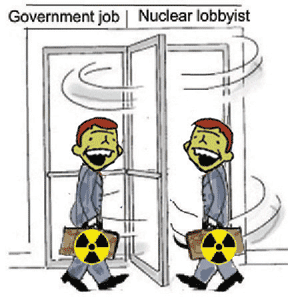
STV News 27 Jan 16 A former Labour MP has been appointed chief executive of the trade body for the civil nuclear industry.Ex-MP for Rutherglen and Hamilton West Tom Greatrex will take up the post at the Nuclear Industry Association next week, succeeding Keith Parker.
Mr Greatrex was an opposition spokesman on energy until he lost his seat in last May’s general election.
He said: “I am delighted to be joining the Nuclear Industry Association at such an exciting time……http://news.stv.tv/west-central/1340504-former-labour-mp-appointed-boss-of-nuclear-industry-trade-body/
It’s looking increasingly as if the Hinkley C Nuclear EPR is dead in the water.

 Unable to raise Hinkley C nuclear cash, EDF turns to French government, http://www.theecologist.org/News/news_round_up/2986989/unable_to_raise_hinkley_c_nuclear_cash_edf_turns_to_french_government.html Oliver Tickell 26th January 2016 Just as EDF was due to make its ‘final investment decision’ on Hinkley C, writes Oliver Tickell, Another delay. In spite of incredibly generous subsidies, the company is unable to finance it. Its last hope is to persuade the French state to take a 10% stake in the doomed project.
It was the decision a lot of people had been waiting for – EDF workers, the UK government, and campaigners for and against nuclear power in the UK.
As reported on The Ecologist today, The EDF board was due to make its ‘final investment decision’ on its controversial Hinkley Point C nuclear power station in Somerset, England, at a long-scheduled meeting tomorrow.
But now it has emerged in French newspaper reports that the decision has been deferred – indefinitely. No decision is now expected until after EDF presents its accounts on 16th February.
John Sauven, Executive Director of Greenpeace UK – the only national green NGO to campaign visibly on the issue – said today: “The EDF board is clearly rattled as they delay yet again this crucial investment decision. It could well signal curtains for Hinkley. EDF managers as well as employee representatives on the board are deeply concerned this project is too risky and too expensive.
“All three EPR projects are massively delayed and hugely over budget. There isn’t a shred of evidence that it’ll be fourth time lucky in Somerset. The UK government needs to join the 21st century and start backing the renewable technologies that are proven to work, are cheaper than nuclear power, create jobs in the UK and contribute to the fight against climate change.”
EDF: ‘We haven’t got the cash!’
The revelation comes in the French newspaper Les Echos, which has been consistently ahead of the pack with high-level leaks from EDF. According to its report, published today, the parastatal corporation has been unable to raise the full sum – some £18 billion – with which to progress the project:
“Two years ago EDF built a financial plan in which it would take 40-50% of the shares, which allowed it not to consolidate the investment in its accounts and so not to weigh too heavily on its balance sheet. Areva was to hold 10% and foreign shareholders the balance.
“But the difficulties of Areva, coupled with the delayed EPR under construction at Flamanville (Manche), changed last autumn: Areva will not participate in the round, and only Chinese investors (CGN), which see it as a gateway for developing their own reactors in Europe, will participate in the consortium, at 33.5%.”
The report goes on to cite the severe financial embarrassment that has overtaken EDF – its collapsing share price, negative credit outlook, increasing nuclear waste disposal liabilities, which just increased by around €10 billion yesterday, steep falls in the French wholesale power price (€37 to €28/MWh) reducing its income by €2 billion a year, and its forced €2.5 billion purchase of its bankrupt sister company, Areva.
Now EDF is demanding French Government support too But then comes the surprise: unable to raise funds it needs for Hinkley Point C through open market financing channels, it is asking the French Government to step in with a huge direct investment in the project, according to Les Echos:
“In this context, according to our information, EDF is now putting pressure on the State, its 84.5% shareholder, to find new financing. Since Areva would have contributed up to 10% in the project, EDF wishes to replace it with another entity.”
Considering that EDF has been casting around the world in its increasingly desperate search for cash, that can only mean one thing – that the French state should step in to make good the 10% funding gap left in the wake of Areva’s financial collapse.
But just consider the implications. First, EDF is itself effectively owned by the French state as 84.5% shareholder.
Second, it is being supported by the British government with a subsidy package of guaranteed index-linked power prices for 35 years at more than double the current wholesale price, plus ceilings on decommissioning and waste disposal costs, plus £10 billion loan finance guarantees, independently valued at over €100 billion over the project lifetime, all giving EDF an estimated 10% per annum return on capital.
Third, unable to obtain open market financing even with this UK energy user and taxpayer-financed package of amazing generosity behind it, it has been forced to turn to a third state-owned entity, China General Nuclear Company (CGN) to take a 33.5% stake in the project.
But now, fourth, even that’s not enough – and EDF needs to go back to its owner, the French government, to demand that it takes (or otherwise procures) a direct 10% stake in the project – because no one else will.
If anyone ever needed any convincing that nuclear power is utterly unable to survive in a free market economy, this is it.
But of course if any such thing happens, that would trigger yet another European Commission investigation into ‘illegal state aid’ for the Hinkley project. And even it it passes the hurdles, fresh legal challenges would surely follow, and further years of delay.
The final question – will any EPR ever be built?
It’s looking increasingly as if the Hinkley C EPR is dead in the water. The Flamanville EPR in France is facing huge problems with its metallurgical flaws in the reactor vessel and lid and it’s odds on that it will never be completed due to the massively escalating costs, delays, and safety uncertainties.
There are also big questions over the Olkiluoto EPR in Finland, as the costs of completing the hugely over-time, over budget reactor may be greater to EDF and Areva than walking away and abandoning the site.
Most likely to be completed is the twin-reactor Taishan EPR in China, which was meant to come in last of the bunch but is now well ahead. However there are widespread suspicions that its reactors, supplied by Areva, may suffer from the same flaws as those at Flamanville, explaining a long delay in construction activity.
So even if it ever is ‘built out’, Chinese safety regulators may never allow it to be turned on.
Sic transit gloria mundi.
North Carolina Environment Chief aims to restrict solar power, promote nuclear power!

 NC environmental chief backs restriction on solar farms, incentives for nuclear plants. WRAL.com By Laura Leslie 28 Jan 16 RALEIGH, N.C. — The solar industry has blossomed in North Carolina since lawmakers granted solar farms tax breaks nine years ago as part of renewable energy standards that require utilities to get a portion of their power from renewable sources.
Brian O’Hara, senior vice president of Chapel Hill-based Strata Solar, said the state and other stakeholders have already drafted a model ordinance to help local officials negotiate. He said the solar industry wasn’t consulted about the proposed state permit.
Chatham County homeowner Sharon Garbutt, who lives 17 miles from the Shearon Harris nuclear plant in southwest Wake County, told the panel
Safety concerns cause China to halt construction of two nuclear reactors

 China admits nuclear emergency response ‘inadequate’ as safety concerns halt construction of two Guangdong reactors, South China Morning Post, Wednesday, 27 January, 2016, Stephen Chen China admitted on Wednesday its nuclear emergency response mechanism is “inadequate” for coping with “new situations and challenges” arising from its nuclear power plants.
The central government also said it had halted construction of two new-generation nuclear reactors in Guangdong province, because of safety concerns, but vowed that they would not be abandoned……..
Concerns over nuclear safety in Hong Kong and Macau have caught particular attention of the central government. A section in the white paper was dedicated to the issue with promise to “answer public concerns in time” and “clear the doubts”.
Xu Dazhe, chairman of the China Atomic Energy Authority, told a press conference on Wednesday that the construction of the two European Pressurised Reactors in Taishan, in Guangdong, had been delayed owing to safety concerns…….
State-owned nuclear companies are also trying to sell their technology and reactors to other countries, including Britain, while considering controversial projects such as building a floating nuclear power plant in the South China Sea to provide remote islands in disputed waters. http://www.scmp.com/news/china/policies-politics/article/1906287/china-admits-nuclear-emergency-response-inadequate
The growing climate problem of data farms’ consumption of energy
the only long-term solution to the energy problem will have to involve significant cuts to our internet use at some point in the future. This could be through some kind of tax or charge on data use – for example, imposing a fee for uploading photographs on to Facebook – or even a straightforward rationing of activity

Global warming: Data centres to consume three times as much energy in next decade, experts warn 416.2 terawatt hours of electricity world’s data centres used last year was far higher than UK’s total consumption,The Independent Tom Bawden Environment Editor @BawdenTom 24 January 2016 The amount of energy consumed by the world’s data centres – the repositories for billions of gigabytes of information – will treble in the next decade, putting an enormous strain on energy supplies and dealing a hefty blow to efforts to contain global warming, experts say.
Whether you’re “liking” something on Facebook, streaming the latest Tarantino movie or posting an instagram from the pub, every internet activity involves huge amounts of data that needs to be stored somewhere. And as the “internet of everything” brings innovations such as driverless cars and high-definition video watches ever closer, the vast network of data centres that have sprung up in the past decade will spread.
This wouldn’t be a problem if these facilities – which range from a small room with a few servers to vast 150,000 square metre “farms” – didn’t consume such enormous amounts of energy.
- Already, data centres have mushroomed from virtually nothing 10 years ago to consuming about 3 per cent of the global electricity supply and accounting for about 2 per cent of total greenhouse gas emissions. That gives it the same carbon footprint as the airline industry.
- To put the size of this consumption into even sharper relief – the 416.2 terawatt hours of electricity the world’s data centres used last year was significantly higher than the UK’s total consumption of about 300 terawatt hours.Massive as data centre energy use may already be, this is nothing to what lies in store, analysts warn. Ian Bitterlin, Britain’s foremost data centre expert and a visiting professor at the University of Leeds, says the amount of energy used by data centres is doubling every four years – despite the innovations in hardware that massively increase their capacity to store data. As a result, analysts forecast that data centres will consume roughly treble the amount of electricity in the next decade.
One way to curb their carbon footprint is to increase the amount of renewable energy they use – a development that is already under way but has much, much further to go to offset the exponential growth in internet traffic, experts say. Even if the industry were able to shift to 100 per cent renewable electricity, the volume of energy they would need would put intolerable pressure on the world’s power systems.
- “If we carry on going the way we have been it would become unsustainable – this level of data centre growth is not sustainable beyond the next 10 to 15 years. The question is, what are we going to do about it?” says Professor Bitterlin.He points to a study focused on Japan which suggests that its data centres would consume its entire electricity supply by 2030 if growth continues at today’s rate.
“We need to be more responsible about what we use the internet for … Data centres aren’t the culprits – it’s driven by social media and mobile phones. It’s films, pornography, gambling, dating, shopping – anything that involves images. It’s a great example of the Jevons paradox – the easier you make it to consume the product the greater the consumption will be.”
- Unless there is some kind of game-changing breakthrough on data storage – such as the development of a far-superior alternative to silicon – the world’s internet use is eventually going to have to be significantly rationed. Professor Bitterlin added that a form of carbon known as graphene could potentially revolutionise data storage.But even with a revolution in data storage capacity, he believes the only long-term solution to the energy problem will have to involve significant cuts to our internet use at some point in the future. This could be through some kind of tax or charge on data use – for example, imposing a fee for uploading photographs on to Facebook – or even a straightforward rationing of activity; but he acknowledges that these kind of moves would probably be “political suicide”. Other measures – such as switching from colour to black and white photographs – could also go a long way to reducing data consumption.
Governments across the world, including the UK, are starting to wake up to the data centre problem at the same time as they encourage the roll-out of data-hungry broadband networks to ever remoter locations. The roll-out is primarily designed to help small businesses, but the bulk of the faster internet access is enjoyed by consumers. And some internet companies – such as Facebook, Google and Apple – are leading efforts to be more environmentally responsible. The measures being taken include housing data centres in cold climates – which dramatically reduces the energy needed to cool the facilities – with a ready supply of renewable energy. …..http://www.independent.co.uk/environment/global-warming-data-centres-to-consume-three-times-as-much-energy-in-next-decade-experts-warn-a6830086.html
Solar panel costs to fall 10% every year
 Solar panel costs predicted to fall 10% a year Climate Home: Power from the sun could supply 20% of energy worldwide by 2027 on current technology trends, say UK researchers, Guardian, Megan Darby, 27 Jan 16, Solar power costs are tumbling so fast the technology is likely to fast outstrip mainstream energy forecasts.That is the conclusion of Oxford University researchers, based on a new forecasting model published in Research Policy.
Since the 1980s, panels to generate electricity from sunshine have got 10% cheaper each year. That is likely to continue, the study said, putting solar on course to meet 20% of global energy needs by 2027.
By contrast, even in its “high renewable” scenario, the International EnergyAgency assumes solar panels will generate just 16% of electricity in 2050. Its widely cited future energy scenarios in previous years failed to predict solar’s rapid growth.
Mathematics professor Doyne Farmer, who co-wrote the paper, said the research could help to shape clean energy policy.
“Sceptics have claimed that solar PV cannot be ramped up quickly enough to play a significant role in combatting global warming,” he said.
“In a context where limited resources for technology investment constrain policy makers to focus on a few technologies… the ability to have improved forecasts and know how accurate they are should prove particularly useful.”
Farmer’s model, jointly developed with economist Francois Lafond, draws on historical data from 53 different technologies……http://www.theguardian.com/environment/2016/jan/26/solar-panel-costs-predicted-to-fall-10-a-year
Former PM Naoto Kan says Fukushima nuclear disaster is still unfolding
 Fukushima nuclear accident not over yet, says ex-PM Kanhttp://www.japantoday.com/category/politics/view/fukushima-nuclear-accident-not-over-yet-says-ex-pm-kan JAN. 28, 2016 WASHINGTON —
Former Prime Minister of Japan Naoto Kan says the nuclear accident at the Fukushima Daiichi power plant is not over, despite nearly five years having passed since a massive earthquake and tsunami triggered the disaster.
“There is no doubt” radioactive materials have been seeping into the sea after mixing with underground water, Kan, who has been a vocal critic of nuclear energy since the accident, told the National Press Club in Washington on Tuesday.
Prime Minister Shinzo Abe has said the issue of water contaminated with radioactive substances at the Fukushima plant is “under control” on various occasions including his presentation to pitch Tokyo as host of the 2020 Olympic Games.
“The accident is still unfolding” at the nuclear plant operated by Tokyo Electric Power Co., Kan said.
Kan was prime minister when the world’s worst nuclear crisis after Chernobyl occurred following the massive earthquake and tsunami on March 11, 2011.
Kan, a lawmaker of the opposition Democratic Party of Japan, also criticized Abe’s decision to raise the ratio of electricity produced by atomic energy to 20-22 percent of the total output in 2030.
“The goal is not achievable” unless Japan extends the maximum legal period of nuclear plant operation or build a new nuclear plant, Kan said.Japan has halted most nuclear reactors since the Fukushima disaster out of concerns about the safety.
Kansai Electric Power Co. is set to reactivate a nuclear reactor at its Takahama plant on the Sea of Japan coast Friday in what would be the third restart since new safety standards were put in place after the quake.
What if EDF says no to Hinkley Point?
EDF is still at the table, but nuclear could go critical for Osborne, Guardian, Nils Pratley, 28 Jan 16 The UK’s nuclear energy strategy will be in meltdown if the French pull out of Hinkley. The best guess is, they’ll find the cash
What if EDF says no to Hinkley Point? What if the French power generator, under pressure from its unions and potential lenders, decides it can’t finance the £18bn project, even with the Chinese chipping in?
After all, the disgruntled French workers make a reasonable point. EDF’s last big foreign adventure, in Finland, is nine years behind schedule and massively over-budget, so why risk another expedition? EDF’s share price, remember, is down 85% since 2004: the company is in a weak position to resist its local critics.
The short answer is that the UK’s nuclear strategy would be in tatters if EDF backs out. If EDF can’t get financing for Hinkley, then Sizewell C, the company’s intended follow-on project in Suffolk, would also bite the dust. The same goes for the next plant at Bradwell in Essex, where Chinese constructors are supposed to be taking the lead, but are relying on Hinkley’s and Sizewell’s infrastructure and momentum.
And, if the UK’s nuclear strategy becomes a non-runner, then the government’s entire energy policy is dead. By the mid-2030s, Hinkleyand other new nuclear plants are supposed to have replaced the current clapped-out fleet and added capacity on top………http://www.theguardian.com/business/nils-pratley-on-finance/2016/jan/27/edf-hinkley-point-nuclear-power-strategy-uk-george-osborne-chinese-sizewell-bradwell
China supports UN move to denounce North Korea over nuclear test
China backs U.N. move to denounce North Korea over nuclear test, WP, By Carol Morello and Simon Denyer January 28 16, BEIJING — Secretary of State John F. Kerry and China’s foreign minister agreed Wednesday to move ahead with a U.N. resolution condemning North Korea for its latest nuclear test, but they appeared as far apart as ever on how far to push Pyongyang………https://www.washingtonpost.com/world/china-agrees-to-sanctions-against-north-korea-during-kerry-visit/2016/01/27/2d09569a-bfcd-11e5-98c8-7fab78677d51_story.html
Nuclear scientist – it’s unwise to rebuild Ontario nuclear plant
 Scientist calls $12.8B rebuild of Ontario nuclear plant ill-advised, CTV News, The Canadian Press January 27, 2016 TORONTO — The proposed $12.8-billion refurbishment of four nuclear reactors at the Darlington generating station is an ill-advised make-work project that will end up soaking taxpayers, a retired nuclear scientist says.
In a letter to Ontario’s energy minister, obtained by The Canadian Press, Frank Greening warns of the formidable technical hazards he says will undermine rosy projections for the project.
“I am quite mystified that you would consider the refurbishment of Darlington to be some sort of solution to Ontario’s economic woes, when in fact the premature failures of (nuclear reactors) are a major cause of Ontario’s economic problems,” writes Greening, a frequent critic of the industry.
“Spending billions of dollars trying to patch up Darlington’s four dilapidated reactors will simply continue the bleeding.”
Earlier this month, the province’s publicly owned generating giant, Ontario Power Generation, announced plans to start refurbishing Darlington — situated east of Toronto on Lake Ontario — this fall. The project aims to extend the life of the CANDU reactors, scheduled for permanent shutdown in 2020, by 30 years……..
Greening argues the units are in need of rebuilding prematurely because their pressure tubes and feeder pipes will soon fail fitness tests. He also warns the reactors’ massive steam generators, which are not part of the proposed project, have had a less than stellar track record and will more than likely need replacement.
“Replacing these steam generators is fraught with very serious problems, both technical and economic, that could prevent the continued operation of Darlington beyond 2030,” says Greening, a senior scientist with OPG until he retired in 2000.
“The decision to proceed with the refurbishment of Darlington could prove to be a disastrous mistake if it is discovered that steam generator replacement is in fact needed in the next 10 to 15 years.”
Environmental groups also argue such projects always run massively over budget and have cost taxpayers untold billions in the past and refurbishment is simply not worth the potential radiation risk to public safety.
The Ontario cabinet has so far given the green light to refurbish one of Darlington’s reactors. OPG would need separate approvals for each of the other three units……….http://www.ctvnews.ca/canada/scientist-calls-12-8b-rebuild-of-ontario-nuclear-plant-ill-advised-1.2754272
Untested and unsafe technology ? Jaitapur nuclear power station
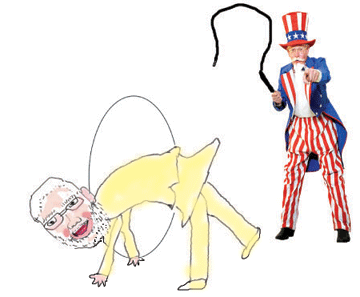 Last year on the Republic Day, to please the United States President Obama who was the chief guest, Modi government effectively surrendered the govt’s option to sue the nuclear vendors in case of a nuclear accident by creating an insurance pool from public funds to channel suppliers’ liability back to the taxpayers, taking an about turn from earlier strong reservations of the BJP on nuclear liability.
This year, Modi’s government seems bent on finalising an insanely dangerous and destructive nuclear project.
 Another Republic Day, another compromise on nuclear safety? A year after giving in on nuclear liability during Barack Obama’s visit, India’s enthusiasm to seal a deal with France on the expensive and dangerous Jaitapur nuclear project is disturbing. Scroll In 28 Jan 16 Kumar Sundaram On Tuesday, chief guest Francois Hollande looked on as India showcased its military might at the Republic Day parade in New Delhi. Nearly 2,000-km away in Maharashtra, farmers and fisherfolk in the port town of Jaitapur are gearing up to protest the French president’s visit. They believe that the nuclear reactors India wants to import from France pose a threat to their lives, livelihoods and the local ecology.
Untested and unsafe technology
In the joint declaration issued on Monday in New Delhi, the two governments reaffirmed their commitment to go ahead with the nuclear deal. The project has been in the pipeline for almost a decade now, and last several bilateral annoucements have ceremoniously menioned the nuclear agreement. The intense negotiations to finalise the commercial agreement are yet to be completed as the staggering cost of the project remains a major sticking point.
The Modi government has added “make in India” in the declaration, a reference to the prime minister’s ambitious plan to turn India into a hub of manufacturing. Now, this is more than a ceremonial insertion and has potentially dangerous implications. The joint declaration mentions “large-scale localisation” of components for the nuclear power project at Jaitapur, a Memorandum of Understanding for which was signed between the Nuclear Power Corporation of India Limited and French government-owned nuclear corporation Areva last year. “Transfer of technology” is also being considered, claims the declaration.
The French company Areva, which is verging on bankruptcy after the Fukushima disaster, desperately needs this project to survive. Its terminal financial crisis has also led to a major re-structuring in France. To save Areva from bankruptcy, the Électricité de France, a govt owned electricity utility company has bought majority stake in Areva. Areva has resorted to massive job cuts – it did 6,000 lay offs worldwide in 2015 – and is frantically seeking investorsto rescue itself from the crisis.
It is actually this financial crisis that has forced Areva to consider partial closure and outsourcing of its reactor manufacturing business. There too, it is giving away only the parts which it cannot absolutely manage on its own for financial and safety reasons. And the European Pressurised Reactor design fits in this scheme. France is building reactors in Jaitapur of the same design, of 1650MWe capacity each. Totalling 9,900 Mwe, Jaitapur would be the world’s largest nuclear power park.
The safety of this design, especially the vulnerabilities of the Reactor Pressure Vessel – the huge iron core where radioactive fission takes place – came under serious questions, raised by France’s own nuclear safety regulator Autorité de Sûreté Nucléaire in April last year. Later in 2015, Areva had to ask the US Nuclear Regulatory Commission to suspend certification review for EPR design. The US has been postponing certification for the European Pressurised Reactor( since 2007. In Finland’s Olkiluoto, the only other place where Areva is building these reactors, the project was supposed to be completed in 2009 but has run into massive cost and time over-run and cannot be completed before 2018. The Finnish regulator has taken Areva to the court on this issue and Finland has cancelled the order for the 4th reactor. Even in China’s Taishan, the only other place where such a reactor is under construction, the project has been delayed. Ironically, just after two days of publication of Autorité de Sûreté Nucléaire’s report, Modi re-affirmed the commitment to buy the reactors from France during his visit to Paris last year in April.
In another extremely dangerous irony, the Modi govt is lauding Jaitapur as a “Make in India” project. The localisation in this case is nothing more than Areva passing off its burden and risks to Indian companies. Without much experience in nuclear sector, Larsen and Toubro has been given the task of collaborating in manufacturing of pressure vessel, the same crucial equipment in which the French regulator has found vulnerabilities. There is also pressure on L&T to keep the cost to the minimum, which would have its own safety implications. Technology transfer in this case actually means experimenting an untested and unsafe technology on the Indian people……….
U-turns and misadventures
For its entire 10-year entire stint in the opposition the Bharatiya Janata Party kept opposing Manmohan Singh government’s nuclear policy, but now nuclear deals have become matters of pride for Modi’s foreign sojourns. In 2010, the BJP had sought a review of the environmental clearance given to the Jaitapur project on the eve of the visit of the then French president Nicholas Sarkozy. But now the government has sought an extension of the same.
Last year on the Republic Day, to please the United States President Obama who was the chief guest, Modi government effectively surrendered the govt’s option to sue the nuclear vendors in case of a nuclear accident by creating an insurance pool from public funds to channel suppliers’ liability back to the taxpayers, taking an about turn from earlier strong reservations of the BJP on nuclear liability.
This year, Modi’s government seems bent on finalising an insanely dangerous and destructive nuclear project.
Kumar Sundaram is Senior Researcher with the Coalition for Nuclear Disarmament and Peace, India. http://scroll.in/article/802473/another-republic-day-another-compromise-on-nuclear-safety
French unions unhappy with arrangements for UK’s Hinkley nuclear build
 New nuclear power: It’s consumer protection vs corporate profit, http://www.carolinelucas.com/latest/new-nuclear-power-its-consumer-protection-vs-corporate-profit January 27, 2016 The Government’s policy of burdening bill payers with eye watering subsidies for new nuclear power has received another blow. Just before a crucial board meeting at EDF (the French state owned energy giant relied on by the Government to invest in and operate Hinkley Point) French trade unions spoke out about their concerns.
When even staff working for EDF are raising serious doubts about numerous aspects of the proposal, UK Ministers’ cavalier attitude to Hinkley Point C needs to change, more urgently than ever.
In advance of an EDF board meeting due to take place today, where the company was rumoured to be making a final investment decision, French unions threw a welcome spanner in the works.
They’ve raise no fewer than 15 questions about the project, suggesting it would be difficult to complete on time and that financing it could threaten EDF’s survival. The good news, for now, is that EDF has, again, delayed the decision.
But the concerns of French unions are worth a closer look. They include pending legal cases, the lack of evidence Hinkley can be built on time, and the partnership with the Chinese nuclear energy company when no other investors appear to be interested.
Most telling of all is the following question: “what happens if the UK government decides to look after consumer interest?”
This shows that the Conservative Government’s pro-nuclear policy flies in the face of everything they say about looking after the interests of consumers and billpayers. Indeed, studies show that solar power coupled with energy storage and smart grid technology could generate the equivalent to Hinkley Point C at half the cost – to the Govt and to you and I. Wind power, even with backup, ischeaper than nuclear power too.
The Government’s obsession with outdated, inflexible, expensive nuclear power stations is looking more economically and environmentally reckless by the day. So I’ve tabled some more urgent parliamentary questions on Hinkley.
The first question relates to the problems with a similar model of nuclear power station being built at Flamenville in France. It’s already 6 years behind schedule, €7.5 billion over budget, and subject to safety tests following some serious flaws in the reactor vessel and bottom. The ruling on these safety concerns has itself been delayed. I’m pressing the Government on whether the agreement to proceed with Hinkley is conditional on the Flamanville plant demonstrating it’s capable of operating.
My second question is about the huge cost of new nuclear to consumers. It picks up on Ministers’ mindboggling double standards when it comes to subsidies for nuclear power verses solar power, onshore wind and other renewable technologies.
In the Commons earlier this month, the Energy Secretary again attempted to justify her huge cuts to solar subsidies on grounds that “subsidies for low carbon power should be temporary, not part of a permanent business model”. So my question asks exactly when she expects nuclear power stations to meet the same standards and operate on a subsidy free basis. Some renewable technologies are nearly there already, with the costs of others on a clear downward cost trajectory. Energy storage, interconnection and smart grids make Ministers appear stuck in the last century as they desperately argue about baseload.
The cost and climate change arguments against new nuclear power grow stronger every day. This week, workers have made their voices heard. It’s surely time the UK Government started to work for us rather than big energy companies and consign new nuclear to the dustbin of history. Ministers need to start listening to the many voices cautioning against Hinkely and instead back 21st century clean technologies.
In other major nuclear news this week, tomorrow sees a Special Parliamentary seminar co-organised by Nuclear Free Local Authorities and Nuclear Consulting Group: “UK Energy Policy: Late Lessons from Chernobyl, Early Warnings from Fukushima” The keynote speaker will be Naoto Kan, Former Prime Minister of Japan at the time of Fukushima.
South Afric a’s nuclear corporation in a mess
Step one: Sort out the mess at the nuclear corporation, Times Live The Times Editorial | 28 January, 2016
Power struggles, factionalism and claims of impropriety at state institutions have become so commonplace they are losing their shock value. “…….The latest public entity to be affected is the Nuclear Energy Corporation of SA, which is involved in two court actions over allegations of corporate governance breaches.
Phumzile Tshelane, the corporation’s chief executive and a supporter of the Zuma administration’s nuclear ambitions, is centrally involved in both cases.
The Nuclear Energy Corporation, meanwhile, is reportedly in disarray.
According to Business Day, it has yet to finalise its financial statements for the 2014-2015 financial year and is without a full board.
Several independent directors resigned, or left after their terms ended last year, after reportedly clashing with Energy Minister Tina Joemat-Pettersson. It would be tempting to dismiss the ructions at the corporation as just another public entity gone awry.
But the fact is that this is the institution that will play a key role in the government’s controversial plan to procure eight nuclear power reactors at a cost, experts warn, that could exceed R1-trillion.
Moreover, the government has decided to go ahead with the procurement and proceed to the next step, which is to invite tenders, even though the nuclear building programme has not been properly costed.
Surely the mess at the nuclear corporation needs to be sorted out before we take a single step further down the nuclear road.http://www.timeslive.co.za/thetimes/2016/01/28/Step-one-Sort-out-the-mess-at-the-nuclear-corporation
1 This Month

of the week – Shut Down Drone Warfare!


Tell the Ukrainian Government to Drop Prosecution of Peace Activist Yurii Sheliazhenko

Petition to revoke the licensing of the Near Surface Nuclear Disposal Facility (NSDF) at Chalk River. https://www.ourcommons.ca/petitions/en/Petition/Details?Petition=e-7247
To see nuclear-related stories in greater depth and intensity – go to https://nuclearinformation.wordpress.com
-
Archives
- April 2026 (44)
- March 2026 (251)
- February 2026 (268)
- January 2026 (308)
- December 2025 (358)
- November 2025 (359)
- October 2025 (376)
- September 2025 (257)
- August 2025 (319)
- July 2025 (230)
- June 2025 (348)
- May 2025 (261)
-
Categories
- 1
- 1 NUCLEAR ISSUES
- business and costs
- climate change
- culture and arts
- ENERGY
- environment
- health
- history
- indigenous issues
- Legal
- marketing of nuclear
- media
- opposition to nuclear
- PERSONAL STORIES
- politics
- politics international
- Religion and ethics
- safety
- secrets,lies and civil liberties
- spinbuster
- technology
- Uranium
- wastes
- weapons and war
- Women
- 2 WORLD
- ACTION
- AFRICA
- Atrocities
- AUSTRALIA
- Christina's notes
- Christina's themes
- culture and arts
- Events
- Fuk 2022
- Fuk 2023
- Fukushima 2017
- Fukushima 2018
- fukushima 2019
- Fukushima 2020
- Fukushima 2021
- general
- global warming
- Humour (God we need it)
- Nuclear
- RARE EARTHS
- Reference
- resources – print
- Resources -audiovicual
- Weekly Newsletter
- World
- World Nuclear
- YouTube
-
RSS
Entries RSS
Comments RSS
 nuclear-news