Karoo, South Africa, community unaware of hazards of uranium mining
 People should make their voices heard in the public consultations expected to take place over the course of the year 2016, before mining rights are granted.
To register as Interested and Affected Parties write to Ferret Mining at info@ferretmining.co.zaor call 012 753 1284/5.
To stay informed, join the Facebook page Stop Uranium Mining in the Karoo.
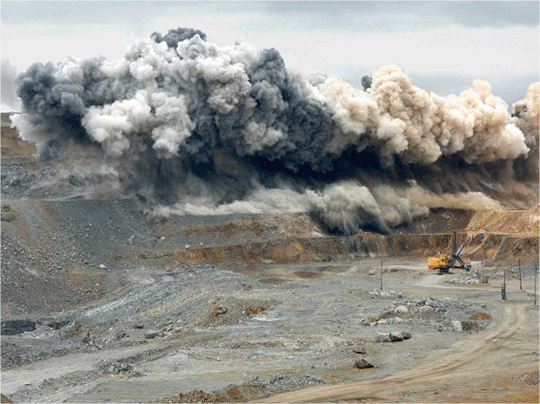
 Uranium Mining Threatens the Karoo, Karoo Space, 18 Jan 16 By Dr Stefan Cramer Images sourced by Dr Stefan Cramer Just as the threat of fracking seemed to recede in the Karoo, the danger of uranium mining has arisen – and it is even more frightening and more likely than shale gas extraction.
The Karoo has long been known to harbour substantial sedimentary uranium deposits. Now an Australian company with Russian funding is planning to get the radioactive mineral out of the ground on a major scale.
The company has quietly accumulated over 750 000 hectares of Karoo properties and concessions around Beaufort West and plans to set up a large Central Processing Plant just outside that town.
While the nation is still debating the pros and cons of fracking, the Environmental Impact Assessment (EIA) as the precursor to mining licences is nearing finalisation. During 2016 the Department of Mineral Resources will make a decision on the industry’s application……….
extensive studies on the risks of uranium mining over many decades are available today.
We can draw on vast experiences on what huge impact the uranium mining industry has had in such diverse places as in Germany, USA, Australia or Niger. The death toll of a hugely dangerous industry is well known and firmly established.
Yet so far there is no public debate, no strategic assessment process in place in the Karoo.
No advocacy groups balance the glossy claims of the industry against sobering experiences on the ground. While global energy prices are depressed, the deepening economic and political crisis makes South Africa less and less attractive to the huge investments necessary to establish an upstream gas industry.
Opponents of fracking had long made mention of the known occurrence of uranium in the Karoo subsoils. They pointed out to the dangers of extensive drilling and fracking of uranium-bearing formations.
Formation and flow-back water could contaminate surrounding waterways in the same way as has happened in Pennsylvania, USA………
There is a deafening silence in the public domain regarding uranium mining in the Karoo.
Unnoticed, the largely unknown South African company Lukisa silently accumulated some 750 000 hectares of uranium exploration concessions in the three Karoo provinces of Northern Cape, Western Cape and Eastern Cape.
The company did so by changing partnerships with different nuclear corporations like UraMin and AREVA, thus gaining access to all earlier exploration data.
The Perth-based Australian uranium miner Peninsula Energy is now engaged in a joint venture with Lukisa, called Tasman RSA Mines, with offices in Beaufort West.
Its working capital comes from several institutional investors, but is dominated by Pala Investments, domiciled in Jersey (UK) with offices in Zug (Switzerland). Pala is a relatively unknown mining giant.
According to its website, the fund has invested since its inception in 2006 in a total of 87 mining ventures in 25 countries across all six continents.
The company is controlled and run by the Russian oligarch billionaires Vladimir Iorich and his son Evgeniy Iorich. This should come as no surprise, as the secret (but leaked) nuclear agreement between Russia and South Africa calls for Russia to invest and possibly control the entire value chain of the nuclear cycles from mining, beneficiation, enrichment and fuel fabrication to energy generation, waste disposal and decommissioning.
It is only in this context that the renewed interest in the Karoo uranium makes sense………
While the specialist studies for the EIA are currently nearing termination, the company will be obliged to disclose its detailed mining and engineering plans to the general public in a series of public consultations in all affected municipalities.
This process of public participation is opening the space for a more rigorous public debate on a key issue of the future development of the Karoo, not only in the directly affected Central Karoo, but also further afield.
But the current level of information on uranium mining in general and the detailed plans for the Karoo in particular is still rather poor.
A series of information sessions in 2015 by the consulting company Ferret Mining attracted only a handful of local farmers and other interested and affected parties
The three provincial governments are completely silent. It is their duty to equip their citizens with the necessary knowledge to participate in a meaningful debate.
The South African government has identified uranium as a strategic mineral. This implies that there would be strong limitations to the export of unprocessed uranium.
The current national nuclear debate centres on nuclear power generation alone, but fails to address uranium mining at the origin of the nuclear value chain, with its widespread damages and costly remediation requirements.
The legacy costs of uranium mining have been well researched and documented (see also Broder J. Merkel, Mandy Schipek, 2011: The New Uranium Mining Boom: Challenge and lessons learned – Springer, Berlin-Heidelberg).
The affected municipalities should start their own debate as part of their legal duty to develop consistent and sustainable Integrated Development Plans (IDP). Many of the affected municipalities’ IDPs do not even reflect, or discuss the long-term threats stemming from uranium mining in their midst.
People should make their voices heard in the public consultations expected to take place over the course of the year 2016, before mining rights are granted.
To register as Interested and Affected Parties write to Ferret Mining at info@ferretmining.co.zaor call 012 753 1284/5.
To stay informed, join the Facebook page Stop Uranium Mining in the Karoo.
- Dr Stefan Cramer is a hydrogeologist from Germany, currently seconded to the Karoo by theSouthern African Faith Communities‘ Environment Institute (SAFCEI). He is based in Graaff-Reinet to assist local communities with the problems of fracking and uranium mining. http://karoospace.co.za/uranium-mining-threatens-the-karoo/
3 Comments »
Leave a reply to miningawareness Cancel reply
1 This Month
26 April – Chernobyl: Inside the Meltdown airs on National Geographic on Sunday 26th April from 4pm
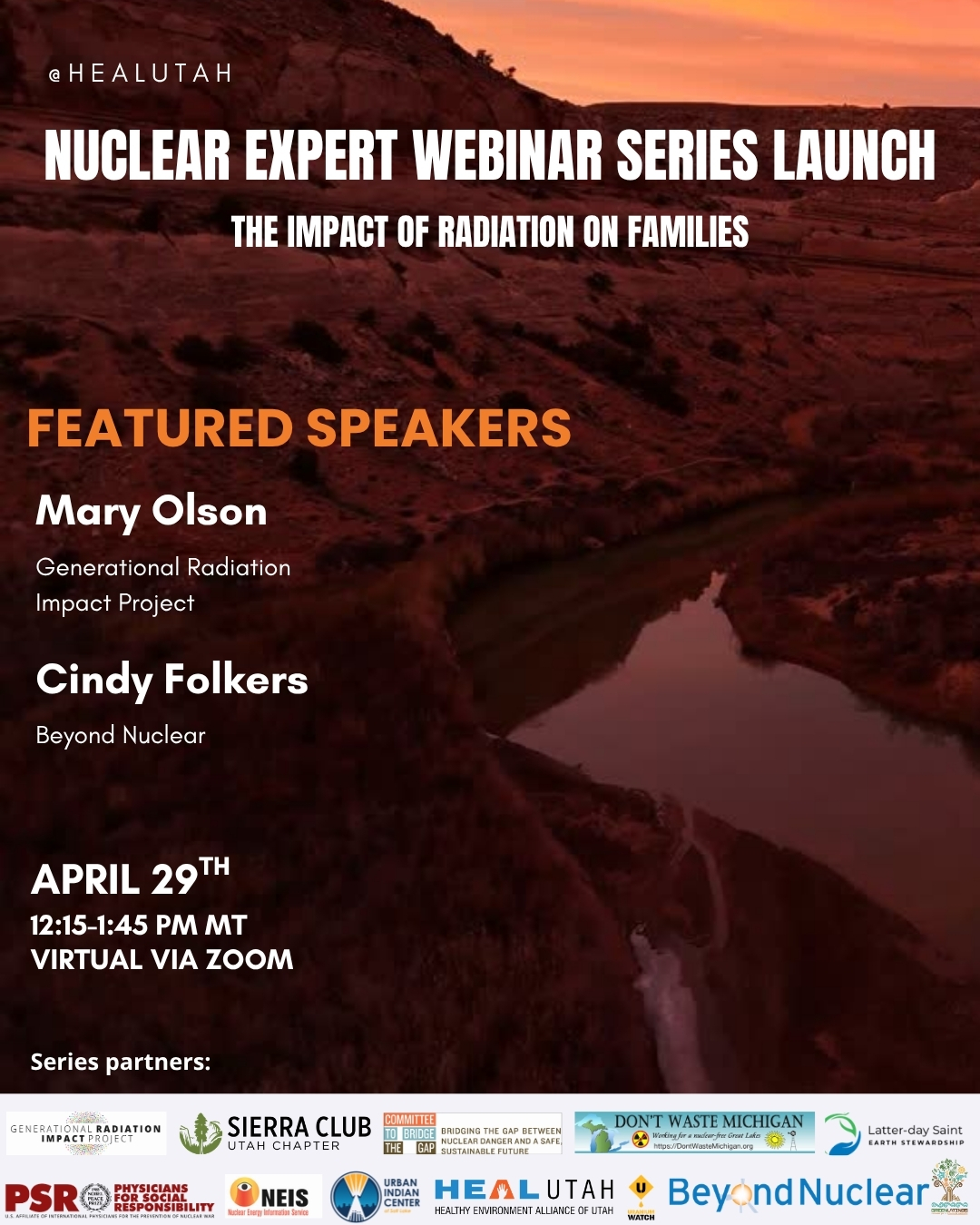
29 April – Nuclear Expert Webinar #1 – Radiation Impacts on Families with Mary Olson and Cindy Folkers
- 12:15 PM MT – 1:45 PM MT
- Location: Virtual – REGISTER TODAY

4 May -West Suburban Peace Coalition to discuss Iran war at May Educational Forum
Monday, May 4, 7:00 – 8:00 PM Central Standard Time
Title: : How Trump’s Narrative Tries to Shape the Reality of the War on Iran.
Contact Walt Zlotow, zlotow@hotmail.com 630 442 3045 for further information
14 May – online event From Bombs to Data Centres: the Face of Nuclear Colonialism

Pine Ridge Uranium is the real threat, not Tehran- Tell Burgum: Stop the Extraction.
Chernobyl: The Lost Tapes – A good documentary on Chernobyl on SBS available On Demand for the next 3 weeks– https://www.sbs.com.au/ondemand/tv-program/chernobyl-the-lost-tapes/2352741955560
To see nuclear-related stories in greater depth and intensity – go to https://nuclearinformation.wordpress.com
-
Archives
- April 2026 (346)
- March 2026 (251)
- February 2026 (268)
- January 2026 (308)
- December 2025 (358)
- November 2025 (359)
- October 2025 (376)
- September 2025 (257)
- August 2025 (319)
- July 2025 (230)
- June 2025 (348)
- May 2025 (261)
-
Categories
- 1
- 1 NUCLEAR ISSUES
- business and costs
- climate change
- culture and arts
- ENERGY
- environment
- health
- history
- indigenous issues
- Legal
- marketing of nuclear
- media
- opposition to nuclear
- PERSONAL STORIES
- politics
- politics international
- Religion and ethics
- safety
- secrets,lies and civil liberties
- spinbuster
- technology
- Uranium
- wastes
- weapons and war
- Women
- 2 WORLD
- ACTION
- AFRICA
- Atrocities
- AUSTRALIA
- Christina's notes
- Christina's themes
- culture and arts
- Events
- Fuk 2022
- Fuk 2023
- Fukushima 2017
- Fukushima 2018
- fukushima 2019
- Fukushima 2020
- Fukushima 2021
- general
- global warming
- Humour (God we need it)
- Nuclear
- RARE EARTHS
- Reference
- resources – print
- Resources -audiovicual
- Weekly Newsletter
- World
- World Nuclear
- YouTube
-
RSS
Entries RSS
Comments RSS
 nuclear-news
Reblogged this on "OUR WORLD".
Reblogged this on Mining Awareness Plus.
Reblogged this on Radiation Free Lakeland and commented:
deafening silence on imminent uranium mining plans …..in South Africa