Mainstream media did not report dangers of flooding to UK’s Drigg nuclear waste site
 NEW YEARS EVE NUCLEAR WASTE SITE FLOOD ALERT VIRTUALLY UNREPORTED http://www.celticleague.net/news/new-years-eve-nuclear-waste-site-flood-alert-virtually-unreported/ NEWS FROM THE CELTIC LEAGUE, 6 Jan 16
Our thanks to Albert Froon in the UK for posting us details of the attached article from ‘The Ecologist’ which was published on New Years Eve and warns of possible dangers from flooding at the Drigg nuclear waste site near Sellafield.
We have in the past highlighted the dangers posed by the drainage inadequacies of the main Sellafield site and the possibility of breaching of the River Calder which flows through the site (see links):
https://www.celticleague.net/news/heavy-rain-in-cumbria-wash-day-at-sellafield/
https://www.celticleague.net/news/enviroment-agency-responds-on-sellafield-drainage-issue/#respond
However in this case as you will see The Ecologist also highlights a UK Environment Agency alert about the River Irt which is adjacent to Drigg described as a nuclear waste repository. Basically however it’s simply a ‘nuclear landfill site’ and it’s probably no exaggeration to say that in its early years very little accurate record of what was disposed there was kept (see link):
You will also see in the article that Cumbrian environment campaigners ‘Radiation Free Lakeland’ sum the issue up succinctly in a letter to Cumbria County Council asking for Drigg’s gates to be locked to any more nuclear waste given the dangers from flood waters entering the site, eroding the landfill and contaminating land, river and sea with radioactive waste.
“To describe the UKs nuclear waste site as a ‘Repository’ is putting a spin on the UKs main nuclear dump for ‘low level’ waste”, the letter states.
“There is controlled discharge direct to the Irish Sea not to mention run off to the Drigg Stream and River Irt.
“Discharges to the air of radioactive gases are ongoing. According to the British Geological Society the Drigg site is above a regional aquifer. It is also likely to be destroyed by coastal erosion in 500 to 5,000 years (computer modelling can be wrong either way). Much of the waste is long lived and high risk.”
There is no doubt that the increasing frequency of storm and flood events in Cumbria pose a danger of sudden and irreversible pollution of the North Irish Sea area.
Meanwhile what are the Manx and Irish governments saying – nothing!
Refuting James Hansen’s claims about nuclear power and climate change
The nuclear power industry has essentially priced itself out of the market for new power plants because of its 1) negative learning curve and 2) inability to avoid massive delays and cost overruns in market economies. This is doubly problematic because the competition — renewable power, electricity storage, and energy efficiency — have seen steady, stunning price drops for a long time.
the IEA and many others have concluded that new renewable energy will play a far bigger role in the transition.
 Why James Hansen Is Wrong About Nuclear Power, Climate Progress BY JOE ROMM JAN 7, 2016 CLIMATOLOGIST JAMES HANSEN ARGUED LAST MONTH, “NUCLEAR POWER PAVES THE ONLY VIABLE PATH FORWARD ON CLIMATE CHANGE.” HE IS WRONG.
As the Nuclear Energy Agency (NEA) and International Energy Agency (IEA) explained in a major report last year, in the best-case scenario, nuclear power can play a modest, but important, role in avoiding catastrophic global warming if it can solve its various nagging problems — particularly high construction cost — without sacrificing safety.
Hansen and a handful of other climate scientists I also greatly respect — Ken Caldeira, Tom Wigley, and Kerry Emanuel — present a mostly handwaving argument in which new nuclear power achieves and sustains an unprecedented growth rate for decades. The one quantitative “illustrative scenario” they propose — “a total requirement of 115 reactors per year to 2050 to entirely decarbonise the global electricity system” — is far beyond what the world ever sustained during the nuclear heyday of the 1970s, and far beyond what the overwhelming majority of energy experts, including those sympathetic to the industry, think is plausible.
They ignore the core issues: Continue reading
Cruel nuclear winter, deadly famine from one “small” nuclear war
One small atomic war could trigger cruel nuclear winters and global famine http://www.techinsider.io/nuclear-explosions-earth-atmosphere-temperature-2016-1 Kevin Loria 7 Jan 16
North Korea’s fourth test of a nuclear weapon — whether it was a hydrogen bomb or not — calls attention to a well-known but sobering fact: There are a terrifying number of nuclear weapons in the arsenals of major powers around the world.
But worse, unprecedented and widespread devastation doesn’t require the unlikely scenario of all those powers unleashing all the firepower at once, according to a recent study published in an American Geophysical Union journal.
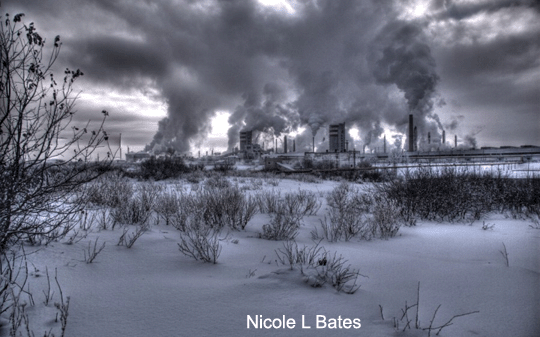
In fact, that study found that a “limited, regional nuclear war” using 100 “small nuclear weapons” — the size of the bomb dropped at Hiroshima — could cause a nuclear winter that would last decades. Continue reading
Hillary Clinton might Oppose Obama’s $1 Trillion Nuclear Arms Upgrade
 Hillary Clinton Suggests She May Oppose Obama’s $1 Trillion Nuclear Arms Upgrade [includes video] The Intercept, Lee Fang Jan. 8 2016 Hillary Clinton signaled the potential for a major national security policy reversal this week after she told an activist in Iowa that the planned $1 trillion nuclear weapons modernization program “doesn’t make sense.”
Despite a momentous speech embracing nuclear disarmament in Prague in April 2009, President Barack Obama has stunned critics by embarking on an aggressive effort to upgrade the military’s nuclear weapons program, including requests to buy 12 new missile submarines, up to 100 new bombers, and 400 land-based missiles, along with upgraded storage and development sites.
The decision has been called the greatest expansion of nuclear weapons since the fall of the Soviet Union.
Clinton’s comments came in response to a question after a Des Moines campaign event from Kevin Rutledge, a coordinator with the American Friends Service Committee’s “Governing Under the Influence” project. Staff and volunteers with the project in Iowa and New Hampshire have been peppering presidential candidates with questions about corporate influence over military policy, immigrant detention, and other issues. Continue reading
Was North Korea’s nuclear test really and H-Bomb: Science can tell

 SCIENCE CAN TELL IF NORTH KOREA’S TEST WAS REALLY AN H-BOMB, Wired, 7 Jan 16, “……North Korea has a history of exaggerating its military claims to achieve its political ends. (South Korea, the US, and Japan are typically named…… because North Korea’s leader Kim Jong Un is unlikely to let international inspectors anywhere near the test site, the only real way to tell whether North Korea’s big boom was the big H is by analyzing data collected from a suite of global sensors……
Hydrogen bombs, on the other hand, use nuclear fusion—melding atoms together—to release way more explosive energy. These “thermonuclear” weapons are so powerful that they actually need atomic fission to kickstart the fusion process. That’s right, H-bombs use an A-bomb just to get going. American scientists detonated the first H-bomb in 1952, on a Pacific atoll. It was over 500 times more powerful than the bomb the US dropped on Nagasaki. Modern H-bombs are at least twice as powerful. Which is why everyone is so freaked out about whether North Korea, the world’s most famous renegade nation, has a hydrogen bomb…….
why seismologists take recordings from multiple sensors. The agency responsible for monitoring atomic blasts, the Comprehensive Nuclear-Test-Ban Treaty Organization, currently has 42 certified seismic stations distributed around the globe (plus over 100 auxiliary stations). Because seismic signals bounce through the Earth, not only did Russia and Japan pick up North Korea’s event, but so did the US……….
The smoking gun can only really come by detecting radioactive material. To that end, CTBTO has radionuclide detection stations scattered throughout the globe. These come in two flavors. The first looks for radioactive dust—fallout. These systems use suction pumps to pull air through a filter, which then goes through a radiation counter. The types of particles present, and their radioactivity, would give a lot of clues as to the bomb’s type. Let’s say you have a typical atom bomb: Its fallout particles would be decayed bits of uranium or plutonium.
A hydrogen bomb also uses those materials, but they’d be mostly burned away by the super hot fusion reaction. According to this 1991 analysis of a Chinese explosionpublished in Science and Global Security, an H-bomb’s radioactive particulate signature would have a lot less decayed plutonium and uranium, and also different ratios of their various decayed isotopes. But if someone knew the exact particles found after an H-bomb went off, they could use that knowledge to build their own H-bomb (that’s probably one of the ways the Soviets copied the US’s weapon). Which is why Wallace told me the details of the analysis are secret. But if the blast is underground, as this one seems to have been, radionuclide detection is little help—the particles get contained.
The other type of detector looks for radioactive gases, rather than particles. Xenon gas is the most potent of these, partly because it is a noble gas that doesn’t interact with other substances. Xenon can, however, decay. And the rate of decay tells scientists the gas atoms’ exact age. For instance, after North Korea’s 2013 test, a Japanese sensor picked up xenon isotopes that scientists deduced were exactly 55 days old. The exact same day as North Korea’s test…….
it matters not just what kind of bomb North Korea detonated, but that the country detonated one at all. http://www.wired.com/2016/01/science-can-tell-if-north-koreas-test-was-really-an-h-bomb/
Fire at Japan’s Hamaoka nuclear power plant
Fire at Japan nuclear plant put out; no danger to public – operator http://www.channelnewsasia.com/news/asiapacific/fire-at-japan-nuclear-pla/2406296.html
Posted 07 Jan 2016 TOKYO: A fire broke out at Chubu Electric Power Co’s (9502.T) Hamaoka nuclear power plant in central Japan on Thursday, but was quickly put out and there had been no danger to the public, the company said.
The fire started at about 11 a.m. (0200 GMT) in the exhaust fan of the turbine building of the plant’s No.2 reactor, which is currently under being decommissioned, a company spokesman said.
The fan was shut down and the fire was confirmed as put out an hour later, he said. An investigation into the cause of the fire was under way.
The plant’s No.1 and No.2 reactors are being decommissioned, while its No.3, No.4 and No.5 reactors remain shut pending stringent safety checks imposed following the Fukushima nuclear disaster nearly five years ago.
(Reporting by Osamu Tsukimori; Editing by Richard Pullin) Reuters
Questions on safety of Chinese nuclear technology
Chinese nuclear safety must be fully scrutinized: but will it be in UK? http://drdavidlowry.blogspot.com.au/2016/01/chinese-nuclear-safety-must-be-fully.html?spref=fb Dr David Lowry, Letter to The Financial Times:
Research into baby teeth showed the nuclear cancer link
 Radioactive Baby Teeth: The Cancer Link Paperback by Joseph J Mangan In 2001, college administrators entered a remote, musty storage room near St. Louis. Not knowing what was in the room, the group was puzzled to find a large wall with hundreds of long boxes stacked against it. They pulled out one of the boxes, took off the cover, and found —- baby teeth. Quite by accident, the group had unearthed 85,000 baby teeth left over from a study done decades before.
The study had found how much radiation from atomic bomb tests had entered human bodies, by testing teeth. News of the discovery spread like wildfire in newspapers across the country. Coverage focused on the fact that the teeth could answer a critical question – how much cancer was caused by radiation exposure?
In this book, read about the mystery faced by scientists of how much radiation from nuclear weapons and reactors actually infiltrated people’s bodies – and how much cancer it really caused. Learn about the furious opposition researchers faced from government and industry. Discover how the research helped end above-ground nuclear testing, how it challenged the claim that nuclear reactors are safe, and how it exposed an undeniable link with cancer. Joseph Mangano draws on his direct experience and his involvement with scientists and citizens to create a lively, intriguing story – a story that continues today. Mangano is a health researcher, and is Executive Director of the Radiation and Public Health Project, based in New York. http://www.amazon.com/Radioactive-Baby-Teeth-Cancer-Link/dp/0615168752/ref=sr_1_3?s=books&ie=UTF8&qid=1452117447&sr=1-3&keywords=joseph+mangano
The West creating conditions to inflame Middle East and lead to wider war
Slouching Toward Global Disaster, Reader Supported News By Richard Falk, CounterPunch 01 January 16
 here are many disturbing signs that the West is creating conditions in the Middle East and Asia that could produce a wider war, most likely a new Cold War, containing, as well, menacing risks of World War III. The reckless confrontation with Russia along its borders, reinforced by provocative weapons deployments in several NATO countries and the promotion of governing regimes hostile to Russia in such countries as Ukraine and Georgia seems to exhibit Cold War nostalgia, and is certainly not the way to preserve peace.
Add to this the increasingly belligerent approach recently taken by the United States naval officers and defense officials to China with respect to island disputes and navigational rights in the South China Seas. Such posturing has all the ingredients needed for intensifying international conflict, giving a militarist signature to Obama’s ‘pivot to Asia.’
These developments are happening during the supposedly conflict averse Obama presidency. Looking ahead to new leadership, even the most optimistic scenario that brings Hillary Clinton to the White House is sure to make these pre-war drum beats even louder.
From a more detached perspective it is fair to observe that Obama seems rather peace-oriented only because American political leaders and the Beltway/media mainstream have become so accustomed to relying on military solutions whether successful or not, whether dangerous and wasteful or not, that is, only by comparison with more hawkish alternatives.
The current paranoid political atmosphere in the United States is a further relevant concern, calling for police state governmental authority at home, increased weapons budgets, and the continuing militarization of policing and law enforcement.
Such moves encourage an even more militaristic approach to foreign challenges that seem aimed at American and Israeli interests by ISIS, Iran, and China. Where this kind of war-mongering will lead is unknowable, but what is frighteningly clear is that this dangerous geopolitical bravado is likely to become even more strident as the 2016 campaign unfolds to choose the next American president.
Already Donald Trump, the clear Republican frontrunner, has seemed to commit the United States to a struggle against all of Islam by his foolish effort to insist that every Muslim is a terrorist suspect Islam as a potential terrorist who should be so treated. Even Samuel Huntington were he still alive might not welcome such an advocate of ‘the clash of civilizations’!
Historical Deep Roots………http://readersupportednews.org/opinion2/277-75/34377-slouching-toward-global-disaster
Underground nuclear testing – the stages
Stages of an underground nuclear test, BBC News [excellent diagrams] 6 January 2016 Nuclear devices are often tested underground to prevent radioactive material released in the explosion reaching the surface and contaminating the environment.
This method also ensures a degree of secrecy.
The release of radiation from an underground nuclear explosion – an effect known as “venting” – would give away clues to the technical composition and size of a country’s device, and therefore its nuclear capability.
The test site is carefully geologically surveyed to ensure suitability. Such tests usually take place well away from population centres.
The nuclear device is placed into a drilled hole or tunnel usually between 200-800m (650-2,600ft) below the surface, and several metres wide.
A lead-lined canister containing monitoring equipment is lowered into the shaft above the chamber. The hole is then plugged with gravel, sand, gypsum and other fine materials to contain the explosion and fallout underground.
The device is remotely detonated from a surface control bunker. The nuclear explosion vaporises subterranean rock, creating an underground chamber filled with superheated radioactive gas.
As this cools, a pool of molten rock collects at the bottom of the chamber.
Minutes or hours after the blast, as the pressure falls, the chamber collapses in on itself causing subsidence and a crater to appear on the surface. North Korea’s test……http://www.bbc.com/news/world-asia-35244474
Decades to clean up former Oldbury nuclear power station?
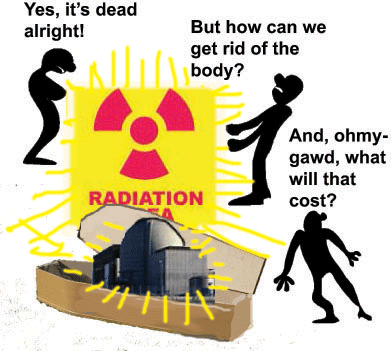 Final nuclear fuel flask leaves former Oldbury power station, BBC News 8 Jan 16 The last flask of nuclear fuel from the former Oldbury power station reactor has been sent for reprocessing.
The site was shut in 2012 after 44 years of operation, during which it produced 137.5TWh of electricity.
Operators Magnox said the final fuel shipment marked the “end of an era” but added “work was far from complete”.
Oldbury now moves to a decommissioning phase aiming to make the site “safe and secure” and free of radioactive hazard by 2027. Mike Heaton, the site director, said: “It has not been an easy task and the work at Oldbury is far from complete, but today is a significant landmark in the journey towards care and maintenance.”
Each flask carried some 200 fuel elements, and since de-fuelling began four years ago 286 flasks have been taken away from the site to be reprocessed at Sellafield in Cumbria.
This final batch of fuel elements has been in storage in a cooling pond at the site since being removed from the reactor last October. ………http://www.bbc.com/news/uk-england-bristol-35245781
‘Decluttering’ is not enough to stop the consumerism mess
Decluttering can’t save us from the consumerist mess we’ve made, Guardian, 7 Jan 16
Suzanne Moore Marie Kondo’s bestselling books sell tidying as a spiritual experience. But liberating ourselves from stuff is about more than just a neat sock drawer
“……What fascinates me is how decluttering has become yet another way of virtue signalling. The rise of mega-selling advice about decluttering is an extension of the detox, an add-on to the binge/purge cycle. For those who live on TED talks and superfood alone, then maybe tidying up really is that liberating.
For decluttering elevates the domestic sphere. This is not just cleaning. Would any woman buy a book on how to do housework?
……we hold on. We are constantly told to get more stuff and we are confused by the value of what we possess. This is acted out perversely by hoarders……
the decluttering industry can’t deal with the broader aspect of why we feel so out of control in our own homes. After all, we have merely done as we were told: consumed. Now, it has become excessive, and we are swimming in our own tat. Is this elevation of tidying enough to stop the circle of shopping, of built-in obsolescence, of fashion, of our complete lack of connection to where any of our products come from?
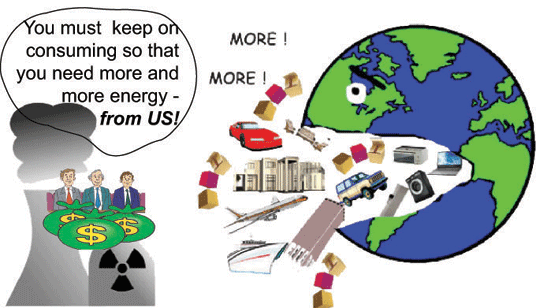
To be free from this cycle may indeed be magical. The illusion that it is up to each of us individually to sort this out may be comforting. But liberation from the mess we have made is about more than a neat sock drawer. http://www.theguardian.com/commentisfree/2016/jan/06/decluttering-cant-save-us-from-the-consumerist-mess-weve-made#comment-66332353
Entergy-Grand Gulf Nuclear Ratepayer Fleece – Bill Clinton Testimony

It’s not just the nuclear power stations of today that are years behind and over-cost. This is one of many parts of the history of nuclear power that the nuclear industry wants forgotten. This was in the mid-1980s. Billions was a lot more then.
In 1984: “Electric rate increases of 25 to 50 percent or more are looming for millions of customers in nine states because of billions of dollars in excess costs at 14 nuclear plants scheduled for completion in the next few years.”
Once one of the Grand Gulf Nuclear Reactors was completed, it was 400% over budget, five years behind and was mostly unneeded. The second one was not completed. Louisiana, Mississippi, Arkansas and New Orleans fought because no one wanted to pay for it.
In 1985: “The issue is how much people here and in neighboring states will have to pay toward the…
View original post 472 more words
January 7 Energy News

World:
¶ Enel Green Power and the mini-grid technology provider Powerhive are partnering on developing solar-powered mini-grids in rural Kenya. The $12 million project will involve work in 100 different villages in Kenya, with 93% of the financing for the project coming via Enel Green Power, and 7% via Powerhive. [CleanTechnica]
 Image by William Warby (some rights reserved)
¶ While the world’s attention is focused on Saudi Arabia’s latest flare up with Iran, many Saudis are concerned about the “economic bomb” at home. The government is slashing a plethora of perks for its citizens.The cash crunch is so dire that the Saudi government just hiked the price of gasoline by 50%. [CNN]
¶ E·ON and Samsung SDI have signed a Memorandum of Understanding to work together in the energy storage field. They will collaborate on energy storage solutions, and develop a business model together. Some of…
View original post 718 more words
Australia’s Nuclear History


Australia has a secret and scandalous nuclear history. But at the same time, Australia has a fine history of successes by the nuclear free movement. Aboriginals have been at the forefront, but not alone, as Australia also has a proud record of environmental and anti nuclear activism.
From the archives. Each week, this site will be reposting items from the past. Lest we forget:
Australia’s Parliament reported on degrading effect of uranium mining on Aboriginal people.
The1997 Australian parliament report observes: ‘(The) history of uranium mining in Australia and its impact on Aboriginal people is deplorable. Past mining in places like Rum Jungle have left areas so degraded that traditional owners are unable to use them, while mines such as Ranger (also in the Northern Territory) have been forced on traditional owners against their will.” “Even at mines such as Olympic Dam,” it adds, “…there was deep concern at…
View original post 278 more words
1 This Month

of the week – Shut Down Drone Warfare!


Tell the Ukrainian Government to Drop Prosecution of Peace Activist Yurii Sheliazhenko

Petition to revoke the licensing of the Near Surface Nuclear Disposal Facility (NSDF) at Chalk River. https://www.ourcommons.ca/petitions/en/Petition/Details?Petition=e-7247
To see nuclear-related stories in greater depth and intensity – go to https://nuclearinformation.wordpress.com
-
Archives
- April 2026 (57)
- March 2026 (251)
- February 2026 (268)
- January 2026 (308)
- December 2025 (358)
- November 2025 (359)
- October 2025 (376)
- September 2025 (257)
- August 2025 (319)
- July 2025 (230)
- June 2025 (348)
- May 2025 (261)
-
Categories
- 1
- 1 NUCLEAR ISSUES
- business and costs
- climate change
- culture and arts
- ENERGY
- environment
- health
- history
- indigenous issues
- Legal
- marketing of nuclear
- media
- opposition to nuclear
- PERSONAL STORIES
- politics
- politics international
- Religion and ethics
- safety
- secrets,lies and civil liberties
- spinbuster
- technology
- Uranium
- wastes
- weapons and war
- Women
- 2 WORLD
- ACTION
- AFRICA
- Atrocities
- AUSTRALIA
- Christina's notes
- Christina's themes
- culture and arts
- Events
- Fuk 2022
- Fuk 2023
- Fukushima 2017
- Fukushima 2018
- fukushima 2019
- Fukushima 2020
- Fukushima 2021
- general
- global warming
- Humour (God we need it)
- Nuclear
- RARE EARTHS
- Reference
- resources – print
- Resources -audiovicual
- Weekly Newsletter
- World
- World Nuclear
- YouTube
-
RSS
Entries RSS
Comments RSS
 nuclear-news