“We are the Miner’s Canary”: Indigenous Organizations Call for Clean Up of Radioactive Pollution Crisis; “Clean Nuclear is a Deadly Lie”

““Native American nations of North America are the miners’ canaries for the United States trying to awaken the people of the world to the dangers of radioactive pollution”, said Charmaine White Face from the South Dakota based organization Defenders of the Black Hills. South Dakota has 272 AUMs [Abandoned Uranium Mines] which are contaminating waterways such as the Cheyenne River and desecrating sacred and ceremonial sites. An estimated 169 AUMs are located within 50 miles of Mt. Rushmore where millions of tourists risk exposure to radioactive pollution each year.” (From Clean Up the Mines! Press Release, below)
Mount Rushmore, South Dakota, National Park Service
From Clean Up the Mines:
“Press Release: ‘We are the Miner’s Canary’: Indigenous Organizations Call for Clean Up of ‘Homegrown’ Radioactive Pollution Crisis
POSTED January 29, 2016 WRITTEN BY Clean Up The Mines!
For Immediate Release
Friday, January 29, 2016
15,000 Abandoned Uranium…
View original post 1,558 more words
January 31 Energy News

Opinion:
¶ Politicians take note: Iowa is the US’s most wind-powered state – and everyone loves it! • Wind supplies 30% of the state’s power, more than any other US state. Windpower also gets real bipartisan support in Iowa. A recent poll taken by Public Opinion Strategies shows an 85% approval rating. [The Ecologist]
 Wind power in Iowa, where it’s big, getting bigger, and everyone loves it. Photo: Andrew Huff via Flickr (CC BY-NC).
¶ Nuclear renaissance? Failing industry is running flat out to stand still • Ten new power reactors began supplying electricity last year (eight of them in China), and eight reactors were permanently shut down. In 1995 there were 434 ‘operable’ reactors. In 2005 there were 441, and now there are 439. [The Ecologist]
Science and Technology:
¶ A new design from Sandia National Laboratories, for wind turbines with gigantic blades longer than…
View original post 545 more words
January 30 Energy News
Opinion:
¶ Why cheap oil isn’t bad for the environment • A lot of opposing forces are shaking the old assumptions. In the jaws of bargain oil, the US DOE expects Americans to increase their use of renewable power this year by almost 10%. Why is this time different? There are many factors, and nearly all favor renewables. [The Daily Advertiser]
 A Vestas service technician walks up the stairs to the door of a wind turbine at the Taralga Wind Farm. (Photo: Mark Kolbe, Getty Images)
¶ The NYC Security Risk That Candidates Aren’t Discussing • It is surprising that presidential candidates don’t do more to protect to New York City. But to be fair, New Yorkers themselves may not know the security risk the Indian Point nuclear plant poses, several miles up the Hudson River. [Huffington Post]
¶ France Peddles Unsafe Nuclear Reactors to India…
View original post 727 more words
Advice of “Father of Health Physics” for Disposing of Tritium Safely Rebuffed by US NRC, Dr. K.Z. Morgan interview: DC, Philadelphia, Baltimore Treated as Guinea Pigs
 http://web.ornl.gov/info/ornlreview/rev25-34/chapter2sb4.htm
From Dr. Morgan interview:
“This attitude [for radiation safety] did not prevail, apparently, at some other places. Certainly it did not at Three Mile Island. Since I left the faculty at Georgia Tech, I’ve testified in over a hundred-fifty cases, trying to help people that have allegedly been injured by radiation. We won the Karen Silkwood case and Crumbeck case, and I was a sole witness [for the plaintiff when] we won in the Three Mile Island class-action suit.
But in most other cases, the AEC and DOE [have] called—[what was] then the Department of Justice [(DOJ)]; let me call it the “Department of Injustice” [to make false claims about radiation exposure] under some of the people there. They [(the DOJ employees)] actually bragged about the fact that they set up courses to train health physicists and lawyers on how to keep injured parties, injured from radiation, from…
View original post 1,278 more words
Contaminated food in Japan – Taro Yamamoto -English Transcription

Now, they are telling us that it’s safe to eat. Please, I beg. Please stop. Give us some mercy. That’s how I feel. Why would a country do such a thing, you wonder. The answer is easy. Unless they use such a high number, the economy won’t turn around. Unless they use such a high number, our food won’t be on the market. There will be compensation and insurance issues to deal with.
Contaminated food in Japan – English Transcription below
被爆の現状: 日本にいる人は必見です。シェアお願いします。
This must be shared by anyone who is in Japan. Please pass on if you know anyone who is in Japan. Taro Yamamoto talks about risk of Fukushima radiation in Japanese food. Current Japanese regulation allows nuclear waste level food to be on the market. He also appeals for people’s right to evacuate in contaminated areas. The political decision to protect the market economy has resulted in this catastrophic situation where many are predicting a major disaster according to numbers indicated by Chernobyl, Hiroshima and etc.
https://m.youtube.com/watch?v=aseCLtFsXgM&feature=youtu.be
Here is a transcript of the interview. I am responsible for any errors in translation.
Hiroyuki Hamada http://hiroyukihamada.com/
Taro Yamamoto Interview, regarding radiation exposure
We should regard the need for elimination of nuclear power as a fact. Japan is an earthquake prone nation. The Fukushima accident has proven that nuclear power plants can’t withstand earthquake and tsunami. But this country is totally heading in the opposite direction. We’ll restart nuclear plants. We’ll build more of them. We’ll export them too. We can only describe the situation as insanity.
When the power that forces nuclear power to prevail dominates us, we must focus our attention in seeking ways to survive. So the words we use to describe our policy should not be elimination of nuclear power, but it should be elimination of radiation exposure. We will not expose our children to radiation. And since it’s grownups’ job to do so, we will not expose grownups either. What can we do to achieve that goal? We have to give the right to evacuate to the people who live in areas with 1 m Sv per year. If anyone wishes to leave, the government must help with financial support as well as guaranteeing a job. That must be done, right? We are all victims. Today, we only have the right to be radiated. That’s not a right at all. It’s a coercion. Coercion of absurdity. Who can stand anything like that? We need the right to evacuate as well as the right to be radiated.
We had the accident in Fukushima caused by TEPCO. And, it is still continuing. There is 10 million Bq per hour radiation coming out of the plants. That’s 240 million Bq per day going out to the sky. The leakage into the ocean is not even counted. It’s just dumped freely. They don’t even know what sort of effects they can expect from it. In fact, they don’t want to know what the effects are. Because if they reveal the situation for what it is, they must admit that the entire area of eastern Japan is contaminated. Of course, the contamination is not evenly spread. But the hot spots do spread in the area. That must be disclosed. There are people who will be affected. In fact, there might be food being produced in such areas.
And they say that there is no need to worry because they inspect the food. The food is contaminated sporadically so it stands to reason that their sporadic inspection can miss the trace of contamination. According to the current Japanese regulation we can safely consume 100 Bq per 1 kg in our food. They say it’s OK to eat that much. But it’s not that clear just by hearing the number, right? But when we compare the number allowed today for our food consumption with the number before the accident, the number we have today is the same as the amount deemed as radioactive waste before the accident: The material that had to be stored in yellow barrels with a strict regulation. It was the material that had to be supervised for 1 million years. Now, they are telling us that it’s safe to eat. Please, I beg. Please stop. Give us some mercy. That’s how I feel. Why would a country do such a thing, you wonder. The answer is easy. Unless they use such a high number, the economy won’t turn around. Unless they use such a high number, our food won’t be on the market. There will be compensation and insurance issues to deal with.
So what can we do? I was compelled to stand up. I heard people saying there is no use for someone like myself. We should let the professionals deal with politics, they said. But the thing is that we are dealing with the result of letting the professionals do the job. I dare say that we need an idiot like myself who can act. I believe that I need to step forward with all my strength and raise my voice as much as I can, as I depend on people’s wisdom.
Taro Yamamoto, Japanese independent Diet member
Source Video (Japanese only)
https://www.youtube.com/watch?v=aseCLtFsXgM
Why the Nuclear Lobby and Australian Politicians want Australia as world’s radioactive trash dump
from CaptD 31 Jan 16 The first reason is MONEY and I mean BIG Money. Politicians are always gear for Nuclear  Payback*
* http://www.urbandictionary.com/define.php?term=Nuclear+payback
Those that support nuclear power because nuclear power somehow supports them; no matter what the health implications or other “costs” are for others.
The “other” reason is that the Nuclear Industry and their Utilities are desperate to create a radioactive waste dumping site for waste is that they are going to want to site Small Modular Reactors (SMRs) very soon, which companies like SD’s General Atomic are now working on. Since CA has a law that says no more nuclear reactors, until a waste site is developed, the lack of a disposal site is the biggest roadblock they face preventing them from deploying SMRs in CA.

I believe that most Utilities will want to phase out Nat. Gas fired Peaker plants and install SMR’s “because they don’t emit CO2.” That is, unless they are going to be making big money using nat. gas like SDG&E will be, since they already have a contract to import Nat. Gas from Mexico (which Sempra owns a share of, so they will be kind of buying Nat. Gas from themselves) for use in their two new state of the art Billion Dollar Peaker Plants that the CPUC just approved for them (despite the fact that the cost of Wind and Solar generation continues to drop almost monthly)!
SCE just had the CPUC decide against approving a Nat. Gas Peaker plant for them, so you can bet that they are now getting “very excited” about installing one or more SMR’s at San Onofre, since the grid wiring connection is already in place and they are going to be guarding that “nuclear waste” site for decades to come.
http://www.kpbs.org/news/2016/jan/08/oceanside-takes-stand-relocating-san-onofres-nucle/
BTW: All waste facilities should be run by the Government, that way they will always be responsible for it, since Big Waste Corp.’s can go out of business any time they want as as everybody knows Radiation is FOREVER since 50 or more than 100 years is forever to everyone living today.
High radiation levels, murky radioactive water, cause Japan to delay Fukushima robot survey
 TEPCO delays robotic surveys at Fukushima nuclear reactors http://ajw.asahi.com/article/0311disaster/fukushima/AJ201601290050 January 29, 2016 By HIROMI KUMAI/ Staff Writer
Tokyo Electric Power Co. has postponed inspections by robots to finally confirm the location and state of melted fuel at two damaged reactors of the Fukushima No. 1 nuclear plant.
The camera-equipped robots were scheduled to enter the containment vessels of the No. 1 and No. 2 reactors within fiscal 2015, which ends in March. But TEPCO said Jan. 28 that a series of unexpected circumstances, such as poor visibility caused by murky radioactive water, have ruined that plan.
The robot for the No. 1 containment vessel will be redesigned, and the remote-controlled survey will be conducted in fiscal 2016, the utility said, without offering a more specific timetable.
Nuclear fuel assemblies in the No. 1 to No. 3 reactors are believed to have melted and fallen to the bottom of the containment vessels following the March 2011 earthquake and tsunami.
Radiation levels inside the containment vessels remain extremely high, making them too dangerous to be approached by workers.The remote-controlled robotic probe was seen as crucial in determining conditions inside the containment vessels for the eventual decommissioning of the nuclear plant.
TEPCO conducted a preliminary survey using an industrial endoscope in the containment vessel of the No. 1 reactor. It found accumulated waste turned the water murky and blocked the view.
For the No. 2 reactor, TEPCO had planned to locate the melted nuclear fuel using a robot last summer. But decontamination and cleanup work near the entrance to the containment vessel proved difficult. That prevented TEPCO from carrying out robotic survey as planned.
Low dose ionising radiation takes its toll on living organisms – Timothy Mousseau
 Even low radiation dose can take toll: scientist http://www.chinapost.com.tw/taiwan/national/national-news/2016/01/27/457138/Even-low.htm By Enru Lin, The China Post TAIPEI, Taiwan–Animals exposed to even low doses of radiation suffer a higher incidence of physical abnormalities, a world-leading ecologist said in Taipei on Tuesday. Timothy Mousseau, an ecologist at the University of South Carolina, is a pioneering expert on what radiation does to organisms.
For decades, he and his research team have studied Chernobyl, Ukraine — site of the world’s worst nuclear disaster in 1986 — and Fukushima in Japan.
Their studies found that radiation exposure had significant effects on local populations, for instance causing tumors, small brain sizes, sterility and cataracts in birds in Chernobyl.
No Safe Dose?
Findings indicate that radiation, even at low doses, can increase mortality rates and the incidence of physical abnormalities.
“There is no threshold below which there is no effect on organisms,” Mousseau said.
“We need to be very concerned not only about the consequences of nuclear accidents, but also the regular day-to-day operations of nuclear power plants, where radiation is released on a regular basis.”
Call for Taiwan Research
Mousseau was speaking on invitation at a press briefing and forum at the Legislative Yuan, where he was joined by three Democratic Progressive Party (DPP) lawmakers including Tien Chiu-chin (田秋堇).
At the event, anti-nuclear activists called on the central government to commission an independent research team to study effects on people who live near Taiwan’s three operating nuclear power plants.
Birds, Butterflies First
Mousseau said his data suggested that some organisms were far more sensitive to radiation than others.
Studies from Chernobyl and Fukushima showed that the first significant effects of radiation occurred in the same taxonomic groups.
“Birds and butterflies are the two most sensitive groups — we saw immediate large responses in birds and butterflies in Fukushima,” he said.
Other animals, such as grasshoppers and spiders, are less susceptible to the effects of radiation.
On Humans
Meanwhile, there is insufficient research on the human population to make convincing assessments on the impact of low dose radiation.
Mousseau said that in the U.S., studies are thwarted when researchers can’t access the relevant health records.
“There are privacy issues related to health records that are so strong in the United States, and there is a lack of organization of the registries. That makes it very difficult to do solid, hard science,” he said.
Germany’s nuclear waste nightmare
Radioactive waste dogs Germany despite abandoning nuclear power https://www.newscientist.com/article/2075615-radioactive-waste-dogs-germany-despite-abandoning-nuclear-power/ Major problems at a salt mine where 126,000 drums of radioactive debris are stored are fuelling public distrust of long-term waste disposal plans, reports Fred Pearce from Asse, Germany
Half a kilometre beneath the forests of northern Germany, in an old salt mine, a nightmare is playing out. A scheme to dig up previously buried nuclear waste is threatening to wreck public support for Germany’s efforts to make a safe transition to a non-nuclear future.
Enough plutonium-bearing radioactive waste is stored here to fill 20 Olympic swimming pools. When engineers backfilled the chambers containing 126,000 drums in the 1970s, they thought they had put it out of harm’s way forever.
But now, the walls of the Asse mine are collapsing and cracks forming, thanks to pressure from surrounding rocks. So the race is on to dig it all up before radioactive residues are flushed to the surface.

“There were people who said it wasn’t a good idea to put radioactive waste down here, but nobody listened to them,” says Annette Parlitz, spokeswoman for the Federal Office for Radiation Protection (BfS), as we tour the mine.
This is just one part of Germany’s nuclear nightmare. The country is also wrestling a growing backlog of spent fuel. Continue reading
Pierce County, USA not happy with DOE plan for a deep bore feasibility study for nuclear waste
 Rocky road for nuclear waste bore hole study, http://bismarcktribune.com/news/state-and-regional/rocky-road-for-nuclear-waste-bore-hole-study/article_7698d465-0316-5031-83e9-bc727d3592b9.html By Lauren Donovan, 29 Jan 16 A plan to explore deep ancient rock in Pierce County for its potential to store nuclear waste hit a bumpy road if not a rock wall in its first introduction to state officials Thursday.
The State Board of University and School Lands heard from the Energy and Environmental Research Center at Grand Forks that its team was awarded $35 million by the federal Department of Energy to drill 16,000 feet down into crystalline rock to learn whether the rock could suitably store spent nuclear fuels.
John Harju, project liaison, said the bore hole is for study purposes only, no waste would be stored there and that such storage isn’t even yet legal under federal rules.
Harju said the bore hole would be an opportunity to analyze rock core that’s rarely ever been looked at for minerals or geothermal properties. The chance to go that deep, into the oldest rock on the planet, “may never present itself again,” Harju said.
The issue was presented to the land board because EERC is proposing to drill on 20 acres of state-owned land about 15 miles south of Rugby.
Pierce County commissioners were at the meeting and said they were startled to read about the project before anyone from EERC even came to the county.
Commissioner Duane Johnston said, if the issue had come up at a local zoning meeting, “half the county would have been there to say no.” Commission chairman Dave Migler said it was tough to take calls from residents and not have much information to share. “It’d be nice to be in the loop,” he said.
While there was no formal application on the table, land board members didn’t hesitate to weigh in with worries that a federal project could become a federal mandate.
In the end, it was far from clear how the EERC would proceed with getting approval to use public land for the project in Pierce County, or perhaps anywhere in the state.
Afterward, Harju said he was a little surprised by his reception. “Plan B? We don’t have one. If the project is not able to proceed, the DOE will have to evaluate” alternatives, he said.
The five-year project was awarded to the Battelle Memorial Institute of Ohio, along with EERC and Schlumberger, a familiar drilling service company in the Bakken. The crystalline rock formation underlies much of the continent.
Bernie Sanders calls for total phaseout of nuclear energy

Protest repressed in India, as government panders to France, USA
the international nuclear industry has faced its worst crisis globally. The industry is looking at India as a big market where they can compensate for their losses and revive their fortunes. India has become an attractive market for global nuclear corporations

France Peddles Unsafe Nuclear Reactors to India, Drawing Protest , 29 January 2016 By Kumar 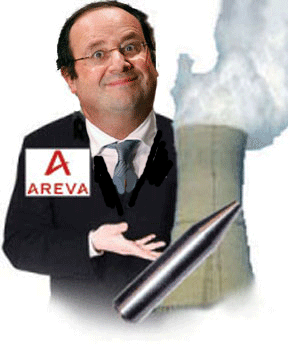 Sundaram, Truthout | News Analysis On January 26, French President François Hollande was the chief guest for India’s Republic Day ceremony, where India showcases its military hardware in a colonial-era parade in its capital. Meanwhile, in Jaitapur on India’s western coast, farmers and fisherfolk were protesting against Hollande’s visit, arguing that the nuclear reactors that India is importing from France threaten their lives, livelihoods and the local ecology.
The Joint Declaration: Localizing Risk, Siphoning Off Profit
In a joint declaration issued on January 25 in New Delhi, the two governments reaffirmed their commitment to go ahead with a long-pending nuclear deal. As per the declaration, the intense negotiations to finalize the commercial agreement are expected to conclude by the end of this year, and the construction of six European pressurized reactors (EPR) imported from France is to begin by early 2017.
The new twist in the declaration is the “maximum localization” of the project and “technology transfer” for the same. Although the government of Indian Prime Minister Narendra Modi seems to have proudly included these new terms and added a “Made in India” tag on the Jaitapur project, it actually means that the French industry would be transferring the burden of its most controversial reactor design at a time of its worst crisis.
The safety vulnerabilities of the reactor pressure vessel (RPV) – the huge iron core where radioactive fission takes place – came under serious questions, raised by France’s own nuclear safety regulator Autorité de Sûreté Nucléaire (ASN) in April 2015. Later in 2015, Areva, the French reactor builder, had to ask the US Nuclear Regulatory Commission to suspend certification review for EPR design. The United States has been postponing certification for EPR since 2007. The Finnish regulator has taken Areva to court on this issue, and Finland has canceled the order for its second EPR. Just two days after the publication of ASN’s report, Modi reaffirmed the EPR deal from France during his visit to Paris in April 2015. It is exactly this controversial component – the RPV – that an Indian private company L&T will now be building, with no experience in the nuclear sector at all.
The current phase of negotiations on Jaitapur is about the price of reactors, which remains a major sticking point. Although the former chief of India’s Atomic Energy Commission promised a tariff of a maximum of 10 US cents per unit for the electricity produced in Jaitapur, independent experts have claimed it will be much higher (20 to 30 cents per unit). This means the government of India would use taxpayers’ money to keep the price competitive. If we go by the cost of EPRs in the United Kingdom, each Indian reactor may cost as much as $8.9 billion. Two reactors in Jaitapur’s first phase will cost as much as India’s total expenditure on science and technology (including the departments of space, science and technology, biotechnology, and research for the entire country). A diplomatic cable revealed by WikiLeaks quoted the general manager of the Nuclear Power Corporation (NPCIL), saying that India is paying a “high” price for Jaitapur………….
The Indian government has managed to acquire land for the project by pressuring farmers and luring a handful of landlords. Despite land acquisition, the farmers in Jaitapur continue to resist. Most villagers either work on others’ land or provide rural services to the agrarian community and do not get any compensation when villages are dislocated for “development” projects. Tabrez Soyekar, a young fisherman, was killed in an indiscriminate police shooting in April 2011, during a peaceful protest. Hundreds of activists and eminent citizens, including the former Navy chief of India and retired justice of the Supreme Court of India, were detainedduring a protest march.
Thirteen village councils in Jaitapur passed unanimous resolutions against the project as recently as November 2015. It is utterly hypocritical for both countries to laud each other’s democratic credentials for international diplomacy if the democratically elected village councils are neglected violently……..
Independent energy experts in India, including a former top official in the Ministry of Power, have argued for a decentralized energy framework that would suit India better, as the majority of its population still lives in villages scattered across the country and transmission losses in centralized Indian grids are staggering.
The 2015 World Nuclear Industry Status Report concludes that, after the Fukushima accident, the international nuclear industry has faced its worst crisis globally. The industry is looking at India as a big market where they can compensate for their losses and revive their fortunes. India has become an attractive market for global nuclear corporations, where the government is mortgaging its financial and environmental health to welcome them. This includes channeling the accident liability to the public; undermining environmental, geological and safety laws; and ignoring the measured advice of independent experts.
Besides Jaitapur, massive and intense anti-nuclear protests have arisen in Koodankulam, Mithi Virdi and Kovvada, where Russian and US corporations are setting up nuclear power plants. Local communities in other places like Chutka, Fatehabad and Mahi Banswara have also been agitating against the nuclear projects. The government has resorted to brutal crackdowns and repression against these consistently peaceful protests. More than 8,000 people in Koodankulam are facing fabricated police cases under colonial-era sedition laws and charges of waging war against the Indian state. The police have killed, arrested and harassed villagers indiscriminately, including women and children. They surrounded the Idinthakarai village in 2012 and disrupted its vital supply lines that deliver goods, including food and milk for children and medicines, to force the village to surrender. One of the first steps that the new government under Modi took in 2015 was to come up with a “confidential” report by the Intelligence Bureau, naming Greenpeace, the Coalition for Nuclear Disarmament and Peace, and other anti-nuclear and environmentalist organizations “anti-national.”http://www.truth-out.org/news/item/34627-france-peddles-unsafe-nuclear-reactors-to-india-drawing-protest
Radioactive trash problem accelerates in Japan , with latest nuclear reactor restart
 Third reactor restart spurs fears over shaky Kansai evacuation plans BY ERIC JOHNSTON STAFF WRITER , JAPAN TIMES, TAKAHAMA, FUKUI PREF 29 JAN 16 . “……The restarts also mean Kepco must once again confront the question of what to do with spent fuel, an issue that is rapidly becoming one of local and national concern.
The spent-fuel storage pools for the Takahama No. 3 and 4 reactors are expected to be full in about eight years. Kepco plans to remove the fuel and nuclear waste to a mid-term storage facility for a half century before transporting them somewhere else for final storage.

In a recent meeting with Fukui Gov. Issei Nishikawa, Kepco President Makoto Yagi said Kepco wants to begin operating a mid-term storage facility outside the prefecture by around 2030. The utility aims to choose a site for the facility by 2020.
That presents a problem. Kepco promised Nishikawa that spent fuel from the Takahama reactors will not be stored within the prefecture but in one of the utility’s other service areas. This means Shiga, Kyoto, Nara, Hyogo, Osaka, Wakayama, Mie or Gifu.But there are certain conditions a potential storage site has to meet. For transportation reasons, Kepco wants it located in a prefecture with port facilities. That eliminates Nara, Shiga, and Gifu prefectures. Second, Yagi says that local consent to build and store the waste is crucial.
That is potentially an even bigger problem. Kyoto Gov. Keiji Yamada has strongly opposed building a facility in his prefecture. Osaka Gov. Ichiro Matsui appears opposed as well, saying he does not want Kepco in charge of the facility. Mie and Hyogo prefectures have said they are not considering hosting a facility at present.
Only Wakayama appears to be a possibility at the moment. In 2009, the port city of Gobo hinted it might be interested in hosting a mid-term facility. Kepco did a survey and agreed it was possible to build there, but nothing has happened since then.http://www.japantimes.co.jp/news/2016/01/29/national/third-reactor-restart-spurs-fears-over-shaky-kansai-evacuation-plans/#.VqvMftJ97Gg
LA gas disaster – a mini Chernobyl?
Breaking: They may have “lost control entirely of entire field” involved in LA gas disaster, and it’s coming up everywhere… We learned there’s many other leaks -Attorney — Officials: Loud sound of gas escaping heard half mile away; A “mini-Chernobyl” — AP: Leak “out of control”… amount released “seriously underestimated” (VIDEO)http://enenews.com/breaking-company-entirely-lost-control-entire-gas-field-involved-la-methane-disaster-leaking-everywhere-learned-many-other-wells-leaking-attorney-official-mini-chernobyl-ap-leak-control-tv-a?utm_source=feedburner&utm_medium=email&utm_campaign=Feed%3A+ENENews+%28Energy+News%29
Porter Ranch Town Hall Meeting, Jan 22, 2016 (emphasis added) — Patricia Oliver, attorney (at 11:30 in): “Now it’s kind of simple — if you have a well blow-out, you quit injecting [more gas] underground… No order had been issued [to stop this] though… We sent a letter [to the Division of Oil, Gas & Geothermal Resources (DOGGR)] saying, “Stop all of the injections, until you can stop the leak”… So we sent a letter on Dec. 1 asking them to stop all injections… Nine days later, they said, “Stop injecting gas”… You’d think that at least temporarily settled it — because if [SoCalGas] didn’t like that, SoCalGas could have temporarily appealed… I have no record of appeal… AQMD [Air Quality Management District] inspected the facility on Nov. 10… and they found all these wells that weren’t accessible — 16 approximately… We don’t know yet why they were inaccessible. We also learned that 15 wells were leaking. We also don’t know why that happened. I spoke at the AQMD hearing this last week and said, “I’m concerned that the fact that now you guys are looking at these injection wells — you don’t know what that means.” You see, DOGGR knows what that means — and that’s a sign that SoCalGas lost control entirely of the entire field and it’s leaking everywhere… So we were like, “We want proof. Now if it’s just coincidental, and you show us why that’s not what’s happening, that’s fine, but provide the evidence”… Families have a right to know what’s going on in that oil field.” (Audience applauds)
Rep. Brad Sherman, U.S. House of Representatives, Jan 21, 2016 (at 17:45): “This the largest natural gas leak in history. We were up there yesterday… what we heard was a loud sound of natural gas escaping that you could hear quite loudly from over half a mile away.”
The Guardian, Jan 11, 2016: Residents attack slow response to what official called ‘a mini-Chernobyl’… “This is a mini-Chernobyl,” Mike Antonovich, the LA county supervisor, told a public hearing at the weekend… [It] is the largest leak of… methane known to experts.
CBS/AP, Jan 15, 2016: A new report shows the level of toxins released… has been seriously underestimated, state regulators said… The findings were released in response to [SoCalGas’ admission that they] underestimated the number of times the cancer-causing chemical benzene has spiked.
AP, Jan 22, 2016: AP, Jan 22, 2016: Officials Waited Months To Monitor California’s Massive Gas Leak — A massive natural gas leak… had been out of control for more than a month when the county’s acting health director said in November that long-term impacts of the cancer-causing chemical benzene should be measured. It took many more weeks to implement the testing… “We can always look back and say, ‘Why didn’t we start with an expanded monitoring program?’” said Angelo Bellomo, deputy county director for health protection… Rob Jackson, an environmental scientist at Stanford University, said… it had undermined the ability to measure health impacts.
UK nuclear power project a bonanza for Japanese companies, Hitachi-GE and others
Hitachi sees over 1tn yen in business for Japan companies http://asia.nikkei.com/Business/Deals/Hitachi-sees-over-1tn-yen-in-business-for-Japan-companies
 TOKYO — A nuclear power project in the U.K. will generate more than 1 trillion yen ($8.42 billion) in orders for Japanese businesses, it was learned Sunday, giving a shot in the arm to exports by an industry suffering from a lack of orders at home since the Fukushima accident of 2011.
More than 3 trillion yen is budgeted for the project if joint venture Hitachi-GE Nuclear Energy constructs four advanced boiling water reactors — and an even higher sum if six reactors get the nod. Hitachi has invited 40 or so Japanese companies to a meeting at the British Embassy here to explain details.
Also expected are water supply pump manufacturer Ebara as well as Kurita Water Industries and Kubota. Shimizu and Kajima, which have experience building housing structures for nuclear plants in Japan, will also likely go.
While Hitachi-GE will handle the reactor core, Japanese companies are expected to undertake key technologies for operating the nuclear plant, giving Japan about 40% of the project total.
(Nikkei)
1 This Month

of the week – Shut Down Drone Warfare!


Tell the Ukrainian Government to Drop Prosecution of Peace Activist Yurii Sheliazhenko

Petition to revoke the licensing of the Near Surface Nuclear Disposal Facility (NSDF) at Chalk River. https://www.ourcommons.ca/petitions/en/Petition/Details?Petition=e-7247
To see nuclear-related stories in greater depth and intensity – go to https://nuclearinformation.wordpress.com
-
Archives
- April 2026 (114)
- March 2026 (251)
- February 2026 (268)
- January 2026 (308)
- December 2025 (358)
- November 2025 (359)
- October 2025 (376)
- September 2025 (257)
- August 2025 (319)
- July 2025 (230)
- June 2025 (348)
- May 2025 (261)
-
Categories
- 1
- 1 NUCLEAR ISSUES
- business and costs
- climate change
- culture and arts
- ENERGY
- environment
- health
- history
- indigenous issues
- Legal
- marketing of nuclear
- media
- opposition to nuclear
- PERSONAL STORIES
- politics
- politics international
- Religion and ethics
- safety
- secrets,lies and civil liberties
- spinbuster
- technology
- Uranium
- wastes
- weapons and war
- Women
- 2 WORLD
- ACTION
- AFRICA
- Atrocities
- AUSTRALIA
- Christina's notes
- Christina's themes
- culture and arts
- Events
- Fuk 2022
- Fuk 2023
- Fukushima 2017
- Fukushima 2018
- fukushima 2019
- Fukushima 2020
- Fukushima 2021
- general
- global warming
- Humour (God we need it)
- Nuclear
- RARE EARTHS
- Reference
- resources – print
- Resources -audiovicual
- Weekly Newsletter
- World
- World Nuclear
- YouTube
-
RSS
Entries RSS
Comments RSS
 nuclear-news