NY Opposes Big Easy Nuclear Relicensing Near NYC: Entergy Aging Management Plan Woefully Inadequate and Evacuation Impossible


Click to access Entergy_Letter.pdf
There can be short-term fatalities as far as 60 miles away from a nuclear accident! See: “Chernobyl on the Hudson“: http://www.ucsusa.org/sites/default/files/legacy/assets/documents/nuclear_power/indianpointhealthstudy.pdf
Frightening: Old Nuclear Reactor near NYC owned by New Orleans “Big Easy” based Entergy. Should this be called New Orleans nukes NYC? Or the Big Easy nukes the Big Apple?
November 26 Energy News

Science and Technology:
¶ This year will be the hottest on record and 2016 could be even hotter due to the El Niño weather pattern, the World Meteorological Organization said. WMO director-general Michel Jarraud rejected climate sceptics’ arguments, saying, “It’s not about believing or not. It’s a matter of seeing the facts. The facts are there.” [Free Malaysia Today]
 How long will it last?
¶ One significant challenge to lithium-ion EV battery technology is coming from the lithium-sulfur field. A lithium-sulfur battery research project at Oak Ridge National Laboratory has had sufficient success that Oak Ridge announced that it has signed an exclusive lithium-sulfur battery agreement with a startup called Solid Power. [CleanTechnica]
¶ Stanford researcher Mark Jacobson has analyzed what it would take for each of the 50 states to go fully renewable. Normally, intermittency issues are expected to be handled by fossil fuel power…
View original post 712 more words
Consume more, conserve more: sorry, but we just can’t do both | George Monbiot

 “Governments urge us both to consume more and to conserve more. We must extract more fossil fuel from the ground, but burn less of it. We should reduce, reuse and recycle the stuff that enters our homes, and at the same time increase, discard and replace it. How else can the consumer economy grow? We should eat less meat to protect the living planet, and eat more meat to boost the farming industry. These policies are irreconcilable. The new analyses suggest that economic growth is the problem, regardless of whether the word sustainable is bolted to the front of it.
“It’s not just that we don’t address this contradiction; scarcely anyone dares even name it. It’s as if the issue is too big, too frightening to contemplate. We seem unable to face the fact that our utopia is also our dystopia; that production appears to be indistinguishable from destruction.” From:
View original post 38 more words
Toxic Interests: In Lead-up to Paris Summit, Conservative Politicians Around the World are Fighting to Kill Renewable Energy

“US Solar energy adoption rates continued to soar in 2015, jumping to 40 percent of all new installed energy capacity for the first half of the year. These great gains have occurred despite broad based assaults on public policies supporting the rapid adoption of this critical renewable energy source. Image source: US Solar Market Summary.” From: robertscribbler.com
GR: This is an excellent review of critical national programs under attack by energy-industry conservatives. Recommended.
Humankind’s Last Days Below 400 PPM CO2?

“By mid November of 2015, atmospheric carbon dioxide levels as measured at the Mauna Loa Observatory had again risen above 400 parts per million. Over the past two weeks, these levels maintained. And even though we may see a few days during which CO2 levels drop below that key threshold during late November and, perhaps, early December, those days could well be the last.” From: robertscribbler.com
GR: What does 400 parts per million mean for the Earth? From the article: “Atmospheric CO2 levels remaining at 400 parts per million for any significant period will push the Earth climate to warm by between 2 and 3 degrees Celsius. It will push for sea levels to rise by at least 75 feet. In other words, a world at 400 parts per million is a world radically changed. A world that human beings have never seen before. And as a cautionary note…
View original post 50 more words
Two-faced Exxon: the misinformation campaign against its own scientists
 “It appears that the only difference between the behavior of Exxon and the tobacco industry is that cigarette companies didn’t publish their research linking smoking and adverse health effects. Exxon’s scientists have published research in scientific journals on the human causes and dangers of global warming. However, in both cases, the industries funded an extensive multi-pronged campaign to misinform the public about the expert scientific consensus and the dangers associated with their products.
“It remains to be seen whether the investigations into the actions of Exxon and the rest of the fossil fuel industry will yield the same results as the investigations into the tobacco industry racketeering.” From: www.theguardian.com
Trisha Springstead on the continuing health effects of the BP Gulf oil disaster
“6 died and more are dying in just the communty of Bayou Labatre” Trisha told us.
 In this fourth part of our Gulf disaster expose we talk to Trisha Springstead, who is a health professional who has been gathering health data concerning the BP Gulf Oil disaster in 2010. She has been interviewed by Charles Williams Digges when he was investigating the health and environmental problems that were being reported.
In the early days of the disaster Trisha was shocked because of reports she was recieving from communities around the coast. The Charles Williams Digges article then caused peoples interest to come to Trisha with their stories and Trisha was able to get data that could be used for future reference (her FB community has some 27,000 people including victims). Her main concern was for the victims though and she holds talks to make people aware of toxicity poisoning and its symtoms so local communities can be enabled in dealing with this problem. As well as giving free legal and health advice.
Dahr Jamail also interviewed Trisha and did some articles on the disaster

Trisha is involved in a new Documentary on the after effects of the BP Gulf oil disaster that is underway but is seeking crowd sourced funding, to finish it. The Creator of this documentry is Mark manning who also did the “Road to Fallujah”
Download link here (right click and “save as”);
The evidence that was ignored
Firstly, we should see what evidence has been brought forward to prove that there was a problem with toxicity within these communities. We should mention a report on Chemical Sensitivity that is peer reviewed that was sent to Washington DC to prove a range of symptoms caused by the disaster.
The peer reviewed report was developed by information from activists and Trisha helped with data from her findings. Trisha mentions in the interview that the final report submitted by Jena Soloman did not give the full picture of harm but did concede that harm existed. The link to the report is here;
http://jama.jamanetwork.com/article.aspx?articleid=186531
Symptom variety found in the gulf region
Secondly, we should look at some of the symptoms found by Trisha and her colleagues.
Flesh eating Bacteria, Sore throat, low stamina, visual problems (eyes fogging over), neurological problems such as twitching and drooping of the mouth, Memory issues (brain fog), skin rashes, hair loss, thyroid problems, blood born cancers, Kidney and liver failure, soft tissue cancers, respiratory disorders, Hodkins Lymphoma (link to study that makes the connection between Benzene and HL) and mental health disorders (PTSD etc). Trisha also said that;
“Brown drainage coming out of the ears”
In fact Trisha herself got ill getting sand samples from contaminated beeches and working in contaminated areas. She was followed by the police on one occasion, until she drove passed the state line. We discussed some of this harrasment with Charles Williams Digges and Maureen Duphinee in previous podcasts. Concerning Trishas illness, she said that one symptom, her skin rashes were awful;
“it itched so bad, you wanted to take the skin off”
She said.

Many Gulf residents claimed that they;
“never got sick before the Gulf oil disaster”
Said Trisha
Other evidence concerning health effects
Dr Micheal Robichaux claimed a connection with these symptoms and the “Gulf War Syndrome” suffered by soldiers after Gulf War 1.
A continuing body of testimonial evidence such as;
“6 died and more are dying in just the communty of Bayou Labatre”
Trisha told us.
 An amazing testimonial written by Charles Williams Digges from Cancer victim, Jack Hill (who has since passed away), informs us of the tragic situation people are facing without support from the agencies that should be there to protect and support them. (Jack Hill picture thanks to Bellona)
No treatment for toxicity
As well as the chemical toxicity report being ignored we find that studies and health programmes are not being instituted or are not being run efficiently. This leaves Trisha wondering if the funding and the response strategy to the oil disaster might be biased towards the interests of the BP corporation and not so much in the interests of the victims of the disaster. We discuss this issue on the podcast. Below we look at the evidence that has formed Trishas views on this situation.
Health studies
Trisha has recieved information that points to serious issues with the health response including bias against looking for toxicity in patients and instead they are sent to a Nose Ear and Throat specialist at best instead of blood work being done for toxcicity.
Another case study looks at a lady who went to the doctors and a test was done and Toulene was found. The police were called in and the mother was charged with allowing the children to poison themselves!
“We need to write up these peoples stories”
Trisha said.
Of a 110 million Dollars, 5 million disapeared because of red tape or kick backs, There are no comprehensive air monitoring being done even though there are still wells leaking (ref interview with Scott Porter) and little independent research funding is being made available.
Flesh eating Bacteria

Image source ; http://www.huffingtonpost.com/riki-ott/bio-remediation-or-bio-ha_b_720461.html
A developing situation is showing an increase in water born disease. Specifically we talk about Vibrio and other oil eating bacteria (that we discussed with Scott Porter also). There was a russian study group (to their surprise) that found out that oil spill booms soaked with a particular bacteria which had only been used in cold climates, was being used in the Gulf without a proper preliminary study on the bacterias impact in a warm water environment. Here is the link to an article discussing a report on the Tar ball and Bacteria connection;
SNIP
Auburn Scientists Find Tar Balls Are Better Left Alone
AUBURN, Ala.—The April 2010 Deepwater Horizon oil spill in the Gulf of Mexico and the waves of tar balls deposited on the beaches shortly thereafter prompted the National Oceanic and Atmospheric Administration to produce a tar ball fact sheet. Among the factoids was one stating that those sticky, coin-sized clumps of weathered oil, though unsightly and annoying, are not a human health hazard.
But new research findings out of Auburn University indicate that tar balls are reservoirs for a multitude of bacteria, including at least one pathogen that can cause life-threatening sickness in some humans.
http://www.ag.auburn.edu/comm/news/2012/TarBall.php
END SNIP
Link to pics and info on the Vibrio bacteria;
http://www.ms-sportsman.com/details.php?id=3167
Concerning the Vibrio bacteria, reports have been coming in that humans are being impacted with this bacteria and it is being described as a flesh eating virus. 47 people have been diagnosed with this disease and there have been 13 deaths as a result. There was a small problem with this but it has increased in recent years. It is suspected that the Gulf disaster may have contributed in some ways to the increase in uptake and deaths of vibrio we have seen since 2010 Trisha claims. We discussed various issues that might also have contributed and clarify that these studies should be have been done but were not funded. In fact the funding has gone to many BP biased research projects instead of more in depth studies to try to trace the polution source.
Sources for other stories mentioned in the interview;
EDF removes employees, fears radicalisation at nuclear facilities

 Radicalization has affected nuclear power plants operated by EDF (Électricité de France). Authorities have already withdrawn access for dozens of employees since the beginning of the year.
Danger to Ukraine’s nuclear power stations, with attack on transmission towers

 Ukraine nuclear power plants ‘dangerously’ without power as towers feeding energy to Crimea blown up, Rt.com 23 Nov, 2015 In an eerie reminder of a possible nuclear catastrophe, a senior Ukrainian energy official revealed that the attack on transmission towers that cut off the delivery of electricity from Ukraine to Crimea also created an emergency situation at nuclear power plants.
The apparent act of sabotage in Ukraine’s Kherson region forced an emergency power unloading at several Ukrainian nuclear power plants, which can be extremely dangerous, according to the first deputy director of Ukraine’s energy company Ukrenergo, Yuriy Katich.
Russia’s Crimea was forced to switch to autonomous reserve power after transmission towers in the adjacent Ukrainian region were blown up, causing a blackout. Meanwhile, the repairs were delayed by Right Sector and Crimean Tatar“activists” attempting to block crews from getting to the scene. None of the groups have accepted responsibility.
“All of these events have led to an additional emergency shutdown of the electrical network of two units at thermal power plants – the Dnieper and Uglegorskaya – and the emergency unloading by 500 MW of nuclear power plants in Ukraine. This includes Zaporozhskaya NPP and the South Ukrainian NPP. I want to stress that such emergency unloading of a nuclear plant – it is very dangerous,” 112. Ukraine online portal quoted Katich as saying………https://www.rt.com/news/323060-ukraine-nuclear-plants-danger/
Did China dump nuclear trash in Northern Sudan?

 Sudan: Govt Urged to Investigate ‘Nuclear Waste Dumping’ http://allafrica.com/stories/201511170207.html Khartoum / Merowe — The Sudanese Parliament and the Communist Party of Sudan (CpoS) have called on the government to “immediately investigate the burial of nuclear waste” from China in the Northern State. The director of the governmental Dams Implementation Unit has strongly denied the “presence of containers with chemicals or harmful substances to Sudan from any other country”.
The former director of the Sudan Atomic Energy Commission in Sudan, Mohamed Siddig, said at a conference in Khartoum last Tuesday that 60 containers with nuclear waste were brought from China to Sudan during the construction of the Merowe Dam in the Northern State.
Siddig told the audience that 40 containers were buried in the desert not far from the Merowe Dam construction site. Another 20 containers were disposed of in the desert. He did not mention the date the waste was dumped, however China worked on the dam between 2004 and 2009. On Sunday, the spokesman for the caucus of the independent MPs, Mubarak El Nur, called for an immediate investigation into the alleged crime. The perpetrators should be brought to justice, he stressed.
The chairman of the Northern State’s parliamentary Services Committee, Ali Hassan Bateik, said that the northern MPs will also demand an investigation into the rapid rise of cancer and kidney failure in the region
Medics The medical contingent of the Communist Party demanded that the government disclose the exact sites of the 60 Chinese containers.
In a statement on Sunday, the doctors emphasise the need for holding those involved in the operation accountable: “Charge them with murder, and sentence them to maximum penalties”.
The medics also blame the government for keeping silent on the growing number of people in the area who suffer from kidney failure or cancer.
Rumours The director of the governmental Dams Implementation Unit, Jaafar Mohamed Hammad, however, strongly denied the “presence of containers with chemicals or harmful substances to Sudan from any other country”.
He told the Sudan News Agency (Suna) in Khartoum last week that he will take legal action “against those who spread the rumours” about the dumping of Chinese nuclear waste in the Northern State.
France’s nuclear company EDF increases security following the Paris attacks
EDF boosts nuclear plant security after Paris attacks http://www.jpost.com/Breaking-News/EDF-boosts-nuclear-plant-security-after-Paris-attacks-435178 France’s EDF has increased security at its nuclear plants following the Paris attacks in which 130 people died last week, the head of the state-controlled utility said on Tuesday.
“We are in a state of extreme vigilance on all our sites,” Jean-Bernard Levy said on France 2 television.
EDF operates 58 reactors at 19 nuclear plants across France, which relies on atomic energy for about three quarters of its electricity.
Levy said EDF had been on “maximum alert” since the Charlie Hebdo attacks in Paris in January and that it made systematic background checks on all people who work in its nuclear installations, both its own staff and outside contractors.
In Japan, the “Nuclear Village” is in charge again
In Japan the propaganda warfare took a more sinister turn blaming the victims for their predicament. Japanese newspaper Asahi Shimbun that is closely connected to Japan’s ruling elite has run a series of articles on “radiophobia”, attributing health complaints of the affected to psychological and emotional stress.
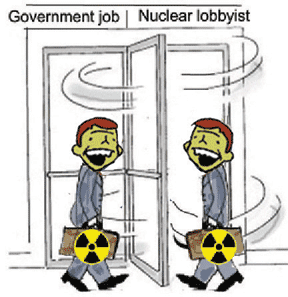 The long standing and corrupt practice of “amakudari” -“descent from heaven” which led to the capture of regulators by the regulated in form of career revolving doors has made any meaningful reform a pipe dream.
The Fukushima disease: Creation of virtual world based on radioactive reality,Rt.com 24 Nov 15 Derek Monroe “…………”We are in a difficult position that we made ourselves reliable on nuclear energy first and then were hurt by it,” said a local Minamisoma city employee who asked to remain anonymous as he was not authorized to talk to the media. “Many people here had good jobs and good lives and when the nuclear accident happened this came to a complete halt,” he said. The city’s website now is very optimistic in its proclamation of moving forward without nuclear power, despite the central government’s move to the contrary. The government in Tokyo has decided what is best for the citizens of Minamisoma and all of Japan.

Furthermore, nuclear power is back in charge as if it never left. Nationalist Prime Minister Abe Shinzo’s administration is another one anointed by “kempatsu mura” – “the nuclear village”, power and money complex that has been a steady fixture in the history of modern Japan. In 2012, Tokyo’s Waseda University researcher Tetsuo Arima disclosed declassified CIA documents dating to the 1950s. It was revealed that the long time kingmaker of Japanese politics, Matsutaro Shoriki and head of the country’s most powerful Yomiuri Shimbun media empire, worked hand in hand with the CIA to popularize nuclear energy as way for the future. Despite its peaceful angle and spin thrown onto the Japanese public that was still traumatized within a generation of the Hiroshima and Nagasaki bombings, Shoriki insisted the way to a successful future would have to include Japan’s nuclear armament………..
The long standing and corrupt practice of “amakudari” –“descent from heaven” which led to the capture of regulators by the regulated in form of career revolving doors has made any meaningful reform a pipe dream. This ultimately allowed the Tokyo Power Company (TEPCO), Japan’s largest utility, to defeat any efforts to improve plant safety as it would cost it too much money to comply with increased regulatory requirements. ………..
In Britain the government together with the industry decided on a strategy to spin the information released to the public as to avert a backlash against nuclear energy experienced in Germany as result of the disaster in Japan.
In Japan the propaganda warfare took a more sinister turn blaming the victims for their predicament. Japanese newspaper Asahi Shimbun that is closely connected to Japan’s ruling elite has run a series of articles on “radiophobia”, attributing health complaints of the affected to psychological and emotional stress. Ironically the same took place during a period of “radiophobia” scare doled out by medical professionals and nuclear experts in the Soviet Union after the Chernobyl disaster. Their fears and concerns were met with explanation that the victims were subjected and suffered from fear of radiation rather than the radiation itself. University of California anthropologist Adriana Petryna’s ethnographic study of the Chernobyl medical assessment and compensation system shown it was biased against the victims and politically manipulated. The same now applies to the case of Fukushima disaster victims as the more sophisticated forms of manipulation employing intrinsically Japanese traits of shame and group think are now used to shift the effects of the disaster onto victims’ own sense of responsibility. This allows the system to move on and not take responsibility for what transpired while using the cultural trait of the population’s acquiescence as a catalyst for its de facto forced amnesia.
Looking at the Japanese media and governmental space that work hand in hand to obfuscate its responsibility to inform, the truth of the matter is : the technology to decommission melted reactors doesn’t exist and the most optimistic scenario of final solution to the crisis is pure fiction.
As the country’s political establishment is readying itself to host the 2020 Olympics in Tokyo for which there is no public money or popular support whatsoever, the nuclear sword of Damocles will be hanging over it. The negligence and incompetence bordering on willful disregard for lives of its citizens makes the Japanese government a perfect candidate for prosecution under the crimes against humanity statues. Its handling of the Fukushima crisis puts into doubt Japanese credentials as a real democracy that is able and willing to address its citizens’ needs instead of using them as fodder for obscene corporate profits and foreign policy gamesmanship.
As a result Fukushima is worse than Chernobyl in many respects, making the difference between both political systems only a semantic one at best.
Japan Red Cross declined to be interviewed for the story.
Japanese Government did not respond to questions about its propaganda funding.
Chicago Tribune did not respond to request for interview.
Greg Burns did not respond to request for interview.
TEPCO did not respond to request for interview.
Japan Times did not respond to request for interview. https://www.rt.com/op-edge/323105-japan-fukushima-nuclear-disaster/
Mini nuclear reactors – costly, and need costly security – while renewables get cheaper
But for all the activity, the nascent SMR industry faces familiar nuclear challenges: cost, public acceptability, security and waste disposal. The nuclear industry has a long record of broken promises over cost
Developing SMRs is not going to be cheap either …40-70 SMRs would need to be ordered to make building a factory worthwhile…….. All the while, the competition from renewable energy gets hotter as it falls in price.
Security is also a key issue for nuclear plants….The challenge for SMRs is that security costs soar relative to power output if there are small reactors in many locations to protect.
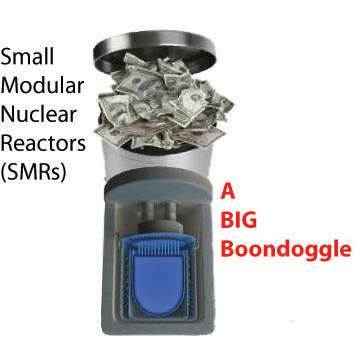 Are mini-nuclear reactors the answer to the climate change crisis?
Industry looks to the UK to develop factory-built reactors ready to provide affordable, low-carbon energy wherever it is needed – but issues around security and waste disposal remain, Guardian, Damian Carrington, 24 Nov 15 Mini nuclear power plants could be trucked into a town near you to provide your hot water, or shipped to any country that wants to plug them into their electricity grid from the dock. That is the aim of those developing “small modular reactors” and, from the US to China to Poland, they want the UK to be at the centre of the nascent industry. The UK government says it is “fully enthused” about the technology.
With UN climate change summit in Paris imminent, the question of how to keep the lights on affordably, while cutting emissions, is pressing.
Small modular reactors (SMRs) aim to capture the advantages of nuclear power – always-on, low-carbon energy – while avoiding the problems, principally the vast cost and time taken to build huge plants. Current plants, such as the plannedFrench-Chinese Hinkley Point project in Somerset, have to be built on-site, a task likened to “building a cathedral within a cathedral”. Continue reading
Paris COP21 Information Hub Virtual Participation
 Paris COP21 Information Hub Virtual Participation http://newsroom.unfccc.int/cop21parisinformationhub/cop-21cmp-11-information-hub-virtual-participation/Along with live webcast, social media community tools such as Facebook, Twitter, YouTube and Flickr enable virtual participation in the UN Climate Change Conference Paris (30 November – 11 December). See the full list of our social media accounts below.
Information on which sessions will be webcast live each day will be made available in the daily programme, and can be seen on the main meetings page and also on the webcast interface.
The main Twitter hashtag for the event is #COP21.
Conference participants can take pictures of themselves next to giant hashtags placed around the conference venue. Screens distributed around the venue will display the global conversation happening in real time on Twitter and Facebook during the event.
Apps, Platforms and Accounts
A UNFCCC Negotiator app collects all the information in one place, including social media and webcast.
App for Iphone/Ipad
App for Android
Full list of our social media accounts
Executive Secretary Christiana Figueres
Other Channels
Corporate greenwashing at Solutions COP21
Paris: closed to civil society, open to greenwashers, New Internationalist , 24 Nov 15 By Pascoe Sabido |”…….Solutions COP21 is a platform for some of the world’s most socially and environmentally destructive corporations, whose business models constantly attack life, youth, friendliness, solidarity and any notion of an equitable approach.
Sponsored by the likes of dirty energy giant Engie (formerly GDF Suez, also an official sponsor of COP21) alongside fracking enthusiast Suez Environment and agrofuels giant Avril-Sofiproteol, the event at the Grand Palais will also welcome Vinci, the company behind the proposed airport at Notre-Dame-des-Landes, coal financiers HSBC and BNP Paribas, and Coca-Cola, among many others.
As the organizers are proud to admit, corporate climate criminals will be joined inside the event by small and medium enterprises, NGOs (some of whom have pulled out after public pressure) and international artists (some of whom have refused to pull out on discovering the true nature of the event).
Such an ensemble lends a veneer of respectability that money can’t buy. But what it can buy is political access. Corporate packages ranging up to $266,000 ensure you don’t have to settle for mere exhibition space but can have VIP access to networking areas with negotiators and politicians, as well as guaranteed TV coverage.
In short, the French government has put its weight behind a corporate greenwashing event for the biggest polluters to push their false solutions – such as fracking, nuclear energy, GMOs and market-based solutions – at the same time as silencing those very communities coming to Paris to denounce such destructive business practices and the fatal impacts they have on the ground.
Before the attacks took place, there was already a public call for mass civil disobedience against (false) Solutions COP21, coming from a diverse range of organizations including ATTAC France, Via Campesina, the trade union Solidaires, the grassroots activist networks Climate Justice Action and the JEDIs, Sortir du Nucleaire and Corporate Europe Observatory. Huge uncertainty followed, but hearing the response from both the organizers of Solutions COP21 and the French government, it now feels more important than ever for the mobilization to take place.
The fight for climate justice is intertwined with the fight for peace, not just in Europe but in communities around the world facing violence and terror as a result of our extractivist economic model.
If the French government thinks that events in the Grand Palais are more important than the voices of those on the frontline fighting climate change and its causes, then that’s where their message needs to be delivered.
If you are in Paris on Friday 4 December, make your way to the venue from 10.00am, where guides will take you on a ‘toxic tour’ around the expo with representatives of frontline communities as they call out the false solutions on offer. Meanwhile, creative acts of civil disobedience are planned to stop the event from staying open.
As others in the climate movement have said already, now is not the time to stay silent. No-one intends to.
Pascoe Sabido is a researcher and campaigner with Corporate Europe Observatory.
http://newint.org/blog/2015/11/24/paris-cop21-civil-society-vs-greenwashers/#sthash.i2AYXtTS.dpuf
1 This Month
Chernobyl: The Lost Tapes – A good documentary on Chernobyl on SBS available On Demand for the next 3 weeks– https://www.sbs.com.au/ondemand/tv-program/chernobyl-the-lost-tapes/2352741955560

of the week–London Campaign for Nuclear Disarmament

Tell the Ukrainian Government to Drop Prosecution of Peace Activist Yurii Sheliazhenko
To see nuclear-related stories in greater depth and intensity – go to https://nuclearinformation.wordpress.com
-
Archives
- April 2026 (124)
- March 2026 (251)
- February 2026 (268)
- January 2026 (308)
- December 2025 (358)
- November 2025 (359)
- October 2025 (376)
- September 2025 (257)
- August 2025 (319)
- July 2025 (230)
- June 2025 (348)
- May 2025 (261)
-
Categories
- 1
- 1 NUCLEAR ISSUES
- business and costs
- climate change
- culture and arts
- ENERGY
- environment
- health
- history
- indigenous issues
- Legal
- marketing of nuclear
- media
- opposition to nuclear
- PERSONAL STORIES
- politics
- politics international
- Religion and ethics
- safety
- secrets,lies and civil liberties
- spinbuster
- technology
- Uranium
- wastes
- weapons and war
- Women
- 2 WORLD
- ACTION
- AFRICA
- Atrocities
- AUSTRALIA
- Christina's notes
- Christina's themes
- culture and arts
- Events
- Fuk 2022
- Fuk 2023
- Fukushima 2017
- Fukushima 2018
- fukushima 2019
- Fukushima 2020
- Fukushima 2021
- general
- global warming
- Humour (God we need it)
- Nuclear
- RARE EARTHS
- Reference
- resources – print
- Resources -audiovicual
- Weekly Newsletter
- World
- World Nuclear
- YouTube
-
RSS
Entries RSS
Comments RSS
 nuclear-news