Global warming endangers world’s energy systems
 Why did this article not mention nuclear facilities – reactors, used fuel pools, waste containers,
 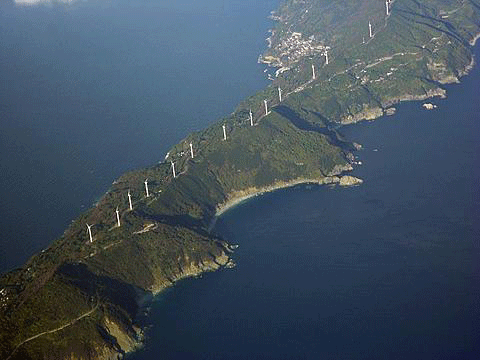 transport of radioactive trash – as being at risk from extreme climate events?
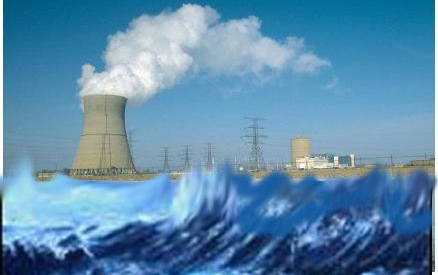 Energy systems, including fossil fuel power stations, distribution grids, and the networks that reach to people’s homes, are all at risk from effects such as flooding, severe storms and sea level rises, according to a new report from the World Energy Council, which brings together energy companies, academics and public sector agencies.
When energy systems fail, the knock-on effects on other aspects of modern infrastructure – from water and sewage to transport and health – can be catastrophic.
Experts point to the effects of Hurricane Sandy in New York to show that these effects are not limited to the developing world, where most of the serious consequences of climate change are expected to wreak havoc, but will be felt even in the most modern of cities.
Christoph Frei, secretary-general of the World Energy Council (WEC), warned that the question of the resilience of modern energy systems under the threat of imminent disaster must be treated as one of great urgency. “We are on a path where today’s unlikely events will be tomorrow’s reality,” he said. “We need to imagine the unlikely. Traditional systems, based on predicted events, no longer operate in isolation.”
The warning comes ahead of a UN climate summit in Paris later this year where developed and developing countries are expected to agree a deal on how to mitigate and adapt to global warming’s impacts………
WEC warned that the number of extreme weather events globally had risen by a factor of more than four in the past three decades, from about 38 events – such as major storms, heatwaves and flooding – to 174 events in 2014. The insurance industry has struggled to keep up, with global insured losses from natural catastrophes and man-made disasters reaching $35bn (£23bn) last year, with the losses of the uninsured exceeding $130bn.
Frei warned: “Current estimates for the cost of energy system adaptation do not fully account for the additional financing required to accommodate these new emerging risks.”………http://www.theguardian.com/environment/2015/oct/01/worlds-energy-systems-at-risk-from-global-warming-say-leading-firms
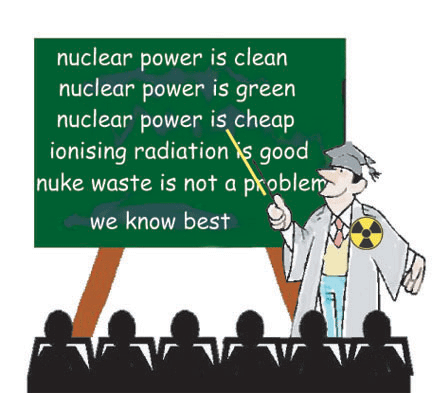
Nuclear lobby keen to ‘educate’ public
 Nuclear leaders say education key to industry’s future, Pittsburgh Business Times,
 A decline in nuclear power has been ongoing in the United States. There are 99 nuclear reactors in operation in 30 states, but the industry’s growth has stalled significantly. In 2013, four reactors went out of service, and another was shut down in December 2014. Two nuclear reactor licenses were approved by the Nuclear Regulatory Commission in 2012, which was a bright point for the industry. But those were the first nuclear licenses approved since 1978………
Dr Lawrence Lindsey spoke during a conference of nuclear power industry leaders gathered Wednesday at the Westin Convention Center in downtown Pittsburgh. Called “Nuclear Going Forward” and underwritten by the advocacy group Nuclear Matters, the power brokers were there to discuss the industry’s future…….
“This is the time we need to start making decisions and start providing some certainty for the industry………
it’s a matter of extolling the virtues of nuclear — and staying course………
Bank of England warns on climate change’s threat to global stability
 The Bank of England governor has given a stark warning that climate change poses a huge risk to global stability.
At a gathering of leading insurers at Lloyd’s of London, Mark Carney pointed out the rapid increase in weather-related catastrophes and the jump in both the physical and financial costs.
He said the challenges currently posed by climate change “pale in significance compared with what might come”……http://www.bbc.com/news/business-34396961
Nuclear weapons – the way to government secrecy and imperialism
Nuclear Weapons: Not Just a Means to an End, But an End Itself, http://fpif.org/nuclear-weapons-not-just-a-means-to-an-end-but-an-end-itself/ More than just a deterrent, nuclear weapons are the cornerstone of imperialism.
By Russ Wellen, October 1, 2015. Much like 9/11 decades later, the development of nuclear weapons served as a pretext for secrecy in government. In his 2010 book Bomb Power: The Modern Presidency and the National Security State (Penguin Books), Gary Wills, according to the back cover, “argues that the secrecy surrounding the Manhattan Project became a model for the covert operations and overt authority that have defined American government in the nuclear era, culminating with the usurpations of George W. Bush.” In fact, the development of nuclear weapons by the United States covered a multitude of sins. Wills writes:
Foreign governments that granted us territory and protection were to be supported, even if they were not very good at recognizing the rights of their citizens. Thus began a long history of friendly relations with dictators. Obtaining and securely maintaining our bases was considered more important than the moral legitimacy of the regimes granting us such access.
Wills’s eye for irony is nothing if not keen.
Being the champion of “the free world” meant maintaining nuclear superiority, not actually advancing freedom in the countries that cooperated with us.
He continues in the same dispiriting vein: “Later we would need similar access to ports for our nuclear subs, and launch sites for our intermediate missiles.” In fact:
Our anxiety over nations “going Communist” was in large part prompted by a fear that this would shrink the area for such bases.
Equally as troubling:
It was not enough to secure the actual bases themselves, their equipment, and their personnel — the politics of the host countries would have to be continually checked, to make sure our secrets as well as our weapons were safe. This meant spying on other countries, propping up those that gave us what we needed, and undermining those that did not.
Just as nuclear weapons formed the foundation of deterrence, they undergirded imperialism itself.

Photoessay on thde most devastated areas of Japan’sFukushima Exclusion Zone.
 Stepping inside the nuclear red zones of Fukushima [Great photos] By: Catie Leary. Mother Nature Network, October 1, 2015, In his eye-opening photo essay, Polish photojournalist Arkadiusz Podniesiński ventures into the most devastated areas of Japan’s Fukushima Exclusion Zone.
The essay, simply titled “Fukushima,” gives readers an exclusive look at how the orange and red zones have changed in the years since the 2011 Tōhoku earthquake and tsunami, which triggered the Fukushima Daiichi nuclear disaster.
Access to the red zones (sometimes referred to as the “no-go zones”) is strictly prohibited unless you are a former resident or have a special permit, but getting one of these permits is exceptionally difficult.
“No tourists are allowed. Even journalists are not welcome,” Podniesiński explains. “The authorities are wary, they [inquire] after the reason, the topic being covered, and attitude towards the disaster. They are worried that journalists will not be accurate and objective when presenting the topic, but they are most likely scared of being criticized for their actions.”
1 This Month

of the week – Shut Down Drone Warfare!


Tell the Ukrainian Government to Drop Prosecution of Peace Activist Yurii Sheliazhenko

Petition to revoke the licensing of the Near Surface Nuclear Disposal Facility (NSDF) at Chalk River. https://www.ourcommons.ca/petitions/en/Petition/Details?Petition=e-7247
To see nuclear-related stories in greater depth and intensity – go to https://nuclearinformation.wordpress.com
-
Archives
- April 2026 (91)
- March 2026 (251)
- February 2026 (268)
- January 2026 (308)
- December 2025 (358)
- November 2025 (359)
- October 2025 (376)
- September 2025 (257)
- August 2025 (319)
- July 2025 (230)
- June 2025 (348)
- May 2025 (261)
-
Categories
- 1
- 1 NUCLEAR ISSUES
- business and costs
- climate change
- culture and arts
- ENERGY
- environment
- health
- history
- indigenous issues
- Legal
- marketing of nuclear
- media
- opposition to nuclear
- PERSONAL STORIES
- politics
- politics international
- Religion and ethics
- safety
- secrets,lies and civil liberties
- spinbuster
- technology
- Uranium
- wastes
- weapons and war
- Women
- 2 WORLD
- ACTION
- AFRICA
- Atrocities
- AUSTRALIA
- Christina's notes
- Christina's themes
- culture and arts
- Events
- Fuk 2022
- Fuk 2023
- Fukushima 2017
- Fukushima 2018
- fukushima 2019
- Fukushima 2020
- Fukushima 2021
- general
- global warming
- Humour (God we need it)
- Nuclear
- RARE EARTHS
- Reference
- resources – print
- Resources -audiovicual
- Weekly Newsletter
- World
- World Nuclear
- YouTube
-
RSS
Entries RSS
Comments RSS
 nuclear-news