URGENT- US Burial of “Low Level” Nuclear Waste: Public Radiation Exposure 33 x Higher than “High Level” Dump; Removes State Rights to Protect People-Environment; Comment Today, 11.59 PM ET (NY-DC)

While it appears a waste of time to comment to the USNRC, comments become public record. As such, they can be used in future legal proceedings against the NRC-US government. Additionally, future generations, if there are any survivors, will know that people cared and tried. The Nuclear Regulatory Commission should change its name to Nuclear Regurgitation Commission, because they directly and indirectly encourage the leaching, leaking, spewing, and even exploding, of nuclear waste into the land, air and water of America, and ultimately of the world. Depending on location, this also impacts other countries such as the Canada, Mexico, and via the Gulf Stream and air currents, Europe, and even the Arctic. “Low-Level Radioactive Waste Disposal; Reopening of Comment Period” Comment Now! Due Sep 21, 2015 11:59 PM ET Proposed Rule Posted: 08/27/2015ID: NRC-2011-0012-0165 Comment here: http://www.regulations.gov/#!docketDetail;D=NRC-2011-0012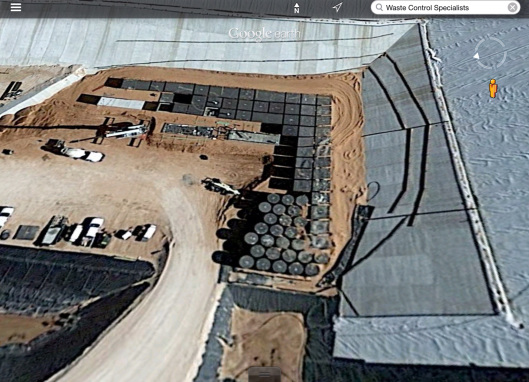
Burial of Radioactive Waste in the WCS Nuclear Waste Dump in…
View original post 4,921 more words
Radioactivity In Our Ocean: Fukushima & Its Impact On The Pacific
Ken Buesseler, Woods Hole Oceanographic Institution, Sep 14, 2015:
- 1:02:15 — Buesseler: “There have been ongoing releases… being maintained at higher levels… The groundwater is almost impossible to stop, so that will continue for decades… very hard to contain. Ice dams, things you can engineer to stop them, have never been done on this scale before, so it’s hard to predict what’s going to happen.”
- 1:09:30 — Audience Q&A: “Can anyone — scientists, physicists, anyone — really estimate the levels that are coming out of Fukushima on a daily basis? This rain event… how could anyone possibly estimate what is going… it’s disingenuous … to make these kind of assumptions — that it ‘probably’ won’t be a problem in the future. How can anyone say that? It’s never happened before… I don’t know where these predictions can really be nailed down, and was wondering your opinion on that as a couple of ‘good scientists’ (laughs).”
- 1:11:00 — Buesseler: “Fair points. It’s never happened before, it’s somewhat unpredictable and dynamic… There’s certainly not enough information. I was very frustrated after the rain event to find almost no information about the amount and levels that were in the ocean… There are some monitoring sites right in the harbor, and you can actually see the level of cesium go up from 1,000 of my units to 3,000 — so there was an impact. How long that’s going to continue? I can’t tell you… How it’s going to change in the future? We hope it gets back down to the levels that were near zero, but it never will be. It’s going to be — for decades, anyway — a site of continuous release… that’s what keeps me up at night, are continuous leaks that could happen at that site.”
The Fukushima Fix
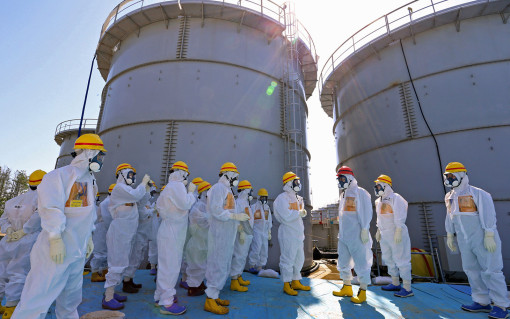
Japanese Prime Minister Shinzo Abe was briefed on the situation at the Fukushima Dai-ichi nuclear power plant as he toured the facility back on Sept. 19, 2013. chief Akira Ono (4th L) in front of two tanks (back) which are being dismantled after leaking contaminated water, during his tour to the tsunami-crippled plant in Okuma, Fukushima Prefecture, northeastern Japan on September 19, 2013. Abe told Fukushima’s operator to fix radioactive water leaks as he toured the crippled nuclear plant on September 19, less than two weeks after assuring the world the situation was under control.
Japan’s Abe government claims portions of Fukushima Prefecture (original population 2 million) are safe for habitation, radioactivity is acceptable; whereas scientific data by third-party NGOs indicates otherwise, stay away!
PM Abe’s specific maneuvers towards rehabilitation give the appearance that the Fukushima full-blown nuclear meltdown is relatively minimal in comparison to Chernobyl’s disastrous explosion of 1986. After all, to this day, Chernobyl after 30 years is still a 30km “exclusion zone” where nobody is allowed due to excessive levels of radiation.
Meanwhile, back in Japan, PM Abe is moving people back into former restricted zones four years after the fact.
It remains an open question as to whether the Fukushima aftermath will be worse than Chernobyl. After all, the China Syndrome may be actively at work at Fukushima and as such could last over many lifetimes.
Still, the immediate direct exposure of radiation over population centers at Chernobyl was significantly more than Fukushima of which 80% drifted out into the Pacific Ocean.
But, that may be slight solace because, horrifyingly, nobody knows where the Fukushima melted cores are located, nobody knows; it’s absolutely true, nobody knows whether the molten cores are within the containment vessels, outside of the vessels, deep in the ground, or cataclysmically traversing towards the water table.
Regardless, PM Abe’s directive appears to be: “No problem, we’ve cleaned up a whole lot of the mess outside of the immediate meltdown… so, move back into former restricted areas.”
Still, it’s nearly impossible to give an all-clear signal at this stage, especially with the Fukushima Daiichi Nuclear Power Station containment vessels completely out of control with wild atom-splitting rogue radionuclides spewing into the Pacific Ocean, and who knows where else (Einstein must be spinning in his grave).
The China Syndrome Worry
“While a molten reactor core wouldn’t burn ‘all the way through to China’ it could enter the soil and water table and cause huge contamination in the crops and drinking water around the power plant. It’s a nightmare scenario, the stuff of movies. And it might just have happened at Fukushima,” Eben Harrell, Was Fukushima a China Syndrome? Time Magazine, May 16, 2011.
If Chernobyl is a leading indicator of Fukushima’s future, “Chernobyl offers many lessons about what Princeton University engineering professor Robert Socolow calls the ‘afterheat’ of a nuclear disaster, but it’s the generational lesson that’s most important. Because some of the isotopes released during a nuclear accident remain radioactive for tens of thousands of years, cleanup is the work not just of first responders but also of their descendants and their descendants’ descendants. Asked when the reactor site would again become inhabitable, Ihor Gramotkin, director of the Chernobyl power plant, replies, ‘At least 20,000 years,” Eben Harrell, Apocalypse Today: Visiting Chernobyl, 25 Years Later, Time Magazine, April 26, 2011.
As of June 12th, 2015, the Abe government is returning residents to the Iitate village in Fukushima’s Prefecture four short years post the nuclear plant meltdowns, and by the upcoming 2018 year, the prime minister is eliminating state compensation to victims.
Not only that, but since August 2015, PM Abe is reopening nuclear facilities, the Sendai No. 1 reactor has already resumed full-scale commercial operations.
Contrariwise, according to former PM Naoto Kan, who was prime minister during the Fukushima disaster: “I now consider nuclear energy to be the most dangerous form of energy, and the risks associated with it are too great for us to continue generating atomic power,” Former Japanese PM Naoto Kan: Fukushima Radically Changed my Perspective, Deutsche Welle, Feb. 25, 2015.
One of the issues in trying to assess the dangers, as well as timing of recovery, for Fukushima is believability. Who can be trusted? In that regard, the Abe government’s enactment of strict extraordinarily broad secrecy laws, similar to WWII, with the threat of prison sentences up to 10 years for any violators of indeterminately wide-open secrecy laws undermines confidence in believability of the Japanese government, by definition.
On the other hand, respected third-party NGOs seem more reliable, if only because they do not have an axe to grind, no broad open-ended secrecy laws, no threats of prison sentences, no scare tactics, no public demonstrations in opposition, no lost revenues, no cleanup costs, no threats to human health, no threats to marine life, and no connections to the upcoming 2020 Tokyo Olympics.
Greenpeace/Japan Exposes Failure of Fukushima Decontamination (July 21, 2015)
Greenpeace Japan presumably takes issue with Prime Minister Abe’s declaration that people can safely move back to parts of Fukushima Prefecture.
Greenpeace Japan conducted a radiation survey and sampling program in Iitate, a village in Fukushima Prefecture. Even after decontamination, radiation dose rates measured ten times (10xs) the maximum allowed to the general public.
According to Greenpeace Japan: “The Japanese government plans to lift restrictions in all of Area 2 [2], including Iitate, where people could receive radiation doses of up to 20mSV each year and in subsequent years. International radiation protection standards recommend public exposure should be 1mSv/year or less in non-post accident situations. The radiation limit that excluded people from living in the 30km zone around the Chernobyl nuclear plant exclusion zone was set at 5mSV/year, five years after the nuclear accident. Over 100,000 people were evacuated from within the zone and will never return.” (Greenpeace Press Release, July 21, 2015).
So, Chernobyl’s 5mSV/year radiation limit morphs into the possibility of 20mSV radiation each year for some areas of Fukushima, subjecting residents to what?
According to Green Cross International, founded in 1993 by Mikhail Gorbachev, who was president of the Soviet Union when Chernobyl exploded: Both Chernobyl and the Fukushima Daiichi nuclear power plant disasters are categorized as Level 7 events defined as a major release of radioactive material.
“However, the number of people affected by radiation in Japan has tripled when compared to Chernobyl, says Nathalie Gysi of Green Cross Switzerland… water leakage at the Fukushima Daiichi power plant remains a problem four years after… There continue to be rising doubts over the safety of seafood, such as radioactivity levels in tuna and other fish.” (Green Cross Int’l March 11, 2015).
The Green Cross International 2015 Fukushima Report was prepared under direction of Jonathan M. Samet, MD, University of Southern California professor Keck School of Medicine and chair Department of Preventive Medicine, using the same standards as a similar 2012 study of Chernobyl.
According to the report: “Continued exposure to low-level radiation, entering the human body on a daily basis through food intake, is of particular consequence.”
Morphologically Defective Fir Trees
According to the National Institute of Radiological Science/Japan (“NIRS” est. 1957 as Japan’s only institute of radiology science) fir trees in Fukushima are exhibiting “strange growth patterns,” meaning the trees are stunted and showing morphological defects, in particular bifurcation or the splitting of a tree body into two parts at the tip. Thus, further normal tree growth is stopped dead.
Fir trees normally extend upward in growth patterns with two or more branches each year. However, 98% of inspected fir trees within a 3.5km area of the Fukushima damaged nuclear plants have severe defects. NIRS believes radiation causes abnormalities of fir trees “without a top bud,” hence no more normalized growth. Results of inspected trees found 125 out of 128 abnormal.
Thus, begging the question: If tree growth is stunted/deformed within 3.5km of the damaged nuclear plants, what’s the analogous impact on people?
Missing Birds
According to CBS News (April 16, 2015): “Birds are becoming a rarity around the damaged nuclear site… dramatic reductions… in terms of swallows in Fukushima, there had been hundreds if not thousands in many of these towns where we were working. Now we are seeing a few dozen… It’s just an enormous decline,” (Dr. Tim Mousseau, biologist, University of South Carolina, Dwindling Bird Populations in Fukushima, sc.edu, 4/14/15).
Fukushima Myths
Chris Harris, a former senior nuclear reactor operator for over three decades and currently a nuclear consultant, claims Fukushima is an extinction level event: Containment is a myth, there isn’t any; cold shutdown is a myth; cooling is a myth because there is no way to measure cooling when nobody knows where the nuclear fuel is located; waste processing is a myth; cleanup is a myth because it’s a “waste generation facility” that won’t stop.
Voices Within Japan
According to Yauemon Sato, the ninth-generation head of a sake brewery, since 1790, and the president of Aizu Denryok, an electric utility: “You know the caldron of hell? You will be sent to hell and will be boiled in that caldron if you do evil. And there are four such caldrons in Fukushima… And the disaster has yet to end. It continues to recur every day. More than 300 tons of water, contaminated with intense levels of radioactive substances, are being generated every day,” The Asahi Shimbun, May 1, 2015.
Hiroaki Koide, professor (retired) at Kyoto University Research Reactor Institute reacts to PM Abe, as of April 24, 2015:
“The Prime Minister [said Fukushima] had been brought to a close. My reaction on hearing his words was, ‘Stop kidding.’ Reality is, though 4 years have passed, the accident has not yet been brought to a close at all… The Japanese government has issued a declaration that this is an emergency situation. As a result, normal laws do not have to be followed. What they are saying is that, in these very high radiation exposure level areas, they have basically abandoned people to live there. They’ve actually thrown them away to live there… The Cs-137 that’s fallen onto Japanese land in the Tohoku and Kanto regions, so much so that this area should all be put under the radiation control area designation [the Kanto region includes Tokyo and is home to over 40 million people].”
Footnote on Cs-137: Cesium-137 is one of the most problematic fission isotopes as it easily moves and spreads in nature and has a half-life of 30 years. It is deadly dangerous, for example: The Kramatorsk Radiological Incident of 1989 in Ukraine a small capsule of Cs-137 was discovered inside concrete walls of an apartment building, probably part of a measurement device, lost and accidentally mixed with gravel used to make concrete. For over 9 years two families lived in the apartment. By the time the capsule was discovered, 6 residents had already died from leukemia.
Fortunately for PM Abe, unfortunately for radiation victims, radiation is a silent destroyer that slowly progresses over time. In fact, it takes 5-40 years for the incubation period to take hold. Next year is the 5th year.
Nevertheless, when hit by powerful rapid radiation exposure, too much too soon, physical damage occurs relatively quickly, now experienced by sailors of the USS Reagan that served in Japan in 2011.
U.S. Sailors File Lawsuit
Two hundred U.S. sailors of the USS Reagan have a pending lawsuit filed in San Diego against TEPCO, General Electric, EBASCO, Toshiba and Hitachi through the law offices of Bonner & Bonner, Sausalito, CA. The plaintiffs won a crucial battle in the U.S. District Court/San Diego last year, allowing the case to move forward.
“The lawsuit is based on the sailors’ participation in Operation Tomodachi (meaning “Friends”), providing humanitarian relief after the March 11, 2011 devastation caused by the Earthquake and Tsunami. The lawsuit includes claims for illnesses such as leukemia, ulcers, gall bladder removals, brain cancer, brain tumors, testicular cancer, dysfunctional uterine bleeding, thyroid illnesses, stomach ailments and a host of other complaints unusual in such young adults. The injured servicemen and women will require treatment for their deteriorating health, medical monitoring, payment of their medical bills, appropriate health monitoring for their children, and monitoring for possible radiation-induced genetic mutations,” Press Release, The Law Offices of Bonner & Bonner, Sausalito, CA.
According to the press release, up to 70,000 U.S. citizens were potentially affected by the radiation and will be able to join the class action suit, which alleges that TEPCO deliberately lied to the public and the U.S. Navy about radiation levels at the time the Japanese government was requesting help.
Therein lies a prime example, although only alleged, of why official sources in Japan cannot be trusted. Moreover, as far as convincing evidence goes: How is it that a disproportionately high number of very young naval personnel, all from the same ship, have severe medical problems like leukemia and brain cancer?
Furthermore, according to Charles Bonner, Esq.: Additional plaintiffs with serious aliments from radiation are continuing to come forward.
The Fukushima nuclear disaster is a grim tragedy that is extremely difficult to fully understand or gain trustworthy information, in large measure because the Japanese government instituted a new secrecy law, Act on the Protection of Specially Designated Secrets, Act No. 108 that is extraordinarily broad and provides up to 10 years in prison for release of “state secrets,” which may be subjectively, not objectively, defined by government bureaucrats… oh, isn’t that just grand!
Essentially, Japan surreptitiously institutes news blackouts of any information that government employees don’t like, carte blanche.
“On Dec. 10, Prime Minister Shinzo Abe’s new special secrets law took effect despite overwhelming public opposition. The new law gives bureaucrats enormous powers to withhold information produced in the course of their public duties that they deem a secret — entirely at their own discretion — and with no effective oversight mechanism to question or overturn such designations. The law also grants the government powers to imprison whistle-blowers, and prohibits disclosure of classified material even if its intention is to protect the public interest. This Draconian law also gives the government power to imprison journalists merely for soliciting information that is classified a secret,” Abe’s Secrets Law Undermines Japan’s Democracy, The Japan Times, Dec. 13, 2014.
Once again: “This Draconian law gives the government power to imprison journalists merely for soliciting information.” For merely soliciting information, for merely soliciting information, gives the government power to imprison journalists for merely soliciting info…. some footprints should never stop.
“Susumu Murakoshi, president of the Japan Federation of Bar Associations, says the law should be abolished because it jeopardizes democracy and the people’s right to know. Meiji University legal scholar Lawrence Repeta agrees with Murakoshi,” Ibid.
What democracy?
Thus, on the surface, by all appearances, the government of Japan has something to hide. It must be really big. Why else adopt a hard-hitting secrecy law on the heels of the worst disaster to hit Japan since America dropped A-bombs on Hiroshima and Nagasaki in 1945. Japan’s citizenry really should expect consolation rather than aggravation, intimidation, and terrorizing by their own government.
At the end of the day, George Orwell’s 1984 has captivated a radiantly glowing ancient country.
Source: Counterpunch
Radioactive rain releases can’t be curbed due to lack of laws: NRA
Tokyo Electric Power Co.’s stricken Fukushima No. 1 power plant has released rainwater tainted with radioactive substances into the Pacific Ocean at least seven times since April.
The Fukushima Prefectural Government, pressured by worried residents and fishermen, has pressed the Nuclear Regulation Authority to set maximum radiation limits for rainwater releases, but the regulator hasn’t acted yet, citing the lack of specific laws on radioactive rainwater.
The plant’s K channel, a gutter that was built to drain rainwater accumulated around the six reactors, leads directly to the sea. After rainwater was found tainted with radiation in April, Tepco, as a temporary fix, installed eight pumps and a special underwater curtain in its artificial bay to segregate the water from the open ocean.
With the pumps and the curtain, Tepco claims it can keep radioactive runoff within the bay as long as the rainfall stays at 14 mm per hour or less. But on Aug. 17, rainfall at the plant exceeded 18 mm per hour, and some untreated rainwater overflowed the K channel and got into the ocean. The same thing happened again on Sept. 9 and 11, amid flooding in the Kanto and Tohoku regions triggered by Typhoon Etau.
When the drainage system is overwhelmed by heavy rain, it is difficult to measure the tainted water and its radiation level, the utility said.
In May 2014, when Tepco succeeded in measuring rainwater on the premises, the cesium-137 level was gauged at 770 becquerels per liter, or over eight times the 90-becquerel limit for water the plant can release into the sea.
To rectify the situation, Tepco has been trying to change the K gutter’s path so it will flow into the artificial bay instead. But the rerouting work will take until March 2016.
While Tepco says the problem will be solved in six months, prefectural officials are demanding Tepco resolve the problem as soon as possible, because if the leaks are allowed to continue throughout the typhoon season, public distrust in the government will deepen, making the decommissioning process even more difficult.
Fishery officials are meanwhile worried that their industry could be damaged further if the unregulated rainwater releases continue.
The prefecture is specifically asking that a new pump be installed close to the source of the tainted rainwater, but Tepco has been reluctant, saying such a pump is structurally impossible to install because the part of the drainage system where tainted water is leaking from is underground.
Tepco has been cleaning the drainage gutters on a regular basis to reduce the radiation levels, but to no avail.
Kiyoshi Takasaka, a prefectural expert on atomic power, wants the NRA to place radiation limits on rainwater immediately.
However, the NRA’s position is that there are no laws that regulate radiation-tainted rainwater and therefore it cannot set numerical limits. One industry source said doing so would require revisions to existing laws, which will take a lot of time.
“I’m worried because we don’t know how much radiation-tainted rainwater has leaked out,” said Tomomitsu Konno, a 56-year-old fisherman in Soma, Fukushima Prefecture. “Tepco should fully investigate the problem and show the results to the fishermen.”
Source: Japan Times
The highest I-131 density of this year detected in 2 Fukushima sewage plants
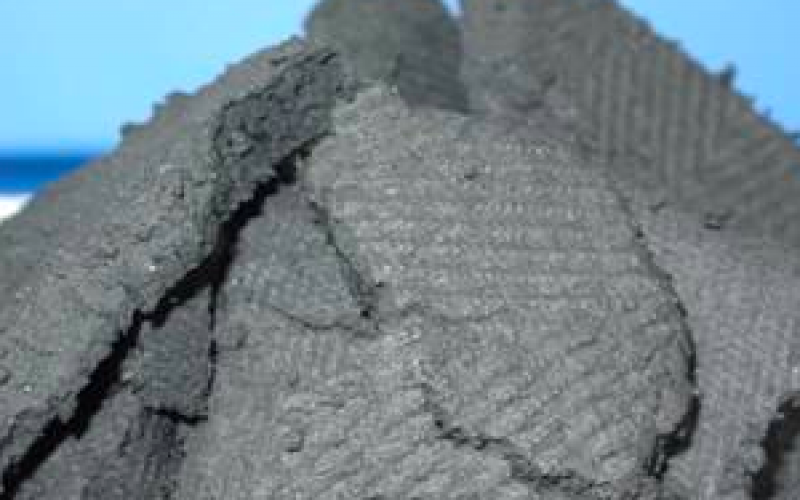
According to Fukushima sewage public corporation, this July over 1,000 Bq/Kg of Iodine-131 was detected in dry sewage sludge. The sewage plant is located in Da-te District of Fukushima prefecture.
High level of I-131 was measured this May, however this reading of July is the highest density of this year. (cf, Significant level of I-131 detected from dry sludge of Fukushima sewage plant after rain in May [URL])
I-131 was detected from the samples collected from 7/9/2015 to 7/29/2015.
The highest reading was 1,038.4 Bq/Kg of 7/11/2015. The highest density of Cs-134 was also detected, which was 44 Bq/Kg the same day. It rained on 7/8/2015 but the precipitation was only 10.5 mm.
Also in another sewage plant in Koriyama city, 889 Bq/Kg of I-131 was detected from dry sewage sludge. This is also the highest reading of this plant. I-131 kept on being detected for 15 days of this July.
http://www.pref.fukushima.lg.jp/uploaded/attachment/129631.pdf
http://www.pref.fukushima.lg.jp/uploaded/attachment/129632.pdf
Source: Fukushima Diary
The highest I-131 density of this year detected in 2 Fukushima sewage plants
The real reason the Nuclear Regulatory Commission cancelled its cancer research
 Nuclear power kills! The real reason the NRC cancelled its nuclear site
  cancerstudy http://www.theecologist.org/News/news_analysis/2985492/nuclear_power_kills_the_real_reason_the_nrc_cancelled_its_nuclear_site_cancer_study.html Chris Busby 19th September 2015
The US’s Nuclear Regulatory Commission just cancelled its study into cancer near nuclear plants citing the ‘excessive cost’ of $8 million, writes Chris Busby. Of course that’s rubbish – similar studies in the UK have been carried out for as little as £600 per site, and in any case $8 million is small change for the NRC. The real reason is to suppress the unavoidable conclusion: nuclear power kills.
After spending some $1.5 million and more than five years on developing strategies to answer the question of increases of cancer near nuclear facilities, the US Nuclear Regulatory Commission (NRC) last week reported that they would not continue with the process. They would knock it on the head [1].
This poisoned chalice has been passed between the US National Academy of Sciences (NAS) and the NRC since 2009 when public and political pressure was brought to bear on the USNRC to update a 1990 study of the issue, a study which was widely seen by the public to be a whitewash.
Dr Chris Busby at the Royal Society on Scientific Dishonesty
The NCR quickly passed the unwelcome task up to the NAS. It requested that the NAS provide an assessment of cancer risks in populations living ‘near’ the NRC-licenced nuclear facilities that utilize and process Uranium. This included 104 operating nuclear reactors in 31 States and 13 fuel cycle facilities in operation in 10 States.
The NRC request was to be carried out by NAS in two phases. Phase 1 was a scoping study to inform design of the study to be begun in Phase 2 and to recommend the best organisation to carry out the work.
The Phase 1 report was finished in May 2012. The best ‘state of the art’ methods were listed and the job of carrying out the actual study, a pilot study, was sent to: Guess who? The NRC. The poisoned chalice was back home. The NRC was now in a corner: what could they do?
If you don’t like the truth … suppress it Continue reading
Fisherman debunks radiation as cause of giant woffish
 The Guy Who Caught the Internet’s Favorite Giant Fish Is Bummed No One Gets It, Motherboard by EMIKO JOZUKA September 18, 2015 Earlier this week, an odd-looking gargantuan fish from Japan became a minor celebrity on Twitter. But the tide soon turned as curious reactions gave way to harmful rumors that its strange appearance is the result of the effects of radiationfrom the Fukushima disaster.
The fish, however, was no radioactive specimen. It was a Bering wolffish (Anarhichas orientalis)—a species found off the coast of Hokkaido, the northernmost island of Japan. It also just happens to look like a cross between a grumpy grandpa and a monster.
When rumors broke of the fish’s supposed contamination, no one was more disappointed than the man who captured the creature: Hiroshi Hirasaka, a reporter and researcher who “lives life in pursuit of odd-looking creatures.”
“The wolffish I caught was given write-ups on the internet as ‘monster as a result of nuclear accident,’” Hiroshi Hirasaka, the man who caught the fish, told me. Hirasaka initially tweeted the photo because he was proud of his catch, but he soon became devastated by the rapid-fire spread of false internet buzz around the fish.
“That fish has been in [Hokkaido] for a long time, so it’s not feasible for it to be affected by radiation. It’s rude to the fish to say that, and it’s not cool to blame everything on radiation,” Hirasaka said. “Creatures only become big in the world of science fiction, and we’re not living in the world of Hulk or Godzilla.”………
“I find slightly odd, grotesque or scary fish interesting,” Hirasaka told me. “There will always be other writers who report on the beautiful creatures of this world, but I want other people to understand the allure of more ugly specimens.”
As for the internet rumour—he tried debunking it on Twitter, but admitted that the misunderstanding was probably still developing out of his sight and control.
“People in Japan are used to seeing that fish in aquariums, but I guess other people don’t know it. I’m not sure if it was a joke or not, but I was sad to think that they thought it was like that because of nuclear radiation,” said Hirasaka. “I just want them to have the correct information.” http://motherboard.vice.com/read/the-fish-that-was-wrongly-accused-of-being-affected-by-radiation
Fukushima’s radioactive overflowing toilet
As the government of Japan continues to declare that the ocean impact from contaminated storm runoff from the Daiichi site is minimal, attention has been completely diverted from the more serious questions concerning the redistribution of toxic radiation and contaminated groundwater through massive rainfall and flooding into previously pristine locations inhabited by innocent people.
Inland impacts are considerable. Typhoon Etau likely washed more radiation from the mountains surrounding the Daiichi disaster than from the nuclear site itself, yet TEPCO and the Japanese government ignore the health impact of these huge, unmonitored releases. Without the government of Japan accepting responsibility for all the contamination caused by the nuclear disaster, the health of the public on both sides of the Pacific Ocean will continue to be jeopardized.
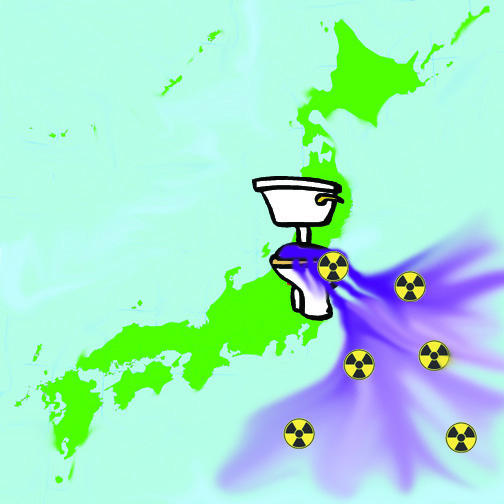
Demystifying Nuclear Power: The Fukushima Toilet Overflows http://www.fairewinds.org/nuclear-energy-education/demystifying-nuclear-power-the-fukushima-toilet-overflows by Sue Prent
Japan just can’t seem to catch a break as extreme forces in nature repeatedly buffet the island.
Efforts are currently underway to coax former Nahara residents, evacuated during the wake of the Fukushima Daiichi triple meltdown, to return to their abandoned homes in the desolated city. Despite assurance that radiation levels in Nahara are now within a ‘safe’ margin, the relatively few who chose immediate return when it officially reopened on September 11, are being issued dosimeters; a reminder that life in this city can never hope to be the same. Continue reading
Video Audio: Radioactive Floods Recontaminate Japan
 Radioactive Floods Recontaminate Japan http://www.fairewinds.org/nuclear-energy-education//radioactive-floods-recontaminate-japan Last week a serious typhoon hit eastern Japan creating flooding that has not occurred for at least 50 years. Tokyo Electric Power Company, the operator and owner of the triple meltdown site Fukushima Daiichi, admitted that drainage pumps at Fukushima failed and radioactive water once again poured into the Pacific. But what about the extraordinary amount of radioactive cesium, strontium, and other isotopes spread hundreds of miles from the nuclear catastrophe site yet to be cleaned up and now displaced by the flood into newly contaminated villages? Once again, Fairewinds’ Chief Engineer, Arnie Gundersen, is here to keep you informed.
Long term effect of radiation leakage to the sea
Officials: “Trillions of becquerels of radioactive material still flowing into sea” at Fukushima — Map shows nuclear waste coming up from bottom of ocean far offshore — Japan TV Journalist: “Contaminated seawater will circulate around globe… disaster like a huge cloth expanding everyday” (VIDEO) http://enenews.com/officials-trillions-becquerels-radioactive-material-flowing-sea-fukushima-map-shows-nuclear-waste-flowing-bottom-ocean-offshore-japan-tv-journalist-contaminated-seawater-will-circulate-around-gl August 11th, 2015
Interview with NHK journalist Morley Robertson, by the Center for Remembering 3.11, published Jun 30, 2012 (emphasis added): I begin with the radiation leakage. Radiation leakage exerts a long term effect on the environment. It contaminates our food chain, the groundwaterand the ocean. And the contaminated seawater will circulate around the globe. We never know how much this will impact on the environment… We’ll never able to study such issues with empirical certainty… [Due to nuclear testing] we have already accumulated “hidden losses” of radiation damage… how much is the [Fukushima] cesium in relation to that?… I believe we should enjoy delicious food rather than worrying about the food. I enjoyed the town’s delicacy… I didn’t mind about how the beef was produced or where it came from. As long as it is tasty, it is no problem for me. With regard to radiation, I have become more optimistic. My hypothesis is that it’s no use worrying about radiation. For people in Fukushima, they have a lot to worry about their future, like damaged reputation… One reason why we have relied on nuclear plants is because we didn’t know about the facts… We need to face the facts… Rad-waste from the nuclear cycle is said to be unsolvable even after 2.5 million years. Continue reading
International Atomic Energy’s sobering Report on Fukushima nuclear accident
Japan is not the only nation “rearranging the nuclear deck chairs”
The Titanic was also ill-prepared to evacuate its passengers because it failed to consider the unimaginable and thus mismanaged the risk. It seems the lessons of Fukushima are also being ignored in favor of wishing away risk, and hoping for inspired improvisation. There is thus good reason why citizens across Japan are filing lawsuits to block reactor restarts and some gutsy judges are resisting pressure from the nuclear village and siding with common sense.
Rearranging the deck chairs on the nuclear Titanic BY JEFF KINGSTON JAPAN TIMES 20 Sep 15 The International Atomic Energy Agency’s recently released postmortem on the Fukushima nuclear accident of 2011 makes for grim reading and serves as a timely reminder of why the restart of the Sendai nuclear plant in Kyushu is a bad idea.
When an atomic energy advocacy organization delivers multiple harsh assessments of Japan’s woeful nuclear safety culture and inadequate emergency countermeasures and disaster management protocols, it’s time to wonder how much has really changed in the past five years — and whether restarting any of the nation’s nuclear reactors is a good idea.
In 2012, the government established a new nuclear safety watchdog agency called the Nuclear Regulation Authority (NRA) and it now contends that Japan has the strictest nuclear safety regulations in the world. But is that true? And does it
matter?
David Lochbaum, co-author of last year’s “Fukushima: The Story of a Nuclear Disaster,” the best book on the meltdowns that I’ve read, likens recent reforms to “rearranging the deck chairs on the nuclear Titanic” He’s not buying Japan’s claim of having the world’s strictest guidelines. Continue reading
UK and USA tried to develop nuclear land mines


 The Ultimate Weapon of War: Nuclear Land Mines? National Interest, Matthew Gault, 20 Sept 15 Land mines and nukes are two of the most terrifying weapons of war — for two very different reasons. Nuclear weapons can wipe out entire cities, and land mines wait buried in the earth, ready to harm anyone who wanders too close.
In the 1950s, Britain tried to combine the two into a nuclear mine … with chickens as a heating source. Yes, this was actually proposed. But we’ll get to the chickens in a moment. The Blue Peacock would have been one of the worst kinds of Cold War weapons — a nuke the enemy doesn’t know you have. The United Kingdom sought to develop and deploy 10 nuclear mines. Once completed, it would ship the nightmare weapons to the British Army of the Rhine — the U.K.’s occupation force in Germany.
The BAOR would then plant the landmines along the East German border in the north and detonate them should the Soviets ever try to cross the Iron Curtain. The project’s primary goal wasn’t to kill Soviet soldiers — though the blasts certainly could — but to irradiate and contaminate the North German Plain so Moscow’s troops couldn’t occupy it.
“A skillfully sited atomic mine would not only destroy facilities and installations over a large area, but would deny occupation of the area to an enemy for an appreciable time due to contamination,” explained a Cold War era policy paper unearthed by Discovery.
Scientists based the Blue Peacock’s design on Britain’s first atomic weapon — the Blue Danube. The Danubes were 10 to 12 kiloton bombs designed to free fall from planes. They looked cartoonish, like a bomb Wile E. Coyote might drop on the roadrunner.
The Blue Danubes packed less of a punch than Fat Man and Little Boy, so in 1954, the British Army decided to adapt that tiny nuclear punch into a land mine.
The War Office ordered development and the Royal Armament Research and Development Establishment set to work converting the Danube into the Peacock. In a few years, the researchers had a prototype. The nuclear land mine used a plutonium core surrounded by conventional explosives with twin firing pins. Steel encased the entire contraption.
The project had several problems.
First, compared to a conventional land mine, the Blue Peacock was massive………
The U.S. Army developed and deployed nuclear bazookas — the Davy Crockett — in the ‘60s, but the tiny nuke was still a nuke. It takes miles for the fallout from even a small nuclear blast to dissipate. The Pentagon thought better and shelved the project.
Britain had a similar problem with its Blue Peacock. How could it detonate a nuclear land mine without being anywhere near the device? It came up with two solutions, one ingenious and the other bizarre……….
The British Army shelved the project. One of the prototype Blue Peacocks is currently on display at the Atomic Weapons Establishment Historical Collection in England.
Britain’s attempts to develop a nuclear land mine were crazy, but it wasn’t the only time a nuclear power attempted to develop mines and smaller, more tactical nuclear munitions. It was just one reflection of the mad logic that was 1950s atomic war planning.
This piece first appeared in WarIsBoring here. http://nationalinterest.org/blog/the-buzz/the-ultimate-weapon-war-nuclear-land-mines-13890
End the uneconomic nuclear power industry – former Japan PM Naoto Kan
Former PM Naoto Kan says nuclear power makes little economic sense, must end http://www.japantimes.co.jp/news/2015/09/16/national/former-pm-naoto-kan-says-nuclear-power-makes-little-economic-sense-must-end/#.Vf8titKqpHx BY KAZUAKI NAGATA Although the first reactor in Japan to be fired up in two years went online last month, former Prime Minister Naoto Kan said Wednesday that Japan needs to seek a nuclear-free path.
This is a lesson the country has learned from the Fukushima nuclear disaster, said Kan, who was prime minister when the Fukushima No. 1 plant was hit by a huge quake and tsunami on March 11, 2011.
“I’m absolutely sure that there will no longer be nuclear power by the end of this century. This is because it doesn’t make sense economically, and enough energy can be provided without it,” Kan said in a lecture to foreign residents in Tokyo.

While reactor 1 at the Sendai plant in Kagoshima Prefecture was restarted in August, Japan has survived the past few summers without nuclear power, Kan said.
He added that although the current government is still promoting nuclear power, Japan has seen an increase of renewable energy since the Fukushima accident, especially from solar panels.
He said nuclear power was believed to be a cheap source of energy, but it is actually expensive, considering the cost of decommissioning and managing nuclear waste.
Kan also shared his experience of visiting Olkiluoto Nuclear Power Plant in Finland, where a final nuclear waste repository is being constructed. There, he was told it would take 100,000 years for the radiation of nuclear waste to descend to the same level of the uranium that exists in the natural environment.
Using nuclear power, Kan said, means increasing the amount of dangerous waste that will trouble future generations, adding that this is why other former prime ministers such as Junichiro Koizumi and Morihiro Hosokawa are also voicing their wish to end Japan’s dependence on it.
Russian bombers began to arm NUKE near UK airspace
How close we came to Armageddon: Russian bombers began to arm NUKE near UK airspace PILOTS in  one of the two Russian supersonic bombers intercepted near UK skies last week had started the countdown to arm a nuclear bomb, sources revealed last night. By MARCO GIANNANGELI, SUNDAY EXPRESS, 20 Sept 15 after RAF specialists analyzed a four-second signal transmitted from one of the Tupolev Tu-160 bombers, known by Nato as “Blackjacks”, in the days following Thursday’s incursion.
Analysts at RAF Boulmer, Britain’s Control and Reporting Centre, confirmed that the Russian bombers had begun the sequence to arm nuclear weapons while carrying out the incursion.
It is not the first time they have done this and comparison with a similar signal transmitted by a TU-95 “Bear” bomber revealed Russian air crew had begun the countdown during an incursion last year, as well.
The Sunday Express revealed that the bomber involved in the February 2014 incident had been carrying a submarine-busting nuclear depth charge designed to attack Britain’s Trident-carrying Vanguard submarines.
“All I can say is that we now know it related to the first stage of arming a nuclear device,” said a senior RAF source last night. “There are several additional arming procedures which, thankfully, were not carried out.”
Last week’s air incursion, which was intercepted by Two RAF Typhoon jets, was the seventh this year by Russian forces.
RAF Boulmer, in Longhoughton. Northmberland, is the headquarters of the Air Surveillance and Control System force and the nerve centre of UK air security operations. Once a target is tracked the information is fed into the NATO network operated by the Combined Air Operations Centre at Uedem, Germany and the RAF’s Air Defence Operations Centre at Air Command, High Wycombe.
However it was only when a female analyst decoded last week’s transmission that it was realised Russia had carried out a similar exercise last year.
Aviation expert Justin Bronk, of the Royal United Services Institute think tank, said the revelation confirmed a “worrying” development in Russian strategy.
“Putin does not allow his air force to fly with cruise missiles because he is so worried about defections, but dual purpose bombs such as nuclear depth charges are a different matter. And these are designed to be a direct threat to our nuclear deterrent. “It is entirely probable that Russian crews have been practicing arming drills. The whole process can take several minutes, and it is important to be able to carry out quickly.”………http://www.express.co.uk/news/uk/606505/Armageddon-Russian-bombers-arm-nuclear-bomb-UK-airspace
UK taxpayers to boost nuclear project by £2 billion support package for Hinkley Point C.
 Taxpayer to give nuclear project a £2bn boost, Times, Robin Pagnamenta Energy Editor, 21 Sep 15 The government has moved to shore up flagging support for Britain’s first new nuclear power station in 20 years with a £2 billion support package for Hinkley Point C. It was originally estimated that Hinkley Point C would cost £5.6bn to build, [now at £24.5bn and rising]
The financing guarantee, backed by taxpayers, was announced as George Osborne arrived in China for final talks about the troubled project to build two giant 1.6-gigawatt nuclear reactors in Somerset……...(subscribers only) http://www.thetimes.co.uk/tto/business/industries/utilities/article4562711.ece
1 This Month
Chernobyl: The Lost Tapes – A good documentary on Chernobyl on SBS available On Demand for the next 3 weeks– https://www.sbs.com.au/ondemand/tv-program/chernobyl-the-lost-tapes/2352741955560

of the week–London Campaign for Nuclear Disarmament

Tell the Ukrainian Government to Drop Prosecution of Peace Activist Yurii Sheliazhenko
To see nuclear-related stories in greater depth and intensity – go to https://nuclearinformation.wordpress.com
-
Archives
- April 2026 (126)
- March 2026 (251)
- February 2026 (268)
- January 2026 (308)
- December 2025 (358)
- November 2025 (359)
- October 2025 (376)
- September 2025 (257)
- August 2025 (319)
- July 2025 (230)
- June 2025 (348)
- May 2025 (261)
-
Categories
- 1
- 1 NUCLEAR ISSUES
- business and costs
- climate change
- culture and arts
- ENERGY
- environment
- health
- history
- indigenous issues
- Legal
- marketing of nuclear
- media
- opposition to nuclear
- PERSONAL STORIES
- politics
- politics international
- Religion and ethics
- safety
- secrets,lies and civil liberties
- spinbuster
- technology
- Uranium
- wastes
- weapons and war
- Women
- 2 WORLD
- ACTION
- AFRICA
- Atrocities
- AUSTRALIA
- Christina's notes
- Christina's themes
- culture and arts
- Events
- Fuk 2022
- Fuk 2023
- Fukushima 2017
- Fukushima 2018
- fukushima 2019
- Fukushima 2020
- Fukushima 2021
- general
- global warming
- Humour (God we need it)
- Nuclear
- RARE EARTHS
- Reference
- resources – print
- Resources -audiovicual
- Weekly Newsletter
- World
- World Nuclear
- YouTube
-
RSS
Entries RSS
Comments RSS
 nuclear-news