Japan Reopens Town 12 miles from Fukushima Daiichi, Govt Says Radiation is at Safe Levels.
 Noraha Mayor Yukiei Matsumoto, rear left, plants a tree with children of Naraha residents during an event in Naraha, Fukushima
More than four years after the 7,400 residents of the Japanese town of Naraha were evacuated after the Fukushima Dai-ichi nuclear plant melted down in the wake of a devastating tsunami, the government is allowing people to return.
Following several years of decontamination, Naraha is the first town in the area to allow residents to return. It was evacuated in March 2011 after the Fukushima plant was smashed by the magnitude-9.0 earthquake and tsunami near Sendai, setting off the worst nuclear disaster since Chernobyl.
The central government has said radiation is at safe levels.
“The clock that was stopped has now begun to tick,” Naraha Mayor Yukiei Matsumoto said at a ceremony attended by about 100 people. Naraha is “at the starting line at last,” he told reporters.
But, according to The Associated Press, a survey indicates that 53 percent of the evacuees from the town, about 12 miles south of the nuclear plant, “say they’re either not ready to return home permanently or are undecided. Some say they’ve found jobs elsewhere over the past few years, while others cite radiation concerns.”
The Japan Times reports: “To address lingering radiation concerns, dosimeters will be handed out and 24-hour monitoring will be conducted at a water filtration plant. Also, tap water will be tested at households worried about radioactive contamination.”
Source:
http://www.npr.org/sections/thetwo-way/2015/09/05/437792215/japan-reopens-town-shuttered-by-fukushima-nuclear-disaster
“Tainted Water Flows Into Sea For Sixth Time From Fukushima No. 1” : Wow, 6 times only? Do you believe this?
 Tokyo Electric Power Co. said rainwater contaminated with radioactive substances flowed Monday into the Pacific Ocean from the Fukushima No. 1 power plant through a drainage ditch.
This is the sixth time that radioactive water has made its way into the sea from the plant, which was heavily damaged in the March 2011 earthquake and tsunami.
Tepco had raised the height of the weir in the ditch’s outlet from 70 cm to 85 cm, but it failed to prevent the latest outflow.
It occurred between 2:55 a.m. and 4 a.m., according to Tepco. The amount of outflow and the level of water contamination was unknown as of Monday evening.
Rainwater in the drainage ditch was to be transferred by pumps to a separate ditch leading to the plant’s port. Although eight pumps were operating at full capacity from 2:51 a.m., they were unable to catch up with the accumulation of rainwater due to heavy rain, allowing contaminated water to flow over the weir, Tepco said.
The company plans to complete its work by the end of March to close the drainage ditch’s outlet and make a new one inside the plant’s port.
Source: Japan Times
EDITORIAL: Each Fukushima water leak weakens faith in Japan’s food safety
 Wholesalers check fish at a market in Iwaki, Fukushima Prefecture.
Japan’s dispute with South Korea over its import restrictions on Japanese seafood imposed after the 2011 Fukushima nuclear disaster is now going to the World Trade Organization.
Following the accident at the Fukushima No. 1 nuclear power plant, South Korea banned imports of some marine products caught in waters off Fukushima and seven other prefectures, mainly areas along the Pacific coast between Aomori and Chiba prefectures. Then in autumn 2013, Seoul expanded the scope of the ban to include all marine products from these prefectures.
The Japanese government responded to the move by criticizing the measure for “lacking a scientific basis.”
Tokyo has been demanding that the measure be withdrawn while cooperating with Seoul’s investigations. But the two countries have failed to resolve their disagreements, and Japan has asked the WTO to set up a dispute-settlement panel comprising experts from third countries to rule over South Korea’s import ban.
More than a dozen countries and areas have barred imports of all or part of Japanese-made foods, but the government has singled out South Korea because the country has expanded its restrictions.
The WTO tends to be regarded as dysfunctional because of the lack of progress in the global trade-liberalizing talks under its auspices. But the world trade watchdog has at least been performing its dispute-settling functions.
Japan has been making active use of the WTO’s ability to settle trade disputes.
Over the past several years, Tokyo has filed complaints with the WTO over China’s restrictions on exports of rare earth minerals and Ukraine’s emergency restrictions on automobile imports, for instance. These actions have produced certain positive results for Japan.
Japan’s diplomatic relations with South Korea remain strained over some long-standing territorial and history-related rows. But both countries should not allow these problems to affect the ways they deal with economic issues like trade disputes.
Tokyo and Seoul need to continue talks to seek an early solution to the dispute even while the WTO’s panel is hearing the case.
Four-and-a-half years after the accident, coastal areas of Fukushima Prefecture, where the disaster-stricken nuclear power plant is located, are still subject to restrictions on shipments of certain kinds of fish. Even for the fishes not covered, fishermen in these areas are allowed to catch and sell them only on a “trial basis.”
A system has been established to ensure that farm, forestry and fishery products made in areas directly affected by the disaster as well as surrounding regions are shipped only after they have passed the safety standards in radiation tests. But consumers have shown a tendency to avoid all food products from these areas.
In cases of fishery products, only small-scale fishing operations and limited sales of products have been conducted to gauge the reactions from consumers.
The South Korean government says it has expanded the import curbs in response to leaks of radiation-contaminated water from the Fukushima plant.
With the South Korean public deeply worried about food contaminated with radioactive materials, the step was aimed at preventing confusion among consumers in the country, according to Seoul.
The scope of the import restrictions and the means involved may be open to dispute. It should be noted, however, that in both South Korea and Japan, food safety from a scientific viewpoint doesn’t necessarily reassure consumers.
The Fukushima No. 1 nuclear plant has been plagued by leaks of polluted water. Local fishermen have lodged protests every time such an incident occurs.
It must not be forgotten that every leak of contaminated water makes consumers even more unwilling to put their faith in the safety of products from the areas.
The only way to restore the public’s trust in the safety of food is to ensure there will be no more leaks of contaminated water nor any exacerbation of the nuclear accident. The food trade dispute with South Korea should serve as a reminder of the absolute need to achieve these most basic nuclear safety goals.
Source: Asahi Shimbun
Tepco Dumps Radioactive Water in Ocean To SAVE Ocean
Tepco Dumps 10,000 Bq Per Liter Tritium Ocean Release Ice wall 2015 https://youtu.be/0fP6iV0_47s
TEPCO releases statement saying they will pump up highly contaminated groundwater for release into the sea. Tepco will constantly check measurements while releasing minimally treated radioactive water into the ocean. The WHO standard says 10,000 BQ of “Tritium” Per Liter is OK. Tritium cannot be filtered or distilled. Half life like 12.5 years could be around 300 years to go back to barely detectable levels. It’s doubtful the Ice wall will ever create a seal to contain radioactivity.
Music: https://youtu.be/31Y103Q1lZs
Not to mention the tanks are not seismicly qualified and are only expected to last a short time. Many have already been leaking. They are running out of physical space to install more and more tanks.
Fukushima Daiichi NPS Prompt Report 2015
Fukushima Daiichi NPS Prompt Report (Sep 02,2015)
Recent topics: SUBDRAIN & GROUNDWATER DRAIN OPERATIONS SET TO BEGIN AT FUKUSHIMA DAIICHI, SHOULD LEAD TO FURTHER PROTECTION OF THE OCEAN
http://www.tepco.co.jp/en/press/corp-…
For more information about the operation of the subdrain and groundwater drain: http://www.tepco.co.jp/en/decommision…
For more information on the seaside impermeable wall: http://www.tepco.co.jp/en/decommision…
For more information on the landside impermeable wall (frozen soil wall): http://www.tepco.co.jp/en/decommision…
-The upper limit of radioactive concentration for Subdrain and Groundwater Drain:
Cs-134 1Bq/L, Cs-137 1Bq/L, Gross 3Bq/L, Tritium 1,500Bq/L
-(Reference 1) The upper limit of radioactive concentration for Groundwater Bypass:
Cs-134 1Bq/L, Cs-137 1Bq/L, Gross 5Bq/L, Tritium 1,500Bq/L
-(Reference 2) WHO Guideline for Drinking-Water Quality:
Cs-134 10Bq/L, Cs-137 10Bq/L, Gross 10Bq/L, Tritium 10,000Bq/L
Prof. Chris Busby at the European Parliament 2013 Radiation Risk ECRR vs. ICRP https://youtu.be/0jG4ePcUzqI
* ECRR-MODEL VS. ICRP *
The existentiality of the lawfuly acceptable amount of radionuclides in the environment is the core question for all life on Earth. This question is scientifically formulated as the intelectual battle between two scientific models on the risk of the radioactivity, the acceptable levels of radionuclides in the environment. The presently by the governments used ICRP-model, by the experts of this website is found guilty to be the cause of ongoing genetical annihilation of all life forms as it underestimates the risks thousands of times. The ECRR-model is suggested to be used.
ECRR-model http://www.euradcom.org
Recommendations of the ECRR http://www.euradcom.org/2011/ecrr2010…
ICRP-model http://www.icrp.org
Analyses of the ICRP model http://irpa11.irpa.net/pdfs/3a35.pdf
Enjoy the scientific battle of both directors of the two Radiation Risk models — J. Valentin and C. Busby, 22.03.2009, Stockholm
The recently resigned Scientific Secretary of the ICRP, Dr Jack Valentin , concedes to Pr. Chris Busby (ECRR) that the ICRP model can not be used to predict the health effects of exposures and that for certain internal exposures it is insecure by up to two orders of magnitude.
He also says that as he was no longer employed by ICRP he could agree that the ICRP and the United Nations committee on radiation protection (UNSCEAR) had been wrong in not examining the evidence from the Chernobyl accident and other evidence which shows large errors in the ICRP risk model.
Fukushima town facing population decline, lack of lifelines as evacuation orders lifted
 Residents began returning to the Fukushima Prefecture town of Naraha on Sept. 5 as evacuation orders issued after the 2011 Fukushima nuclear disaster were lifted, but the town’s revival is uncertain as residents fret over the scarcity of medical services and other lifelines.
To make Naraha residents’ return to their homes successful and to increase momentum for the reconstruction of additional towns, the national government is drawing up policies to provide assistance to local businesses.
In the district of Kamikobana, an area near central Naraha that is surrounded by forest, Noriko Sato, 53, smiled on Sept. 4 as she watched her 93-year-old mother-in-law tend to flowers in the garden of the family’s home, to which they returned after having evacuated to the Fukushima prefectural city of Iwaki.
“She is really happy to be back,” Sato said.
The women had participated in a program that began in April to allow temporary overnight stays, launched in preparation for the full lifting of the evacuation orders in Naraha.
Among the 18 households in the district, however, some 30 percent have built new homes in the areas where they evacuated — and though the evacuation orders have been lifted, hardly any of them plan to return anytime soon.
Sato says that she had also planned to resettle permanently outside of Naraha, but that she decided to return due to her mother-in-law’s desire to live in her hometown, which had been her residence for 70 years. Meanwhile, Sato’s 56-year-old husband has been living on his own in Niigata Prefecture, after the foodstuffs company where he works relocated there following the nuclear crisis. With their 28-year-old daughter living and working alone in the city of Iwaki, the family of four continues to live scattered apart.
In the meantime, Naraha residents are voicing their anxiety about life in the town following the lifting of the evacuation orders. For example, a high concentration of radioactive materials remains sunk at the bottom of a dammed lake within the town’s borders that serves as a local water source.
“It is only the elderly who wish to return here,” Sato noted. “In the future, the population will continue to decrease even further,” she added. “And if people don’t return here, places to shop and to seek medical treatment won’t be built. I really don’t know whether this town will make it or not.”
Farmer Tamio Watanabe, 68, spent time cleaning his home on Sept. 4 in preparation for moving back in together with his family, whose members span three generations. “This town is going to experience financial hardship at some point after the government has finished with its period of intensive reconstruction,” he commented worriedly. “The governmental services available here are likely going to decline as well.”
Prior to the meltdowns at the Fukushima No. 1 Nuclear Power Plant operated by Tokyo Electric Power Co., the town did not receive local government tax allocations because it was receiving subsidies for hosting the Fukushima No. 2 Nuclear Power Plant. Now, the town is receiving tax allocations because its tax revenues have fallen to less than one-third of pre-disaster levels. Anticipated population declines also mean that predictions for the future there remain uncertain.
Sachio and Hiroko Watanabe, aged 56 and 61, respectively, say that with more than four years having passed since the disaster, life as evacuees has become the new norm.
The couple tore down their home in Naraha this year in February, and bought a 38-year-old home in the city of Iwaki, where Sachio’s company had relocated. “We will be watching what happens in Naraha from afar,” Sachio commented softly, an air of sadness about him.
According to prefectural estimates, populations of the 12 municipalities where evacuation orders were issued following the nuclear accident have decreased due to factors such as people relocating their residence registries to the areas where they evacuated.
As a consequence, eight towns and villages in the Fukushima prefectural county of Futaba are considering merging in the future.
Evacuation orders for six whole towns and villages in Futaba County are still in place. Among them, large areas in the three towns of Namie, Futaba and Okuma are designated as “difficult-to-return zones” where annual cumulative radiation exposure levels exceed 50 millisieverts.
The mayor of one of the municipalities in Futaba County commented, “Everyone here realizes that at some point, we will need to begin looking at the possibility of merging.” Meanwhile, a top prefectural official noted, “While we do not have the capacity to undertake such a merger at present, this will eventually be a discussion that we can no longer avoid.”
As evacuation orders were lifted in Naraha, the city of Minamisoma and the town of Kawamata, along with the village of Katsurao, began a program of provisional overnight stays on Aug. 31.
In Minamisoma, however, only 32 percent of residential neighborhoods and other areas where residents visit throughout the course of their daily activities had been decontaminated as of Aug. 7 although the municipal government is aiming to have evacuation orders for the city lifted by April next year.
“Decontamination is ongoing, and there is almost no one around,” commented Toshiyuki Kuroki, 66, a former agricultural cooperative employee who returned with his wife to their home in Minamisoma’s Odaka district.
“We are not yet receiving postal mail delivery, and life here is inconvenient, he added. “But at the place the authorities had rented (as a temporary housing unit for us), we could not work in the garden — and in fact, there was nothing to do at all. Here, at least things are better than they were there.”
Source: Mainichi
http://mainichi.jp/english/english/newsselect/news/20150905p2a00m0na010000c.html
IAEA claims ‘no harm from Fukushima’ – they’re wrong
 Why The IAEA Claim Of No Harm In Fukushima Is Wrong http://www.fukuleaks.org/web/?p=15006 September 2nd, 2015
Portions of the new IAEA report on Fukushima have been criticized by the media and roundly slammed by Greenpeace. Much of the dispute is around a contradictory statement about the potential thyroid cancers in evacuees. IAEA admits that the exposure data being used is limited and unclear but went on to give a solid prediction there would be no thyroid cancers from Fukushima related exposures.
UNSCEAR and IAEA have been relying on outdated estimates done by the Fukushima Health Survey. The Fukushima Health Survey adopted a dose estimate scheme created by NIRS. There are a number of problems with this dose estimate scheme.
- The NIRS dose estimate is for external exposure only. The critical portion of any exposure related to thyroid cancer is the internal exposure. Usually by the inhalation or ingestion of iodine 131.
- There are no actual radiation readings used for estimates made for exposures during the first three days of the accident. These first three days are also when some of the largest exposures would have happened
- NIRS uses the source term radiation estimate provided by the Japanese government. This estimate has been proven to be extremely low by later studies including one that used CTBTO radiation monitors to back track estimate the levels of radiation released from the plant.
- NIRS assumed most residents evacuated before radiation levels rose, for many this was not the case as not all residents evacuated early in the disaster
- NIRS admits there is considerable uncertainty in their estimates and that recalculations may be in order if new data shows the source term or radiation levels were higher. This has never been done…………..
How ionising radiation gets into water
 by Gordon Edwards, Ph.D.
(1) When nuclear fuel is used in a nuclear reactor or an atomic bomb, the atoms in the fuel are “split” (or “fissioned”) to produce energy. The fission process is triggered by subatomic particles called neutrons. In a nuclear reactor, when the neutrons are stopped, the fission process also stops. This is called “shutting down the reactor.”
(2) But during the nuclear fission process, hundreds of new varieties of radioactive atoms are created that did not exist before. These unwanted radioactive byproducts accumulate in the irradiated nuclear fuel — and they are, collectively, millions of times more radioactive than the original nuclear fuel.
(3) These newly created radioactive materials are classified as fission products, activation products, and transuranic elements. Fission products — like iodine-131, cesium-137 and strontium-90 — are the broken pieces of atoms that have been split. Activation products— like hydrogen-3 (“tritium”), carbon-14 and cobalt-60 — are the result of non-radioactive atoms being transformed into radioactive atoms after absorbing one or more stray neutrons. Transuranic elements — like plutonium, neptunium, curium and americium — are created by transmutation after a massive uranium atom absorbs one or more neutrons to become an even more massive atom (hence “transuranic,” meaning “beyond uranium”).
(4) Because of these intensely radioactive byproducts, irradiated nuclear fuel continues to generate heat for years after the fission process has stopped. This heat (“decay heat”) is caused by the ongoing atomic disintegration of the nuclear waste materials. No one knows how to slow down or shut off the radioactive disintegration of these atoms, so the decay heat is literally unstoppable. But decay heat does gradually diminish over time, becoming much less intense after about 10 years.
(5) However, in the early years following a reactor shutdown, unless decay heat is continually removed as quickly as it is being produced, the temperature of the irradiated fuel can rise to dangerous levels — and radioactive gases, vapors and particles will be given off into the atmosphere at an unacceptable rate.
(6) The most common way to remove decay heat from irradiated fuel is to continually pour water on it. Tepco is doing this at the rate of about 400 tons a day. That water becomes contaminated with fission products, activation products and transuranic elements. Since these waste materials are radiotoxic and harmful to all living things, the water cannot be released to the environment as long as it is contaminated.
(7) Besides the 400 tons of water used daily by Tepco to cool the melted cores of the three crippled reactors, another 400 tons of ground water is pouring into the damaged reactor buildings every day. This water is also becoming radioactively contaminated, so it too must be stored pending decontamination.
(8) Tepco is using an “Advanced Liquid Processing System” (ALPS) that is able to remove 62 different varieties of radioactive materials from the contaminated water — but the process is slow, removal is seldom 100 percent effective, and some varieties of radioactive materials are not removed at all.
(9) Tritium, for example, cannot be removed. Tritium is radioactive hydrogen, and when tritium atoms combine with oxygen atoms we get radioactive water molecules. No filtration system can remove the tritium from the water, because you can’t filter water from water. Released into the environment, tritium enters freely into all living things.
(10) Nuclear power is the ultimate example of the throwaway society. The irradiated fuel has to be sequestered from the environment of living things forever. The high-quality materials used to construct the core area of a nuclear reactor can never be recycled or reused but must be perpetually stored as radioactive waste. Malfunctioning reactors cannot be completely shut off because the decay heat continues long after shutdown. And efforts to cool a badly crippled reactor that has melted down result in enormous volumes of radioactively contaminated water that must be stored or dumped into the environment. No wonder some have called nuclear power “the unforgiving technology.”…….http://akiomatsumura.com/2013/06/experts-explain-effects-of-radioactive-water-at-fukushima.html
Tritium contamination of water: 9 medical implications
by Helen Caldicott, M.D.
(1) There is no way to separate tritium from contaminated water. Tritium, a soft beta emitter, is a potent carcinogen which remains radioactive for over 100 years. It concentrates in aquatic organisms including algae, seaweed, crustaceans and fish. Because it is tasteless, odorless and invisible, it will inevitably be ingested in food, including seafood, over many decades. It combines in the DNA molecule – the gene – where it can induce mutations that later lead to cancer. It causes brain tumors, birth deformities, and cancers of many organs. The situation is dire because there is no way to contain this radioactive water permanently and it will inevitable leak into the Pacific Ocean for over 50 years or longer along with many other very dangerous isotopes including cesium 137 which lasts for 300 years and causes very malignant muscle cancers –rhabdomyosarcomas, strontium 90 which also is radioactive for 300 years and causes bone cancers and leukemia, amongst many other radioactive elements.
(2) All cancers can be induced by radiation, and because much of the land in Fukushima and beyond is contaminated, the food – tea, beef, milk, green vegetables, rice, etc. – will remain radioactive for several hundred years.
(3) “Cleanup” is a misnomer, radioactively contaminated soil, timber, leaves, and water cannot be decontaminated, just possibly moved to another site there to contaminate it.
(4) Incineration of radioactive waste spreads the cancer-inducing agents to other areas including non-contaminated areas of Japan.
(5) Cancers have a long incubation period – 2 to 80 years after people eat or breath radioactively contaminated food or air.
(6) The IAEA says that decommissioning of these reactors will take 50 to 60 years and some people predict that this mess will never be cleaned up and removed.
(7) Where will Japan put this highly radioactive melted fuel, fuel rods and the like? There is absolutely no safe place to store this deadly material (that must be isolated from the exosphere for one million years according to the US EPA) on an island that is riven by earthquakes.
(8) As these radioactive elements continually seep into the water and the ocean and are emitted into the air the incidence of congenital deformities, cancer and genetic defects will inevitably increase over time and into future generations.
(9) Children are 10 to 20 times more sensitive to the carcinogenic effects of radiation than adults (little girls are twice as sensitive as boys) and fetuses are thousands of times more sensitive – one X ray to the pregnant abdomen doubles the incidence of leukemia in the child. http://akiomatsumura.com/2013/06/experts-explain-effects-of-radioactive-water-at-fukushima.html
UK govt on brink of sealing Hinkley and Sizewell nuclear deal with China

 David Cameron gives go ahead to build Chinese nuclear reactor in ESSEX http://www.express.co.uk/news/uk/603390/China-nuclear-reactor-Essex-nuclear-power
DAVID Cameron is poised to sign a landmark deal next month to allow China to build a prototype nuclear reactor in Bradwell, Essex – which would become the first Chinese-operated facility in the West.
 The plant is the price Beijing wants in return for its agreement to help pay for two new plants to be built by France’s EDF Energy – one at Hinkley Point in Somerset and the other at Sizewell, Suffolk.
EDF has admitted that Hinkley Point – Britain’s first atomic power station in almost two decades – is already facing delays. It was originally scheduled to open in 2017, but disputes over how it will be funded have held up the start of work – with EDF admitting it would not open before 2024. Problems with the EPR reactor design have also halted progress.
However, David Cameron is adamant to get the project off the ground – which is at the core of the Government’s drive to replace Britain’s ageing fossil fuel plants with low-carbon alternatives.
A similar EDF plant in Flamanville, France, has gone three times over budget and fallen six years behind schedule.
Hinkley Point, which will be twice as big, is on course to become the world’s most expensive power station.
The Chinese – who are currently have 26 nuclear power reactors in operation – are vital to Britain’s low-carbon initiative.
Whitehall officers are said to be hammering out the final details of an agreement under which two of Beijing’s state power companies – China General Nuclear and China National Nuclear Corporation – will take a large minority stake in Hinkley Point. They would also become junior partners, and cover part of the costs for a follow-on plant at Sizewell.
The construction and operation of both sites would be led by EDF.
In return for Beijing’s support on those plants, EDF would sell its right to a development site it owns at Bradwell.
The French, who would become a minority partner, would assist the Chinese through Britain’s approval process for a new reactor design – which the Chinese would use as a selling point as it bids to become the world leader in nuclear technology.
The Chinese design is expected to be capable of producing one gigawatt of electricity – enough to power 1m homes.
Hinkley Point will comprise of two larger EPR reactors – each with a capacity of 1.6GW – which will generate seven per cent of Britain’s electricity needs.
However, the plans for the nuclear plant have stirred controversy because of the huge subsidies the Government has agreed to pay EDF and its Chinese partners – which will be tacked on to taxpayers’ household bills and pay out until 2060.
The starting rate of £92.50 per megawatt hour of power produced is more than double the current wholesale rate and will rise every year with inflation.
A growing number of critics have begun to lobby against Hinkley Point.
USA’s secret plans with Japan to dump radioactive trash into oceans
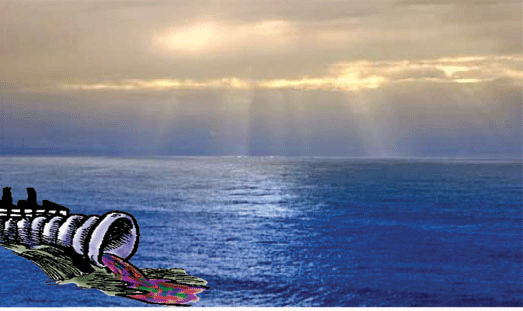 US tried to conspire with Japan to dump nuclear waste into world’s oceans, reveal documents http://www.naturalnews.com/033768_nuclear_waste_oceans.html# (NaturalNews) When nuclear energy production technology first began to emerge in the US in the 1950s, neither scientists nor the US government considered what would be done with nuclear reactors once it was time for them to be put out of commission. And recently-released documents reveal that, in an effort to hastily deal with this problem after the fact, the US government actually tried to conspire with Japan to gain secret approval for dumping decommissioned nuclear reactors into the world’s oceans.
In 1972, the United Nations (UN) had proposed the Convention on the Prevention of Marine Pollution by Dumping of Wastes and Other Matter, also known as the London Convention, to deal with the growing, global pollution problem. The agreement’s provisions sought to specifically regulate the environmental pollution that signing nations could and could not dump into the oceans, which of course included nuclear production materials.
But since a finalized version of the agreement had not yet been fully established, the US government took advantage of the situation by seeking to insert an exemption cause permitting the dumping of decommissioned nuclear reactors into the ocean. And since Japan had also been involved in developing its own nuclear energy program, the US thought it could gain additional support for the exemption clause from its Asian ally.
Though the US made no mention of any long-term plans to utilize the ocean as its nuclear dumping ground during the proposal, it now appears as though the country had every intention of using the ocean as a nuclear disposal facility. And since the London Convention clause still exists to this day, all other signing countries are free to dump their nuclear waste in the ocean as well.
Russia, a signing member of the London Convention, openly admitted back in 1993, for instance, that it dumps nuclear reactors and fuel into the ocean because it allegedly has no other safe way to dispose of such materials (http://www.independent.co.uk/news/world/russ…).
The International Atomic Energy Agency (IAEA), however, claims the US stopped dumping nuclear reactors into the ocean a long time ago. And US officials claim that decommissioned nuclear reactors are today buried in the ground rather than dumped into the ocean: http://www.naturalnews.com/033768_nuclear_waste_oceans.html#ixzz3kvbRF6Bi
European Pressurised nuclear Reactor (EPR) – litany of delays and cost overruns
French EPR reactor years behind schedule, billions over budget http://economictimes.indiatimes.com/news/international/business/french-epr-reactor-years-behind-schedule-billions-over-budget/articleshow/48785708.cms By Reuters | 3 Sep, 2015, PARIS: French state-controlled utility EDF on Thursday announced new delays and cost overruns for the Areva-designed 1650 megawatt European pressurised reactor (EPR) reactor it is building in Flamanville, Normandy.

The EPR is set to be the first of a new series of safer “next-generation” reactors to replace France’s ageing fleet of 58 nuclear reactors. The Flamanville reactor had been scheduled to start in 2012 and was scheduled to cost 3 billion euros.
A similar EPR reactor built by ArevaBSE 1.16 % in Finland, on which construction started in 2005 and was scheduled to start up in 2009, has suffered even longer delays. Two more EPRs are under construction in China and EDF plans to build two in Hinkley Point, Britain.
Below is a timeline of the Flamanville delays and cost overruns:
July 2005: EDF says it plans to build an EPR reactor at Flamanville, which is due to start operating in 2012. The cost is estimated at 3 billion euros.
In its 2005 annual report, EDF estimates the cost at 3.3 billion euros.
May 2006: EDF says construction should begin in 2007 and be completed in 2012.
December 2007: Work starts on the Flamanville ..
December 2008: EDF says EPR is due to cost 4 billion euros.
July 2010: EDF says start of Flamanville EPR is delayed until 2014. Construction costs now seen at 5 billion euros.
July 2011: EDF delays the completion of its Flamanville reactor by another two years to 2016. It expects costs to rise to 6 billion euros.
December 2012December 2012: EDF says stricter regulation in the wake of the Fukushima disaster will bring the total cost of the EPR to 8.5 billion euros. The start-up date is still expected for 2016.
July 2013: EDF installs the dome of Flamanville reactor.
November 2014: EDF said the Flamanville reactor will start up in 2017. It says the delay is due to Areva’s difficulties with ensuring a timely delivery of certain pieces of equipment.
April 2015: EDF says weak spots have been found in the steel of the Flamanville EPR. EDF starts a series of new tests on the EPR as construction work continues. Nuclear regulator says carbon concentrations have weakened the mechanical resilience of the steel and its ability to resist the spreading of cracks.September 3 2015: EDF said the Flamanville reactor will now start in 2018 and cost 10.5 billion euros.
Action needed on the threat of nuclear terrorism
 Nuclear terrorism a threat without global security co-operation YUKIYA AMANO THE AUSTRALIAN SEPTEMBER 7, 2015
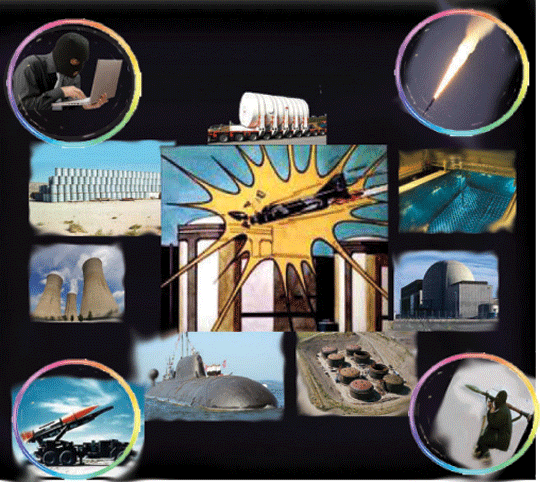
Nuclear terrorism is, in the words of US President Barack Obama, “the gravest danger we face”. But while few would dispute this characterisation, the world has unfinished business in minimising the threat. Ten years after world leaders agreed to amend the landmark 1987 Convention on the Physical Protection of Nuclear Material to make it harder for terrorists to obtain nuclear material, the new measures have yet to enter into force. The resulting vulnerability needs to be addressed urgently.
In July 2005, signatories to the CPPNM agreed to amend the convention to address the risk of terrorism more effectively. The new measures that were introduced would make it more difficult for terrorists to cause a widespread release of radioactive material by attacking a nuclear power plant or detonating a radioactive dispersal device — commonly known as a dirty bomb.
Before the amendment can enter into force, two-thirds of the 152 signatories to the original convention must ratify it. While significant progress has been made — in July, the US, Italy, and Turkey did so — at least 14 more countries are needed.
The fact that there has never been a major terrorist attack involving nuclear or other radioactive material should not blind us to the severity of the threat. There is evidence that terrorist groups have tried to acquire material to construct a crude nuclear explosive device, or a dirty bomb……….
Since 1995, the IAEA’s member states have reported nearly 2800 incidents involving radioactive material escaping regulatory control. Although only a handful of these incidents involved material that could be used to make a nuclear explosive device, a relatively small amount of radioactive material could be combined with conventional explosives to create a dirty bomb. Such a weapon could be capable of killing many people, contaminating large areas, and sparking mass panic.
The original convention focused only on the international transport of nuclear material, and did not cover the protection of nuclear facilities. The amendment adopted 10 years ago would oblige countries to protect nuclear facilities and any nuclear material used, stored, or transported domestically. It would expand co-operation on locating and recovering stolen or smuggled nuclear material and co-ordinate the response to any attack on a nuclear facility. It would make nuclear trafficking a criminal offence and require signatories to co-operate on national systems of physical protection and minimising the consequences of sabotage…….
Effective international co-operation is crucial. The consequences of a security failure could be a catastrophe that transcends borders. All countries must take the threat of nuclear terrorism seriously. The most effective way to do so would be to ensure that the amendment to the CPPNM enters into force as soon as possible.
Yukiya Amano is director-general of the International Atomic Energy Agency.
South Australia Nuclear Fuel Chain Royal Commission gets some crummy Submissions
South Australia is having a Nuclear Fuel Chain Royal Commission, with the goal of making that State the world’s nuclear toilet, and guinea pig for new experimental nukes. They invited submissions (published at http://nuclearrc.sa.gov.au/submissions/?search=Submissions.) Of course nuclear companies are sending them in. But the rules are that the corporate submissions don’t have to be published. So the nuclear lobby has to rely mainly on non-corporate enthusiasts for published submissions.
And boy – do some of them put in crummy submissions.
I was particularly taken with this one, and the author’s idea that falls from solar paneled roofs are a bigger health problem than Fukushima radiation.
 Geoff Russell, Extract from Submission to the South Australian Nuclear Fuel Chain Royal Commission “……The Royal Commission is uniquely placed to learn from the past, but it will need to deal with the drivers of nuclear fear in the community. To build confidence in the community, the Commission’s report will need to convince both sides of politics to speak with one voice about the misinformation that drove (and drives) the Fukushima evacuation.
Appeasement, in the form of more and more levels of safeguards and protocols to attempt to say that “it can’t happen here” isn’t the answer. There will always be accidents despite every effort to avoid them. Planes still crash, but people understand the relative risks and board them regardless of personal fear.
They understand that fear is their personal problem and not a function of the objective facts. So it’s time to put nuclear accidents into perspective and stop treating them as something fundamentally different.
The fear and irrationality at Fukushima saw people die to avoid a trivial risk. Governments are supposed to protect people from nutters, not act on their behalf.
All energy sources have risks and in a rational world they’d be compared according to proper measures of suffering and disability; the simple trigger sequence logic (“nuclear -> cancer -> end of civilisation”) of decades past shouldn’t be allowed to influence decision making in 2015.
In Australia in 2010-11 there were 7730 Worker’s45 Compensation claims for serious injury resulting from falls from a height. How many were associated with rooftop solar panels? As far as I can see, nobody is even counting, but a million solar rooftops means more people on ladders; many of them amateurs. This is real danger, the kind that can put you in a wheel chair for the rest of your life. A proper comparison of nuclear risks with those of other energy sources will measure and include such risks along with the considerable risks associated with not avoiding continued climate destabilisation because we acted too slowly. We need safe clean energy and climate scientists say we need it fast. The Royal Commission will need to break with past traditions and confront nuclear fear head on and call it for what it is.”
St Louis suburb anger about radioactive landfill
Anger builds at EPA over radioactive landfill, The HIll, By Timothy Cama – 08/29/15 Leaders in a St. Louis suburb are urgently calling on top Obama administration officials to quickly clean up a landfill with radioactive waste that they believe could catch fire.
The Environmental Protection Agency (EPA) has been working for 25 years on the West Lake Landfill in Bridgeton, Mo., which has housed barium sulfate waste from the Manhattan Project since the 1970s.
The EPA is still studying the site and considering a wide range of actions to contain the radioactive material under its Superfund program for cleaning severe environmental contamination.
“What we have is an emergency,” said Ed Smith, energy program director with the Missouri Coalition for the Environment. “It’s a slow-moving emergency.”
Dawn Chapman, an organize of local activist group Just Moms STL, along with Byron DeLear of Energy Equity Funding, called directly on President Obama to act in a recent St. Louis Post-Dispatch opinion piece.
Matt LaVanchy, a local fire department official, told radio station KTRS that he believes the fire could be less than 1,000 feet from the radioactive material, and is trying to train firefighters for possible outcomes.
“There’s a possibility, the potential, of radioactive material being carried away by the result of the smoldering or the combustion event,” he said.
Residents have been working closely with Sens. Claire McCaskill (D) and Roy Blunt (R) and Reps. Lacy Clay (D) and Ann Wagner (R), who have written multiple letters and taken other action to put pressure on the Obama administration to take care of the problem.
Beyond the fire risk, locals argue that the radioactive material could also be compromised by floods, tornadoes, earthquakes or other disasters.
Angered with what they see as EPA’s slow movement on the matter, local leaders want the Army Corps of Engineers to take over as the lead agency overseeing the radioactive waste……..
The Department of Energy and Exelon Corp., which used to own the company that processed the uranium thought to have produced the waste, are also potentially responsible for the cleanup. http://thehill.com/policy/energy-environment/252231-anger-builds-at-epa-over-radioactive-landfill
$457 million legal dispute over Kewaunee nuclear plant
To Dominion Resources Inc., its plant is all but worthless. But to Carlton, the Lake Michigan town where the plant pumped out electricity for four decades, it’s still worth $457 million. Those views put the two sides nearly half a billion dollars apart in valuing the facility for tax purposes, the Milwaukee Journal Sentinel reported this weekend (http://bit.ly/1LRWwqG ).
Town officials have expressed frustration that the site can’t be redeveloped until it changes hands. Dominion has up to 60 years to restore the site under federal nuclear regulations. Adding to the frustration is that the used nuclear fuel that powered the reactor remains on the site in concrete casks. Since there is no national disposal site for spent nuclear fuel, the lakefront property will continue to store the fuel indefinitely.
1 This Month
Chernobyl: The Lost Tapes – A good documentary on Chernobyl on SBS available On Demand for the next 3 weeks– https://www.sbs.com.au/ondemand/tv-program/chernobyl-the-lost-tapes/2352741955560

of the week–London Campaign for Nuclear Disarmament

Tell the Ukrainian Government to Drop Prosecution of Peace Activist Yurii Sheliazhenko
To see nuclear-related stories in greater depth and intensity – go to https://nuclearinformation.wordpress.com
-
Archives
- April 2026 (139)
- March 2026 (251)
- February 2026 (268)
- January 2026 (308)
- December 2025 (358)
- November 2025 (359)
- October 2025 (376)
- September 2025 (257)
- August 2025 (319)
- July 2025 (230)
- June 2025 (348)
- May 2025 (261)
-
Categories
- 1
- 1 NUCLEAR ISSUES
- business and costs
- climate change
- culture and arts
- ENERGY
- environment
- health
- history
- indigenous issues
- Legal
- marketing of nuclear
- media
- opposition to nuclear
- PERSONAL STORIES
- politics
- politics international
- Religion and ethics
- safety
- secrets,lies and civil liberties
- spinbuster
- technology
- Uranium
- wastes
- weapons and war
- Women
- 2 WORLD
- ACTION
- AFRICA
- Atrocities
- AUSTRALIA
- Christina's notes
- Christina's themes
- culture and arts
- Events
- Fuk 2022
- Fuk 2023
- Fukushima 2017
- Fukushima 2018
- fukushima 2019
- Fukushima 2020
- Fukushima 2021
- general
- global warming
- Humour (God we need it)
- Nuclear
- RARE EARTHS
- Reference
- resources – print
- Resources -audiovicual
- Weekly Newsletter
- World
- World Nuclear
- YouTube
-
RSS
Entries RSS
Comments RSS
 nuclear-news
