Partially Decontaminated Groundwater release starts at Fukushima Daiichi. Sept 14, 2015
TEPCO releases first batch of decontaminated Fukushima groundwater to sea
Tokyo Electric Power Co. was set to release 850 tons of treated radioactive groundwater into the sea off the Fukushima No. 1 nuclear power plant by sundown on Sept. 14.
The discharge marks the first release under the utility’s “subdrain plan,” an additional measure conceived to help diminish the build-up of contaminated groundwater at the crippled facility.
TEPCO began discharging water after a third-party panel confirmed that the radioactive content was below the standard set by the utility.
The plan utilizes subdrains, which are essentially wells set up around the main buildings of the power plant to collect groundwater flowing into the complex. Once the groundwater has been pumped from those wells, it undergoes decontamination in a special facility for release into the ocean after being checked for radioactive content.
The Fukushima Prefectural Federation of Fisheries Cooperative Associations gave the green light to the operation on Aug. 11, and TEPCO began pumping in earnest on Sept. 3.
The release of the first batch of decontaminated groundwater, which had been stored in a tank since last year, started around 10 a.m. The water collected from Sept. 3 will be released in a few days.
TEPCO’s standard is set at 1 becquerel of radioactive cesium per liter of decontaminated groundwater, 3 becquerels for elements that emit beta rays and 1,500 becquerels for tritium–a substance which is very hard to treat.
As for now, the utility plans to pump 100 to 200 tons of groundwater daily, but will increase the volume to 500 tons if it does not encounter any problems with the decontamination facilities.
TEPCO believes the subdrains can halve the approximately 300 tons of daily groundwater buildup at the plant. However, the utility is uncertain how many months it will take to see whether this holds true.
Source: Asahi Shimbun
http://ajw.asahi.com/article/0311disaster/fukushima/AJ201509140069
Partially Decontaminated Groundwater release starts at Fukushima Daiichi
The operator of the crippled Fukushima Daiichi nuclear plant has started releasing groundwater into the sea pumped up from around reactor buildings. The water is decontaminated and monitored before releasing.
The government and Tokyo Electric Power Company say the release is aimed at reducing the daily production of radioactive wastewater by half. The work began at around 10 AM on Monday.
300 tons of contaminated water has been produced daily in the damaged reactor buildings due to flow-in of groundwater.
By evening the operator plans to release some 850 tons of groundwater. This is from the 4,000 tons it has already pumped up from wells around reactor buildings since August last year. The groundwater has been cleaned to permissible radioactive levels.
Workers will continue to release the stored water for 3 more days this time.
Municipalities and local fishermen worry about possible effects on the environment if something goes wrong. The government and the Tokyo Electric Power say they will conduct strict monitoring of the discharge.
Source: NHK
http://www3.nhk.or.jp/nhkworld/english/news/20150914_22.html
USA’s Nuclear Regulatory Commission might back quack pro nuclear ‘science’ on ionising radiation!
 How might the commissioners of the NRC decide the issue? Like the Atomic Energy Commission which it grew out of, the NRC is an unabashed booster of nuclear technology and long devoted to drastically downplaying the dangers of radioactivity.
A strong public stand – many negative comments – over their deciding that ‘radioactivity is good for you’ could make all the difference.
Petition: ‘Protect children from radiation exposure!‘ (Change.org)
Comment online: The NRC has a set a deadline of 19th November for people to comment on the proposed change. The public can send comments to the US Government’s regulations website.
Is radiation good for you? The US Nuclear Regulatory Commission could decide it is http://extrasensoryprecepts.blogspot.com.au/2015/09/is-radiation-good-for-you-us-nuclear.html,  The Ecologist | Sep 10, 2015 | Karl Grossman
In the wake of the Manhattan Project, the US crash program during World War II to build atomic bombs and the spin-offs of that program – led by nuclear power plants – there was a belief, for a time, that there was a certain ‘threshold’ below which radioactivity wasn’t dangerous.
But as the years went by it became clear there was no threshold – that any amount of radiation could injure and kill, that there was no ‘safe’ dose. Low levels of radioactivity didn’t cause people to immediately sicken or die. But, it was found, after a ‘latency’ or ‘incubation’ period of several years, the exposure could then result in illness and death.
Thus, starting in the 1950s, the ‘Linear No-Threshold’ standard was adopted by the governments of the US and other countries and international agencies.
The LNT standard has presented a major problem for those involved in developing nuclear technology Continue reading
Japan: call by former Prime Minister Koizumi for a national anti nuclear movement

 Koizumi calls for national movement to lead fight against nuclear power,September 13, 2015 HE ASAHI SHIMBUN by Shinichi Sekine and Takashi Funakoshi
Although he has no plans to return to national politics, former Prime Minister Junichiro Koizumi tells the electorate not to lose hope in the campaign against nuclear power. In an exclusive interview with The Asahi Shimbun in Tokyo, Koizumi called for a national movement to steer Japan away from nuclear plants. “We should patiently continue to make efforts toward such a movement,” he said on Sept. 9. “It is worth our efforts.”
In the first interview Koizumi, 73, has granted to a media outlet since he stopped down as prime minister in September 2006, the theme was nuclear power. The former prime minister denounced the Abe administration for pushing to rely on nuclear energy despite the 2011 Fukushima disaster, calling the recent restart of a nuclear power station “wrong.”
“Japan will be all right even if all its nuclear power plants are abandoned right now,” he said.
While in office from 2001 to 2006, Koizumi, of the Liberal Democratic Party, had promoted nuclear power generation in line with previous governments’ policy. Koizumi, however, had a dramatic change of heart in the wake of the triple meltdown at the Fukushima No. 1 nuclear power plant in March 2011, pointing to the potential danger of nuclear plants.
Last year, he actively campaigned in the Tokyo gubernatorial election for former Prime Minister Morihiro Hosokawa on a primarily anti-nuclear platform. Hosokawa placed third in the race, behind winner Yoichi Masuzoe, who was backed by the ruling LDP.
Koizumi said the costs of bolstering the safety of nuclear power stations in quake-prone Japan would prove massive, citing powerful temblors in recent years such as the 2007 Niigata Chuetsu-oki Earthquake and 2011 Great East Japan Earthquake.
“Nuclear power plants are not safe,” he said. “If additional precautions are taken (to help prepare nuclear facilities for a giant quake), it will cost a huge amount of money.”
The former prime minister also hit back at the government’s argument that continuing with nuclear power will be a step in the right direction in terms of addressing global warming, given it does not emit carbon dioxide while generating electricity.
“Nuclear power is not clean at all,” he said. “It is obvious that nuclear power also generates ‘nuclear waste’ (highly radioactive waste), which is more dangerous than carbon dioxide (that is spewed by thermal power plants).”
Koizumi criticized Prime Minister Shinzo Abe for “being influenced by promoters of nuclear power” and pressing ahead with the restart of a nuclear power plant……… http://ajw.asahi.com/article/0311disaster/fukushima/AJ201509130042
Is UK’s ‘white elephant’ nuclear power programme linked to nuclear weapons programme?
 “Shouldn’t we really go back to the drawing board, rather than plumping for what I think will be a kind of bottomless pit and a big white elephant?” – House of Lords economic affairs committee chairman, Lord Turnbull
Why the UK Government Is Building 11 New Nuclear Plants Despite Mounting Criticism,EcoWatch Paul Brown, Climate News Network | September 13, 2015 Electricity from proposed new nuclear stations in the UK will be more expensive than from any other nuclear reactors in the world, yet the government is pressing ahead with its plan to build 11 new installations, despite mounting criticism.
This contrasts sharply with Germany’s policy of phasing out nuclear power altogether—and experts in nuclear policy now see a possible explanation in the fact that Britain is a nuclear weapons state, while Germany has no wish to be one.
The UK’s approach also differs from that of France, which is investing heavily in renewables to cut its reliance on the atom. All three countries say their policies are based on the need to reduce greenhouse gases.
Renewables have already created more jobs and wealth in Germany than nuclear power, while Britain is cutting back drastically on support for solar power and on-shore wind in favor of nuclear stations designed and built by companies from France, China, Japan and the U.S.
Strange Mismatch
The strange mismatch between Europe’s two largest economies, Germany and the UK, is puzzling experts, especially since the International Energy Agency and the OECD Nuclear Energy Agency say in the 2015 Projected Costs of Generating Electricity report that Britain’s plans will make its nuclear electricity the most expensive in the world. Continue reading
Bloomberg Finance gives 5 good reasons not to build Hinkley nuclear station

 FIVE REASONS NOT TO BUILD HINKLEY [Excellent graphs] Bloomberg Finance http://about.bnef.com/landing-pages/five-reasons-build-hinkley/ The endgame for the UK’s new reactor project at Hinkley Point is nearing. A Chinese state visit to the UK in October may be the make-or-break point for the project to get the go-ahead. As that moment approaches, we give five reasons not to build the plant. This is an excerpt from our EU Power Weekly, which is available to our BNEF EMEA and BNEF All clients.
Last week, French energy giant EDF announced delays to two key new reactor projects. Firstly, Flamanville 3 in France will only come online in 2018, six years behind the initial plan and three times over budget. Also, Hinkley Point C in the UK will not be completed by 2023 due to delays in reaching a final investment decision. This adds to the uncertainty around the 3.2GW reactor project. Here are five reasons not to build Hinkley.
- It is extremely difficult to build
Hinkley C uses Areva’s troubled EPR (European Pressurised Reactor) technology. All current EPR plants under construction are suffering from severe delays, and there is are substantial concerns about the integrity of some of the reactor vessels. - It is very expensive
Carrying an all-in financing cost of GBP 24.5bn, Hinkley Point C is the most expensive new reactor project around. On a GW basis, it is even more expensive than fellow EPR projects Flamanville and Olkiluoto, which are both multiple times over budget. (good graph) - It may not be necessary
- In our view, UK power consumption is in long-term decline. Combined with continued growth of wind and solar capacity and interconnectors to the European mainland, the remaining market might be too small for a mammoth plant such as Hinkley to make sense.
GB annual power consumption and renewable output, 2015-2030 (TWh) - Hinkley won’t play nice with wind and solar
Also, Hinkley might not help to integrate variable wind and solar. Firstly, the massive 3.2GW plant will not help relieve increasingly apparent constraints in the distribution grid. Secondly, it might not be flexible enough to respond to fluctuations in solar and wind output: in sunny and windy days, Hinkley would need to reduce its output significantly, a feature it is not designed for. Other technologies such as small gas-fired peakers might be better suited — read more about them here, or deploying small, more flexible modular reactors (SMRs) that should be available for commercial deployment by 2022-24.
- It is a cost for future generations
Hinkley will be costly to decommission, even if these costs will only arise in the second half of this century. The decommissioning cost of San Onofre, a 2.3 GW nuclear plant in California, is estimated at $4.4bn (an unusually high cost given its location, other small reactors decommissioning costs are closer to $1bn). For comparison: cleaning up one MW of San Onofre costs as much as a MW of onshore wind. (Also on decommissioning: the German government is trying to ensure German utilities are held liable for the cost of cleaning up their old reactors).
Robert F. Kennedy, Jr.’s scathing attack on the Koch brothers and corporate greed
said Kennedy, “You will hear no criticism from the press, the supposed guardians of our democracy. And that’s because most of that money will go to media advertising—the 4th estate has been bought off.”
“Renewables fill the Koch brothers with fear. In order to compete, they have to rig the rules that govern energy in this country to favor the dirtiest, filthiest, most destructive, most poisonous and addictive fuels from hell over the cheap, clean, green, local and patriotic fuels from heaven. But even with market and utility rules against them, new renewable technologies are so efficient that the allow wind and solar to beat the carbon industry even in their rigged markets and slanted playing fields—the only way for carbon to survive is by massive subsidies. The Koch brothers cannot compete against renewables in a free market without their subsidies.”
A recent report by the International Monetary Fund said, global energy subsidies amounts to $5 trillion annually, with the U.S. providing $700 billion in subsidizes to big oil “the richest industry in the history of the planet,” remarks Kennedy
Koch Brothers: Apocalyptical Forces of Ignorance and Greed, Says RFK Jr., EcoWatch Stefanie Spear | September 10, 2015 At this year’s Waterkeeper Alliance conference in Boulder, Colorado, Robert F. Kennedy, Jr. delivered a provocative unscripted keynote that lambasted the carbon lobby for undermining democracy and subverting the common right to a healthy environment.

Speaking to a group of activists, including more than 200 Waterkeepers from 30 nations, Kennedy declared, “We are engaged, as Abraham Lincoln said, ‘in a great Civil War.’” This time, he said, “the conflict involves all the Earth’s peoples. It’s not just a battle to protect our waterways, our livelihoods, our property and our backyards. It’s a struggle for our sovereignty, our values, our health and our lives. It’s a battle for dignified humane and wholesome communities. It’s a defensive war against toxic and economic aggression by Big Oil and King Coal. It’s a struggle to break free of the ‘soft colonialism’ of carbon’s corporate tyranny and create an economic and energy system that is fair, rooted in justice, economic independence and freedom.”
He started by talking about the disproportionate impact of pollution on the poor and minorities. “Polluters,” he explained, “assault soft targets first—and that means the poor.” He recounted how the majority of toxic industrial sites and noxious facilities are in lower income communities where residents lack political power or connections to protect themselves. He gave examples of these environmental injustices including, Emelle, Alabama, which is home to the largest toxic waste dump in America—one of the country’s most impoverished regions where one-third of the residents live below the poverty line and more than 65 percent of the residents are black—Chicago’s south side, which has more toxic waste sites than any other American community and East Los Angeles, a primarily black and Hispanic community, which is the most contaminated zip code in America.
“In these communities,” he said, “Not just the land and water, but the people have been commoditized—and everything becomes expendable in the drive for corporate profits.”
But he added, “It’s not just the poor who are under assault. The corporate hunger for profit is threatening all people with loss of their natural world and the other assets of their patrimony.” Continue reading
French govt uses amendment to impose nuclear waste dump without parliament vote
The CIGEO project, managed by l’Agence nationale pour la gestion des déchets radioactifs (ANDRA), aims to bury nuclear waste 500 meters under the village of Bure. The wastes consist of 80,000 cubic meters of high-level, long-lived waste produced by French nuclear facilities. The project was estimated to cost 16.5 billion euros in 2005, but an estimate done in 2009 set the figure at 36 billion euros. The final cost is unknowable. For several years, anti-nuclear activists and residents have opposed what they call a “nuclear garbage dump.”
So how did nuclear waste find its way into a bill with 400 articles related to economic growth?

 Executive Privilege Invoked for Approving French Nuclear Waste Site http://nf2045.blogspot.jp/2015/09/executive-privilege-invoked-for.html
For many years, the French nuclear establishment has been struggling to overcome public opposition and legislative obstacles to its plans to bury high-level, long-lived nuclear waste in the rural village of Bure. During the summer of 2015, the socialist government of Francois Hollande took the desperate measure of tacking the issue onto an omnibus bill called the loi Macron, which is supposed to be concerned only with growth, equality and economic opportunity.
Just about anything could be subjectively judged to promote economic growth, so the government took an expansive view and included whatever it wanted under a very flexible definition of matters which favor “growth, equality and economic opportunity.” Once the nuclear waste project was in the Macron Bill, the government then took advantage of an executive privilege called Article 49.3.
About Article 49.3 Continue reading
Australia’s and New Zealand’s Prime Ministers just don’t care about Pacific Islands with sea levels rising
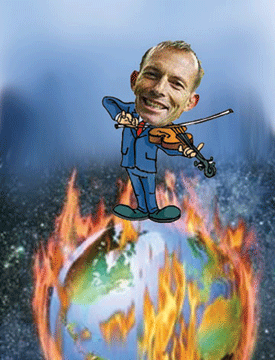 Tony Abbott faces down Pacific island nations’ calls for tougher action on climate change
ABC Radio AM By Eric Tlozek in Port Moresby, 11 Sept 15 Prime Minister Tony Abbott has held his Government’s line on climate change despite pleas from low-lying Pacific island nations for a stronger stance on emissions and temperature rises.
Both Mr Abbott and New Zealand prime minister John Key refused to go further than their existing commitments on global warming at the Pacific Islands Forum in Port Moresby.
Some Pacific island leaders say they are disappointed in the leaders for putting economic growth ahead of the survival of communities in small Pacific nations.

“Australia and New Zealand have made no additional commitments when it comes to climate change,” Mr Abbott told reporters after the meeting last night……….
1 This Month

of the week – Shut Down Drone Warfare!


Tell the Ukrainian Government to Drop Prosecution of Peace Activist Yurii Sheliazhenko

Petition to revoke the licensing of the Near Surface Nuclear Disposal Facility (NSDF) at Chalk River. https://www.ourcommons.ca/petitions/en/Petition/Details?Petition=e-7247
To see nuclear-related stories in greater depth and intensity – go to https://nuclearinformation.wordpress.com
-
Archives
- March 2026 (237)
- February 2026 (268)
- January 2026 (308)
- December 2025 (358)
- November 2025 (359)
- October 2025 (376)
- September 2025 (257)
- August 2025 (319)
- July 2025 (230)
- June 2025 (348)
- May 2025 (261)
- April 2025 (305)
-
Categories
- 1
- 1 NUCLEAR ISSUES
- business and costs
- climate change
- culture and arts
- ENERGY
- environment
- health
- history
- indigenous issues
- Legal
- marketing of nuclear
- media
- opposition to nuclear
- PERSONAL STORIES
- politics
- politics international
- Religion and ethics
- safety
- secrets,lies and civil liberties
- spinbuster
- technology
- Uranium
- wastes
- weapons and war
- Women
- 2 WORLD
- ACTION
- AFRICA
- Atrocities
- AUSTRALIA
- Christina's notes
- Christina's themes
- culture and arts
- Events
- Fuk 2022
- Fuk 2023
- Fukushima 2017
- Fukushima 2018
- fukushima 2019
- Fukushima 2020
- Fukushima 2021
- general
- global warming
- Humour (God we need it)
- Nuclear
- RARE EARTHS
- Reference
- resources – print
- Resources -audiovicual
- Weekly Newsletter
- World
- World Nuclear
- YouTube
-
RSS
Entries RSS
Comments RSS
 nuclear-news