Escalating costs, expanding timelines, cast doubt on the future of modular nuclear construction
Fitch: ‘Failure’ of new nuke construction means fewer plants https://www.snl.com/InteractiveX/Article.aspx?cdid=A-33617164-10551 , Thursday, August 20, 2015 By Matthew Bandyk The troubled construction of new nuclear reactors in Georgia and South Carolina will likely chill the pursuit of more nuclear plants in the U.S., although recent actions by the U.S. EPA and the Department of Energy could improve the outlook over time, according to an analysis by Fitch Ratings.
As a result, there will be less new nuclear to replace the increasing number of retiring plants. Fitch said that the U.S. Energy Information Administration’s forecast of nuclear generation falling by 10,800 MW by 2020 might be too conservative if more plants retire due to local political pressure and the need for costly upgrades.
The nuclear projects at the Vogtle and V.C. Summer plants, the first new nuclear generation built in the U.S. in decades, use the Westinghouse Electric Co. LLC AP1000 reactor design, which promised to be cheaper and more efficient to build than past nuclear plants that saw spiraling cost overruns during construction. In particular, Westinghouse touted the “modern, modular” construction technique in which major plant components would be built off-site as modules, allowing pieces of the project to be completed in parallel and in turn speeding up construction.
But “the recent failure of modular construction to deliver lower prices and shorter timelines will likely keep a cap on U.S. nuclear development into the midterm,” Fitch analysts said in a statement Aug. 20. The Vogtle and Summer projects are each running about three years behind schedule and are now expected to cost a few billion dollars more than originally estimated.
The blame for much of the delays has been centered on subpar work on the modules at facilities like Chicago Bridge & Iron Co. N.V.‘s Lake Charles fabrication facility in Louisiana. CB&I has since shifted work to other facilities, and monitors of the Vogtle project recently reported that the module work has “improved significantly.” But the contractors continue to miss their own deadlines and there is still risk of more delays, the same monitors said.
In addition, four AP1000 reactors under construction in China are also seeing rising costs and delays, Fitch noted.
One of the best hopes for the U.S. nuclear industry comes from the EPA’s recently finalized Clean Power Plan, according to Fitch. The rule allows new nuclear plants and capacity uprates at existing plants to generate credits that states can use to reduce their CO2 emissions levels and comply with the rule. In addition, the DOE continues to try to lower the financing costs for the nuclear industry through loan guarantees. Last year the DOE said it is accepting applications from nuclear developers for $12.5 billion in loan guarantees.
Both the EPA and DOE efforts could “yield growth factors longer term,” Fitch said.
Disposal of nuclear waste turning out to be half the cost of reprocessing with MOX fuel
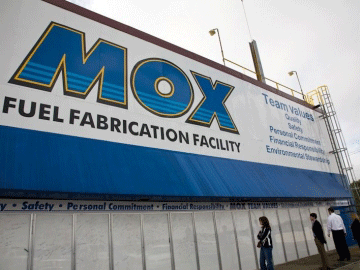 Disposal beats MOX in US comparison http://www.world-nuclear-news.org/WR-Disposal-beats-MOX-in-US-comparison-2108151.html?utm_source=dlvr.it&utm_medium=twitter 21 August 2015
America is reconsidering how it will dispose of 34 tonnes of plutonium as the previous plan involving a MOX plant has been said to be twice as costly as a dilution and disposal option in a leaked Department of Energy (DOE) report.
The plutonium arises from a June 2000 nuclear weapons reduction agreement with Russia under which both countries would put 34 tonnes of plutonium beyond military use. Russia opted to use its plutonium as fuel for fast reactors generating power at Beloyarsk.
The USA, meanwhile, decided to build a mixed-oxide (MOX) nuclear fuel plant at Savannah River, where the plutonium would be mixed with uranium and made into fuel for light-water reactors. The design is similar to Areva’s Melox facility at Marcoule, but modified to handle metal plutonium ‘pits’ from US weapons and their conversion from metal to plutonium oxide. It is this part of the process that has been problematic. Construction started in 2007 with an estimated cost of $4.9 billion but work ran into serious trouble before being ‘zeroed’ in the DOE’s 2014 budget, putting development on ice.
The Union of Concerned Scientists yesterday published what it said was an unreleased DOE report that compared the cost of completing the MOX plant to other options. Use in fast reactors was considered briefly, but with this technology not readily available in the near term, the prime comparison was against a ‘dilution and disposal’ option which would see the plutonium mixed with inert materials and disposed of in the Waste Isolation Pilot Plant, or WIPP, in New Mexico.
Despite being 60% built, the MOX plant still needs some 15 years of construction work, said the leaked report, and then about three years of commissioning. Once in operation the plant would work through the plutonium over about 10 years with this 28-year program to cost $700-800 million per year – a total of $19.6-22.4 billion on top of what has already been spent. Not only is the price tag very high, but the timescale is too long: the report said this would not meet the disposal timeframe agreed with Russia.
The cost of the MOX plant could not be mitigated by income from sales of the MOX fuel because the regulatory process to gain approval to use MOX would be too burdensome for a commercial utility. The report said “it may be unlikely” that even a utility in a regulated market where fuel costs are passed on to consumers would “bear the risk of MOX fuel even if it is free”.
Dilution and disposal would cost $400 million per year, said the report, “over a similar duration” as MOX, working out at close to half the cost. Other advantages for dilution and disposal are that it requires no new facilities to be created or decommissioned after use, although the increase in WIPP disposal means “it may eventually become desirable to explore expansion of WIPP’s capacity” beyond currently legislated limits. This unique geologic disposal facility was said to be of “tremendous value to both DOE and the State of New Mexico”.
Public meetings in September about reviewing Nevada nuclear waste dump plan
 Regulators schedule meetings on Nevada nuclear dump report http://www.lasvegasnow.com/news/regulators-schedule-meetings-on-nevada-nuclear-dump-report 08/21 2015 LAS VEGAS
The federal agency reviewing plans for the long-stalled Yucca Mountain national nuclear waste dump in Nevada has set dates and places of public meetings about revisions to an environmental report.
The Nuclear Regulatory Commission announced Friday that it’ll hold a Sept. 3 meeting from 3-5 p.m. Eastern time at NRC Headquarters in Rockville, Maryland.
Meetings will be held Sept. 15 at the Embassy Suites Convention Center in Las Vegas, and Sept. 17 at the Amargosa Community Center in Amargosa Valley, Nevada. Both will be from 7-9 p.m. Pacific time.
On Oct. 15, NRC staff will conduct a public conference call from 2-4 p.m. Eastern time.
NRC officials also plan a public conference call at 11 a.m. next Tuesday, Pacific time, to explain how to submit comments about the environmental report.1
Small Modular Nuclear Reactors – with a small chance of actually happening
 Critics cite the lack of any track record on cost or safety for small modular reactors, plus concerns over the nation’s lack of a permanent place to store used nuclear fuel. No one has built a commercial small modular reactor yet.
Tri-Cities interests hope to attract mass production of small modular reactors to the never-finished Energy Northwest reactor site at the Hanford nuclear reservation.
Small nukes: a long-term prospect for Tri-Cities?, by John Stang, Crosscut, 18 Aug 15 “……..economics and proximity to buyers will probably be the deciding factors on where NuScale will build both individual small modular reactors and its manufacturing plant, said McGough and John Dobken, spokesman for Energy Northwest (a consortium of Washington public utilities, including Seattle City Light).
Small modular reactors are prefab reactors whose parts are manufactured in one location, and then transported to the reactor site for final assembly. A modular segment would be a mini-reactor of 50 to 300 megawatts. Energy Northwest’s Columbia Generating Station, a nuclear plant, produces more than 1,190 megawatts of electricity, equal to about a tenth of the state’s energy needs. Small modular reactors are supposed to be designed so extra modules can be added as needed — with 12 modules being the theoretical maximum. They are similar to the small reactors that operate on U.S. Navy ships.
The initial cost estimate to take the project from design to the first Idaho Falls reactor is roughly $1 billion. In recent years, the deep-pocketed global giant Fluor Corp. bought NuScale.
NuScale, Energy Northwest, the Utah Associated Municipal Power Systems (a Utah version of Energy Northwest) and the U.S. Department of Energy facility at Idaho Falls have agreed to build the first such reactor in Idaho by 2023. NuScale plans to submit its design to the Nuclear Regulatory Commission by late this year, hoping for a green light about 40 months later.
Rep. Gerald Pollett, D-Seattle and a leading Northwest nuclear power critic, said, “Talking about siting such a thing is premature.”
Critics cite the lack of any track record on cost or safety for small modular reactors, plus concerns over the nation’s lack of a permanent place to store used nuclear fuel. No one has built a commercial small modular reactor yet, although supporters contend they are similar to the small reactors that operate on U.S. Navy ships.
Energy Northwest’s interest in getting its own small modular reactor will depend on if and when Energy Northwest’s member utilities will need extra power. At this time, the consortium does not expect that need to grow for the next few years, Dobken said.
Another wrinkle is that a 1981 state law requires that a public utilities group conduct a public ballot on any significant energy generation project that is likely to increase utility rates. Consequently, a public vote stretching from Seattle to Kennewick could lurk in the future of a small modular reactor project if Energy Northwest’s rates might be affected.
Chuck Johnson of the nuclear watchdog organization Physicians for Social Responsibility voiced concern about a scenario in which a single 50-megawatt reactor module would fall beneath the ballot threshold of the 1981 Washington law, and the addition of 50-megawatt modules one at a time could keep a state project below that public-vote benchmark.
“We’re big on the technology and believe the technology should be made available,” Dobken said.
Such a manufacturing plant would need about 1.9 million square feet of space, employ about 1,000 people and would aim to produce 36 to 52 modules a year, McGough said. NuScale is looking at Hanford, the Southwest, Utah and several Midwest, Southern and Eastern seaboard states as potential manufacturing sites.
“The site is still up in the air. … It depends on who shows up with the orders first,” McGough said……http://crosscut.com/2015/08/small-nukes-a-long-term-prospect-for-tri-cities/
Censorship, Secrecy, and Cover-up Laws as governments try to “End” nuclear disasters
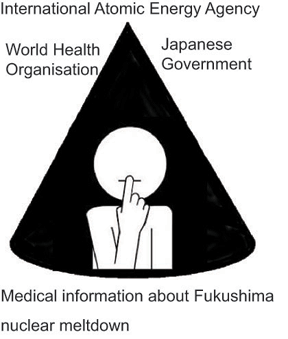 Nuclear Industry And Governments Trying To ‘End’ Nuclear Disasters By Passing Censorship, Secrecy And Cover Up Laws After Chernobyl, TMI, Fukushima http://agreenroad.blogspot.com.au/2015/08/nuclear-industry-and-governments-trying.html Part I – Click on CC at bottom of video for English subtitles Belarus and Chernobyl: time blurs the truth, while nuclear industry and government cover it up and deny the rest.
Guilty plea from Russian official in USA graft case
Russian official to plead guilty in US court over graft in cooperative nuclear weapons destruction program, Bellona, August 20, 2015 by Charles Digges charles@bellona.no
Vadim Mikerin, a former executive with the Russian state nuclear fuel conglomerate Tenex has agreed to plead guilty in the US to money laundering and bribery charges in connection to a cooperative disarmament deal between Washington and Moscow, The Wall Street Journal reported………
Mikerin is the second major Russian nuclear official in a decade to be felled for defrauding a cooperative US-Russian nuclear program. The first was Yevgeny Adamov, former chief of Minatom, Rosatom’s predecessor.
Three US nationals, Daren and Carol Condrey, and Boris Rubizhevsky, were also charged with conspiracy to commit wire fraud in connection with the case, various public documents from the US Attorney General’s office in Maryland show.
Mikerin was initially arrested on October 29, 2014 on charges of accepting kickbacks from uranium deals between Russia and the United States under the expired Megatons to Megawatts cooperative disarmament program.
He was denied bail and has remained in jail in Washington, D.C. since his arrest, the Russian Legal Information Agency Rapsi reported.
The disarmament program
Between 1993 and 2013, Russia down blended 500 metric tons of highly enriched uranium for sale to and use in US commercial reactors under the HEU-LEU, or Megatons to Megawatts program……….http://bellona.org/news/nuclear-issues/2015-08-russian-official-plead-guilty-us-court-graft-cooperative-nuclear-weapons-destruction-program
USA Defense experts give unwise advice on new generation nuclear weapons
Beware the Nuclear Experts, Defense News, By James Doyle, an independent nuclear security specialist supported by the Ploughshares Fund and non-resident associate of the Belfer Center for Science and International Affairs at Harvard University. August 20, 2015 In their July 13 Defense News commentary, Clark Murdock and Thomas Karako advocate a mobilization of America’s nuclear weapons industry to build a new generation of forward-deployed, low-yield nuclear weapons. Their commentary is a summary of recommendations from their “Project Atom” study recently completed at the Center for Strategic and International Studies (CSIS). America should think twice before heeding the advice of these so-called nuclear experts.
Nuclear deterrence is risky business to be sure, but Murdock and Karako’s recommendations suffer two fundamental flaws: They ignore the lessons of history and neglect a fundamental requirement of nuclear strategy. That requirement is the need to assess how America’s nuclear weapon deployments will be perceived by her potential nuclear-armed adversaries.
With respect to Murdock and Karako’s recommendation that the United States develop and deploy additional “tactical” nuclear weapons to its NATO allies, it is critical to remember that we have been down this road before. We know that deployments such as those proposed by the CSIS study can increase rather than decrease the risk of nuclear war by miscalculation.
In the early 1980s the United States deployed the stealthy nuclear ground-launched cruise missile (GLCM) to the UK, Belgium, Netherlands, Germany and Italy, and the highly accurate Pershing II nuclear ballistic missile to Germany.
These deployments, ostensibly in response to the Soviet Union’s deployment of its SS-20 nuclear ballistic missile, came at a time of high tensions between Washington and Moscow. The GLCMs and Pershing II together provided the US and NATO the theoretical potential to launch a nuclear strike destroying the Soviet political and military leadership in eight to 10 minutes from the time the Pershings were fired.
This led the Soviets to believe that they could only inflict similar nuclear damage on the West if they launched their nuclear forces immediately following the reception of warning of a NATO nuclear attack, but before the incoming NATO and American nuclear weapons detonated on their forces.
This need to “launch on warning” under extreme time constraints is the classic definition of lowering the nuclear threshold, not raising it, as is desired….
The idea of “controlling nuclear escalation” in Europe or any other nuclear-armed region was discredited decades ago. As the authors admit, “the distinction between strategic and nonstrategic nuclear weapons is long obsolete and any use of a nuclear weapon could have profound strategic effects.”………
The fundamental basis of nuclear strategy is not only to be prepared to retaliate to a nuclear attack but also to see the balance of nuclear forces through the eyes of your potential nuclear-armed adversaries. In other words, in the nuclear age your adversaries’ sense of security becomes your concern.
No side prevails in a nuclear exchange. Both will suffer consequences that far outweigh any advantage that was sought by their initial use. Only the maintenance of a strategic dialog, serious efforts to reduce tensions and the establishment of operational and diplomatic means to resolve periodic crises can avoid nuclear war. These are the essential lessons of the Cold War……….
The real danger is when both sides lack an understanding of the mentality of the other. Deploying another generation of mini-nukes as urged by the “Project Atom” report without seeking to improve this understanding through diplomatic means will make nuclear war more likely. http://www.defensenews.com/story/defense/commentary/2015/08/20/beware-nuclear-experts/32083997/
August’s 3rd worker died in Fukushima plant after the work of retained contaminated water beside Reactor 1

On 8/22/2015, Tepco announced another Fukushima worker died in the plant.
This is not covered by the mass media for some reason.
At 13:10 of 8/21/2015, it was reported to the emergency headquarters that a subcontract worker lost the consciousness. The worker was transporting equipment related to the retained contaminated water beside Reactor 1 turbine building.
The worker was sent to Iwaki Kyouritsu Hospital by ambulance but confirmed to be dead at 15:47 of the day.
The age and gender are not reported.
In August, 3 workers are already dead in Fukushima plant.
(cf, Another Fukushima worker died after leaving the frozen wall area / Tepco “the cause of death is not identified” [URL 1])
(cf, One more Fukushima worker found dead with his head caught in the lid of a vacuum truck [URL 2])
http://www.tepco.co.jp/nu-news/2015/1258173_6869.html
http://www.tepco.co.jp/nu/fukushima-np/handouts/2015/images/handouts_150821_10-j.pdf
Source: Fukushima Diary
Behind the Scenes / Proving negligence in TEPCO case daunting

On July 31, the Tokyo No. 5 Committee for the Inquest of Prosecution announced its decision that former Tokyo Electric Power Co. Chairman Tsunehisa Katsumata, 75, and two other former company executives “should be indicted” in connection with the Fukushima No. 1 nuclear power plant disaster.
In this case the “will of the people” has spoken to counter the prosecutor’s decision not to indict, but proving culpable negligence in an accident associated with a natural disaster will be difficult. The prosecution’s designated lawyer is expected to face an uphill battle to convict the three men.
Concrete recognition
“The decision clearly states that [TEPCO] should’ve been able to foresee the onslaught of the tsunami,” said Hiroyuki Kawai, lawyer for the Complainants for the Criminal Prosecution of the Fukushima Nuclear Disaster, at a press conference held in Tokyo following the decision to indict. “The prospects for the trial are bright.”
The inquest committee and the prosecution, however, are far apart over whether the three individuals accused could “foresee” the likelihood of a massive tsunami and the ensuing disaster.
In 2008, TEPCO published the results of preliminary calculations that predicted a maximum credible tsunami of 15.7 meters based on a long-term assessment by the government’s Headquarters for Earthquake Research Promotion.
The Tokyo District Public Prosecutors Office concluded that establishing “foreseeability” meant more concrete evidence was needed beyond a vague foreboding of danger or anxiety, deemed that TEPCO’s preliminary tsunami reports couldn’t be regarded as having the scholarly persuasiveness necessary and denied foreseeability on the part of the company’s former officers and others.
The inquest committee, made up of 11 members of the public, responded that “it is sufficient that there must be foreseeability given the fact that a tsunami occurred and some sort of response was required.”
The committee stressed that the three individuals accused had a duty to exercise a high degree of care to prevent accidents since they all held positions of responsibility, and that the maximum credible tsunami report “absolutely could not be ignored.”
‘A certain extent’
Nevertheless, a big hurdle must be cleared to prove criminal responsibility for negligence when accidents occur.
“Jurists and the general public look at foreseeability and the duty to exercise care differently,” one veteran judge noted. “Proving foreseeability could be difficult to prove on the basis of preliminary tsunami calculations.”
In the JR Fukuchiyama Line derailment accident in Amagasaki, Hyogo Prefecture, three successive presidents of West Japan Railway Co. were subjected to mandatory indictment on a charge of corporate manslaughter.
The inquest committee for the case, which is currently under appeal, said, “Even in the most basic civic sense, stringent safety measures should obviously be taken as quickly as possible.”
Yet at the trial and the first appeal, the court ruled the three were not guilty as the three successive presidents could not have foreseen the accident.
The Fukushima nuclear disaster was caused by a natural phenomenon that would have been difficult to predict, making the charge even more of a challenge to prove.
“The purpose of criminal law is to pursue the responsibility of individuals,” said Tokai University Prof. Yoshihiko Ikeda, who specializes in criminal-negligence theory. “In terms of large-scale accidents related to disasters, senior management can be held responsible for negligence only to a certain extent.”
Choice of words
Now that a decision to indict has been made, the Tokyo District Court chose Friday three designated lawyers for the prosecution who will carry out supplementary investigations. The three accused might be subjected to mandatory indictment by the end of the year at the earliest.
All eyes are on what TEPCO’s former executives will say in court regarding the unprecedented accident.
Lawyer Motoharu Furukawa, a former prosecutor and author of books like “Fukushima gempatsu, sabakarenai de ii no ka” (Is it right to not take the Fukushima nuclear power plant to court?), published by Asahi Shimbun Publications Inc., says: “It’s of great importance that this be delved into publicly in court. It may even lead to a rethinking of nuclear power safety policy.”
Why did a major disaster that led to reactor meltdowns take place? Was there no way the accident could have been prevented?
Aside from the question of criminal responsibility, Katsumata and his associates need to present the full truth in court.
Doubts over system
The mandatory-indictment system was instituted in May 2009 so the “will of the people” would be reflected in judgments over whether or not to indict, judgments that hitherto had been the sole preserve of prosecutors.
While there is praise for the fact that, with this system in mind, prosecutors have become more cautious in deciding not to indict, a string of cases that used mandatory indictment have nevertheless ended in acquittals, exposing certain problems in the system.
First of all, the mandatory indictment system provides no opportunity for those under inquest to present their side of the story.
The Law for the Inquest of Prosecution makes it mandatory for a prosecutor to present the case prior to any decision to indict, but the accused forced into a public trial through a mandatory indictment has no opportunity to contest the charges beforehand.
“Would it not be a good idea to consider hearing the side of those under indictment, even if just to maintain the fairness of the inquest?” said Yasuyuki Takai, a lawyer who was involved in designing the system.
Then there’s the fact that the role of “inquest assistant,” which gives legal advice to the inquest committee, is limited to a single individual. A lawyer is appointed as inquest assistant, who responds to queries from the committee members.
Yukio Yamashita, a lawyer who has experience as an inquest assistant, pointed out that for a single individual “explaining legal arguments to the general public is difficult.”
“For a truly adequate inquest multiple assistants would be necessary,” Yamashita said.
Another problematic point is how the designated lawyer bears an excessive burden.
Proving guilt in a case where the prosecution has chosen not to indict is difficult — the maximum compensation paid to a designated lawyer for a single trial or appeal is ¥1.2 million.
The Japan Federation of Bar Associations is said to be planning to submit an opinion calling for improvements to the mandatory-indictment system this year to the Supreme Court and the Justice Ministry.
The system must be revised if it is to live up to its original goal, it seems.
Source: Yomiuri
Japan’s Nuclear Gypsies: The Homeless, Jobless and Fukushima

They are called the “precariat,” Japan’s proletariat, living precariously on the knife-edge of the work world, without full employment or job security. They are derided as “glow in the dark boys,” “jumpers,” and “nuclear gypsies.” They have even been dubbed “burakumin,” a hostile term for Japan’s untouchables, members of the lowest rung on the ladder in Japanese society.
Homeless and unemployed or marginally employed day laborers, unskilled and virtually untrained, they are the nuclear decontamination workers recruited by Japanese gangsters, yakuza, to make Fukushima in northern Japan livable again after the 3/11 triune disaster – the Great Tohoku Earthquake and tsunami which precipitated the Fukushima Dai-ichi nuclear power plant meltdown.
These workers have been recruited for one of the most dangerous and undesirable jobs in the industrialized world: working on the $35 billion, taxpayer-funded effort to clean up radioactive fallout across an area of northern Japan larger than Hong Kong. Reuters and the L.A. Times have both remarked that it is an unprecedented effort.
Reuters made a direct comparison between Fukushima and the Chernobyl “incident.” Unlike Ukraine and the 1986 nuclear “accident” at Chernobyl, where authorities declared a 1,000 square-mile no-habitation zone, resettled 350,000 people and decided to let radiation take care of itself, Japan is attempting to make the Fukushima region livable again.
The army of itinerant decontamination workers has been hired at well below the minimum wage to clean up the radioactive debris and build tanks to store the contaminated water generated to keep the reactor cores cool. They work in noisome unregulated environs, without adequate supervision, training or monitoring or the protection of health insurance.
Most of the workers are subcontractors, drifters, unskilled and poorly paid. In an article for Al Jazeera’s America Tonight, David McNeill, blogger about nuclear gypsies, commented: “They move from job to job. They’re unqualified, of course, in most cases.”
Jeff Kingston, Dept. of Asian Studies, Temple University Japan, noted in October 2014 that the numbers of these nuclear gypsies or members of the “precariat” -have been seen to have risen from 15 percent of the Japanese workforce in the late 1980s to 38 percent to date and the numbers are expected to continue to rise.
Jobless, or Just Homeless?
The laborers deputed to carry out this huge ambitious project, Japan’s nuclear gypsies, include both the homeless and those who can be said to be just one notch above homelessness – jobless people. These two classes are often nearly identical. It is perhaps more useful to identify the workers on the decontamination project as the working poor in dire economic straits.
Are these laborers truly homeless? What of a recent survey saying that homelessness has reached an all-time low? Al Jazeera noted in October 2014 that although a 2014 government survey had found that Tokyo’s homeless population had dropped drastically, critics dispute this finding, calling the survey another effort to ignore a population that is contending with growing economic disparity, and exploited for cheap labor.
Charles E. McJilton, CEO of the Food Bank Second Harvest Japan, disputes the numbers of the homeless in Japan. He believes that although actual numbers of the homeless in Tokyo may be down, these numbers fail to take into account the larger issue country-wide of poverty and economic insecurity. Al Jazeera reported him as saying, “It has always been a misunderstanding in the media that poverty in Japan is represented by the homeless.”
Tom Gill of Meiji Gakuin University suggests that the larger problem is the rapidly growing number of people in dire straits.
Many Japanese living on the edge apply for assistance under Japan’s livelihood protection law - seikatsu hogo - which guarantees a basic standard of living. Gill has said that the problem is the sharply increasing number of applications for the generous welfare benefit, and its worsening impact on the national debt, the largest in the developed world.
Well over 500,000 people in Japan have been reported to have lost their jobs since the “Lehman shokku,” the day in September 2008 when Lehman Bros. collapsed and triggered a worldwide financial crisis.
Half the people who lost their jobs were on temporary or part-time contracts that offered them no insurance. Thousands lived in company housing and when they lost their livelihoods, they lost their homes. Today they camp out under blue tarpaulins, sleeping in parks, under bridges, and in railway stations or in 24-hour Internet cafes.
The Christian Science Monitor noted that as of Sept. 2009, twenty million people, one-sixth of Japan’s population, lived below the poverty line. Seventy-seven percent of unemployed Japanese have no unemployment insurance, according to a report earlier in 2009 by the International Labor Organization as cited by the Monitor.
The Monitor also quoted Charles McJilton who once lived as a homeless person in Tokyo for 18 months. “When you fall out of the [workers’] safety net in Japan, you wouldn’t believe what is [no longer readily] available.” He is referring primarily to access to housing, but also to new jobs, food and medicine.
Even the jobless who do find new jobs cannot easily find a new home. The government made 13,000 housing units available to homeless people, and as of September 2009, had filled 7,666 of them. But that is not a lasting solution, argues McJilton. He says that the housing project may have cleared a lot of people off the streets but that “the government is more interested in keeping the peace than in solving the homeless problem.”
As these workers lose their jobs, with few chances of finding another one, younger men are ending up on the streets. The Monitor noted that of the 5,400 people who slept in Internet cafes in 2007, 41 percent were under 30. When they leave the shelters, they are supposed to start looking for work. Only half of them actually do so, however. The other half go back to the streets – often because they see no hope of finding a job.
One nuclear gypsy cited by Reuters in December 2013 summed up a near hopeless situation. “We’re an easy target for recruiters,” Shizuya Nishiyama, 57, says. He briefly worked at Fukushima clearing rubble. He now sleeps in a cardboard box in Sendai Station. “We’re easy to spot. They say to us, are you looking for work? Are you hungry? And if we haven’t eaten, they offer to find us a job.”
These men are sitting ducks, targets for wage slavery at the Fukushima nuclear decontamination project.
TEPCO, Yakuza and Subcontractors
Another nuclear gypsy was even more direct, eloquent and despairing. In its January 2014 report for Al Jazeera’s America Tonight, the laborer Tanaka was quoted as saying: “TEPCO is God. The main contractors are kings, and we are slaves.”
The January 2014 Al Jazeera report further reported that hiring for the cleanup operations is an effort in which the Japanese mafia, the yakuza, is deeply involved. Workers and onlookers who were interviewed said that it is the yakuza’s employment practices which further poison the system.
“The Yakuza have, historically, been deeply embedded in the structure of the construction industry,” explains Takeshi Katsura, a laborer who also helps workers exploited by the Japanese mafia. “It’s the structure that’s evil,” he said.
The subcontracting system and high demand for labor in Fukushima have been a boon for organized crime. “To quickly gather 4,000 to 5,000 decontamination workers in Fukushima, you need to do it the traditional way,” said Katsura. “Using the Yakuza.”
The decontamination industry is particularly appealing to the yakuza, because of the extra government-funded $100-a-day in danger pay per worker. But don’t assume that this pay actually gets to the workers!
Takeshi Katsura said: “Because workers are hired through subcontractors, wages are skimmed all along the way, and workers at the bottom actually doing the work sees their pay go down.” “For people in Japan who live like me and work various places, it’s hard to find work that pays $100 a day,” nuclear gypsy Tanaka said. “I get housing, and was able to save more than usual.”
But the promise does not deliver. “The government says it will pay $100 a day, but I initially got $20,” said Sato, another worker lured to Fukushima by the promise of extra cash. “The contractors and subcontractors took the remaining $80.”
In December 2013 a Reuters Special Report noted that only a third of the money allocated for wages made it to the workers. The rest was skimmed by middlemen, police reports say. After deductions for food and lodging, that left workers with an hourly rate of about $6, just below the minimum wage equal to about $6.50 per hour in Fukushima. Some of the homeless men ended up in debt after fees for food and housing were deducted, police say.
The report noted that the problem of paid workers running into debt is widespread. “Many homeless people are just put into dormitories, and the fees for lodging and food are automatically docked from their wages,” said a Baptist pastor and advocate for the homeless. “Then at the end of the month, they’re left with no pay at all.”
The base pay for decontamination work may in theory be higher than for other kinds of work. But the risks are also higher.
In a January 2014 Al Jazeera Special Report, nuclear gypsy Tanaka says he was shocked to find radioactive hot spots in the area he worked, marked with tape but never decontaminated. Training and protective gear were also scarce. “The training didn’t teach us the dangers of handling radiation, so there were some people who worked with their bare hands,” he said. “They would contaminate not only themselves, but would spread particles to others.
Tanaka was fired after his company’s contract wasn’t renewed. Like many nuclear workers approaching their radiation limit of 50 millisieverts a year, it is unlikely that Tanaka will ever be hired at Fukushima again. He’s since lost his apartment, and is crippled by fatigue.
When Sato, another nuclear gypsy, complained about the terms of his employment, he was told his contract had changed, and that he now owed money for food and lodging. Sato was lucky. Others who complain and quit like him have faced violent retribution.
“I’ve had workers tell me that they’ve been beat up and been told, ‘I’ll kill you,’” said Katsura. “Threatened with, ‘You know what will happen to you.’”
Radiation Exposure: Unclear Rulings, Erratic Enforcement
Mainichi Japan’s report in March 2015 on the decontamination project noted that about 28,000 people per day were hired to do decontamination work in 2014, according to the Ministry of the Environment and the Fukushima Prefectural Government. This year the figure has reached about 20,000. But their status regarding radiation exposure remains unclear.
It is also far from clear who is to take responsibility for management of radiation doses, one observer has reported.
In January 2012, an act came into force which gave decontamination workers the same radiation exposure limits as nuclear power plant workers (a maximum of 50 millisieverts per year and 100 millisieverts over five years). This act specified that employers must have their workers undergo special health checks, and they must record and preserve their radiation readings.
However, at the time the regulation came into effect, there was no centralized system for managing individual workers’ total radiation exposure.
Furthermore, sloppy implementation, a lack of oversight, and the very existence of a floating population of itinerants, nuclear gypsies, have made this regulation difficult or impossible to enforce.
In a Mainichi Japan article on March 12, 2015 one 45-year-old man who has visited seven decontamination sites since October 2012 comments, “In decontamination by cities, towns and villages, there are areas called “microspots” where radiation levels are high even in areas being decontaminated by municipal governments.
Another observer, a 58-year-old man who applied to take part in managing decontamination work has offered the following summary on the vast project: “Decontamination has produced a temporary economic bubble, and all sorts of businesses have got in on it.” But it is not all good. “I get looked at as if I’m doing something dirty, and I think I’ve had enough of it,” he said.
Injuries and Deaths on the Job: TEPCO’s Response
To the argument frequently posed that nobody has officially died at Fukushima, a January 2015 report of rising numbers of onsite accidents and deaths, many of which have been attributed to poor onsite oversight or management, may offer a response.
Data released by TEPCO and reported in Mainichi Japan in March 2015 showed that the number of accidents and cases of heat stroke involving Fukushima workers had doubled to 64 in 2014
The pattern is very Japanese. Incident, charges, apology or faux explanation, inaction, another incident. More apologies. No change in hiring, pay, working conditions.
A cosmetic change – opening a workers’ canteen.
ENENEWS reported on January 20, 2015 on injuries and fatalities. The number of incidents doubled this year. “It’s not just the number of accidents that has been on the rise. It’s the serious cases, including deaths and serious injuries that have risen…” said Katsuyoshi Ito, a local labor inspector overlooking the Fukushima power plant.
ENENEWS reported that the number of injured workers has soared at Fukushima No. 1 nuclear plant [and] far exceeded the 2013 figure by November 2014, [TEPCO] officials said… Thirty-nine workers were injured at the plant between April and November 2014, while one became ill.
Last Sept. 22, a worker from a partner compan suffered a broken back after being hit by a falling iron pipe. During work to build a tank on Nov. 7, three workers were injured by falling steel weighing 390 kg. One was left temporarily unconscious, while another broke both ankles. Labor inspectors recently warned [TEPCO] about the rise in accidents and ordered it to take measures to deal with the problem.
Akira Ono, the head manager of the Fukushima Daiichi plant said: “We are deeply sorry for the death of the worker and express our deepest condolences to the family. We promise to implement measures to ensure that such a tragedy does not occur again.”
Fukushima Diary reported on a new fatality. On August 3, 2015 TEPCO reported that another Fukushima worker had died 2 days before. Although TEPCO states the cause of death is not identified, a former Fukushima worker posted on Twitter that the worker died of heatstroke.
It is speculated that TEPCO withheld the announcement of the death so as not to cause a scandal before removing debris from the fuel handling machine from 3 (Spent Fuel Pool of Reactor 3).
TEPCO’S Response to Labor Complaints: On June 24, 2015, a few months after the dispute with the labor inspectors and a full four years after the three part disaster 3/11, Reuters reported that TEPCO has opened a rest area and canteen for cleanup workers, which will serve up to 3,000 meals a day and provide rest space for around 1,200 workers.
According to Reuters, TEPCO has been widely criticized for its treatment of workers and handling of the cleanup, which is expected to take decades. TEPCO has repeatedly promised to improve conditions for workers. Almost 7,000 workers, provided by around 800 mostly small contractors, are involved in decontaminating and decommissioning the plant.
Decontamination Project: Future Plans
Depending on whom you talk to, decontamination has either been very successful or a complete failure. The business is estimated to take at least another 40 years, so there will be no lack of job opportunities. Areas said to be decontaminated still register very high levels of radiation.
However, the project has not met with local approval. Most Fukushima folk displaced by the nuclear accident have said they do not believe the government’s assurances of safety and they are unwilling to return home.
In a July 21 2014 press release, a Greenpeace Japan investigation revealed that “Radioactive contamination in the forests and land of Imitate district in Fukushima prefecture is so widespread and at such a high level that it will be impossible for people to safely return to their homes.”
The press release noted that these findings follow the Abe Government’s announcement on 12th June 2015 to lift evacuation orders by March 2017 and terminate compensation by 2018, which effectively forces victims back into heavily contaminated areas.
Jan Vande Putte, radiation specialist with Greenpeace Belgium: “The Japanese government has condemned the people of Litate village to live in an environment that poses an unacceptable risk to their health. Stripping nuclear victims of their already inadequate compensation, which may force them to have to return to unsafe, highly radioactive areas for financial reasons, amounts to economic coercion. Let’s be clear: this is a political decision by the Abe Government, not one based on science, data, or public health,” he said.
Decontamination: Greenpeace’s Summary
It is possible that the people of Fukushima took note of Greenpeace’s July 21 2015 report. In July 2015, the administration of Prime Minister Shinzo Abe appeared to be taking a big step toward the goal of repatriating Fukushima evacuees by adopting a plan that would permit two-thirds of evacuees to return by March 2017, the sixth anniversary of the disaster.
But while some evacuees have cheered this chance to return, many more have rejected it. In fact, polls show a majority do not even want to go back.
In a telling move in a country where litigation is relatively rare, more than 10,000 have joined some 20 class-action lawsuits to demand more compensation so they can afford to choose for themselves whether to return.
The Abe government’s new timetable, adopted on June 12, calls for accelerating the pace of this cleanup with a “concentrated decontamination effort” over the next two years.
In Litate, the narrow valleys are filled with workers scraping off the top two inches of soil, which is then put into black bags that are stacked into man-made hills. Across the entire evacuation zone, workers have already filled 2.9 million bags, which will be stored for at least the next 30 years at toxic waste sites that the government is building inside the zone.
But even with the massive cleanup, only about one-fifth of the 6,200 displaced residents of Litate are willing to return, according to a recent head count by village officials.
To summarize the future of Japan’s nuclear decontamination program, perhaps the best commentary also comes from Greenpeace.
“Decontamination efforts are, many times, missing the government’s targets. Massive amounts of highly radioactive water flow into the ocean from the reactor site every day. The location of molten reactor cores in Units 1-3 remains unknown – which is a problem that requires massive amounts of cooling water every day to minimize the risk of another major radiation release.”
“Those who created the Fukushima Daiichi nuclear catastrophe know that their nuclear power plants have no place in a modern Japan. And they are fighting as hard as they can to stop clean energy progress and shore up their dirty-energy-based profits.”
“But, for the people of Japan, a majority of whom oppose any nuclear restart, there are massive opportunities on the horizon for a truly safe and clean future. And we, at Greenpeace, will stand with them – against the onslaught of the nuclear village – to ensure that the clean, renewable energy future becomes a reality.”
Source: International Policy Digest
Sendai nuclear plant halts output increase
The operator of Japan’s only activated nuclear power plant says it will delay ramping up power output due to reactor equipment trouble.
Kyushu Electric Power Company says an alarm went off on Thursday afternoon indicating trouble with a condenser at the No. 1 reactor of the Sendai power plant in Kagoshima Prefecture. The condenser turns steam from the power turbine back into water. Neither the steam nor the water is radioactive.
The utility says water in one of the reactor’s 3 condensers had higher than normal salt concentrations.
Kyushu Electric officials say a small amount of seawater that is used for cooling steam appears to have entered the condenser, possibly through holes in the intake pipes.
They say the salt is being removed while one system within the condenser is halted for inspections. A condenser has 2 systems.
Kyushu Electric says the other condensers are working normally, and that power generation and transmission will continue.
The utility was due to raise power output from 75 percent to 95 percent on Friday, before achieving full capacity on August 25th. It now expects a delay of about one week.
The operator restarted the reactor on August 11th at the Sendai nuclear power plant.
It was the first reactor to go back online under new regulations introduced after the Fukushima nuclear accident in 2011.
Source: NHK
http://www3.nhk.or.jp/nhkworld/english/news/20150821_28.html
23,900 Bq/Kg of Cs-134/137 still measured from fish in Fukushima plant port

Still extremely high level of Cesium-134/137 is detected from fish of Fukushima plant port from Tepco’s report released on 8/18/2015.
Cs-134/137 density was 23,900 Bq/Kg, which is 239 times much as the food safety limit.
The sample was the muscle part of Sebastes cheni collected on 7/28/2015.
Sr-90 density and other nuclides’ analysis data are not reported.
http://www.tepco.co.jp/en/nu/fukushima-np/f1/smp/2015/images/fish01_150818-e.pdf
Source: Fukushima Daiichi
23,900 Bq/Kg of Cs-134/137 still measured from fish in Fukushima plant port
Tepco Restructures, Subdividing Non-Nuclear Concerns
Tokyo Electric Power Company in Japan said it was restructuring the company, creating three businesses that continue with its 2014 separation of its nuclear businesses from its non-nuclear concerns.
As from 1 April 2016, Tepco said, the company will spin off its fuel and thermal power generation business into a company called TEPCO Fuel and Power, Incorporated. Its distribution and transmission business will become TEPCO Power Grid Incorporated. Its retail electricity business will be spun off as TEPCO Energy Partner Incorporated.
Tepco said it was making the major structural changes to survive in the post-Fukushima Daiichi reality. The new brand “signifies [the company’s] … determination to survive in the midst of competition while fulfilling its responsibilities for the Fukushima nuclear accident,” the company said.
“Japan’s electricity market is entering a period of dramatic change. Full liberalization of the electricity retail market is scheduled for April 2016, and the law requires separation of electricity transmission and distribution functions from the retail business in 2020.
“The changes in TEPCO’s company structure anticipate these changes and prepare it to succeed in the new, competitive environment, while serving its customers with a stable supply of electricity and full retention of its responsibilities not only for Fukushima but also for safety and reliability throughout its business,” the company said in a statement.
The company has already been effectively nationalized in the post-Fukushima era. The company’s 10-year plan allowed the government 51 percent of the company in exchange for $8 billion in government funding. Last year, in 2014, it restructured to form a separate division that would focus on decommissioning at the Fukushima Daiichi power plant where three reactors suffered meltdowns after a tsunami event that followed the March 11, 2011 Great East Japan Earthquake.
Source: Nuclear Street
First peacetime deaths from nuclear weapons
The Strange Story of the First People to Die From Nuclear Weapons During Peacetime, TIME, Lily Rothman @lilyrothman Seventy years ago, a young physicist made a tragic mistake
The first wartime deaths from nuclear weaponry were vast in number and world-changing in scope. The first peacetime deaths from that same technology were far quieter incidents, free of violence but still illustrative of the awful power of the bomb………http://time.com/3964701/atomic-bomb-deaths-peacetime/
Taipei prosecutors lose legal case against anti nuclear protestors
Prosecutors lose case on anti-nuclear protesters, Taipei Times, 18 Aug 15 By Chang Wen-chuan and Jake Chung / Staff reporter, with staff writer National Taiwan University student Hung Chung-yen (洪崇晏) and Alliance of Referendum for Taiwan convener Tsay Ting-kuei (蔡丁貴) were yesterday found not guilty on charges linked to their involvement in anti-nuclear protests in Taipei in April last year.
Prosecutors had charged Hung and Tsay with violating the Parade and Assembly Act (集會遊行法) for allegedly urging participants in the April 27 anti-nuclear protest to deviate from the route that organizers had laid out in their application for a demonstration permit and ignoring orders from Zhongxiao E Road police office chief Tsui Chi-ying (崔企英) to disband the crowd.
Some of the protesters removed the center road blocks along a section of Zhongxiao W Road in front of Taipei Railway Station and occupied both sides of the road, paralyzing traffic in the area……..http://www.taipeitimes.com/News/taiwan/archives/2015/08/18/2003625629
1 This Month
Chernobyl: The Lost Tapes – A good documentary on Chernobyl on SBS available On Demand for the next 3 weeks– https://www.sbs.com.au/ondemand/tv-program/chernobyl-the-lost-tapes/2352741955560

of the week–London Campaign for Nuclear Disarmament

Tell the Ukrainian Government to Drop Prosecution of Peace Activist Yurii Sheliazhenko
To see nuclear-related stories in greater depth and intensity – go to https://nuclearinformation.wordpress.com
-
Archives
- April 2026 (126)
- March 2026 (251)
- February 2026 (268)
- January 2026 (308)
- December 2025 (358)
- November 2025 (359)
- October 2025 (376)
- September 2025 (257)
- August 2025 (319)
- July 2025 (230)
- June 2025 (348)
- May 2025 (261)
-
Categories
- 1
- 1 NUCLEAR ISSUES
- business and costs
- climate change
- culture and arts
- ENERGY
- environment
- health
- history
- indigenous issues
- Legal
- marketing of nuclear
- media
- opposition to nuclear
- PERSONAL STORIES
- politics
- politics international
- Religion and ethics
- safety
- secrets,lies and civil liberties
- spinbuster
- technology
- Uranium
- wastes
- weapons and war
- Women
- 2 WORLD
- ACTION
- AFRICA
- Atrocities
- AUSTRALIA
- Christina's notes
- Christina's themes
- culture and arts
- Events
- Fuk 2022
- Fuk 2023
- Fukushima 2017
- Fukushima 2018
- fukushima 2019
- Fukushima 2020
- Fukushima 2021
- general
- global warming
- Humour (God we need it)
- Nuclear
- RARE EARTHS
- Reference
- resources – print
- Resources -audiovicual
- Weekly Newsletter
- World
- World Nuclear
- YouTube
-
RSS
Entries RSS
Comments RSS
 nuclear-news