Fukushima nuclear disaster evacuees promised 2017 return but ‘ineffective’ clear-up may take 200 years

Radiation levels in the abandoned towns near the power plant in Japan are 19 times higher than that considered safe for humans
In an abandoned village where 15,839 people used to live, an unnerving silence prevails.
The families have gone, their cars have been left to rust, and house roof tiles lie shattered on the pavement.
Something terrible has taken place.
Even though the power lines are still down above the deserted streets, a newly installed LED screen over the main road flashes up numbers: 3.741, 3.688, 3.551.
They are radioactivity readings measured in microsieverts per hour, taken from Geiger counters in the ground below.
The normal safe level of background radiation in the air for humans to live in is 0.2 microsieverts. Here in Tomioka, in the shadow of the stricken Fukushima nuclear power plant, radiation is 19 times that.
Recent photographs purporting to show mutant daisies near the plant went viral on Twitter. No wonder people are not coming back.
In March 2011, the largest nuclear disaster since Chernobyl left the world fearing the extent of the fallout.
Japan’s 43 other reactors were shut down after the meltdown and remained dormant until earlier this month, when Japan restarted its nuclear power programme by turning on a reactor at its Sendai plant in northwest Japan.
But just last week, London-based radioactivity expert Dr Ian Fairlie claimed that while 2,000 people have already died from the effects of evacuation and suicide, another 5,000 could develop cancer after exposure to radiation.
Today, the deathly pall of radiation still lingers. I went back to Japan’s devastated northeast coast after the government opened up part of the evacuation zone enforced after a tsunami caused the disaster.
An unprecedented decontamination operation continues around the clock in a 50-mile radius around the stricken power station.
It is part of a £7billion effort by a Japanese government wanting the community to be able to return.
But as I enter the dead zone I see scores of decontamination workers in masks, plastic gloves and thick overalls. Field by field, they are clearing the top layer of soil from every affected area of farming land and the places where people used to live.
They clear a buffer strip along the side of the forest covering the hillsides above.
The soil is shovelled into thick plastic bags, which are then piled up in football pitch-sized pyramids at designated radioactive waste sites by the roadside.
At one seafront storage facility, where the now-defunct Tomioka railway station used to be, thousands of tonnes of toxic waste line the beach.
Many here believe it is impossible to get rid of the radioactive dust coating this densely forested rural area following the meltdown of three reactors at Fukushima.
As my guide Makiko Segawa says: “They are only digging up the farmland and three metres on both sides of the roads. That is a drop in the ocean, really.
“When you look up into the mountains and the forests, you realise radioactivity is everywhere around us and they will never get rid of it properly.
“People here are genuinely terrified of the effects of radiation and don’t believe assurance it is safe to return.”
Some of the 200,000 evacuees who had to leave in the days after the reactor’s cooling system failed can return, but the majority say they never will.
A mask-wearing policeman patrolling to prevent looting tells me it is dangerous to spend more than 24 hours here.
“We are sent up from Tokyo for a few months at a time, but we never stay longer than we have to,” he concedes.
“I have a family, so of course I worry. We stay in the car as much as possible and try to keep on the move.”
The hands on the clock on the main street outside Tomioka’s supermarket have stopped at five minutes to three. It is a permanent reminder of the earthquake that happened 40 miles out to sea, triggering a 130ft-high tsunami that caused meltdown at Fukushima.
A few metres away, opposite a roadside garage, vending machines are shrouded in six-foot weeds.
There are haunting reminders of broken lives everywhere I look. Children’s shoes have been left on a Mickey Mouse rack by the front door of one shuttered-down property.
Behind screens, through windows cracked by the earthquake, are glimpses of families suddenly uprooted: clothes left to dry, meals unfinished.
It was recently announced the clearance teams have started decontaminating a school in Iitate, one of the places downwind from the Fukushima where radiation remains highest.
I peer through the window of the locked-up school building in Kusano and see it remains as it was on the day of the reactor failure. Boxes of textbooks and stationery sit unopened following a delivery, while the swimming pool is murky and covered in green algae.
Iitate was right in the path of the plant but residents were evacuated only a month later, so many face health problems due to dangerous exposure levels. And only a quarter of the town has been properly decontaminated so far.
A Greenpeace spokesman said: “The decontamination efforts are largely insufficient and ineffective. It is clear that radiation levels in Iitate are too high for a safe return of its residents.”
The disaster has also been blamed for 80 suicides. Last year, a court ordered Tokyo Electric Power Company to pay £284,000 to relatives of a woman who killed herself after evacuation.
We pass abandoned amusement arcades, retail parks, restaurants and factories, all taped off and awaiting demolition. A church building is now a clean-up facility for the workers.
The government has assured all evacuees they can return home by 2017. Yet authorities were recently forced to admit the clean-up operation at the plant could take 200 years. Recent scans of one reactor revealed nuclear fuel in the furnace had melted and dripped into the outer containment vessel. It is so radioactive humans cannot go near it.
Tepco is developing robots capable of entering the ruined reactors and removing radioactive material safely. The alternative is to enclose the whole power station in concrete, above ground and below, as happened at Chernobyl.
Beyond a line of trees I see the outline of the plant. A security official stops our car when we stop at the turn-off.
His hands crossed in an X-shaped warning, it is clear Japan wants to keep its dirty secret away from prying eyes.
Source: Mirror
http://www.mirror.co.uk/news/world-news/fukushima-nuclear-disaster-evacuees-promised-6307229
Cameco Uranium Mining vs. Clean Water & Lakota People

The Atomic Safety and Licensing Board, is holding evidentiary hearings starting today, Aug. 24 through August 28, in Crawford, Nebraska: “Cameco, Inc. must apply to renew its Crow Butte license, and has filed permit applications to open three additional uranium mines, 30 miles from our southern border inside our ancestral Ft. Laramie Treaty lands. They have opposition…” Read more at http://indiancountrytodaymedianetwork.com/2015/08/17/environmental-justice-or-corporate-rights-water
Cameco Crow Butte In Situ Leach (ISL) Uranium Mine Nebraska
Crow Butte In Situ Leach (ISL) Uranium Mine Evaporation Pond


(Emphasis added. Read the rest here: http://www.mining-law-reform.info/lakotasurvival.pdfhttp://www.oweakuinternational.org/uranium-case—allies-and.html We may upload more pages as time allows.)
Image from the document above, but painted.
Final episode of SBS Uranium Documentary – PR for the nuclear industry

Dennis Matthews, 24 Aug 15Watched the final episode tonight. The Canadian-Australian physicist comes up with the inevitable physicists conclusion, we need nuclear energy. This program takes the cake for outright sneekiness. After looking at the aftermath of Chernobyl and Fukushima any normal person would have no alternative but to conclude that nuclear is a non-starter.
Along the way, the physicist-turned-journalist contradicts himself when he acknowledges that in cases of (ionising) radiation it is difficult to make a connection between cause and effect and that (like asbestos) the deaths may come many years after the event, yet a few minutes later he definitively claims that no one was killed by (ionising) radiation at Fukushima. This is straight out of the nuclear industry handbook.
He also interviewed a pro-nuclear medical researcher who was allowed to state unchallenged that low doses of (ionising) radiation MAY be good for you and that the…
View original post 90 more words
Climate system changing more rapidly than expected.

A STUNNING new Climate Council report that reveals the climate system is changing more rapidly than expected and with larger and more damaging impacts paints a stark picture of the urgent need for action, Professor Tim Flannery said today.
Climate Change 2015: Growing Risks, Critical Choices provides the most up-to-date, comprehensive synthesis of climate science in Australia and exposes the extent of the dramatic changes in the climate system worldwide.
“In short, the more we know about climate change, the riskier it looks,” Prof Flannery said.
“Heatwaves, sea level rise and ice loss are all increasing as the air, the ocean and the land continues to warm strongly. Extreme weather events like dangerous bushfire weather are becoming more severe and frequent.
“But this is a future we don’t have to have. Tackling climate change and moving to clean, renewable energy is the right thing to do. It’s the right thing…
View original post 363 more words
Big Oil hates a California climate bill so much that it’s telling outright lies about it


As Western wildfires follow the worst drought in modern history, the impacts of global warming have never been more stark. And as electric cars, LED light bulbs, and solar panels proliferate, the solutions have never been more obvious. Sourced through Scoop.it from: grist.org
France’s new nuclear power – not successful at home, so they might try to sell it off to Czech Republic
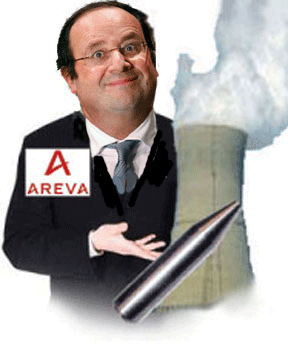 French foreign minister: EDF to consider participating in building new Czech nuclear reactors US News 23 Aug 15 PRAGUE (AP) — French Foreign Minister Laurent Fabius says his country’s company will consider participating in developing the Czech Republic’s nuclear program.
The Czech government has recently approved a long-term plan to increase the country’s nuclear power production. As part of the plan, the government wants to build one more reactor at the Temelin nuclear plant and another at the Dukovany plant, with an option to build yet another reactor at each plant…..Speaking to reporters after meeting Czech counterpart Lubomir Zaoralek on Sunday, Fabius said it will be state-controlled utility Electricite de France that will be part of a public tender to build the reactors. http://www.usnews.com/news/business/articles/2015/08/23/france-to-consider-helping-czech-nuclear-program
South Africa’s Finance Minister under pressure about govt plans for unaffordable nuclear power
Nuclear must be affordable, says Nene, Business Day, BY CAROL PATON, 24 AUGUST 2015, FINANCE MINISTER NHLANHLA NENE SAYS HE WILL HOLD THE LINE ON THE PROCUREMENT OF NUCLEAR ENERGY IF IT IS UNAFFORDABLE, AND WILL REDUCE THE HEAD COUNT OF THE PUBLIC SERVICE TO ENSURE SPENDING STAYS IN LINE WITH FISCAL TARGETS.
Mr Nene is under enormous political pressure to accede to a presidency-backed plan to procure 9,600MW of nuclear energy capacity at a time when public finances are at their weakest since the mid 1990s.
Underlining this pressure was the appearance of a fake intelligence dossier last week, smearing top Treasury officials as apartheid agents and alleging that they and Mr Nene are part of a conspiracy by the old white establishment to control the Treasury.
The document aroused grave concern among the public, and in political and investor circles, as it is feared it may signal a political attack on the Treasury, which until now has been a strong source of confidence given its ability to exercise tight control over government finances.
The Treasury and Mr Nene say that the document is baseless but appears to be a worrying attempt “to undermine and destablise the institution”.
Mr Nene’s comments, in an exclusive interview with Business Day on Friday, come at a time of keen interest from ratings agencies and the investor community regarding whether the government will stick to self-imposed spending ceilings designed to cut debt in this challenging political context.
Of the challenges, top of the list is whether Mr Nene will be able to hold the line on the nuclear procurement.
Treasury and Department of Energy officials spent most of last week locked in an intense engagement in Cape Town over the financing options for the project.
Mr Nene said that since the Treasury had only just been invited into the process, it was too early to make pronouncements.
However, if it was unaffordable to the country and to consumers, who would have to pay for the energy generated, it could not be done, he said….. the Department of Energy’s discussions with vendors have all assumed the full 9,600MW would be commissioned. The department also envisages using the programme for industrialisation and job creation, and aims to create a nuclear export industry.
It has to date refused to make public its studies or provide evidence that a nuclear procurement of 9,600MW is affordable.
Mr Nene said that as with any project that involved the allocation of resources, the Treasury would have to account to the nation.
“That is why following process is critical…. My job is spelt out in legislation and my role is to uphold and stay within the confines of the Constitution and the Public Finance Management Act.”…..http://www.bdlive.co.za/business/energy/2015/08/24/nuclear-must-be-affordable-says-nene
Mismanagement at WIPP plant
Critics blame mismanagement for WIPP delay By Lauren Villagran / Journal Staff Writer – Las Cruces Bureau
PUBLISHED: Sunday, August 23, 2015 Albuquerque Journal
The U.S. Department of Energy says its decision to indefinitely delay reopening a southeast New Mexico nuclear waste repository is due to safety concerns and equipment setbacks, but critics claim the holdup has as much to do with missteps and inadequate oversight.
DOE says it needs more time to ensure a safe recovery from last year’s underground fire and radiation leak at the Waste Isolation Pilot Plant, so the March 2016 target to restart some operations is no longer feasible. A new schedule is expected this fall – and is likely to come with increased costs above the original $500 million estimated.
But local watchdogs claim the delays stem from errors made by the site contractor and inadequate oversight by DOE – not just safety concerns.
John Heaton, head of the Carlsbad mayor’s Nuclear Task Force, rattled off a list of issues at WIPP, including ventilation equipment that was damaged en route from the manufacturer, a safety document that has taken more than eight months to rewrite, delays in decisions about how to permanently reconfigure the contaminated underground ventilation system – among other things.
“It’s just really frustrating,” he said. “How would you call it anything but incompetence?……..http://www.abqjournal.com/632748/news/wipp-delay-blamed-on-mismanagement.html
Pilgrim Nuclear plant shutdown – inquiry to begin
Inquiry to begin over Pilgrim nuclear plant’s ‘safe’ shutdown By Nicole Fleming GLOBE CORRESPONDENT AUGUST 23, 2015 The Pilgrim Nuclear Power Station on Cape Cod Bay in Plymouth remains closed Sunday after going into an automatic shutdown Saturday afternoon, according to station and government officials.
“The plant is currently in a safe, stable shutdown condition and there is no impact on the health and safety of the public or plant employees,” said Lauren Burm, a spokeswoman for Entergy Corp., the company that operates Pilgrim, in a statement……This is the Pilgrim station’s third automatic shutdown since Jan. 1. https://www.bostonglobe.com/2015/08/23/pilgrim/167XSkCzXsipC7rRILcV2L/story.html
How Canada’s PM Harper removed the teeth of the nation’s nuclear watchdog
 How Harper turned a nuclear watchdog into a lapdog http://www.greenpeace.org/canada/en/blog/Blogentry/how-harper-turned-a-nuclear-watchdog-into-a-l/blog/53839/
Greenpeace and other environment groups asked the Commission today to release a study censored by CNSC staff because it apparently reveals weaknesses of offsite emergency response around the Darlington nuclear station.
We learned the study had been suppressed by requesting documents under federal Access to Information legislation, but its cover-up fits with the Harper government’s ongoing attack on our democratic institutions.
For a decade now the Harper government has gagged scientists, intimidated independent government watchdogs, and gutted environmental protection laws. All these attacks have a common objective: prevent the release of any information at odds with Harper’s goal of making Canada an energy “super power”.Whether it’s Alberta’s tar sands or Ontario and Saskatchewan’s nuclear industry, Harper’s endgame was to deny Canadians information that puts dirty power in a bad light.
The CNSC decision to suppress this public safety shows how much Harper’s succeeded.
One of Harper’s first attacks on arms-length watchdogs was when he fired the CNSC’s former president Linda Keen in 2008.
Keen was fired because she had the audacity to tell the Canadian nuclear industry they’d need to meet modern international nuclear safety standards if they wanted to build new reactors.
This angered the nuclear lobby, and especially the engineering giant SNC-Lavalin, who wanted to build new reactors on the cheap by cutting back on safety systems by building an outdated pre-Chernobyl, pre-September 11th reactor design.
SNC-Lavalin set out to have Keen ousted and found a sympathetic ear with Harper. Letting environmental protection block industry expansion is anathema to goals of the Harper government. Harper fired Keen and installed a more industry-friendly president.
The new president Michael Binder quickly remade the Commission in Harper’s image. The CNSC became an industry cheerleader with Binder even providing promotional quotes for industry press releases.
While the Harper government gutted environmental laws, Binder let it be known that environmental reviews would be little more than a foregone conclusion under his watch anyway.
And the muzzling of government scientists appears to be alive and well at the CNSC.
A 2014 Environics survey of federal scientists found CNSC staff often feel that politics trumps science at the Commission
The censored study we asked for today is a tangible example of how public safety assessments are being re-written for political ends.
In 2014, the CNSC released a severe accident study purportedly assessing the impacts of a “severe”accident at the Darlington nuclear station.
Such an assessment is needed because Ontario Power Generation (OPG) wants to extend the lives of four aging reactors at Darlington. Sitting just 60 km from downtown Toronto the Darlington reactors are located in Canada’s densely populated. This raises questions about the ability of Canada’s largest city to cope with a major nuclear accident.
The public had also pushed for this study. Following the Fukushima disaster hundreds of citizens called for such a study. It was a reasonable request. Believe it or not, the CNSC has never studied the consequences of a major Fukushima-scale accident in Canada.
CNSC staff reluctantly relented and committed to produce an accident study before hearings on OPG’s application to rebuild the aging Darlington reactors later this year.
But eyebrows were raised when the CNSC finally published the promised study in 2014. Media coverage focused on the study’s rather anti-intuitive conclusion: a severe accident at Darlington would have a negligible impact on the Greater Toronto Area (GTA).
I learned later the reason for the curious conclusion. Senior CNSC management had suppressed the original study, which did look at a Fukushima-scale radiation release.
According to documents I received through Access to Information, senior CNSC management stopped the release of the original study when apprised of its findings. They instructed staff to redo the study and exclude scenarios leading to a Fukushima-scale radiation release.
The justification to censor the study provided by CNSC Director Francois Rinfret shows how the CNSC has operationalized Harper’s policy of suppressing any evidence at odds with the expansion of major energy projects.
After Rinfret reviewed the study in early 2013, Rinfet told staff:
“I have taken a quick look at the draft submitted; indeed, this will become a focal point of any licence renewal, and despite brilliant attempts to caution readers, this document would be used malevolent-ly [sic] in a public hearing. It’s a no-win proposition whatever whatever (sic) we think the Commission requested.”
We were refused the details of the study, but Rinfret’s comments suggest the study reveals significant threats to public safety.
This makes sense. Ontario’s nuclear emergency plans effectively pre-date Chernobyl. Population is growing across the Greater Toronto Area (GTA). There are surely weaknesses, especially in light of Fukushima.
An independent watchdog mandated to protect public safety would publish the data and use the information to improve safety requirements. But under Harper the CNSC is a lapdog with a mandate to protect the image and profits of the industry it regulates.
CNSC management were clearly concerned the study would be used to challenge the adequacy of the CNSC’s safety requirements. Worse, the public could decide the Darlington life-extension just isn’t worth the risk. Under the Harper regime, such inconvenient information is suppressed instead of being addressed by the government agencies.
We have nevertheless asked for the Commission to release the study. If public safety is at risk, it must be released – and we all need to call for its release.
Whatever the Commission’s response, Harper has created a dangerous culture at the CNSC. It puts Canadians at risk.
The public had good reason to ask for an assessment of the impacts of a Fukushima-type accident. Accidents are happening about once a decade internationally, and we need to know if Toronto could cope with such an event at Darlington before OPG is allowed to spend billions rebuilding the station.
As became clear after the Fukushima disaster, Japan’s industry-friendly nuclear regulator was a key cause of the accident.
Under Harper’s watch, the CNSC has been transformed from a watchdog into a lapdog. The parallels with Japan’s nuclear regulator before Fukushima are worrisome.
Let’s hope the next federal government cleans up the CNSC.
Protest by 3 middle aged women costs nuclear firm €1million
Anti-nuclear demo ‘cost firm €1million’ http://www.bridgwatermercury.co.uk/news/13610163.Anti_nuclear_demo____cost_firm____1million___/?ref=twtrec AN anti-nuclear protest by three women that blocked the main road into Hinkley B power station cost EDF approximately one million euros, it it was claimed at Taunton Magistrates Court on Friday.
Ornella Saibene, 55, Marian Connelly, 61, and Caroline Hope, 73, effectively prevented all access to the power plant on April 1 this year when they chained themselves together and lay across the road, preventing workers from accessing the site.
The protest started just after 7am and caused a three-mile build up of traffic until they agreed to move at 90.30 a.m.
The women – all from Bristol – were each fined £200 and ordered to pay £105 costs after pleading guilty to obstructing the route. Joanne Pearce, prosecuting, said: “The closure cost one million euros. Their disregard to safety and the security of a nuclear power station cannot be tolerated.”
Connelly, Saibene and Hope argued they were exercising their democratic right to civil disobedience and had not committed a criminal offence.
She read out a statement from Green West Euro MP Molly Scott Cato comparing nuclear power stations to “ageing dinosaurs.”
PCAH says…1:04pm Wed 19 Aug 15
Drought-Fueled Wildfires Burn 7 Million Acres in U.S.

Bobby Magill: “Sap a forest of rain — say, for three or four years — toss in seemingly endless sunshine and high temperatures, and you’ve got just the right recipe for some catastrophic wildfires.
“Such is the story playing out in the West, where, thanks in part to climate change, drought-fueled infernos are incinerating forests at a record pace from Alaska to California, claiming the lives of 13 firefighters, destroying more than 900 structures and requiring firefighting agencies to call in help from the U.S. Army and as far away as Australia and New Zealand.
Photo: The Aggie Creek fire burns along the Trans-Alaska Pipeline in June. Credit: USDA/flickr
“Here’s the breakdown: As of Aug. 20, more than 41,300 wildfires have scorched more than 7.2 million acres in 2015, mostly in the Pacific Northwest and Alaska. That’s nearly three times the 2.6 million acres that burned nationwide in 2014…
View original post 90 more words
Nuclear SAFER NOT – Nuclear Emergency Backup in Heart of New Madrid Quake Zone

One of the most dangerous, and often ignored, aspects of nuclear energy is that nuclear power stations always have need for backup energy supplies for cooling of the nuclear reactors, and spent fuel pools, as dramatically demonstrated by the never-ending Fukushima Daiichi nuclear disaster.
Thus, belatedly, last year, “The nuclear industry has officially opened two National Response Centers — in Memphis, Tenn., and Phoenix, Ariz… The centers, previously called Regional Response Centers, contain extra equipment to duplicate plants’ emergency diesel generators, pumps, hoses and so on. … An industry group, called the Strategic Alliance for FLEX Emergency Response (SAFER), is managing the response centers. This organization also has two control centers that are separate from response centers and would coordinate equipment deliveries.” http://public-blog.nrc-gateway. gov/2014/08/18/watching-response-centers-put-trucks-on-the-road/
Is the area of the New Madrid fault a place to put one of two National Response Centers? It is amazingly blinkered. The Memphis…
View original post 3,699 more words
US NRC: Spreading the Italian Triangle of Death to America? Refuse Omertà. Remember to Comment by September 8th
Why, and by what right, has a “researcher”, Giovanni Pagano, from Italy’s “Triangle of Death”, put in a comment to the US NRC that the US should raise their public radiation level over 100 fold to 100 mSv PER YEAR, which would make America into an even more deadly zone than Italy’s “Triangle of Death”? (Comment until Sept. 8th if you don’t wish to die of cancer, or see your loved ones do so: http://www.regulations.gov/#!docketDetail;D=NRC-2015-0057. It will quickly spread elsewhere if approved.)
Triangle of Death
Pagano must know very well that Sorensen (see e-mail) works for Pagano’s colleague Dr. Calabrese, and yet seems to feign ignorance. Sorensen is “Managing Director of the International Dose-Response Society” and Calabrese is the “Director“. The “International Dose-Response Society“, run from U. Mass Amherst, was formerly called the “International Hormesis Society,” (more commonly known as radiation is…
View original post 8,510 more words
23rd to 25th August Wylfa Twinning Camp

 Wylfa-Fukushima
23rd -25th August 2015
 Wylfa -Fukushima August 23-25th Events
 Naoto Kan
On 23 to 25 August, at a camp near the Tregele and Cemaes, the location of
WYLFA power station, guests from Japan, who have lived through the
Fukushima disaster, will warn the people of North Wales and the pro-nuclear
authorities not to go ahead with the planned huge 3 GigaBite reactor WYLFA
B. There are countless unknowns that can lead to a nuclear catastrophe and
any safety is a completely unrealistic idea in connection with any nuclear
devices . Speakers from the campaign against Hinkley point, the nuclear
powerstation in Sumerset, and representatives from Greenpeace and Friends
of the Earth will inform us about their progress.
The existing power station at Wylfa has been shut down many times because
of faults and leaks of radiation into the environment and such events have
always been kept quiet. As there…
View original post 127 more words
1 This Month
Chernobyl: The Lost Tapes – A good documentary on Chernobyl on SBS available On Demand for the next 3 weeks– https://www.sbs.com.au/ondemand/tv-program/chernobyl-the-lost-tapes/2352741955560

of the week–London Campaign for Nuclear Disarmament

Tell the Ukrainian Government to Drop Prosecution of Peace Activist Yurii Sheliazhenko
To see nuclear-related stories in greater depth and intensity – go to https://nuclearinformation.wordpress.com
-
Archives
- April 2026 (127)
- March 2026 (251)
- February 2026 (268)
- January 2026 (308)
- December 2025 (358)
- November 2025 (359)
- October 2025 (376)
- September 2025 (257)
- August 2025 (319)
- July 2025 (230)
- June 2025 (348)
- May 2025 (261)
-
Categories
- 1
- 1 NUCLEAR ISSUES
- business and costs
- climate change
- culture and arts
- ENERGY
- environment
- health
- history
- indigenous issues
- Legal
- marketing of nuclear
- media
- opposition to nuclear
- PERSONAL STORIES
- politics
- politics international
- Religion and ethics
- safety
- secrets,lies and civil liberties
- spinbuster
- technology
- Uranium
- wastes
- weapons and war
- Women
- 2 WORLD
- ACTION
- AFRICA
- Atrocities
- AUSTRALIA
- Christina's notes
- Christina's themes
- culture and arts
- Events
- Fuk 2022
- Fuk 2023
- Fukushima 2017
- Fukushima 2018
- fukushima 2019
- Fukushima 2020
- Fukushima 2021
- general
- global warming
- Humour (God we need it)
- Nuclear
- RARE EARTHS
- Reference
- resources – print
- Resources -audiovicual
- Weekly Newsletter
- World
- World Nuclear
- YouTube
-
RSS
Entries RSS
Comments RSS
 nuclear-news